Can You Dump Concrete Washout Down the Drain?
No. You should never dump concrete washout down a storm drain, and you should treat any other drain as off-limits unless the local sewer authority has explicitly approved it, because washout water is highly caustic with a pH near 12 and can damage waterways and trigger enforcement.
If you're reading this at the end of a pour, you already know the moment. The chute needs rinsing. The pump tools are caked. Someone points at the nearest drain and says, “Can we just wash it out there?” That's where jobs go sideways.
I've had to explain this to more than a few new supervisors: concrete washout is not routine rinse water. It's a controlled waste stream. Handle it casually, and you risk an illegal discharge, damaged pavement or soil, a failed inspection, and the kind of cleanup nobody budgets for. Handle it correctly, and the job stays clean, the crew has clear instructions, and you don't spend the afternoon explaining a preventable mistake.
The Short Answer and the Real-World Scenario
A crew finishes a sidewalk pour late in the day. The ready-mix truck is waiting. The finisher wants to rinse tools before the mud sets up. The nearest low point is a curb inlet, and the nearest indoor plumbing is inside the building shell. That's usually when the question comes up.
The answer on a site is simple. Storm drains are never the place for concrete washout. Sanitary drains, like a toilet or utility sink, are not an automatic yes just because they're indoors. They're regulated differently, and that distinction matters.
A lot of field mistakes happen because people hear “don't dump it down the drain” and think only of the curb inlet. Others hear “the sewer goes to a treatment plant” and assume a mop sink is fine. Neither shortcut is safe.
Practical rule: If the crew hasn't been told exactly where washout goes before concrete arrives, the site isn't ready for the pour.
On a well-run project, the washout area is already in place before the first truck shows up. It's marked, accessible, and big enough for the expected rinse water and solids. The truck driver, pump operator, and laborers all know where it is. Nobody improvises.
What works on real jobs is boring, which is exactly the point. Designate one containment area. Keep it away from drainage paths. Check it before and after use. Arrange removal before it overfills. The cheap-looking shortcut of “just this once” is what creates expensive problems.
The Hidden Dangers in Concrete Washout Water
Concrete washout looks harmless if you judge it by appearance alone. It's gray water with grit in it. On some jobs it even looks diluted enough to ignore. That's the trap.
The U.S. EPA says concrete washout water is “caustic and corrosive,” with a pH near 12, and it can contain toxic metals, which is why the agency calls for collecting and retaining all washout water and solids in leak-proof containers so the material doesn't reach soil, groundwater, or surface waters, as explained in the EPA concrete washout guidance.

Why pH 12 matters
People hear “high pH” and think it means the water is a little stronger than normal. It doesn't. The pH scale is logarithmic. A material near pH 12 isn't just modestly basic compared with neutral water at pH 7. It's in a completely different category.
A useful way to explain it to crews is to compare pH to earthquake scales or sound intensity. The number jump looks small. The true effect isn't.
When washout water with that level of alkalinity hits soil, stormwater infrastructure, or surface water, it can burn vegetation, damage habitat, and upset water chemistry fast. It also leaves behind solids that harden where they don't belong.
It doesn't stay where you dumped it
The second mistake people make is assuming a little rinse water will soak in and disappear. On active sites, it rarely does. It follows slope, curb, ruts, and drainage patterns.
If washwater is dumped on the ground, the EPA warns it can run off the site into roadside storm drains and then into rivers, lakes, and estuaries. That's why even a “small” washout dump near the edge of pavement can become a much bigger problem after irrigation, a cleanup hose, or the next rain.
Washout water isn't just messy. It moves, it spreads, and it carries the problem off your work area.
The field consequences crews actually see
The environmental language is important, but supervisors also need the practical version:
- Skin and material contact: Fresh washout can irritate or burn. Crews notice this first on hands, boots, and clothing.
- Soil impact: Dump spots often turn into barren, crusted areas that have to be dug out or remediated.
- Drainage damage: Solids settle where you don't want them, then cure.
- Cleanup escalation: What could have been contained in one pan turns into pavement scraping, inlet cleaning, and documentation.
The chemistry is why regulators treat concrete washout differently from ordinary wash water. The field reality is why good supers do too.
Storm Drains vs Sanitary Sewers Explained
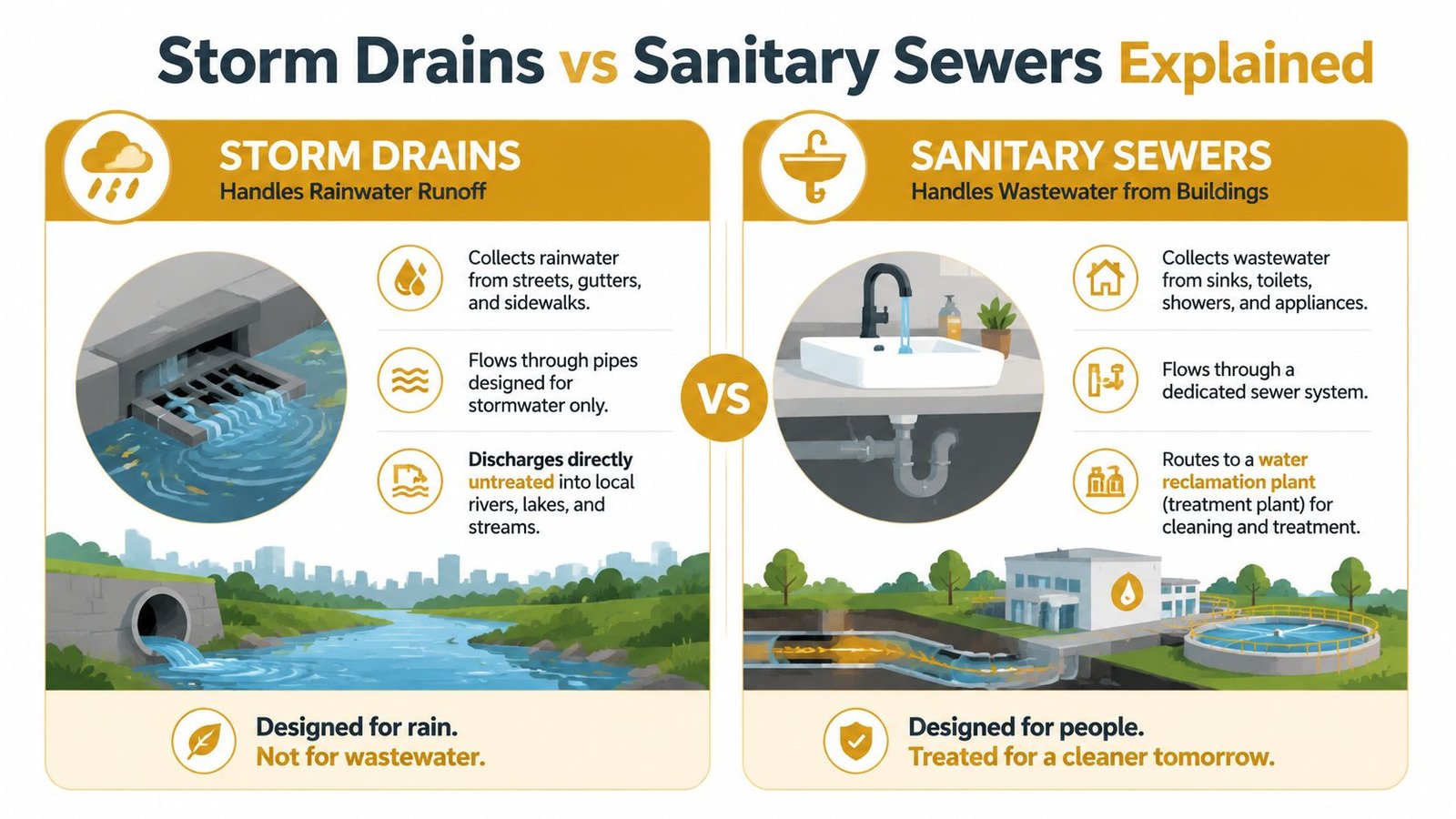
This is the part many individuals need clarified. When someone asks, “Can you dump concrete washout down the drain?” they may be talking about a curb inlet, a floor drain, a mop sink, or a toilet. Those are not the same thing.
The biggest compliance failures I see come from treating all drains as one system. They aren't.
What a storm drain does
A storm drain is built to move runoff away from streets and sites. It is generally not there to treat industrial waste. Public guidance consistently warns against putting concrete washout into streets, storm drains, ditches, or streams because the discharge can reach waterways without treatment, as discussed by the Franklin Soil and Water Conservation District on concrete washout disposal.
That means these are all bad ideas:
- Curb inlets
- Area drains connected to stormwater
- Roadside ditches
- Catch basins
- Any low point that drains off-site
If the crew washes into a storm drain, they're not “sending it away.” They're sending it into the stormwater system.
What a sanitary sewer does
A sanitary sewer is the plumbing system connected to sinks, toilets, and other wastewater fixtures that route flow to a treatment plant. That sounds safer, and in some ways it is. But it still does not mean you can dump concrete washout into it.
Local sewer authorities regulate what can enter that system. High-pH slurry, solids, and industrial wastewater can be restricted or prohibited without pretreatment or prior approval. That's the distinction most short articles skip, and it's the one contractors need to understand.
A treatment plant is designed to handle wastewater. It is not a blank check for concrete residue.
The fast comparison supervisors need
| Drain type | Where it usually goes | Can you dump concrete washout there |
|---|---|---|
| Storm drain | Untreated runoff pathway to local waterways | No |
| Street gutter | Typically to storm drainage | No |
| Ditch or swale | Drainage system or surface water pathway | No |
| Utility sink or toilet on sanitary sewer | Wastewater treatment system | Only if the local authority has explicitly approved it |
If you don't know whether a drain is storm or sanitary, treat it as prohibited until someone with authority confirms it.
What works in practice
On a project, don't ask laborers to make plumbing judgments in the moment. Make the rule simple:
- No washout to any drain by default.
- Use the designated washout container or lined containment area.
- If anyone suggests an indoor drain, stop and verify with the local wastewater utility first.
- If permission exists, keep the documentation.
That last point matters. A verbal “it should be okay” from someone in the field isn't enough. If a sanitary discharge is being considered, the site needs actual approval and any required conditions in writing.
Navigating Fines and EPA Regulations
Contractors sometimes treat washout compliance like housekeeping. It isn't. It sits in the same risk category as other discharge controls that can trigger inspection findings, notices, cleanup orders, and permit trouble.
In regulated construction, washout discharge to surface waters is explicitly prohibited. Oregon DEQ permit language reproduced in Clean Water Services concrete washout guidance states that excess concrete belongs only in designated washout areas, hardened waste must be disposed of, reused, or recycled appropriately, and any spillage or discharge to surface waters is prohibited.
Why enforcement hits hard
Inspectors don't need a dramatic spill to care about washout. A small discharge at the wrong location can be enough because it shows a control failure. From a compliance standpoint, the problem is rarely just the liquid itself. It's what the discharge says about site management.
Typical failures include:
- No designated washout area
- An undersized container that overflows
- Washout placed in a drainage path
- Crews rinsing tools wherever they finish work
- No one assigned to monitor capacity or service
That's how a minor operational issue becomes a permit issue.
Your paperwork has to match the field
A supervisor can't rely on “everybody knows what to do.” If your project operates under stormwater controls and a SWPPP, the washout procedure needs to be reflected in how the site is being run.
That means the field setup should answer basic inspection questions:
- Where is the washout area?
- Who uses it?
- How is it contained?
- How do you keep it from discharging?
- Who checks it and when?
- How is waste removed?
A compliant site doesn't improvise concrete washout. It assigns it, contains it, and documents it.
The business reason to care
Environmental harm is reason enough. But even if a superintendent is focused only on schedule and cost, improper washout still hurts the job. Cleanup interrupts work. Investigations burn management time. Rework creates friction with owners and agencies. Repeat issues can follow a contractor from project to project.
That's why experienced site managers don't frame washout as a minor concrete task. They treat it as part of active risk control.
Best Practices for On-Site Washout Containment
A washout area succeeds or fails on placement first. Put it where runoff can reach a storm drain, ditch, or low spot, and you have built a compliance problem into the site before the first truck rinses out.
A common field benchmark is the 50-foot setback. Guidance from the University of Delaware and Clean Water Services recommends keeping washout areas at least 50 feet from streets, storm drains, open ditches, and streams, as outlined in the University of Delaware concrete washout guidance.
Where to place the washout area
Choose a spot that crews and drivers can reach without cutting across active traffic, but far enough from drainage features that a spill or overflow stays contained. Flat ground is preferable because it keeps liquids where you put them. Sloped ground turns a small mistake into off-site discharge.
Use the setback as a starting point, then check the site like an operator, not just a planner:
- Keep distance from drainage features: The 50-foot buffer is a sound minimum planning rule.
- Stay out of flow paths: Rainwater should not be able to run through the washout area and carry slurry away.
- Make access easy for trucks and crews: If a driver has to guess, back too far, or block the job to use it, someone will rinse out somewhere else.
- Protect the area from damage: Equipment traffic, deliveries, and public exposure can tear liners, crack berms, or tip smaller units.
What containment options work
Containment has to match the work. A small repair crew washing hand tools creates one kind of waste stream. Repeated truck chute washout and pump cleanup create another.
Common options include:
- Lined temporary bermed areas: Suitable for short-duration work if the liner is intact and the berm height is enough for the expected volume.
- Portable washout bags or compact units: Useful on tight sites and for lighter washout loads, but only if the capacity matches what the crew will generate that day.
- Steel washout pans or bins: Better for repeated use, truck chute washout, and projects that need durable containment that can handle rough treatment.
- Serviced rental containers: A practical choice when the site wants delivery, swap-out, and removal handled by an outside provider. Reborn Rentals offers washout pans and containers for concrete washout containment on construction and renovation projects.
Capacity matters as much as the container type. Washout slurry behaves like wet cement because it is wet cement. Once solids build up, usable volume drops fast, and crews start washing over the side.
Do's and Don'ts of Concrete Washout Management
| Do | Don't |
|---|---|
| Use a designated washout area that crews can identify immediately | Let each trade choose its own rinse spot |
| Place containment away from storm drains, ditches, and streams | Set up in a low area where runoff collects |
| Choose a leak-proof container or properly lined facility | Assume any improvised container will hold caustic slurry |
| Size the washout for actual site activity | Wait until it's nearly overflowing to make a plan |
| Mark the area and tell every driver and laborer where it is | Rely on word-of-mouth after the truck arrives |
| Arrange disposal or service before capacity becomes a problem | Let hardened waste and liquid build up unchecked |
Crews follow the easiest path on the site. Make the legal washout option the easiest one to use.
Common setup mistakes
The repeated failures are predictable.
- Too small: The container holds one rinse cycle, not a full day of chute washout, pump parts, and tool cleaning.
- Too close to where water already moves: The washout may be convenient, but any overflow heads straight toward inlets or drainage swales.
- Poor visibility: Drivers, laborers, and subcontractors do not use what they cannot find quickly.
- No inspection or service trigger: Without a defined point for cleanout or swap-out, the site keeps using a unit that is already at capacity.
A good washout setup also helps with the storm drain versus sanitary sewer issue that contractors often miss. On-site containment keeps caustic concrete residue out of storm drains completely, which is the baseline rule. It also prevents crews from making their own decision to dump wash water into an indoor floor drain or mop sink without approval. If a sanitary sewer discharge is even being considered, that decision belongs with the owner, the utility, and the permit conditions, not the field crew.
Implementing Your Site's Washout Management Plan
Knowing the rule isn't enough. The site needs a system that still works when the pour is late, the crew changes, and the truck driver is in a hurry.
The easiest plans to enforce are the ones that remove judgment calls from the field. If people have to stop and debate where washout goes, the plan is too loose.
Start before concrete arrives
A workable plan begins in pre-task planning, not after the first rinse.
Identify where washout will come from on your project:
- Truck chute washout
- Pump parts and hoses
- Hand tools and finishing gear
- Buckets, wheelbarrows, and mixing tubs
- Residual slurry from small patch or repair work
Each source creates both liquid and solids. If you only plan for the water, the hardened residue will catch up to you.
Assign ownership clearly
This part is where many sites fail. They assume “the concrete crew” owns washout. That's too vague.
Assign named responsibilities such as:
- Supervisor responsibility: Confirms the washout location, capacity, and access before placement starts.
- Crew responsibility: Uses only the designated area and reports capacity issues immediately.
- Driver and pump operator coordination: Gets direct instructions on arrival, not halfway through the rinse.
- Environmental or safety lead check: Verifies containment condition and documents any issue.
- Service coordination: Schedules removal, swap, or disposal before the container becomes a problem.

Build the procedure into daily operations
The best plans are short enough that foremen will readily use them. I recommend a field procedure that can be explained in under a minute:
- Before work starts: Verify the washout container is in place and usable.
- At crew huddle: Tell everyone where concrete waste goes.
- When trucks arrive: Direct drivers to the designated spot early.
- After each use: Check for splatter, leaks, or approaching capacity.
- At day's end: Confirm the area is stable, contained, and ready for the next shift or pickup.
That's not glamorous, but it prevents most incidents.
Document what matters
Documentation should support control, not create paperwork for its own sake. Keep it practical.
A useful washout plan typically includes:
- Location of the designated washout area
- Type of containment being used
- Who is responsible for inspection and servicing
- How waste will be removed or disposed of
- How the procedure fits the site's SWPPP or environmental controls
- What to do if a spill or misdirected washout occurs
If the site map shows a washout area but the field crew can't point to it, the plan isn't implemented.
Review after the first pour
The first concrete activity tells you whether the plan is real. Watch what people do.
Ask direct questions:
- Did the truck have enough room to use the washout properly?
- Did the crew bypass the container for tool cleaning?
- Was the capacity adequate?
- Did anyone seem unsure about what counted as washout?
- Is service timing realistic?
Adjust based on behavior, not assumptions. Good washout management is repetitive by design. Once the routine is set, crews stop treating it as a special instruction.
Protecting Your Site and the Environment
A truck finishes rinsing out, the nearest inlet is ten feet away, and someone asks whether it can go down the drain. The answer depends on which drain they mean. Storm drains are never the option. A sanitary sewer connection is a different system, but it still requires permission from the local sewer authority and often pretreatment conditions. Without that approval, the practical answer is still no.
That distinction matters because concrete washout water is not ordinary dirty water. Its high pH works like a chemical burn hazard for streams and aquatic life, and the suspended solids harden into blockages once they settle. A shortcut at the end of a pour can turn into a clogged line, a notice of violation, cleanup costs, and an uncomfortable conversation with the owner or inspector.
Professional sites remove the guesswork. They set a defined washout area before concrete arrives, keep it away from inlets and curb lines, and make one person responsible for checking capacity and condition. Crews follow the plan they can see.
Washout control is also one of the easiest field signals of whether supervision is tight. If slurry is splashed around a drain or tools are being rinsed wherever water is convenient, other environmental controls are usually slipping too.
Set the washout location before the pour starts. Mark it clearly. Tell drivers and finishers where it is. Then check that the site is using it the way the plan says.
If your project needs a dedicated containment option instead of an improvised setup, Reborn Rentals offers concrete washout pans and containers for short-term jobsite use. That gives crews a defined place to wash out, helps keep slurry contained, and makes day-to-day compliance easier to maintain.