Concrete Disposal Colorado Springs: Avoid Fines
The pump is washed out, the finisher wants to leave, and there's still a pile of broken concrete by the cut line. That's usually when concrete disposal turns into somebody else's problem. Then the truck tracks slurry across the access road, the laborer hoses residue toward the curb, and by the next morning you've got a compliance issue instead of a cleanup task.
That scene is familiar on Colorado Springs jobs. Fast pours, tight access, wind, changing weather, and crews trying to keep production moving all push disposal decisions to the end of the day. That's exactly when expensive mistakes happen. In this market, concrete disposal colorado springs isn't just about getting rubble off site. It's about keeping washout contained, keeping loads clean enough for local recyclers, and avoiding the kind of permit trouble that can follow a project long after the pour is done.
The End of the Pour Is Just the Beginning
A lot of disposal problems start with good crews and bad timing. The pour goes fine. The schedule is tight. Everyone's focused on finish quality, cure protection, and getting the pump cleaned before dark. Then the leftovers show up all at once. Wet slurry, chute washout, splatter around the staging area, and chunks from overpours or demo cuts all need a destination.
On Colorado Springs sites, that last phase decides whether the job stays clean and profitable. If you don't designate a washout area before the truck arrives, the crew improvises. Improvised washout is where stormwater problems start. The same goes for broken concrete. If demo debris sits mixed with dirt, asphalt, rebar, and trash, it stops being recyclable material and turns into a disposal bill.
I've seen the same pattern over and over. The contractor thinks the hard part was the pour. It wasn't. The hard part is what happens after the pour when nobody wants to spend another hour separating material, checking contamination, or coordinating the right haul.
Wet concrete waste spreads fast. Disposal mistakes spread even faster because one bad cleanup choice usually creates three more problems. Site mess, rejected loads, and paperwork.
Colorado Springs gives you workable options if you plan ahead. Facilities like Asphalt Concrete Recycling and Colorado Aggregate Recycling are real outlets for concrete and asphalt rubble. But they reward clean loads and punish sloppy ones. That means your disposal plan has to start on site, not at the gate.
Three habits separate smooth jobs from problem jobs:
- Pick a washout location early. Don't wait until the truck is ready to rinse.
- Keep rubble clean from the start. Concrete mixed with asphalt, soil, or metal gets harder to place economically.
- Assign one person to own the closeout. If everyone is “kind of handling it,” nobody is handling it.
That's the practical mindset. Disposal isn't cleanup. It's part of production.
Navigating Colorado Springs Disposal Regulations
A crew finishes a slab near the end of the day, the driver rinses out along the curb because everyone wants to get off site, and a summer storm hits before sunrise. By morning, slurry has tracked across pavement and toward a storm inlet. That is how a routine pour turns into a compliance problem in Colorado Springs.

Concrete waste causes trouble because crews treat wash water and slurry like ordinary mud. Inspectors do not. On any site covered by stormwater requirements, concrete residue is judged by where it can travel, whether it is contained, and whether the site team can show control over the process.
In Colorado Springs, that matters on everything from small infill work to larger commercial pads. Sites often have tight access, sloped streets, open curb lines, and fast afternoon weather changes. A setup that looks acceptable at 4 p.m. can be running downhill by 7 p.m. if washout was left exposed or placed too close to drainage.
What actually gets flagged
Inspectors usually start with what they can see in five minutes. If the site looks disorganized around the concrete operation, the rest of the inspection tends to get stricter.
The common problem areas are straightforward:
- Washout outside a designated container or bermed area. Bare-ground rinse-out is the fastest way to create runoff exposure.
- Concrete slurry near gutters, valley pans, ditches, or storm inlets. On many Colorado Springs sites, the slope does the transport for you.
- Tracked residue leaving the work zone. Pump cleanout, buggy traffic, and laborers washing tools in the wrong spot leave a visible trail.
- Mixed waste piles. Broken concrete combined with soil, wood, trash, or rebar signals poor control and creates trouble later at disposal facilities.
- Missing or weak documentation. If your SWPPP requires inspections and corrective actions, concrete handling needs to show up there.
One bad habit creates two bills. The first is cleanup. The second is disposal, because contaminated material costs more to haul and is harder to place at a recycler.
The field standard that works
Crews do not need a long policy memo. They need a standard the foreman can check in a minute.
Use these rules on every pour and demo phase:
- Keep all wash water and slurry contained on site. If water can leave the work area, the control is failing.
- Place the containment where drivers and pump crews can use it without improvising. Convenience prevents bad decisions.
- Keep concrete waste separate from soil, asphalt, trash, and steel. Clean material gives you more options and usually lower downstream cost.
- Protect nearby inlets before the pour starts. Do not wait until cleanup.
- Check the area before the crew leaves. End-of-day overflow, torn liners, and splash-out are common and easy to miss.
Field check: If a laborer can point to the washout area without stopping work, the setup is probably clear enough. If the driver has to ask, it is not.
Local rules are only half the issue
The written requirement is simple enough. Prevent discharge, maintain your controls, and document what the permit requires. The harder part is operational. Colorado Springs recycling yards and disposal outlets reward clean loads and reject messy ones. That means compliance on site affects what happens at the scale house.
A contractor who contains washout, keeps rubble clean, and prevents soil contamination usually gets a smoother closeout. A contractor who lets slurry hit the ground often pays for extra labor, extra hauling, and rejected material. That is the trade-off crews feel first, long before any formal enforcement shows up.
Colorado Springs has workable disposal options, but they favor contractors who plan ahead. The job is easier when the washout area is established early, the closeout responsibility is assigned to one person, and the concrete debris stays clean enough to remain a recyclable load instead of becoming mixed construction waste.
Mastering On-Site Concrete Washout Containment
A crew finishes the last truck, the pump is cleaning out, and everyone wants to get off the site. That is the point where a manageable concrete job turns into a runoff problem, a soil contamination problem, or a rejected load at a Colorado Springs recycler. Washout containment decides which one you get.
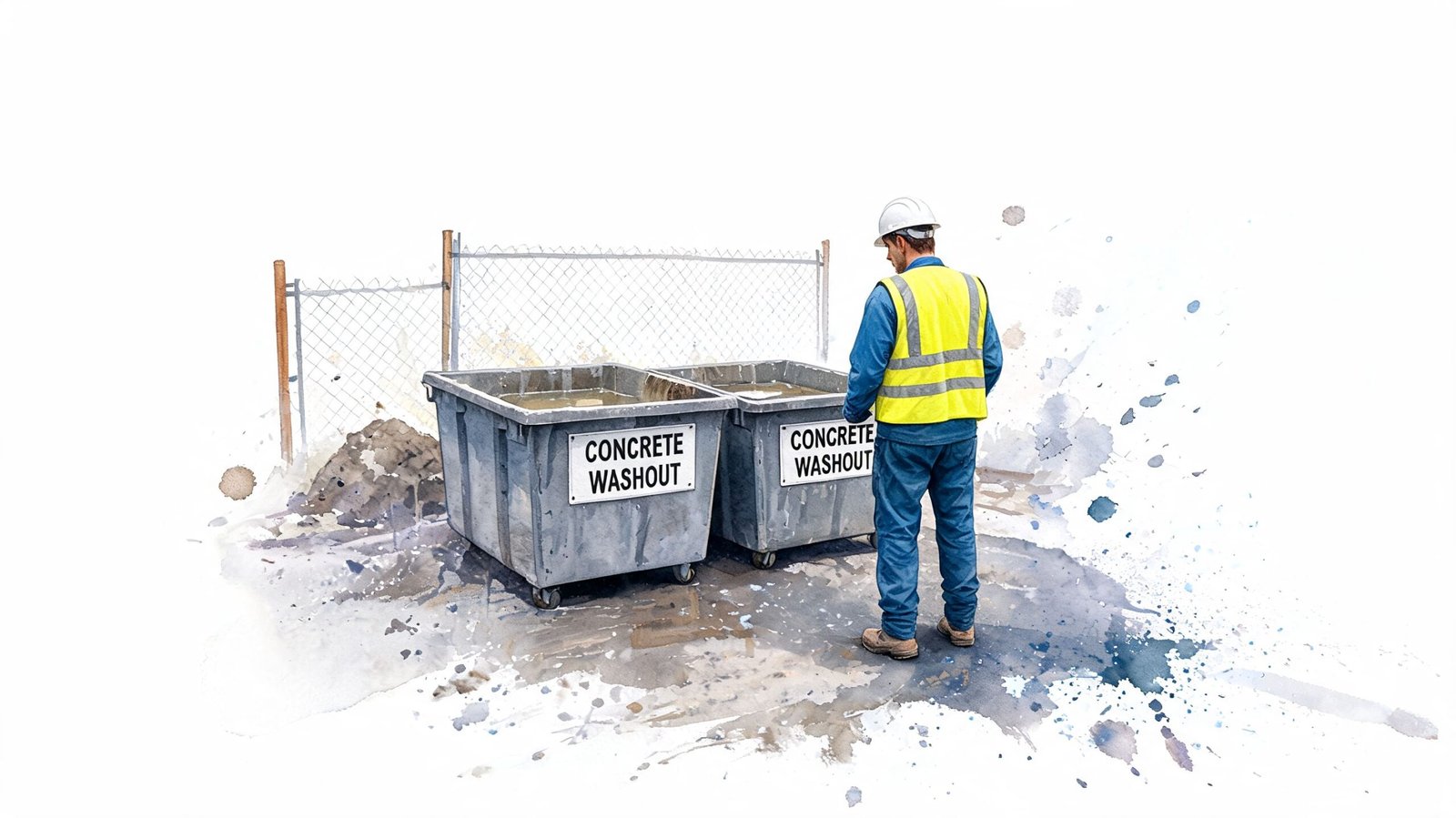
Good containment is simple. Put a dedicated washout container in place before the first truck arrives, keep it obvious, and make it easier to use than any bad shortcut. If the driver can see it from the pour area and the laborer can direct him there without hesitation, the setup is usually workable.
The trade-off is practical, not theoretical. A cheap, poorly placed washout area often creates dirty rubble, contaminated soil, extra hand cleanup, and a load that costs more to haul away. A properly placed pan or contained washout system costs money up front, but it usually saves more at closeout, especially in Colorado Springs where clean concrete has better recycling options and mixed waste gets expensive fast.
What works on active jobs
Placement matters as much as container type. Set the washout area close enough that drivers and pump crews will use it, but outside the haul path so equipment does not clip it during the day. Put it on stable, level ground. Keep it away from inlets, curb cuts, swales, and any low spot that starts carrying water after an afternoon storm.
Visibility matters too.
A washout location that exists only on the site map will fail in the field. Mark it clearly, point it out during the pre-pour talk, and assign one person to check it during cleanup. On larger commercial jobs in Colorado Springs, I have seen the best results when the superintendent or lead laborer owns that check instead of assuming the ready-mix crew will handle it.
Size the containment for the actual work
Small washout setups create expensive problems. One rinse-out might fit. Then the pump cleans out, the finishers wash tools, another truck arrives, and the container is already near the top.
That is when overflow starts around the edges. Then someone throws wire, cups, or scrap lumber into the pan, and the material stops being a clean concrete residual stream.
Choose a container or pan based on the full sequence of work, not the first hour of it. Multi-day placements, pump work, wall pours, and jobs with repeated truck washouts need more capacity and more frequent service. Contractors who use a managed washout service usually get a cleaner site because the pickup schedule is tied to the pour schedule instead of waiting until the pan becomes a problem.
Field routine that keeps the site under control
Crews do better with a short routine than with a long speech. Use one that is easy to repeat:
- Point out the washout location before the pour begins. Include drivers, pump operators, finishers, and laborers.
- Keep the container for concrete washout only. Trash, wood, rebar, and packaging create sorting problems later.
- Check capacity before the next placement starts. Do not assume the remaining volume is enough.
- Clean residue around the container the same day. Splash-out around the pan still creates compliance and cleanup issues.
- Inspect the liner or container walls before release. Small tears and cracked corners get missed until slurry is already on the ground.
One clear instruction prevents a lot of cleanup: all rinse water and cementitious residue go into the designated containment, every time.
Failure points that show up repeatedly
Some mistakes keep costing contractors money in Colorado Springs because they affect both compliance and disposal.
| Bad practice | What it leads to |
|---|---|
| Washing out on bare ground | Contaminated soil, runoff exposure, added excavation or cleanup |
| Putting the container in an unmarked back corner | Drivers improvise and residue gets spread across the site |
| Using a pan that is too small for the pour sequence | Overflow, side buildup, and emergency cleanup at the end of the day |
| Letting washout collect trash and demo debris | Mixed loads that are harder to recycle and more likely to be charged as waste |
| Ignoring splash and tracking around the container | A contained system on paper, but a messy site in practice |
Containment pays off twice. It helps keep the SWPPP side under control, and it protects the value of the concrete you still need to haul out. On Colorado Springs jobs, that usually means fewer headaches at pickup, fewer arguments at the scale house, and a better chance of keeping concrete in the recycling stream instead of paying mixed-waste rates.
Choosing Your Disposal Route Recycling vs Landfill
A truck is loaded, the crew wants to clear the site, and the scale house is about to decide whether that load saves money or turns into a headache. On Colorado Springs jobs, that decision usually comes down to one thing. Did the material stay clean enough to qualify for recycling, or did the site turn it into mixed waste before it ever left?
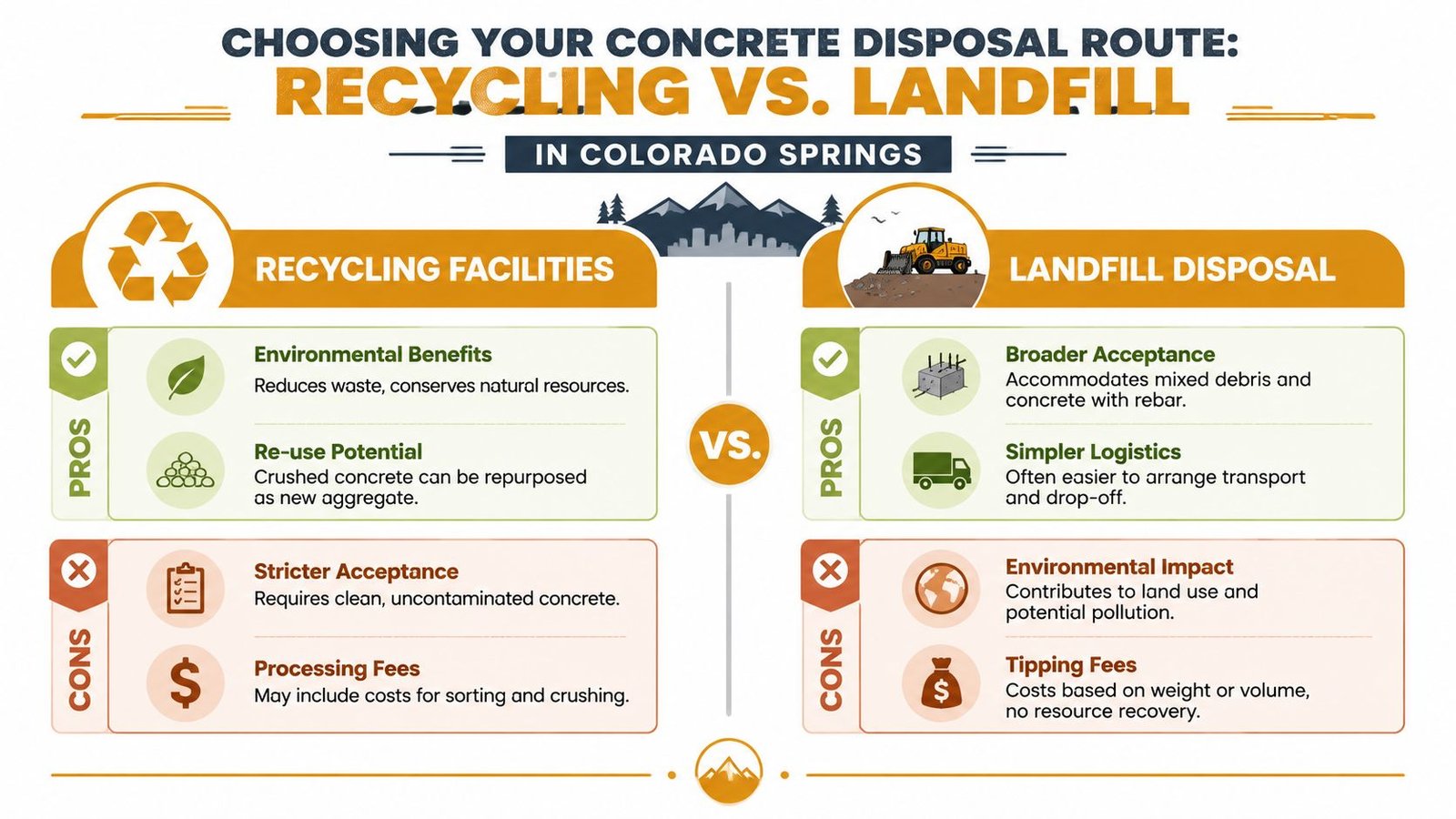
Recycling works well when the concrete is sorted, reasonably clean, and loaded with some discipline. Landfill is usually the practical route when the material is mixed with asphalt, soil, trash, or demolition debris. Contractors get into trouble when they treat all broken concrete as recyclable. Local yards do not.
What actually separates a recycling load from a landfill load
The biggest mistake happens before the truck leaves. Material gets piled in one corner, a loader scoops from the bottom, and now the load includes roadbase, dirt, wire, trash, and slurry-hardened residue. At that point, the issue is not disposal theory. The issue is whether a local recycler wants to spend time sorting out your jobsite mess.
Colorado Springs gives contractors both options. Colorado Aggregate Recycling and Asphalt Concrete Recycling are real outlets, but they are not interchangeable. One clean load can move through recycling with little friction. One dirty load can get downgraded, redirected, or priced like waste.
That is why on-site washout containment matters here, even though the concrete rubble and the washout are different waste streams. If rinse water and cement slurry stay in containment instead of splashing into the rubble pile or haul path, the outbound concrete stays closer to recycler specs. That usually means fewer arguments at intake and fewer loads that should have been recyclable ending up in a landfill.
Practical choice: recycler or landfill
Use this standard in the field:
| Decision factor | Recycling facilities | Landfill disposal |
|---|---|---|
| Best fit | Clean concrete, separated from other debris | Mixed demolition material or contaminated loads |
| What the yard expects | Sorted material with limited contamination | Broader acceptance of mixed waste |
| Risk on arrival | Rejection, reclassification, or extra handling if the load is dirty | Less screening risk, but higher disposal cost in many cases |
| Crew discipline required | High | Moderate |
| Best project type | Planned demo, flatwork removal, staged tear-out | Tight-access demo, emergency removals, heavily mixed debris |
A recycler wants aggregate feedstock. A landfill takes waste.
What crews should do if they want the recycling rate
Crews that consistently hit the recycling stream usually follow the same habits:
- Stage concrete separately from general demo debris.
- Pull exposed rebar, mesh, and metal attachments before loading when possible.
- Keep asphalt and base material in their own pile.
- Load from the cleanest part of the stockpile first, not the muddy edge or the mixed bottom.
- Keep washout residue, trash, and packaging out of the concrete pile from day one.
Those habits sound basic because they are. They also determine whether the truck gets accepted as clean material or treated as a problem load.
When landfill is the smarter call
Landfill is not a failure. Sometimes it is the cleanest operational decision.
Use landfill when the concrete is already mixed beyond practical separation, when the site has no room to stage clean piles, or when production matters more than salvaging one load. I have seen contractors lose half a day chasing recycling on a small repair job, then pay for extra labor, extra truck time, and a second dump run after rejection. On those jobs, landfill was the cheaper answer even if the per-ton rate looked worse on paper.
The wrong move is gambling on a dirty load. If the yard turns it away, you pay in truck time, labor delay, fuel, and usually a second tipping fee somewhere else.
The real Colorado Springs trade-off
Colorado Springs contractors do best when they make the decision early, not at the gate. If the site can support clean separation and controlled washout, recycling usually gives the better outcome. If the site is cramped, muddy, or running mixed demolition at speed, landfill may be the more honest and more efficient route.
The disposal route is chosen at the pile, at the washout area, and at the loader bucket. By the time the truck hits the road, most of the cost has already been set.
Estimating Your Total Concrete Disposal Costs
The disposal number on the invoice is rarely the actual number. That's where budgets go sideways. A superintendent sees a low recycling rate per ton and assumes the job is covered. Then the trucking surcharge shows up, the load gets tagged as contaminated, or the crew spends half a day rehandling material that should've been kept clean in the first place.

For concrete disposal colorado springs, the useful budget is a full handling budget, not just a gate fee.
The numbers that belong in your estimate
According to CrushRite's Colorado concrete disposal pricing discussion, recycling averages $12 to $18 per ton versus $25 to $40 per ton for landfilling. That sounds like an easy choice until the hidden costs hit. The same source notes trucking surcharges of $100 to $300 per load, penalties for contaminated loads up to $50 per ton, and on-site washout rentals starting at $25 per day. It also states that integrating washout rentals can reduce overall haul fees by 15% to 25% by preventing slurry contamination.
Those are the numbers I'd build around, because they reflect what goes wrong in the field.
A practical budgeting worksheet
Use this checklist when pricing the disposal phase:
Material handling rate
Are you paying a recycling rate or a landfill rate? Don't assume the lower number unless the load will stay clean.Truck cost
Add the likely trucking surcharge for each load. Short hauls and rejected trips particularly impact this cost.Contamination risk
If your site has soil mixing with rubble, leftover slurry, or asphalt nearby, price in the possibility of penalties.Containment rental
Include a washout container from day one instead of treating it like a last-minute add.Labor for sorting and cleanup
Even when not broken out on a vendor ticket, this cost is real. Someone has to separate and police the area.
Budget rule: A cheap disposal plan that depends on perfect field behavior usually ends up being the expensive plan.
Sample cost logic without guessing beyond the data
Here's the correct approach:
| Cost category | What changes the number |
|---|---|
| Per-ton disposal | Clean recycling vs landfill route |
| Load-based trucking | Distance, access, and number of trips |
| Contamination charges | Slurry, mixed debris, asphalt, or metal in the load |
| On-site containment | Rental duration and site logistics |
| Delay cost | Time lost when crews rehandle waste or trucks get redirected |
Notice what's missing. There's no line for “hope the yard accepts it.” That's not a budget item. That's a gamble.
Where contractors usually miss the mark
The common estimating mistake is separating washout from disposal as if they're unrelated. They are directly related. If slurry is controlled on site, rubble stays cleaner. Cleaner rubble gives you better recycling odds. Better recycling odds improve your disposal cost profile.
That's why the daily rental for containment often protects the entire disposal budget. It doesn't just solve one compliance issue. It affects hauling efficiency, load acceptance, and cleanup labor.
A realistic estimate should include two scenarios:
- Best-case clean material route
- Dirty-load fallback route
If both scenarios still work financially, your estimate is solid. If the job only works when every load gets perfect recycling treatment, the estimate is too thin.
Maintaining SWPPP Compliance and Final Tips
Paperwork doesn't fix a bad site, but bad paperwork can make a manageable site look worse than it was. For SWPPP compliance, you need records that match what happened in the field.
The useful standard comes from Iron Mountain Construction Services' construction waste recycling methodology. They note that proper documentation is key for compliance and can support LEED v4 credits (MRc2), and that on-site crushing and recycling processes can achieve 85% to 95% diversion rates, with success depending on contamination control because even 10% asphalt can lead to rejection or surcharges.
What to keep in your project file
Don't overcomplicate it. Keep the documents a reviewer or owner rep would ask for.
Washout location records
Mark where the washout area was placed and note any moves during the job.Inspection notes
Record that the washout area, surrounding ground, and discharge paths were checked.Haul tickets and disposal receipts
Keep every load documented. If material went to a recycler, make that easy to prove.Photos
Take simple field photos of the washout setup, material separation, and clean load staging.Diversion tracking
If the job requires sustainability reporting or LEED support, track what was recycled versus discarded.
A final field checklist
Use this before closing out any concrete phase:
- Confirm no slurry can leave the site.
- Verify rubble piles are separated from asphalt, soil, and scrap metal.
- Make sure drivers know the approved washout and haul route.
- Collect tickets before the truck leaves the paperwork chain.
- Take end-of-day photos while the area is still clean.
Clean material and clean records usually travel together. When one falls apart, the other usually does too.
What keeps jobs out of trouble
The best operators in Colorado Springs treat disposal as a controlled sequence. They don't leave it to the end of the shift. They assign responsibility, contain washout early, and protect load quality before the truck is ever loaded.
That's what works. What doesn't work is trying to save a few dollars by skipping containment, mixing waste streams, or assuming local yards will sort out the problem for you.
If you want concrete disposal colorado springs to stay predictable, run it like any other risk item. Plan it, stage it, inspect it, and document it.
Contractors who want a cleaner closeout and fewer disposal surprises can use Reborn Rentals for dedicated concrete washout containment with straightforward daily pricing, practical pan sizes, and delivery coordination that fits active job sites. If your crew needs a defined washout solution before the next pour, they're built for that exact problem.