Concrete Recycling Portland Oregon: 2026 Guide
The pour is finished. The crew has stripped forms, the pump is gone, and what’s left on site is the part newer project managers often underestimate. Broken slab pieces in one corner. Chipped curb sections in another. A truck chute that still needs washout. Maybe a pan was ordered. Maybe someone figured they’d “deal with it later.”
That’s where jobs in Portland start getting expensive.
In this market, concrete waste isn’t just a cleanup task. It touches hauling, recycling compliance, SWPPP discipline, truck routing, and whether the receiving facility will even take your load. If the concrete stays clean and the washout is contained, you’ve got a recyclable material stream. If it gets mixed with trash, dirt, chemicals, or sloppy slurry, you’ve turned something useful into a disposal problem.
For contractors searching for concrete recycling portland oregon, the practical question isn’t whether recycling exists. It does. The real question is whether your site is set up to make recycling possible without slowing the schedule.
Your Guide to Smart Concrete Disposal in Portland
A lot of concrete disposal problems start with one bad assumption. People think the hard part is the pour, and the cleanup will sort itself out. It usually doesn’t.
On a typical job, the sequence is predictable. Demo leaves behind chunks of old footing or sidewalk. Finishers need a place to wash tools. The ready-mix truck needs washout. Someone tosses wood, plastic, and concrete into the same box because it’s faster in the moment. Then the load reaches a recycler or material recovery facility, and suddenly the material isn’t “clean concrete” anymore.

That’s why smart concrete disposal starts before the first bucket of rubble hits a bin. You need a plan for what goes where, who owns washout, and how the material leaves the site. In Portland, that planning matters even more because local construction waste rules are strict and facilities care about contamination.
What experienced crews do differently
They don’t treat concrete as generic debris. They treat it as a separate material stream.
That changes a few things right away:
- Broken concrete gets isolated early. It doesn’t sit in a mixed C&D pile.
- Washout gets a dedicated containment area. Crews know where the chute, pump, and tools get cleaned.
- Hauling gets coordinated with acceptance rules. The site doesn’t send a questionable load and hope the yard takes it.
Practical rule: If the recycler has to sort your mistakes, you’ll pay for it in time, handling, or rejection.
Concrete recycling in Portland works best when the field team, PM, and hauler all make the same decision early. Keep the material clean, keep the slurry contained, and move it through the right facility. Done right, recycling supports compliance, protects the site, and keeps disposal from turning into a late-job headache.
What Concrete Recycling Actually Means
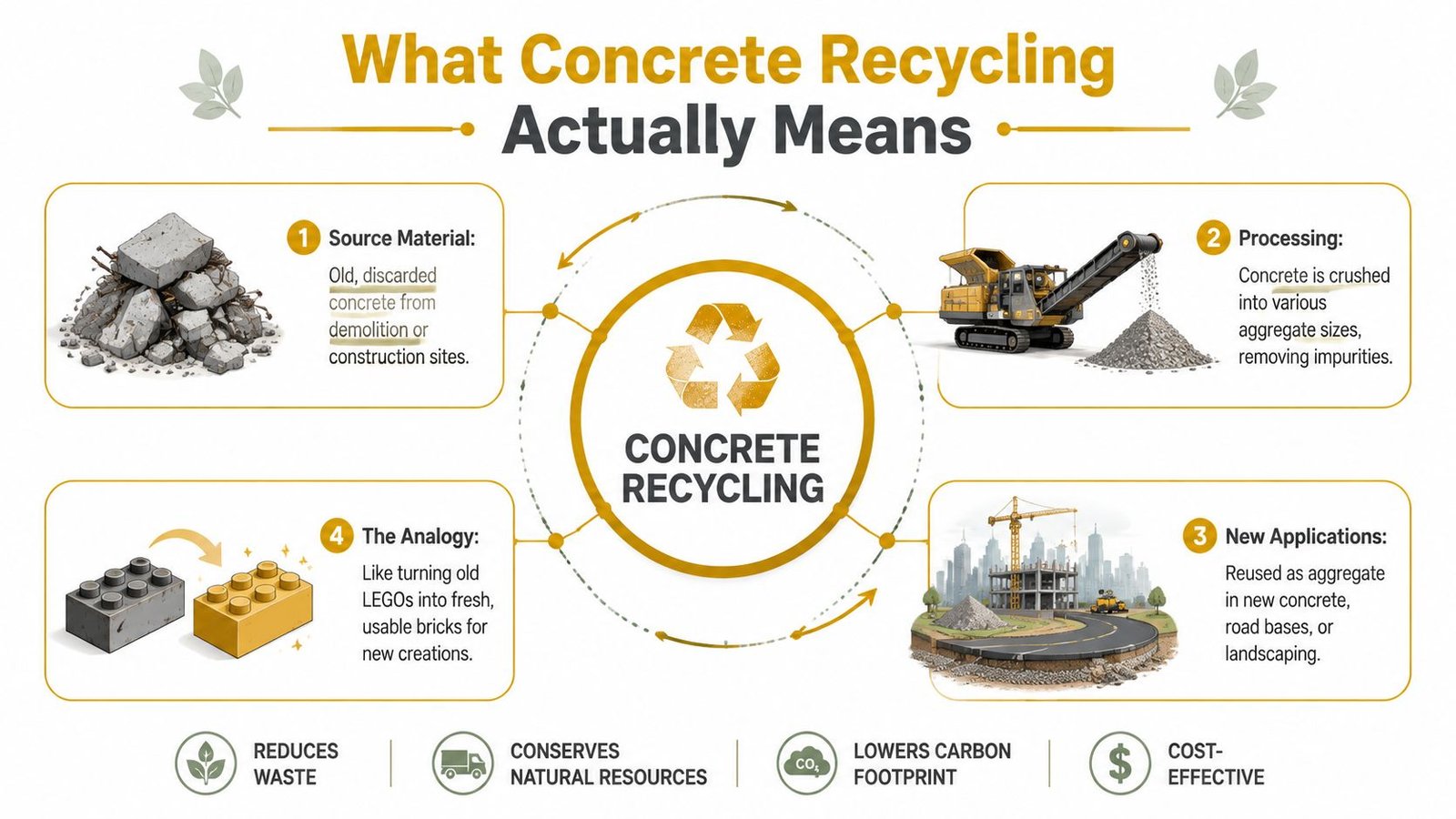
Concrete recycling is simpler than people make it sound. Old concrete comes off a site as rubble, but it doesn’t stay rubble. A recycler processes it into usable aggregate and, in some cases, recovers more value from the cement portion itself.
A good way to think about it is LEGO bricks. If a bucket of old bricks is clean, sorted, and intact enough to process, those bricks can go back into a new build. If that same bucket is mixed with trash, glue, and broken hardware, the next use gets a lot harder.
The basic recycling path
Most contractors only need to understand the field version of the process:
- Concrete is collected from demolition or construction work. That can include slab pieces, curbs, sidewalks, footings, and other clean concrete waste.
- The material is crushed and screened. Recyclers separate it into usable aggregate sizes.
- Obvious contamination is removed. The cleaner the incoming load, the easier this step is.
- The processed material goes back into use. Common end uses include road base, fill, and other construction applications.
The important lesson for the site team is this. Your recycler does the processing, but your crew controls the quality of what arrives.
Clean concrete versus problem concrete
“Clean concrete” doesn’t mean it looks pretty. It means the load stays free of the stuff that makes recycling harder or impossible.
That usually means avoiding:
- Mixed trash
- Drywall and wood
- Hazardous or chemical contamination
- Excess soil and loose site debris
- Uncontained washout residue that ruins material purity
If you’re dealing with hardened concrete and slurry on the same project, manage them as related but different streams. Broken concrete can often be recycled if it’s kept clean. Washout needs containment first so it doesn’t contaminate soil, stormwater, or the concrete stream you’re trying to preserve.
Why the material is becoming more valuable
Recycling technology is moving well beyond simple crushing. Research covered by Tech Xplore on thermoactivated recycled cement reports that approximately five gigatons of concrete waste are produced globally each year, and advanced processes could recover about one gigaton of usable cement powder. The same reporting says that, when combined with other technologies, this approach could cut cement industry emissions by up to 61%.
That matters on the ground because it changes how you should think about leftover concrete. It’s not just something to get off site. It’s material with downstream value, which is exactly why purity, separation, and washout control matter so much.
Portland and Oregon Recycling Rules You Must Follow
If you run work in Portland and Multnomah County, construction recycling isn’t a nice extra. It’s part of the job.
The key rule is straightforward. The City of Portland and Multnomah County require construction projects to recycle 75% of their waste, as described in Multnomah County’s discussion of construction recycling oversight. That same source notes that GreenWay Recycling in Northwest Portland was named the 2024 Recycler of the Year by the Construction and Demolition Recycling Association.
What that means for a project manager
You can’t wait until closeout to think about diversion. If your project is subject to that recycling requirement, the field setup has to support it from day one.
That usually means building recycling into:
- Site logistics plans
- Hauling scopes
- Dumpster and bin layouts
- Trade coordination
- Daily cleanup expectations
- Documentation and load tracking
A PM who treats concrete as one item inside a generic debris plan usually creates work for everyone else. The superintendent ends up policing contamination. The hauler gets unclear instructions. The labor crew fills the wrong container. Then accounting sees higher disposal costs and the team starts scrambling for paperwork.
Concrete and SWPPP discipline
Even if your project team thinks of concrete recycling as a waste issue, washout makes it a water-quality issue too. Fresh concrete residue and wash water don’t belong on soil, pavement, or anywhere runoff can carry them.
That’s why washout planning needs to sit next to your recycling plan, not apart from it. The same habits that protect your recycling stream also protect the site:
- designate one washout location
- keep it stable and obvious
- prevent overfilling
- keep crews from improvising cleanup spots
The site loses control fast when three subs all wash tools in different places.
Where teams go wrong
The biggest compliance mistakes are usually operational, not legal. Nobody says, “Let’s violate recycling rules today.” What happens is simpler.
A project gets busy. Concrete and mixed debris end up in the same container. Washout pans arrive late or not at all. Loads go out without clear documentation. The site assumes the recycler will figure it out.
That approach doesn’t hold up in Portland. If the job is expected to recycle a substantial share of construction waste, then the material stream has to stay identifiable and manageable from the moment it’s created.
The practical standard
If you want this to run cleanly, set one expectation with the whole team: concrete gets handled separately, and washout never gets left to chance.
That’s the standard that keeps paperwork cleaner, hauling simpler, and the site in a better position when the owner, jurisdiction, or environmental consultant asks how the job is managing waste.
The Cost and Environmental Benefits of Recycling
Many operations start caring about recycling when disposal costs get their attention. That’s fair. Budget pressure is real, and hauling mixed debris usually costs more in time and hassle than people expect.
But the stronger business case is broader than tip fees. Clean concrete is easier to route. It gives the site more disposal options. It reduces the chance that a load gets treated like contaminated junk. It also helps the project avoid the kind of cleanup problem that burns labor and blows a schedule late in the week.
The financial side that matters in the field
There’s a gap in published Oregon data on the exact cost comparison between compliant washout containment and the downstream cost of non-compliance. The available information specifically notes that this ROI data isn’t readily published, while also pointing to rental pricing context such as Reborn Rentals starting at $25/day for washout equipment options and listing 441-gallon capacity pans in its specification context, as summarized in this Oregon concrete recycling and containment discussion.
So the honest answer is this. You shouldn’t promise a neat formula nobody has published. What you can say, from a superintendent’s point of view, is that contained washout and clean separation usually cost less than confusion. Confusion creates rehandling, rejected loads, extra labor, and environmental headaches.
The environmental case isn’t abstract
Concrete recycling also matters because the downstream uses are becoming more advanced. According to a U.S. Department of Energy document on recycled concrete separation and CO2 mineralization, advanced recycling can separate cement paste from aggregate, and that paste can then be used to mineralize CO2 from cement manufacturing emissions into value-added cementitious material. The same document ties this recovery pathway to Portland-area recycling participation by major firms including Skanska, Howard S Wright, and the Oregon Department of Transportation.
That’s a practical point, not just a sustainability talking point. If the industry can recover more value from concrete waste, then your site has more reason to keep that waste stream usable.
Field takeaway: Clean material has options. Contaminated material has excuses.
Why owners and contractors both care
Recycling supports the story many owners already want to tell about their projects. It shows the team isn’t dumping usable material by default. It also aligns with how many public and private clients think about waste, embodied carbon, and procurement expectations.
You don’t need to oversell it. The point is simple. When your site separates concrete correctly and contains washout properly, you’re protecting budget and supporting a material recovery system that’s becoming more capable, not less.
On-Site Best Practices for Clean Concrete
The best recycling plan in Portland falls apart if the site doesn’t control the material at the source. Most failures happen in the first few hours after debris is created, not at the recycling yard.
The rule is basic. Separate early, contain aggressively, and don’t let convenience decide disposal.
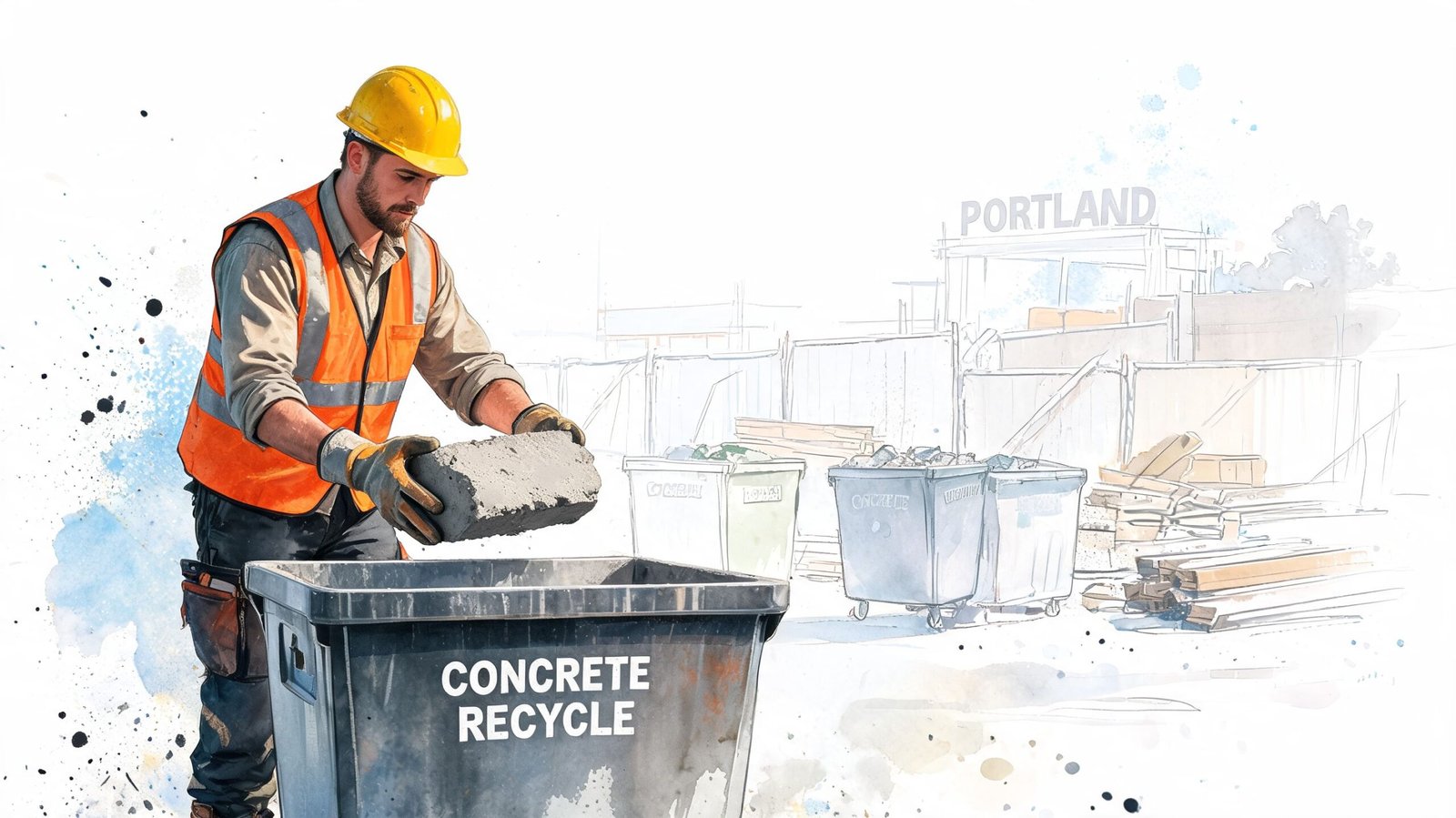
Separate at the source
If crews have to guess where concrete goes, they’ll guess wrong when the site gets busy.
Use dedicated areas or containers for:
- Broken concrete and masonry
- Mixed construction debris
- Washout residue and slurry
- Metal and recoverable scrap removed during demo
This doesn’t need to be complicated. It needs to be obvious. Label the area, walk every trade through it, and correct bad habits the first day. Waiting until the box is half contaminated means the correction comes too late.
Keep the concrete stream clean
A recycler can handle concrete. What they don’t want is a pile that also includes garbage, treated wood, drywall scraps, or chemical contamination.
Train labor leads and foremen to look for three common failure points:
- Demo piles that become general trash zones
- Concrete bins used for “just one bag” of unrelated waste
- Washout splatter or overflow turning clean material into a contaminated mess
Supervision matters. One five-minute walk by the superintendent often prevents a half day of re-sorting later.
Don’t park your clean concrete pile next to the lunch-trash barrel and expect it to stay clean.
Treat washout as its own operation
Concrete washout is where a lot of otherwise organized jobs lose control. Trucks, pumps, buggies, and hand tools all need cleaning. If you don’t assign one legal, contained place to do that work, crews will create one for you.
For Portland-area work, use dedicated washout containment that can hold the expected volume and stay intact through service and removal. The specification context provided in the verified material notes that properly sized pans can include 441-gallon capacity options. One example available to contractors is Reborn Rentals, which offers washout pan rentals for concrete slurry containment on construction sites.
What matters more than brand is function:
- The container can’t leak
- The capacity has to match the pour and cleanup plan
- The location has to be accessible
- The crew has to know it’s the only approved washout point
Put the washout in the right place
Bad placement creates avoidable risk. Don’t tuck the washout pan behind stored material where drivers can’t reach it. Don’t leave it where runoff can move spilled residue across the site. Don’t place it so far from the work that crews start rinsing tools somewhere easier.
A workable setup usually has these traits:
- Easy access for ready-mix and pump crews
- Clear separation from drains and traffic conflict points
- Enough room for servicing or swap-out
- Good visibility so misuse gets spotted quickly
Inspect before it becomes a problem
Washout containment isn’t a “set it and forget it” item. Someone on the site team needs to check it.
Look for:
- Approaching capacity
- Cracks, punctures, or damage
- Improper materials tossed into the pan
- Evidence that crews are washing out somewhere else
If the pan is full, inaccessible, or abused, people will improvise. That’s when concrete slurry ends up where it shouldn’t, and the whole recycling conversation gets replaced by an environmental cleanup problem.
Hauling and Recycling Logistics in Portland
Once the material is clean and contained, logistics take over. During this stage, Portland jobs either move smoothly or lose time on preventable mistakes.
The biggest one is showing up with a load the facility won’t accept in its current condition. That usually happens because the site team never matched its field practices to the receiving yard’s rules.
What facilities care about
For Portland-area loads, pay attention to the operating rules at Recology Portland’s Suttle Road Material Recovery Facility. The facility states that all loads must remain covered during transport or additional fees apply, and it cannot accept hazardous materials, asbestos-containing materials, or chemically contaminated waste.
That tells you a lot about how to run the job before the truck leaves:
- Cover the load
- Keep concrete separate from prohibited materials
- Don’t assume contaminated material will get sorted out at the gate
- Use washout containment that preserves material purity
Self-haul versus contracted hauling
Both can work. The right choice depends on the crew, truck availability, and how controlled the material stream is.
| Option | Best fit | Main advantage | Main risk |
|---|---|---|---|
| Self-haul | Smaller jobs, quick removals, controlled material streams | Direct control over timing | PM or super has to manage acceptance details closely |
| Dedicated hauler | Larger sites, repeat loads, multi-trade projects | Better routing and less field disruption | Bad instructions from site can still produce rejected or problem loads |
If the site is generating both clean broken concrete and washout residue, don’t let those streams blur together in the hauling plan. The recycler and the hauler need to know what they’re receiving.
Key concrete recycling facilities in the Portland Metro Area
| Facility Name | Location | Accepts | Notes |
|---|---|---|---|
| Recology Portland Suttle Road MRF | Portland | Separated concrete and other accepted construction materials | Loads must be covered. No hazardous, asbestos-containing, or chemically contaminated materials. |
| GreenWay Recycling | Northwest Portland | Construction and demolition materials | Recognized in Portland-area C&D recycling. Confirm current concrete acceptance requirements before dispatch. |
| COR recycling operations | Portland area | Concrete recycling materials | Verify current specifications and load prep before hauling. |
The scheduling piece people miss
Hauling isn’t just disposal. It’s production support.
If the concrete pile sits too long, it blocks staging. If the washout container isn’t serviced on time, crews lose the approved cleanup point. If a load gets bounced for contamination or coverage issues, the truck, labor, and schedule all absorb the hit.
That’s why the best logistics plans are boring. The material is separated, the load is covered, the receiving facility knows what’s coming, and nobody is making disposal decisions from the cab gate.
Frequently Asked Questions for Site Managers
A lot of jobsite questions about concrete recycling come down to one issue. People want to know whether the material they’re managing is still recyclable, or whether somebody already ruined it.
Can concrete with rebar be recycled
Often, yes, but don’t assume every facility handles it the same way. The practical move is to ask the receiving yard what prep they expect before the truck leaves your site. If rebar is still embedded, make sure the recycler knows what kind of load is coming.
What’s the biggest mistake crews make with concrete disposal
Mixing clean concrete with general debris. Once wood, drywall, trash, or chemical contamination gets into the pile, the load becomes harder to recycle and more expensive to manage.
Is concrete washout the same as broken concrete
No. Broken hardened concrete can often move through a recycling stream if it’s kept clean. Washout slurry is a separate containment issue and has to be managed so it doesn’t contaminate soil, runoff, or recyclable material.
If you let slurry spread across the site, you haven’t “disposed” of it. You’ve created another cleanup scope.
Where does recycled concrete go around Portland
Local reuse matters to contractors because nobody wants to believe the material is hauled away with no real second life. Available reporting notes that organizations like Depave have removed over 38,500 square feet of pavement across six Portland-Metro sites, and that recycled concrete is often reused locally as road base, in new construction projects, or to support green initiatives, as described by Interesting Engineering’s coverage of cement recycling and Portland-area reuse context.
How should a PM think about concrete recycling portland oregon on a real job
Think of it as a chain. Site separation, washout containment, covered hauling, and facility acceptance all depend on each other. If one link fails, the whole plan gets more expensive and less predictable.
That’s the practical standard. Keep concrete clean, keep slurry contained, and make sure the truck arriving at the recycler is carrying a material stream the facility wants.
If your crew needs a defined washout plan instead of an improvised one, Reborn Rentals provides concrete washout containment equipment with clear rental details and delivery coordination for Portland-area projects. For site managers trying to keep loads recyclable and cleanup compliant, having dedicated containment in place before the pour is usually the difference between an orderly closeout and a preventable disposal problem.