Concrete Slurry Disposal: A Contractor’s Site Guide
The pour is finished, the pump is rinsed out, the saws are cleaned, and everyone wants to move on to the next task. That's exactly when slurry gets mishandled. It looks like dirty water, crews are tired, and the easiest option is often the one that creates the biggest compliance problem on the site.
Concrete slurry disposal is one of those jobsite tasks that separates organized operators from reactive ones. If you capture it early, process it correctly, and document what happened, it stays manageable. If you let it spread, overflow, or discharge where it shouldn't, you've created an environmental issue, a cleanup issue, and potentially a regulatory issue all at once.
Why Slurry Management Is a Non-Negotiable
A crew finishes a cut, rinses the saw, and the gray water starts creeping toward the nearest inlet. That is the point where a routine cleanup task turns into a compliance problem, a cleanup cost, and a schedule risk.
Slurry carries cement fines and high alkalinity. Once it leaves the controlled work area, it can burn vegetation, stain pavement, raise pH in runoff, and trigger a stop-work conversation nobody wants. On a busy site, a major mistake is treating slurry like dirty water instead of a waste stream that needs a system.
Work activities create it fast. Truck washout, pump cleanup, wet cutting, coring, grinding, and slurry vacuum recovery can all overwhelm a site that has no collection plan, no assigned equipment, and no clear disposal path. Small failures spread quickly. One overloaded washout, one torn liner, or one hose dumped in the wrong spot can create rework for operations, safety, and environmental staff at the same time.
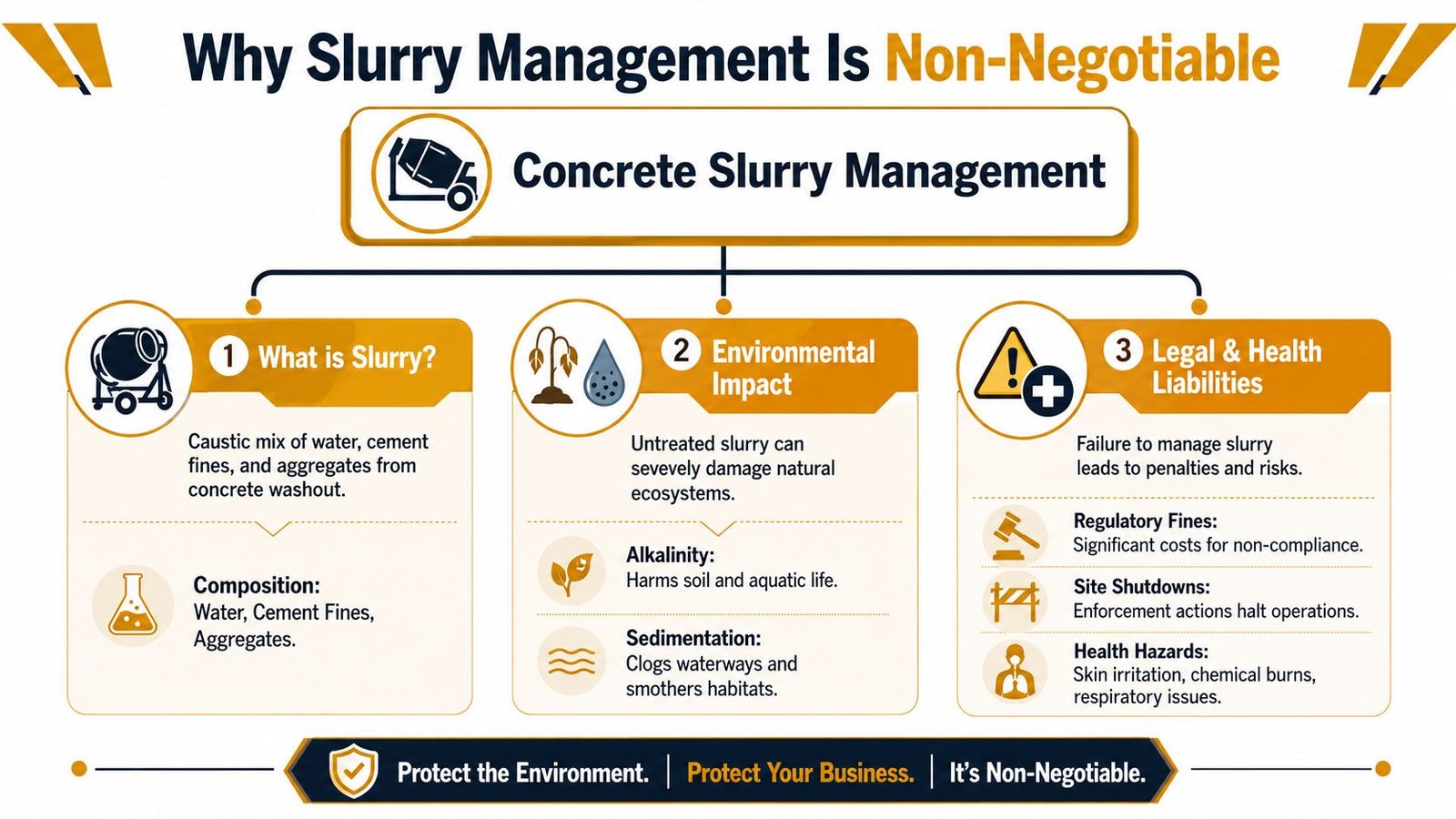
The risk is operational as much as environmental
Crews usually feel the cost before they read the regulation. If slurry reaches a drain, crosses a property line, or hardens where other trades need access, the site loses time first. Then come the cleanup labor, replacement materials, inspection scrutiny, and potential penalties.
The U.S. EPA reports that construction and demolition debris makes up a major share of the waste stream in the United States, based on its construction and demolition debris materials page. Slurry is only one piece of that picture, but it is the piece that can create an immediate discharge issue if the site does not control it from the start.
One rule matters here. If slurry can travel, the site has not contained the risk.
What a controlled system looks like
Good slurry management starts before cleanup begins. The site needs a defined collection point, the right containment equipment, enough capacity for peak production, and a known end point for the material after capture. That might mean washout pans, lined pits, vacuum recovery, filter bags, dewatering boxes, or solidification media, depending on the work and the site constraints.
The equipment choice is not an accessory to the plan. It is part of compliance. A small pan on a high-volume pour creates overflow risk. A distant washout area invites shortcuts. A vacuum setup without enough storage forces crews to dump early. Every equipment mismatch increases the chance of a spill, an unauthorized discharge, or a delay while the team scrambles for a fix.
Sites that stay out of trouble usually do four things well:
- Set one approved collection method: Crews know where slurry goes every time.
- Match equipment to production volume: Capacity covers the busy day, not the average day.
- Separate slurry from drains and traffic: The system stays protected from runoff, vehicle damage, and accidental contact.
- Assign ownership: One person checks condition, capacity, and pickup timing before the problem starts.
Improvisation is what fails. Plastic sheeting tossed on rough ground fails. Undersized containment fails. A plan that depends on everyone remembering the right thing at the end of a long shift fails. Slurry control works when the site removes guesswork and treats the process like any other high-risk operation.
On-Site Containment Your First Line of Defense
A crew finishes a saw-cut near the curb, the slurry hose comes off, and gray water starts tracking toward a storm drain. At that point, the site is no longer dealing with cleanup alone. It is dealing with a discharge risk, lost production time, and a paper trail nobody wants. Good containment stops that chain of problems before it starts.

Pick the location before the work starts
Containment only works if crews can reach it fast and use it without slowing the job down. Put the washout pan, pit, or recovery tank too far away and someone will rinse out in the wrong place. Put it near a drain, curb line, landscaping bed, or slope and one overflow becomes runoff.
Set the location before concrete work, cutting, grinding, or pump washout begins. The right spot gives operators a clear approach, stable ground under the unit, and enough room for service access if the container has to be swapped or pumped out during active work.
Use these location criteria:
- Access for equipment: Place containment where ready-mix trucks, pump crews, saw-cutting teams, or slurry vac operators can reach it without awkward backing or long hose runs.
- Distance from stormwater paths: Keep it away from inlets, drainage swales, and any slope that carries runoff off the work area.
- Stable ground: Soft or rutted ground leads to shifting, tipping, and torn liners.
- Room for service access: Leave enough clearance for pickup, swap-out, or vacuum service if the container needs to be removed while the job is active.
Improvised setups versus engineered containment
Improvised containment usually fails in familiar ways. Plastic-lined pits tear on rough subgrade. The edges collapse after foot traffic. Rainwater fills the hole and wipes out the remaining capacity. Then the crew has to sort out trash, excess water, and spilled material before the actual slurry can be handled.
Purpose-built containment cuts those failure points down. Steel washout pans, sealed boxes, recovery tanks, and vacuum-supported systems give the site a defined collection area with known capacity and predictable service needs. That matters for compliance, but it also matters for production. A container that holds shape and can be emptied efficiently causes less downtime than a temporary setup that has to be rebuilt mid-job.
For contractors that want portable containment without building a temporary system, rental equipment from Reborn Rentals is one practical option for washout control.
The right containment setup is the one that removes excuses and keeps slurry out of the wrong place, even at the end of a long shift.
Treat containment as a compliance control
Slurry is highly alkaline. Once it leaves the work area, the problem gets expensive fast. The immediate cost is usually labor for cleanup, then schedule disruption, then inspection issues, owner complaints, or environmental enforcement if the material reaches drainage infrastructure or exposed soil.
That is why containment needs an owner, not just a location on the site map. Someone should check it before work starts, after heavy washout periods, and before crews leave for the day. On busy sites, I treat that check the same way I treat fuel levels in critical equipment. If nobody is watching capacity and condition, the system is already starting to fail.
A useful field checklist is simple:
| Check | Why it matters |
|---|---|
| Container is in place before concrete work starts | Prevents ad hoc washout |
| Access route is clear | Keeps crews from using the wrong location |
| No storm drain connection nearby | Reduces discharge risk |
| Sidewalls and seams are intact | Prevents leaks |
| Capacity is reviewed before high-washout tasks | Avoids overflow |
Containment does not need to be complicated. It needs to be visible, sized for the work, and maintained like any other risk control on the site.
Dewatering and Solidifying Slurry for Safe Handling
A slurry container can look under control right up to the moment someone tries to move it. If the load is still mostly liquid, the risk shifts from spill prevention to transport failure, extra haul cost, and avoidable cleanup. Dewatering is the step that turns a hard-to-manage waste stream into something the crew can handle without creating a second problem.
The job is straightforward. Separate the water from the fines, reduce the volume, and leave yourself with a solid or semi-solid material that will stay put during handling. That lowers disposal cost, but the bigger benefit is risk reduction. Less free liquid means fewer leaks, fewer rejected loads, and less chance of slurry reaching soil, pavement joints, or drainage paths during removal.
One published example in DiamaPro Systems' guide to concrete slurry management and disposal describes adding 4 oz of flocculant per 20 gallons of recovered slurry, allowing at least 15 minutes for hydration and separation, then removing the clarified water and handling the remaining solids. Their guide also explains why flocculants and filter bags can cut disposal cost by reducing the amount of material hauled off site.

A workable field process
Crews do not need a complicated lab setup. They need a repeatable process that keeps the slurry contained, gets the chemistry right, and produces a material that can be loaded without sloshing back out of the container.
Collect the slurry in a dedicated vessel.
Use a washout pan, recovery tank, tote, or similar container that holds the full batch. Treating slurry on open ground creates two exposures at once. Loss of containment and inconsistent separation.Add the flocculant or solidifier at the recommended rate.
Follow the product instructions or the site-approved method. Underdosing leaves fines suspended. Overdosing wastes material and can slow the crew down if the batch has to be reworked.Mix and allow separation time.
The chemistry needs contact time to bind the fines and start settling. Rushing this step usually means cloudy water on top and soft sludge at the bottom, which creates more work later.Remove the clarified water without disturbing the settled material.
Decant carefully or vacuum from the top. If the settled layer gets stirred back up, the batch goes backward and the crew loses time.Remove the dewatered solids and check consistency before transport.
The processed material should hold shape under a shovel or in a filter bag. If it still flows, it is not ready to leave the treatment area.
How the Equipment Works
Specialized equipment is not a luxury on high-volume jobs. It is part of a compliant slurry system because it controls the points where crews usually lose the process.
- Slurry vacuums: Capture slurry at the saw, grinder, or drill location before it spreads across the slab.
- Recovery tanks or totes: Give the batch a controlled place to settle and be treated.
- Filter bags: Separate fines from water in a contained setup and reduce the mess around the treatment area.
- Filter presses: Remove more water and produce a firmer cake, which makes loading and disposal easier.
- Metered dosing tools: Keep flocculant application consistent across batches and reduce guesswork.
Each tool solves a specific field problem. Vacuums reduce tracking and runoff. Tanks prevent improvised dumping. Filter bags and presses reduce free liquid, which lowers transport risk. Metered dosing helps the crew avoid inconsistent batches that waste product and labor.
If your solids still pour, the slurry needs more processing.
Reuse water carefully
Separated water still needs control. Clearer water is not the same as approved discharge. Depending on the site requirements, crews may reuse it for limited site tasks, hold it for further treatment, or manage it under the project's disposal plan.
Treatment capacity also needs planning. As noted earlier, slurry treatment products only work if the site has enough material, container space, and time set aside to process the full volume generated that shift. If capacity runs short, crews start improvising, and that is when overflows, improper discharge, and schedule delays show up.
Compliant Transport and Disposal of Processed Solids
Once slurry has been dewatered, the disposal question becomes much easier. You're no longer trying to move a caustic liquid that sloshes, leaks, and expands the scope of transport risk. You're handling a solid or semi-solid residual that can be loaded, covered, and taken to an approved destination under the site's waste plan.
That difference matters in the field. Crews can work faster around material that behaves predictably. Trucking is simpler. Containers stay cleaner. The site superintendent has fewer moving parts to manage during pickup.
Separate the disposal path for solids and residual liquid
The biggest mistake at this stage is lumping everything together. Processed solids and residual liquid don't belong in the same decision path.
A practical split looks like this:
- Dewatered solids: Move these to the approved landfill or other authorized receiving facility identified for the project.
- Residual liquid: Keep this under control until it's reused, further treated, or disposed of in a way that fits the site's permit and local requirements.
If there's any doubt about whether the material is still too wet, stop and reprocess it. Extra time in a filter bag, another treatment cycle, or more settling time is cheaper than dealing with leakage during transport.
Keep the load stable and contained
Processed slurry solids still create operational problems if they're loaded carelessly. Fine material can dry on the surface and create dust. Wet pockets can shift during movement. A truck bed or dumpster with gaps, damage, or leftover liquid can spread contamination beyond the work zone.
Use a transport checklist before anything leaves the site:
| Transport check | What it prevents |
|---|---|
| Solids are dewatered before loading | Leakage and rehandling |
| Container or truck bed is suitable for the load | Material loss in transit |
| Load is covered when needed | Dust and spillage |
| Pickup route is clear | Delay and accidental tracking |
| Receiving location is confirmed in advance | Turned-away loads and idle trucks |
A load that leaks on the haul route creates a new incident, not a completed disposal task.
Why this step saves time even when it adds labor
Some crews resist on-site processing because it looks like an extra task. In practice, hauling untreated slurry usually creates more work. It takes longer to transfer, requires tighter containment, and leaves less room for error. By contrast, dewatered solids are easier to stage, easier to load, and easier to account for.
How sites manage slurry often dictates whether they gain or lose control. The efficient jobs don't wait until the end of the week to figure out where all the slurry went. They process it in batches, remove solids on a predictable schedule, and keep the washout area serviceable for the next round of work.
There's also a quality-of-site issue that owners notice immediately. A project with managed solids and clean containment looks supervised. A project with unmanaged slurry, stained runoff paths, and overloaded washout areas looks unstable. That perception matters when inspectors, clients, and neighboring tenants walk the site.
Navigating Regulations and Recordkeeping
The field work matters, but documentation is what protects the company when someone asks what happened to the slurry. If the site can't show where material was contained, how water was managed, and where processed waste went, the team is relying on memory. That's not a defense.
Minnesota's road-construction guidance is a good example of how specific regulators can get. It requires slurry pH to be kept between 6 and 12, checked at least once per hour during startup, calibrated daily, and reduced to 4 tests per day once the process is stable. It also says slurry outside that range can't be deposited on the ground. For on-site solids, the guidance limits management to 0.5 cubic yards, with burial at least 2 feet below the surface and at least 3 feet above the groundwater table, according to the Minnesota Pollution Control Agency concrete slurry guidance.
What a site file should contain
A strong slurry compliance file is straightforward. It doesn't need legal language. It needs records that match the crew's actions.
Keep these items together:
- pH logs: Especially for any treated water stream managed under project requirements.
- Daily inspection notes: Condition of washout containers, berms, liners, covers, and surrounding ground.
- Volume estimates: Even rough operational estimates help explain frequency of service and disposal decisions.
- Pickup and disposal records: Manifests, weight tickets if provided, and receiving facility documentation.
- Corrective-action notes: If a container overflowed, rain entered the pit, or treatment didn't separate properly, record what the team did next.
Translate rules into a field routine
The reason many slurry compliance plans fail is simple. They live in a binder instead of in the superintendent's daily routine. The paperwork should mirror the physical process on site.
A good routine looks like this:
- Start of day: Check containment condition and available capacity.
- Active operations: Log testing and observations while crews are producing slurry.
- Processing period: Note treatment steps, water removal, and solids status.
- End of shift: Confirm storage condition, cover if needed, and schedule removal if capacity is getting tight.
Regulators don't just look for disposal. They look for control.
Why records prevent delays
When an inspector, owner's representative, or consultant asks about slurry, a quick and complete answer keeps the project moving. You can show where the waste was generated, where it was contained, what testing was done, and how the processed material left the site. Without that, the discussion expands. More questions follow. Work can slow down while people reconstruct events after the fact.
Concrete slurry disposal is easier to defend when it's treated as a repeated system, not a one-off cleanup.
Troubleshooting Common Slurry Disposal Scenarios
It is 3:30 p.m., the saw crew is still cutting, a storm cell is moving in, and the washout pan is already close to capacity. That is how slurry incidents start. Not with one big mistake, but with a routine shift getting away from the crew.
The job at this stage is risk control. Each response below ties to a specific problem you are trying to prevent: overflow to soil, noncompliant discharge, rejected loads, haul-off issues, or avoidable downtime.
Sudden rain is filling the washout area
Treat rain as a capacity and overflow problem right away. Stop adding new slurry if operations allow, protect the containment area from direct rainfall, and lower the liquid level with approved pumping or transfer methods once conditions are stable.
Do not let diluted slurry leave the containment area uncontrolled. Rain changes pH, suspended solids levels, and available freeboard. A washout pit that looked manageable an hour ago can turn into a reportable release before the shift ends.
The pan is almost full and trucks are still lining up
Call it early. Redirect crews to preapproved backup containment, bring in service, or pause washout until capacity is back under control.
Waiting for one more load is how pans overtop, access roads get contaminated, and cleanup spreads into the next day. The trade-off is simple. A short stoppage costs less than spill response, rehandling, and inspector attention.
Purpose-built containment equipment helps here because it gives the crew a defined collection point and known capacity instead of relying on improvised tubs, lined holes, or whatever container is available that morning.
The flocculant is not separating the slurry
Start with the variables that changed. Check batch volume, confirm the actual dose used, and verify that the crew allowed enough mixing and settling time.
Then look at the material itself. Slurry from saw cutting, coring, grinding, or wash water from different mixes does not always behave the same way. Admixtures, fines, and excess dilution water can all change separation. If treatment stops working, do not keep adding product blindly. Adjust the process, run a small test batch, and keep the failed material contained until you get a clean break between water and solids.
The solids are still too wet to load
Wet cake creates problems beyond the pit. It can leak from the truck, violate transporter requirements, or get turned away by the receiving facility.
Give the material more drying time, improve filtration, or run it through the dewatering step again. If the solids still slump or release free liquid under handling, they are not ready to move.
A crew member washed out in the wrong place
Respond fast. Isolate the area, stop the spread, recover what can be recovered, and clean affected surfaces before runoff carries fines off site.
Then fix the cause, not just the mess. In the field, this usually comes back to layout and communication. The approved washout area was too far away, poorly marked, blocked by other operations, or never explained clearly during the shift brief.
The system keeps failing under normal production
That points to a planning problem, not a one-off mistake. Capacity may be too small for actual production, the treatment setup may not match the slurry stream being generated, or the service interval may be based on a clean schedule instead of real site conditions.
Review the process like a superintendent reviewing a traffic plan. Where is slurry generated, how fast is it accumulating, what equipment is handling it, and where is the bottleneck? Once those answers are clear, the fix is usually practical: more containment, earlier service, better separation equipment, or stricter control over where crews wash out.
If the site needs purpose-built washout containment instead of improvised setups, Reborn Rentals offers rental equipment for concrete washout operations that helps crews establish a defined collection point, plan capacity, and keep slurry handling aligned with site compliance requirements.