10 Construction Site Best Management Practices
You already know the difference between a site that feels under control and one that feels one rainstorm away from a problem. On the weak site, materials drift, trucks track mud into the street, crews ask the same questions twice, and nobody is fully sure where concrete washout is supposed to happen. The work still gets done, but it costs more effort than it should, and every inspection feels like a scramble.
On the strong site, the same trades move with less friction. The superintendent knows where the high-risk areas are. The labor crew knows what gets cleaned daily. Concrete drivers know where to wash out before they arrive. Environmental controls are in place early, not after someone notices runoff heading toward an inlet. That site doesn't run on luck. It runs on systems.
That's what construction site best management practices really are. They aren't isolated compliance tasks. They're the operating habits that keep safety, quality, schedule, and environmental performance tied together instead of fighting each other.
The U.S. EPA's National Menu of BMPs for construction stormwater organizes construction controls into major groupings that include Erosion Control, Runoff Control, Sediment Control, and Good Housekeeping or Materials Management, with dozens of specific practices under those categories. That framework matters because construction sites create several risks at once. Disturbed soil, concentrated flow, tracked sediment, wash water, and material handling all interact on the same ground.
The ten practices below are the ones that consistently separate a reactive site from a professional one.
1. Concrete Washout Containment and Environmental Compliance
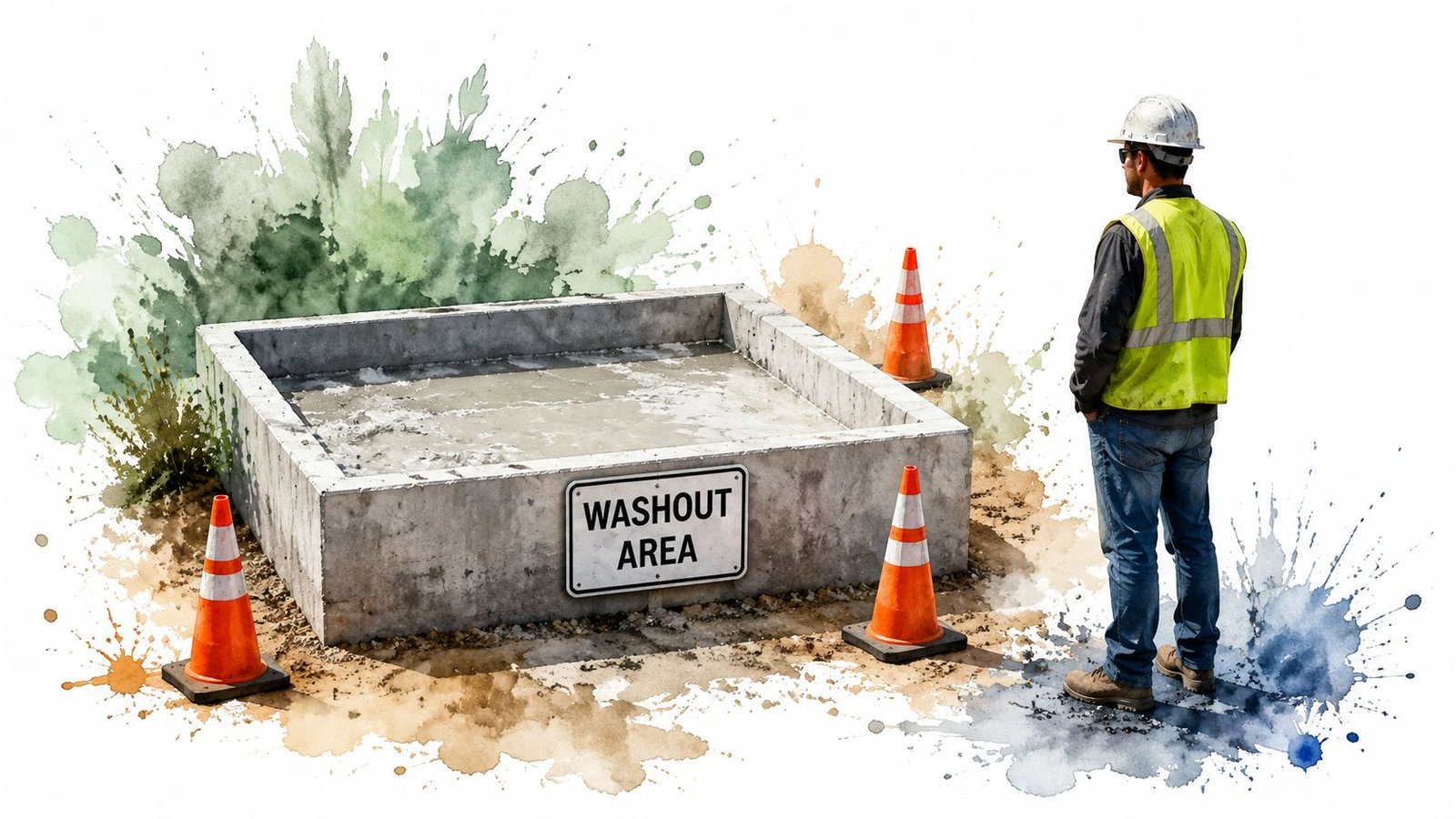
Concrete washout is one of the fastest ways to tell whether a site is managed or just pretending to be. If drivers, pump crews, and finishers don't have a clear, accessible washout location, they'll solve the problem themselves. That usually means a corner of the lot, a gravel edge, or a spot too close to drainage.
The problem is simple. Concrete wash water and residue are highly alkaline, and if they reach soil, gutters, or storm drains, you've created a pollution issue instead of a cleanup task. The University of Arkansas Extension guidance on construction BMPs describes concrete washouts as leakproof containers designed to collect and retain both water and solids, and states that wash water and leftover product must be contained in a lined container.
What works in the field
Placement matters more than is commonly thought. If the washout is too far from the pour, too hard to access, or blocked by staging, people won't use it consistently. On downtown pours, school renovations, and urban infill jobs near inlets, that mistake shows up fast.
A good setup usually includes a clear route for trucks and crews, visible marking, and enough capacity for the planned work. Reusable or single-use containment can both work if the system contains the material and someone owns maintenance.
- Set it near the work: Put washout containment close enough to finishing and pump activity that crews can use it without improvising.
- Assign responsibility: One person should check condition and remaining capacity before every pour.
- Tie it to the pour plan: Don't schedule concrete without confirming the containment is delivered, placed, and ready.
- Record disposal: If your project uses SWPPP logs or daily reports, document washout use and cleanout there.
Practical rule: If the washout location isn't obvious to a driver arriving for the first time, your setup isn't finished.
The trade-off is straightforward. Dedicated containment takes planning, space, and coordination. But informal rinsing creates bigger downstream problems, especially when inspectors, owners, or neighboring properties are watching closely.
2. Site Safety and Hazard Management Planning
Safety plans fail when they live in a binder and nowhere else. The best sites turn hazard management into a daily operating system. Crews know who has stop-work authority, where exclusion zones are, how access changes during the day, and which tasks create overlapping risk.
That matters because environmental controls and safety controls often sit in the same physical space. A poorly placed washout pan can interfere with vehicle routing. A sediment-control line can create a trip hazard if nobody coordinates access. A material pile can block both an emergency path and stormwater flow.
Make hazards visible before work starts
Roadway jobs, raised slab work, trench operations, and pump setups all need different controls, but they all benefit from the same habit. Review the day's work before equipment starts moving. Don't wait for field conditions to reveal the conflict after a crew is already committed.
The strongest site managers use short pre-task conversations with foremen and labor leads. They walk the route, identify what changed overnight, and confirm who owns corrective action.
- Name one authority: A site safety lead needs clear authority to stop unsafe work.
- Post visual instructions: Laminated signs and marked zones work better than verbal reminders alone.
- Include every trade: The hazard review has to include subcontractors, not just the GC's direct crew.
- Track near-misses: The pattern behind a serious incident often shows up first in the close calls people ignore.
Safety gets easier when the site is organized. It gets harder when crews have to guess.
A good hazard plan doesn't slow production. It protects production. When people know where they can move, stage, wash out, and work, the day runs cleaner and faster.
3. SWPPP Management
A Stormwater Pollution Prevention Plan only helps if it reflects the actual site. Too many projects build a decent plan at mobilization and then let field conditions drift away from it. Once that happens, inspections become defensive instead of useful.
For construction site best management practices, SWPPP management is where the whole system gets tied together. Erosion control, runoff control, sediment control, housekeeping, washout containment, inspections, and corrective actions all need to line up with what crews are really doing that week.
The EPA's construction BMP framework exists because modern construction stormwater control moved from local habit to standardized, inspectable, permit-linked practice. That shift made compliance more consistent across markets and made BMP performance something teams can verify in the field.
Treat the SWPPP like a live map
The strongest SWPPP coordinators walk the site with operations, not around operations. They update BMP locations when grading changes, when new access points open, and when storm drains become exposed to work that wasn't close to them a week earlier.
On phased developments and utility work, teams either stay ahead or fall behind. A fence line that worked in phase one may be useless in phase two if flow paths changed.
- Start on day one: Install core BMPs before the site gets fully active.
- Train crews on the plan: Laborers, operators, and foremen need to know what controls matter and why.
- Photograph conditions consistently: Photos tied to dates and locations make maintenance and disputes easier to manage.
- Close corrective actions fast: Don't leave known deficiencies waiting for the next inspection cycle.
A SWPPP isn't paperwork support for the field. It's field management with paperwork attached. When teams treat it that way, washout, tracking control, and sediment management stop being recurring surprises.
4. Inventory and Equipment Tracking Systems
Missing equipment rarely looks dramatic. It shows up as a delayed pour, a rented item sitting on the wrong pad, a crew looking for inlet protection that was moved without notice, or a washout container still on another project when today's concrete trucks are already on the way.
That's why equipment tracking belongs on the BMP list. Environmental controls fail when the tools behind them are unmanaged. If nobody knows where the sweep attachment, track-out control materials, spare wattles, or washout containment units are, the site drifts into workarounds.
Control the yard before the yard controls you
Large commercial jobs and multi-site contractors feel this pain first, but even small renovation work gets burned by weak equipment control. Rental-heavy operations need a simple system that the field will use. Fancy software isn't the point. Accountability is.
A practical setup can be as basic as one current log, one owner for updates, and one visual storage plan in the yard. Mobile apps help, but only if foremen and labor leads update them from the field.
- Assign one equipment coordinator: Shared responsibility turns into no responsibility.
- Mark storage zones clearly: Crews return tools and rental items faster when the location is obvious.
- Photograph delivery condition: This protects the project during pickup disputes or damage questions.
- Match rentals to schedule: Washout containment, pumps, and specialty items should be tied directly to the work plan, not requested at the last minute.
I've seen sites spend more time hunting for rented gear than it would've taken to build a proper tracking routine on day one. Once that happens, schedule pressure pushes people toward shortcuts, and shortcuts are where compliance failures start.
5. Material Storage and Housekeeping Standards
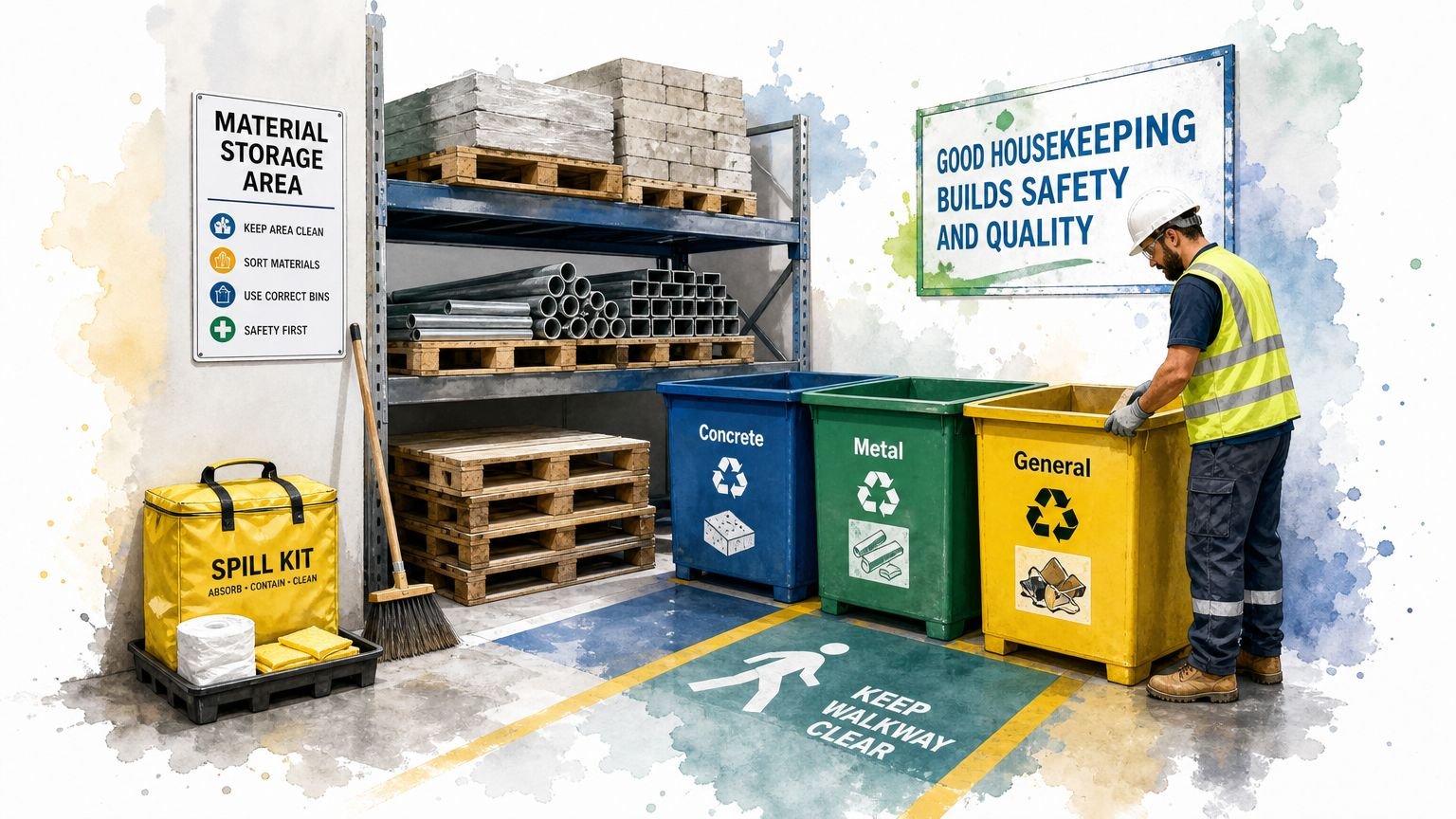
Housekeeping sounds basic until you walk a crowded site after rain. Then you see what bad housekeeping really does. It blocks drainage, hides hazards, contaminates clean areas, slows delivery routes, and makes every inspection look worse than it should.
This is one of the clearest examples of how construction site best management practices function as a system. Good housekeeping supports safety. It supports quality. It supports SWPPP compliance. It also makes the site easier for every trade to work on.
The standard has to be visible
Sites don't become organized because the superintendent cares. They become organized because staging zones, waste areas, access routes, and cleanup expectations are physically defined and consistently enforced.
That matters most on tight urban sites, hospital work, school renovations, and any project where several trades are stacking work in small areas. If the washout area, scrap zone, and material laydown all blur together, people stop respecting boundaries.
The Stormwater Best Management Practices overview from the Spartanburg Water quality resource highlights common field controls such as silt fences, fiber rolls, sediment basins or traps, inlet protection, stabilized construction exits, check dams, street sweeping, and concrete washout areas. In practice, that same logic applies to housekeeping. Control runoff at the source, control movement paths, and keep waste from spreading into active drainage routes.
- Build designated zones: Separate waste, reusable material, equipment parking, and washout clearly.
- Use daily cleanup ownership: “Everyone cleans” often means nobody cleans.
- Keep routes open: Access and drainage paths need to stay clear of pallets, spoils, and packaging.
- Use visible waste sorting: Color-coded containers and labeled bins reduce dumping mistakes.
A clean site isn't cosmetic. It's operational control you can see.
6. Communication and Documentation Protocols
Most site problems aren't caused by missing information. They're caused by information arriving too late, in the wrong format, or to the wrong person. A washout unit gets delivered, but the finishing crew doesn't know where it is. The inspector flagged inlet protection, but the night crew never heard about it. A foreman assumed another trade was handling cleanup.
That's not a communication volume problem. It's a protocol problem.
Build one chain for field information
The best projects use a single communication path for daily updates, environmental issues, logistics changes, and action items. That can be email, a project platform, a shared report, or a messaging tool. What matters is that everyone knows where official instructions live.
For multi-trade pours, utility work, or phased commercial builds, written confirmation matters more than verbal reassurance. If a delivery window, corrective action, or inspection note affects the next day's work, document it.
Write down the decisions that will matter tomorrow. Memory is weakest when the site is busiest.
A strong documentation routine usually includes daily reports, photo logs, meeting notes, and issue tracking with named owners. If your team can't answer who noticed a problem, when it was documented, and who was assigned to fix it, you don't have a useful record.
- Use one official hub: Too many channels create blind spots.
- Standardize photo records: Include date, location, and what the image shows.
- Log field decisions daily: Small changes pile up fast on active sites.
- Share compliance notes broadly: SWPPP and safety findings shouldn't stay with one person.
Clear communication makes inspections smoother because the site can prove what happened, not just explain what it meant to do.
7. Quality Control and Inspection Procedures
Inspection routines tell you whether your BMPs exist on paper or in reality. They also catch the kind of quality drift that leads to rework, failed pours, damaged controls, or preventable compliance issues.
The most effective inspections happen before crews are committed, not after the damage is done. Pre-pour checks, access reviews, BMP condition reviews, and housekeeping walks all help because they catch conflicts while the solution is still cheap.

Inspect the interfaces, not just the tasks
A lot of managers inspect concrete, safety, and stormwater separately. That misses key trouble spots. Problems usually appear where scopes overlap. The pour is ready, but washout isn't in place. Inlet protection exists, but truck traffic destroyed it. Materials are stacked safely, but they block maintenance access to sediment controls.
Municipal guidance often emphasizes inspection before and after storm events and quick deployment of temporary controls when conditions change. The Sonoma County construction BMP guidance) is useful on this point because it reflects what field teams deal with every week. The issue isn't only installing BMPs. It's maintaining them through weather, traffic, and changing excavation.
A practical inspection routine should include:
- Pre-task verification: Confirm BMP placement before major work starts.
- Condition checks after rain: Temporary controls often fail at edges, low points, and access crossings.
- Nonconformance tracking: Write deficiencies clearly, with deadlines and named owners.
- Closeout review: Don't remove controls or rentals until the related work is fully complete.
The best inspection question isn't “Do we have this control?” It's “Will this control still work after today's work is done?”
That shift catches far more real-world failures.
8. Scheduling and Logistics Coordination
The slab crew is on site at 6:00 a.m. The first truck is rolling. Then the gate is blocked by steel delivery, the pump has no clear setup area, and the washout container is still twenty minutes out. That is how a schedule slips before the pour even starts.
Good scheduling on a construction site is really logistics management tied to production. Dates matter, but movement matters more. Trucks, labor, equipment, temporary controls, cleanup, and inspection all have to arrive in the right order or one failure spills into the next. A missed delivery does not just cost time. It can force unsafe access, damage BMPs, create runoff problems, and turn a clean pour into a cleanup job.
That is why scheduling has to connect with the rest of the site management system. If washout containment is late, environmental compliance takes the hit first. If access routes change without notice, housekeeping, safety, and quality control usually follow.
Schedule the route, the setup, and the reset
A workable schedule answers field questions before the first truck shows up. Where does each vehicle enter. Where does it wait. What path stays open for emergency access. Where is the pump staged. Where is washout located. Who resets the area after placement and who signs off that it is done.
Those details change fast on phased work. A haul road that worked last week may now cross soft grade, trenching, or utility rough-in. If the logistics plan stays static while the site changes daily, crews start making their own decisions under pressure. That is when production and compliance start pulling against each other.
Use a short coordination checklist before major placements:
- Lock delivery windows: Stagger trucks so the gate, staging area, and pump location do not choke each other.
- Map current access: Review the active route against current grading, stored material, and trade congestion.
- Confirm environmental support: Verify washout, inlet protection, sweeping needs, and cleanup assignments before work starts.
- Assign site control roles: One person manages arrivals and routing. One person owns post-task cleanup and release.
- Plan the reset: Include barrier moves, debris pickup, traffic changes, and equipment retrieval in the same work package.
Rental equipment coordination belongs in that same discussion. Reborn Rentals concrete washout equipment can fit a pour schedule well, but only if delivery timing, placement area, and pickup conditions are clear before the operation starts. Vague instructions create field delays. Clear handoffs keep the crew building instead of improvising.
The best schedules do not treat logistics, environmental controls, and production as separate topics. They run them as one system. That is what keeps the site predictable when the plan meets real conditions.
9. Sustainability and Environmental Stewardship
Sustainability on a construction site gets dismissed when people treat it like branding language. In practice, it's just disciplined waste reduction, pollution prevention, better material handling, and cleaner closeout. The same habits that protect water quality also make the site more professional and easier to manage.
Here, environmental stewardship becomes practical instead of abstract. If your crews contain washout properly, keep tracked sediment off public roads, separate waste streams, and stabilize disturbed areas promptly, you're already doing work that owners and regulators care about.
Focus on actions crews can repeat
The mistake is setting broad environmental goals that don't translate to field behavior. Crews need specific expectations. Which materials go where. How cleanup gets documented. Where concrete residue belongs. Who calls for container service. How spoil and debris stay out of drainage paths.
These actions are especially visible on public work, institutional projects, and owner-sensitive jobs where neighbors, inspectors, and facility staff see the site every day. Environmental performance becomes part of your reputation.
- Tie goals to operations: Recycling and pollution prevention have to fit daily production.
- Train for repeatable tasks: Keep instructions simple enough that every trade can follow them.
- Use containment instead of cleanup: Preventing a discharge is easier than explaining one.
- Show the owner the system: Clients respond well when they can see clean staging, contained washout, and maintained controls.
A sustainable site usually looks like a well-managed site because the underlying discipline is the same.
10. Regulatory Compliance and Permitting Management
Permitting problems usually don't explode on the first day. They sit until an inspection, a complaint, a weather event, or a milestone review exposes that the site is working ahead of its approvals or behind its obligations.
That's why compliance management belongs in operations, not just administration. Someone has to know which permit conditions affect field work, which BMPs must be maintained, what documentation has to stay current, and what inspectors are likely to check on any given visit.
Keep permit conditions in the daily routine
For construction stormwater work, permit-linked BMPs only work when crews know they're part of the job, not just part of the file. Copies of permits, plan sets, inspection records, and corrective-action logs should be accessible on site and understood by the people directing the work.
On projects near sensitive drainage, active streets, schools, healthcare facilities, or neighboring properties, this matters even more. Compliance isn't just a relationship with an agency. It's a relationship with everyone affected by the site.
A good compliance manager or superintendent keeps a running list of required actions and deadlines. They don't wait for outside pressure to trigger maintenance.
- Start permit review early: Field plans should reflect compliance requirements before mobilization.
- Track obligations in one place: Spreadsheets, logs, or software all work if someone maintains them.
- Train crews on permit-linked BMPs: Washout, tracking control, and inspections need field ownership.
- Audit the site routinely: Small corrections are cheaper than formal findings.
The strongest sites don't treat compliance as the thing that interrupts production. They treat it as one of the controls that keeps production steady.
Construction Site BMPs: 10-Point Comparison
| Item | Implementation complexity | Resource requirements | Expected outcomes | Ideal use cases | Key advantages |
|---|---|---|---|---|---|
| Concrete Washout Containment & Environmental Compliance | Moderate, site layout, containment units, SWPPP integration | Washout pans, disposal service, space, trained crew | Prevents slurry pollution; regulatory compliance; reduced remediation costs | Urban pours, sites near waterways, regulated jurisdictions | Eliminates violations; supports certifications; protects reputation |
| Site Safety & Hazard Management Planning | Moderate–High, policies, training, enforcement | Safety officer/coordinator, PPE, training, inspections | Fewer accidents, lower insurance/claims, fewer shutdowns | High-risk operations (falls, heavy equipment, trenches) | Reduces injuries; improves morale; prevents costly shutdowns |
| Stormwater Pollution Prevention Plan (SWPPP) Management | High, regulatory documentation, monitoring, BMP placement | SWPPP coordinator/consultant, inspection logs, BMP materials | Permit compliance; avoided fines; sustained environmental protection | Sites ≥1 acre, sensitive watersheds, concrete-heavy projects | Ensures permit compliance; integrates BMPs like washout containment |
| Inventory & Equipment Tracking Systems | Low–Moderate, system setup and discipline | Software/apps, QR/RFID tags, coordinator, mobile access | Reduced loss/theft, accurate billing, faster equipment location | Large/multi-site projects, rental-heavy operations | Improves accountability; lowers rental overages; streamlines logistics |
| Material Storage & Housekeeping Standards | Low–Moderate, procedures and enforcement (5S) | Designated zones, signage, bins, spill kits, crew time | Fewer trip/fall incidents, less waste, better inspection readiness | Tight urban sites, high-cleanliness or inspection-sensitive jobs | Improves safety/productivity; supports SWPPP compliance |
| Communication & Documentation Protocols | Moderate, tool adoption and consistent practice | PM software, templates, logs, trained staff | Fewer disputes, documented compliance, faster issue resolution | Multi-trade projects, projects requiring strict coordination | Creates legal record; improves coordination; speeds decisions |
| Quality Control & Inspection Procedures | Moderate–High, skilled inspectors and testing regimes | Qualified inspectors, checklists, testing equipment, labs | Higher workmanship, reduced rework, verified compliance | Structural concrete pours, high-spec commercial/infrastructure work | Prevents rework; validates quality and warranty claims |
| Scheduling & Logistics Coordination | High, complex sequencing and contingency planning | Skilled schedulers, software, stakeholder coordination | Reduced delays, optimized equipment use, lower costs | Multi-pour concrete projects, constrained-access or remote sites | Improves efficiency; reduces rental duration and premium charges |
| Sustainability & Environmental Stewardship | High, certification processes and systemic changes | Sustainability consultants, recycling systems, tracking tools | LEED/Envision credits, long-term cost savings, enhanced reputation | Green building, public projects, clients seeking sustainability | Market differentiation; certification eligibility; future-proofing |
| Regulatory Compliance & Permitting Management | High, multi-agency approvals and ongoing reporting | Permitting coordinator/consultant, documentation, lead time | Permits secured, avoided fines/shutdowns, legal defensibility | Large developments, wetlands/ESA proximity, projects needing variances | Prevents shutdowns; reduces legal/risk exposure; ensures due diligence |
Building a Culture of Excellence, One Practice at a Time
The biggest mistake teams make with construction site best management practices is treating them like separate boxes to check. They aren't. They're connected systems that either support each other or fail each other.
Concrete washout containment is a good example. On paper, it looks like one environmental line item. In reality, it depends on scheduling, communication, site layout, training, housekeeping, inspection, and accountability. If any one of those breaks down, the washout setup gets ignored, misplaced, overfilled, or used incorrectly. The same pattern applies to inlet protection, stabilized exits, material storage, and every other visible control on a job site.
That's why the best-managed projects feel different from the first week. The site team doesn't rely on reminders alone. They build repeatable routines. The foremen know where controls are supposed to be. The labor crew knows what gets checked after rain. The superintendent knows which areas create the most risk when schedule pressure rises. Inspectors see a site that looks intentional, not reactive.
This systems view also helps resolve the old tension between compliance and productivity. In the field, those two aren't enemies unless the site is poorly coordinated. When crews have the right equipment in the right place, when cleanup routes are planned, when washout is ready before the pour, and when BMPs are inspected before they fail, work moves with less friction. You spend less time fixing preventable messes and less energy defending the job after something goes wrong.
The strongest operators understand that environmental controls aren't separate from professional site management. They are professional site management. A contained washout area protects stormwater, but it also keeps the work area cleaner, reduces confusion for truck drivers, and supports a more orderly closeout after the pour. Street sweeping helps with sediment control, but it also improves access and appearance. Clear documentation helps with compliance, but it also protects the team during disputes and turnover.
If you're trying to improve a site, don't start by chasing perfection everywhere at once. Start by tightening the practices that connect to everything else. Housekeeping. Communication. Inspections. Scheduling. Washout containment. Those are foundational practices. Once they improve, the rest of the operation usually gets easier to manage.
For concrete work in particular, reliable washout containment is one of the cleanest ways to reduce risk quickly. It protects the site environmentally, supports SWPPP execution, and removes guesswork from one of the messiest parts of the operation. Partnering with a specialist such as Reborn Rentals helps because you're not asking your crew to invent a solution under pressure. You're putting a defined system in place before the pour starts.
Good sites don't happen by accident. They happen because someone decided that control, cleanliness, safety, and compliance were going to be built into the work, not added after the fact.
If your next pour needs a cleaner, more reliable washout plan, Reborn Rentals gives contractors a straightforward way to secure concrete washout containment with clear pricing, delivery coordination, and equipment built for real job site use. It's a practical fit for supers, concrete crews, SWPPP consultants, and project managers who want one less variable to fight on pour day.