Essential Construction Stormwater Pollution Prevention Plan
You’re on a job that’s finally ready to move. The crew wants to break ground, the schedule is tight, and then someone asks a question that stops the momentum cold: “Where’s the SWPPP?”
That moment catches a lot of new site superintendents off guard. They assume the construction stormwater pollution prevention plan is a permit file somebody else handles in the office. It isn’t. On an active site, it becomes an operating document. If it’s weak, outdated, or disconnected from field conditions, you don’t just risk a paperwork issue. You risk muddy discharges, concrete washout problems, inspection findings, and expensive delays while the crew waits for corrections.
The best SWPPPs are practical. They match the site as it drains, they call out the pollutants your work really generates, and they give the field team controls they can maintain without guessing. That matters even more on concrete-heavy jobs, where washout gets overlooked until slurry is sitting in the wrong place after a rain.
What is a Construction Stormwater Pollution Prevention Plan
Rain hits a graded site fast. If the crew has been cutting, hauling, washing out concrete equipment, and stacking material without a clear stormwater plan, that runoff leaves with sediment, slurry, trash, and stains you now have to explain to an inspector.
A construction stormwater pollution prevention plan is the site-specific document that lays out how the project will prevent polluted stormwater from leaving the job. Under the EPA’s National Pollutant Discharge Elimination System program, construction activity that disturbs 1 acre or more of land, or less if it is part of a larger common plan, typically needs one. The point is simple. The SWPPP turns permit requirements into field instructions your superintendent, foremen, and crews can follow.
On a good project, the SWPPP is not a binder that stays in the trailer. It shows how water moves across the site, where discharges could leave the property, which activities create pollution, what controls are required, and who is responsible for keeping those controls working. That includes the obvious items like exposed soil and stockpiles, but it also needs to deal with the pollutants that trigger expensive problems on active jobs, especially concrete slurry, washout water, saw-cut residue, fuel, and trash.
Concrete work is where generic plans break down. Many template SWPPPs mention washout but do not tell the field where it goes, how it is contained, what happens when the container is full, or how to keep slurry from reaching inlets and low areas after a rain. That gap is where violations start.
Why the requirement matters in the field
The legal requirement matters because enforcement follows the discharge, not your intent. If the site meets the disturbance threshold, the plan has to exist and the controls in it have to be installed, inspected, and maintained. Some states can issue penalties of up to $10,000 per day for non-compliance, as summarized in this Florida SWPPP guide.
The bigger day-to-day problem is lost control of the site. Crews start work before perimeter controls are in. Material laydown ends up in drainage paths. Concrete trucks wash where it is convenient instead of where it is contained. Then one storm turns small oversights into corrective actions, cleanup costs, and schedule friction.
Practical rule: If the superintendent cannot walk the site and point out where runoff goes, where sediment is trapped, and where concrete washout is contained, the SWPPP is not ready for field use.
What a usable SWPPP does
A usable SWPPP answers the questions the field team will ask under pressure, not just the questions a template asks in the office.
- Where does water go? Show the grades, flow paths, low points, drains, ditches, slopes, and discharge locations clearly enough that a foreman can read the plan and set work accordingly.
- What are the pollutant sources? List exposed soil, stockpiles, fuel, waste, and portable toilets, but give extra attention to high-risk materials such as concrete slurry, wash water, and saw-cut fines.
- What control is installed for each risk? Identify the BMPs, map their locations, and describe the containment method. For concrete operations, that usually means a defined washout area with enough capacity, protection from overflow, and a maintenance plan.
- Who keeps it current? Name the people responsible for inspections, repairs, updates, and records. If ownership is vague, missed maintenance is only a matter of time.
The strongest SWPPPs read like the site has already been walked by someone who understands how construction really unfolds. They account for sequencing, weather, subcontractor habits, and the fact that slurry and sediment will always find the low spot if you do not control them first.
Assembling Your SWPPP Foundation Before You Write
Most bad SWPPPs fail before the first page is written. The problem usually isn’t the template. It’s missing groundwork.
If the team hasn’t agreed on roles, and nobody has done a serious site walk, the finished plan will be generic by default. It won’t reflect the haul roads, the stockpile locations, the utility trench sequencing, or the practical realities of where concrete trucks and pump crews will work.
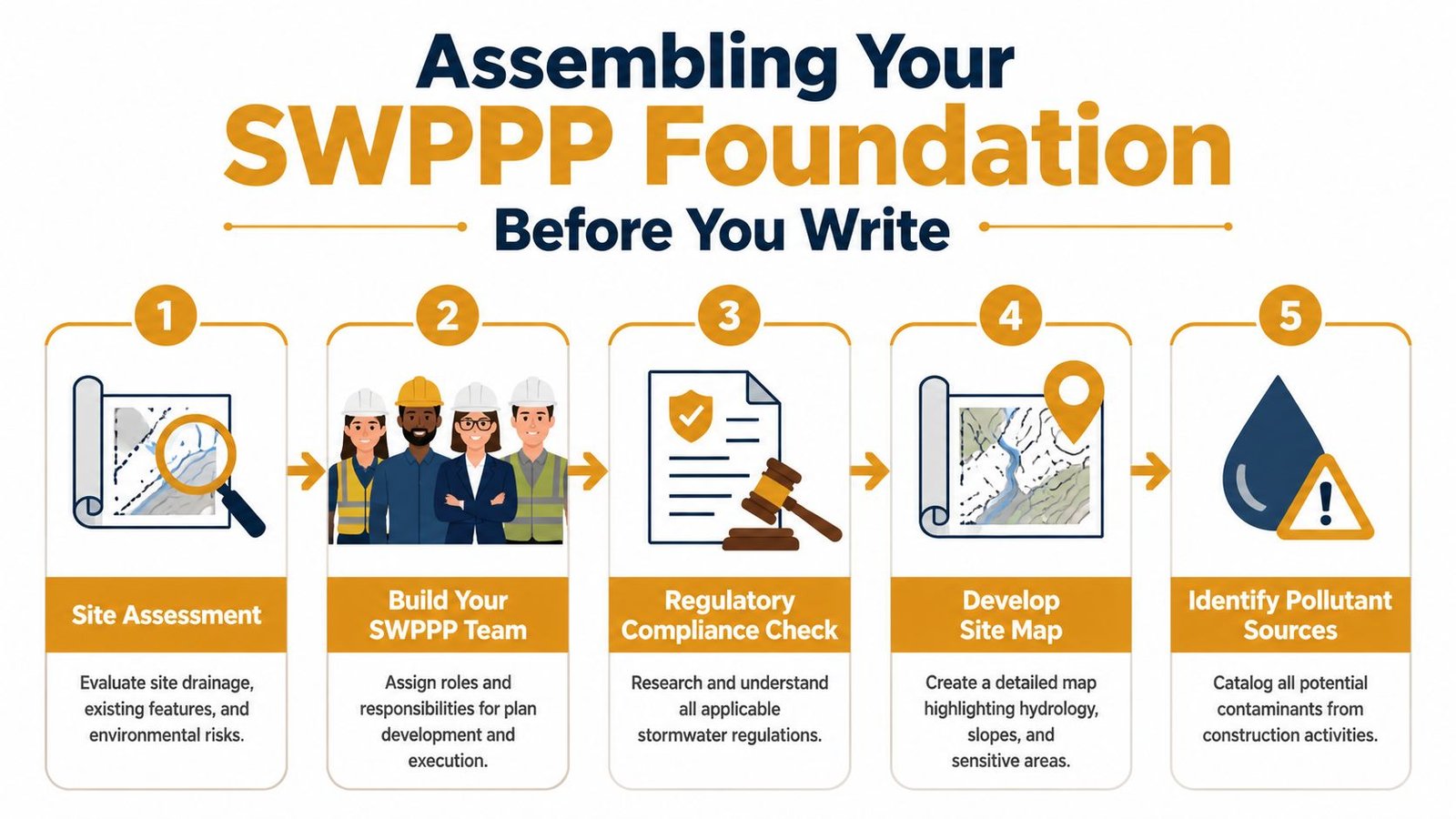
Put names next to responsibilities
A SWPPP works better when responsibility is specific. “Project team” is not a responsible party. Real people are.
At minimum, you want clear ownership for plan development, field installation, inspections, corrective action, and document control. On some projects that’s spread across a SWPPP practitioner, superintendent, foreman, and project engineer. On smaller jobs, one person may wear several hats, but the duties still need to be assigned.
Use this kind of structure:
- Plan lead: Owns the written SWPPP, updates, permit coordination, and supporting records.
- Superintendent: Controls sequencing, site logistics, and whether BMPs are installed before work exposes risk.
- Foremen and trade partners: Keep work inside designated areas, protect installed controls, and report failures immediately.
- Inspector or compliance representative: Documents conditions, deficiencies, and corrective actions with enough detail to stand up during review.
If you skip this step, the most common field problem appears fast. Everybody assumes somebody else is handling it.
Walk the site before you draft anything
A rigorous SWPPP process starts with data collection. That includes topography, soil types, ground cover, and critical areas like steep slopes greater than 15 percent gradient, and accurate mapping is essential for identifying pollution hotspots such as washout zones, according to the Tacoma stormwater manual.
That sounds technical, but in practice it means getting your boots dirty and looking at the site as water will see it.
What to map on the first site walk
Don’t stop at the property boundary and a couple of contour lines. You need to identify the features that affect runoff behavior and pollutant exposure.
- Drainage patterns: Find the actual flow paths, not just the ones on a civil sheet. Tire ruts, temporary grading, and staging areas often change flow quickly.
- Sensitive edges: Note wetlands, creeks, storm drain inlets, curb openings, neighboring properties, and anywhere runoff leaves your control.
- Slope changes: Steep transitions, cut faces, and long exposed runs deserve attention early because erosion starts there fast.
- Work phases: Mark what gets disturbed first, what stays untouched for now, and what gets stabilized between phases.
- Concrete activity zones: Identify pump setup, truck access, chute wash areas, saw cutting locations, and any place slurry could reach drainage.
Walk the site after a rain if you can. Water will show you the weak points faster than any meeting.
Treat the site map as a field tool
The site map should help the superintendent make decisions, not just satisfy a filing requirement. If a crew can’t read it in the trailer and then find the same conditions outside, it needs work.
A useful map usually includes these practical layers:
| Map focus | Why it matters in the field | What gets missed most often |
|---|---|---|
| Drainage direction | Shows where a failure will travel | Temporary grade changes during early earthwork |
| Disturbed areas | Defines where controls must be active | Off-limit areas that crews gradually encroach on |
| BMP locations | Lets crews install and maintain the right controls | Vague symbols with no tie to actual work zones |
| Material and waste areas | Keeps pollutant sources contained | Fueling, washout, and trash areas added later |
| Discharge points | Identifies where inspection attention should be highest | Small offsite paths at low corners |
Check reality against the paperwork
The strongest prep habit is simple. Compare the drawings, the permit assumptions, and the actual ground conditions before the plan is finalized.
If a stockpile area on paper is now your access road, revise the plan. If the designated washout location sits in a drainage swale, move it before the first pour. If utilities force disturbance outside the original phase limit, update the site map and controls before that work starts.
That’s how a construction stormwater pollution prevention plan becomes usable. It starts with real people, a real site walk, and a real map.
Identifying and Controlling On-Site Pollutant Sources
Most crews recognize sediment as a stormwater issue. Fewer take a complete inventory of everything else that can leave the site with runoff. That’s where generic plans fall apart.
A solid SWPPP doesn’t just say “control erosion and sediment.” It identifies the actual pollutant sources created by the job. On one site that may be tracked soil and stockpiles. On another, the bigger threat may be saw cutting slurry near curb inlets, trash blowing into drainage paths, or a refueling area set on bare ground.
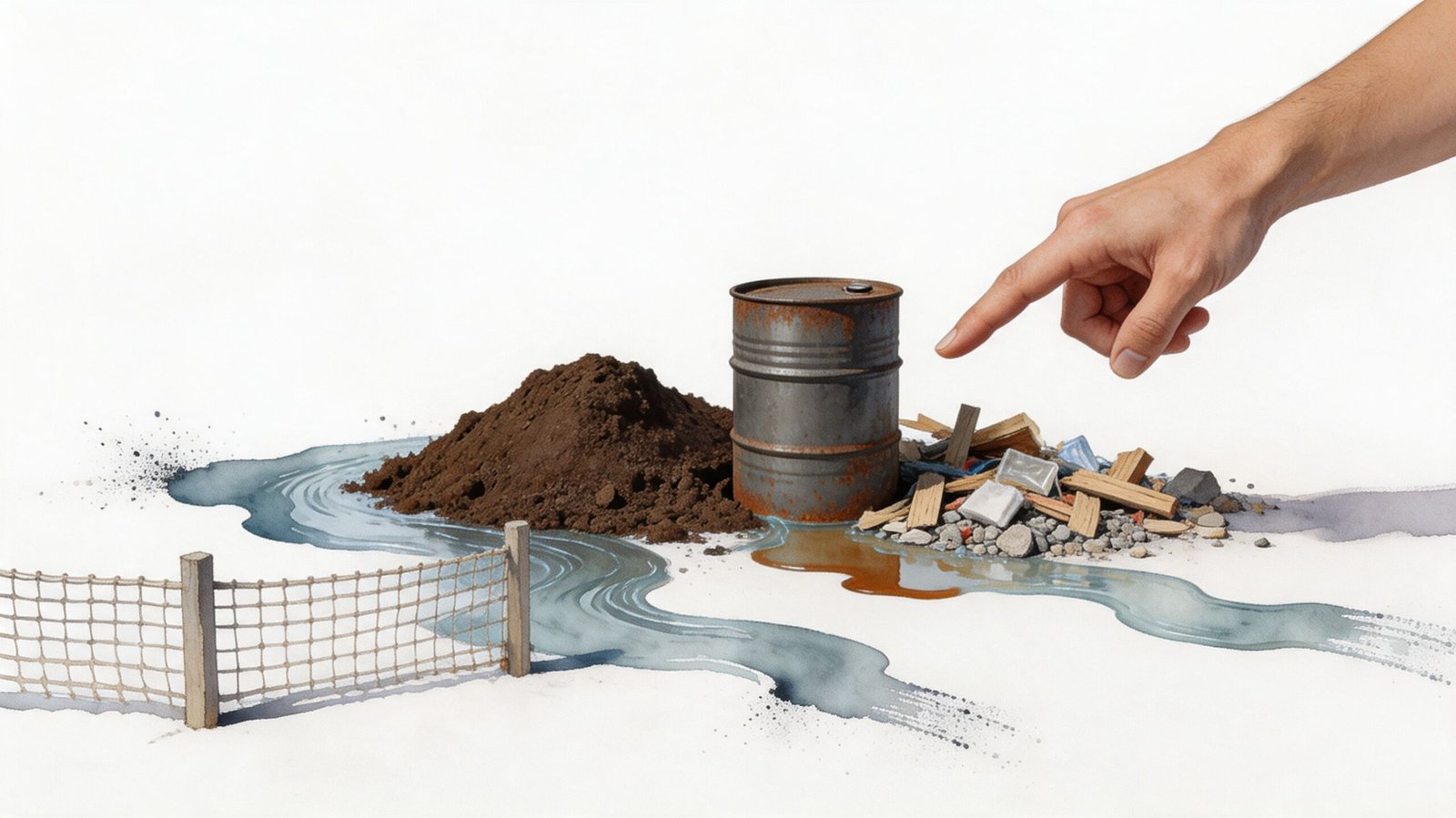
Start with a field inventory, not assumptions
Walk the project and list pollutant sources by activity area. Don’t group the whole site into one vague category.
Think in zones:
- Earthwork areas: Exposed soil, stockpiles, track-out, dewatering residue.
- Concrete work areas: Chute wash water, pump washout, slurry from finishing, saw cutting residue, broken-out concrete fines.
- Material storage areas: Pallets, bagged product, chemical admixtures, curing compounds, paints, solvents.
- Equipment zones: Fuel, hydraulic leaks, grease, maintenance waste.
- General housekeeping areas: Trash, packaging, scrap, portable toilets, food waste, loose debris.
This inventory matters because different pollutants need different controls. Sediment is handled one way. High-pH concrete washout is handled another. Fuel and chemicals need containment and spill response. A single blanket statement about “BMPs as needed” doesn’t help anyone on the ground.
The pollutant source most plans underplay
Many SWPPP resources cover erosion controls in detail but don’t adequately address concrete slurry containment. That gap matters because 30 percent to 50 percent of construction stormwater violations involve washout failures, and the slurry can reach a pH up to 12.5, which can harm aquatic life, according to this construction washout compliance overview.
That finding lines up with what happens in the field. Sediment controls usually get at least some planning attention. Concrete washout often gets handled informally. Someone points to an empty corner, a laborer puts down plastic or a makeshift pit, and everybody assumes it’s good enough.
It often isn’t.
Why concrete washout fails so often
Washout failures usually come from one of four mistakes.
Bad location
The washout area gets placed where trucks can reach it easily, but nobody checks drainage. If that spot is near an inlet, low area, curb line, ditch, or travel path that sheds runoff, the containment is one storm away from becoming a problem.
Bad sizing
The designated washout is too small for the pace of the concrete work. Crews then improvise. They rinse in multiple places, wash out next to forms, or leave residue where it lands because the approved area is already full or inaccessible.
Bad maintenance
Even a good containment setup fails if hardened buildup reduces usable capacity or if the liner tears and nobody notices. Washout controls need inspection just like silt fence and inlet protection do.
Bad communication
Pump operators, finishers, drivers, and cleanup labor don’t all get the same instruction. One crew uses the designated area. Another uses the nearest open ground because nobody briefed them.
Field advice: If your washout plan depends on every driver asking permission before rinsing out, your plan is too fragile.
How to control concrete slurry in a workable way
A practical approach has three parts.
First, choose a containment method that fits the jobsite and can be placed where access is convenient without exposing runoff pathways. On active sites, durable containment tends to work better than improvised solutions because crews recognize it, use it consistently, and can see when it needs service.
Second, show the washout location clearly on the site map and tie it to the concrete operation itself. Don’t bury it in a general notes section. If the project has phased pours, identify whether one location serves all phases or whether containment moves as the work moves.
Third, define maintenance responsibility. Someone needs to check condition, remaining capacity, surrounding staining, and nearby tracking. If hardened material is building up or overflow risk is developing, the response should happen before the next pour, not after a storm.
Other pollutant sources that need equal attention
Concrete is the high-risk gap, but it isn’t the only one. New superintendents often miss how quickly small housekeeping issues turn into discharge issues.
Consider these examples:
| Pollutant source | What goes wrong | Better control approach |
|---|---|---|
| Stockpiles | Runoff cuts through uncovered material and carries fines offsite | Place away from drainage, perimeter them, and stabilize if they sit |
| Fuel and fluids | Leaks spread over bare ground and wash during rain | Use designated fueling and spill materials in one visible area |
| Trash and packaging | Windblown debris reaches inlets and perimeter controls | Use covered or secured collection and frequent pickup |
| Saw cutting residue | Slurry enters curb lines and drains before cleanup | Contain at the work area and remove before washing anything down |
| Portable toilets | Tip-over or leakage reaches runoff path | Place away from inlets and secure them on stable ground |
Use the inventory to tighten the SWPPP
Once you’ve identified sources, document them in plain language the field can follow. “Potential pollutants include construction materials” is too broad to be useful. Name the materials, the activities, the exposure points, and the controls.
A strong construction stormwater pollution prevention plan links each source to a specific field practice. That’s what keeps the plan from becoming a template that only looks complete on paper.
Selecting and Documenting Your Best Management Practices
Choosing BMPs isn’t about listing every control you’ve ever seen. It’s about matching controls to site conditions and documenting them clearly enough that the crew installs the right thing in the right place at the right time.
The easiest way to make that manageable is to think in three groups. Erosion controls keep soil in place. Sediment controls capture what moves anyway. Housekeeping and materials management keep non-sediment pollutants out of stormwater in the first place.
Erosion controls that prevent the problem upstream
Erosion control is often the best money you’ll spend because it reduces the load on every downstream control.
Use stabilization and disturbance management where the site is vulnerable, not just where the spec book repeats standard notes.
- Phased clearing: Limit how much bare soil you open at once. This is one of the simplest ways to keep a site manageable during changing weather.
- Temporary cover: Mulch, blankets, or other cover make sense where an area will sit before the next operation.
- Slope protection: On long or steep exposed areas, protect the face early instead of waiting for rills to form.
- Stabilized construction access: If track-out starts at the gate, perimeter controls and street sweeping will become a constant chase.
Sediment controls that back up the erosion plan
Sediment controls are your interceptors. They are not a substitute for stabilization, but they’re necessary where runoff leaves disturbed ground.
Common choices include perimeter barriers, inlet protection, check structures in concentrated flow areas, and sediment trapping measures where drainage converges. The key is installation quality. A good detail drawn in the SWPPP won’t help if the field installs it loosely, leaves gaps, or buries it after the next grading pass.
When deciding what to use, ask three blunt questions:
- Is flow sheet flow or concentrated?
- Will this control stay in place through the next work phase?
- Can the crew maintain it without specialized effort they won’t realistically provide?
If the honest answer to the third question is no, choose something simpler.
A BMP that is slightly less sophisticated but maintained consistently will outperform a “better” control that nobody services.
Housekeeping and materials management controls that inspectors notice fast
This category is where experienced inspectors often separate organized sites from sloppy ones. It includes waste storage, material cover, fueling areas, spill response, and concrete washout containment.
These controls tend to fail when they are treated as informal. The field benefit of formalizing them in the SWPPP is that they stop being optional habits and become expected site setup.
For concrete work, document dedicated washout containment, its location, how crews access it, who monitors it, and how the area around it stays clean. For trash and materials, define storage and pickup routines. For fuels and chemicals, designate handling areas and keep response materials visible and accessible.
Essential SWPPP document checklist
| Element | Required Content | Common Pitfall |
|---|---|---|
| Site description | Scope of work, disturbed areas, drainage features, receiving points, sequence overview | Using a generic project summary with no connection to field conditions |
| Site map | Drainage paths, BMP locations, access points, material areas, washout area, discharge locations | Map symbols that don’t match what crews can find onsite |
| Pollutant source inventory | Specific materials and activities that may contact stormwater | Listing only sediment and ignoring concrete, waste, and fluids |
| Erosion controls | Temporary and permanent stabilization measures tied to phases | Installing them too late, after soil is already moving |
| Sediment controls | Perimeter and drainage-point controls with location details | Relying on them as the only line of defense |
| Good housekeeping practices | Waste handling, storage, spill response, concrete washout procedures | Treating housekeeping as “common sense” instead of documented practice |
| Inspection procedures | Who inspects, when inspections occur, what gets documented, how corrections are tracked | Vague language with no assigned responsibility |
| Maintenance procedures | Trigger for repair or replacement, cleanup expectations, service responsibilities | Not defining how fast deficiencies get corrected |
| Update process | How plan revisions are made when phasing, drainage, or work areas change | Letting the SWPPP stay frozen while the site evolves |
| Records and logs | Inspection reports, maintenance records, training notes, corrective actions | Missing paperwork for work that did happen |
Document what the crew can actually build
When you write BMP descriptions, avoid language that sounds polished but leaves room for interpretation. “Install sediment controls as necessary” invites inconsistency. “Install perimeter control along downgradient edge before grading begins” gives the superintendent something enforceable.
The best documentation also reflects trade-offs. If an inlet protection device will be destroyed by traffic at a certain phase, note an alternate strategy for that phase instead of pretending one control solves the whole project. That kind of realism is what makes the SWPPP durable.
Bringing Your SWPPP to Life Through Inspection and Maintenance
A SWPPP only works when the field treats it like an active control system. Once grading starts, conditions change constantly. Entrances shift, stockpiles move, trades overlap, and yesterday’s clean drainage path can become today’s failure point.
That’s why inspection and maintenance matter more than polished language. A rough but current plan with disciplined follow-through usually performs better than a detailed document that sits untouched in the trailer.
Build a routine the crew can sustain
EPA inspection expectations include weekly and post-rain inspections, and maintenance problems are a common failure point, especially on small sites. A 2025 ASCE study cited in the Tacoma material found that under-training on sites under 5 acres contributed to a 25 percent violation rate, higher than on large projects, as summarized in this small-site stormwater guidance reference.
On smaller projects, the challenge usually isn’t bad intent. It’s lack of structure. One person may be running deliveries, subs, safety issues, and owner questions. SWPPP maintenance gets pushed until a complaint, a storm, or an inspection forces it back to the top.
What to check during each inspection
Inspections work best when they follow the same route every time. Start upstream and work toward discharge points. Check active work zones first, then support areas, then perimeter and discharge areas.
Look for:
- BMP condition: Torn, buried, undercut, flattened, overtopped, or missing controls
- Runoff evidence: Rills, sediment trails, staining, ponding where it shouldn’t occur
- Concrete-related issues: Slurry residue outside the designated containment area, splash-out, tracking, or an overfilled washout
- Housekeeping drift: Overflowing trash, loose material, open containers, leaks
- Plan mismatch: Work happening in areas not reflected on the latest site map or phase notes
A short inspection that catches real issues is better than a long one that records nothing useful.
Don’t write “BMPs functioning.” Write what you saw, where you saw it, and what needs to happen next.
Train people at the point of work
Formal training has value, but field reminders usually make the bigger difference. The crew pouring concrete needs washout instructions before the pour. The grading subcontractor needs perimeter limits before opening the next area. The laborer assigned cleanup needs to know what materials can’t be washed toward a drain.
For small and mid-size projects, keep training simple:
- Use short task briefings: Tie SWPPP expectations to the day’s work, not a one-time orientation only.
- Show locations physically: Walk crews to washout, storage, and waste areas.
- Include trade partners: If subcontractors aren’t hearing the same message, the site won’t perform consistently.
- Correct immediately: When someone uses the wrong area or damages a BMP, fix the behavior on the spot.
Keep records current enough to defend the site
Good records don’t need to be fancy. They need to be complete, legible, and current.
That means inspection logs, maintenance notes, corrective actions, and plan updates should line up with what the site looks like. If you repaired a perimeter control, note it. If a concrete washout location changed because the work moved, update the map and file. If rain exposed a new weak point, document the fix.
The point isn’t paperwork for its own sake. It’s proving that the construction stormwater pollution prevention plan is being implemented as a live jobsite system.
Avoiding Costly Fines and Common SWPPP Mistakes
Most enforcement problems don’t come from obscure technical failures. They come from ordinary site management mistakes that compound until an inspector sees them all at once.
California’s CGP review covering 2016 to 2021 found the most frequent violations were late or insufficient reports, BMP failures, and incomplete or inadequate SWPPPs. The same review noted that only 12 percent to 33 percent of projects were inspected annually, which means weak practices can persist for a long time before they’re forced into the open, according to the California CGP review summary.
That limited inspection reach creates a false sense of security on some projects. Teams assume they’re fine because nobody has shown up. That’s a bad bet. If your records are late, your controls are failing, and your plan doesn’t match the site, the problem already exists whether or not an inspector has visited yet.
The mistakes that trigger trouble most often
The first is the template SWPPP. It looks complete until you compare it with the actual project. The map is outdated, the pollutant inventory is generic, and the BMP notes don’t reflect current phasing or staging. Inspectors notice that mismatch quickly.
The second is installing BMPs after exposure has already happened. Controls belong ahead of the work, not after runoff starts carrying material. Once a site is reacting instead of planning, compliance becomes more expensive and less reliable.
The third is letting paperwork lag behind the field. Reports, logs, and updates are often treated as office tasks that can wait. They can’t. Late records tell reviewers that implementation is slipping, even if some controls are in place.
What experienced teams do differently
They keep the plan close to operations. The superintendent knows where the current map is. Foremen know where the no-disturbance edges are. Concrete crews know exactly where washout happens. And when work shifts, the SWPPP shifts with it.
They also make fewer assumptions about trade partners. A subcontractor may be excellent at production and still create a stormwater problem if nobody explains the project rules. Good sites brief subs clearly, monitor compliance, and correct issues immediately.
The easiest fine to avoid is the one prevented by a ten-minute site walk before work starts.
A practical standard for staying out of trouble
If you want one operating standard, use this: the written plan, the installed controls, and the current site conditions should agree with each other at all times.
When those three drift apart, violations follow. Maybe not today. Maybe not this week. But eventually.
A disciplined construction stormwater pollution prevention plan protects more than water quality. It protects schedule, owner confidence, and the reputation of the contractor running the site. Teams that manage it well usually run cleaner projects in every sense. The site is more organized, trades know the rules, corrections happen faster, and inspections feel routine instead of threatening.
That’s what professionalism looks like in stormwater compliance. Not perfect paperwork. Consistent field control.
If concrete work is part of your project, your SWPPP is only as strong as your washout containment plan. Reborn Rentals helps contractors, site managers, and consultants deploy durable concrete washout containment with straightforward rental options, clear daily pricing, and responsive logistics support, so crews can contain slurry properly, keep sites cleaner, and support compliant stormwater practices without improvising in the field.