Do I Really Need a Washout Pan for Small Concrete Jobs?
You're standing on a small job. Maybe it's a patio patch, a short driveway pour, a footing repair, or a one-day placement behind an occupied building. The concrete side feels simple. One truck, maybe a pump, maybe just chute work. Then the question comes up at the last minute: do you really need a washout pan for this?
Usually, that question gets framed the wrong way. People treat it like a legal technicality or a line item they're trying to dodge.
The better way to look at it is break-even. What costs more on this job: renting a purpose-built container, or handling the labor, mess, disposal, and risk yourself if wash water gets away from you? On small concrete jobs, that's often the whole decision.
The Real Problem with Concrete Washout
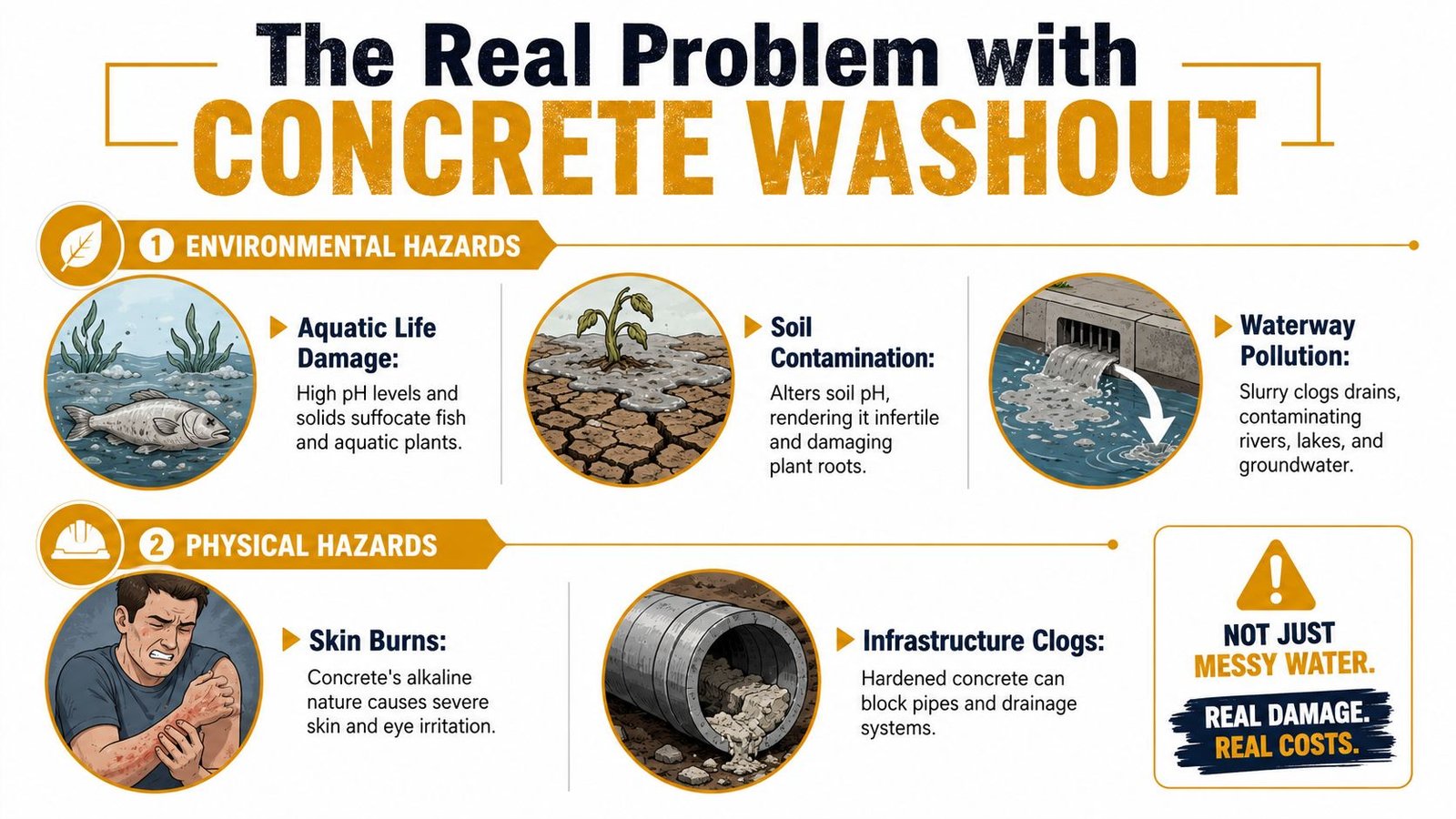
Concrete washout isn't just dirty water. It's a chemically active slurry that creates problems fast if you treat it like ordinary mud.
Concrete wash water is highly alkaline, commonly above pH 11, and even small volumes can damage vegetation, alter soil chemistry, and violate discharge rules if they reach drains or bare ground, as noted in this concrete washout overview. That matters on a small job because the hazard comes from the material itself, not from whether the pour looked minor on the schedule.
Right below is the simplest way to think about it.
What actually makes washout hazardous
The first problem is chemical. Fresh slurry can burn skin, irritate eyes, and kill grass or planted areas where crews dump it. If it hits bare soil, it doesn't just disappear. It changes the condition of that soil.
The second problem is physical. Slurry hardens. So when somebody washes out onto gravel, into a dirt corner, beside a curb, or near a drain inlet, they're not getting rid of waste. They're just moving it to a place where it will set up and become harder to remove.
Practical rule: If the material can burn plants, stain surfaces, and harden into a solid mass, treat it like controlled waste on site.
What goes wrong on real jobs
A lot of small-job mistakes come from improvising. Someone grabs a bucket. Someone uses a wheelbarrow. Someone says they'll “just rinse it out over there.” That works until the volume is more than expected, the water runs farther than expected, or the residue hardens where the owner can see it.
Typical failure points look like this:
- Storm drain exposure: Gray wash water follows grade and ends up where inspectors, owners, or neighbors can photograph it.
- Ground dumping: The top looks dry later, but the solids and high-pH residue stay in place.
- Finished surface staining: Decorative concrete, paving, and adjacent hardscape can get marked during cleanup.
- Tool and chute washout spread: A small amount from multiple tools adds up faster than crews think.
This is why the question “Do I really need a washout pan for small concrete jobs?” usually isn't about job size. It's about whether you can contain the washout completely and cleanly.
Why Rules and Regulators Care About Your Small Job
Inspectors don't care that it was only one truck. They care where the wash water went.
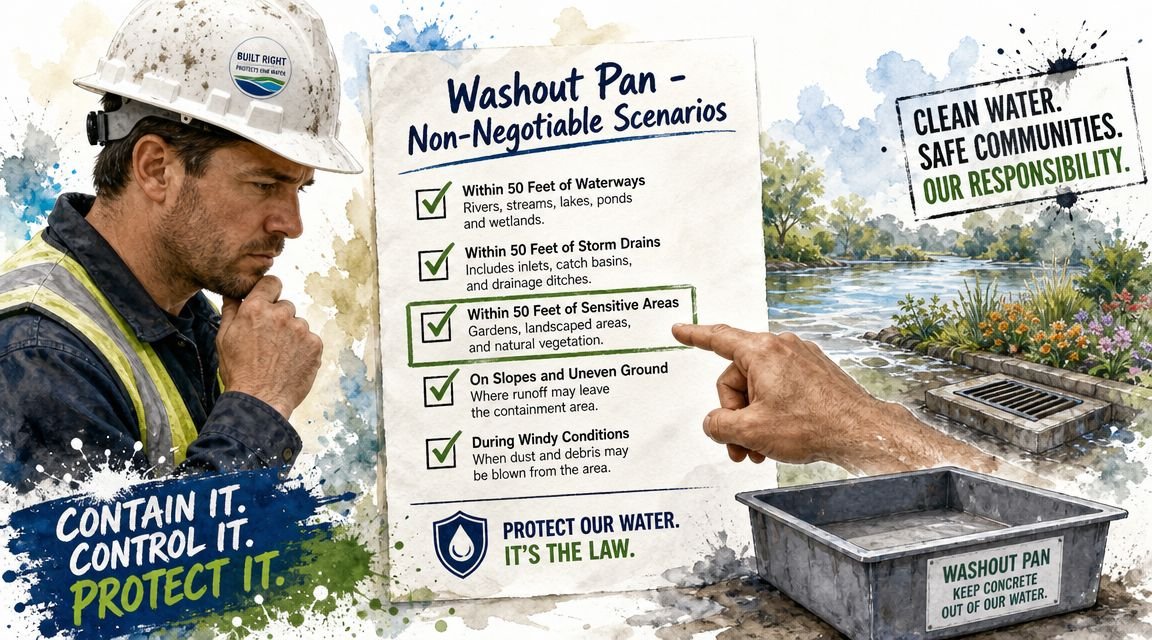
The U.S. EPA's stormwater BMP guidance says concrete washout should be collected in leak-proof containers, managed before they exceed 75% capacity, and located at least 50 feet from storm drains or waterbodies, according to the EPA's stormwater concrete washout guidance. That language matters because it doesn't create a practical “small job” exception. The standard is containment.
Compliance is binary on washout
You either kept wash water contained or you didn't. There isn't much middle ground once slurry hits soil, pavement runoff, a drain line, or a ditch.
That's why small jobs can be deceptive. Crews often assume the lower concrete volume means lower risk. In the field, the opposite can happen. Tight access, occupied properties, limited staging space, and rushed cleanup make short jobs more likely to rely on bad washout habits.
A simple checklist shows how regulators look at it:
| Site question | Why it matters |
|---|---|
| Is washout in a leak-proof container? | That's the basic containment standard. |
| Is the container placed away from drains and water? | Poor placement turns one spill into a discharge issue. |
| Is the container being monitored before overflow? | Overfilled containment is failed containment. |
| Can the crew point to the designated washout area immediately? | If nobody knows where to wash out, someone will improvise. |
If gray water leaves your work area and enters drainage, the story about how small the pour was won't help much.
What contractors miss
A lot of crews think enforcement starts on major civil work or large commercial sites. It doesn't have to. One visible runoff path, one complaint, or one site photo can create a headache that takes longer to fix than it would have taken to plan washout correctly.
That's the business side of compliance. You're not just avoiding a rule. You're avoiding stop-work conversations, cleanup arguments, and owner distrust.
Calculating the Hidden Costs of DIY Washout Methods
Most debates about washout pans focus on the rental fee. That's the wrong number to isolate.
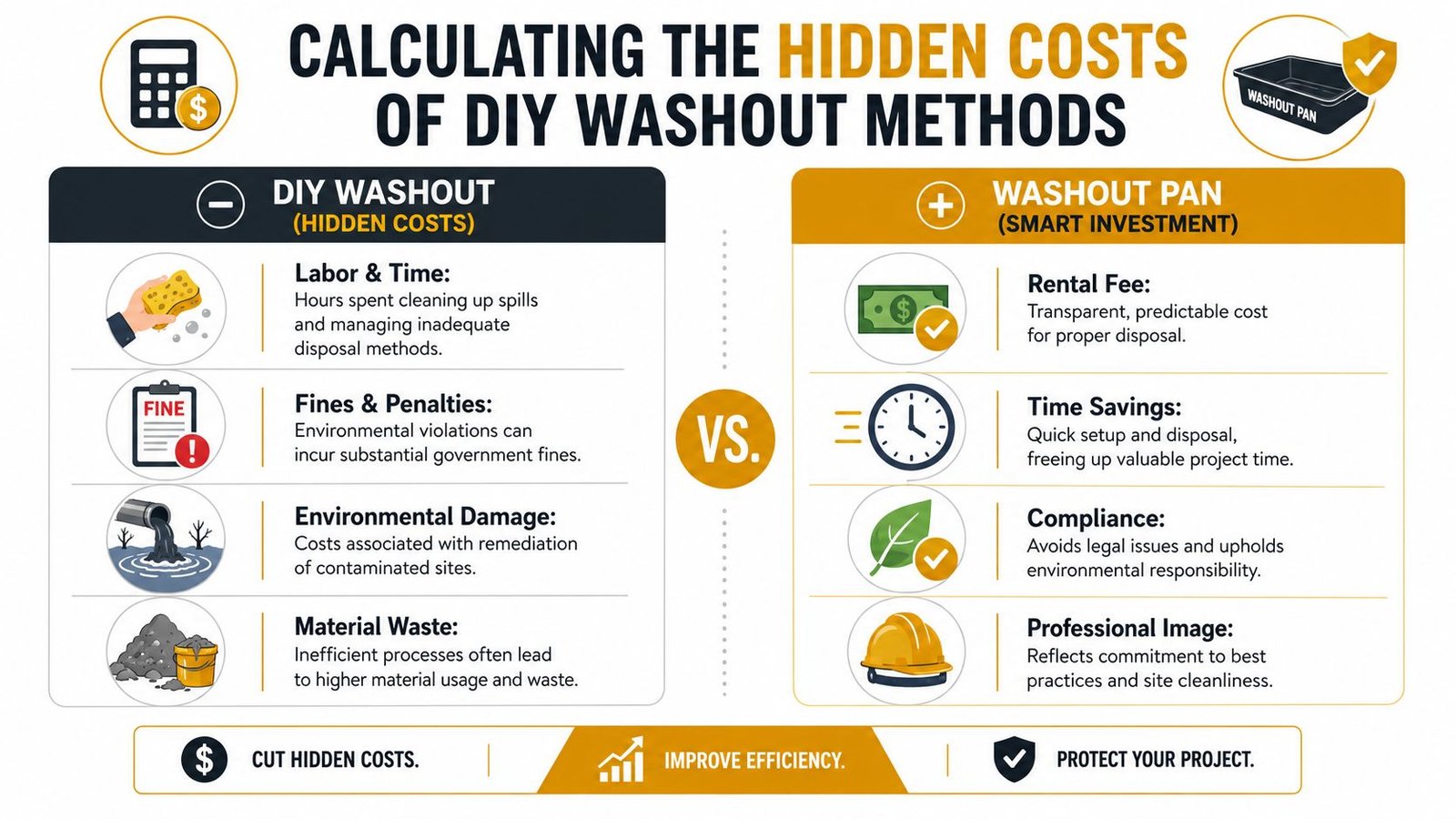
The break-even point often involves labor, cleanup time, and spill avoidance, not just the one-time cost of a washout pan. The hidden cost of not renting one is the downstream cleanup and compliance burden, which often outweighs the rental fee on small jobs, as explained in this small-pan washout cost discussion.
That's why DIY washout setups look cheap only before the pour starts.
Where DIY methods lose money
A wheelbarrow seems harmless until it's too small. A tarp-and-lumber setup seems workable until it tears, shifts, or pools in the wrong corner. A lined pit seems fine until access is poor or disposal becomes somebody else's problem.
The hidden costs usually show up in four places:
- Crew time: Someone has to build the setup, direct washout, babysit it, and break it down.
- Rework: If slurry escapes, somebody cleans pavement, shovels hardened residue, or replaces stained materials.
- Disposal hassle: Improvised containment still leaves you with hardened waste that has to go somewhere legally.
- Schedule drag: End-of-day cleanup on a “small” pour can keep equipment and labor tied up longer than planned.
A practical break-even test
Ask yourself these questions before the truck arrives:
- Who is handling washout from the chute, hopper, tools, and pump components?
- What container is guaranteed not to leak or overflow during active cleanup?
- How much labor are you assigning to monitor and clean the improvised setup?
- What happens if slurry gets onto finished pavement, landscaping, or into drainage?
If the answer to any of those is vague, the math is already moving toward a pan.
Cheap on paper isn't cheap if two workers spend the end of the day managing a problem that a purpose-built container would have prevented.
When a Washout Pan Becomes Non-Negotiable
Some jobs leave room for judgment. Others don't.
If you have a pump truck on site, the decision is basically made for you. The market evolved to include compact 7' x 7' x 14' pans specifically to fit under the hopper of a truck-mounted boom pump, showing that dedicated containment is standard practice even on constrained jobs, according to the CDOT approval sheet for Eco-Pan.
Situations where there's no good workaround
A washout pan is essential in jobs like these:
- Pump truck work: Hopper washout creates concentrated slurry fast. This is exactly why compact pans were developed.
- Sites near drainage paths: If runoff can reach a catch basin, swale, ditch, or low point, you need hard containment.
- Occupied properties: Retail, multifamily, healthcare, schools, and residential remodels don't give you much tolerance for visible mess.
- Finished surroundings: Decorative flatwork, asphalt, pavers, and curbed areas are poor places to gamble on improvised washout.
- Tight urban access: Small sites often have less room for error, not more.
The field test
Use this simple if-then logic.
If the crew has to wash out a pump hopper, use a pan. If the wash water can't be returned to the mixer or fully controlled at the source, use a pan. If the site has drains, visible public exposure, or owner-sensitive finishes nearby, use a pan.
That's not overkill. It's recognizing the jobs where one sloppy cleanup step can overshadow otherwise good work.
Choosing the Right Washout Solution for Your Job
The decision usually gets made in the last ten minutes of the pour, when the truck is ready to wash out and the crew wants to go home. That is when bad choices get expensive.
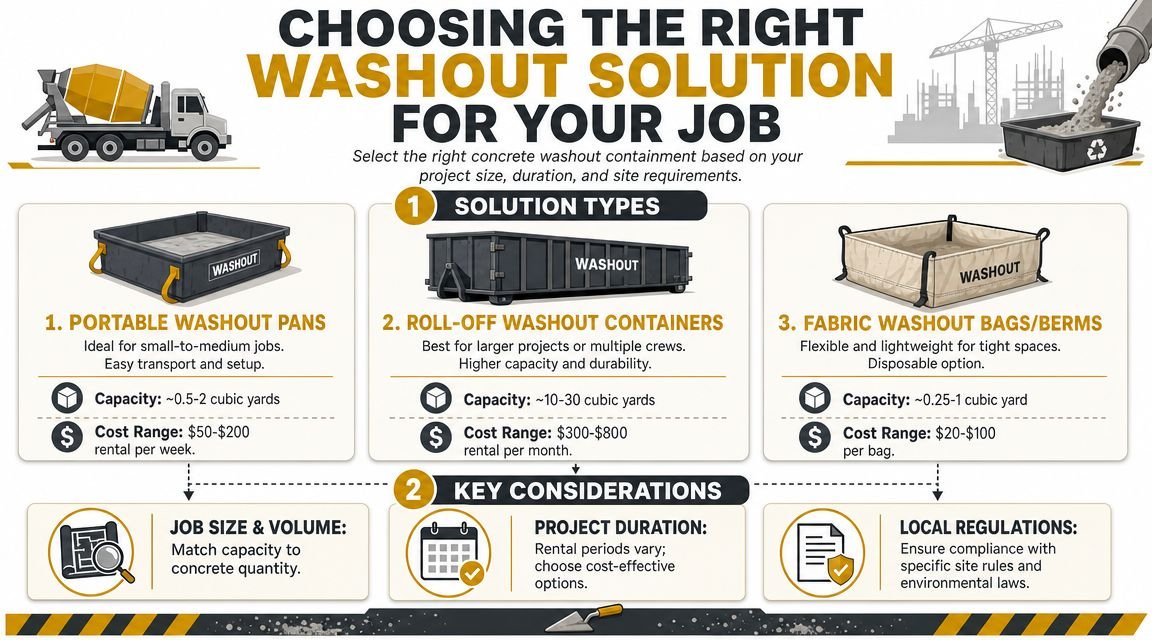
A washout setup should match the way the job will end, not just the size of the pour. A small pan can handle routine chute cleanup on a short job, and Eco-Pan's small washout pan specifications show the capacity is built for repeated field washouts, not just a token amount of slurry. The practical question is simpler than the spec sheet. Will this container hold all the rinse water and paste your crew will generate without overflow, splatter, or a second cleanup step?
Match the container to the operation
Total yardage only tells part of the story. Washout volume spikes based on equipment, access, and how many people need to use the same containment point.
Use this logic on site:
- Short pour with chute cleanup only: A compact pan usually covers the work if the crew can wash directly into it without dragging slurry across the site.
- Pump truck on a tight site: Set a pan where the hopper can be washed out cleanly in one move.
- Multiple crews or a longer workday: Use larger or additional containment so the last crew is not left hunting for a place to dump rinse water.
- Remote access or strict site logistics: Use a service that handles placement, pickup, and disposal so your labor is not tied up dealing with waste at the end of the job.
The break-even point comes down to labor and exposure. If your crew spends even half an hour building a makeshift washout area, protecting surrounding surfaces, and then shoveling out hardened residue later, you have already started burning more money than a simple rental often costs. Add one callback for stained asphalt, tracked slurry, or a property manager complaint, and the math gets worse fast.
What a rental service changes
A rental does not remove your responsibility. It removes a lot of the avoidable mess.
Reborn Rentals offers washout containment rentals with delivery and pickup, which matters on small jobs where the crew is already packed with forms, tools, and finish work. That kind of setup reduces the chances that someone improvises with a wheelbarrow, a plastic-lined pit, or a corner of the lot that looked harmless at the time.
A quick field guide:
| Job condition | Better fit |
|---|---|
| Tight access, one-day concrete work | Compact washout pan |
| Pump hopper washout required | Pan placed for direct controlled capture |
| Several washout points over longer duration | Larger or additional containment |
| Crew cannot spend time handling disposal | Rental with delivery and pickup |
A good washout plan lowers cleanup labor, limits site damage, and gives the crew one clear place to go. If the setup still leaves room for guesswork, it is undersized, poorly placed, or the wrong solution for the job.
A Professional Finish Includes Professional Cleanup
Good contractors don't separate the pour from the cleanup. It's one operation.
That's why the answer to “Do I really need a washout pan for small concrete jobs?” often comes down to professionalism as much as compliance. If the job creates slurry you can't fully control by hand, then proper containment is part of the work, just like formwork, curing, or protection of adjacent surfaces.
Clients notice the cleanup. Owners remember whether you left a clean site. Inspectors notice whether your crew had a plan. Your own people work better when they aren't inventing disposal methods at the end of a long day.
The shortcut mindset usually costs more. It costs time, labor, credibility, and sometimes a lot of awkward cleanup after the concrete work itself went fine.
A washout pan isn't just a box for gray water. It's a way to finish the job without creating a second problem.
If you need washout containment for an upcoming pour, Reborn Rentals gives you a straightforward way to schedule equipment, set delivery details, and line up a practical cleanup plan before the truck arrives. That's the easier path on small jobs where time is tight and there's no room for sloppy washout.