Environmental Monitoring Systems: Site Compliance in 2026
A storm cell moves in faster than the forecast said it would. Your crews are still wrapping up a pour, the washout area is active, and runoff starts finding every low spot on the site. At that moment, compliance stops being paperwork and becomes a field problem. You either know what's moving, where it's moving, and whether your controls are holding, or you're guessing.
That's where environmental monitoring systems earn their place on a construction project. On a busy site, they're not fancy add-ons. They're tools for seeing trouble early enough to do something useful about it, especially when concrete washout, sediment-laden runoff, and stormwater discharge all intersect in the same few acres.
Keeping Your Construction Site Compliant and Clean
A lot of site managers still think of monitoring as something regulators want after the fact. That mindset gets people in trouble. By the time an inspector asks questions about cloudy discharge, track-out, or concrete slurry near an inlet, the important work should already be done. The best time to catch a problem is when it's still a small one, not when it's leaving the property.

An environmental monitoring system gives you that early visibility. On construction sites, that usually means tracking site conditions tied to runoff risk, discharge conditions, and known hot spots like washout stations, perimeter controls, dewatering points, stockpiles, and storm drain protection. Instead of relying on one superintendent's memory and a clipboard inspection after the rain starts, you build a system that watches those conditions continuously or at planned intervals.
The business case is no longer theoretical. The U.S. environmental monitoring market was estimated at USD 4,149.8 million in 2024 and is projected to reach USD 6,102.6 million by 2033, according to Grand View Research's U.S. environmental monitoring market report. That doesn't tell you which sensor to buy, but it does tell you this category has moved into mainstream compliance operations.
What site managers actually need from a system
Most projects don't need a lab-grade science program. They need a system that answers practical questions fast:
- Is runoff moving toward a discharge point? If yes, your team needs to inspect controls before water leaves the site.
- Is washout water staying contained? If no, crews need to stop adding slurry and correct the containment issue.
- Did weather conditions change enough to trigger action? If yes, the SWPPP inspection cadence and field response need to tighten up.
- Can you document what happened? If no, even a well-managed site can struggle during a compliance review.
Practical rule: If a monitoring point doesn't drive a field decision, it's probably in the wrong place or measuring the wrong thing.
Why reactive cleanup doesn't work
Reactive cleanup costs more in labor, schedule disruption, and risk. It also tends to be sloppy. Crews rush. Temporary fixes pile on top of each other. Documentation gets reconstructed later, and that's never as defensible as data captured when the event occurred. On concrete-heavy sites, washout management is where that gap shows up fast. High-pH water doesn't need much time or distance to become a problem once containment fails.
What Are Environmental Monitoring Systems
A site gets into trouble when field conditions change faster than the team can see them. A storm cell moves in during a concrete pour. Water starts collecting near the washout pan. An inlet downstream is already taking runoff. If nobody catches that shift early, a containment issue turns into a discharge issue.
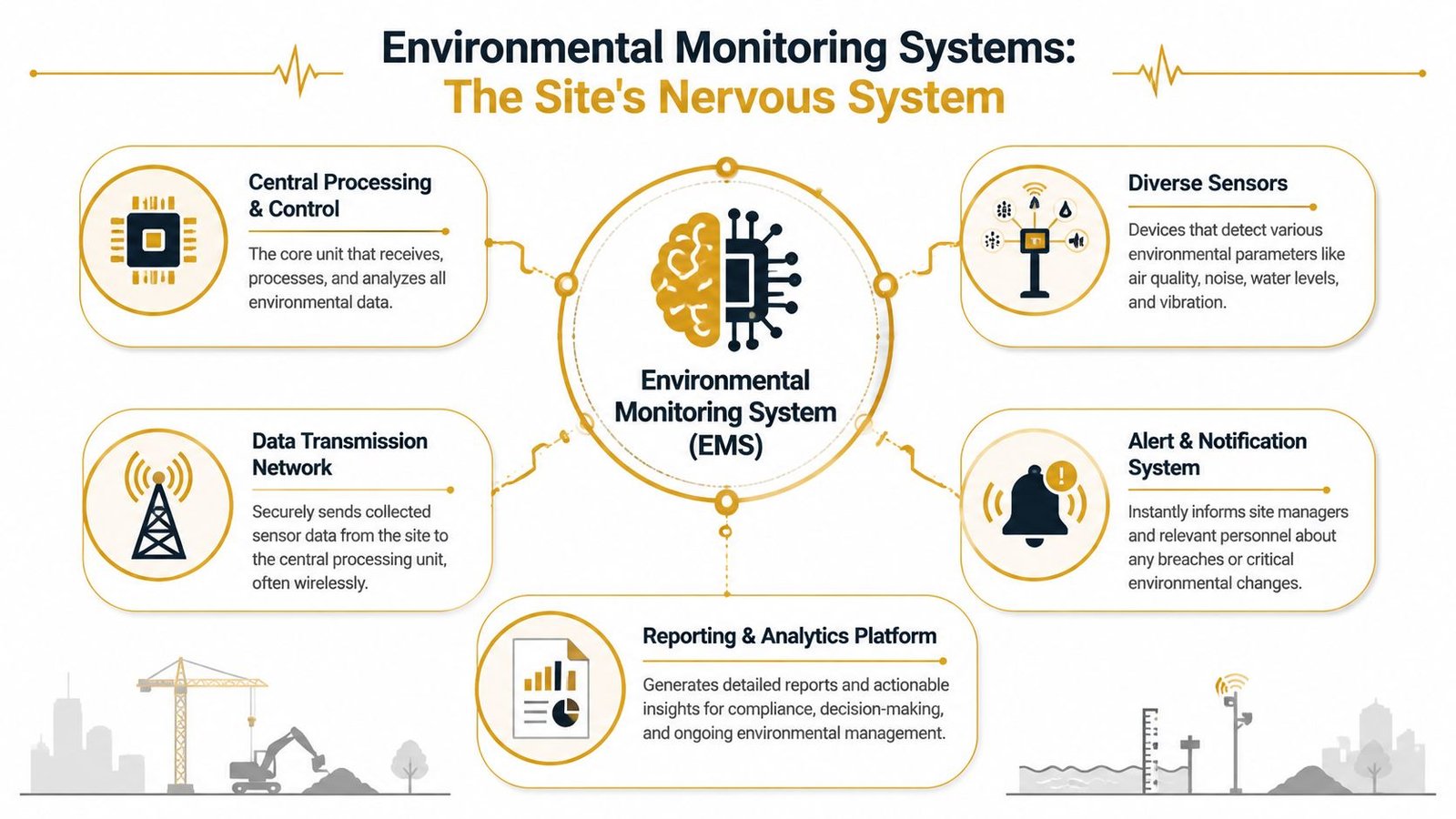
An environmental monitoring system is the setup that tracks those changing conditions and gets the information to the people who need to act. On a construction site, that usually means sensors in the field, a method for collecting and sending readings, and a dashboard or alert system that ties those readings to a response. The point is not to gather data for its own sake. The point is to catch problems early enough to protect the site, the stormwater controls, and the inspection record.
That matters most in high-risk areas such as concrete washout management. A washout pan does its job only if crews use it correctly, the pan has enough capacity, and runoff cannot carry alkaline water out of the containment area. Monitoring closes that gap. It shows whether conditions around the washout area are staying controlled or drifting toward a compliance problem.
The three parts that matter on a construction site
The first part is the field layer. Here, sensors are placed near washout areas, drainage paths, low spots, perimeter controls, inlets, and discharge points. Placement matters more than sensor count. One sensor in a convenient location can miss the part of the site that creates the violation.
The second part is the communication layer. Some sites use local loggers that crews check during inspections. Others send readings by cellular or wireless connection so the superintendent, project engineer, or SWPPP lead sees changes the same day. The right choice depends on site size, power access, signal reliability, and how quickly the team needs to respond after rain or a release.
The third part is the management layer. That is where readings become alerts, trends, inspection support, and documentation. If pH near a washout area starts climbing after a crew cleans out pumps and chutes, the system should help the team trace the location, timing, and likely cause so they can fix the containment issue, not just acknowledge an alarm.
What works and what fails
A system works when every monitoring point is tied to a field decision. If water level rises near a washout pan, someone checks capacity and containment. If pH shifts near a drainage path, someone inspects for slurry migration. If rainfall crosses the threshold your permit or SWPPP cares about, someone knows the inspection and response clock has started.
I have also seen the opposite. Sensors get installed because they looked good in a submittal package, then nobody sets practical alarm thresholds, assigns response responsibility, or keeps the equipment calibrated. The result is predictable. Crews stop trusting the alerts, and the system becomes another screen in the trailer instead of a compliance tool.
Good environmental monitoring systems support inspections with better timing and better direction. On concrete-heavy projects, they also connect the dots between generic environmental monitoring and actual site risk. Washout water, runoff movement, and weather exposure. If those three are not tied together, the site is still guessing.
Key Sensors for Water and Weather on Site
For construction compliance, the useful sensor mix is narrower than many vendors suggest. You don't need to monitor everything. You need to monitor the things that can turn into a discharge violation, washout release, or missed response. On concrete jobs, water and weather are where most of the risk lives.
The sensor types that matter most
A pH sensor helps you identify alkaline water conditions that can show up around concrete washout activity. Fresh concrete slurry and washout water can push pH in the wrong direction fast. If you're using pH monitoring near a washout area, the point isn't abstract water quality theory. The point is to catch loss of containment before that water migrates toward perimeter controls or a storm drain.
A turbidity sensor tracks how cloudy the water is. On a construction site, that can help flag sediment movement, disturbed soil runoff, or mixed waste streams leaving an area that should be contained. It won't tell you everything by itself, but it gives a practical signal that water quality has changed.
A TSS-related monitoring approach is often part of the same conversation because suspended solids are a common compliance concern. On many projects, field teams use turbidity as an early operational signal and pair it with whatever sampling and documentation the permit or SWPPP requires. The key is to know what your permit language expects before you rely on one reading type.
A flow meter matters when discharge volume changes your risk picture. If water starts moving off-site from a low point, dewatering outlet, or temporary conveyance path, flow data helps you understand whether you're looking at a nuisance drip, a sustained release, or a condition that needs immediate shutdown and correction.
A site weather station is one of the most underrated tools on a project. Rainfall, wind, temperature, and humidity don't just affect scheduling. They affect erosion control performance, cure conditions, stockpile management, and the likelihood that washout water or slurry will migrate during a storm event.
Why multi-point sensing beats one “good” sensor
Industry guidance on environmental monitoring stresses that robust monitoring should include multiple parameters, not just one, and that multi-point sensing is critical for catching localized issues before they escalate, as described in TierPoint's guidance on environmental monitoring parameters and sensor placement. Their examples come from facilities work, but the principle applies directly to construction. One average reading for the whole site can hide a localized failure near a washout pan, a low corner, or an inlet at the bottom of a slope.
That's why I tell contractors to stop thinking in terms of “the site condition” and start thinking in terms of risk zones.
Construction Site Sensor Comparison
| Sensor Type | What It Measures | Why It Matters for Concrete Washout |
|---|---|---|
| pH sensor | Acidity or alkalinity in water | Helps identify alkaline washout water escaping containment or mixing with stormwater |
| Turbidity sensor | Water cloudiness | Flags sediment or slurry-laden runoff moving away from the washout area |
| TSS-related monitoring | Suspended solids in water | Supports evaluation of solids leaving disturbed areas or washout-adjacent runoff paths |
| Flow meter | Water movement or discharge volume | Shows whether a release is minor, ongoing, or moving off-site fast enough to require immediate response |
| Rain gauge or weather station | Rainfall and changing site weather | Ties runoff conditions to storm events and helps crews act before containment is overwhelmed |
| Water level sensor | Depth or accumulation in low areas | Helps identify ponding around washout containment, berm breaches, or drainage backup |
Placement mistakes that waste money
The biggest mistake is placing sensors where access is easy instead of where failure is likely. A pH sensor set far from the washout area may confirm that water is already diluted downstream. That's useful too late. The better approach is to monitor close enough to the source to catch change early, while also watching the pathway where water could exit the site.
Another mistake is treating weather data as separate from washout management. It isn't. If the rain gauge shows a rising event, your concrete washout area should move up the inspection list immediately.
Choosing Your System Architecture
A storm hits at 4:30 p.m., the concrete crew is wrapping up, and nobody notices washout water creeping past a berm until it shows up near the inlet. That is usually not a sensor problem. It is an architecture problem. The system was not set up to catch the release early, route the alert to the right person, and support a fast response.
The right setup depends on how your site operates. A highway job with multiple discharge paths, changing access, and several washout areas needs a different approach than a compact commercial build with one washout pan, one storm drain risk point, and tight daily supervision.
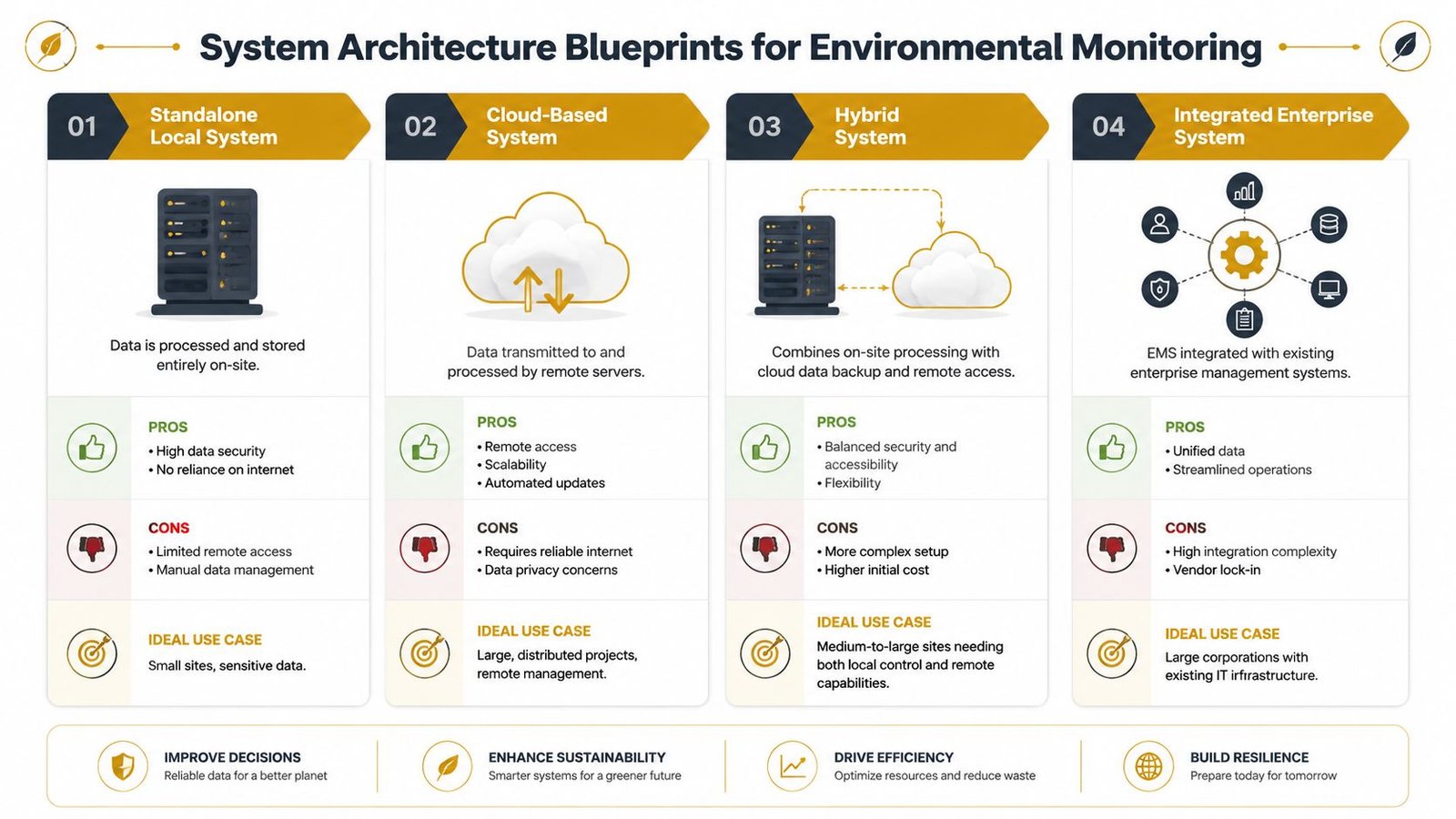
Four common approaches in the field
Fixed stations fit sites with stable drainage patterns and long durations. If your concrete washout area, perimeter controls, and discharge watch points will stay in place for months, fixed stations usually produce cleaner trend records and fewer relocation mistakes. They also make sense when the washout area is built around permanent or semi-permanent containment that crews will use through multiple pours.
Portable units fit phased work. They are useful when the washout pan moves with the work, when haul roads change runoff direction, or when one risk area is temporary but serious. The trade-off is field discipline. If the sensor gets moved without updating the map, or if it ends up on the wrong side of a berm after regrading, the reading may be accurate and still useless.
Wireless networks are often the best fit for active construction. They allow coverage at the washout area, along runoff pathways, and near site exits without sending someone to each point every hour. That matters on days when a superintendent is juggling deliveries, inspections, pump trucks, and weather.
Manual sampling still belongs in the program, especially for permit records, confirmation checks, and follow-up after an alert. It is a weak primary system for fast storm events. By the time someone gets to the low point with a meter or sample bottle, the release may already be off site.
What the architecture needs to do on a construction site
On paper, any monitoring setup can look adequate. In the field, it has to answer three questions fast. Where is the problem starting. Who needs to know. What action does the crew take next.
For concrete washout management, that usually means linking source-area monitoring to response steps. If pH rises near the washout pan, the crew checks the pan, surrounding berms, and any signs of overtopping or track-out. If turbidity jumps along the downstream flow path after rain, the inspection shifts to runoff controls between the washout area and the property line. A dashboard is helpful, but the primary benefit is a clear chain from alert to field correction to documentation.
That is the gap many contractors miss. They buy monitoring as a reporting tool, when they really need it as an early-warning system tied to equipment placement, washout containment, and inspection responsibilities.
How to choose without overbuilding
Ask these four questions before you spend money.
- How quickly do you need to act? If the goal is to stop washout water before it reaches an inlet or boundary, real-time or near-real-time alerts matter.
- How often will the risk point move? If the washout area shifts every phase, portability may matter more than a hard-mounted setup.
- Who reviews alerts every day? Assign that job to a named role, not a general team inbox or a vague handoff.
- What happens when connectivity drops? If signal is unreliable, choose units that store data locally and sync later instead of depending on constant cloud access.
One more practical point. Match the architecture to the consequence of missing an event. If a missed reading only delays a routine inspection, a simpler setup may be fine. If a missed reading means alkaline washout water can leave the site during a storm, spend the money on better alerting, backup logging, and clear ownership.
Buy the system for the worst rain day and the busiest concrete day on the project. That is when weak architecture shows up.
Navigating Compliance and Regulatory Drivers
Contractors don't need more acronyms. They need a simple answer to one question. Why does this matter enough to spend money and field time on it?
It matters because environmental compliance is judged by what leaves the site, what reaches state waters or storm infrastructure, and what your records can prove about your controls. If your SWPPP says concrete washout will be contained, inspectors expect to see functioning containment, proper housekeeping, and evidence that your team is managing the risk. If runoff leaves the property carrying sediment or washout residue, “we were going to fix it” won't help much.
Monitoring is part of defensible compliance
For more than 30 years, long-term environmental monitoring programs have served as a core EPA tool for evaluating whether emissions-reduction and water quality programs are working, according to the EPA overview of environmental monitoring programs. That long history matters for construction because it reinforces a basic regulatory reality. Agencies trust data-backed oversight more than assumptions, memory, or after-the-fact explanations.
On a site level, that means your monitoring records can support the same kind of defensible logic. If your team receives an alert, inspects the washout area, documents corrective action, and confirms conditions afterward, you've built a clean chain of evidence. If you have no data and no timestamped response trail, you're left with opinions.
What inspectors and owners care about
They care about three things:
- Was the risk foreseeable? On concrete jobs, washout management is a known risk. You don't get to act surprised.
- Did the team respond in time? A good monitoring setup shortens the gap between condition change and field action.
- Can the project document control? Logs, alerts, photos, and inspection notes matter when disputes start.
A lot of firms still treat monitoring as a burden imposed from outside. That's backwards. On real jobs, it's a risk-control tool that protects schedule, owner relationships, and your ability to keep work moving.
If your washout area is one storm away from becoming a reportable mess, that's not a washout problem alone. That's a site management problem.
A Step-by-Step Site Implementation Guide
The best systems are built from the ground up around actual site risk. If you start with gadgets, you'll overspend and still miss the problem areas. Start with water movement, work activities, and compliance triggers instead.
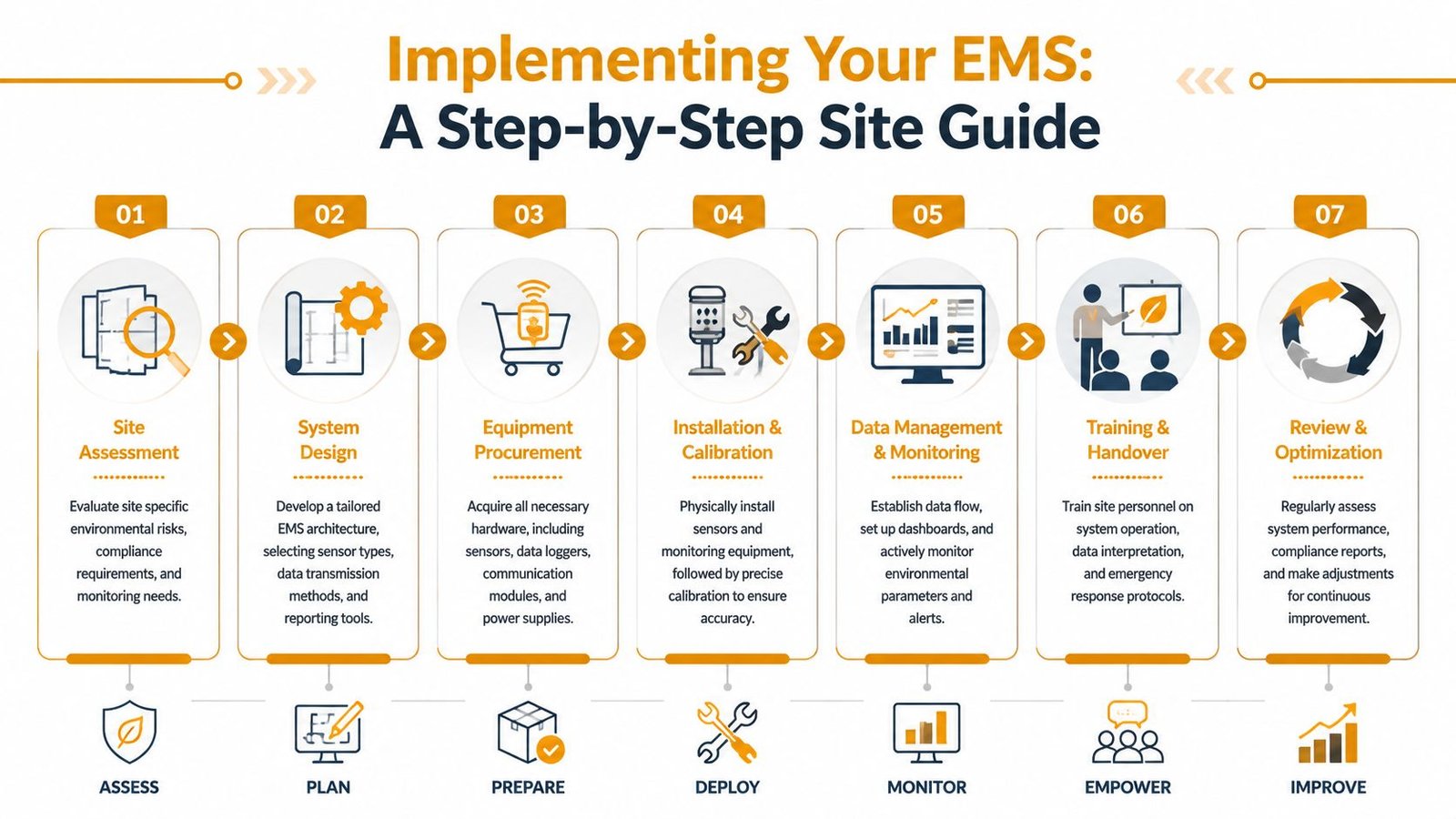
Step 1 through Step 3
Step 1 is mapping risk on the ground. Walk the site after asking one simple question. If a storm hits during active concrete work, where does water go first? Mark the washout location, the downslope paths, low areas, inlets, discharge points, dewatering zones, and any spot where slurry or sediment could escape containment.
Step 2 is matching the monitoring approach to the project. Some sites need fixed points. Others need portable devices that shift with the work. Research summarized by EBSCO on environmental monitoring highlights a growing shift toward low-cost, community-based, wearable, and smartphone-enabled monitoring, while also warning that distributed sensing creates new QA/QC, maintenance, and interpretation challenges. That's relevant on construction sites too. Cheap and easy only helps if the readings are reliable enough to support decisions.
Step 3 is choosing action-oriented sensor locations. Put sensors where a reading changes your next move. Near the washout area, that may mean monitoring the containment zone and the most likely runoff pathway away from it. Near discharge points, it may mean pairing water-quality indicators with rainfall or water-level tracking.
Step 4 through Step 5
Step 4 is installation and calibration. Don't let this become a vendor-only task. The superintendent, SWPPP lead, or designated competent person should know where every sensor sits, what it measures, and what a bad reading looks like. If the team on site doesn't trust the equipment, they'll ignore it.
Step 5 is writing response triggers into daily operations. Most systems fail at this stage. An alert without a required action is just noise.
Use direct trigger-response rules such as:
- High pH near washout containment: Inspect the washout pan or container immediately. Check for overtopping, cracks, overflow, hose wash-off outside containment, and migration toward drains.
- Rising water level near a low point: Verify berms, wattles, inlet protection, and drainage paths before discharge starts.
- Rain event alert during concrete operations: Pause any non-contained washout activity and inspect the area before crews leave.
- Turbidity change near perimeter discharge: Check upstream disturbed areas and look for sediment-laden flow bypassing controls.
The best alert is the one that tells a foreman exactly where to walk and what to inspect within the next few minutes.
Step 6 through Step 7
Step 6 is assigning ownership. One person should review alerts each day, but field response can't depend on one person being available. Build a small chain of responsibility that covers nights, weekends, and weather events.
Step 7 is reviewing the data after the first few events. If a sensor never changes, it may be in the wrong place. If it alarms constantly without useful findings, adjust the threshold, the placement, or the workflow. Environmental monitoring systems improve when they're tuned to how the site behaves, not how the brochure says they should behave.
Managing Data Maintenance and ROI
Environmental monitoring systems aren't install-and-forget tools. Sensors drift. Batteries die. Mud covers probes. Crews bump equipment with loaders and pickups. If you want defensible data, maintenance has to be part of the compliance plan, not an afterthought.
Keep the data usable
Use a short maintenance routine:
- Check calibration status on the schedule recommended for the device and the conditions on your site.
- Inspect physical placement after storms, grading changes, and major concrete operations.
- Review alerts in batches so the team can spot recurring issues instead of reacting to each reading in isolation.
- Tie records together by linking sensor data with inspections, photos, and corrective actions.
The return on investment is usually straightforward even without forcing a hard dollar calculation into every project. If the system helps you catch one washout release before it leaves the site, or helps document a timely response when conditions turn, it has already done work that cleanup crews, schedule recovery, and compliance disputes would cost far more to handle later. The value isn't just in collecting data. It's in turning that data into quicker field decisions and cleaner documentation.
If your project needs dependable concrete washout containment to support the monitoring and compliance practices above, Reborn Rentals is built for that job. Their rental lineup focuses on washout pans and containers for active construction and renovation sites, with straightforward booking, clear pricing, and delivery coordination that helps crews keep slurry contained and sites organized.