Environmental Regulations for Construction Sites: A Guide
You're trying to keep the crew moving, the concrete truck on schedule, and the owner off your back. Then someone asks where the washout area is, whether the storm drain is protected, or where the inspection log went. That's usually the moment environmental compliance stops feeling like paperwork and starts feeling like a jobsite problem.
Such is the breadth of environmental regulations for construction sites. They don't just apply to giant civil jobs with a trailer full of binders. They hit small commercial renovations, tenant improvements, utility patches, and any site where mud, slurry, chemicals, debris, or wastewater can leave the work area. If you're disturbing soil, handling concrete, storing solvents, or generating waste, you're already in the compliance game whether you planned for it or not.
The good news is that most environmental issues on a site are manageable when you treat them like production risks. Set the controls early. Keep the site clean. Give crews clear instructions. Write down what you did. That's what keeps work moving and keeps a minor issue from turning into a stop-work headache.
Why Environmental Compliance Is Non-Negotiable
An inspector doesn't care that your pour started before daylight or that a sub moved the washout pan without telling anyone. They walk the site, look for runoff paths, open containers, stained soil, unprotected drains, scattered debris, and missing records. If your controls are weak, your explanation won't carry much weight.
That's why environmental compliance has to be treated like safety. You don't wait for someone to fall before tying off. You don't wait for muddy runoff to hit the gutter before deciding where the inlet protection goes. On a working site, prevention is cheaper than cleanup and a lot less disruptive than arguing after the fact.
What usually gets crews in trouble
Most problems come from a short list of misses:
- Stormwater runoff issues that let sediment, trash, or slurry leave the site
- Concrete washout mistakes where crews dump rinse water wherever it's convenient
- Waste handling failures such as mixed debris, leaking containers, or unlabeled hazardous materials
- Weak documentation where the site may have done the work, but nobody can prove it
Practical rule: If material can leave your site by water, wheels, wind, or a hauler, control it before work starts.
Compliance protects more than the environment
It protects your schedule. It protects your relationship with the owner and municipality. It protects the superintendent who has to answer for the site condition when someone shows up unannounced.
It also separates organized contractors from everybody else. A clean washout setup, maintained perimeter controls, and current logs tell inspectors and clients the same thing. Your site is being managed, not just worked on.
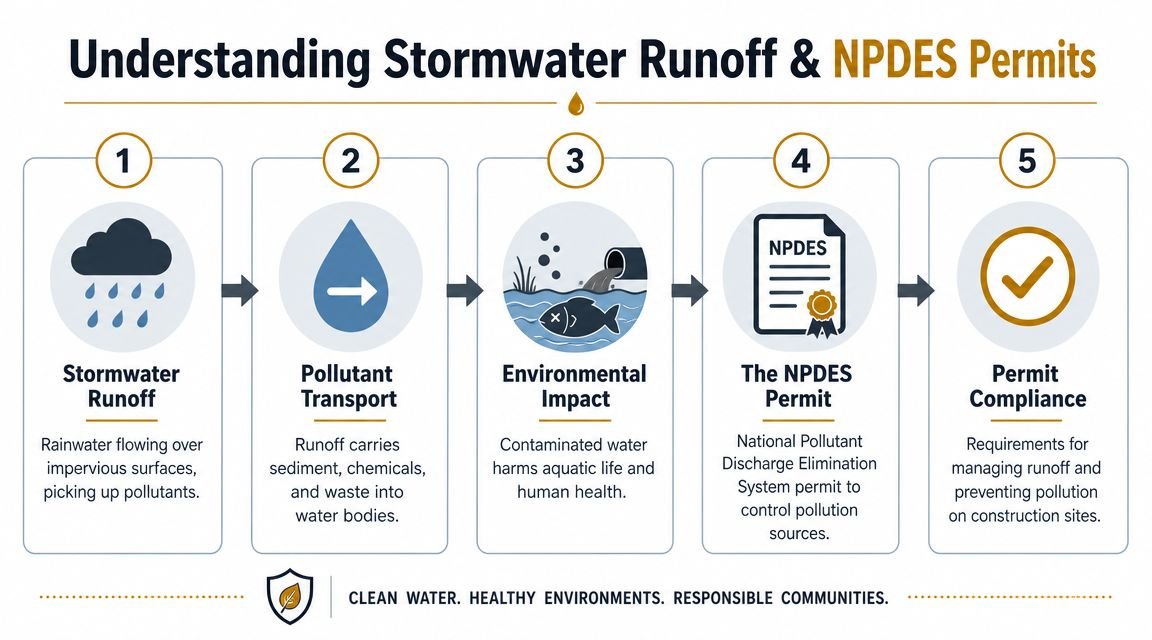
Understanding Stormwater Runoff and NPDES Permits
You can have a small site, a short schedule, and a crew that keeps things fairly clean, then one hard rain sends mud and slurry to the curb inlet. That is often the moment a routine job turns into an enforcement problem. Stormwater moves fast, and once it leaves your site carrying sediment, concrete residue, trash, or chemicals, you may have to answer for where it went and what you did to stop it.
Regulators focus on runoff because disturbed ground sheds material easily. Bare soil, stockpiles, saw-cut slurry, and loose debris do not stay put once water starts moving across the site. On a tight lot or street job, the travel path can be short. A few feet of slope is enough to carry a problem from your work area to a drain.
The one-acre trigger that matters
For many U.S. construction projects, disturbing 1 acre or more triggers NPDES permit coverage under the Clean Water Act. That usually means filing permit paperwork, keeping a project-specific SWPPP on hand, and closing out coverage properly when the job is done.
That threshold changes the level of formal compliance, but it does not change the basic job in the field. Water still has to be controlled. If an inspector asks what your runoff controls are, where they are installed, and who checked them after the last storm, you need a clear answer and records to back it up.
On smaller crews, contractors often feel the pressure. The work may fall below the formal permit threshold, but the expectation to prevent discharge is still there, especially on urban infill, sidewalk, utility, and renovation jobs where runoff reaches a storm drain almost immediately.
What runoff control looks like in the field
Permit compliance needs to show up in daily site setup and crew habits. The basics are familiar, but they only work if they match the actual drainage pattern on your site:
- Perimeter controls such as silt fence or fiber rolls at the edges where water leaves disturbed ground
- Stabilized entrances to cut down on tracking mud onto public roads
- Inlet protection at nearby drains that could receive sediment, wash water, or debris
- Covered or contained materials so powders, waste, and liquids are not exposed to rain
- Concrete and slurry controls in areas where saw cutting, washout, or cleanup happens
The trade-off is real. Every control takes time to install, maintain, and move as the job changes. But cleanup after a discharge costs more, and lost time during an inspection costs even more.
A storm drain is a direct path off your site. Treat it that way.
Smaller sites still have exposure
A lot of smaller contractors assume the one-acre threshold means the job is too small to draw attention. That assumption causes trouble. Inspectors do not need a large subdivision to find violations. They can find them on a storefront remodel, a short trench run, or a parking lot repair if runoff leaves the work area or if the site cannot show what controls were in place.
Documentation matters more now than it used to. On a smaller job, you may not have a full permit file, but you still want dated inspection notes, delivery tickets for control materials, photos after rain, and records showing when a failed control was fixed. If your site did the right thing but nobody wrote it down, you have less protection when questions come up.
That is the practical point. Control the water, know where it goes, and keep proof that your crew stayed ahead of it.
Developing Your Stormwater Pollution Prevention Plan
A SWPPP works best when you treat it like a site playbook, not a binder you print once and forget in the trailer. If it doesn't match the way your crews move through the site, it won't help you in the field and it won't help you during an inspection.
Good plans are specific. They show where runoff goes, where materials are stored, where concrete work happens, how washout is contained, who inspects controls, and what gets corrected when something fails.
What belongs in a workable SWPPP
A useful plan usually includes these core pieces:
- A site map showing disturbed areas, drainage paths, inlets, stockpiles, entrances, and control locations
- Pollutant sources such as exposed soil, concrete washout, fuels, paints, dumpsters, and portable toilets
- Best management practices describing what controls are installed and where
- Inspection and maintenance procedures so failed controls don't sit for days
- Record logs that show what was checked, what was fixed, and when
If your SWPPP says there's a washout area on the south side, but crews are rinsing chutes on the north curb, the document is already losing value.
The plans that work versus the plans that don't
The plans that hold up are written around real operations. They account for delivery routes, changing access, phased excavation, and where subs stage materials. They also get updated when the site changes.
The plans that fail usually have one of three problems:
| SWPPP problem | What it looks like on site | Why it causes trouble |
|---|---|---|
| Too generic | Boilerplate language with no job-specific controls | Crews can't use it and inspectors can see that |
| Out of date | Old maps, missing phases, controls shown in the wrong place | The record doesn't match the work |
| No ownership | Nobody knows who updates logs or fixes deficiencies | Problems stay open until someone else notices |
Keep it where the work is happening
A SWPPP only helps if the people running the work know what's in it. The superintendent needs it. The foreman needs the site controls explained clearly. The concrete crew needs to know the approved washout location before the truck shows up, not after.
Field check: If a new foreman can't walk the site and point out runoff controls, washout, and waste areas in a few minutes, your plan isn't operational yet.
On active sites, the best SWPPP is the one tied to daily decisions. Where does runoff leave? What changed this week? What needs repair before the next storm? That's how it becomes a management tool instead of shelf paper.
Practical Controls for Sediment Concrete and Waste
A small crew finishes a pour at 3:30, the truck driver asks where to wash out, and nobody has a clear answer. That is how a routine day turns into a runoff problem, a neighbor complaint, or an inspection headache. On smaller jobs, this scenario often catches contractors. The site feels too small for formal controls, but the discharge still happens and you still need to show how you contained it.

Sediment control needs maintenance, not just installation
Sediment controls fail in ordinary ways. A fence gets knocked down by deliveries. Stone at the stabilized entrance gets buried in mud. A stockpile cover comes off in the wind and nobody resets it before rain. By the time water starts moving, the site has already lost control.
Focus on the places that send sediment off your site:
- Outfalls, curb cuts, and low points where runoff leaves the work area
- Site entrances and traffic routes where trucks track mud onto pavement
- Stockpiles and bare soil that sit exposed between work phases
- Downslope edges of disturbed areas where grading changes redirect flow
The trade-off is simple. Controls that are easy for crews to work around usually get maintained. Controls dropped into the plan without considering access often get moved, damaged, or ignored. Set them where they can work and where your crew can still build the job.
A five-minute walk after grading, utility work, or material delivery catches a lot of problems early.
Concrete washout is a direct compliance issue
Treat concrete washout as a planned pollution control task. Slurry, chute rinse water, saw-cut slurry, and pump wash water can all leave a clear violation if they reach pavement drains, soil, or adjoining property. Permit threshold or not, inspectors care about the discharge path in front of them.
This matters even more on jobs under one acre. Smaller sites often have less room, tighter access, and more pressure to improvise. That is exactly why the washout location needs to be decided before the truck arrives and marked so every driver and finisher can find it fast.
What works in the field:
- One approved washout area close enough that crews will use it
- Physical containment sized for the day's pour volume
- Clear instructions at the pre-pour talk so nobody guesses
- Separation from drains, gutters, and low spots that can overflow during cleanup
- A pickup plan before the container is full
What creates problems:
- Letting crews wash into a dirt corner
- Rinsing tools on pavement
- Placing the washout so far away that drivers skip it
- Waiting until the end of the pour to decide where washout goes
One practical option is Reborn Rentals, which rents concrete washout pans and containers for construction and renovation jobs. Dedicated containment helps you assign one approved location and document that the control was in place, which matters if someone asks later how your site managed wash water.
Waste control gets harder when the dumpster becomes the default
General trash, demolition debris, liquid waste, and hazardous materials cannot all be handled the same way. Trouble starts when everything goes into one container and nobody checks what the subcontractors are throwing away. On a small site, that usually happens because space is tight and the dumpster is convenient.
Keep waste streams separated at the point of use. If a material needs a labeled container, put that container where the work happens. If a product can leak, keep it under cover and out of stormwater contact. If a hauler needs specific paperwork, get it lined up before the container is full.
Pay close attention to materials that may fall into a hazardous category, including solvents, paint products, adhesive removers, fuels, aerosols, and mercury-containing items. Once you cross into hazardous waste rules, storage time limits, labeling, compatible containers, and disposal requirements become much stricter. That is where small jobs can get exposed. The volume may be low, but the handling rules still apply.
For day-to-day control on your site, make sure you have:
- Separate containers for trash, recyclable material, and regulated waste
- Lids or covers where rain can contact the waste
- Labels that match the contents
- A designated storage area away from drains and traffic
- A record of pickups and disposal receipts kept with the job file
Good housekeeping is part of compliance, but it also keeps work moving. Clean waste areas reduce rehandling, keep access open, and give you something solid to point to if an owner, consultant, or regulator asks how your site stayed under control.
Monitoring Inspections and Keeping Good Records
A clean site helps. A documented clean site helps more. Regulators and owners both want proof that controls were installed, checked, maintained, and corrected when needed.
That's where a lot of contractors stumble. They do some of the right work, but they don't leave a paper trail. Then a question comes up two weeks later, after the rain, after the crew rotation, after the spilled bag of material got tossed in the dumpster. At that point, memory is weak evidence.
Documentation is now part of the job
Current guidance puts more emphasis on detailed records, regular monitoring, and compliance software, which shows that audit readiness is becoming more operationalized and data-driven. The broader shift is toward integrated planning and digital documentation, as discussed in this analysis of modern environmental compliance practice.
That lines up with what's happening in the field. Owners ask for logs. Consultants want photo records. Agencies expect inspection notes that show follow-up, not just a signature on a form.
If you fixed the problem but didn't record it, you may still spend time defending the site as if you didn't.
What to record on a real job
You don't need fancy language. You need usable records. Keep them consistent and tied to actual site conditions.
- Inspection logs with date, location, conditions observed, and corrective actions
- Photos of installed controls, repairs, and protected drain inlets
- Maintenance notes for silt fence repair, inlet cleaning, or washout servicing
- Crew communication records showing subs were told where washout, waste, and storage areas are
- Hauling and disposal paperwork for waste streams that need traceability
A simple standard that holds up
Use the same standard every time. Who inspected. What they found. What was fixed. When it was fixed. Add photos when the condition matters.
A record system doesn't need to be complicated. Paper forms can work. Shared digital folders can work. Inspection apps can work. The bad system is the one nobody updates because it takes too long or lives only on one person's phone.
Common Violations and Their Costly Penalties
Most site violations aren't caused by obscure rules. They come from ordinary lapses. No washout plan. Failed perimeter control. Open waste containers. Missing records. The expensive part is that these issues can stack fast once a site starts looking unmanaged.
I'm not going to invent fine ranges, because penalty amounts vary by agency, violation type, and how long the condition continued. What matters operationally is that penalties can escalate quickly, especially when the site shows repeated neglect or poor control of known risks.
Where crews usually get exposed
The table below keeps it practical.
| Violation | Description | Potential Penalty |
|---|---|---|
| Improper concrete washout disposal | Chute rinse water, slurry, or tool washout discharged onto soil, pavement, curb line, or near storm drains | Enforcement action, cleanup costs, and project disruption |
| Failure to maintain BMPs | Silt fence down, inlet protection clogged, tracking pad ineffective, stockpiles left exposed | Notices of violation, required corrective work, and added inspection scrutiny |
| Incomplete or outdated SWPPP | Site plan doesn't match current conditions, controls missing from plan, inspection procedures not followed | Permit noncompliance findings and documentation-based enforcement exposure |
| Poor recordkeeping | Missing inspection logs, no repair history, no evidence of crew direction or maintenance | Harder defense during audits or inspections, with increased risk of citation |
| Improper hazardous waste handling | Solvents, paint thinners, or mercury-containing items stored or disposed of without proper control | Stricter handling and disposal consequences because hazardous-waste rules are more demanding |
Why hazardous materials raise the stakes
Once waste meets hazardous criteria, the controls tighten around storage, labeling, transport, and disposal. That's because the rules depend on the material's characteristics. Not every mixed debris pile creates that problem, but a bucket of solvent waste or improperly handled mercury-containing material can move the issue into a very different compliance category.
The practical tip is simple. Don't let questionable materials drift into general site cleanup. Isolate them, label them, and make sure the disposal path is clear before they sit around long enough to become everybody's problem.
Smart Compliance for Projects Under One Acre
It is 4:30 p.m. on a small job. The pour is done, the crew is packing up, and a storm rolls in overnight. By morning, rinse water has dried across the gutter, a catch basin has slurry at the grate, and nobody wrote down who set the controls or checked the cleanup. That is how a minor job turns into a compliance problem.

Projects under one acre often sit below the level where people expect formal permit attention. The risk does not disappear. Small sites still send concrete wash water, sediment, paint, fuel, and trash into the street if nobody assigns control points and checks them before leaving. On these jobs, the weak spot is usually not the rule itself. It is the assumption that a small footprint means small exposure.
That is why small jobs need simple controls that are assigned, visible, and documented. If an inspector, owner, or city official asks what your crew did to prevent discharge, you need more than a verbal answer. You need a short record that shows the setup, the check, and any correction.
A short checklist for any small site
If your project is under the formal permit threshold, use this as your field minimum:
- Set one washout location before concrete work starts, and make sure every finisher, pump operator, and laborer knows it
- Protect nearby drains and low points if runoff, slurry, or loose sediment could leave the work area
- Keep waste separated and contained so debris does not blow across the site or get mixed with liquids and questionable materials
- Store fuels, coatings, cleaners, and other liquids under control with lids on and spill supplies close by
- Walk the site at the end of the shift and check what rain or street flow would carry off the job
- Keep a basic log with phone photos showing controls in place, cleanup completed, and repairs made
On a smaller project, that log matters more than many contractors realize. You may not have a full-time superintendent, a dedicated environmental manager, or a trailer full of paperwork. Fine. Use a dated note on your phone, a shared folder, or a simple daily report. What matters is being able to show that your site had a plan, your crew followed it, and problems were corrected quickly.
I have seen small jobs run clean with very little paperwork because the crew had clear assignments. I have also seen simple sidewalk and utility work create avoidable trouble because nobody decided who owned washout, who checked the inlet, or who took the closeout photos.
Big projects usually have systems built in. Small projects run on habits, and habits fail when the day gets rushed.
If your crew needs a straightforward way to contain concrete washout on renovation work, commercial pours, or short-duration site activity, Reborn Rentals offers washout containment rentals that fit real field logistics. You can set dates and delivery details online, use the listed specifications to match the container to the job, and give crews one designated place for slurry and rinse water so your site stays cleaner and easier to manage.