How Long Can Concrete Washout Sit in a Pan? A Guide
You've probably been in this spot already. The pour is done, the truck is rinsing out, the washout pan is getting close to the top, and someone asks the wrong question: “How long can that sit?”
That sounds simple, but it's not a time question. It's a risk question.
Concrete washout can sit in a pan long enough to become a scheduling problem, a capacity problem, or a compliance problem, depending on what happens first. If you treat the pan like permanent storage, you'll eventually lose usable space, create pickup headaches, or put yourself in a bad position when rain hits and the container is already near its limit.
A better question is this: How long should concrete washout sit in a pan before service, removal, or replacement? That answer depends on site access, fill level, weather exposure, your containment setup, and whether the pan is helping the project move or subtly slowing it down.
The Contractor's Dilemma A Full Washout Pan
A nearly full washout pan usually shows up at the worst time. The slab is down. Finish work is still moving. More trucks may be coming. The superintendent is watching schedule pressure build, and nobody wants to pay for a rush pickup if they think the pan can “make it another day.”
Sometimes it can. Sometimes that decision creates three new problems before lunch.
The first mistake is assuming the washout pan only matters after the concrete hardens. In practice, the pan starts affecting the job the moment it gets tight on capacity or sits in the wrong place too long. A full or awkwardly placed pan blocks access, limits where crews can work, and forces drivers and pump operators to improvise. That's where spills and bad decisions start.
Ask the right question
Don't ask only how long the material takes to dry. Ask these instead:
- How much usable capacity is left: If another rinse cycle or surprise rainfall could push the container too high, the pan has already sat long enough.
- What space is it tying up: If the pan is parked where deliveries, lifts, or follow-on trades need access, waiting costs more than service does.
- What happens if conditions change: Rain, added pours, a delayed hauler, or a crew using the wrong container can turn a manageable situation into an incident.
Practical rule: A washout pan should stay on site only as long as it remains controlled, accessible, and easy to service without overflow risk.
What works and what fails
What works is simple. Place the pan where trucks can reach it, where pickups can happen without site drama, and where supervisors can inspect it without hunting for it. Then service it before it becomes a problem.
What doesn't work is the “leave it there until it's solid” mindset. That approach ignores the underlying problem. The pan isn't just holding waste. It's occupying space, carrying liquid, and creating liability the longer it sits unmanaged.
Timing Compliance and Concrete Curing
A pan can sit on site long enough for the contents to harden and still be a bad call.
That is why contractors should stop asking how long washout can sit and start asking how long it should sit before it starts hurting production, eating up capacity, or increasing compliance risk. Concrete washout cures on its own timeline. Site operations do not.
One legal washout resource notes that allowing concrete washout to fully dry can take “weeks and in some cases months”, according to legal options for concrete washouts. On a live project, waiting that long only makes sense if the pan still has room, stays contained, and is not occupying space the job needs.
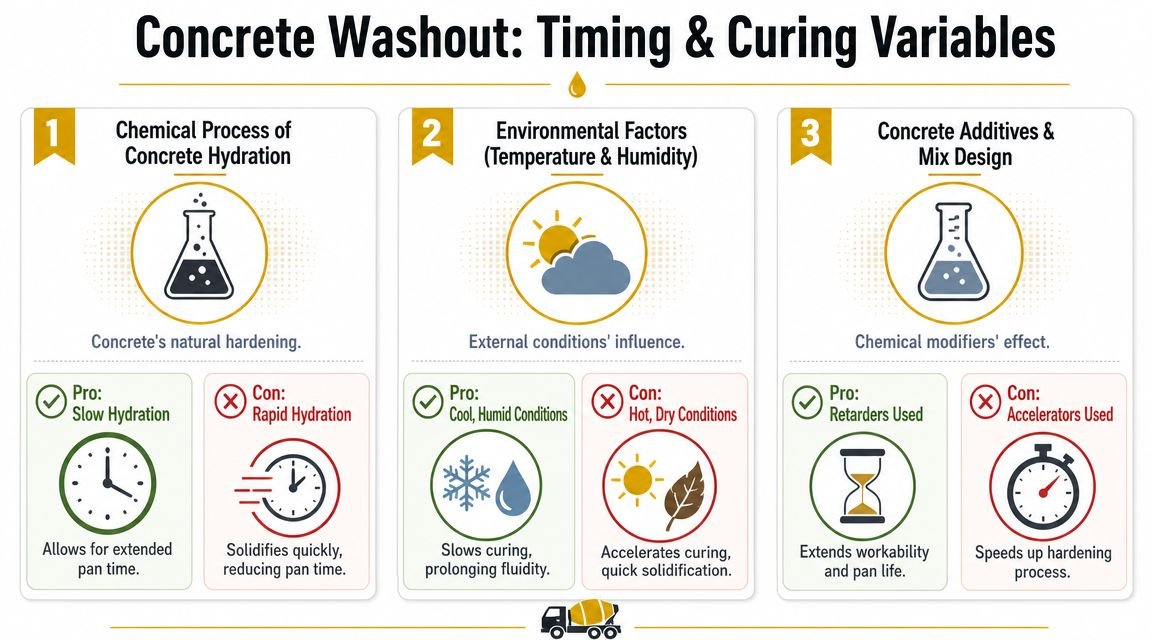
Curing time does not set the service schedule
Newer contractors often watch the surface and wait for the slurry to stiffen. That misses the bigger decision point. A pan needs service based on remaining capacity, exposure to rain, pickup access, and the risk of letting caustic liquid sit unmanaged too long.
Washout water stays high-risk long before the solids finish curing. If the container is still holding liquid, the job still has something to manage, inspect, and protect from runoff or accidental discharge. Hardening helps with final disposal. It does not give you a free pass to leave the pan in place.
What decides sit time
Three conditions usually drive the schedule:
| Driver | What it affects | What it means on site |
|---|---|---|
| Solids buildup | Usable capacity inside the pan | Crews lose more room than they think as slurry layers stack and harden |
| Weather | Freeboard and overflow risk | A pan that looks fine at the end of shift can be a problem after one storm |
| Service access | Pickup timing and crew efficiency | If the hauler cannot reach it cleanly, the pan is already staying too long |
The best field rule is simple. Service the pan while you still have options.
If you wait until it is nearly full, every routine delay becomes expensive. A missed pickup, a rain event, an extra truck rinse-out, or a blocked access lane can force a rushed fix. Rushed fixes are where spills, tracking, and cleanup costs start.
Where contractors usually get into trouble
The problem is rarely that washout sat for a certain number of days. The problem is that nobody matched the pan's condition to the pace of the job.
A pan can remain on site for a reasonable period if it is leak-proof, monitored, and has enough free capacity for the next work cycle. It should be removed or serviced sooner when any of these change:
- The next pour will push capacity too high
- Rain is forecast and the pan is uncovered
- The pickup truck will lose access once the site layout changes
- The pan is tying up space needed for concrete, rebar, lifts, or follow-on trades
That is the practical standard. Do not manage washout by the calendar alone. Manage it by how much room is left, how exposed it is, and how much trouble it will cause if you leave it one more day.
Choosing Your Containment Equipment and Specs
A pan that is too small, too light for the abuse it will take, or hard to service will sit longer than it should. That is the fundamental equipment question.
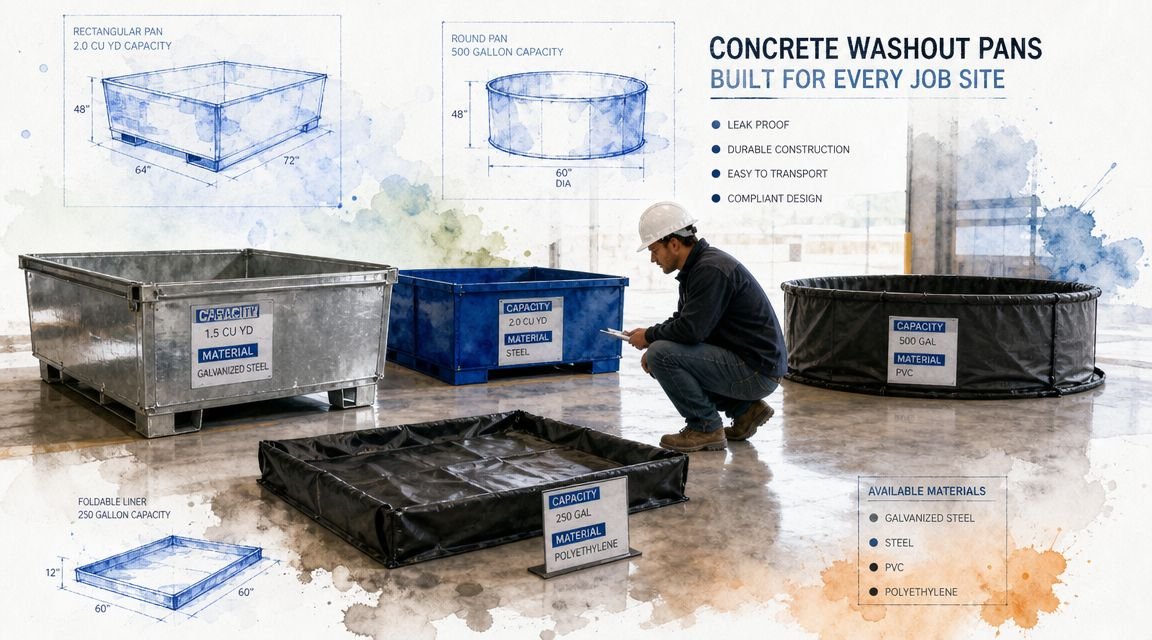
Crews often focus on the pour and treat washout containment as a small accessory. On site, it affects schedule, cleanup labor, and compliance exposure. If the container does not match the pace and volume of the work, you end up babysitting slurry, calling for unscheduled service, or explaining a preventable mess to the inspector.
Start with contained, inspectable equipment
According to Dane County concrete washout guidance, unlined washout areas are only suitable in limited conditions and need separation from sensitive resources. Where that separation is not available, an impermeable liner is required. For many commercial and municipal jobs, that pushes the decision toward aboveground, leak-proof containment because it is easier to inspect and easier to control.
That matters more than the cure time of the concrete. A well-built pan gives you room to manage the material before it becomes a site problem.
Pick the container for the job you actually have
Different setups solve different problems:
| Option | Best use | Trade-off |
|---|---|---|
| Steel washout pan | Repeated ready-mix traffic, larger pours, rough jobsite handling | Holds up well, but weight and cleanup get harder if hardened buildup is ignored |
| Poly container | Smaller placements, lighter-duty work, tighter handling conditions | Easier to move in some cases, but not always the right fit for heavy repeated use |
| Lined containment area | Longer jobs with a fixed washout zone and enough protected space | Can work well, but installation, liner protection, and inspection all take attention |
| Unlined pit or area | Limited low-risk conditions where local setbacks and soil conditions allow it | Harder to justify on regulated sites and harder to keep controlled |
A lot of bad calls happen here. Contractors rent by footprint because they want to save space, then lose that space anyway when the pan fills faster than expected or needs early pickup.
Specs that drive how long it should stay on site
Capacity is the first filter, but it is not the only one. I look at four things before I approve a washout container for a job:
- Usable liquid capacity. Not advertised size alone. You need working room for rinse water, slurry buildup, and some buffer.
- Lifting access. Fork pockets, rigging points, and serviceability matter if the container has to be swapped without disrupting the pour area.
- Wall height and containment security. Low sides can be a problem where splatter, hose washout, or sloppy truck cleanout is common.
- Cleanup method. If hardened residue turns every service cycle into a labor problem, the cheap option stops being cheap.
A factual example is Reborn Rentals concrete washout pans, which are offered in different sizes and liquid capacities for short-term jobsite use. That kind of spec sheet is useful because it lets you match the pan to expected rinse-out volume instead of guessing.
The practical rule is simple. Choose equipment that lets you remove or service the washout on your schedule, not only when it is already full. That is how you keep the pan from sitting longer than it should.
Mastering Delivery and Pickup Logistics
Friday afternoon is where bad washout planning shows up. The pan is nearly full, the service truck cannot get past stacked material, rain is in the forecast, and nobody on site knows whether to hold it, pump it, or swap it. That is the key question on most jobs. Not how long the washout can sit, but how long it should sit before it starts slowing the work or raising compliance risk.
Good logistics start before the pan is delivered. Placement has to work for the pour crew and for the pickup truck later. The washout area also needs enough separation from drainage features and traffic paths to keep a small mistake from turning into runoff or a cleanup claim. As noted earlier, site controls and local stormwater requirements set the boundaries. Your service plan has to fit inside them.
Walk the site with pickup in mind
A quick site walk saves a lot of expensive rescheduling. I check the drop point, then I check how that same container will leave once it is heavier, dirtier, and surrounded by more activity than it was on day one.
Look at these four items before delivery:
Truck access
Confirm the route in and out for both the initial drop and the retrieval. Soft subgrade, tight gates, crane setup, and stacked forms can turn an easy delivery into a missed pickup.Runoff exposure
Identify low areas, nearby inlets, and any slope that could carry liquid off the pad if the pan is overfilled or hit by rain.Sequence conflicts
Check what trade will take that space next. A good washout location today can block paving, excavation, or framing tomorrow.Service window
Decide when the pan will be inspected and who has authority to call for pump-out or swap-out before capacity becomes a problem.
Tie service timing to production
The mistake is treating pickup like a cleanup chore at the end. It is part of production planning.
If a project has multiple pours, set service expectations before the first truck washes out. If the schedule is uncertain, use decision points tied to actual work. After a slab pour, after wall placement, before a weather event, before a weekend shutdown. That keeps the pan on site only as long as it still supports the job.
A washout pan that sits too long costs you in three ways. It takes up access, it limits your buffer for the next rinse-out cycle, and it increases the chance that hardened buildup turns a routine pickup into a slower, more expensive service call.
Use a simple field routine
Crews do better with a short routine than with vague instructions.
- Before the pour: confirm placement, access, and the person responsible for checking fill level.
- During active washout use: monitor remaining capacity and watch for sloppy cleanout outside the pan.
- Following the day's work: decide whether the container should stay in place, be serviced, or be exchanged.
- Before rain, long breaks, or schedule shifts: reassess exposure, access, and whether the pan still fits the next phase of work.
Boring is good here. A well-run washout setup should not generate surprise calls.
Mistakes that create avoidable pickup problems
Experienced crews keep the pan out of future laydown areas. They do not bury it behind rebar, block it with masonry cubes, or place it where fencing will cut off access next week. They also do not leave service decisions to whoever happens to be on site at the close of the workday.
The practical rule is simple. Keep the pan only as long as it helps the job run cleanly and within plan. Once it starts threatening access, capacity, or compliance, it has stayed longer than it should.
Pricing Your Washout Rental Service for Profit
If you provide washout service, your pricing has to reflect more than the box itself. The container is only one part of the job. Delivery, placement, monitoring expectations, swap-outs, pump-outs, and disposal handling are where margins get protected or destroyed.
The mistake is charging a flat rental rate and hoping the rest works out. That approach usually underprices difficult sites and overcomplicates simple ones.
Build pricing around the real work
A practical pricing model usually separates the service into pieces:
| Fee Type | Typical Range | Purpose |
|---|---|---|
| Delivery and setup | Varies by distance, access, and site conditions | Covers transport, driver time, and correct placement |
| Daily rental | Varies by container type and local market | Charges for the pan occupying inventory on site |
| Weekly or project rental | Varies by duration and service expectations | Simplifies billing on longer jobs |
| Pump-out or removal service | Varies by fill condition and disposal method | Covers handling liquid and solids safely |
| Swap-out service | Varies by urgency and equipment needs | Replaces a full or hardened unit with a clean one |
| Express or emergency call | Varies by timing and dispatch disruption | Prices after-hours or urgent response |
| Access surcharge | Varies by rough terrain or restricted entry | Covers extra time, equipment, or difficult positioning |
Why the line items matter
Separate fees do two useful things. First, they show the contractor what they're paying for. Second, they keep you from absorbing costs that should have been identified at dispatch.
If a site has rough access, a long carry, or narrow delivery windows, price that up front. If the customer wants standby flexibility because the pour schedule may shift, that needs to be part of the agreement too.
Two common models
Simple rental model
Works for straightforward jobs with predictable use. You charge delivery, rental period, and pickup. Best for short pours where the pan is unlikely to need mid-project attention.
Managed service model
Works better for repeat contractors, larger placements, or sites where fill levels can change quickly. You charge for deployment plus scheduled checks, pump-out, swap-out, or removal as needed.
Don't price from the yard. Price from the site.
A pan sitting on your lot is just inventory. A pan on a jobsite becomes a service obligation. If access is poor, timing is tight, or compliance expectations are high, your price has to reflect the coordination required to keep that container from becoming someone else's problem.
That's how you stay profitable without padding every quote. Charge for the variables that create work.
Sales and Customer Service for Contractors
The easiest way to lose money in washout service is taking vague orders. The easiest way to keep customers is asking better questions before the pan ever leaves the yard.
Most contractors don't need a speech about environmental responsibility. They need someone who understands the job and helps them avoid avoidable mistakes. That starts in the first phone call.
The questions that change the quote
A useful sales conversation sounds more like a field check than a pitch:
- What kind of concrete work is happening?
- How many pours are planned?
- Is this one-day use or a multi-day setup?
- Where can the pan be placed and retrieved?
- Is the site open, tight, muddy, gated, or active with other trades?
- Who is responsible for checking fill level?
Those answers tell you whether the customer needs a simple drop and pickup, or whether they need active service planning.
Turn one rule into a service habit
One practical benchmark from a sanitation provider is to vacuum out the contents when the container reaches about 75% full to avoid overflow, according to guidance on handling concrete washout boxes. That's a useful customer-service rule because it gives the contractor a clear trigger before the situation becomes urgent.
You don't need to lecture clients. Just make the threshold part of the handoff.
Tell the customer exactly when to call. “If that pan is getting near three-quarters full, don't wait for the next truck. Call then.”
A real-world conversation pattern
A superintendent says, “Just drop me a pan. We'll call when it's full.”
A better response is: “What's the pour sequence, and who's watching the pan? If nobody owns that check, let's set a service expectation now.”
That changes the relationship. You're no longer just dropping equipment. You're helping the contractor keep the site moving.
What good customer service looks like
- Confirming placement in plain language: Not just “delivered on site,” but where it sits and how it will be accessed.
- Setting a fill-level expectation: Give the crew a clear action point before overflow risk builds.
- Checking schedule changes: Pours move. If the work shifts, the washout plan should too.
- Preventing emergency calls: A quick reminder beats an urgent dispatch every time.
Crews remember vendors who make their day easier. In this business, that usually means clear communication, no surprises, and service that matches how the job runs.
Your Guide to SWPPP and Environmental Compliance
Concrete washout is one of those jobsite details that seems minor until an inspector sees it handled badly. Then it becomes a major issue fast.
That's why washout control belongs inside the site's Stormwater Pollution Prevention Plan, or SWPPP. If your operation touches concrete work, washout isn't separate from compliance. It's one of the visible proof points of whether the site is being managed seriously.
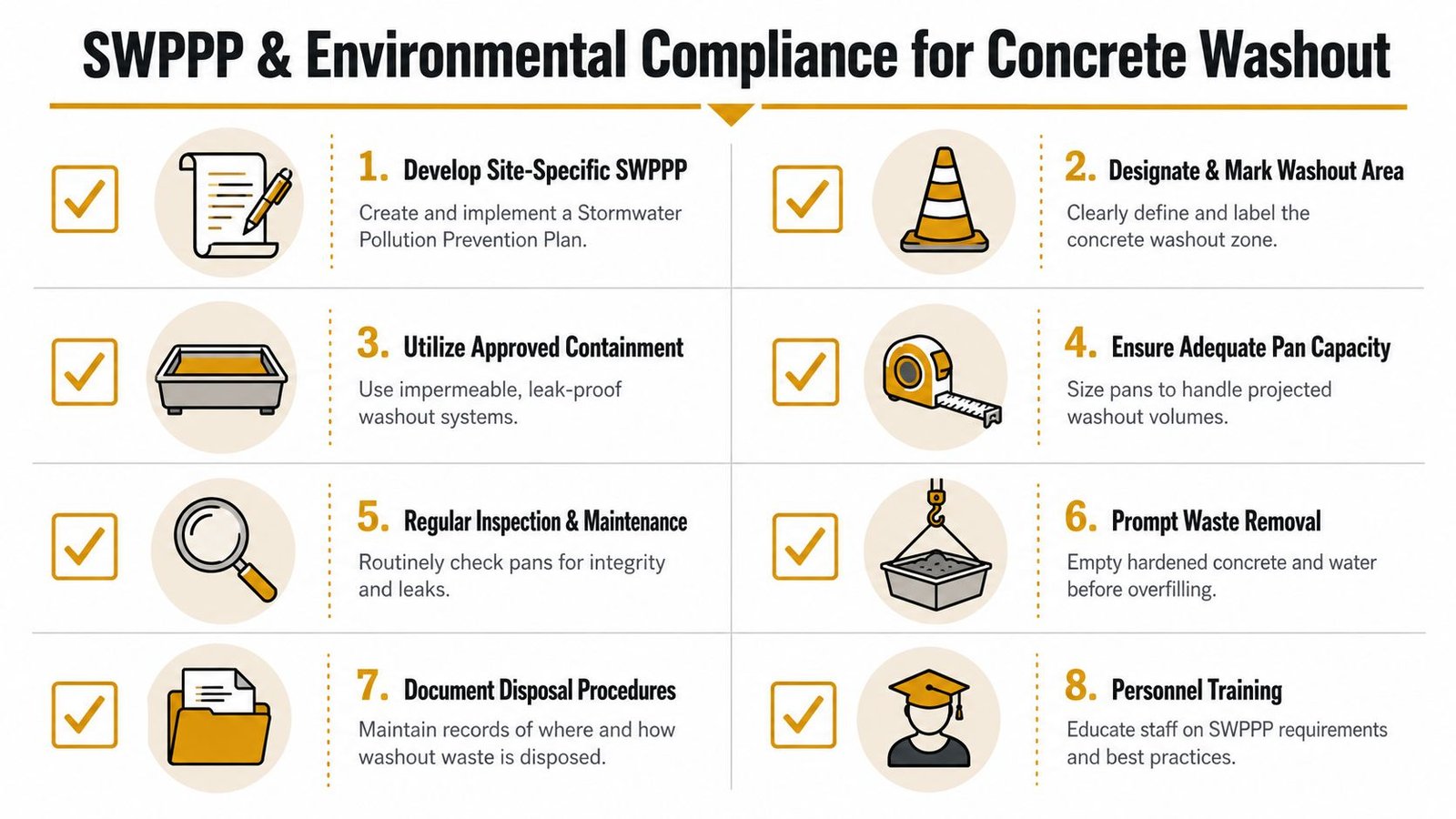
What compliance looks like in practice
The paperwork matters, but field execution matters more. A compliant washout setup is usually obvious:
- The area is clearly designated.
- The containment is appropriate for the site.
- The pan is intact and not overfilled.
- Crews know where washout goes.
- Service happens before failure, not after.
If any of those pieces are missing, the site starts relying on luck.
Documentation is part of the job
A lot of contractors think documentation only matters after a problem. That's backwards. Records matter because they show the plan existed before the problem.
Keep basic documentation such as:
| Record | Why it matters |
|---|---|
| Delivery log | Shows when containment was placed on site |
| Placement notes | Helps confirm the pan was set in the intended area |
| Inspection checks | Shows the container was being monitored |
| Service or pickup log | Proves the pan was emptied, swapped, or removed |
| Disposal records | Supports proper handling after removal |
Compliance pays for itself
Some crews treat SWPPP-related work as overhead. Experienced operators know it's part of the value they provide.
If your washout process is organized, documented, and easy for the site team to follow, you become easier to hire again. The contractor doesn't have to worry that your container will become the ugly item in the weekly inspection walk.
Clean paperwork and clean containment do the same job. They show the site team is in control.
A washout vendor or site supervisor who understands compliance is more useful than one who only knows where to drop a pan. Anyone can rent equipment. Fewer people can help a project stay orderly, inspectable, and defensible.
Frequently Asked Questions About Washout Management
Can concrete washout sit in a pan until it fully hardens
It can, but that doesn't mean it should. Full drying may take a long time, and during that period the pan or occupied area is still tying up space and requiring oversight. If the container remains on site, inspect it and manage it based on condition, access, and overflow risk, not wishful thinking.
What if rain is coming and the pan is already getting high
Treat that as a service decision, not a wait-and-see situation. Rain changes available capacity. If you're already close to the working limit, pump-out, swap-out, or removal is the safer call before weather hits.
Is hardened concrete easier to deal with than wet slurry
Sometimes, but only if the container was designed and managed for that outcome. Hardened buildup can also reduce future usable volume, complicate cleaning, and make the pan less efficient on the next job.
Can crews use any open container as a washout pan
That's where bad habits create expensive messes. The container should be leak-proof and appropriate for the site. Improvised solutions are where runoff, overflow, and poor placement decisions show up.
Does the mix design change how I should manage the pan
Yes, operationally. Some mixes may harden faster or behave differently in the container, which changes how quickly usable volume disappears. The safest move is to monitor the actual pan condition, not assume every job will behave the same way.
What should the foreman tell truck drivers and pump crews
Keep the instruction short and direct. Show them the designated washout location, make sure it's the only approved spot, and tell them who to notify if the container is getting close to its limit. Confusion at the end of a pour is when people start washing out in the wrong place.
When is a pan definitely overdue for service
A pan is overdue when it's creating uncertainty. If the crew is asking whether the next rinse will fit, if weather is turning, if pickups will be harder tomorrow, or if the container is interfering with work, that's your answer.
What's the simplest way to avoid washout problems
Assign one person to own it. Not everyone. One person. If nobody is checking the pan, no one really is.
If you need a practical washout setup without overcomplicating the job, Reborn Rentals provides concrete washout containment rentals for construction and renovation projects, with options for scheduling dates, delivery location, and container selection based on jobsite needs.