How to Dispose of Concrete Slurry Safely in 2026
You usually don't think about concrete slurry until it starts spreading where it shouldn't. A truck chute gets washed out at the wrong spot. A saw-cutting crew leaves a milky trail across pavement. Someone assumes the water will evaporate, and by the end of the day you've got a mess, a cleanup problem, and a compliance problem.
That's why knowing how to dispose of concrete slurry matters long before final cleanup. On a professional site, slurry management isn't a side task. It's part of production. When crews contain it early, treat it correctly, and document what happened, the job runs cleaner, inspections go smoother, and nobody is scrambling to fix preventable mistakes.
Mastering Immediate Containment on Your Job Site
A driver rinses out at the curb because nobody pointed out the washout pan. By lunch, slurry has crossed the pavement, tracked into traffic, and put storm drain protection at risk. That problem starts fast, and it gets expensive fast.
Immediate containment is the first field control in the whole slurry management process. If crews catch slurry where it is created, treatment, hauling, disposal, and paperwork all stay organized. If they miss that first step, every step after it takes longer and costs more.
Containment starts before the first rinse water hits the ground. Set one designated washout area, mark it clearly, and make sure every driver, pump operator, cutter, and laborer knows where it is. If people have to guess, they will make their own spot.
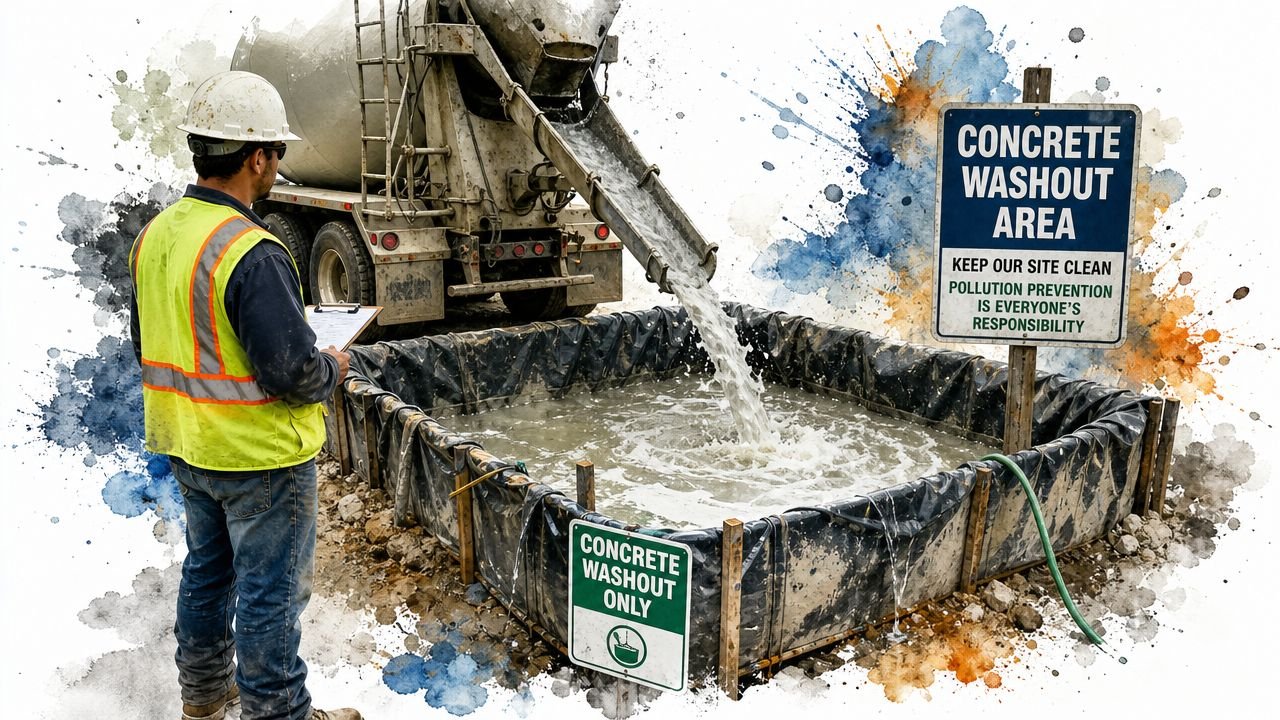
Pick the washout location like it affects the whole job
It does.
A good location keeps production moving and keeps slurry in one managed area. A bad one creates hose drag, backing conflicts, splash outside the container, and cleanup work that burns labor. Put the washout close enough that crews will use it, but far enough from drains, runoff paths, and foot traffic that one sloppy rinse does not become a reportable problem.
Check these conditions before you place the container:
- Access: Ready-mix trucks, pump crews, and cleanup crews need a straight approach without backing through congestion.
- Stable base: The pan or container needs level ground that will not rut or shift under load.
- Drainage separation: Keep it out of low spots, drainage swales, and any route where rain can carry slurry off area.
- Service room: Leave clearance for pickup, swap-out, and inspection.
- Crew visibility: People should be able to identify it immediately from the work zone.
One field rule works well. If a new driver needs directions after entering the site, the washout setup is not done.
Use containment built for slurry
Improvised containment fails in predictable ways. Plastic tears. Berms flatten. Plywood bows. A shallow pit looks fine until the second rinse cycle or the first rain. Then the crew is shoveling wet material, the superintendent is documenting a preventable spill, and the job loses time.
Engineered washout pans and lined containment systems give crews a defined target and give management a repeatable process. That repeatability matters. A clean, controlled washout area is not just housekeeping. It is what lets you treat the material properly, load it out efficiently, and show an inspector that the site is under control.
Capacity still matters in the field, even before treatment starts. Small washout setups fill quickly on placement days, while larger pours, pump cleanout, and repeated tool washdown can overwhelm a container that looked adequate on paper. Size the containment to the actual work, not to habit.
Match containment to the task in front of you
Different operations generate slurry in different ways. Truck washout creates short bursts with higher volume. Saw cutting and grinding create a steadier flow that needs collection throughout the shift. A repair crew may only need a compact, well-placed pan. A large placement may need a larger container and a service plan before the pour even starts.
Use a quick field check:
| Job condition | What to think about |
|---|---|
| Short-duration patching | Place containment close to the work so crews do not bypass it for convenience |
| Pump and truck washout | Allow enough volume and sidewall height for repeated rinses without splash or overtopping |
| Saw cutting or grinding | Plan for continuous recovery and transfer, not a single end-of-day washout |
| Tight urban site | Protect adjacent pavement, pedestrian routes, and stormwater inlets with a fully contained setup |
One option in this category is Reborn Rentals, which offers concrete washout containment equipment for temporary job-site use. That approach can make sense when the site needs defined containment without building a custom system that has to be removed later.
Professional crews handle slurry the same way they handle fuel, debris, and traffic control. They assign a location, set the equipment, brief the crew, and inspect it during the shift. That discipline is what turns slurry disposal from a recurring mess into a controlled job-site process.
How to Treat Slurry for Safe Handling and Disposal
A foreman can have containment set correctly and still lose control of the job if the slurry inside it is left untreated. That is where spills, rejected loads, and water quality violations start. Treating slurry is the step that turns a messy byproduct into something your crew can handle, transport, and document without scrambling at the end of the shift.
The job is to move the material through a controlled sequence. Settle or separate the solids. Check and adjust the water. Finish the solids so the load can be handled without free liquid. Crews that skip steps usually pay for it twice, once in labor and again in disposal trouble.
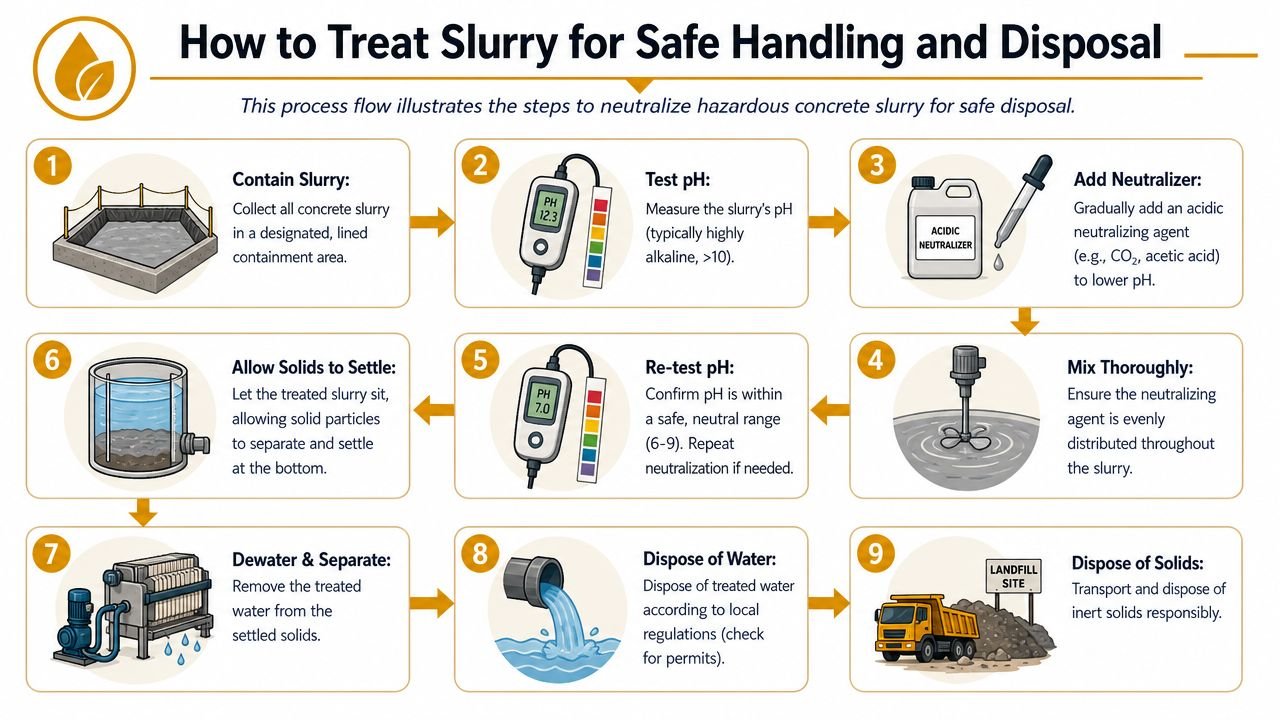
Start by separating solids from water
Treating slurry gets easier once you stop handling it as one uniform mix.
On most sites, the practical setup is straightforward. Collect the slurry in a tote, pit, or recovery tank. Let heavier solids settle where possible, then use flocculant and filtration to pull more fine material out of suspension. That reduces volume, shortens drying time, and gives you two streams to manage properly instead of one unstable slurry mass.
Diamatic lays out a field procedure crews can follow, including measured flocculant dosing, hydration time, filtration, and final solidification of the remaining material (field slurry treatment workflow). The main value of a process like that is consistency. If treatment depends on whoever is standing closest to the tote, results will vary from load to load.
Control pH before anyone assumes the water is safe
Clearer water is not the same as acceptable water.
Concrete slurry water is often highly alkaline, and that is where a lot of environmental exposure sits. Settling helps remove solids, but it does not solve the chemistry. If the water phase is going to be reused, stored, hauled, or managed for disposal, the crew needs to test it and know where it stands before making the next call.
On a working site, that means keeping pH paper or a calibrated meter with the slurry setup, assigning one person to record readings, and adjusting treatment based on actual results instead of appearance. If pH starts high, you need more time, more treatment, or both. If no one is checking, the site is guessing.
That record matters too. A treated load is easier to defend with disposal facilities, inspectors, and project owners when the crew can show what was tested, when it was tested, and what action was taken.
Finish the material so it can be moved cleanly
The endpoint is simple. No free water in the solids, no uncontrolled liquid leaving the treatment area, and no question about what the hauler is picking up.
A practical field sequence looks like this:
- Collect slurry in a contained tank, tote, or washout unit.
- Add treatment products by measured dose according to the product instructions and the volume on hand.
- Allow reaction or hydration time so settling and separation can occur.
- Filter or decant the water phase into a separate container for testing and further management.
- Add solidifier to the remaining solids until the material holds together without shedding liquid during loading.
That last step saves time later. Wet cake that still weeps water creates problems during transport, at the disposal point, and during final cleanup around the treatment area.
Crews sometimes try to wait slurry out and let evaporation solve it. That usually fails on active jobs. Weather changes, production keeps adding more material, and the site ends up storing wet waste longer than planned. Measured treatment costs money, but so do rehandling, stained pavement, delayed pickup, and a driver refusing the load because liquid is still present.
Treat the slurry as part of the job flow, not as end-of-day cleanup. That is how professional sites keep the work area safer, keep disposal options open, and avoid turning a manageable waste stream into a schedule problem.
Calculating Slurry Volume and Transport Loads
At 2 p.m., the saw crew is still cutting, the washout bin is nearly full, and the hauler is due before the gate closes. That problem did not start at pickup. It started hours earlier, when nobody matched slurry production to container space, treatment time, and the number of loads the site could move.
Good slurry disposal runs on volume control. If the estimate is wrong, crews rehandle material, treatment slows down, drivers wait, and wet waste sits longer than it should. That costs money and creates compliance risk.

Estimate from the work plan
Start with the operations creating the waste. Pump washout, chute rinse-out, coring, saw cutting, grinding, and cleanup water do not produce the same material, and they do not hit the containment area at the same pace. A decent estimate separates those streams so the crew can see what arrives in surges and what builds steadily through the shift.
Use the daily work plan, not a rough memory from the last job. Count the activities, the equipment involved, and the number of times each crew will wash out or rinse down.
A practical field breakdown looks like this:
- Placement washout from trucks, chutes, pumps, and hoses
- Cutting or grinding slurry from surface prep and demolition work
- Tool and equipment rinse water from cleanup stations
- Repeat wash cycles when equipment is cleaned more than once in a day
- Contingency volume for rework, rain intrusion, or missed collection
That last item matters. Sites rarely miss the plan by a gallon or two. They miss it when production changes and the slurry setup stays the same.
Check storage against processing rate
Container size is only part of the calculation. The other part is how fast the site can turn slurry into a shippable load.
If a crew fills a tank faster than the treatment area can decant, filter, or solidify it, the site is falling behind even if there is still space left in the bin. That is how jobs ultimately end up with overflow risk and emergency pickups that cost more than scheduled service.
Measure three things together:
| Field question | Why it matters |
|---|---|
| How much slurry will this activity generate today? | Sets the collection volume you need on site |
| How quickly can the treatment setup process it? | Shows whether slurry will back up during production |
| How many loads can the hauler legally and practically move? | Prevents treated waste from piling up after processing |
This is the full chain. Collection, treatment, transport. Miss one step and the whole disposal plan starts to slip.
Convert volume into realistic haul loads
Once the estimate is on paper, turn it into truck and container decisions. Wet slurry is heavy, unstable, and expensive to move compared with treated solids. That is why good sites reduce water first whenever space, equipment, and schedule allow.
For small or intermittent generation, batch treatment on site usually makes sense. For continuous cutting or grinding, the better move is often to pair collection with active dewatering so the waste stream does not outrun the setup. Tight urban sites may need more frequent container swaps because they cannot store much material safely. Remote jobs sometimes have more room to stage, but they still need to plan around haul distance, driver availability, and the risk of holding waste too long.
Use a simple planning table before work starts:
| Site condition | Transport planning choice |
|---|---|
| Light, intermittent slurry generation | Batch-treat and schedule pickup only when a full load is ready |
| High daily washout volume | Increase container capacity or shorten service intervals |
| Continuous slurry production | Add dewatering capacity so transport is moving solids, not excess water |
| Limited access or strict delivery windows | Pre-book haul times and keep a backup container available |
The goal is not perfect math. The goal is no surprises. A professional site manages slurry the same way it manages concrete deliveries or equipment time. From the first rinse-out to the final haul ticket, every step should be planned, checked, and documented so the job stays clean, compliant, and profitable.
Compliant Disposal and Reuse Options for Treated Slurry
A lot of slurry problems happen after treatment, not during it. The crew gets the pH under control, the material looks better, and someone assumes the hard part is done. It isn't. The job is only finished when the solids go to an approved destination, the recovered water is handled within site rules, and the paperwork matches what left the site.
Treated slurry splits into two waste streams. One is the solid cake. The other is recovered water. If the site treats both the same, costs go up and compliance starts to slip.
Send solids out only when they behave like solids
The first field check is simple. Does the treated material still contain free liquid?
If it is still draining, slumping in the bucket, or leaving standing liquid in the container, it is not ready for transport as a solid waste. Give it more dewatering time, add treatment if needed, or change the setup. Crews get into trouble when they rush this step and load wet material that leaks during transport or gets rejected at the receiving end.
For high-volume operations, equipment choice plays a key role in disposal options. Filter-press systems can remove more water and produce a drier cake, which makes hauling cleaner and cheaper because you are moving solids instead of excess water. They take planning, space, and operator attention, so they are not the right fit for every site. On continuous cutting or grinding work, though, they can solve a lot of downstream disposal headaches.
Reuse water only under controlled conditions
Recovered water can save money, but only if someone is managing it like a process stream instead of leftover wash water. Separation methods such as settling, filtration, and flocculant-assisted dewatering can make reuse possible, but reuse still depends on site rules, project specs, and water quality checks.
A practical summary from closed-loop slurry water handling guidance makes the main point clearly. Keep slurry out of storm drains, sewers, and waterways, and use a closed-loop approach with testing and documentation. That matches what works on real jobs. Recovered water is useful when the site has a defined storage point, an approved use, and one person responsible for checking condition before it is reused or discharged.
Choose the outlet before the container is full
Crews should know the destination before they start loading containers, not after.
Here is the practical decision check:
Off-site disposal of treated solids
- Best when the material is dry, stable, and accepted by the receiving facility
- Keeps the site cleaner and closes the waste stream fast
- Costs more if poor dewatering leaves you hauling extra weight
On-site reuse of treated solids
- Can work for stabilized material if local rules and project requirements allow it
- Needs approval from the right parties before anyone spreads, buries, or repurposes it
- Fails fast if the material still acts like slurry or the crew cannot document what was done
Reuse of recovered water
- Reduces freshwater demand and cuts disposal volume
- Only works with controlled storage, testing, and clear limits on where that water can be used
- Creates risk if containers are unlabeled or water quality is assumed instead of checked
The trade-off is straightforward. Disposal is often the fastest path. Reuse can lower handling costs and reduce waste, but only when the site has control over testing, storage, approvals, and final records.
That is the part crews miss. Proper slurry disposal is not one decision at the end. It is a managed chain from treatment, to dewatering, to transport, to reuse or disposal, to the final ticket or log entry. Sites that run that chain well stay cleaner, avoid fines, and waste less time fixing preventable messes.
Your Site Checklist for Documentation and Compliance
Rain starts up at 3:30. The washout area is holding, one tote is ready for pickup, and an inspector asks for the pH log, the disposal record, and the name of the person checking the containment. That is when a site finds out whether slurry control was managed like a process or handled from memory.
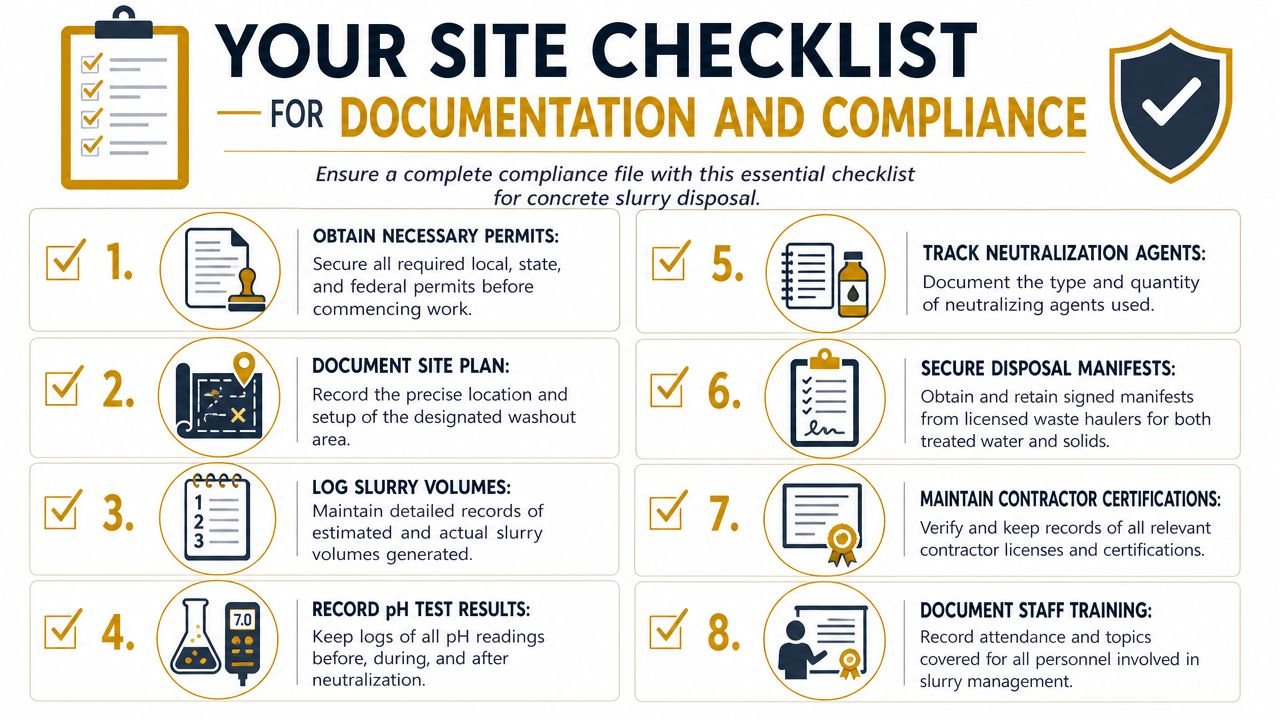
Documentation has to track the whole chain. Start with where the slurry is generated and contained. Keep records through treatment, testing, hauling, reuse, or final disposal. Finish with a closeout file that matches what happened in the field. That file does more than satisfy an inspector. It shows the job was controlled, the crew followed the plan, and the company can defend its decisions if questions come up later.
Keep records in real time
Field records fall apart when someone tries to rebuild the story at the end of the week. Ticket times do not match the log. The hauling record shows one volume, while the crew says another. No one can say who checked pH before water was reused or discharged.
As noted earlier, Minnesota guidance is a good example of how specific slurry compliance can get. During start-up, pH testing may need to happen at least once per hour. Once the process is stable, the frequency can drop. The same guidance also sets conditions for burying small amounts of solid material on site in limited cases. Those details belong in the record, along with dates, locations, test results, and who made the call.
If the file cannot show what the crew did, the site is exposed.
Use a checklist that matches field work
A good checklist is short enough to use during a busy shift and detailed enough to hold up during review. It should cover the full lifecycle, not just the last haul ticket.
Keep these items current:
- Washout location record: Mark the containment area on the site plan or SWPPP documents. Add a field photo if your company uses them.
- Daily slurry activity log: Note when slurry-generating work took place and which crew or subcontractor produced it.
- Treatment record: Write down the treatment method used, including any flocculant, solidifier, or other product added.
- pH log: Record readings in order, with time, date, and the name of the trained person who took them.
- Final disposition record: Keep haul tickets, disposal receipts, or internal reuse records tied to the treated material.
- Exception log: Note spills, weather impacts, overflow risk, liner damage, or corrective action taken.
Paperwork protects the job when conditions change fast.
Assign ownership before the work starts
Slurry compliance usually breaks down because responsibility is vague. One crew assumes another crew is checking the washout. A truck driver rinses out in the wrong spot. A laborer moves material without telling the foreman, and the paperwork never catches up.
Set ownership at startup and review it with every crew and subcontractor that can generate slurry. Put one trained person in charge of pH testing and logs. Make the foreman responsible for daily containment checks. Make the superintendent or project admin collect haul tickets and closeout records before they disappear into glove boxes and pickup seats.
A simple handoff process keeps that clear:
| Responsibility | Who should own it |
|---|---|
| Washout area setup | Site superintendent or designated foreman |
| Daily inspection of containment | Foreman or environmental lead |
| pH testing and treatment log | Assigned trained crew member |
| Haul tickets and disposal receipts | Project admin or superintendent |
| Closeout file review | Project manager or compliance lead |
That structure saves time. It also keeps small mistakes from turning into a notice of violation.
A clean slurry file is a jobsite performance record. It shows the waste stream was controlled from containment to final disposition. It shows the crew worked safely, kept the site cleaner, and avoided paying to fix preventable problems twice.
If your crew needs a defined washout setup instead of improvising containment in the field, Reborn Rentals provides concrete washout containment rentals that fit short-term construction and renovation work. It's a practical option for contractors who want a cleaner starting point for slurry control, treatment, and documentation on active job sites.