Your One Day Dumpster Rental Playbook for Job Sites
You’ve got a pour wrapped, the crew wants to demob, and the site still has debris, washout residue, or demo material that can’t sit overnight. That’s when a one day dumpster rental sounds like the obvious fix.
Then the calls start. One company says “daily rates” but books in multi-day windows. Another can drop today but can’t promise pickup. A third will do a short turn only if dispatch has an open truck. On paper, one day service looks simple. On an active job, it’s usually a scheduling puzzle with cost traps baked in.
Contractors run into the same mistake over and over. They treat a one day rental like a smaller version of a normal dumpster booking. It isn’t. Short-term rentals demand tighter planning, better debris estimates, cleaner site access, and sharper questions about terms. That’s even more true when the waste stream includes concrete washout, slurry, or other heavy material that can blow past weight limits fast.
Why True One Day Dumpster Rentals Are Hard to Find
Most contractors assume a provider can drop a dumpster in the morning and pull it that afternoon if you’re willing to pay for one day. In practice, that’s rarely how the market works.
Many haulers advertise flexibility, but the actual rental terms usually tell a different story. Nearly all providers enforce minimum rental periods in the 3 to 7 day range, and examples cited in this market include Junk King with a 3-day minimum and WM with 7 days according to Junk King’s dumpster rental information. That’s why a “one day” option often turns into a custom dispatch request instead of a standard product.
Why providers price it this way
The provider’s biggest costs don’t disappear because you only need the box for a few hours. The truck still has to roll out, the driver still has to place the container, and the hauler still has to return, load, and haul it away. Disposal and routing costs also stay in play.
That’s why many companies would rather book a container for several days than reserve truck time for a tight same-day turn. A short rental creates more pressure on dispatch and less room for delays caused by traffic, access issues, or late loading. From the hauler’s side, longer bookings are easier to schedule and usually more profitable.
Field reality: When a company says it offers one day service, ask whether that means a true same-day drop and pickup, or just that you can finish in one day while paying for a longer rental window.
What usually works better
If you need a one day dumpster rental, don’t start by asking for “best price.” Start by asking whether they can commit to a specific drop window and a specific pickup window. If they can’t, the rate doesn’t matter much.
Use this filter when you call:
- Ask about minimum terms: Is this a true 24-hour rental, or are you paying for a longer standard term?
- Pin down dispatch: Is same-day pickup guaranteed, or only “subject to availability”?
- Get written terms: If the site has to be clear by closeout, verbal promises won’t protect you.
- Explain the waste stream: Concrete, masonry, roofing, and wet debris change the conversation fast.
The hard truth is simple. One day rentals exist, but they’re often special handling jobs, not off-the-shelf bookings.
Sizing Your Dumpster and Estimating Weight Accurately
A one-day rental goes sideways fast when the box is wrong for the material. I see two bad calls more than any others. Crews order for cubic yards when the actual limit is tons, or they grab a bigger container and assume that solves the problem.
It does not, especially with concrete, block, dirt, asphalt, and washout solids.
Start with the material, not the container
On short jobs, the waste stream should drive the order. Haulers care about two things first. How much space the debris takes up, and how heavy it gets before the container is full.
Use this split:
| Material type | What matters most | Common mistake |
|---|---|---|
| Light mixed debris | Volume | Paying for a larger box than the job needs |
| Dense debris | Weight | Loading to the top and blowing past the ton limit |
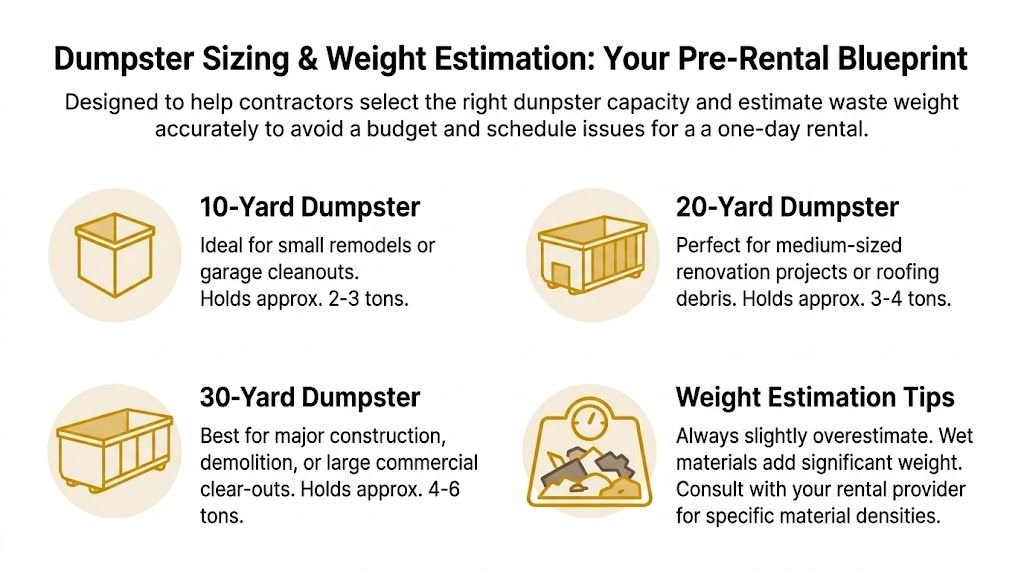
That trade-off matters more on a 24-hour turn because there is no cushion for a swap-out, reload, or second truck. If the load is heavy, a smaller container is often the right call. A 10-yard box for concrete is common because the truck can legally haul it. A 20-yard box full of the same material can become a disposal and transport problem before it ever leaves the site.
Use size ranges as a first pass
Size charts help, but only as a starting point.
- 10-yard dumpster: Often used for small remodels, roofing squares, heavy masonry, and concrete because it keeps dense loads manageable. Angi’s dumpster sizing and pricing overview describes these as a common fit for smaller residential cleanup loads and notes typical weight capacity ranges around 2 to 3 tons.
- 20-yard dumpster: A standard choice for renovation debris, flooring tear-outs, siding, and general construction cleanup. Many haulers price these with a moderate weight allowance, but that allowance disappears quickly with plaster, shingles, or wet debris.
- 30-yard and 40-yard dumpsters: Better for bulky, lighter material such as framing scrap, packaging, and large-volume cleanouts. They are usually the wrong tool for dense waste unless the hauler has approved the load in advance.
The field rule is simple. More yards does not mean more usable capacity for heavy material.
Concrete washout needs its own estimate
Concrete washout gets underestimated because crews look at liquid and forget what happens after it settles. Water evaporates or gets decanted. The fines and solids stay, and they are heavy.
For washout, estimate the settled material, not the wet surface area you see at the end of the pour. The same goes for slurry from saw cutting, coring, and cleanup. If you are sending that material off in a one-day box, ask the hauler whether they want the load as concrete, mixed inert, or a dedicated washout container. Those categories can price differently, and some yards will reject a load that was described too loosely on the phone.
Don’t size washout by eyeballing the puddle. Size it by the settled solids and the disposal category the hauler will actually use.
A practical pre-rental sizing routine
Before calling dispatch, get these five points straight:
List each material separately
Keep concrete, block, dirt, roofing, mixed C&D, and washout residue in different buckets on paper, even if they are leaving the same site.Estimate what leaves that day
One-day planning breaks down when the crew sizes for the whole project instead of the actual 24-hour scope.Let the heaviest stream control the order
If even part of the load is dense, size around that material first.Keep the load below the top rail
Overfilled containers can be refused for pickup or reworked on site, which burns time you do not have.Get material approval in writing
This matters most for concrete washout, wet fines, and mixed inert debris. If the dispatcher approves it, make sure it shows up on the confirmation.
That extra ten minutes of planning usually saves far more than it costs. On one-day rentals, accurate sizing is not about getting the biggest box fast. It is about getting a box the truck can legally haul, the landfill will accept, and your crew can fill without creating a second problem by the end of the shift.
Decoding the Real Cost of a 24-Hour Rental
A crew can finish demo by 2 p.m. and still lose money on the dumpster by 4. The usual problem is not the posted rate. It is the short list of charges that only shows up after dispatch, disposal, or a failed same-day pull.
For a true 24-hour rental, the hauler is pricing a fast truck turn, a specific waste stream, and the risk that your load does not match what was ordered. That matters more on concrete, block, dirt, and washout residue than on light mixed debris. Dense material fills the weight allowance long before it fills the box, and washout can trigger a different disposal category altogether if the solids are wet, contaminated, or described loosely.

What the market says a one day rental costs
Short-term pricing often looks simple because the quote starts with a low base number. Dano’s overview of one-day dumpster costs describes one-day rentals as typically landing between $50 and $200, with smaller containers at the lower end and larger boxes pushing higher. That same source notes a one-day booking can be priced close to half of a full-week rental.
That pricing pattern catches contractors off guard. The extra days are not what drive most of the cost. Delivery, pickup, fuel, dispatch time, and disposal setup are already baked into the first turn. If you only need the box for one shift, you are still paying for the truck to make that route work.
Where the invoice usually grows
The difference between a good quote and a bad one comes from four things:
- Included tonnage that is too low for the material
- Disposal rules for concrete fines, slurry residue, or mixed inert loads
- Same-day turnaround risk if the truck cannot return on your exact window
- Trip-related charges tied to waiting time, failed pickup, or changed placement
Heavy debris is where short rentals get expensive fast. A one-day box for clean wood or light C&D behaves one way. The same box loaded with broken slab, mud-heavy demo, or washout solids behaves very differently at the scale house.
Concrete washout is the category that gets missed most often. Some providers will accept dried solids in a dumpster. Others want a dedicated washout container or a lined system, and they price it under a separate disposal stream. If that difference is not settled before delivery, the low quote stops being your real number.
Practical rule: Ask for the all-in price for this material, this container, this site, and this pickup window. Then ask what changes that number.
Questions that expose hidden charges
A usable quote answers the job, not just the rental period:
- What material is approved on the order confirmation
- How much weight is included for that exact material
- What the overage charge is if the load scales heavy
- Whether wet washout solids, slurry residue, or mixed heavy debris are rejected or reclassified
- What fee applies if pickup rolls to the next morning
- Whether the driver charges for waiting, blocked access, or a dry run
- Whether a one-day request is still billed under a longer minimum term
I always want one more detail in writing on short rentals. Ask who makes the call if the load arrives different from the description, dispatch or the landfill. That tells you where a disposal upcharge is likely to hit.
A one-day dumpster rental can be cost-effective. It is not forgiving. The contractors who keep these jobs profitable are usually the ones who price the disposal category correctly before the truck ever leaves the yard.
Prepping Your Site for Flawless Delivery and Pickup
The truck shows up at 7:00 a.m., your crew is ready, and the box still does not hit the ground because a van is parked in the swing area, the grade is softer than expected, or the driver cannot clear a low branch. On a one-day rental, that lost half hour matters. It cuts directly into loading time and can push pickup past the window you paid for.

What the driver needs from you
Drivers need more than an open patch of ground. They need enough room to approach, roll the container off, and pull back out without fighting cars, mud, fencing, or overhead obstructions. A placement area that looks workable to the foreman on foot can still fail once a roll-off truck has to line up and tilt.
Keep the drop zone level, clear, and firm. If the dumpster will sit on asphalt, decorative concrete, pavers, or another finished surface, put protection down before the truck arrives. If the container is going onto dirt, gravel, or a partially built pad, say that when you book. Soft ground, slope, and uneven bearing surfaces change how the driver sets the box and whether the location is usable at all.
As noted earlier, short-rental guidance commonly uses a clear placement footprint and overhead clearance standard for planning. Treat that as a starting point, not a guarantee. Truck style, container size, and site layout still decide whether the drop works.
Where one-day jobs actually get derailed
The common failures are not complicated. Access is blocked. The truck cannot make the turn. The surface will not support the wheels. The crew stacks debris too close to the swing path. Pickup gets scheduled, then someone parks a lift in front of the container.
I see the same mistake on washout-heavy jobs. Crews focus on filling the box and ignore how the truck gets back to it. If concrete residue, hardened spill, or palletized material builds up around the container door, retrieval slows down fast. For a provider that bills extra time or a return trip, that turns a cheap one-day rental into an expensive correction.
On short rentals, site prep is schedule control.
Site prep checklist before dispatch arrives
- Clear the full access route: Move cars, trailers, skids, lifts, and staged material before the delivery window opens.
- Check vertical clearance: Look for tree limbs, power lines, scaffold, temporary power drops, and fencing.
- Confirm the ground will hold the truck: Wet soil, fresh fill, and broken asphalt cause placement problems and surface damage.
- Protect finished surfaces: Use plywood or another suitable buffer where the rails or wheels may bear.
- Mark the exact spot: Paint, cones, or a quick site photo help prevent a bad placement call.
- Verify street placement rules: If the box sits in a public lane, shoulder, or right-of-way, permit requirements may apply.
Pickup prep matters as much as drop-off
A clean delivery does not guarantee a clean pickup. By the end of the day, access has usually gotten worse, not better. Material spreads, equipment gets parked wherever there is room, and crews overfill the box because they are trying to beat the clock.
Before pickup, reopen the approach path, keep the load below the top rail, and make sure nothing hangs over the sides or blocks the door. Heavy one-day loads need extra attention here, especially concrete chunks, washout solids, and dense mixed debris. If the driver has to wait while the crew breaks material down, levels the load, or clears access, you may get hit with added labor, a delayed pickup, or both.
The practical move is simple. Set the container where the truck can reach it twice, once empty and once full. That is the difference between a one-day rental that closes on time and one that drifts into day two.
Meeting Compliance for Waste and Washout
Short-term disposal doesn’t reduce your compliance burden. It concentrates it.
That’s especially true for concrete washout, where the waste stream can include slurry, rinse water, cement fines, and hardened residue. If your site handles that material casually, a one day schedule won’t save you. It can increase the risk because crews rush cleanup and toss incompatible material together.
A standard dumpster is not a free-for-all
Every hauler has a prohibited materials list, and the smart move is to ask for it before booking. Liquids, hazardous materials, and certain specialized waste streams are common problem areas. Washout is where contractors get tripped up because they assume “concrete waste” and “concrete slurry” are treated the same way. They aren’t always.
For construction crews under stormwater requirements, that distinction matters. Your SWPPP obligations don’t disappear because cleanup is happening fast. If slurry escapes containment, leaves staining, or reaches drainage paths, you’ve created an environmental problem, not just a housekeeping issue.
Why washout needs dedicated handling
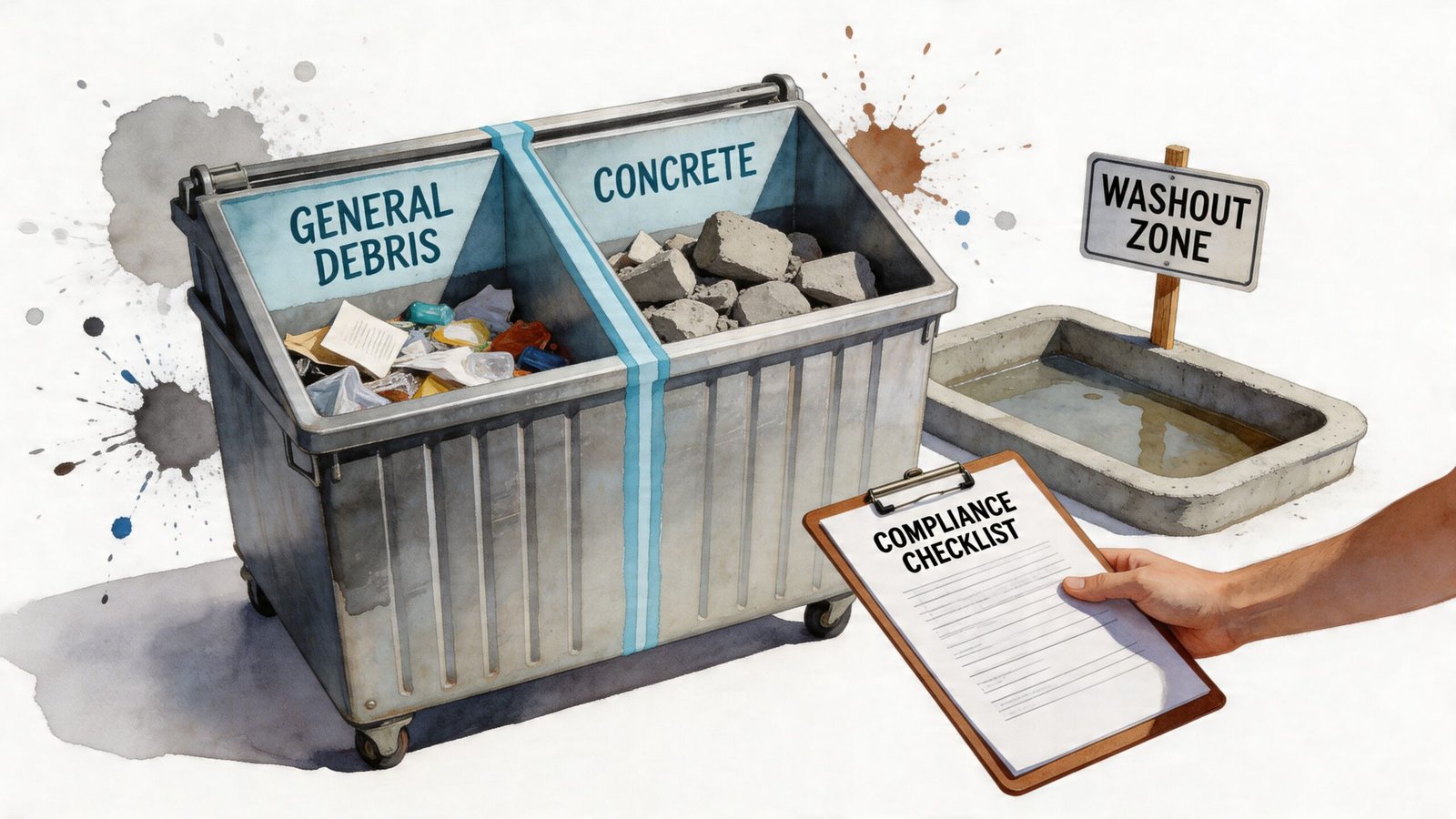
Washout should be treated as a containment task first and a disposal task second. That means the crew needs a defined washout area, clear instructions on what goes where, and a plan for pickup that matches the work sequence. Tossing wet slurry into a general debris box without confirming terms can create a rejection, a surcharge, or both.
The compliance side is getting tighter. 24 Hour Dumpster’s market commentary says that, amid rising SWPPP compliance demands, EPA trends for 2025 show a 20% increase in stormwater violation fines in major markets. Treated as a projection for 2025, that’s still a clear warning for contractors handling concrete waste and slurry carelessly.
If your site generates washout, the cleanup plan needs to be as deliberate as the pour plan. Crews should know the containment point before the first truck arrives.
What keeps a site inspection-ready
Use these habits on concrete jobs:
- Separate washout from general debris: Don’t mix sludge, rinse water, and light demolition waste unless the provider has approved it.
- Keep waste inside containment: Slurry on bare ground, pavement edges, or near storm drains is asking for trouble.
- Train the crew on prohibited loads: The laborer doing end-of-day cleanup shouldn’t be guessing.
- Confirm disposal terms early: If the hauler won’t take the material as loaded, you need to know before the container is full.
Clean compliance isn’t about paperwork alone. It shows up in where the crew washes tools, where the residue settles, and whether your disposal plan matches the material coming off the job.
Your One-Day Dumpster Rental Checklist
Use this as a field sheet, not a theory sheet.
Pre-rental checklist
- Define the waste stream: Separate mixed debris from dense material like concrete, masonry, soil, or washout residue.
- Choose the size based on weight risk: Don’t book by visual volume alone.
- Confirm the true rental term: Ask whether you’re getting a real one day dumpster rental or a longer minimum billed as a short job.
- Get the quote in writing: Include delivery window, pickup window, weight allowance, overage rate, and accepted materials.
- Verify site access: Check ground condition, turning room, surface protection, and overhead clearance.
- Check permit requirements: Street placement can trigger local approval.
- Plan the loading sequence: Put the right labor and equipment on the site when the box arrives.
On-site checklist
- Inspect placement immediately: Make sure the dumpster lands where it should and the doors operate safely.
- Protect the loading area: Keep the path clear for carts, skid steers, or hand carry routes.
- Load heavy material low and evenly: Don’t create an unstable or uneven load.
- Stay below the rim: If debris sits above the top edge, expect pickup problems.
- Keep prohibited material out: Don’t let the cleanup crew improvise with liquids or restricted waste.
- Call for pickup confirmation early: On a short rental, silence from dispatch is a risk.
- Photograph the final load: It helps if there’s any dispute about condition, level loading, or contamination.
A smooth short-term rental usually comes down to one thing. Treat it like a timed logistics move, not just a dumpster order.
Frequently Asked Questions About One-Day Rentals
Can I book a one day dumpster rental for a weekend or holiday?
Sometimes, but it depends on dispatch capacity and whether the provider treats that as custom service. Ask early, and get the pickup window in writing. Weekend drop-off is easier than guaranteed weekend pickup in many markets.
What if the rental company delays pickup?
Call as soon as the pickup window starts to slip. Ask for an updated ETA and whether the delay changes your charges. If the site has hard closeout requirements, document the missed pickup and keep photos showing the load was ready on time.
Can I mix concrete with lighter construction debris?
You can sometimes mix materials, but it’s often a bad move unless the provider has approved that exact load. Heavy concrete can push the container over its included tonnage long before the box looks full, and mixed loads can create disposal issues at the landfill or transfer point.
What if we finish loading hours before pickup?
Call dispatch and ask whether they can advance the pull. Sometimes they can. Sometimes they can’t because truck routing is already locked. Either way, keep the area around the container clear so the driver can grab it without waiting.
Is same-day drop-off and same-day pickup realistic?
It can be, but only when the provider has truck availability, your site is ready, and the material is clearly defined. For tight-turn work, the practical approach is to confirm the loading window first, then build your crew plan around that commitment.
What matters most on a washout-heavy job?
Containment first, disposal second. If the crew doesn’t have a clear washout process, the dumpster decision won’t fix the compliance risk.
If your job includes concrete washout, slurry containment, or short-turn cleanup that can’t afford guesswork, Reborn Rentals is built for that kind of work. Their catalog focuses on washout containment equipment with clear daily pricing, practical capacity details, and straightforward delivery coordination, which helps crews plan cleanup around the actual pour instead of forcing a generic dumpster approach onto specialized waste.