Public Dumpster Sites: A Contractor’s Guide to Rules & Risks
The truck is loaded, the crew is tired, and everyone wants the same thing. Dump the debris, wash up, and head home.
That's usually when someone says, “Let's just hit the nearest public dumpster site.” On paper, that sounds efficient. You've got wood offcuts, busted drywall, a few bags of mixed trash, and maybe a bucket or two that still has concrete residue clinging to the sides. It feels like one stop should solve all of it.
For a construction crew, that's where trouble starts.
Public dumpster sites can work for the right material, the right vehicle, and the right facility. But they're rarely as simple as they look from the road. One site takes self-haul debris but not commercial loads. Another accepts clean concrete but rejects mixed C&D. Another closes its gate earlier than the posted office hours. And the minute liquid, slurry, paint, fuel-contaminated absorbents, or other questionable material enters the load, the risk jumps from inconvenience to liability.
Crews don't lose time on disposal because they don't work hard. They lose time because disposal is operational work, not an afterthought. Treat it like cleanup at the end of a pour, and you'll get burned. Treat it like part of site logistics, and you'll avoid the fines, turnarounds, and ugly phone calls that follow bad dumping decisions.
The End of Day Dilemma
A typical end-of-day load tells the whole story. You finish a remodel or small civil scope, sweep out the truck, and realize the leftover material isn't one waste stream. It's a mixed pile. Studs, broken pallet wood, drywall chunks, packaging, metal cutoffs, and a washout bucket that “looks empty” until it tips.
That's the moment crews make rushed decisions.
The nearest public dumpster site feels like the practical answer because it's visible, local, and familiar. But familiarity is not the same as fit. Construction debris is heavier, dirtier, and more regulated than what is typically considered "trash." If the load includes anything wet, dusty, sharp, oversized, or hard to classify, you're already in the zone where gate staff start asking questions.
Practical rule: If the crew can't clearly describe every material in the truck bed before leaving the site, the load isn't ready for a public drop-off.
I've seen crews lose more time at a scale house than they would have spent sorting on-site. I've also seen good foremen avoid that entirely by treating disposal like staging. They separate clean fill from mixed debris, keep questionable material out of the haul, and call ahead before the truck rolls.
Public dumpster sites are useful, but they're not forgiving. The reward is convenience when the load matches the site. The risk is delay, rejection, cleanup orders, or worse when it doesn't.
Not All Public Dumpsters Are Created Equal
The term public dumpster sites causes half the confusion by itself. It makes crews think there's one kind of place with one set of rules. That's not how local systems work.
Local governments often run a mix of landfills, transfer stations, yard-waste locations, recycling centers, and bin sites, all with different access rules, accepted materials, and hours. Hillsborough County's facility finder shows multiple site types, and San Diego's Miramar Landfill applies different cutoff times depending on what kind of vehicle or material is coming in, as shown on Hillsborough County's waste disposal facility guidance.
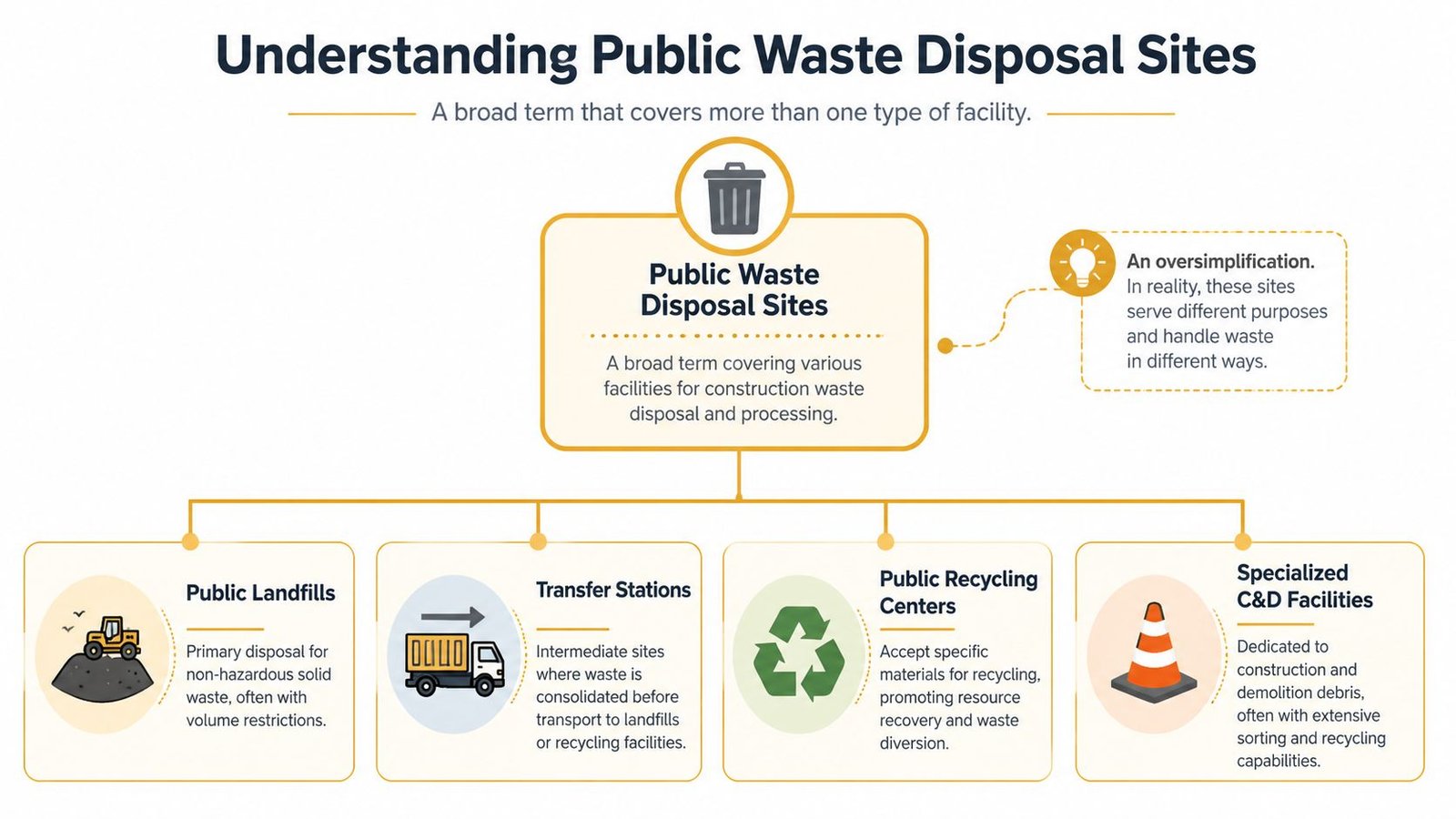
Landfill versus transfer station
A landfill is a final disposal site. A transfer station is a handling point where waste gets consolidated and moved elsewhere. That difference matters in the field.
At a landfill, staff may focus on what's being buried, whether the load contains prohibited material, and whether the waste class matches the permit. At a transfer station, staff may be stricter about sorting, load presentation, traffic flow, and turnaround speed because the material still has to move through another chain.
If you treat a transfer station like a landfill, you can show up with a messy mixed load and get turned away. If you treat a landfill like a generic dump, you can end up bringing material that belongs in a recycling or specialty stream.
Why bin sites confuse crews
Rural and suburban bin sites create a second layer of confusion. They look simple because they are simple for the intended user. But many are meant for household drop-off, limited categories, or local residents only.
Construction crews run into trouble when they assume “public” means “open to any load.” It doesn't. A public-facing site can still restrict commercial vehicles, charge differently for contractor loads, or reject material from outside the service area.
Here's the cleanest way to understand it:
| Facility type | Best fit | Common friction point |
|---|---|---|
| Landfill | Non-hazardous disposal | Mixed loads with banned items |
| Transfer station | Consolidated self-haul waste | Sorting and traffic rules |
| Recycling center | Separated recoverable material | Contamination in the load |
| Bin site | Small local drop-off use | Commercial access restrictions |
Different tools for different jobs
Crews understand this instantly when you compare it to equipment. You wouldn't use a skid steer where a crane is required. You also wouldn't send a concrete pump where a debris box should've been planned.
Use the same logic for disposal. Match the facility to the waste stream before you load the truck, not after you arrive. That single habit cuts most of the friction contractors blame on the site.
If the disposal plan starts with “we'll figure it out at the gate,” the job is already off track.
Finding and Accessing the Right Disposal Site
The fastest way to waste half a day is to rely on memory, a map pin, or a coworker's old recommendation. Disposal access changes by jurisdiction, and the rules that matter most are usually local.
One good example is Massachusetts. As of 2024, MassDEP maintains a list of 247 public dumpster and landfill sites, with 158 active, and those sites processed 14.2 million tons of solid waste in 2023, including 38% construction and demolition debris, according to MassDEP's list of Massachusetts landfills, transfer stations, compost sites, and recycling facilities. That tells you two things. First, construction material is a real part of the public waste stream. Second, the system is formal, regulated, and site-specific.
Where crews should actually look
Start with official sources, not crowdsourced listings.
Use this order:
- County or city public works pages for local facility names, gate addresses, and resident or contractor access rules.
- State environmental agency databases for active facility status and facility type.
- Direct facility phone call to confirm what the website doesn't spell out clearly.
- Maps and routing apps only after the first three steps are done.
A map app can get the truck to the driveway. It can't tell you whether the scale closes before the posted site hours, whether trailers use a separate entrance, or whether your material class is accepted that day.
The five-minute call that saves the trip
Before a truck leaves the site, someone should call and ask a short set of questions. Not ten. Just the ones that decide whether the load moves or sits.
- What material are you bringing. Say it plainly: mixed C&D, clean concrete, drywall, brush, scrap metal.
- Who is hauling it. Some facilities distinguish between resident drop-off and contractor self-haul.
- What vehicle is arriving. Pickup, dump trailer, single-axle, tandem, or vehicle with sideboards.
- What time is the last accepted unload. Not office closing time. Actual unloading cutoff.
- What proof is required. Payment type, ID, account status, permit, or service-area verification.
Access problems crews overlook
Most disposal mistakes aren't dramatic. They're operational.
The trailer is too tall for the route to the unload area. The site accepts concrete but only if it's clean and segregated. The gate takes card only. The commercial entrance is different from the public entrance. The truck arrives in time to get weighed in but not in time to unload.
A foreman who plans disposal like material delivery avoids that. Confirm the facility, confirm the route, confirm the load. Then roll.
Permitted Materials Versus Costly Contaminants
Construction crews usually know the obvious no-go items. The problem lies in the gray zone. Material that looks harmless can still contaminate a load or trigger rejection.
Clean wood, separated metal, uncontaminated masonry, and properly managed drywall are often easier to place than mixed debris. Trouble starts when the load includes residues, liquids, pressure-treated scraps mixed with clean wood, containers with product left in them, or anything that can leak when it shifts.
That's especially true for concrete-related waste. A bucket with slurry residue isn't “just dry mud” if free liquid is still present. The same goes for wet saw-cut fines, rinse water, and washout material. Those wastes don't behave like ordinary solid debris, and disposal sites know it.
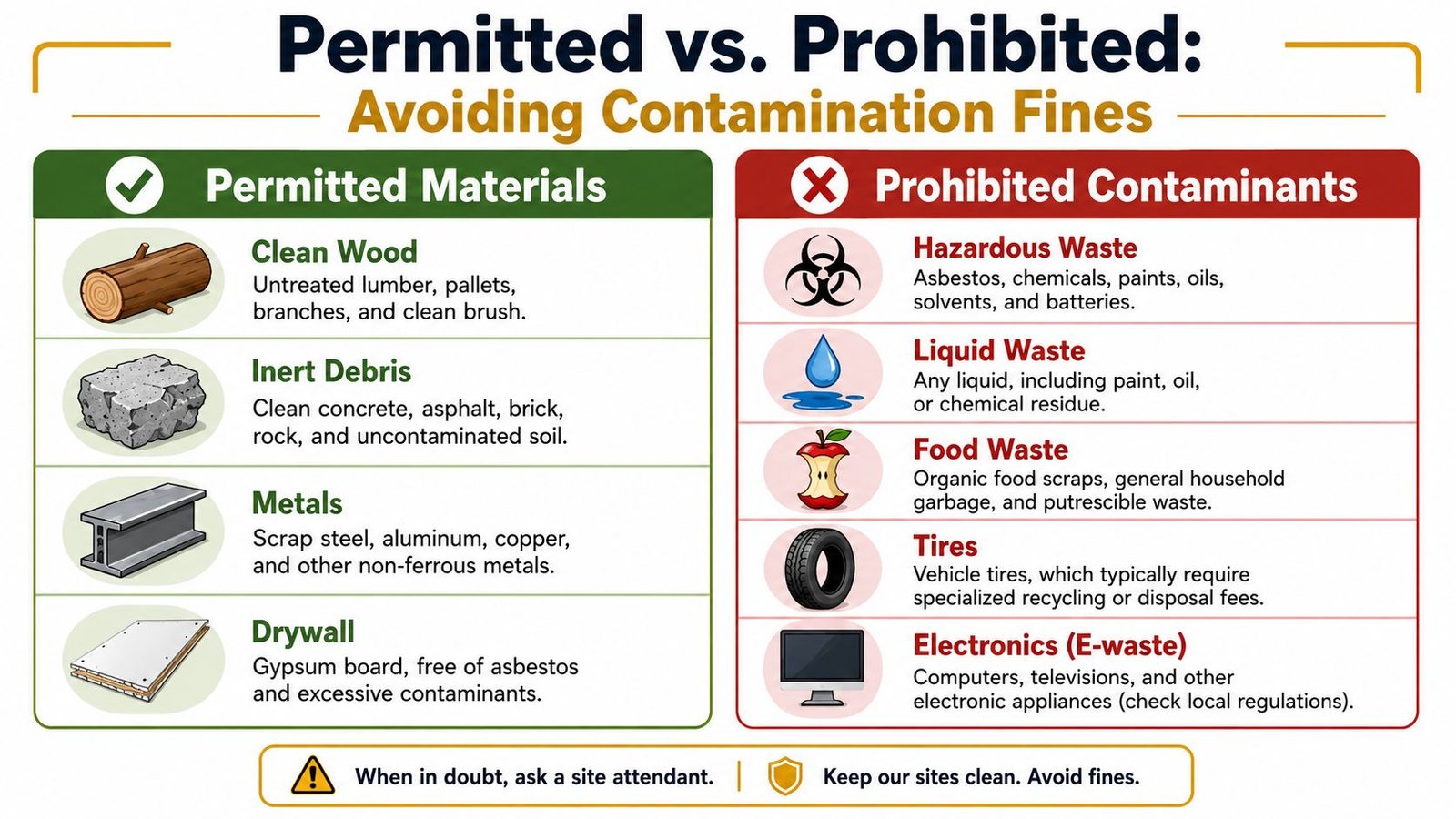
Why sites care about liquids and reactive material
High-quality public disposal sites rely on a composite liner and leachate collection system, and that system must keep leachate depth below 30 cm. A typical design uses a 60-mil HDPE flexible membrane over 2 feet of compacted soil with very low permeability, as described in the solid waste disposal facility criteria technical manual.
That system is built for predictable solid waste. It is not an invitation to dump whatever won't fit back on the truck.
Liquids move. Chemicals react. Fine suspended solids travel differently than broken lumber or clean brick. Once that material enters a disposal cell or handling floor, the operator has to deal with containment, drainage, cleanup, and possible reporting consequences. That's why gate staff get strict when they see wet loads, stained containers, or drums that “probably used to hold something.”
A landfill liner is an engineered control, not a safety net for sloppy waste handling.
A practical field breakdown
Here's how I advise crews to think about common materials before they haul:
Usually manageable if separated
Clean wood, scrap metal, uncontaminated concrete, brick, asphalt, and clean drywall. “Clean” matters more than the material name.Often accepted with conditions
Mixed C&D debris, provided the site accepts contractor loads and the load doesn't include obvious prohibited material.Common rejection items
Paints, solvents, oils, fuel containers, batteries, electronics, tires, asbestos-containing material, and any load with visible liquid.Frequent contractor mistake
Concrete washout residue, slurry, and rinse water. Crews often treat this as harmless because it comes from their own work. Disposal sites don't see it that way.
The hidden contaminant problem
The biggest contamination issues usually come from convenience. Somebody tosses a half-full adhesive tube into the drywall pile. A laborer drops food trash into a clean concrete load. A bucket used for washout gets stacked with general debris because it “looked empty enough.”
That's how a clean load becomes a mixed problem.
If you want public dumpster sites to work for your crew, sort at the source. Don't rely on the disposal site to do classification for you. They'll do it, but you may not like the result.
The Real Risks Liability and Enforcement
Most contractors think the biggest risk is a fine at the gate. That's only the visible part.
The deeper risk is that disposal mistakes don't stay at the disposal site. They come back to the generator, the hauling company, the superintendent, or the subcontractor named on the project paperwork. Once a bad load is tied to a truck, a company, or a jobsite, the problem can follow the chain backward fast.
I've watched this play out in a pattern that's painfully common. A crew mixes prohibited material into what should have been a routine debris run. The site spots it during unloading or after the fact. The operator isolates the load, documents the vehicle, and starts asking where it came from. Suddenly the job isn't dealing with cleanup. It's dealing with records, calls, and a disposal issue that now touches project management and compliance.
Why operators enforce hard
Operators aren't being difficult for sport. Their systems depend on moisture control and surface protection.
EPA guidance for final cover systems requires the cap's permeability to be less than or equal to the bottom liner or natural subsoils, or no greater than 1×10^-5 cm/sec, and illegal dumping that compromises moisture control increases leachate generation, raises operating costs, and increases failure risk, according to EPA guidance on final cover systems. In plain job-site terms, when crews dump the wrong material, the operator inherits a problem that can damage an engineered system.
That's why the response is often immediate. Loads get rejected. Accounts get flagged. Access gets restricted. Staff document plates, company names, and load contents because they have to protect the facility.
Field note: If site staff stop trusting your loads, every future trip gets slower, more expensive, and harder to argue through.
The contractor-side consequences
For a construction business, disposal violations create three kinds of damage at once.
Schedule damage
A rejected load means the truck isn't where it's supposed to be. The crew may be waiting for a vehicle, a cleanup, or a new disposal plan while the clock keeps running.Documentation damage
If the project has compliance requirements, disposal questions can trigger requests for receipts, manifests, logs, and internal explanations that nobody wanted to write at the end of the week.Reputation damage
Owners, GCs, and inspectors don't separate “small disposal mistake” from “sloppy operation” the way crews often do. They see one as evidence of the other.
What enforcement looks like in practice
Enforcement doesn't always start with a citation. Sometimes it starts with a ban from a facility. That can be just as disruptive, especially if that site was the only convenient outlet for a recurring waste stream.
Sometimes it starts with a cleanup order tied to the dumped material. Sometimes it starts with a call to the contractor asking why a load contained something that should never have left the project that way.
The practical lesson is simple. Public dumpster sites are not where you solve uncertainty. They are where uncertainty gets exposed.
Best Practices for Safe and Compliant Dumping
When crews have to use public dumpster sites, a short disciplined routine makes all the difference. The goal isn't perfection. It's to avoid preventable mistakes that create risk, delay, and arguments at the gate.
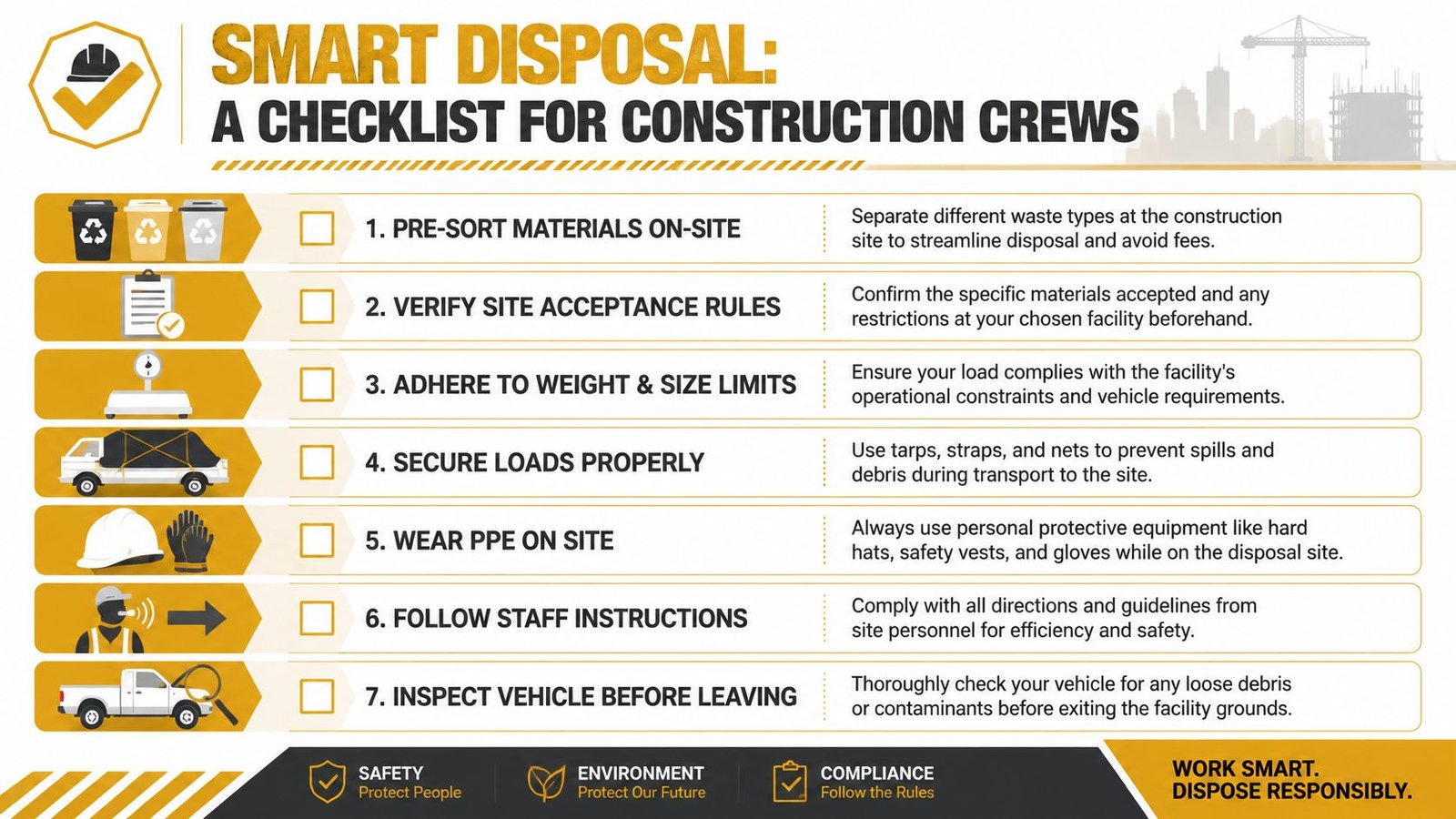
The crew checklist that works
- Sort before loading: Keep clean concrete separate from mixed debris, and keep anything questionable out of the truck until it's identified.
- Secure the load: Use tarps, straps, and sideboard checks so debris doesn't blow off on the road or shift at the scale.
- Bring the right PPE: Gloves, eye protection, high-visibility gear, and work boots still matter at disposal sites. A dump floor is part traffic zone, part industrial yard.
- Know your unload plan: The driver should know which material is coming off first and where the site wants it.
- Have payment and paperwork ready: Don't discover at the window that the facility needs a different payment method or company information.
- Get the receipt and keep it: Proof of disposal matters when questions come up later.
- Inspect the vehicle before exit: Check tailgates, trailer corners, tire areas, and bed rails for loose debris.
What separates smooth drop-offs from messy ones
Crews that move through public sites cleanly usually do one thing better than everyone else. They remove ambiguity.
The load is visibly sorted. The driver knows what's in it. Nothing is leaking. Nothing looks hidden. Nothing requires a debate with the gate attendant.
Keep the load boring. Boring loads unload fast.
That mindset also improves safety. When material is sorted and secured, drivers don't have to climb around a tangled pile looking for a prohibited item, and site staff don't have to stop the line to inspect a mystery load.
Smarter Alternatives for Professional Construction Waste
Public systems handle enormous volume. The EPA reported that public landfills received about 137.5 million tons of municipal solid waste in 2023, with public dumpster sites serving as the primary collection point for an estimated 60% of that volume, as noted in the referenced EPA-linked waste report. That scale is exactly why construction crews should be careful about treating public infrastructure as their default disposal plan for specialized waste.
Public sites are built to process a broad stream, not to solve every job-specific waste problem. They can be workable for routine, properly sorted debris. They become inefficient when the material is specialized, recurring, wet, hard to classify, or operationally sensitive.
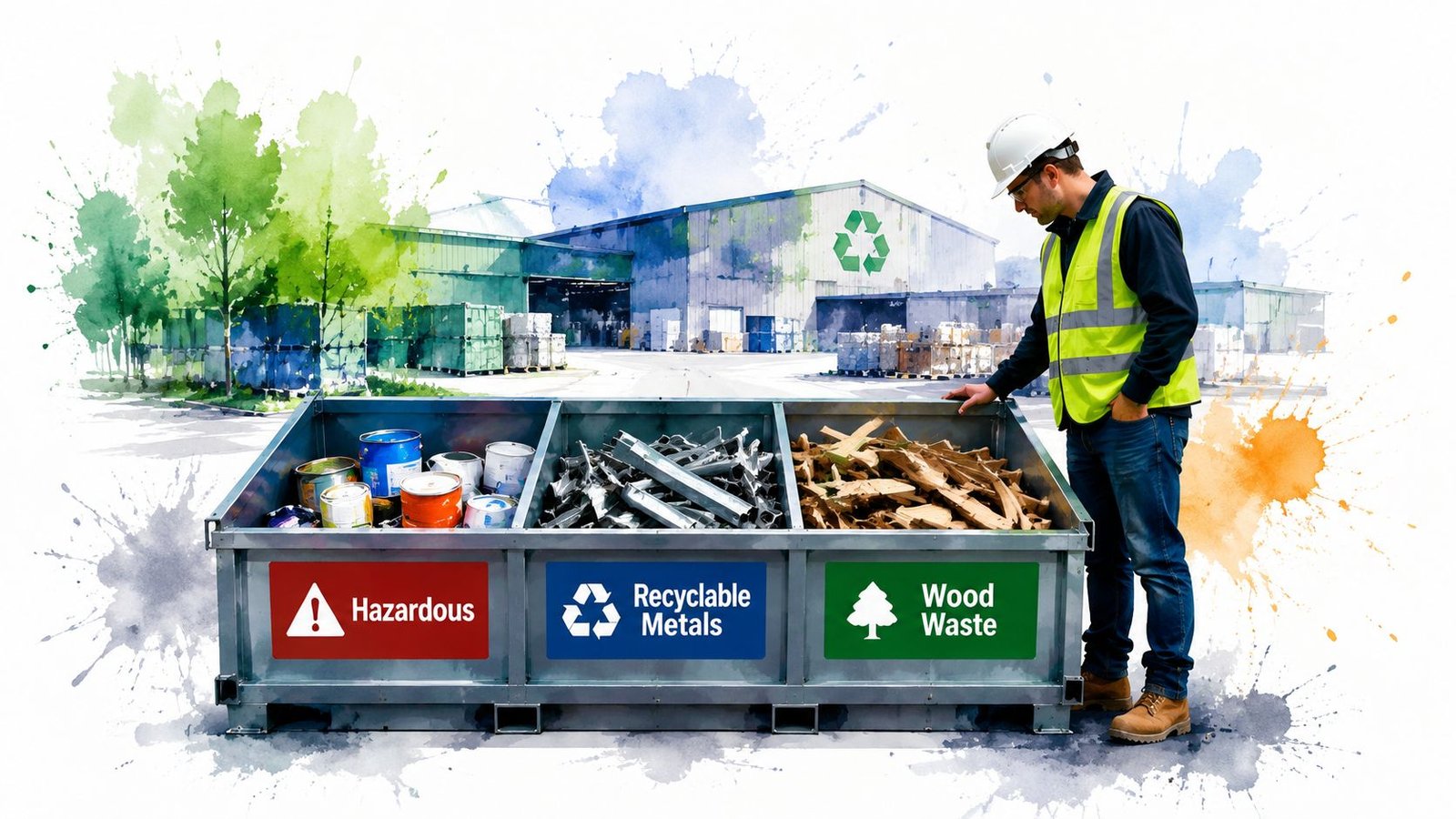
Where dedicated solutions make more sense
For general demolition debris, a dedicated roll-off often beats repeated self-haul trips because it keeps the waste stream on-site and reduces end-of-day scrambling.
For concrete washout, the case is even stronger. Washout isn't just another debris category. It's a controlled waste-handling task. It needs containment, predictable placement, and a disposal path that doesn't depend on a gate attendant making a judgment call over what's sloshing in the back of a truck.
That matters for production as much as compliance. A crew pouring concrete needs a washout plan before the first chute swings, not after the forms are stripped and the bucket is half full.
Better operations usually start earlier
The best disposal decisions happen before material is created. On a well-run site, the superintendent or foreman decides:
- what waste streams will be generated,
- where each one will be staged,
- which ones can use public infrastructure,
- and which ones need dedicated containment.
That approach is also more responsible. Public disposal access varies a lot by location, service category, and practical convenience, so relying on public options alone doesn't always produce consistent or equitable access across jobs and communities. Dedicated containers reduce some of that guesswork because the solution is brought to the site instead of pushed onto whatever local public option happens to be closest.
For professional crews, that's the dividing line. Public dumpster sites are a tool. They are not a waste strategy.
If your crew needs a more reliable way to handle concrete washout and keep the site clean, Reborn Rentals offers specialized washout containment with clear pricing, straightforward scheduling, and delivery options built for active construction projects. It's a practical way to avoid end-of-day disposal guesswork and keep slurry contained where it belongs.