Best Roll Off Dumpster for Concrete: 2026 Disposal Guide
If you're pricing a slab demo, a driveway tear-out, or a small foundation removal, the first question usually sounds simple. What size roll off dumpster for concrete do I need?
On a real job site, that question splits in two fast. One waste stream is cured concrete rubble. That usually can go in a roll-off if you size and load it correctly. The other is wet concrete washout and slurry. That is a different material, a different compliance issue, and a different container altogether.
A lot of costly mistakes happen because crews treat both materials the same. They aren't. If you want to keep the job moving, avoid surprise charges, and stay out of trouble with stormwater compliance, you need to separate solid concrete disposal from washout containment from the start.
Choosing the Right Roll-Off for Cured Concrete Rubble
For solid, broken, fully cured concrete, a roll off dumpster for concrete is the standard tool. The catch is that concrete is a weight problem long before it's a space problem.

According to guidance on concrete dumpster rental pricing, concrete weighs approximately 4,000 pounds (2 tons) per cubic yard, and roll-off dumpsters used for concrete are generally subject to a 10-ton maximum weight capacity. That same guidance notes that even a 10-yard container can only take about 2.5 cubic yards of concrete before hitting its weight limit. That's why crews who order by volume instead of by material type get burned.
Why the 10-yard lowboy is usually the right call
For concrete, the safest default is usually a 10-yard lowboy dumpster. It's lower to the ground, easier to load with a skid steer or mini ex, and built around the reality that heavy debris needs manageable load height.
Larger boxes don't solve the weight issue. They give you more wall height and footprint, but they still have to travel legally and safely. For concrete rubble, extra cubic yards can create false confidence and bad loading habits.
Practical rule: For concrete, choose the container around weight compliance and loading safety, not around how much space the box appears to offer.
Here's the basic decision logic:
- Small slab or patch removal: A 10-yard lowboy usually makes the most sense because crews can load dense material without stacking it dangerously high.
- Multiple demolition phases: Plan on more than one haul instead of trying to make one oversized box do everything.
- Mixed debris jobs: Keep concrete separate from lighter demolition waste when you can. Separation makes hauling and downstream disposal simpler.
Load by weight, not by how full it looks
Concrete fools new project managers because the box may look underfilled while already pushing the legal load. That's where overages, reloads, and pickup delays start.
A good field approach is to estimate the concrete volume from the work area before the dumpster arrives. Then translate that into weight. If the tear-out includes thickened edges, footings, or chunks with mud attached, leave more margin than you think you need.
A few loading habits make a big difference:
- Break oversized pieces down first. The same rental guidance recommends limiting concrete pieces to 18 inches by 18 inches for efficient loading and handling in concrete dumpsters.
- Load flat and even. Start at the floor of the container and spread the weight rather than creating one high mound.
- Keep rebar and protruding metal under control. Exposed steel slows loading and can create handling issues during transport.
- Protect the approach path. A loaded concrete dumpster is hard on asphalt, curbs, and soft subgrade.
What works and what doesn't
A simple comparison helps.
| Job site approach | Result |
|---|---|
| Ordering a lowboy specifically for cured rubble | Better loading access and fewer weight surprises |
| Estimating by cubic yards alone | Missed weight limits and avoidable overage problems |
| Separating clean concrete from mixed demo debris | Cleaner disposal stream and fewer downstream complications |
| Tossing in soil, trash, and wet material with rubble | More confusion, more handling issues, more cost exposure |
One more thing matters on bid day. The roll-off market overview notes that the global roll-off dumpster industry is projected to reach $998.9 million by 2033 at a 6.8% CAGR, that the U.S. industry comprises 351 businesses and grew at a 4.5% CAGR between 2020 and 2025, and that concrete is the single largest material in the construction and demolition debris stream by weight according to the EPA. It also identifies the 10-yard dumpster as the most popular size for concrete disposal, with typical rental costs ranging from $300 to $795 depending on location. That lines up with field reality. Concrete disposal is common, but it only goes smoothly when the container is chosen for density, not convenience.
Why Wet Concrete and Slurry Cannot Go in a Roll-Off
A lot of jobs go sideways when crews finish a pour, rinse tools, wash out a chute, or dump leftover wet mud into the same container holding cured rubble. That isn't a minor mistake. It's a compliance problem.
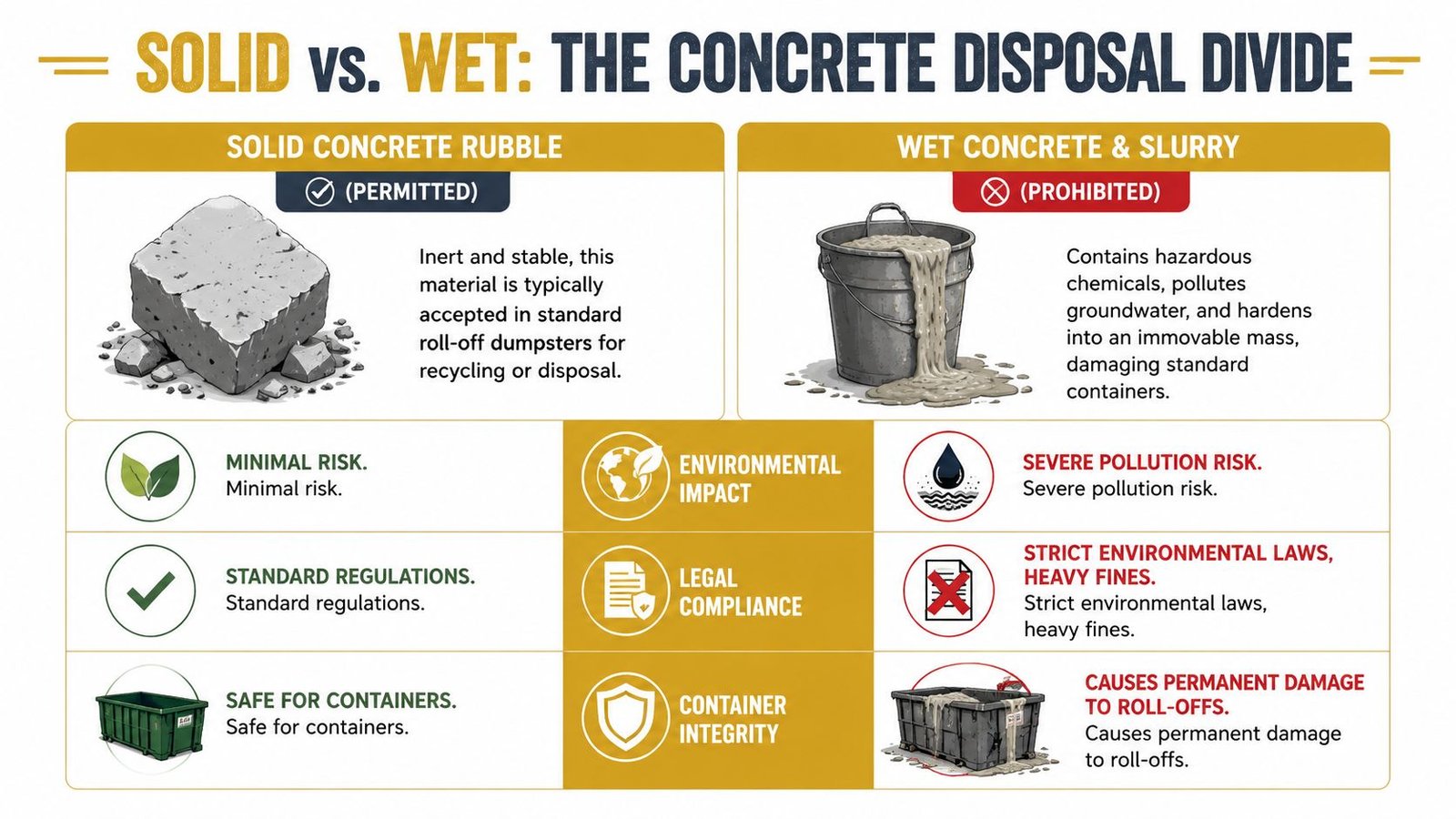
The key distinction is simple. Cured concrete rubble is a solid material. Wet washout and slurry are liquid or semi-liquid waste streams that can escape, run off, and contaminate drains or soil. A standard roll-off isn't the right containment system for that.
According to industry guidance on concrete disposal restrictions, a major knowledge gap in the field is that wet slurry cannot go into a standard dumpster, and that mistake can trigger SWPPP violations with potential fines exceeding $10,000 per day in some jurisdictions. That's not a paperwork issue. That's money, schedule, and owner confidence on the line.
Why the material is treated differently
Solid rubble sits where you place it. Slurry doesn't. It flows, leaks, splashes, and hardens where it shouldn't.
Once slurry gets loose on a site, several problems show up at once:
- Stormwater exposure: If wash water reaches a drain path, you've created a reportable issue on many projects.
- Container damage: Standard roll-offs aren't intended to serve as leak-proof washout systems.
- Cleanup drag: Wet concrete doesn't stay a simple cleanup item for long. It hardens in corners, on pads, and around access routes.
- Inspection risk: If a site inspector sees improper washout control, the conversation gets serious fast.
Wet concrete washout isn't just “messy concrete.” It's a separate waste stream that requires deliberate containment.
What crews get wrong in the field
The most common failure isn't malice. It's shortcut thinking.
A foreman sees an open-top box on site and assumes it can take anything related to concrete. Then the pump crew rinses into it, laborers dump slurry buckets into it, and everyone moves on to the next task. By the time someone notices runoff, hardened residue, or a complaint from the site superintendent, the problem is bigger and more expensive to fix.
Here's the practical distinction:
| Material | Standard roll-off | Compliance risk |
|---|---|---|
| Cured concrete rubble | Typically acceptable when loaded correctly | Routine hauling and weight compliance |
| Wet concrete washout | Not appropriate | Stormwater and environmental exposure |
| Slurry and rinse water | Not appropriate | Leakage, runoff, and violation risk |
Why this matters to schedule, not just compliance
Improper washout handling can stop a job in ways people don't account for. Cleanup crews get pulled off production work. Site access gets restricted. Inspectors want corrective action. Haulers may refuse contaminated loads. The concrete work is done, but the site still can't move cleanly into the next phase.
That's why a roll off dumpster for concrete should never be treated as the answer for every concrete-related waste stream. For cured rubble, yes. For wet washout, no. Keeping that distinction straight is one of the easiest ways to avoid preventable fines and keep the project moving.
The Right Tool for the Job Specialized Washout Containers
Once wet concrete enters the picture, the correct answer is a specialized washout container, not a standard roll-off. This is one of those areas where purpose-built equipment matters because the wrong container creates risk even when the crew has good intentions.
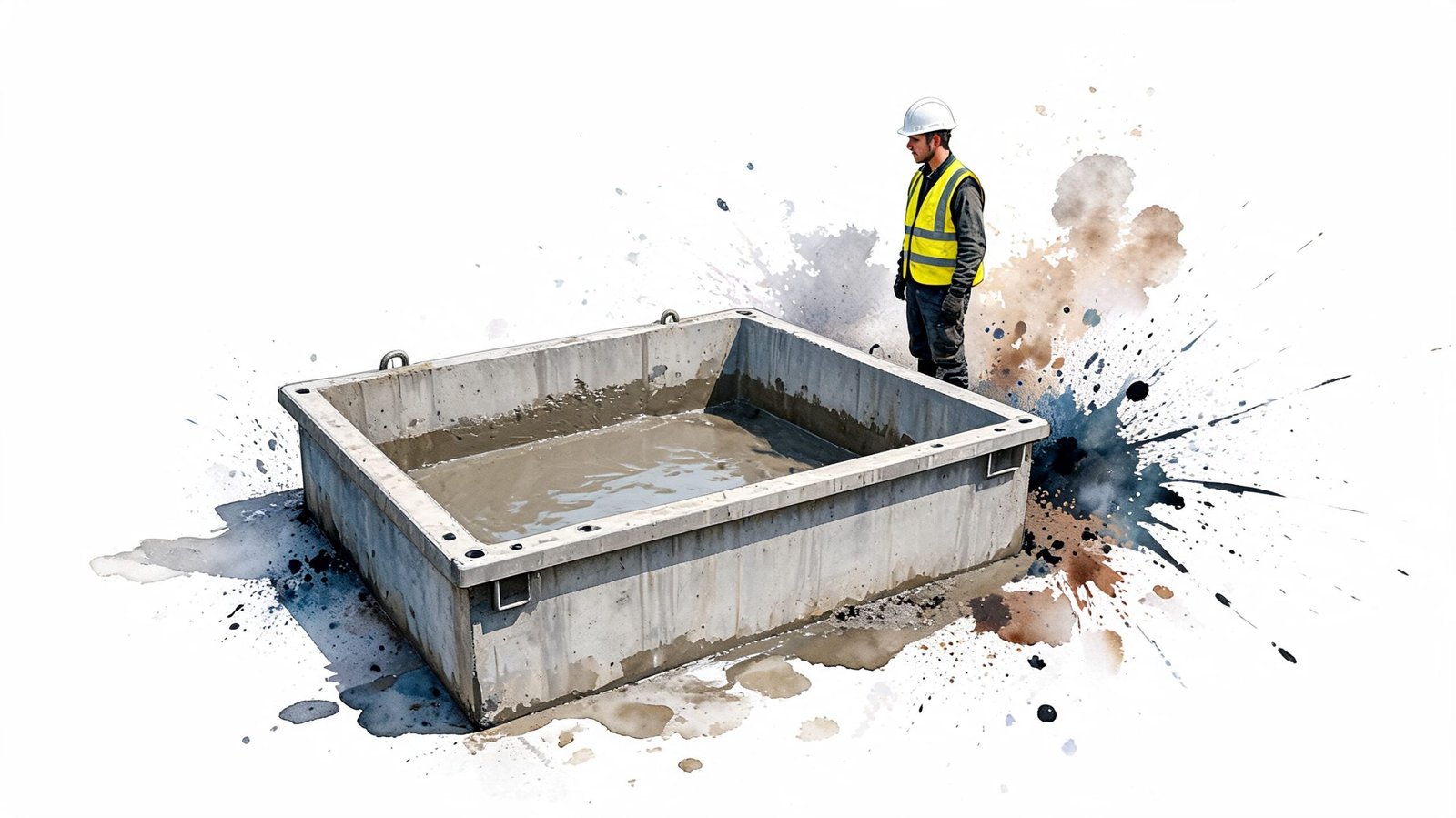
The reason is containment. Washout systems have to hold liquid residue, slurry, and solids without leaking into the ground or toward a drain path. They also need enough capacity that crews don't improvise when the pan starts getting full.
Best-practice washout guidance points to dedicated, leak-proof washout pans as the standard approach for concrete projects. That guidance cites pans with dimensions such as 72' x 72' x 24', providing about 441 gallons of capacity, used to support Clean Water Act protocols and SWPPP requirements.
What to look for in a washout container
Not every basin on a site is a compliant washout solution. The details matter.
A proper container should solve for these job site realities:
- Leak-proof construction: If slurry can seep out, the pan has already failed its main purpose.
- Sufficient liquid capacity: Crews need room for rinse water, not just hardened residue.
- Structural strength: Washout gets heavy. The container has to carry that load without deforming or becoming unsafe to service.
- Predictable servicing: A good setup includes planned removal or swap-out before overflow becomes a risk.
Those points sound basic, but they are exactly where jobs get lazy. Someone sets a makeshift basin near the pour, nobody tracks fill level, and overflow becomes an afternoon problem.
Field note: Put the washout solution in place before the first truck arrives. Once the pour starts, crews will use the closest available option.
Placement matters as much as the container
The right pan in the wrong spot still creates trouble. Placement should support both workflow and compliance.
Good placement usually means:
- Away from drains and runoff paths. If water leaves the containment area, you've lost control of the waste stream.
- Close enough to the work area for crews to use it. If the washout point is inconvenient, people will improvise.
- On a stable surface. The pan needs to sit level and remain accessible for service.
- Visible to the crew and subs. If only one supervisor knows where washout goes, someone will rinse out in the wrong place.
Why separation saves headaches
Keeping solid rubble in one stream and washout in another does more than satisfy compliance. It keeps the site cleaner, the hauling cleaner, and the closeout easier. When containers are dedicated to one purpose, the crew doesn't need to guess what goes where.
That clarity matters most on busy sites with multiple trades. Concrete finishers, pump operators, laborers, and cleanup crews all need the same instruction. Rubble to the roll-off. Slurry to the washout pan. If the setup reflects that clearly, site behavior usually follows.
On-Site Best Practices for Concrete Waste Management
Good concrete waste management isn't complicated, but it does require discipline. The fastest crews aren't the ones reacting to a full box, an overflowing washout, or an inspector's complaint. They're the ones who set the site up right before demolition or pouring starts.
The biggest operating mistake is loading by sight. According to roll-off loading guidance for demolition projects, a common pitfall is judging concrete loads by visual fill even though a dumpster that appears only half-full can already exceed its 10,000 to 14,000 pound limit for concrete. That same guidance recommends proactive swap plans with smaller containers rather than trying to force a single overloaded haul.
Separate the waste streams on day one
Set two clearly defined zones before work begins:
- Solid rubble area: For cured concrete, broken slab, block, and similar debris going to the roll-off.
- Washout area: For chute rinse, tool rinse, slurry, and leftover wet mud going to the dedicated containment system.
Don't leave this to verbal instruction alone. Mark the areas, brief the crew, and remind subs at the start of the shift. On a busy site, the physical layout drives behavior more than a toolbox talk does.
Use a swap plan instead of chasing one perfect load
A swap plan is simple. You accept that concrete-heavy work will likely need multiple pulls, and you build that into logistics from the start.
That works better than trying to stretch one container because:
| Approach | What usually happens |
|---|---|
| One big box, loaded until it “looks right” | Weight surprises, delayed pickup, overage fees |
| Smaller concrete-focused containers on a swap schedule | Predictable hauling and cleaner staging |
| Mixed debris dumped into the same box | Slower sorting and less control |
| Dedicated concrete loads | Easier loading discipline |
On larger removals, I prefer a plan where the next container is already scheduled before the first one is close to cutoff. That keeps the breaker crew and machine operators moving instead of standing around a full can.
Don't let a demolition crew decide haul timing by looking over the side wall of the dumpster.
Loading and placement habits that keep the job moving
A few basic habits do most of the work:
- Set the roll-off where equipment can reach it cleanly. Tight turns and long pushes with a skid steer waste time.
- Keep the approach stable. Soft ground around a heavy debris box creates rutting and slows haul exchange.
- Load the base evenly. Uneven loads travel poorly and create handling issues.
- Watch contamination. Soil, trash, and wet material mixed into the concrete stream make everything messier downstream.
- Coordinate service with the actual work plan. If demo is scheduled for the morning and pickup can't happen until late the next day, you've created your own bottleneck.
Make one person accountable
Concrete disposal gets sloppy when everyone assumes someone else is watching it. Assign one person to monitor the roll-off and one person to monitor washout. On smaller crews, that may be the same superintendent or lead laborer. What matters is ownership.
If nobody owns the waste stream, the site starts making decisions one shortcut at a time. That's when costs climb and the schedule starts slipping over issues that were easy to prevent.
Partnering with Reborn Rentals for Compliant Projects
Most rental problems on concrete jobs come from two blind spots. First, teams assume every concrete-related waste can go into the same container. Second, they don't get clear pricing and scope expectations up front. Both mistakes lead to friction when the site is already under pressure.
That is why contractors need a rental partner that understands the difference between cured rubble disposal and washout containment. A standard dumpster vendor may handle the first part well enough. Concrete washout is where specialization starts to matter.

The budgeting issue is real. As noted in guidance on hidden dumpster rental costs, contractors often run into unexpected overage charges because concrete reaches weight limits faster than the container size suggests, and that pain point is better addressed by providers using transparent, upfront daily pricing models. That kind of pricing clarity matters when a project manager is trying to coordinate pours, cleanup, haul timing, and closeout without getting surprised on the back end.
What a useful rental partner should solve
A good provider shouldn't just drop equipment and disappear. They should reduce uncertainty in the field.
For concrete-related work, that means the provider should help you answer practical questions such as:
- Which container is for solid rubble and which is for washout?
- What capacity fits the pour schedule and crew size?
- What service timing keeps the containment from becoming a problem?
- What site conditions could change delivery or handling?
Those questions sound routine, but they are what separates a clean operation from a site that improvises under pressure.
Why Reborn Rentals fits the real job site need
Reborn Rentals is built around the part many vendors gloss over, which is concrete washout containment. That matters because washout isn't a side issue on concrete work. It's a required part of doing the job cleanly.
From an operations standpoint, a few things stand out:
| Need on site | Why it matters | Reborn Rentals approach |
|---|---|---|
| Clear pricing before the rental starts | Helps PMs budget accurately and explain costs internally | Upfront daily pricing starting at $25/day |
| Equipment sized for concrete washout | Prevents makeshift containment and confusion | Catalog centered on dedicated washout pans and containers |
| Capacity that matches active concrete work | Reduces overflow risk and ad hoc dumping | Options include 72' x 72' x 24' units at about 441 gallons and 72' x 72' x 14' units at about 310 gallons |
| Fast communication | Keeps pours and cleanup from waiting on admin | Support through Messenger, WhatsApp, email, QR contact sharing, and callbacks |
The checkout flow also fits how field teams work. A simple sequence of cart, details, and checkout is easier to manage than a drawn-out quoting process when a superintendent needs dates, location, and delivery confirmed without a pile of back-and-forth.
Where transparent pricing helps most
Concrete work rarely unfolds on a perfect script. Access changes. Terrain changes. Delivery windows tighten. Sometimes a project needs a container longer than expected because another trade slipped.
Reborn Rentals is useful here because the company doesn't hide the fact that certain site conditions may affect charges. Notes around delivery, rough terrain, and express orders help the customer plan around those variables early instead of discovering them after service is complete.
Clear rental terms don't just protect the vendor. They protect the project manager who has to defend the budget and keep the crew moving.
That transparency matters most on jobs with multiple decision-makers. If you're coordinating with a superintendent, a SWPPP consultant, a concrete sub, and an owner rep, you need less ambiguity, not more. You want a provider that spells out what the equipment is for, how the rental works, and what site conditions can affect service.
The bigger advantage is operational clarity
The best part of working with a specialist isn't just the product. It's that the whole site starts making better decisions. When the crew has a proper washout pan, there is less temptation to misuse a roll off dumpster for concrete. When pricing is clear, there are fewer end-of-month surprises. When communication is easy, field problems get solved before they turn into schedule problems.
That is the value of specialization on concrete jobs. It keeps waste streams separate, compliance cleaner, and execution tighter.
If your project includes both cured concrete rubble and active concrete washout, get the setup right before the first truck or breaker shows up. Reborn Rentals helps contractors secure dedicated washout containment with clear upfront pricing, practical support, and equipment built for compliant concrete work.