Site Access Requirements: A Contractor’s Delivery Guide
A delivery truck shows up on time. The rental is on the deck. The crew is waiting. Then the driver stops at the entrance, gets out, looks once, and says the same thing site teams hear every day: it's not going in there.
Maybe the gate opening looked wide enough from the street but the swing gate steals clearance. Maybe the ground at the drop zone turned soft after irrigation ran overnight. Maybe a dumpster, temporary fence panel, or stack of material narrowed the path just enough that the truck can't complete the turn without clipping something. None of that feels like a major planning miss until the driver has to leave with the equipment still loaded.
That's when a routine delivery turns into a jobsite problem. Crews wait. Concrete work shifts. A pump, washout container, forklift, or mini-excavator lands a day late and pushes other trades behind it. Most of these failures aren't caused by dramatic mistakes. They come from small assumptions about site access requirements that nobody tested before the truck rolled.
The Cost of a Failed Delivery
The ugliest delivery failures are the ones that almost work.
A driver can reach the site, clear the neighborhood, and line up at the entrance. The truck may even nose through the gate. Then the trailer off-tracks into a curb, the rear tires sink near the placement area, or the unload zone turns out to be blocked by material that was moved there the night before. At that point, the job has already spent time and money, but nothing has been delivered.
The direct loss is obvious. The truck is tied up. The crew is standing by. The schedule starts moving in the wrong direction. The indirect loss is worse because it spreads. One failed equipment drop can throw off the pour sequence, inspection timing, labor planning, and follow-up deliveries that were stacked tightly to keep the project moving.
What failure usually looks like in the field
On active sites, failed access usually comes from one of a handful of preventable misses:
- The approach looked fine on paper: The map showed an entry route, but nobody checked parked cars, narrow curb returns, or how the truck would square up before the gate.
- The landing zone wasn't ready: The space was reserved in theory, but another subcontractor filled it with pallets, spoils, or fencing.
- The ground was treated like a minor detail: A level-looking area can still rut, settle, or break down under a loaded truck.
- The exit path got ignored: Teams focus on getting the truck in. The harder problem is often getting it back out cleanly.
A site isn't ready just because there's a place you want the equipment to go. It's ready when a truck can enter, unload, and leave without improvising.
That's the practical side of site access requirements. They aren't just design notes or permit language. They control whether rented equipment reaches the point of use without chewing up half a day and creating a safety problem in the process.
Why Site Access Is More Than an Open Gate
A lot of teams still treat site access as a yes-or-no question. Is there a gate? Is the driveway open? Can the truck get in? That's too shallow to be useful.
Real access planning is a risk-control job. You're checking whether the route works at the specific hour of delivery, under the site conditions that exist that day, with the truck and load that are present. That's a different standard than “there's usually enough room.”
The gap in most guidance is easy to recognize. As Castle Pines access requirements guidance notes, most public guidance focuses on permanent driveway geometry, sight distance, and permit criteria, but it rarely answers the question contractors ask: what site conditions must exist on the day the truck arrives? That matters because access rules can depend on road classification, whether access is private or public right-of-way, and whether deviations need a permit or special approval.
The operational view that actually matters
When a logistics plan works, it usually includes four things that don't show up on a basic sketch:
A confirmed route in and out
Not just the property line. The truck's full approach from the street, including where it stages before turning.A usable unload zone
Clear, stable, and protected from last-minute site clutter.Control over people flow
Workers, visitors, and pedestrians can't be allowed to drift through the truck path when the driver is backing or swinging wide.A fallback plan
If the first drop point fails, the team needs a second option that doesn't create a bigger problem.
What works and what doesn't
What works is boring. One person owns the delivery. That person confirms measurements, route conditions, who opens the gate, where the truck waits, and where the equipment lands.
What doesn't work is group assumption. The superintendent thinks the foreman checked it. The foreman thinks the rental yard knows the truck dimensions. The driver assumes someone on site will guide the last hundred feet. That's how a simple rental turns into a stalled truck on a live street.
Practical rule: Treat temporary equipment delivery like a short-duration operation with its own access plan, not like an errand tucked into the day.
That shift in mindset saves jobs from preventable delays.
Assessing Ground Conditions and Placement Options
The first question isn't whether the truck can reach the site. It's whether the site can carry the truck and the load where you want it placed.
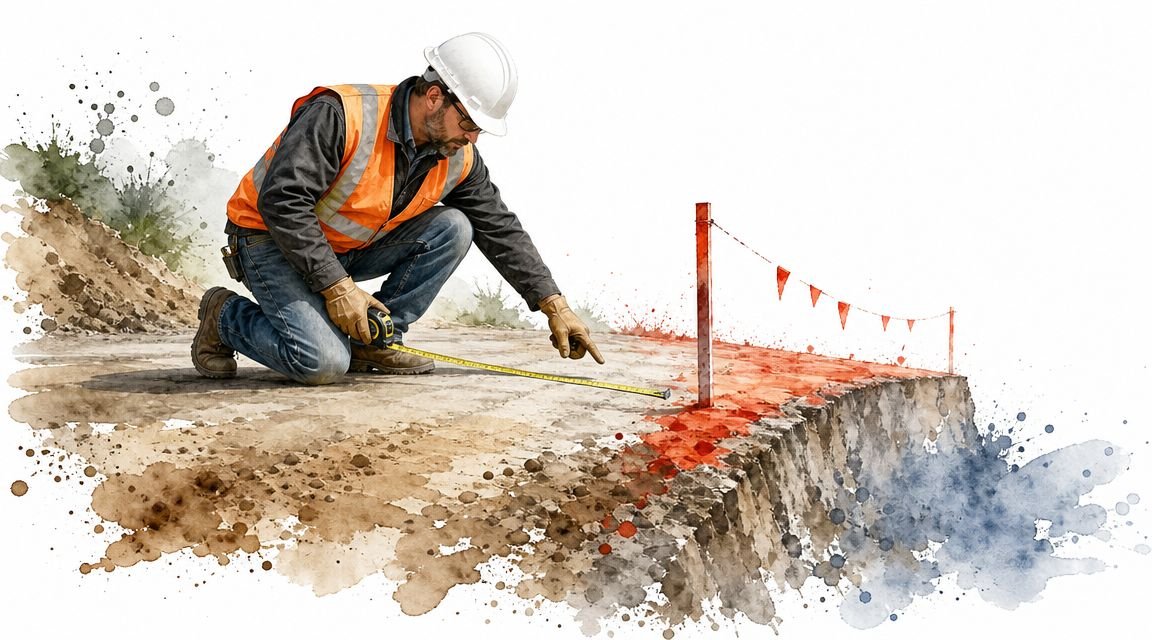
Walk the route and the drop zone in person if you can. Photos help, but they flatten grade, hide soft edges, and make overhead conflicts look farther away than they are. A delivery area that seems fine from a phone picture can fail fast once a loaded truck starts turning its weight into the soil.
Start with the ground, not the equipment
Crews often look for a flat patch and stop there. That's not enough. You need to know whether the full path and final placement area stay stable under truck traffic.
Check these conditions before you book the delivery window:
- Surface type: Compacted gravel behaves differently than loose fill, wet clay, fresh landscaping, or recently backfilled utility trenches.
- Edge stability: The center of a route may feel firm while the shoulder breaks away under a trailer tire.
- Water issues: Hose runoff, washdown, irrigation, and low spots can soften an area overnight.
- Grade transitions: A truck can high-center or drag where pavement meets a steep apron or rough temporary ramp.
Then check the things above and below
Overhead conflicts are easy to overlook because the truck may arrive unloaded or with a low profile, then change position during unloading. Look for utility lines, tree limbs, scaffold outriggers, temp lighting, and balcony projections.
Underground risk is quieter but just as expensive. Septic systems, irrigation, vaults, utility boxes, and poorly marked trench repairs can all sit below what looks like an acceptable route. If you don't know what's under the path, don't guess.
A practical site walk should answer three questions:
| Question | Why it matters | What to verify |
|---|---|---|
| Can the truck reach the drop point? | Route failure stops the delivery before unload | Width, turning room, slope, obstructions |
| Can the truck stand there safely? | Placement failure can damage property or trap the truck | Ground firmness, level area, shoulder stability |
| Can the truck leave without backing into chaos? | Exit problems create the longest delays | Clear reverse path, traffic control, material storage |
Don't block the pedestrian path
Temporary operations create their own access conflicts. A perfect staging area for equipment can still be the wrong choice if it cuts off the path people need to use. Federal pedestrian access guidance emphasizes accessible routes to parking areas and entrances free of barriers like bollards, grates, steps, and other obstructions. On active jobs, temporary fencing, dumpsters, washout areas, and staged equipment are common causes of blocked access.
That's where a lot of site teams get burned. They solve the truck problem by creating a people-flow problem.
If the proposed drop zone sits across the natural pedestrian route, pick a different zone or establish a protected temporary path before delivery starts.
Mastering Vehicle Clearances and Turning Radii
Most access mistakes happen because teams measure the opening and ignore the geometry around it.
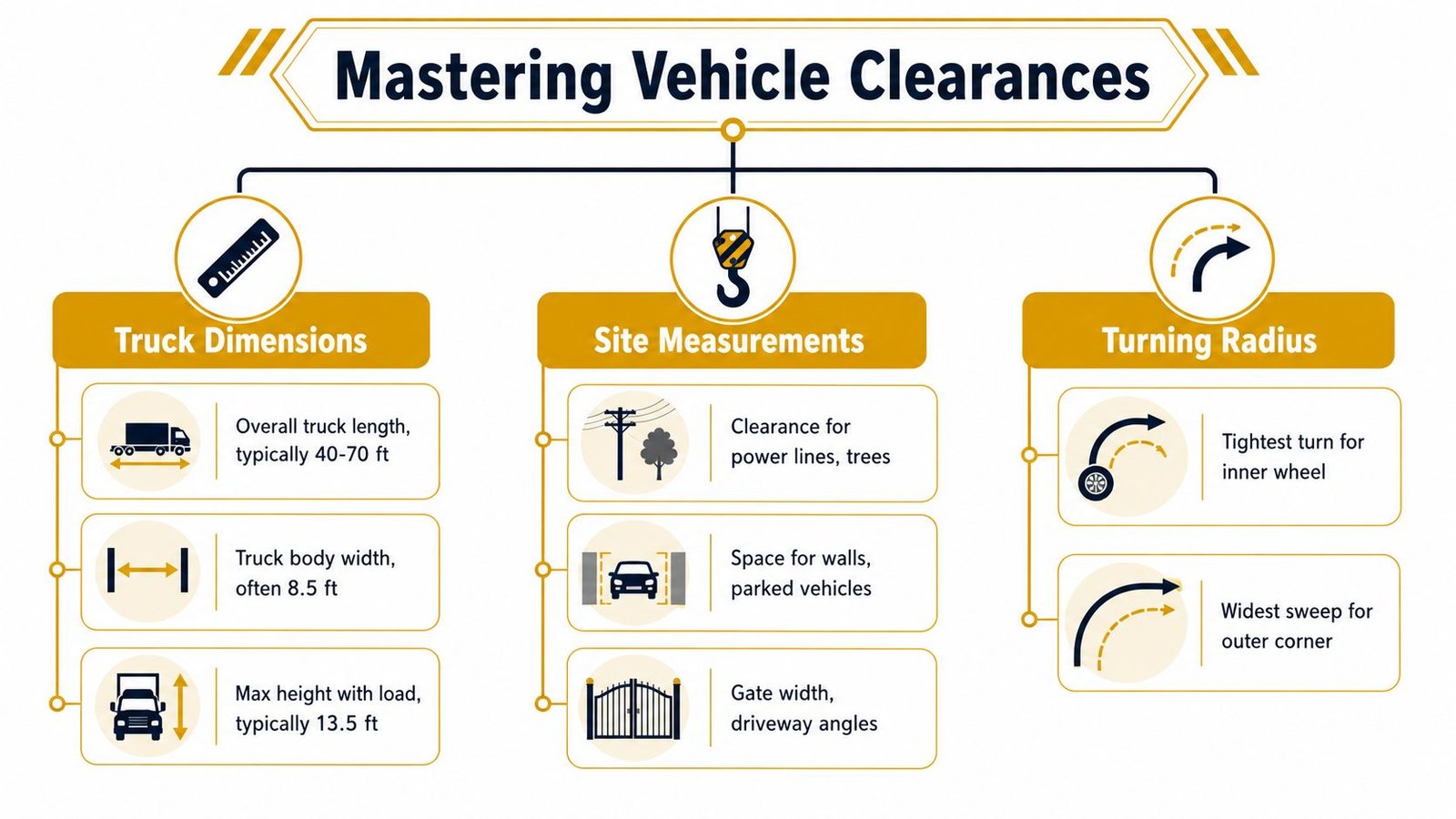
A gate can be wide enough on paper and still be unusable. The truck doesn't teleport through the opening. It approaches at an angle, the trailer tracks inside the turn, and the rear corner swings wider than people expect. That's why experienced drivers hesitate at entrances that look “big enough” to everyone else.
Measure the usable opening
Start at the gate, but don't stop at the gate.
You need the effective clearance, not the nominal opening. That means accounting for gate leaves, posts, hardware, fencing returns, bollards, and anything parked or stored near the entrance. If a swing gate sits open but intrudes into the turning path, count that as lost space. If the driveway narrows inside the property line, measure that pinch point too.
Use this field sequence:
Street approach width
Can the truck line up for the turn without crossing into parked vehicles, opposing traffic, or fixed objects?Entrance opening at the narrowest point
Measure between the true obstructions, not decorative edges or fence lines.Inside recovery area
After the truck clears the gate, is there enough space to straighten out?Final path width to the drop zone
Watch for stacked material, temp power, site fencing, and parked machines.
Understand off-tracking
Off-tracking is what causes the trailer wheels to cut inside the path of the tractor during a turn. That's why a truck that clears the front end through a gate can still drag the rear tires into a curb, wall, or soft shoulder.
The other side of the problem is tail swing. As the truck turns, the rear corner can sweep into fence lines, poles, parked pickups, and people who thought they were standing clear.
If you only measure the truck's width, you're checking the wrong dimension. Turning space is the issue that usually decides whether the delivery succeeds.
Don't ignore slope and route shape
Grade matters more than often acknowledged. The Access Board's accessibility guidance states that the running slope on accessible walking surfaces cannot be steeper than 1:20, which makes route geometry and grade control a practical constraint in layout planning. The same reality shows up during temporary deliveries. An approach that breaks sharply or tilts across the truck path can reduce traction, shift load behavior, and limit the driver's ability to maneuver cleanly.
That doesn't mean every truck route is an accessible path. It means the same geometric discipline applies. Smooth transitions and controlled grades work better than abrupt improvised ones.
A simple field check before delivery
Use this quick comparison before you confirm the drop:
- Good candidate: Straight approach, clean gate opening, room to recover inside, firm ground, no overhead conflict.
- Borderline candidate: Tight entry angle, one choke point, limited staging room, but manageable with spotters and clear controls.
- Bad candidate: Blind backing from a busy street, soft shoulder, overhead obstruction, pedestrian conflict, or no exit plan.
Borderline sites can still work. But they only work when somebody measures first and controls the move instead of hoping the driver “figures it out.”
Navigating Permits Insurance and Communication
A truck can have the right route, the right equipment, and an experienced driver, then still get turned away at the curb because nobody cleared the street use with the city or sent the COI in the wording the site required. That is a common failure point on short-term rental deliveries. The move is temporary, but the approval problems are very real.
If the unload touches a sidewalk, curb lane, alley, fire lane, or any other part of the public right-of-way, verify the requirement before dispatch. Short duration does not automatically mean exempt. On rental jobs, this gets missed because the equipment is only on-site for a few days or weeks, and the team treats delivery like a quick drop instead of a controlled street operation.
Document the plan like it matters
The paperwork standard has tightened across industries. In the federal public access policy summary, the Institute of Education Sciences states that applications will require “a digital persistent identifier for all key personnel listed in the application” starting in FY2024, and “a data management and sharing plan for all application types” starting in FY2025. Different field, same lesson. If a process affects access, agencies and site owners increasingly expect the details in writing and on time.
Temporary equipment logistics works the same way in practice. A superintendent may know the plan. The driver does not. The dispatcher only sees what was written down. If the gate code, permit reference, approved staging area, or insurance contact lives in somebody's memory, the delivery is exposed.
A clean delivery file prevents that. It also gives the rental company something usable when conditions change an hour before arrival.
What to gather before dispatch
A workable handoff to the rental company usually includes:
- Site contact information: Name, mobile number, and who has authority to redirect the truck if conditions change.
- Delivery window details: Date, gate hours, lunch restrictions, quiet-hour limits, and whether school traffic or tenant movement affects timing.
- Entry instructions: Correct gate, approved street approach, and the direction the truck should face on arrival.
- Placement note: Exact drop location, plus a backup location if the primary area is occupied.
- Administrative items: Certificate of Insurance requirements, site-specific insurance wording if needed, and permit confirmations tied to curb use, lane occupancy, or staging.
What to tell the dispatcher
“Call when close” is not dispatch information. It is how trucks end up circling the block or parking where they should not.
Give the dispatcher the details the driver can act on:
| Item to confirm | What good looks like |
|---|---|
| Arrival contact | One person answers the phone and meets the truck |
| Gate access | Gate is open and clear before arrival |
| Route note | Driver has the correct street and approach direction |
| Drop point | Marked and free of materials |
| Special constraints | Narrow turn, school zone, active pedestrians, temp fencing, or restricted street use noted in advance |
Keep the handoff brief and specific. Drivers need the route, the contact, the restrictions, and the approved place to put the machine. If any of those are still unclear on delivery morning, the job is not ready.
Delivery Day Safety and Traffic Control
By delivery day, planning should be over. Execution starts the moment the truck turns onto the block.
The site needs one person in charge of the move. Not two. Not a cluster of people waving from different directions. One lead spotter gives signals, stays in view of the driver, and controls who else enters the area. Everyone else stays out unless they have a defined role.

Set the zone before the truck arrives
If you wait until the truck is backing to start moving cones, barricades, or people, you're late.
An effective access-control setup typically combines a check point, a physical barrier, and clear worker authorization. As Eyrus construction access control guidance explains, access control works when the system matches actual movement patterns and choke points. The same principle applies to temporary delivery zones. Spotters act as the check point, cones create the physical barrier, and radio or direct verbal coordination keeps the move organized.
A field setup that works
Before the driver enters, lock down these basics:
- Cone the truck path: Mark the approach, swing area, and unload footprint.
- Clear the exclusion zone: Keep laborers, visitors, and parked equipment out of the immediate maneuver area.
- Confirm PPE: Anyone involved in guiding the move should already be in required high-visibility gear and standard site protection.
- Assign stop authority: The spotter and the driver both need the ability to stop the move immediately.
The safest delivery is the one that looks slow from the outside. Nobody should be rushing a loaded truck through a tight site.
Keep communication simple
Hand signals only work if everyone uses the same ones. Radios help, but they don't replace line of sight. If the driver loses the spotter, the truck stops. That's the rule.
A clean delivery sequence usually follows this order:
- Truck stages outside the conflict area.
- Spotter confirms route and drop zone are still clear.
- Driver enters under single-point guidance.
- Equipment is placed.
- Exit route is rechecked before the truck pulls away.
What fails is improvisation. Another subcontractor starts moving material during backing. A laborer cuts through the cone line. Someone gives side instructions from the blind side of the trailer. That's how a routine drop turns dangerous fast.
The Reborn Rentals Site Access Checklist
A truck can leave the yard with the right equipment, the right paperwork, and a confirmed time slot, then still fail the delivery because one access detail was guessed instead of checked. That is why the site access checklist matters. For short-term rental equipment, access conditions change fast. A laydown area that worked earlier in the week may be blocked by fencing, pallets, or another trade by the day of delivery.
Eight checks that prevent most failures
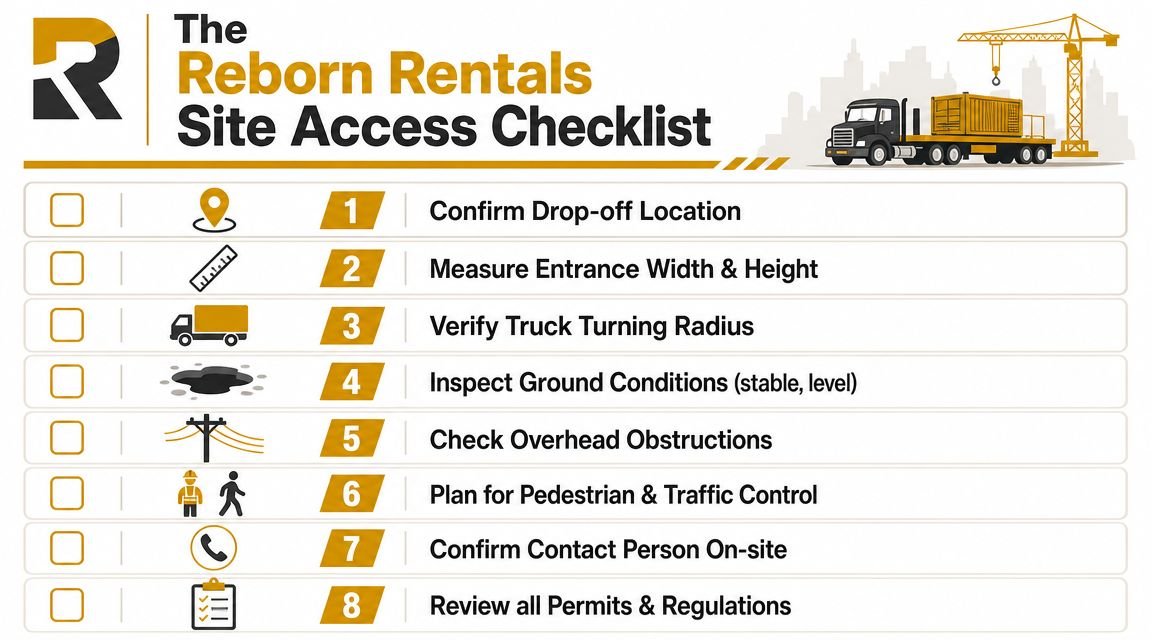
Run these checks before dispatch, then confirm them again the day before the truck rolls:
- Confirm the drop-off location: Identify the primary placement area and a backup spot that also works.
- Measure entrance width and height: Check actual pinch points at the street, gate, fence line, and interior path.
- Verify truck turning room: Confirm the approach angle, swing space, and recovery room if the driver needs to correct the line.
- Inspect ground conditions: Watch for soft fill, recent trench backfill, saturated soil, unstable shoulders, and abrupt grade changes.
- Check overhead obstructions: Look for power lines, tree limbs, scaffolding, temporary lighting, and roof overhangs.
- Plan pedestrian and traffic control: Protect the truck path and unload area from foot traffic and competing site movement.
- Confirm the on-site contact: Assign one person to answer the phone, meet the driver, and make placement decisions.
- Review permits and rules: Verify curb use, right-of-way restrictions, insurance requirements, and any owner or property rules.
A practical equipment table
Use the table below as a screening tool, not a substitute for a site review. If the truck setup is unclear, the route is tight, or the placement area has changed, stop guessing and verify the delivery conditions with the rental provider before dispatch.
| Container Model | Approx. Loaded Weight | Minimum Gate/Path Width | Minimum Overhead Clearance |
|---|---|---|---|
| 72 x 72 x 24 washout container | Approximately 18.25 tons from the Reborn Rentals publisher information provided in this brief | Site-specific. Confirm with the rental provider based on delivery vehicle and route conditions | Site-specific. Confirm clear path from street to placement area |
| 72 x 72 x 14 washout container | Heavier when loaded than when empty. Confirm actual delivery setup with provider | Site-specific. Confirm with the rental provider based on delivery vehicle and route conditions | Site-specific. Confirm clear path from street to placement area |
Reborn Rentals collects site-access details during intake for concrete washout containment deliveries. That step matters because temporary rental placements have a shorter planning window and less tolerance for bad assumptions than permanent installations.
How to use the checklist in the real world
Use the checklist in two passes.
The first pass happens at scheduling. That is where the team catches basic conflicts, such as a bad route assumption, a gate that only looks usable on a plan sheet, or a drop zone that will interfere with active work.
The second pass happens the day before delivery. Sites change constantly. Dumpster swaps, fresh material deliveries, revised fencing, parked equipment, and partial excavations can all turn a workable route into a failed delivery.
A site can clear access review early in the week and still be undeliverable by the time the truck arrives.
If the second pass exposes a problem, reset the plan before the driver is dispatched. That usually costs less than a failed trip, a redelivery charge, or a crew standing by while the equipment stays on the truck.
Frequently Asked Questions
What if the site isn't ready when the truck arrives
Expect trouble. If the gate is blocked, the contact won't answer, the route is unsafe, or the drop zone can't take the load, the driver may have to leave with the equipment still on the truck. That usually means rescheduling, extra coordination, and a delayed start for the crew that needed the rental.
The avoidable mistake is calling the site “mostly ready.” Delivery sites need to be fully ready.
Can the driver place equipment somewhere else if the first spot doesn't work
Sometimes, but only if the alternate location is safe, reachable, and approved by the site contact. Ad-libbing a new drop point often creates a second problem, such as blocking circulation, trapping the equipment behind later staging, or putting it on weak ground.
If you think you may need a backup location, designate it before the truck is dispatched.
What if access is too tight for a normal truck delivery
Then you may be looking at a different delivery method or a change to site prep. That can mean clearing more approach room, removing temporary obstacles, changing the drop point, or bringing in other lifting or transfer equipment if the provider allows it. Those solutions are usually slower and more expensive than fixing access ahead of time.
Tight sites can work. Unplanned tight sites usually don't.
Who's responsible for checking for ground damage risk
The site team should assume responsibility for verifying that the route and placement area can support the delivery. Drivers can flag obvious problems, but they can't be expected to know what's buried below the surface or whether a soft edge will hold under load.
If the path crosses decorative paving, irrigation, vaults, or recently disturbed soil, call that out before delivery day.
What if temporary fencing or dumpsters changed the route overnight
Re-check the path before the truck leaves the yard if possible, and definitely before it enters the site. Temporary layouts are one of the biggest reasons yesterday's route fails today. That's especially common on renovation jobs and urban sites where space is already tight.
Do site access requirements apply only to vehicles
No. Good access planning also protects pedestrian movement and usable paths through the site. A truck delivery that blocks people from reaching entrances, parking connections, or work areas cleanly is still a bad plan even if the equipment gets dropped.
What's the single biggest mistake contractors make
They assume the last hundred feet will work itself out. That's where most delivery failures happen. The street approach, gate geometry, final turn, ground condition, and unload area need the same attention as the rental order itself.
If you need concrete washout containment delivered to an active job and want to confirm site access requirements before the truck rolls, Reborn Rentals can help you coordinate the basics that matter: delivery location, timing, site conditions, and the access details that keep a routine drop from turning into a delay.