What Happens if You Don’t Use a Concrete Washout Pan?
You're at the end of a pour. The truck is wrapping up, the pump is waiting, the finish crew wants to move, and somebody says the line everyone has heard on a rushed job: “Just rinse it off over there.”
That decision feels small because it happens fast. It usually comes when the site is noisy, the schedule is tight, and everyone is trying to get one more task off the board before dark. But if you're asking What Happens if You Don't Use a Concrete Washout Pan?, the honest answer is simple. You turn a routine cleanup step into a site risk with environmental, legal, operational, and worker-safety consequences.
Crews don't skip containment because they don't care. They skip it because they're under pressure, they think they can control the mess, or they've seen makeshift methods “work” before. The problem is that washout rarely fails all at once. It spreads, hardens, tracks, overflows, or runs off when nobody is watching. Then the cleanup gets bigger, the paperwork gets uglier, and the project loses time on something that was easy to prevent.
The Costly Mistake of an Uncontained Washout
A lot of bad washout decisions start the same way. The pour is done, the chute or pump hose needs cleaning, and the crew picks a corner of the site that looks out of the way. Bare dirt. Gravel edge. Maybe a spot near a temporary fence. Somebody figures the material will dry up, get buried, or be scraped out later.
That's the mistake.
Fresh washout doesn't stay where you first dump it unless you put it in a dedicated container. It spreads while it's wet, seeps where the grade lets it travel, and leaves hardened residue where people still need to walk, stage tools, or move equipment. If rain hits before someone deals with it, the problem gets larger without anyone touching it.
What looks easy usually becomes rework
The shortcut only saves time for a few minutes. After that, it starts costing time.
Common jobsite fallout looks like this:
- Crew interruption: Finishers, pump operators, or laborers stop productive work to scrape slurry, relocate tools, or protect nearby areas from contamination.
- Site disorder: The washout area turns into a no-go zone that creates tracking, slips, and ugly housekeeping problems.
- Supervisor distraction: Instead of closing out the pour cleanly, the superintendent or foreman starts managing a preventable issue.
- Owner and inspector exposure: One visible washout mistake can raise questions about the rest of the site controls.
Practical rule: If your washout plan depends on “we'll clean it later,” you don't have a washout plan.
There's also a business judgment issue here. Skipping containment isn't a neutral choice. It's a gamble that the slurry won't move, nobody will step in it, no runoff path will open up, and no one with authority will see it before cleanup happens. On an active site, that's a weak bet.
The crews that stay out of trouble treat washout the same way they treat edge protection, traffic control, and dust management. It's not optional because the cleanup is annoying. It's not optional because the downside is too broad.
Immediate Environmental Damage From Slurry Runoff
Concrete washout isn't just dirty water. It's a caustic slurry made up of cement fines, water, and residual material from chutes, tools, mixers, pumps, and finishing equipment. Once it leaves a controlled container, it starts interacting with soil, drains, and stormwater pathways immediately.

One of the biggest reasons it causes so much damage is alkalinity. Concrete slurry pH can measure as high as 13, compared with neutral water at pH 7. It can take about 800 gallons of clean water to dilute just 1 gallon of concrete washout, which is why rinsing it onto the ground is not a safe disposal method, as explained by the Marion Soil and Water Conservation District concrete washout guidance.
What it does to soil and vegetation
High-pH washout acts like a chemical shock to the ground around it. Soil chemistry changes. Plants struggle. Vegetation near the discharge point can decline or die off because the slurry isn't just covering roots and leaves. It's changing the condition of the ground itself.
That's why the damage often outlasts the visible mess. Even after the surface residue dries, the affected area may still need remediation, removal, or replacement before the site can be restored properly.
A practical way to think about it is this:
| Area affected | What uncontained washout does |
|---|---|
| Soil | Alters chemistry and leaves caustic residue behind |
| Planting areas | Inhibits growth and damages vegetation |
| Ground surface | Creates hardened waste that has to be removed |
| Drainage paths | Carries polluted material away from the original spot |
How it reaches water offsite
The runoff path is what catches many crews off guard. What starts as “just a little washout” near a pour area doesn't stay local if water can move it.
The EPA warns that concrete washwater dumped on the ground can run off to roadside storm drains that discharge to surface waters such as rivers, lakes, and estuaries. The same EPA guidance says rain can cause uncovered washout containers to overflow, and contaminated rainwater can percolate through soil, alter soil chemistry, inhibit plant growth, and contaminate groundwater. That language comes directly from the EPA concrete washout guidance.
Uncontained washout doesn't need a large spill to become a real pollution problem. It only needs a path.
That path might be a curb line, a temporary slope, a swale, a catch basin, or a storm drain at the edge of the site. Once slurry reaches stormwater infrastructure, the issue stops being a housekeeping problem and becomes an environmental release.
Why “just hose it down” fails
Crews sometimes believe extra water solves the problem because it makes the residue disappear from view. In reality, water usually expands the problem area and gives the slurry a route to travel.
What works is collection and containment. What doesn't work is dilution, spreading, or hoping the site will absorb it.
The Steep Legal and Financial Penalties You Will Face
Most contractors understand that inspectors care about concrete washout. What gets underestimated is how fast a small containment failure can become a compliance issue with real project cost behind it.
If your site is operating under stormwater controls and documented best management practices, washout isn't a casual cleanup choice. It's part of whether your site is being run in a defensible way. When slurry reaches soil, drainage paths, or stormwater systems, you're no longer arguing over appearance. You're dealing with noncompliance exposure.
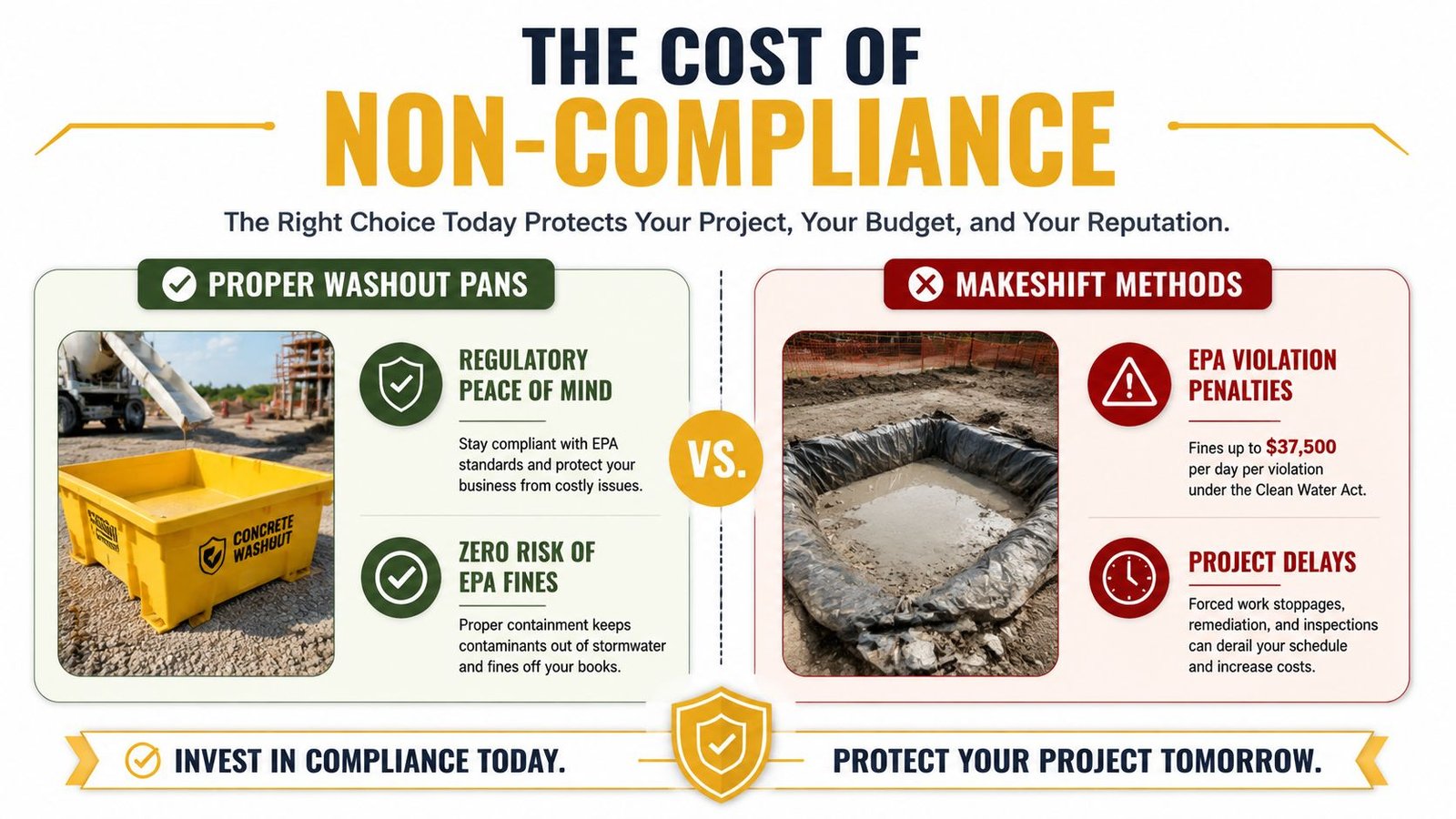
Where the money starts leaking out
The direct cost isn't limited to any citation itself. The bigger hit often comes from everything attached to the event.
A bad washout incident can trigger:
- Immediate cleanup work: Labor, equipment time, contaminated soil handling, and disposal all show up fast.
- Schedule disruption: Crews get pulled off planned work to manage containment, scraping, removal, and documentation.
- Inspection pressure: Once one visible control fails, inspectors may look harder at the rest of the site.
- Client friction: Owners, construction managers, and consultants don't like preventable compliance issues showing up in photos and reports.
One industry source also notes that overflowing or mismanaged washout can result in fines, and runoff into stormwater systems can contaminate waterways and harm aquatic life, according to Stratex guidance on concrete washout waste.
Why makeshift compliance is still noncompliance
A lot of crews think they can avoid trouble if they at least put washout in “some kind” of contained area. That's risky logic. If the method leaks, overflows, tears, or allows runoff, it won't hold up when someone asks whether the site had proper control in place.
Here's the trade-off in plain terms:
| Approach | Likely result |
|---|---|
| Dedicated, leak-resistant containment | Predictable cleanup and cleaner documentation |
| Improvised pit or loose ground area | Runoff risk and difficult closeout |
| Uncovered container | Rain exposure and overflow risk |
| Plastic-sheet workaround | Tear, puncture, and spill risk |
If your containment only works in dry weather, with perfect crew behavior, and no surprise inspection, it doesn't work.
The legal side matters because washout failures are visible and easy to understand. A photo of gray slurry leading toward a drain doesn't need much interpretation. That's why this is one of the worst corners to cut. It creates evidence quickly.
And the financial side matters because these incidents rarely stay confined to one line item. You can lose labor hours, management attention, inspector goodwill, and client confidence at the same time. Compared with that, a proper washout setup is a necessary part of the cost of running a professional site.
Hidden Jobsite Risks and Worker Safety Hazards
Most discussions about washout stop at stormwater. That's incomplete. The more immediate risk on many jobs is what improper washout does to your own crew, your own workflow, and your own liability exposure.

The EPA notes that workers handling wet concrete and washout water risk skin irritation and eye damage. There's also a training gap on many sites. As discussed in this industry article on common washout pan mistakes, minimal content addresses the occupational safety risks of improvised containment, and many crews are not trained on how difficult washout is to dilute safely.
The contact hazard crews underestimate
Workers often respect fresh concrete placement hazards more than washout hazards. That's backwards. Washout tends to look less serious because it appears watered down, spread out, or already “waste.” But the exposure is still there.
Typical contact scenarios include:
- Boot and pant contact: Crew members walk through residue, then keep working with contaminated clothing against the skin.
- Hand exposure during cleanup: Laborers scrape hardened material or move contaminated tools without recognizing the caustic risk.
- Eye splash risk: Hose cleaning and chute washdown can throw material upward or sideways.
- False confidence during rinsing: People assume more water means less hazard, which leads to more direct handling.
Field reminder: If a worker wouldn't kneel in fresh concrete, that worker shouldn't be standing in uncontained washout either.
The productivity loss nobody budgets for
Improper washout creates a drag on the day's work that many teams never track cleanly. It eats time in short, frustrating bursts. A laborer gets tied up scraping a hose path. Someone has to move stacked material away from runoff. A foreman starts coordinating a cleanup instead of tomorrow's work. Tools get caked, buckets harden up, and the pour closeout runs long.
Those losses are operational, not theoretical. They show up as:
- Broken workflow during end-of-pour cleanup.
- Unplanned labor to contain or remove spills.
- Tool maintenance headaches from hardened residue.
- Reputation damage when the site looks unmanaged.
The worst part is that crews usually absorb these losses. They don't get coded as “washout failure.” They just show up as a rough closeout, overtime pressure, and a superintendent wondering why a simple concrete day turned messy.
Liability starts inside the fence
Improvised containment also creates a management problem. If workers are exposed, if access routes get fouled up, or if cleanup becomes rushed and reactive, the site's risk profile gets worse before any regulator ever shows up.
That's why washout containment should be treated as a worker safety control and an operational control, not just an environmental best practice. A proper washout setup gives the crew a known place to go, reduces improvisation, and lowers the odds that the end of the pour becomes the most disorganized part of the shift.
Why Makeshift Washout Solutions Inevitably Fail
Contractors usually don't skip washout containment completely. More often, they substitute something that seems close enough. A lined pit. An open dumpster corner. Hay bales around a low spot. Plastic sheeting thrown under a chute. Those methods can look acceptable for an hour. They rarely stay acceptable for the life of the work.

Concrete washout is described as caustic and corrosive with a pH of approximately 12, and guidance notes it can contain toxic metals such as chromium and lead. If left uncontained, it can clog drains and create noncompliance exposure. That's what turns a routine cleanup task into a regulatory incident.
Side-by-side reality on common shortcuts
Here's how the usual substitutes fail in the field:
| Makeshift method | Why crews use it | Why it fails |
|---|---|---|
| Plastic sheeting on ground | Fast and cheap | Tears, shifts, punctures, and allows leaks underneath |
| Dirt pit or shallow excavation | Feels contained | Soaks, sloughs, overflows in rain, and is difficult to clean out |
| Hay bales or wattles | Already onsite for erosion control | They slow sediment, but they are not leak-proof liquid containment |
| Open bin or scrap container | Convenient | If it isn't set up for washout, splash and overflow become real problems |
The hidden weakness is predictability
A proper washout pan is built for slurry, liquid loading, hardened residuals, and removal. Makeshift methods are not. That difference matters because washout control is only useful if it works when the crew is busy, the weather changes, and the site conditions get rough.
The practical failure points are simple:
- Plastic tears when equipment or tools hit it
- Excavated pits become mud and spread contamination
- Porous barriers don't stop caustic liquid
- Open improvised containers invite overflow and tracking
- Cleanup becomes harder because the waste isn't consolidated
Most improvised washout setups don't fail because crews are careless. They fail because the setup itself was never designed to control caustic slurry.
That's why “good enough” usually isn't. The test isn't whether a workaround holds material for a short window. The test is whether it contains washout cleanly, safely, and consistently until final removal. If it can't do that, it's not a control. It's just a temporary hope.
The Professional Standard for a Clean and Compliant Site
The pour is wrapping up, the pump is waiting, and two laborers are rinsing tools wherever they can find space. That is how a small cleanup task turns into a site control problem. Good crews avoid that scramble by setting a defined washout area before the first load arrives.
A professional standard is simple. Put dedicated containment in place early, make it easy to reach, and make it the only approved washout location. That protects more than the ground surface. It keeps caustic slurry out of work zones, reduces foot traffic around contaminated areas, and prevents the end of the pour from turning into an unplanned cleanup operation.
A dedicated washout pan gives the crew one place for chute wash, tool rinse, and leftover slurry. Waste stays consolidated for pickup. Supervision gets easier because nobody has to guess where washout should happen. That matters on busy sites, where even a short delay can pull operators, laborers, and finishers away from productive work.
What professional containment changes on the ground
The main benefit is control under real job conditions.
With a purpose-built washout pan, crews get:
- One known washout location that drivers, pump operators, and laborers can use without hunting for it
- Cleaner access routes because slurry stays out of travel paths and staging areas
- Safer housekeeping with less splashing, less spread, and less worker contact during cleanup
- Faster closeout because hardened material and liquid waste are contained in one place
- Better accountability because foremen can inspect one setup instead of chasing problems around the site
Contractors often use rented concrete washout containment equipment, including products from Reborn Rentals, for pours, pumping, mixing, grouting, and cutting work where slurry has to be collected and removed in a controlled way.
The standard good crews follow
A washout plan does not need to be complicated. It needs to be clear and enforced.
- Place the containment unit before concrete work starts.
- Set it where trucks, pumps, and laborers can reach it without crossing active operations.
- Keep it stable, visible, and sized for the expected washout volume.
- Assign one person to check capacity and condition during the pour.
- Remove or service it before overflow, tracking, or hardened buildup create extra work.
Crews feel schedule pressure. Everyone wants to get washed out and released. That is exactly why the setup has to be decided in advance. If the washout location is inconvenient, too small, or not ready, people improvise. Improvisation is what creates slippery surfaces, worker exposure, equipment tracking, and the kind of mess that costs half a shift to fix.
The professional standard is straightforward. Contain the washout, inspect it, document it, and clear it out before it affects production. That is how clean sites stay compliant, safer to work on, and easier to run.