What Size Washout Pan Do I Need for My Project?: 2026 Guide
The truck is done pouring. The chute needs to be washed out. The pump crew wants the hopper cleaned before they pull off the site. That's the moment when a lot of jobs find out whether the washout plan was real or just a box checked in the precon.
If the pan is too small, too far away, or blocked by other equipment, crews improvise. Improvisation around concrete washout is where clean jobs turn into compliance problems, schedule friction, and expensive callbacks. The right answer to what size washout pan do I need for my project isn't just a capacity number. It's a decision about expected slurry volume, truck and pump access, servicing frequency, and whether the pan can be used the way the site is laid out.
A pan that looks fine on the order sheet can still fail in the field. It might not fit under the pump hopper. It might fill too quickly. It might sit in the wrong area and force drivers to wash out where they shouldn't. Good sizing prevents that.
The Real Question to Ask About Concrete Washout
By the time you're asking about pan size, the job has already told you a lot. You know whether this is a one-day foundation pour, a residential repair, a retail pad, a TI job with limited access, or a larger commercial sequence with repeated concrete activity. That matters more than chasing a generic “standard size.”
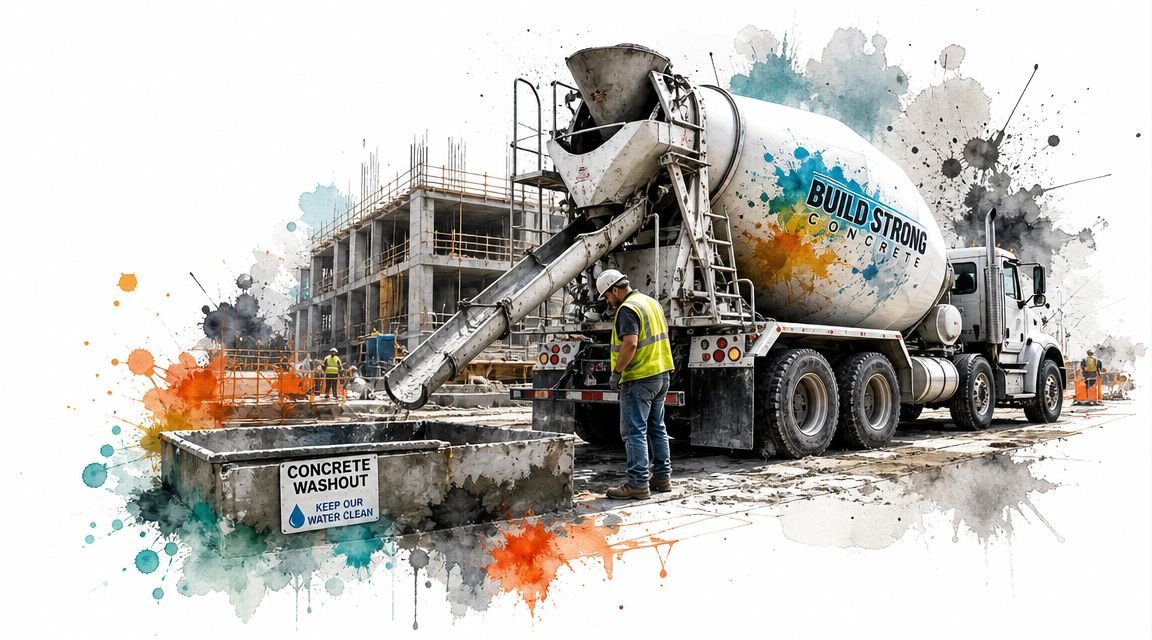
The better question is this. How will this site handle washout without overflow, delays, or bad crew behavior? That shifts the conversation from equipment rental to field management.
What usually goes wrong
Most washout problems come from one of a few predictable mistakes:
- The pan is sized for optimism: Someone assumes there will be minimal residue, then the actual washout from trucks, pump equipment, and hand tools proves otherwise.
- The pan is placed for convenience, not use: If the driver can't line up cleanly, or the pump crew can't reach it without a hassle, they'll look for another option.
- The site treats all pours the same: A small patch job and a repeated commercial pour sequence don't create the same washout demand.
- Nobody plans for servicing: Even the right pan becomes the wrong pan if it can't be pumped out, swapped, or managed on time.
Field reality: Crews use the washout setup that's easiest in the moment. If your plan isn't practical, the site will create its own plan.
What to decide before you order
Before you pick a size, lock down four things:
- How much washout material you expect
- Where the pan will sit
- Who needs to use it, including mixer trucks, pump operators, finishers, and cleanup crews
- How it will be serviced, especially if the work runs across multiple days
That's why there isn't one universal pan for every project. A workable washout setup has to match both the pour and the site.
Why Pan Sizing Is a Critical Compliance Decision
Concrete washout isn't just housekeeping. It's part of environmental control on an active job. Once slurry leaves containment, you're no longer talking about cleanup efficiency. You're dealing with a discharge problem.
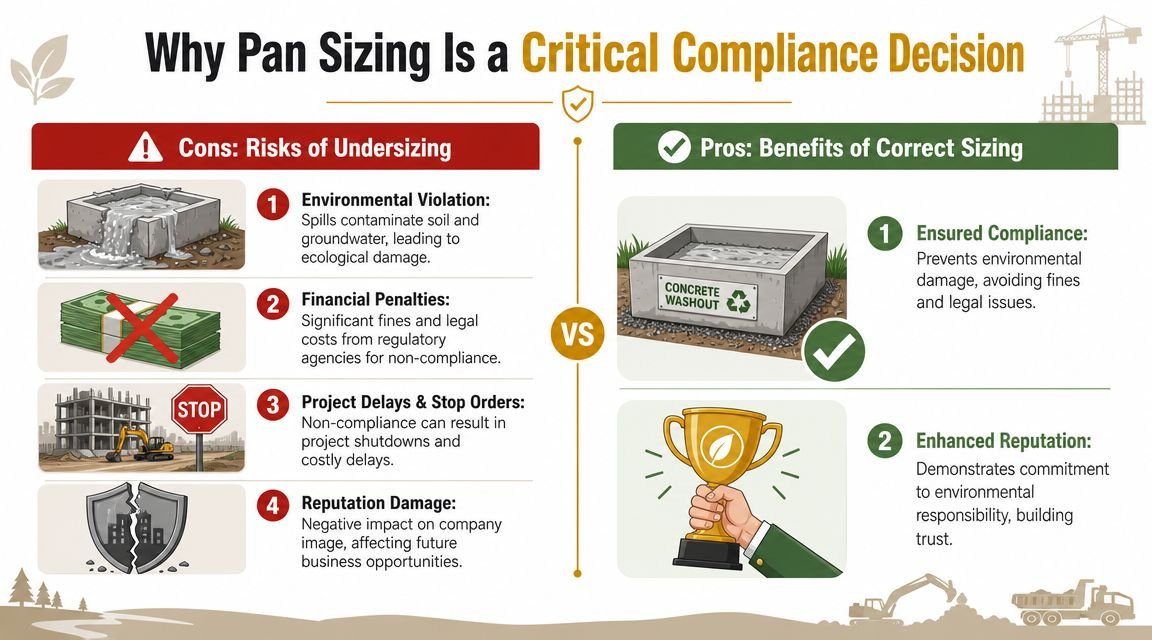
A key point from Minnesota DOT washout guidance is that washout capacity must be sized to expected daily washout volume and site controls. The same guidance notes EPA direction that washout containers should be kept away from storm drains, open ditches, and waterbodies, and should be managed when they exceed 75% capacity by vacuuming off liquid or allowing evaporation.
That one threshold changes how you should think about pan size. The pan's advertised capacity is not your working capacity.
Why undersizing causes real trouble
A pan that fills too quickly creates pressure on the crew. Once that happens, the site starts making bad decisions fast.
- Overflow risk increases: Slurry and rinse water don't stay where they belong when the pan gets crowded.
- Maintenance gets more frequent: A small pan that reaches the management threshold too soon needs more pump-out or more swaps.
- Crews lose time: Drivers wait. Pump operators wait. Finishers work around a bottleneck.
- Compliance gets weaker: A pan that can't handle daily use pushes people toward shortcuts.
A washout pan should be sized for the job you're actually running, not the best-case version of it.
Capacity is only part of compliance
Good compliance means more than picking a container and dropping it on site. The pan also has to be in the right place and managed at the right time.
Here's the practical chain of cause and effect:
| Problem on site | What it leads to |
|---|---|
| Pan reaches the management threshold too early | More urgent pump-out or swap needs |
| Pan sits near drainage pathways | Higher chance of noncompliant discharge |
| Pan is hard to access | More off-plan washout behavior |
| Pan is undersized for daily activity | Repeated operational friction |
Minnesota DOT guidance also states that trap size must be commensurate with daily washout requirements and allow sufficient time for evaporation or pump-out. That's the engineering side of the same issue. If the pan is too small, your margin disappears.
The cost of getting it wrong
Nobody needs to be told that spill response, inspection issues, and stoppages are expensive. Even without putting a dollar figure on it, the pattern is obvious. Cleanup work steals labor. Rework steals time. Compliance problems attract attention you don't want on a live project.
Treat washout sizing as risk control. That's what it is.
How to Accurately Estimate Your Washout Volume
A lot of pan orders are based on habit. “We usually get a small one.” That works until it doesn't. A better approach is to estimate washout volume from the actual work plan, then choose a pan setup that gives you breathing room.
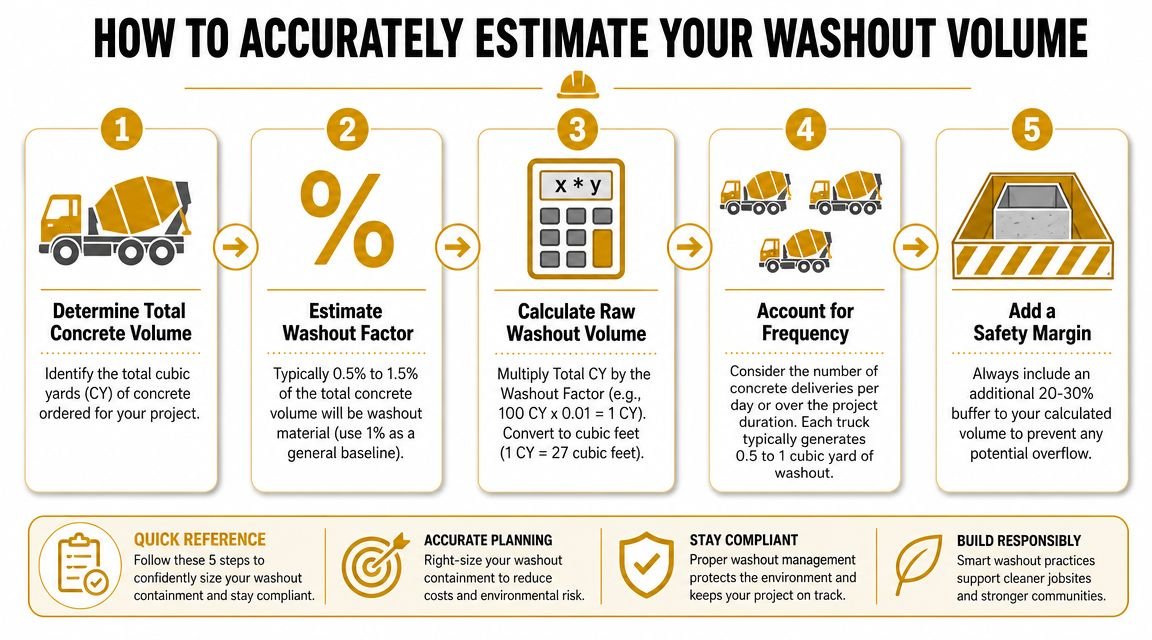
For rough planning, independent washout capacity guidance shows a useful break between container sizes. A 1.5 cubic-yard pan holds about 400 gallons, a 2.35 cubic-yard pan holds about 720 gallons, and a 6.75 cubic-yard roll-off washout bin holds about 1,600 gallons. The practical lesson is simple. Match the container to expected washout volume, not just the number of pours.
Start with the actual sources of washout
Don't just think about the ready-mix truck chute. On many jobs, that's only part of the total.
Count all likely contributors:
- Mixer truck washout: Chute cleanup and residual rinse material
- Pump truck cleanup: Hopper washout can add a meaningful load
- Concrete buggies or wheelbarrows: Small individually, but they add up over a pour
- Hand tools and finishing gear: Shovels, rakes, floats, buckets, screeds, and cleanup water
- Multi-day work: Repeated small washouts can outfill a pan just as surely as one heavy pour
If more than one trade or crew uses the pan, estimate for shared use, not isolated use.
Build the estimate in the field
Use this sequence instead of guessing:
List each concrete activity by day
Separate one major pour from staggered pours, curb work, patch work, or pump days.Identify whether a pump is involved
Hopper washout changes the requirement. It also affects placement because the pan may need to fit under or near the pump cleanup area.Ask when the pan can be serviced
If the job runs hard for the day and service won't happen until later, the pan needs enough working room to carry that interval safely.Apply a margin for real site conditions
Rain, delayed pickup, extra truck cleanup, and unplanned tool washout all happen. Tight sizing leaves no recovery room.
Practical rule: Estimate for the busiest washout window, not the average day.
Think in daily load, not just total project duration
A small project spread across several days can still overwhelm a compact pan if washout activity clusters into a short window. On the other hand, a larger overall project may work fine with a moderate-size pan if servicing is reliable and the site controls access well.
That's why the best estimate answers three questions together:
- How much material hits the pan in one day
- How fast it accumulates during peak activity
- How long the site must live with that load before pump-out, evaporation, or replacement
Once you have that, pan sizing gets much clearer. You're not ordering based on guesswork. You're ordering based on use.
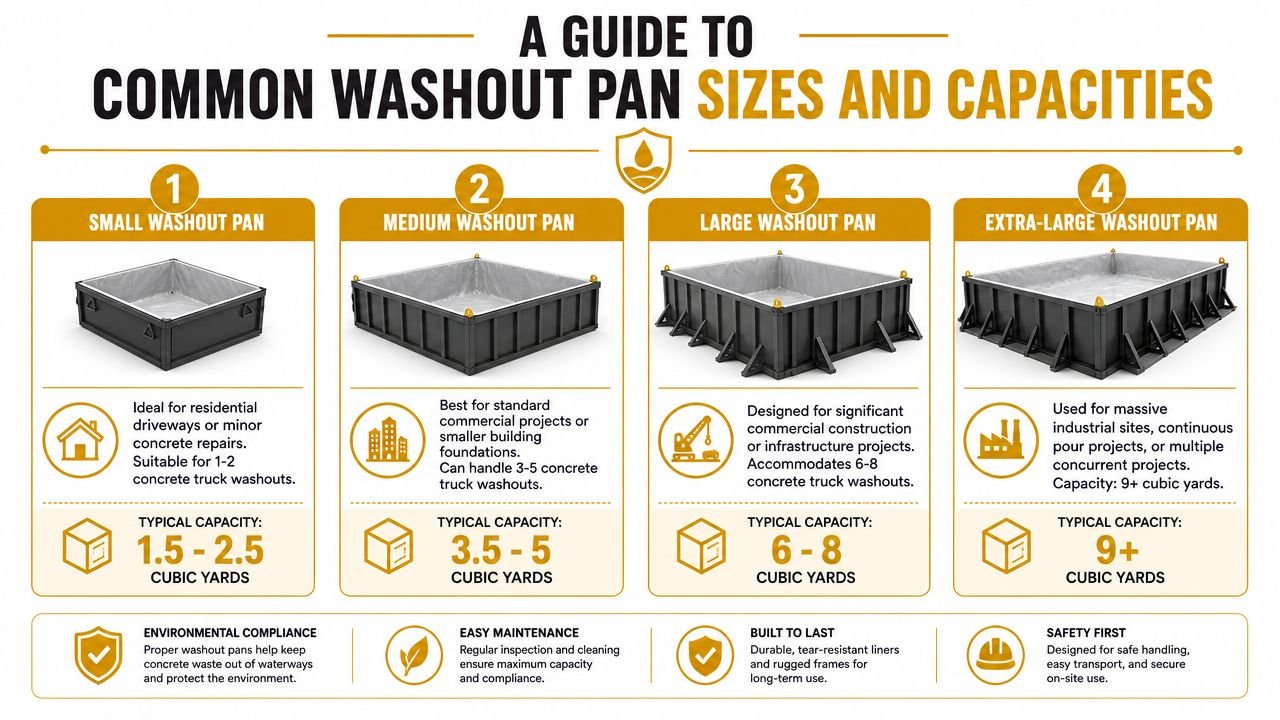
A Guide to Common Washout Pan Sizes and Capacities
Once the expected washout load is clear, the next step is matching it to equipment that fits the job. Many teams either oversimplify or overcorrect at this stage. They either order too small because it's familiar, or too large because they want to “be safe” without thinking through access and handling.
Small and mobile options
At the compact end of the market, one published washout pan size is 62 in × 55 in × 12 in with a capacity of 130 gallons, and the manufacturer notes that it fits in the back of a pickup truck, as shown in this compact washout pan listing. That kind of unit makes sense when mobility matters more than bulk storage.
Typical fit for this type of pan:
- Small repairs
- Short-duration residential work
- Mobile crews that need easy transport
- Tight sites where a larger footprint creates more trouble than it solves
The limitation is obvious. Compact pans are easy to move, but they don't give you much room for repeated washout activity.
Common field benchmarks
A practical benchmark used in the industry comes from Colorado DOT approved product specifications. A small washout pan is often specified at 7 ft × 7 ft × 14 in with a capacity of 1.5 cubic yards, about 3 tons, and 300 gallons of slurry storage. That same specification explicitly describes it as suitable when a pan must fit under the hopper of a truck-mounted boom pump for hopper washout.
That matters on real jobs. If the pour uses a boom pump and space is tight, this isn't just a size reference. It's an operating clue.
The same specification lists a large pan at 7 ft × 7 ft × 28 in with 2.35 cubic yards, 5 tons, and 475 gallons of capacity. That jump in depth and holding volume shows why “one standard pan” is the wrong mindset.
A quick comparison
| Pan type | Published size or capacity | Best fit |
|---|---|---|
| Compact mobile pan | 62 in × 55 in × 12 in, 130 gallons | Small or mobile work where transport is the main constraint |
| Small benchmark pan | 7 ft × 7 ft × 14 in, 1.5 cubic yards, 300 gallons | Pump hopper washout, tighter sites, moderate cleanup demand |
| Large benchmark pan | 7 ft × 7 ft × 28 in, 2.35 cubic yards, 475 gallons | Larger pours with more washout volume and more onsite holding need |
When someone asks, “What size washout pan do I need for my project?”, the useful answer starts with the work sequence and ends with the pan that crews can actually use without workarounds.
Thinking Beyond Capacity
The pan that works best on paper can still fail on site. Capacity matters, but layout, access, and handling often decide whether the setup will work for the full job.
One of the most overlooked decisions is whether multiple smaller pans are better than one larger pan. Industry guidance discussed in this washout solution overview notes that a standard commercial site can manage concrete waste with a 3 cubic-yard pan, while high-rise or high-volume work may require crane-rated pans, multiple pans for recycling workflows, or roll-off tubs for large pours.
When smaller pans are the smarter move
A single larger unit sounds safer because it offers more holding room. But that only helps if the site can support it.
Multiple smaller pans often work better when:
- Access is constrained: One large unit may block circulation or be hard to place where crews need it.
- The site has more than one washout point: Splitting traffic reduces crew conflict and keeps cleanup local to the work.
- Service timing is uneven: Rotating smaller pans can be easier than waiting on one oversized unit to be managed.
- The job changes by phase: Early site work, structure work, and finish phases may need different pan locations.
Special cases that change the answer
High-rise work is a different animal. The question isn't just volume. It's whether the pan is crane-rated and whether picks can be made safely within the lift plan.
Constrained urban sites create another problem. You may have enough theoretical room for a large pan, but not enough turning room for delivery, enough laydown clearance for use, or enough service access for pump-out.
Then there's internal site behavior. If one oversized pan sits in the “approved” location but crews find it inconvenient, they'll start looking for shortcuts. A smaller pan placed closer to real work often protects compliance better.
The best washout setup is the one that crews will use correctly every time, under production pressure.
Your Final Washout Pan Sizing Checklist
Before you order, run through the job the same way you'd review any other site control. Pan sizing gets easier when the decision is broken into field questions instead of guesswork.
Confirm the washout demand
- Map the concrete activities: Note whether this is one pour, repeated pours, pump work, repair work, or a sequence of smaller placements.
- Count all cleanup sources: Include truck chutes, pump hopper washout, tools, and any support equipment that will hit the pan.
- Think in peak daily use: The pan has to handle the busiest period, not the calmest one.
Check the site layout
A good-sized pan in the wrong place still causes problems. Walk the route before committing.
Ask these questions:
- Can trucks or pump crews reach the pan cleanly?
- Is the pan placed away from storm drains, open ditches, and waterbodies?
- Is there enough room for servicing, swapping, or pump-out?
- Will other trades block access once the job gets moving?
If the answer to any of those is no, adjust location or change the pan strategy.
Decide between one pan and a staged setup
Experience is key. Don't assume bigger is better.
Use one larger pan when the site has:
- clear access,
- one main washout location,
- enough room for service equipment,
- and a steady, predictable washout pattern.
Use multiple smaller pans when the site has:
- phased work areas,
- restricted access,
- multiple active cleanup points,
- or a layout that makes one central pan impractical.
Verify the management plan
The pan size and the maintenance plan have to match. If the container approaches the management threshold and nobody is scheduled to handle it, the plan is incomplete.
Finish with this short review:
| Final check | Why it matters |
|---|---|
| Pan matches expected daily washout | Prevents early overfill and rushed decisions |
| Placement matches actual crew movement | Increases proper use |
| Service access is available | Keeps the setup workable through the job |
| Pump, truck, and tool washout are all included | Avoids underestimating demand |
| The chosen setup fits the site, not just the spec sheet | Reduces field improvisation |
If you answer those points thoroughly, you'll usually land on the right setup the first time. That's the ultimate goal. Not just renting a pan, but keeping the site clean, compliant, and moving.
If you need a washout rental partner that understands real job-site constraints, Reborn Rentals is built for exactly that. They specialize in concrete washout containment, publish clear daily pricing, and make it easy to set dates, location, and delivery details without a long back-and-forth. For contractors, pump crews, site managers, and consultants who need dependable washout equipment that supports compliance and smooth field operations, Reborn Rentals is a practical place to start.