What’s the Difference Between Concrete Washout Methods?
Concrete washout methods differ in how they handle time, labor, and material recovery. Traditional pits are cheap to set up but labor-heavy, portable pans give you compliant containment with less site hassle, and automated systems can wash out in minutes while turning leftover material into a recoverable asset.
If you're managing a pour, this decision usually shows up at the worst possible time. The truck is empty, the pump crew wants to move, the finisher is focused on the slab, and somebody asks where the washout is going. If that answer isn't settled before the pour starts, the job can get messy fast.
Most crews treat washout like cleanup. That's the mistake. Washout affects site flow, labor allocation, inspection exposure, and how much rework you create for yourself later. The right method depends on the job, but the wrong one usually costs more than it looked like on paper.
The End of the Pour The Real Work Begins
A pour can be going perfectly and still go sideways in the last few minutes.
The concrete is down. The truck has discharged. The pump is finishing up. Then the leftover slurry, rinse water, and residual concrete have to go somewhere. If the crew has a clear washout location, the job keeps moving. If they don't, you get confusion, mud, delays, and a compliance problem sitting in plain view.
On most jobs, the options come down to three categories. A traditional on-site washout pit. A portable washout pan or container. Or, on high-volume operations, an advanced reclaimer or automated closed-loop system.
Those choices aren't just different ways to catch gray water. They reflect three very different operating models.
- Pits keep upfront cost low, but they put more work on the crew.
- Pans trade some rental cost for predictable containment and cleaner logistics.
- Automated systems treat washout like a recovery process instead of disposal.
If you're trying to answer, what's the difference between concrete washout methods, the practical answer is simple. You're balancing compliance, labor, site space, truck turnaround, and whether leftover concrete becomes a burden or a resource.
Why Concrete Washout Is a Critical Compliance Issue
Concrete washout becomes a compliance issue the moment slurry leaves the truck or pump.
The problem isn't just that it's messy. The U.S. EPA describes concrete washout water as a slurry with a pH near 12, which makes it caustic and corrosive. Official guidance says it has to be collected in leak-proof containment, placed at least 50 feet from storm drains or waterbodies, and managed before the container exceeds 75% capacity, as outlined in the EPA concrete washout guidance.
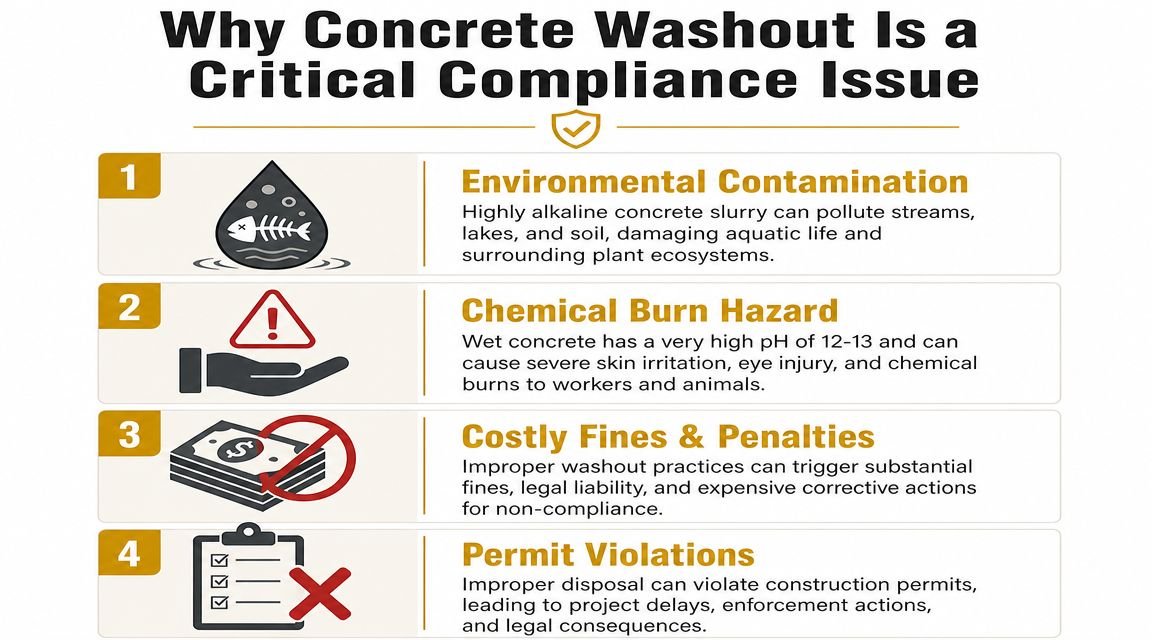
That requirement changes the conversation. Washout isn't a convenience item. It's a controlled waste stream on an active jobsite.
What goes wrong on real jobs
Crews usually get into trouble through routine shortcuts, not deliberate bad decisions. Someone rinses into a low spot. A makeshift area gets too close to drainage. A container is left too full before rain. A liner gets punctured by traffic or debris and nobody sees it until inspection day.
Those are field problems, but they turn into management problems quickly:
- Site housekeeping breaks down: Slurry spreads, hardens, and creates extra cleanup.
- Inspections get harder: If the washout area looks improvised, inspectors start asking more questions.
- The schedule takes a hit: Cleanup and corrective action steal time from crews who should be building.
- The risk sits in your SWPPP execution: It's one thing to have a plan on paper. It's another to have a washout setup that matches it on site.
Practical rule: If your washout area depends on everyone "being careful," it isn't a system yet.
Why method selection matters
The chosen method holds greater significance than commonly perceived. A washout pit, a steel pan, and a closed-loop reclaimer can all satisfy the same basic need, but they don't carry the same failure points.
A rough, improvised setup asks the crew to manage more variables by hand. A purpose-built container removes some of those variables. A closed-loop recovery system goes further and changes the whole objective from containment to processing.
That's why concrete washout should be treated like any other operational decision on a project. If the method reduces uncertainty, it reduces labor friction and inspection exposure too.
Method 1 The Traditional On-Site Washout Pit
The old-school washout pit is still common because it looks cheap and simple.
You pick a location, excavate a shallow area, line it, and create a designated spot for truck chutes, pump parts, and tools to be rinsed out. On paper, that sounds efficient. On the ground, it usually becomes a small maintenance project nobody priced correctly.
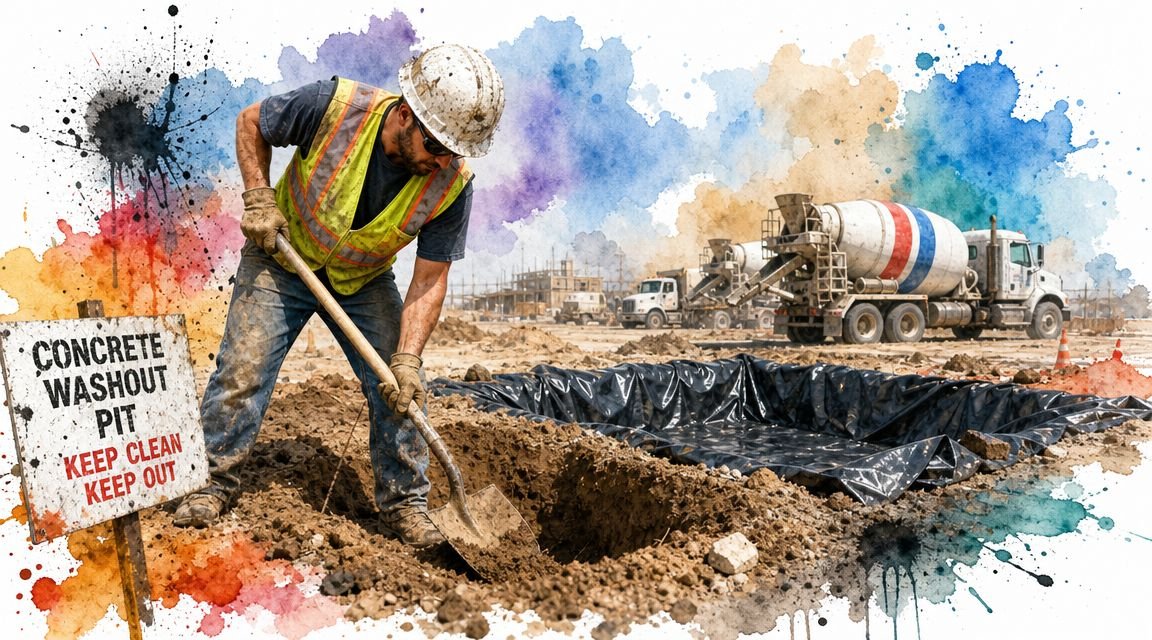
How pits are typically managed
A pit only works if someone treats it like active jobsite infrastructure. That means:
- Picking the location carefully. It has to be out of traffic, out of drainage flow, and workable for trucks and crews.
- Building containment that holds up. A liner has to stay intact under use, weather, and nearby movement.
- Monitoring capacity. If washout accumulates faster than expected, the pit becomes a spill risk.
- Cleaning out hardened material. Once concrete sets up, somebody still has to break it out and dispose of it properly.
None of that is impossible. It just isn't free.
Where pits usually fail
The problem with pits isn't that they never work. The problem is that they depend on steady attention from people who already have other priorities.
Common trouble spots include:
- Liner damage: Equipment, foot traffic, and debris can tear or puncture a liner.
- Rain events: A pit that looked fine yesterday can overflow or soften around the edges after weather moves through.
- Bad access: If the washout area is inconvenient, drivers and crews start improvising.
- End-of-job cleanup: Hardened concrete in a pit doesn't disappear. Somebody has to deal with it.
A washout pit often looks inexpensive only because the labor is spread across the project instead of showing up as a line item on day one.
When a pit still makes sense
There are jobs where a pit can still be workable. Remote sites, very short-duration work, or projects with plenty of room and a crew that can actively manage the setup may choose this route.
But on tighter commercial sites, renovation work, urban infill jobs, and anywhere multiple trades are sharing limited space, pits tend to create more coordination issues than they solve. They also look temporary and improvised, even when the team built them with good intentions.
That matters. Site appearance isn't cosmetic. It affects traffic flow, cleanup effort, and how much confidence an inspector has in the rest of your controls.
Method 2 Portable Washout Pans The Modern Standard
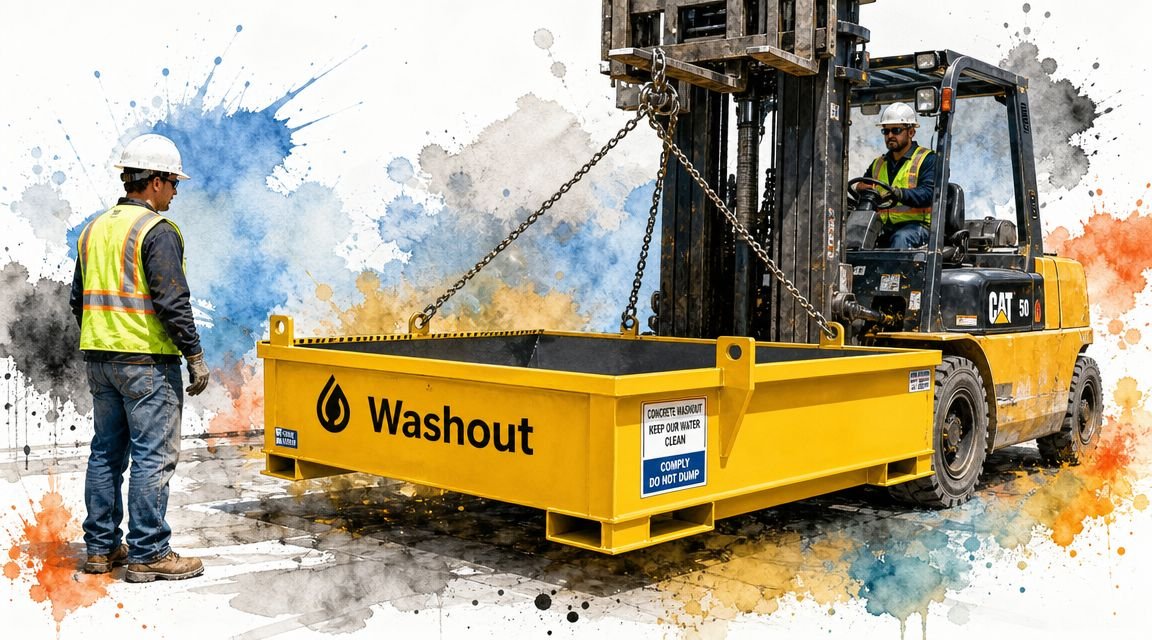
A portable washout pan turns washout from a field-built task into an equipment decision.
That matters on jobs where every extra labor hour, truck movement, and cleanup step hits the budget. Instead of asking the crew to build and babysit a temporary containment area, the project team puts a defined container in place and manages it like any other rented site asset. The result is usually better control, fewer gray areas, and less time spent fixing preventable messes.
Why pans work on busy sites
On an active job, washout fails when the process is unclear or inconvenient. Portable pans solve that by giving drivers and crews one visible, designated location that does not depend on excavation, berms, or a liner in the ground.
That improves more than housekeeping. It improves traffic planning, startup coordination, and inspection readiness. A pan is easier to place near the work, easier to identify during site orientation, and easier to service before it becomes a problem.
I have seen this play out on tight commercial sites. The crew is trying to keep deliveries moving, other trades are stacked on top of each other, and nobody has time to rebuild a washout area after it gets chewed up by traffic. A pan keeps the process simple.
The real trade-off is not just rental cost
The usual objection is the rental charge.
On paper, a pit can look cheaper. In the field, the comparison is broader. A pan replaces digging, liner setup, protection, repeated checks, cleanup around the area, and the final effort to break out and haul off hardened waste. It also reduces the chance that a driver washes out somewhere he should not because the approved location was too far away or hard to find.
That is why pans often make financial sense even when the daily rate looks higher than a do-it-yourself option. They trade some equipment cost for lower labor drag and better control.
Where pans fit best
Portable pans are a strong fit for projects where space is tight, access is controlled, and the schedule leaves little room for rework. That includes commercial builds, renovations, tenant improvements, municipal work, and repeated-pour jobs where washout needs to function the same way every time.
They also make sense on paved sites or near occupied buildings, where site disturbance and cleanup exposure carry real cost. In those conditions, washout is not just an environmental box to check. It affects how cleanly the job runs and how much supervision the issue demands.
Reborn Rentals is one supplier in this category. The practical value is straightforward. Rental pans let a project manager assign washout to a defined piece of equipment instead of relying on a field-built setup that needs constant attention.
Where pan setups still go wrong
A pan only works if the plan around it works.
The common failures are operational:
- Poor placement: If trucks or crews have to fight their way to the pan, use drops fast.
- Wrong size or quantity: One pan may not handle the washout volume from multiple pours, pump work, or several crews.
- Late service: A full pan creates the same kind of site problem as any other neglected waste container.
- Weak ownership: If nobody is assigned to monitor condition, fill level, and access, the setup drifts.
The best pan setup is routine. People know where it is, they can reach it without delay, and someone is accountable for keeping it usable. That is why portable pans have become the standard on many projects. They cut down improvisation, which usually means fewer compliance headaches and fewer labor hours wasted on cleanup.
Method 3 Advanced Reclaimer and Automated Systems
Automated washout systems belong in a different category from pits and pans.
A pit contains waste. A pan contains waste more reliably. An automated closed-loop system is built to process that material, separate components, and recover value from it. That's why these systems show up most often in ready-mix and high-volume operations rather than temporary project sites.
What makes them different
The key difference is speed and recovery.
According to industry reporting in Modern Pumping Today on fast concrete washouts, high-speed automated systems can complete washout in minutes and can generate annual savings ranging from $195,000 to $500,000+, with some operations reaching seven figures when truck, driver, reclamation, and added delivery revenue are included. The same reporting says reclaimed material can add about $25 per cubic yard of processed concrete.
That changes the economics completely. At that point, washout isn't just a disposal obligation. It's part of plant operations, fleet efficiency, and recovered-material value.
Why the business case gets stronger at scale
On a high-volume ready-mix operation, truck turnaround matters. Yard congestion matters. Driver time matters. Material recovery matters.
An automated system addresses all of those at once:
- Faster washout cycle: Trucks spend less time tied up at the end of a load.
- Material separation: Sand, aggregate, and water can be routed into reuse workflows depending on the setup.
- Less disposal mindset: Residual concrete becomes something the operation can process, not just haul away.
- More predictable throughput: The washout area stops being a bottleneck.
On large operations, the biggest mistake is evaluating an automated system as if it's just a more expensive washout box. It isn't. It's an operations tool.
Where they don't fit
For a general contractor running temporary jobsites, an automated reclaimer usually isn't the right answer. It requires capital, space, process discipline, and enough washout volume to justify the investment.
That's why most project managers don't choose between a pan and a reclaimer on the same job. They choose between a field containment method for the site, while a producer or plant operator decides whether washout at the yard should be handled as a recovery operation.
So if you're asking what's the difference between concrete washout methods, this is the far end of the spectrum. You're no longer deciding how to contain slurry. You're deciding whether leftover concrete should be processed into operational value.
How to Choose Your Washout Method A Side-by-Side Comparison
The right method depends less on theory and more on job conditions.
A project manager usually has to balance five things at once: available labor, site space, expected washout volume, inspection exposure, and whether the setup needs to move with the work. The cheapest option upfront can be the most expensive one once the crew starts babysitting it.
Start with the field questions that matter
Before choosing anything, ask these questions:
- How long will concrete work be active? A one-off pour creates different demands than repeated placements over weeks or months.
- How much room do you have? Open ground can support methods that make no sense on tight urban sites.
- Who is going to maintain the washout area daily? If the answer is vague, avoid methods that rely on constant attention.
- How many access points do crews need? On larger sites, convenience isn't a luxury. If the washout is too far away, people stop using it correctly.
- Is this disposal or recovery? Most jobsites need containment. Plant operations may need reclamation.
Concrete Washout Method Comparison
| Factor | DIY Washout Pit | Prefabricated Pan (Rental) | Automated Reclaimer System |
|---|---|---|---|
| Upfront cost | Low apparent cost | Predictable rental cost | High capital commitment |
| Crew labor | High. Crew has to build, monitor, maintain, and clean out | Lower. Most labor shifts to placement and routine checks | Lower in day-to-day manual washout handling, but requires operational management |
| Compliance control | Depends heavily on execution | Stronger because containment is purpose-built | Strong for controlled facilities with defined processes |
| Site footprint | Can consume useful ground space | More compact and defined | Best suited to fixed, high-volume locations |
| Mobility | Poor once established | Good. Can be delivered, placed, and removed as needed | Not intended for temporary project relocation |
| Best fit | Remote or simple jobs with space and available labor | Small to mid-sized projects and controlled commercial jobsites | Ready-mix plants and high-volume operations |
| Main weakness | Hidden labor and failure points | Requires proper placement and service planning | Doesn't fit most temporary construction sites |
| Core value | Cheap setup | Reliable containment and cleaner logistics | Recovery of material and operational savings |
Placement still matters after you choose
The method is only half the decision. Placement and capacity planning matter just as much.
Best-practice guidance says washout containers should be placed at least 50 feet from storm drains and waterbodies, and large sites should use multiple locations so crews can reach them easily and so capacity can handle the full wash volume before the next storm event, according to the Dane County concrete washout guidance.
That guidance lines up with what works in the field. If the washout is too far away, too small, or hard to access, people improvise. Once crews improvise, your method no longer matters because your execution has already broken down.
A practical selection guide
Use a pit when the site is simple, open, and the team can actively manage it.
Use a pan when the project needs predictable containment, clean logistics, and less labor tied up in maintenance.
Use an automated reclaimer when the operation is large enough that washout affects plant throughput, fleet efficiency, and material recovery economics.
The best washout method is the one your crew will use correctly every time without stopping production.
Frequently Asked Questions About Concrete Washout
What do I do with hardened concrete from a washout pan
Remove it before it cuts into usable capacity or makes cleanup harder than it needs to be.
Crews get into trouble when they treat hardened residue like a cosmetic issue. It is an operations issue. Once buildup starts reducing volume, drivers have less room to wash out properly, service gets delayed, and the container can turn into a bottleneck during active pours. On rented equipment, follow the provider's pickup and loadout requirements so the pan can be hauled without extra labor, rejected service, or added disposal charges.
Can I be cited if I use a washout pit
Yes. Inspectors care about the condition and control of the washout area, not whether the method is familiar.
A pit can still create violations if it leaks, overflows, sits in the wrong location, or is left without maintenance after rain or repeated truck use. The same pit that looked cheap on day one can cost more once labor, rework, and corrective action hit the job.
Are washout pans necessary for small jobs
Small jobs still need a defined washout plan.
A short residential pour may not need the same setup as a large commercial slab, but slurry and rinse water still have to stay contained. On tight sites, a pan often saves time because the crew knows exactly where to wash out, the area stays cleaner, and the closeout is simpler. That matters on small jobs where one laborer pulled into cleanup can throw off the whole day.
What documentation should I keep
Keep records that show the washout plan was assigned, placed, used, and maintained.
That usually includes:
- Site plan notes: Identify the designated washout location.
- Inspection logs: Record condition, remaining capacity, and any corrections made.
- Rental or hauling paperwork: Keep service records for pans, containers, or removal.
- Photos: Document placement and condition during the pour.
- Crew direction: Make sure foremen, pump operators, and drivers were all told where to wash out.
Good documentation does two jobs. It supports compliance if questions come up later, and it gives the PM a clean record of what worked on that site and what needs to change on the next one.
What causes most washout problems in practice
Coordination failures cause more trouble than the container itself.
The usual problems are predictable. The washout is too far from the pour. Another trade blocks access. Capacity is too small for the number of trucks. Nobody schedules service until the pan is nearly full. Then the crew starts improvising, production slows down, and a simple containment task turns into a cost and schedule problem.
If you want an equipment-based option instead of field-building containment, Reborn Rentals offers rental washout pans and containers that can be scheduled around project dates and site access. That approach can be easier to manage on jobs where the priority is keeping trucks moving, keeping cleanup controlled, and avoiding extra labor tied up in washout maintenance.