Why Do Concrete Contractors Need Washout Pans?
Concrete contractors need washout pans for three main reasons: to comply with environmental rules, to avoid fines and shutdown risk, and to keep caustic concrete wash water contained instead of spreading it across the site. On many jobs, that means controlling a waste stream that may need to stay at pH 10 or less for sewer discharge and around pH 9 for release to waterways, which is why a dedicated containment system matters.
You know the moment. The pour is wrapping up, the finish crew is moving on, the pump is waiting to rinse out, and the driver asks the question that should already have an answer: where's the washout going?
That question separates organized jobs from risky ones. If the answer is “over there on the dirt” or “just hit that corner,” you're creating a mess, a safety problem, and a compliance issue at the same time. Concrete slurry doesn't stop being your problem because the slab is down. The job isn't finished until the chutes, pump lines, tools, and residue are handled the right way.
A good washout pan solves a very practical problem. It gives crews one place to contain slurry, rinse equipment, manage hardening waste, and keep runoff out of places it doesn't belong. More important, it turns a rushed end-of-pour situation into a controlled process.
The Job Isnt Over Until the Chutes Are Clean
At the end of a pour, everybody wants to move fast. The truck has another run. The pump crew wants to break down. Labor wants to clean up and head to the next task. That rush is exactly when bad washout decisions happen.
I've seen the same pattern on a lot of sites. The concrete work goes well, then the last ten minutes create the biggest risk. Someone hoses down the chute onto bare ground. Somebody else rinses tools near a curb line. The slurry starts moving, the area turns slick, and now the site has a cleanup problem before the concrete has even set.
The part many crews underestimate
Concrete washout isn't just dirty water. It's a mix of water, cement fines, and residue that can stay active enough to create skin and eye hazards, damage surfaces, and trigger environmental trouble if it leaves containment. That's why experienced supers don't treat washout as an afterthought.
A washout pan gives the site a designated answer before the first truck arrives. That matters operationally. It tells drivers where to go, keeps the cleanup area predictable, and avoids the scramble that leads to shortcuts.
Practical rule: If the washout location isn't decided before the pour starts, the crew will decide it under pressure. That's usually when mistakes happen.
There's also a professionalism piece to this that owners and inspectors notice right away. A clean, marked washout area tells people the site is being managed. Slurry tracked across access paths or pooled near drains tells them the opposite.
What works and what doesn't
What works is simple. Put a dedicated pan where trucks and pump operators can reach it without crossing the whole site, and make sure everyone knows that's the only washout point.
What doesn't work is relying on memory, verbal instructions, or a “temporary spot” in the dirt. Temporary usually becomes messy, and messy usually gets expensive.
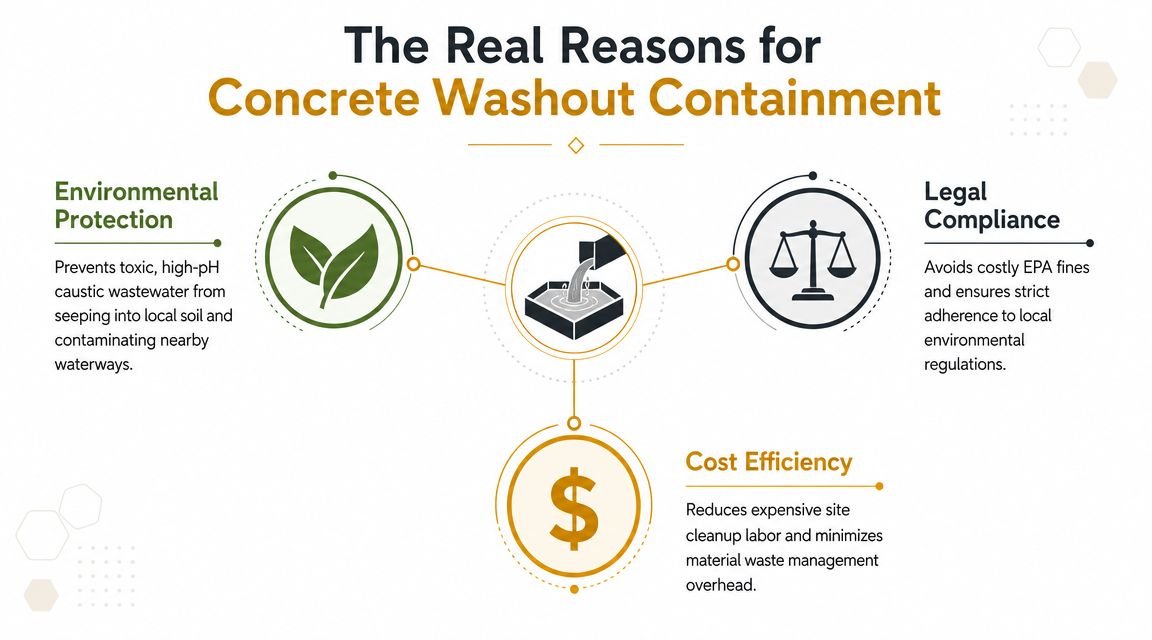
The Real Reasons for Concrete Washout Containment
The reason contractors need washout pans isn't abstract. It's tied to what concrete wash water does, what the rules require, and what happens when a site ignores both.
Environmental harm is real
Concrete wash water is highly caustic. On site, that means it isn't harmless rinse water. When it hits soil, stone, or drainage paths, it can kill vegetation, stain finished areas, and carry cement fines where they shouldn't go.
The easiest way to explain it is this: uncontrolled washout acts a lot like a chemical burn on the ground. It changes the surface, leaves residue behind, and creates damage that often spreads farther than crews expected.
That matters even more near storm drains, swales, curb inlets, and low spots. Once slurry starts moving with runoff, containment gets a lot harder.
The rules are written for exactly this problem
The U.S. EPA says concrete washout systems should “collect and retain all the concrete washout water and solids in leak proof containers” so the material doesn't migrate to surface water or groundwater. The same guidance notes that many jurisdictions require wastewater entering sewers to be pH 10 or less and water released into waterways to be around pH 9 maximum, which is why washout containment isn't optional on a properly managed site. Those requirements are laid out in the EPA concrete washout guidance for construction sites.
If your crew can't show where washout is contained, you're asking an inspector to assume everything went where it was supposed to. That's not a position you want to be in.
Washout pans earn their place, providing the project with a leak-resistant, designated container for a regulated waste stream. That is a lot different from hoping slurry stays put in a scraped-out corner of the lot.
Financial risk usually starts with shortcuts
Most contractors don't need a lecture on environmental stewardship. They need to know what the actual exposure is. The exposure is simple: cleanup, rework, schedule disruption, and enforcement problems.
A washout mess rarely stays a small mess. Labor has to stop and clean it. Equipment can get fouled. Access paths become slippery. If slurry reaches paving, landscaping, or drainage structures, somebody pays to fix it.
The trade-off is straightforward:
- Use containment upfront: You plan a washout location, direct the crew once, and manage one contained waste point.
- Skip containment: You spend time chasing residue, explaining site conditions, and fixing a preventable problem.
- Try to improvise later: You usually end up doing both. Cleanup first, then proper containment after the fact.
Washout pans are not a bureaucratic add-on. They are one of the cheapest forms of risk control on a concrete job.
Selecting the Right Washout Pan for Your Project
A pan that does not match the job will create its own set of problems. Crews miss the container, operators avoid a hard-to-reach setup, or the pan fills faster than anyone planned for. The result is the same. Slurry ends up where it should not be, and the superintendent is left solving a preventable issue during the pour.
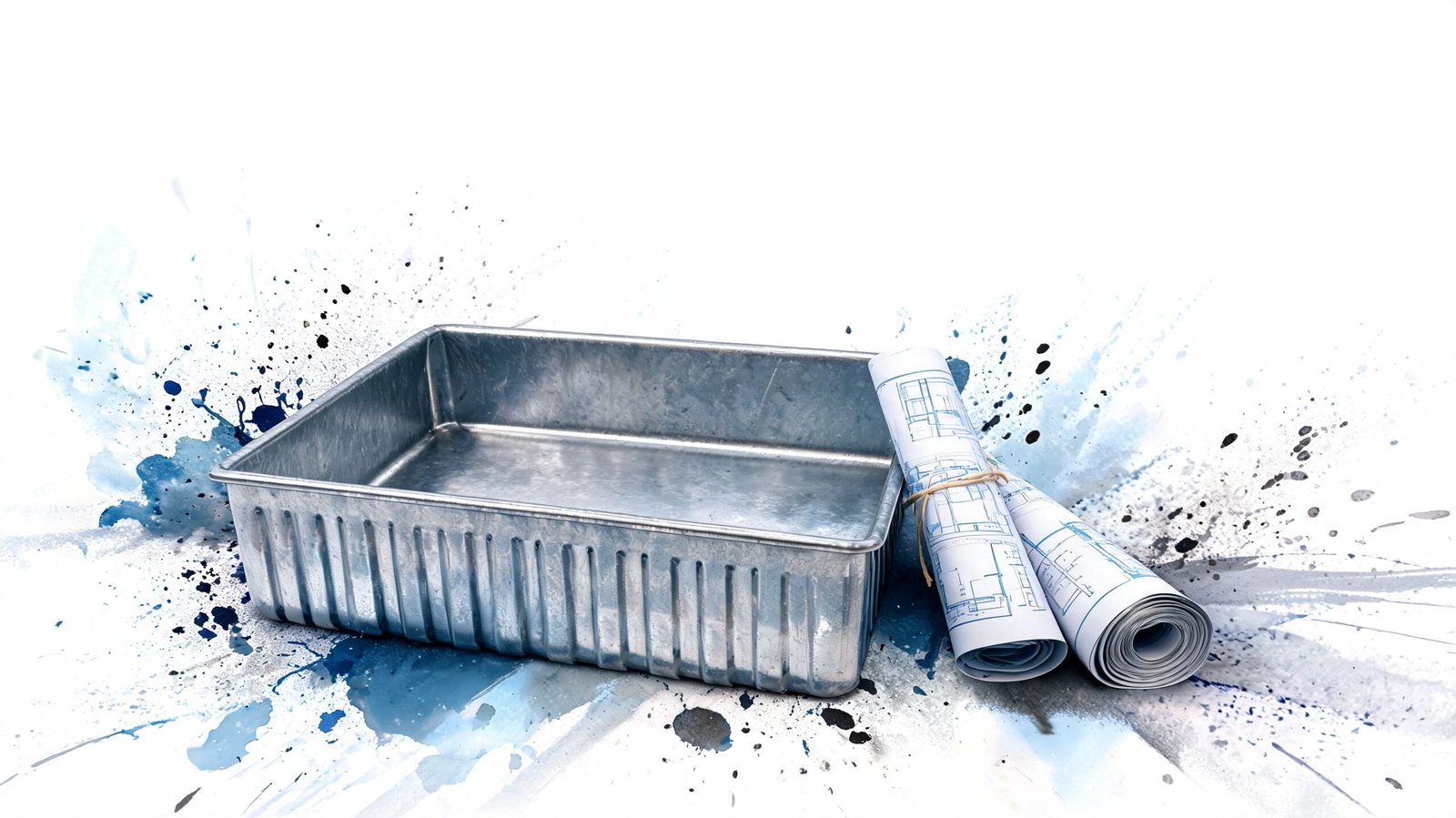
Steel versus poly in the field
Material choice starts with site conditions.
Steel pans usually make more sense on active commercial jobs, roadway work, and any site with steady forklift traffic, pump hoses, or ready-mix trucks moving in tight areas. They handle abuse better, stay put, and give crews a tougher target for daily use. That matters if the pan will sit near staging, truck washout, or a pump setup where it is going to take hits all week.
Poly pans have their place. On smaller pours or sites where weight and handling matter more than impact resistance, they can be easier to position and relocate. But they need more protection from traffic and rough handling. A lighter pan is only an advantage if the job conditions are light enough to support it.
Size should follow the pour plan
The right capacity comes from field activity, not a product sheet alone. Count the trucks. Account for chute washout, leftover mud, pump line cleanout, and whether one station will serve more than one crew. Those details drive volume faster than many contractors expect.
Reborn Rentals offers washout pans in multiple sizes, including shallow and deeper 72-inch by 72-inch models. That kind of range is useful because a short, controlled residential pour and a larger commercial placement do not create the same washout load.
Undersizing is a common mistake because the first estimate usually assumes ideal behavior. Jobs rarely stay ideal once trucks stack up, access gets tight, or a pump crew needs space at the same time.
Match the pan to the way the site actually runs
A good selection check is simple:
- Truck count and turnaround: More trucks usually means more rinse water and more solids.
- Pump washout: Line cleanout can fill a pan quickly.
- Equipment exposure: Forks, loaders, and delivery traffic push many sites toward steel.
- Access: If drivers and laborers cannot reach the pan without extra maneuvering, use drops.
- Service plan: Longer jobs need pickup, swap-out, or cleanout scheduled before the pan hardens up and loses usable capacity.
One rule holds up on almost every project. Order for your heaviest realistic washout day, not the smallest pour on the schedule.
That usually costs a little more up front. It often saves a lot more in labor, cleanup, and site headaches before the concrete phase is done.
Best Practices for Washout Station Setup and Use
A good pan in the wrong place still causes trouble. Setup matters just as much as selection because the station has to work for the crew, the site, and the inspection process.

Siting the station
The washout area should be established before concrete placement, not after the first truck shows up. Guidance commonly requires designated washout areas to be sized for all expected waste, inspected daily, and set back from sensitive points. Some guidance calls for 100 feet from storm drains, open ditches, or water bodies and 1,000 feet from wells or drinking-water sources, which is why location needs thought instead of guesswork. Those practical siting benchmarks are summarized in this construction washout setup guidance.
On the ground, that means choosing a stable, accessible location where trucks, pump crews, and labor can reach the pan without crossing finished work or dragging slurry through traffic paths. It also means staying out of low areas where rainwater collects.
Setup that helps crews use it
The best washout station is the one nobody has to ask about twice. Mark it clearly. Keep the approach clean. Put it where the washout operation feels natural instead of inconvenient.
A solid setup usually includes:
- Clear placement: The pan sits on stable ground where it won't rock, settle, or shift during use.
- Obvious access: Drivers and pump operators can reach it without complicated backing or crossing congested staging.
- Visible identification: Signage or direct marking tells every crew member this is the washout point.
- Overflow awareness: The pan has enough room left that the next rinse cycle won't send material over the edge.
Keep the washout station easy to reach. If using it adds ten extra minutes or a difficult maneuver, crews will look for shortcuts.
Daily management and end-of-use handling
Most washout failures aren't dramatic. They come from neglect. Nobody checks the fill level. Rain gets into the container. Hardened buildup reduces usable capacity. Then one more rinse cycle pushes slurry over the side.
Daily management should be routine:
- Check the fill condition before each pour or cleanup cycle.
- Inspect for leaks or damage around seams, edges, and the surrounding ground.
- Watch weather exposure so rain doesn't turn a manageable station into an overflow risk.
- Schedule removal or swap-out before capacity becomes a problem.
As the water evaporates and the concrete residue hardens, the waste becomes much easier to handle than free-flowing slurry. That's the whole point of containment. You convert a moving liquid problem into a controlled material that can be removed and disposed of under local requirements.
Renting vs Buying Washout Pans A Cost Analysis
This decision usually comes down to volume, logistics, and how much support your team wants to handle internally. Some contractors benefit from ownership. Most don't need another piece of equipment to store, transport, inspect, clean, and manage between jobs.
Where renting makes sense
Renting fits contractors whose concrete work varies from project to project, or whose jobs move across multiple locations with different access conditions. It keeps washout containment available when needed without tying up capital or yard space.
It also helps when your needs change. One week you may need a single pan for a small retrofit. The next month you may need a larger unit or multiple pans for a broader pour schedule. Rental lets the containment plan follow the project rather than forcing the project to fit owned inventory.
Where buying makes sense
Buying starts to make more sense for concrete specialists with frequent, repeat use and the internal systems to support ownership. If your crews handle pours constantly, have transport lined up, and already manage equipment maintenance and storage, ownership can be practical.
The catch is that ownership also means every headache belongs to you. If a pan is full, damaged, sitting in the wrong yard, or unavailable when a superintendent needs it, that's now an internal coordination issue.
Rent vs. Buy Comparison for Concrete Washout Pans
| Consideration | Renting | Buying |
|---|---|---|
| Initial cost | Lower upfront commitment | Higher upfront capital outlay |
| Flexibility | Easier to match pan size to each project | Limited to the pans you own |
| Storage | No long-term yard storage after use | Requires storage space between jobs |
| Transport | Often coordinated as part of rental logistics | You handle movement and scheduling |
| Maintenance | Provider typically manages equipment condition | Your team manages repairs and upkeep |
| Scalability | Easy to add more pans for larger sites | Expansion requires more purchases |
| Best fit | General contractors, short-term jobs, variable demand | High-volume concrete specialists with infrastructure |
A lot of contractors think buying saves money because the equipment becomes “theirs.” Sometimes it does. But if the pan sits idle, gets buried behind other equipment, or isn't the right size for the next job, ownership loses some of its appeal quickly.
Common Washout Questions from the Job Site
The questions that come up most often aren't about the rulebook. They're about shortcuts, edge cases, and what crews can realistically get away with on a busy day.
Can we just dig a lined pit?
You can, but that doesn't mean you should. Makeshift pits are harder to protect from tears, overflow, rain intrusion, and vehicle damage. They also tend to become vague responsibility zones. One crew uses it, another crew misses it, and nobody owns the condition by the end of the day.
Engineered pans are simpler to manage because the containment boundary is obvious. They are easier to inspect, easier to place, and easier to remove when the work is done.
A washout system only works if crews can recognize it instantly and use it the same way every time.
What happens to the waste afterward
Once contained, the slurry is no longer spreading across the project. Water can evaporate, solids can harden, and the waste can then be handled according to local disposal requirements. That is far easier than trying to recover material from soil, aggregate, pavement edges, or drainage features after an uncontrolled washout.
The practical lesson is that disposal starts with containment. If you don't contain it first, every later step gets harder.
What if the site is large or the pours are staged
Use more than one pan if the site layout calls for it. Long travel distances lead to bad habits. If truck access, pump location, and finishing areas are spread out, one central washout point may look efficient on paper but fail in practice.
In those cases, contractors usually do better with a plan like this:
- Separate by activity: One pan near truck and chute cleanup, another near pump operations.
- Separate by phase: Move or rotate pans as the workfront shifts.
- Separate by access route: Put containment where crews already travel, not where you wish they would go.
Do small jobs really need a dedicated pan
Small jobs create the same type of waste, just in lower volume. The temptation to skip proper washout is usually highest on small jobs because crews think the amount is too minor to matter. That's exactly when sloppy cleanup shows up in landscaping, driveways, alleys, and curb lines.
If concrete is being placed and equipment is being rinsed, the site needs a real washout plan. The scale changes. The need doesn't.
If you need a practical washout setup for an upcoming pour, Reborn Rentals offers concrete washout containment equipment for short-term jobsite use, with delivery scheduling and product details that help crews line up the right pan before concrete placement starts.