
Concrete Washout Pans: A Contractor’s Complete Guide
You’re usually looking for a concrete washout pan when the job is already moving. Trucks are showing up, the pump is staged, the finishers are focused on the pour, and nobody wants to stop production to argue about where the chute washout is going.
That’s exactly when bad habits show up. Someone rinses into a muddy corner. A hopper gets washed where it’s convenient instead of where it’s compliant. Slurry starts tracking across the site, and now a simple pour creates cleanup, inspection risk, and extra hauling. What should’ve been routine turns into a preventable mess.
A good foreman doesn’t treat washout as an afterthought. Concrete washout pans are one of those small decisions that keep a site organized, keep crews out of trouble, and keep margins from leaking away through rework, delays, and disposal headaches.
What Are Concrete Washout Pans and Why They Matter
A concrete washout pan is the designated leak-proof container where crews wash out chutes, pump hoppers, tools, grout, and concrete residue. Its job is simple. It contains caustic slurry and solids so they don’t end up in the soil, storm system, or traffic path of the site.
That sounds basic, but on a live project, this is one of the controls that separates a clean operation from a sloppy one.
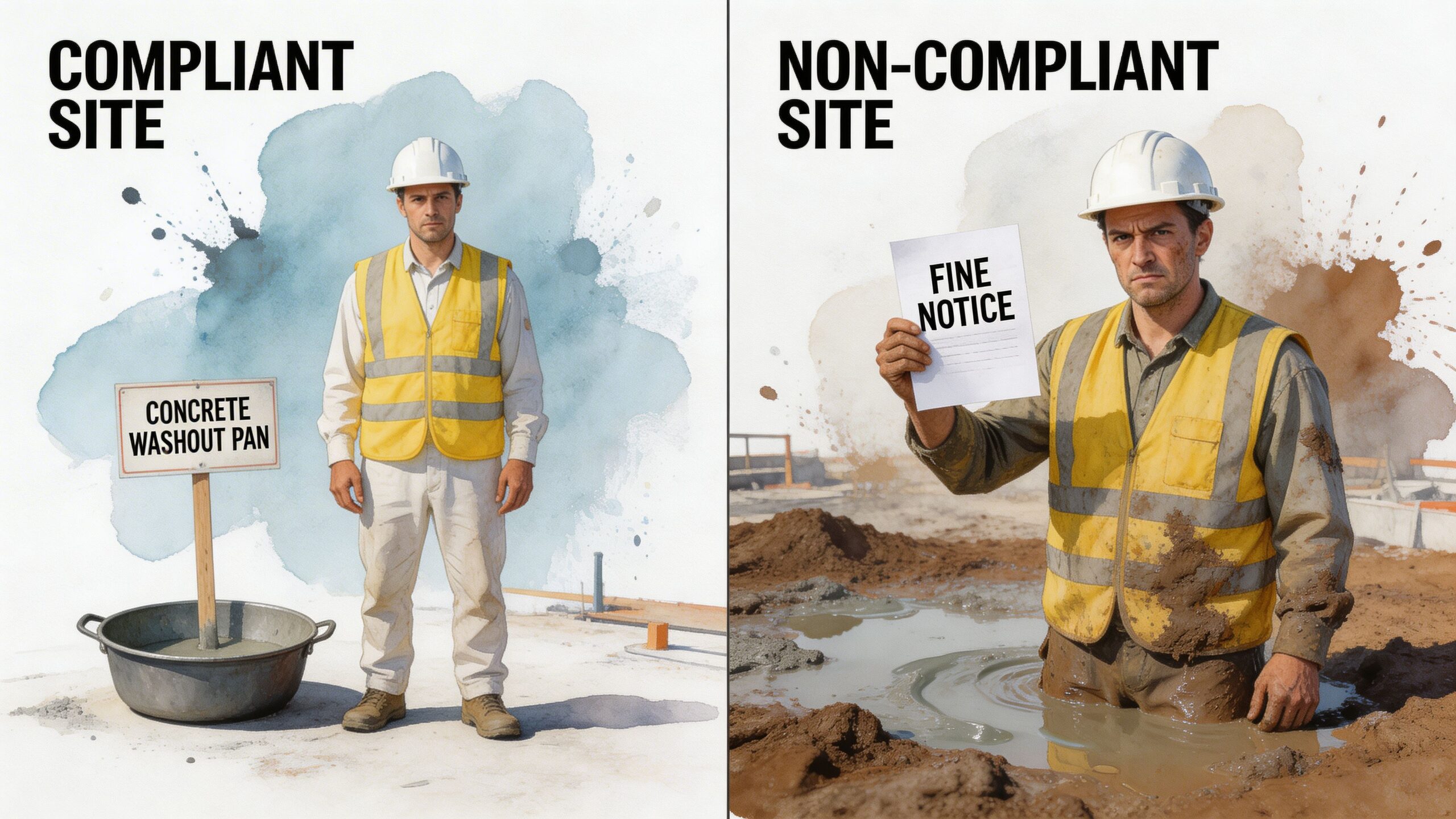
What the pan actually does on site
When the pour wraps up, the concrete doesn’t disappear just because the placement is finished. You still have leftover material in truck chutes, pumps, wheelbarrows, buckets, screeds, and wash water. If there’s no controlled place for that material to go, crews will create one on the fly.
That’s where trouble starts.
A proper pan gives the crew one obvious answer to a common field question: where does the washout go? It keeps the operation predictable. The truck driver knows where to pull up. The pump crew knows where to rinse out. The laborer handling cleanup isn’t chasing splatter across the site.
Why experienced crews treat it as standard equipment
Concrete washout pans matter for three reasons:
- Compliance: They support the site’s stormwater controls and keep washout where it belongs.
- Safety and housekeeping: They reduce wet, slick, high-pH mess in work areas.
- Cost control: They centralize cleanup and make final hauling or recycling far easier.
A pan also keeps responsibility clear. If washout is happening in one designated location, you can inspect it, protect it from overflow, and schedule service before it becomes a problem.
Practical rule: If your crew has to ask where to wash out, you’re already behind.
What works and what doesn’t
What works is a pan that matches the pace of the job and sits where crews can use it without fighting access.
What doesn’t work is any setup that looks fine on paper but gets ignored in the field. A pan placed too far from the pump, blocked by other equipment, or undersized for the volume will get bypassed. Then you’re back to ground contamination, extra labor, and a foreman trying to explain why there’s hardened slurry where nobody planned for it.
A solid washout setup also supports cleaner end-of-day routines. Instead of scattered piles and half-rinsed tools, the crew has one containment point. That keeps the site tighter and makes closeout easier.
The real value
The best concrete washout pans don’t attract attention. That’s the point. They resolve a recurring problem before it spreads into schedule, compliance, and cleanup issues.
On well-run sites, nobody debates whether to have one. They debate which size, which material, and whether renting or buying makes more sense for the work in front of them.
Navigating Washout Regulations and Environmental Risks
A pour can be going fine all morning, then one rinse-out in the wrong spot turns into a stop-work conversation with the inspector. I have seen jobs lose time over a mess that would have taken five minutes to prevent.
EPA guidance requires leak-proof containers for concrete washout, and those containers must retain all solids and liquids, be placed at least 50 feet from storm drains, and serve as a control under federal SWPPP requirements according to the EPA’s Stormwater Best Management Practice for Concrete Washout.

Why washout gets attention from inspectors
Concrete washwater causes trouble fast because it is not just muddy runoff. It is alkaline slurry that can stain pavement, kill grass, harden in soil, and move toward drains if the site grades that way.
On the product side, steel washout pan specifications note alkaline leachate can reach pH up to 12.5 and can harm aquatic life if discharged into streams or groundwater, as described for the Enviro Pan 72 x 72 x 14 Pro.
Inspectors know that. So do municipalities and stormwater managers. Once slurry leaves the containment area, the discussion shifts from cleanup to discharge, documentation, and who is paying to fix it.
For a small or mid-sized contractor, that cost matters. One preventable washout issue can wipe out the savings from choosing the cheapest pan option on paper.
Where jobs usually fail
Washout problems usually come from ordinary site decisions, not unusual events. The pan gets set where the driver cannot reach it cleanly. It sits in a low area where rainwater runs through. Nobody checks condition before the next pour. Subs are told there is a washout area, but nobody marks it clearly.
The field mistakes are predictable:
- Wrong location: Too close to drainage, traffic routes, or runoff paths
- Poor access: Pump crews and ready-mix drivers lose time reaching it, so they rinse out somewhere easier
- Missed service timing: Material builds up, freeboard disappears, and the next washout creates overflow risk
- Damaged containment: Cracks, bent steel, or worn seams let slurry escape
- Weak site communication: Drivers, finishers, and subs all follow different habits
That last one gets expensive. If crews are guessing, they will choose the closest spot, not the compliant one.
A washout setup has to work under production pressure, not just during the site walk.
What the rule means in the field
The practical standard is simple. Contain the slurry, keep it away from drains and waterways, and make the washout area obvious enough that a tired driver can find it without asking.
That affects cost decisions more than many contractors realize. Renting can make sense when the supplier handles swap-out and disposal on short-duration work or on sites with tight compliance oversight. Buying can pencil out on repeat work, but only if someone on your team inspects the pan, tracks fill level, and handles haul-off before it becomes a problem. Cheap ownership gets expensive if the pan sits full, leaks, or triggers a cleanup crew and a failed inspection.
Use the video below if you need a quick field refresher to show a crew or client what proper washout control looks like.
Liability starts small and gets expensive fast
Washout trouble rarely starts with a major spill. It starts with residue on the ground, one overloaded pan, or a rinse-out done ten feet outside the designated area because everyone was in a hurry.
Then weather, traffic, and the next truck make it worse.
Good foremen treat washout as part of production control. They assign the location early, check access before the first truck arrives, and make sure the containment plan matches the actual pour volume. That approach protects the site, keeps the SWPPP clean, and helps control one of the hidden costs in the rent-versus-buy decision. Compliance failures are not just environmental problems. They are margin problems.
Selecting the Right Concrete Washout Pan for Your Job
The wrong pan choice shows up fast on site. The truck backs in, the pump crew is waiting, the washout area is too tight, and now a simple cleanup task is slowing production and raising the chance of a spill.
Choosing the right pan starts with how the job runs. Pour size matters, but access, handling, and service frequency usually decide whether the setup works.
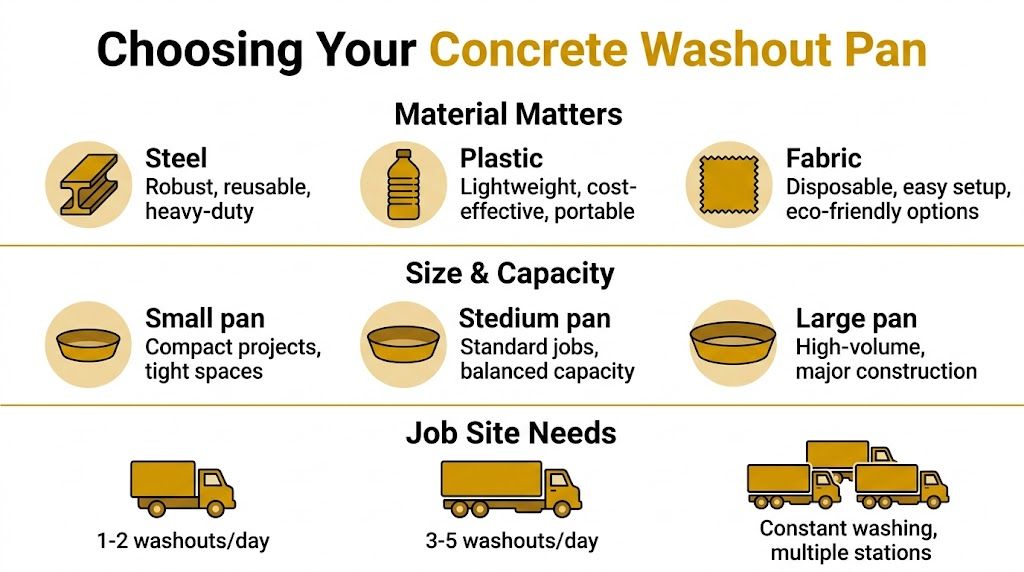
Start with material and handling conditions
For most small to mid-sized contractors, the first real decision is steel or plastic.
Steel pans are built for repeated abuse. If the pan will be set with forks, bumped by equipment, or used on active pump work week after week, steel usually holds up better and gives the crew fewer excuses. The trade-off is weight. It takes equipment to place it, reposition it, and load it out.
MDPE plastic pans solve a different problem. They are easier to carry, stage, and move on tight sites where a forklift is not always available. That can save labor on smaller jobs and short pours. The trade-off is durability. I would not put a lightweight pan in a spot where it is going to get knocked around all day by heavy equipment and expect it to last like steel.
Match the pan to the crew, not just the spec sheet
A lot of foremen overbuy capacity and underthink placement.
A larger pan gives you more room for slurry and rinse water, but it also takes up laydown space, blocks traffic, and can become one more obstacle in an already crowded work area. On a renovation, alley access job, or infill site, that matters. On a spread-out commercial slab, it may not.
A smaller pan can work well for basic chute rinse-out or limited pump washout if someone is watching fill level and service timing. If several trucks, pump residue, grout wash, and general cleanup are all headed to one container, small gets risky fast.
As noted earlier, larger containment options exist for high-volume pours. For day-to-day field selection, the better question is simpler: how much material is really going into this pan before it gets serviced?
Steel versus MDPE in plain jobsite terms
Use steel when the site is hard on equipment. Use MDPE when access and labor are tighter than the pour schedule.
Steel usually fits better when:
- Forklift or telehandler placement is normal
- Pump truck washout is frequent
- The pan will stay in one active location for days or weeks
- The crew needs a container that tolerates rough treatment
MDPE usually fits better when:
- Access is through gates, alleys, courtyards, or interiors
- A small crew has to set and move the pan
- The job is short enough that easy transport saves real time
- You need several lighter containment points instead of one heavy unit
Field call: The best pan is the one your crew can place correctly, reach easily, and empty before it turns into a cleanup job.
Size should follow washout volume and service plan
Capacity is where selection ties directly into cost control. That part gets missed in a lot of compliance articles.
If you rent, oversizing can mean paying for a larger unit than the job needs, plus giving up valuable site space for no real benefit. If you buy, oversizing means more money tied up in equipment that may sit idle between jobs. Undersizing creates a different cost problem. Extra service calls, rushed swap-outs, production delays, and spill cleanup can wipe out any savings from choosing a cheaper pan.
For small to mid-sized contractors, the practical goal is simple. Pick a pan that handles your expected washout volume with a buffer, but not so much extra capacity that handling, transport, and site layout get worse.
A practical comparison
| Feature | Steel Pans | MDPE (Plastic) Pans |
|---|---|---|
| Material feel | Rigid, heavier, better for repeated abuse | Lightweight, easier to reposition |
| Typical use | Active production sites, repeated pump washout | Small jobs, remote access, renovation work |
| Handling | Better when forks or lifting equipment are available | Better when one or two workers handle setup |
| Transport | Less convenient without equipment | Easier to stack, load, and move between jobs |
| Best fit | Longer-duration work with steady use | Short-duration work or tight-access sites |
| Trade-off | More durable, but heavier and harder to move | Easier logistics, but less suited to constant abuse |
Choose for the whole job, not the catalog photo
Before ordering a pan, answer a few questions in the trailer, not after the first truck arrives:
- Where will the washout point sit relative to truck and pump access?
- How many crews will use it in the same shift?
- Will rainwater reduce usable capacity?
- Can the pan still be moved safely after material builds up?
- Is one central pan more efficient, or do you need multiple smaller stations?
I have seen expensive pans fail on simple jobs because nobody thought through approach path, service timing, or who was responsible for checking fill level. I have also seen basic setups work well because the foreman matched the pan to the site and the crew used it the same way every time.
That is the standard. Pick the pan that fits the work, the access, and the labor you have.
Renting vs Buying Your Washout Solution
Small and mid-sized contractors frequently make the wrong decision for the right reason. They think buying is always cheaper because the asset is theirs. Sometimes that’s true. Often it isn’t.
If you only need concrete washout pans for specific pours, periodic renovations, or short-term scopes, ownership can tie up cash and create more problems than it solves.
The hard cost comparison
The numbers that matter are straightforward. Renting a washout pan at around $25/day can avoid an upfront purchase cost of $5,000 to $15,000, and that rental model is described as ideal for short-term projects under 30 days while avoiding storage, maintenance, and potential disposal fees of $1,000+ if slurry hardens improperly, according to Marion SWCD’s concrete washout guidance.
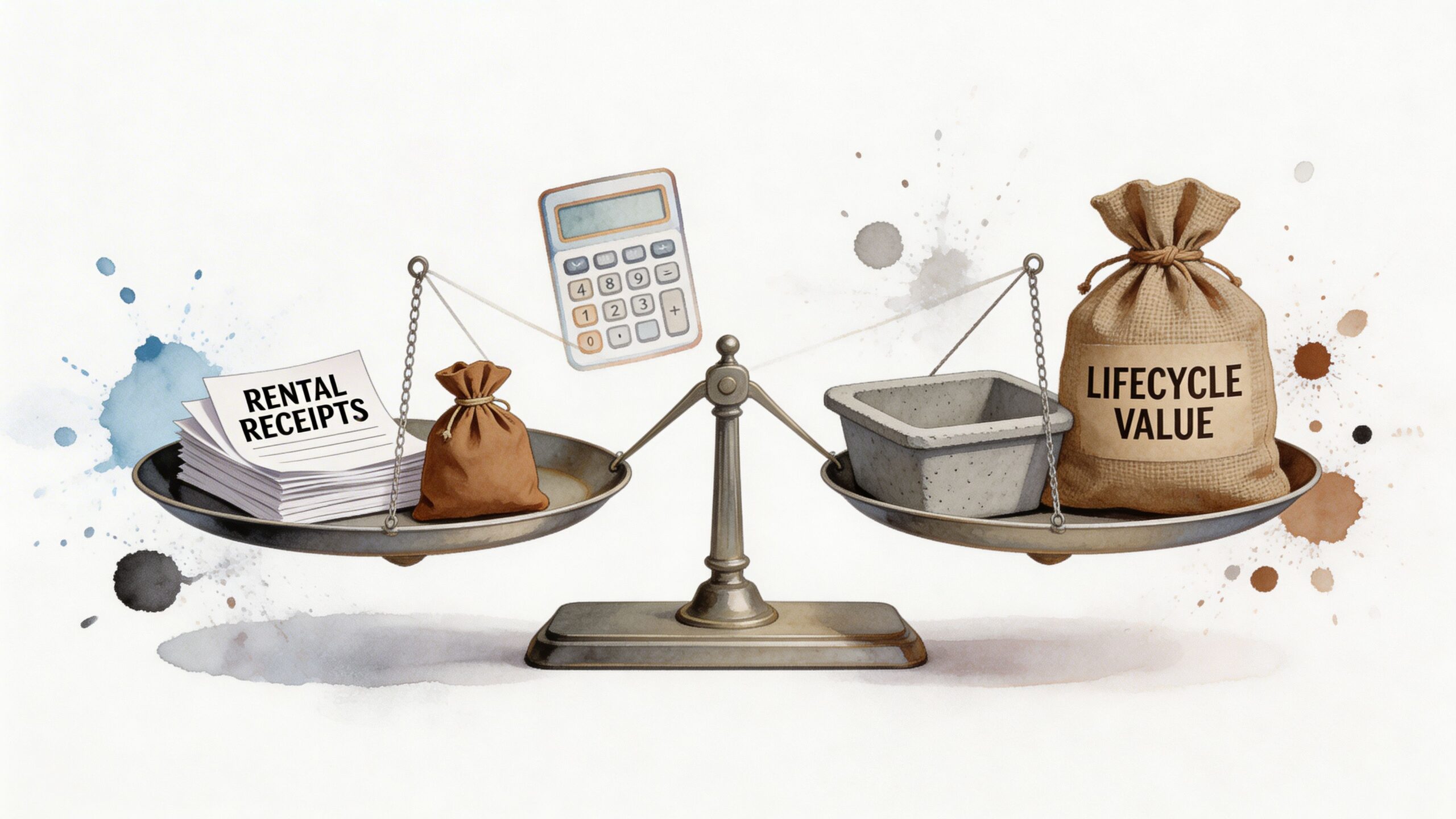
If your job is short, the math usually favors renting. You preserve capital, get the pan when you need it, and hand the equipment burden back when the pour is done.
If your work is constant, repeatable, and you have space, equipment, and staff to manage the asset, buying gets more attractive. But even then, buying only works when you account for the full lifecycle.
What ownership really includes
A purchased pan isn’t just a one-time line item. It creates a chain of responsibilities.
You have to store it between jobs. You have to move it. You have to inspect for leaks, damage, and buildup. Someone has to clean it well enough for reuse. If hardened material gets neglected, disposal can stop being routine and become expensive.
That’s the part many estimates miss. The pan may be “paid for,” but the ownership labor never goes away.
Renting makes sense when the pan is a tool for the project. Buying makes sense when managing pans is part of your business model.
When renting is the stronger move
For small to mid-sized contractors, renting is usually the better play in these situations:
- Short duration work: A small foundation package, a slab pour, a retrofit, or a quick civil scope doesn’t justify tying up capital.
- Variable schedule: If concrete work comes in waves, owned equipment sits idle between jobs.
- No storage plan: Yard space isn’t free, especially when gear turns over slowly.
- Changing site conditions: Different jobs may need different pan sizes or handling setups.
Renting also reduces the risk of picking the wrong asset. If one project needs a compact pan and the next needs a larger containment option, you’re not stuck making one piece of equipment serve every condition.
When buying can still be justified
Buying makes more sense if your operation uses washout containment constantly and predictably. A contractor with regular concrete pumping work, dedicated storage, internal hauling capacity, and a crew that maintains equipment can spread the cost over more use.
Even then, discipline matters. Owned pans fail financially when they’re ignored, misplaced in the yard, or returned to service in poor condition.
A pan is like any other site control. If nobody owns the process, the equipment won’t solve the problem by itself.
A simple way to think about it
Rent if you need flexibility, lower upfront exposure, and fewer ownership headaches.
Buy if you have enough repeat use to keep the pan working, not sitting, and you’re set up to maintain it properly.
For most smaller contractors, that’s the practical answer. The cheapest-looking decision on paper isn’t always the most profitable one in the field.
Best Practices for On-Site Washout Management
A washout plan usually fails at 4:30 p.m., when the pour is running long, the pan is half buried behind stored material, and a driver rinses out wherever he can reach. That is how a small site control turns into cleanup labor, schedule drag, and a compliance problem.
Good on-site management starts with placement, but it only works if the crew can use the pan fast and without extra hassle.
Place it where the crew will actually use it
Set the pan on stable, level ground with clear access for the truck, pump, and laborers handling washout. If the pan is hard to reach, blocked by traffic, or placed too far from the work, the crew will create a second washout spot without asking.
Keep it out of busy haul paths and away from places where forklifts, loaders, or delivery trucks can crowd it. Protect the area with simple barricades or cones if needed. Mark it clearly as the designated washout location, and make sure every driver and pump operator knows where it is before the first rinse starts.
Distance matters too. As noted earlier in the regulations section, washout areas need separation from drains and sensitive runoff paths. Field conditions vary, so the foreman should confirm the exact placement before concrete work begins, not after slurry is already on the ground.
Manage volume before it becomes a service call
Overflow is rarely a surprise. It usually comes from nobody owning the check.
Assign one person to monitor the pan during active concrete work. On a smaller crew, that may be the foreman. On a busier placement, it may be a laborer who already controls cleanup and site housekeeping. The point is simple. If everyone is watching it, no one is watching it.
Use a routine that holds up on real jobs:
- Check capacity during the pour, not after it.
- Watch for rain in the forecast and protect open pans if needed.
- Call for service before the pan gets tight on volume.
- Do not let one extra truck be the reason it spills over.
That early service call matters financially. A scheduled swap is cheaper than emergency cleanup, crew downtime, and the labor it takes to scrape hardened material off surrounding ground. For smaller contractors especially, that is where washout management shifts from a compliance task to a margin issue.
Keep the contents clean enough to handle efficiently
A washout pan should hold concrete washout. Nothing else.
Do not let crews toss trash, wire, wood, cups, bags, or cutoffs into it. Mixed debris slows removal, adds sorting labor, and can push material into a more expensive disposal path. It also makes recycling harder, which cuts off one of the few ways to reduce end-of-job handling costs.
The cleaner the pan stays, the easier the closeout goes. That is a field reality, not theory.
Properly managed material can still have value. Diligent’s concrete washout report shows that disciplined recovery and recycling programs can keep large volumes of concrete washout material out of disposal streams. Small and mid-sized contractors may not run that kind of program themselves, but the lesson still applies. Clean separation lowers handling cost.
Keep the washout pan for washout. Once it turns into a junk bin, disposal gets slower and more expensive.
Close out the pan the same way you ran the job
End-of-job cleanup goes smoothly when the crew stayed disciplined from day one. If the contents remained contained and free of random debris, hardened material is easier to remove and route correctly.
That saves labor at the end of the project, which is where a lot of contractors give back money they thought they saved earlier. A pan that was managed well all week usually closes out with fewer surprises, fewer extra hours, and fewer arguments about who is cleaning up the mess.
Understanding Costs and Logistics for Washout Pans
A lot of frustration around concrete washout pans comes from bad planning, not bad equipment. The daily rate is only one part of the decision. The rest is logistics.
If you don’t pin those down early, your estimate can look fine in the office and feel wrong on the job.
What to budget beyond the base rate
The first number most contractors look at is the rental rate. That matters, but it isn’t the whole picture.
You also need to ask about delivery timing, pickup coordination, access conditions, and whether the drop area creates extra handling difficulty. A pan set near a clean, accessible approach is one thing. A pan that has to be placed in a tight or rough area is another.
The right way to budget it is to treat the pan like any other short-term site support item. Confirm the use window, verify the location, and ask about extra charges before you schedule.
The logistics questions that save headaches
Before placing an order, make sure you have answers to these:
- Delivery window: Will the pan arrive before the first concrete operation that needs it?
- Drop location: Can the driver place it where the crew needs it?
- Ground condition: Is the area stable enough for safe placement and later removal?
- Pickup timing: Who calls for removal, and how much notice is needed?
- Material condition at return: What level of cleanup is expected before pickup?
Those questions matter more than people think. A pan that arrives late or gets dropped in the wrong part of the site creates exactly the kind of improvisation you were trying to avoid in the first place.
Keep procurement simple
The best rental process is the one your team can complete quickly without phone tag or missing details.
A clear workflow helps. Add the item, enter dates and location details, then confirm checkout and delivery. That sounds obvious, but simple ordering reduces mistakes. It also gives the office and field the same expectation about when the pan is showing up and where it’s going.
If a provider is transparent about possible delivery, terrain, or express-order charges, that’s usually a good sign. You want those details up front, not after the pour has already been scheduled.
What a foreman should confirm before the truck rolls
Call it in writing or text if you have to, but don’t leave these unstated:
- Exact pan size needed
- Date on site
- Placement instructions
- Site contact
- Pickup plan after use
That short confirmation list prevents most avoidable mistakes. When logistics are clear, concrete washout pans do what they’re supposed to do. They solve a problem efficiently and let the crew focus on production.
Frequently Asked Questions About Concrete Washout
How many trucks can one pan handle before it’s full
There isn’t one universal truck count that fits every job. It depends on the pan size, how much residual material each truck carries, whether pump washout is going into the same container, and whether rainwater is taking up space.
The right move is to track actual fill during the first washouts on that site. After that, you’ll know whether one pan is enough or whether you need a larger unit or more frequent service.
What’s the best way to deal with hardened concrete in the pan
Don’t wait until the end of a long stretch and hope cleanup stays easy. Manage the pan before buildup becomes excessive.
If the material has already hardened, keep the handling method consistent with the pan design and your site safety rules. The biggest mistake is letting hardened buildup sit so long that removal, return, or disposal becomes a separate problem with added labor and fees.
Can I place a washout pan on unpaved ground
Yes, if the ground is stable, level, and won’t rut or shift under the load. What matters is control.
If the location turns muddy, settles unevenly, or channels runoff toward the pan, pick another spot or improve the base. Unpaved doesn’t automatically mean bad. Unstable does.
Do I need more than one washout location
Sometimes, yes. One pan works when traffic is simple and all washout activity naturally funnels to one point.
If trucks, pumps, and finishing crews are spread across a large site, multiple stations can be cleaner and easier to enforce. The key is making each station obvious and accessible enough that nobody creates their own unofficial washout area.
What should I tell a new crew member on day one
Keep it short. Show them the pan, explain what goes in it, and make it clear that washout never goes on open ground.
That simple orientation does more than a long lecture. Most field mistakes happen because nobody gave a direct instruction early.
What usually causes washout setups to fail
Three things show up again and again. The pan is in the wrong place, it’s too small for the actual workload, or nobody owns checking it during active concrete work.
Fix those three, and most washout issues get much easier to manage.
If you need a dependable washout setup without tying up capital, Reborn Rentals offers concrete washout containment with straightforward booking, clear daily pricing starting at $25/day, and practical support for delivery, placement, and scheduling. For contractors who want compliant containment without the ownership burden, it’s a simple way to keep the site cleaner and the pour moving.