
Concrete Clean Out: A Contractor’s On-Site Guide
The crew is finishing the slab. The last bull float pass is done, the edges are cleaned up, and everybody's looking at the surface. Meanwhile, the truck is still loaded with residue in the drum and chute, the pump still has material in the line, and the driver is waiting for one answer that decides whether the end of the pour stays organized or turns into a mess.
That answer is simple only when somebody already made the plan.
On a lot of jobs, concrete clean out gets treated like a leftover task. It isn't. It's part of the pour. If nobody has defined where the truck washes out, who manages the area, who monitors capacity, and who handles the waste after the trucks leave, the site lead usually gets handed the problem in real time.
That's where jobs get sloppy fast. One person points at the driver. The driver points at the concrete contractor. The concrete contractor points at the GC. The owner wants it gone. By then, slurry is already on the ground, someone is dragging a hose across active work, and the jobsite is one mistake away from a stormwater problem.
The Moment After the Pour
The pour feels finished before it is complete. That's the trap.
A slab can look clean and still leave you exposed if the washout side of the operation hasn't been controlled. The truck chute still needs to be rinsed. Tools still need to be cleaned. The hopper, buggy, pump components, and any spot where concrete residue gets washed down all have to go somewhere. If that “somewhere” is improvised after placement, you've already lost control of the process.
I've seen the same sequence more than once. The finishers stay focused on the slab, which is exactly what they should do. The driver asks where to wash out. Nobody gives a clear answer. Someone waves toward a dirt edge, an empty corner, or a gravel strip that “should be fine.” It isn't. What looks like harmless gray water is really high-alkalinity washout mixed with solids, and once it gets loose on the site, cleanup becomes harder than the pour itself.
The bigger issue isn't appearance. It's exposure.
A lot of crews still think cleanup means scraping up the obvious residue and hosing off the rest. That misses a significant risk. The under-discussed problem on mixed subcontracted jobs is that crews often haven't defined who legally and operationally owns washout cleanup, even though uncontrolled slurry and pH runoff can create SWPPP violations and jobsite conflict, as noted by Concrete Network's concrete questions discussion.
Field reality: The slab can be perfect and the job can still go sideways if the washout wasn't planned.
Once that happens, the site lead is no longer managing finishing quality. They're managing traffic, finger-pointing, and containment. That's why concrete clean out belongs in the pre-pour conversation, not the end-of-day scramble.
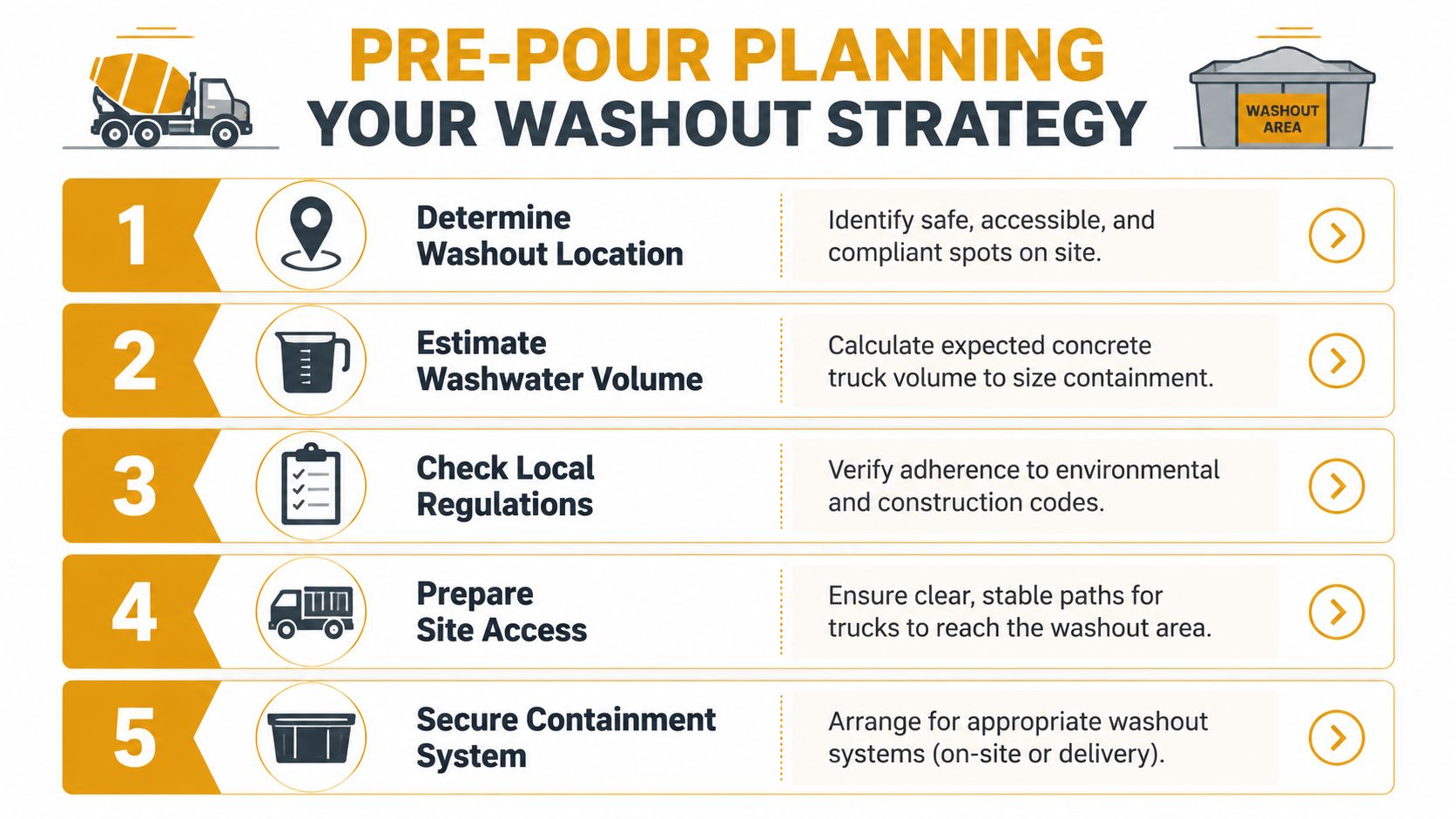
Pre-Pour Planning Your Washout Strategy
A clean washout operation starts before the first truck leaves the plant. If you wait until the drum is spinning on site, you're making decisions under pressure with equipment moving around you.
The first question is location. It has to be accessible enough that drivers and pump crews can use it without crossing active work, but isolated enough that a mistake won't send slurry into travel paths, drains, cultivated areas, or unfinished grades that matter later. If trucks have to back into a tight corner, climb unstable fill, or cross where other trades are working, the location is wrong even if it looks good on paper.
Lock down ownership before the trucks roll
Most jobs get fuzzy at this stage. On mixed subcontracted work, crews still argue over whether washout belongs to the driver, the placing contractor, the pumper, the GC, or the property owner. That confusion is common enough that it stands out as a gap in mainstream guidance, even though the risk is operational and legal, not just cosmetic.
The practical fix is straightforward. Put responsibility in writing before the pour.
Use your pre-pour meeting or work plan to answer these points:
- Who provides the containment. Name the party supplying the pan, pit, bag, or other approved system.
- Who directs the trucks. One person on site should own traffic and driver instructions.
- Who monitors capacity. If multiple trucks are coming, somebody has to watch fill level and call for backup before overflow is even possible.
- Who handles post-pour removal. Cleanup isn't over when the truck leaves. The waste stream still exists.
- Who documents compliance. On regulated sites, that record matters when questions come up later.
If none of those items has an owner, then the owner is effectively “whoever is standing there when it goes wrong.”
Size the plan to the job, not to wishful thinking
A small patio pour and a long structural day don't need the same setup. What matters is matching the washout plan to the number of trucks, the amount of equipment being cleaned, and the amount of time the containment will sit on site.
Think through the day like a supervisor, not like a purchaser:
- Truck count and sequencing: Back-to-back arrivals create washout congestion at the worst possible time.
- Pump use: Pump cleanup adds another source of slurry and rinse water.
- Access conditions: Mud, tight gates, overhead conflicts, and night work all change what's realistic.
- Site duration: One-day pours can use one approach. Multi-day work usually needs something more durable and easier to manage.
If the washout area is hard to reach, crews won't use it correctly. That's not a discipline problem. That's a planning problem.
Walk the route, not just the destination
I always care as much about the path as the location. A compliant washout area doesn't help if the truck has to swing across fresh flatwork, soft shoulder, or pedestrian access to get there.
Before the pour, physically check:
- Ground condition: Stable, level, and able to support vehicle movement.
- Turning clearance: Enough room for a driver who hasn't worked your site before.
- Traffic separation: Keep washout away from laborers, forklifts, and staging zones.
- Exit path: Trucks need to get in and out without backing the whole site into confusion.
Good concrete clean out starts with a simple rule. If the plan depends on everybody improvising correctly under time pressure, it isn't a real plan.
Selecting the Right Washout Containment System
After the pour, crews stop thinking about equipment categories and start looking for the fastest place to rinse. That is why containment choice is an operations decision, not a purchasing detail. If nobody clearly owns the washout plan, the crew will default to whatever is closest, and that is usually where spills, rework, and compliance problems start.
What fails in the field
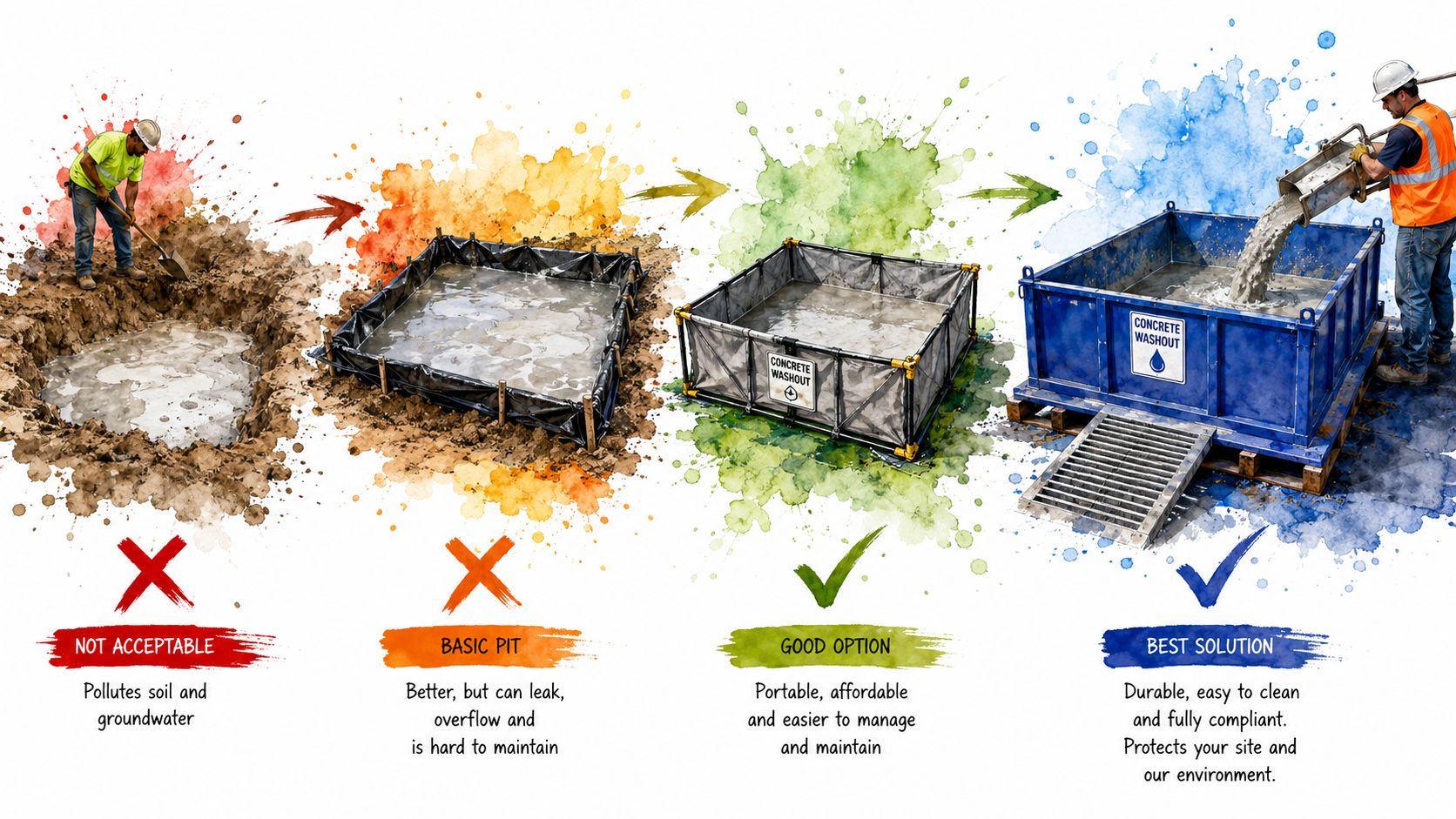
Site-built pits and plastic-lined hay bale setups stay common because they are cheap and familiar. They also fail in predictable ways. The liner gets punctured, the sidewall slumps, runoff escapes after rain, or a truck gets too close and crushes the edge. On paper, that setup counts as containment. In the field, it often turns into a maintenance problem that nobody owns once production starts.
Washout bags and other light portable systems fit small pours and tight sites better. They are easier to stage and easier to remove. They also need tighter control. Overfilling, punctures, and poor placement show up fast, especially when multiple crews use the same area without one person checking capacity and condition.
Steel pans usually give the superintendent the most control on active sites. They hold shape, stay visible, and tolerate repeated use without turning into a soft spot or torn liner problem. That does not make them automatic. They need equipment access for delivery and pickup, and they need solid ground. If the site cannot support the pan safely, a heavy unit can create its own headache.
Match the container to the project
Pick the system that fits the actual cleaning load and the person responsible for managing it. If pump washout, truck chute rinse, hand tools, and multi-day use are all hitting the same container, light-duty containment gets overwhelmed fast.
| Method | Capacity | Durability & Compliance | Best For |
|---|---|---|---|
| Plastic-lined pit | Varies by how it's built | Can work, but damage and collapse are common field issues | Short jobs on open sites with close supervision |
| Washout bag | Varies by product | Portable, but vulnerable to puncture and overfilling | Small pours, retrofit work, constrained access |
| Steel washout pan | Fixed by unit size | Strong, visible, reusable, easier to manage consistently | Repeated pours, urban sites, commercial work |
The question is simple. Who is checking it, controlling use, and calling for removal? If that answer is vague, choose the system with the least room for field improvisation.
A brief example helps. Reborn Rentals lists steel washout pans in a 72' x 72' x 24' format at approximately 441 gallons and a 72' x 72' x 14' format at approximately 310 gallons, according to their equipment overview. Fixed dimensions like that help with planning because the crew can assign one unit to the expected washout load instead of guessing what a makeshift pit will hold.
Choose for control, not just price
Cheap containment gets expensive when it fails during cleanup. One torn liner, one overloaded bag, or one pan full of unrelated trash can stop work and create disposal problems that cost more than the original rental or setup savings.
Before approving a system, confirm these points:
- Assigned ownership: One person needs responsibility for inspection, use, and removal coordination.
- Expected washout volume: Account for trucks, pumps, tools, and repeat rinsing, not just the concrete quantity.
- Tolerance for misuse: Busy sites need containment that still works when the day gets sloppy.
- Removal conditions: The unit should leave without blocking the next phase of work or sitting full over a weekend.
- Debris control: Keep wood, wire, cups, and general trash out of the washout so disposal stays straightforward.
My rule is to choose the washout system the tired crew will still use correctly as their shift winds down. Visible, stable, and hard to misuse usually beats cheap and makeshift. On most commercial pours, that is the difference between a controlled cleanup and a preventable mess.
Safe and Compliant On-Site Cleanout Procedures
A good washout area can still produce a bad result if the operation around it is loose. Cleanout needs the same discipline as placement. One person directs it. One path leads to it. Everyone else stays out of the way.
Set the area before the first rinse starts
The container or washout system should be on level ground and clear of routine traffic. Don't place it where laborers cut through, where forklifts corner hard, or where trucks need to jockey around stored material. If the washout area is in a conflict zone, splashing and spills go up immediately.
The approach matters too. The driver needs a straight, predictable move into position. A spotter should guide the truck or pump crew into place so the chute, hopper, or line discharge lands where it should on the first try. Hand signals need to be clear and consistent. If two people are directing, nobody is directing.
Before any rinse starts, make sure the crew handling the area has the basics ready:
- PPE on hand: Gloves, eye protection, boots, and whatever the site requires for splash protection.
- Spill response materials: Enough to contain a small release before it spreads.
- Signage or cones: Other trades need a visible cue that this area is active.
- A stop point: The spotter should know exactly where the truck needs to stop.
Control the wash, don't just spray
A lot of cleanout mistakes come from rushing the rinse. The chute gets swung too quickly, the water comes on too hard, or the operator stands at the wrong angle and starts throwing material outside the containment.
The cleaner approach is slower and more controlled. Keep the chute low enough to direct slurry into the container without a long drop. Wash incrementally rather than blasting the whole assembly at once. If the pump hopper or tools are being cleaned nearby, keep all of that activity inside the same controlled footprint.
For finished concrete surfaces that need pressure washing later, technique matters more than aggression. A common field benchmark is that a pressure washer rated at 3,000 PSI or higher is ideal for tougher grime, while some crews use a minimum of 500 PSI for routine wash-down of broomed or stamped concrete. Guidance also recommends testing a small area first, holding the wand about 12 to 16 inches from the surface, using overlapping passes, and keeping the nozzle moving to avoid etching, according to A-1 Concrete's cleaning guide.
That's a separate task from washout disposal, but the lesson is the same. More force doesn't fix sloppy technique.
Keep the nozzle moving. The same rule applies to the whole cleanout operation. Controlled motion beats rushed cleanup every time.
Run it like a short safety operation
Concrete clean out goes better when the site treats it like a defined activity instead of background noise.
A simple field routine works well:
- Assign one lead: The lead controls timing, directs the driver, and stops the operation if the setup isn't right.
- Keep the zone tight: Only the spotter, operator, and necessary labor stay inside the working area.
- Watch splash points: Chute joints, hopper edges, and pan rims are where sloppy washout usually starts.
- Check capacity while cleaning: Don't wait until the end to realize the containment is too full for the next truck.
- Inspect before release: Once the truck leaves, look at the surrounding ground, access path, and container edge immediately.
The jobs that stay clean aren't always the jobs with the fanciest equipment. They're the jobs where somebody owns the procedure and doesn't let the end of the pour get casual.
Managing Washwater and Disposing of Solids
Once the truck is rinsed out, the waste hasn't disappeared. It has only changed form.
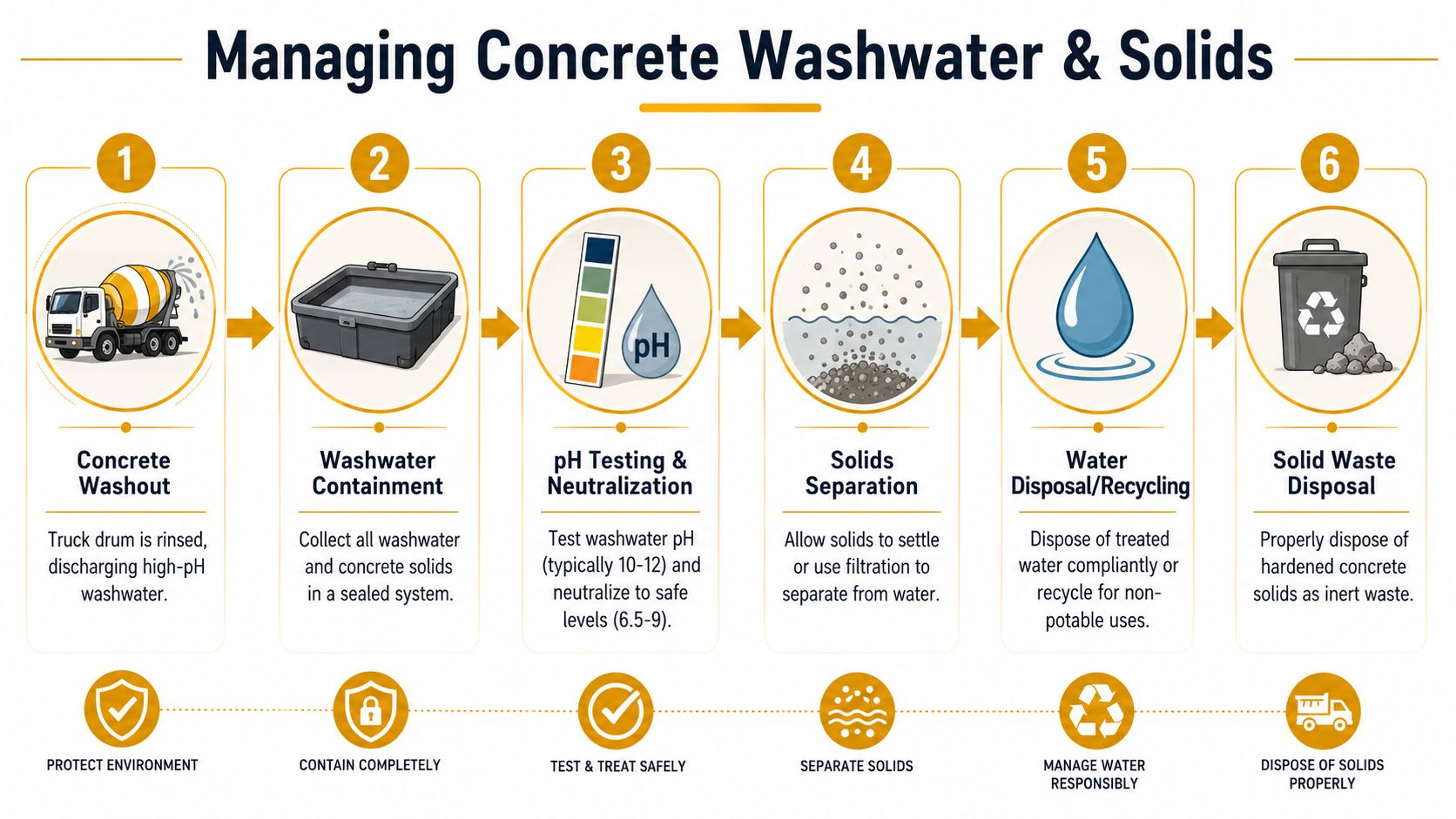
What sits in the washout area is a mix of liquid and solids, and the smart move is to treat those as separate management problems. Crews get in trouble when they act like the whole thing can be handled with one shortcut.
Start with separation
The Environmental Protection Agency's guidance is practical. Concrete washwater can be passed through filters to remove solids and then reused, and the agency recommends a dedicated washout area to keep the material away from stormwater and soil. The key operating sequence is to segregate the slurry, let solids settle, remove captured solids, and recycle or properly dispose of the remaining washwater, according to the EPA concrete washout guidance.
That sequence matters because it keeps crews from making the most common bad decision, which is treating the liquid like nuisance water instead of a managed waste stream.
In practical terms, that means:
- Hold it in containment: Don't discharge to grade, drains, or unimproved ground.
- Let the material calm down: If you keep stirring it, you delay separation and make the next step harder.
- Remove solids deliberately: Don't leave chunks and slurry mixed together if you can separate them cleanly.
- Handle the remaining water as its own item: Reuse if your setup allows, or dispose of it properly through your established process.
Solids are easier. That doesn't mean ignore them
Once the solids harden, they're far less messy to deal with than fresh slurry. That's why some crews focus only on waiting until everything sets. The problem is that this mindset often ignores the liquid phase, which is where the primary exposure starts.
Hardened concrete residue still needs planned removal. Depending on the container and service arrangement, that can mean breaking out accumulated material, hauling solids for disposal, or scheduling pickup of the whole unit. What matters is keeping unrelated trash, wood, rebar tie wire, and general debris out of the washout. Mixed waste complicates removal fast.
The easiest waste to dispose of is the waste you kept separated from the start.
Don't confuse “dried up” with “handled correctly”
A lot of jobs rely on evaporation and time. Sometimes that's part of the process. It isn't the whole process.
If rain hits before the material has settled, if another truck needs the same container, or if the washout sits in place longer than planned, the half-finished situation becomes its own problem. That's why the removal plan needs to exist before the first rinse. Someone should know whether the washwater will be filtered and reused, held for further handling, or removed by service arrangement. Someone should also know when the solids will be taken off site and who is authorized to make that call.
Concrete clean out stays compliant when the team stops thinking about “cleanup” as one moment and starts treating it as a chain of controlled steps.
Troubleshooting Common Concrete Clean Out Issues
Washout problems usually start with one bad assumption. Someone thinks cleanout will sort itself out at the end of the pour.
It does not.
The trouble starts when nobody clearly owns capacity, access, weather checks, driver direction, and the call to swap or remove containment. On a well-run site, those decisions belong to one person before the first truck arrives. On a sloppy site, they get made in a hurry after the washout is already overloaded or in the wrong spot.
The pan is almost full and another truck is inbound
Treat that as a planning failure, then fix it fast. A nearly full container should trigger the backup plan immediately, not a debate beside the chute.
That backup might be a second washout already staged, a designated overflow location that meets site rules, or a scheduled swap-out with the rental provider. What should never happen is asking a driver to rinse lightly and hope for the best. Slurry does not respect good intentions, and cleanup costs rise fast once material gets outside containment.
Rain starts during or right after cleanout
Rain changes the job. Extra water cuts into capacity, raises spill risk, and turns a manageable washout into runoff exposure if the setup is left open.
The fix is simple, but only if it was assigned ahead of time. Someone needs to own cover materials, placement, and the decision to pause or redirect cleanout activity if the container is close to full. I want that responsibility named in the pre-pour plan, because weather delays are cheaper than contaminated ground and a preventable cleanup report.
A small spill hits the ground
Handle it at once.
Small spills spread because crews keep working for another ten minutes, then another thirty. By then, boots, tires, and rainwater have moved the material farther than the original splash zone. Stop the source, isolate the area, recover what can be collected, and clean the surface before the residue hardens where it does not belong.
The driver doesn't know your site procedure
That is a site control issue. Ready-mix drivers move between jobs all day, and each site has different access points, traffic flow, and washout locations.
Give direction before the truck gets into position. Mark the washout area clearly. If access is tight, have a designated person meet the truck and point it in. Correcting a bad setup after the chute is over finished work usually means rework, delay, or both.
There's almost no room on site
Small sites force discipline. Urban infill jobs, interior placements, and tight commercial pads leave very little margin for bad container placement or extra rinse water.
In those conditions, improvised cleanout spots create more problems than they solve. Compact containment, a short path from placement to washout, and a defined traffic route matter more than convenience. If the site cannot support the original plan, change the plan before pour day. Do not push the decision onto the crew while concrete is in the air.
The common thread in all of this is ownership. Concrete clean out stays under control when one responsible party has authority to set the washout location, confirm capacity, brief drivers, respond to weather, and order removal. If that responsibility is vague, routine cleanout turns into a preventable site problem.
If you need a practical washout setup that crews can schedule around, Reborn Rentals provides concrete washout containment rentals built for active jobsites. Their catalog is geared toward short-term site use, delivery coordination, and durable containment, which helps GCs, concrete subs, and site managers keep concrete clean out controlled from placement through pickup.