
Facility Management Solutions for Modern Projects
A project manager is trying to keep a concrete pour moving while answering a tenant complaint and preparing for an inspector who may arrive before lunch. The maintenance team wants access to a mechanical room, the superintendent needs a clear truck route, and someone still has to prove that slurry, dust, and debris won't reach a drain.
That is the practical problem facility management solutions must solve. They aren't limited to an enterprise software dashboard. They include the people, procedures, equipment, containment, documentation, and vendor coordination that keep a project safe, compliant, and productive from groundbreaking through punch-list.
The market's scale confirms that facility management is now a core enterprise function. The global facility management market was valued at USD 1,001.0 billion in 2024 and is projected to reach USD 1,360.3 billion by 2030, with an implied 5.2% CAGR from 2025 to 2030, according to Frost & Sullivan's facility management market forecast. But a software platform won't decide where a washout pan goes, who calls for pickup, or whether a Saturday pour has enough containment capacity. Those decisions still belong to the people running the site.
What Facility Management Solutions Actually Mean on a Job Site
Facility management solutions are the operating system behind a built environment. On an active construction or renovation project, that system combines people, processes, tools, and services to keep physical assets working, occupants protected, environmental obligations controlled, and project work moving.
The term covers a wide range. At the enterprise end, a CMMS can manage preventive maintenance, work orders, asset history, and technician assignments. A CAFM platform may organize floor plans, space use, and move coordination, while an IWMS can bring portfolio, capital-project, sustainability, and compliance information into one environment. At the field end, the same discipline includes a temporary dust wall, a negative-air machine, a documented inspection, or a rented concrete washout pan.
Field rule: If a decision protects the building, the people using it, the surrounding environment, or the work sequence, it belongs in the facility management conversation.
Hard services meet soft services
Hard facility management covers the physical infrastructure. That includes HVAC, electrical distribution, plumbing, structural elements, equipment, fire and life-safety systems, and temporary site infrastructure. Soft facility management covers services that support the working environment, such as cleaning, security, landscaping, waste coordination, reception, and occupant communication.
Construction and renovation managers sit directly between those categories. A demolition activity affects indoor air quality and tenant communication. A concrete pour affects stormwater protection, access routes, cleanup, and waste handling. A mechanical shutdown requires technical planning, occupant notification, vendor scheduling, and a restoration check.
Start with the work, not the software
Before buying a platform, map the decisions your team makes every day. Identify who owns inspections, work orders, environmental controls, vendor calls, documentation, and closeout. Then decide which tasks need software, which need a written procedure, and which need a temporary physical solution.
Facility management has matured into a strategic industry because it affects employee and occupant experience, business continuity, and enterprise resilience, as described in Fortune Business Insights' facility management industry coverage. On a job site, that strategy becomes practical only when it reaches the chute, drain, access gate, mechanical room, and inspection folder.
The Three Working Categories Every Manager Should Know
On an active construction or renovation project, facility management has three simultaneous jobs: keep required systems operating, control what the work releases, and provide temporary equipment where the permanent setup cannot serve the immediate need.
Those responsibilities overlap. A renovation may require HVAC isolation, dust control, after-hours cleaning, and negative air within one work package. A foundation pour can involve equipment access, stormwater protection, washout containment, truck routing, and disposal records. Buying a separate solution for each task creates handoff gaps, while the general contractor still carries the operational and compliance risk.
Maintenance belongs in the project schedule
Maintenance starts during construction, not at handover. It includes temporary power, pumps, generators, access systems, active building equipment, and permanent systems that must remain available while work proceeds.
Use three maintenance modes:
- Preventive maintenance: Schedule inspections and servicing before failure, especially for equipment that could stop work or affect occupants.
- Predictive maintenance: Review condition and operating data for unusual runtime, load, temperature, or vibration patterns before they become breakdowns.
- Corrective maintenance: Respond to a known fault, restore service, and record both the cause and the resolution.
Connected software can combine utility intervals, asset information, and workflow automation. Platforms that receive meter and BMS or EMS data can flag unusual energy use and turn those findings into prioritized technician work orders, as described by Siemens Energy Manager. That workflow links detection, action, and verification. It does not replace field judgment, access planning, or a technician who can confirm the condition on site.
Environmental controls start before disturbance
Environmental controls cover indoor air quality, dust, noise, waste, stormwater, sediment, and concrete slurry. Set them before demolition, excavation, drilling, or pouring begins, then maintain them through final cleanup and landscaping.
A usable control plan assigns:
- Air and dust: Locations for barriers, filtration, negative air, and cleaning.
- Noise: Work windows that protect occupants, neighbors, and other crews.
- Water and slurry: Drains, grades, curbs, and discharge points requiring protection.
- Waste: The person responsible for separating, storing, documenting, and removing each waste stream.
Temporary containment is a facility decision
A dust wall can serve a demolition window. A lined container can handle a limited waste stream. A washout pan can support one concrete pour and leave when that task ends. These choices are targeted controls for temporary risks, not failed versions of permanent systems.
That distinction matters when budgets and schedules are tight. Enterprise FM software may organize inspections, work orders, and records, but it cannot contain slurry at the pour location. For a short, defined task, renting a washout pan can be the better facility decision than expanding a broader systems program.
| Category | Core Activities | Typical On-Site Deliverables |
|---|---|---|
| Maintenance | Preventive, predictive, and corrective work on systems and equipment | Work orders, inspection records, service schedules, repair closeout |
| Environmental controls | Dust, air, noise, waste, stormwater, and slurry management | Barriers, filters, logs, SWPPP actions, disposal records |
| Temporary containment and specialty rentals | Short-duration control of project-specific materials and activities | Washout pans, containment units, negative-air equipment, pickup documentation |
The strongest facility management solutions connect all three categories without forcing every problem into software. A maintenance plan that ignores access routes can disrupt a pour. A containment rental without confirmed pickup timing can overflow. An environmental plan without a named owner becomes paperwork rather than control.
Compliance and Regulatory Requirements That Shape Daily Choices
Compliance changes the job before the first truck arrives. It affects the site layout, subcontractor scope, rental period, inspection routine, and records your team must retain.
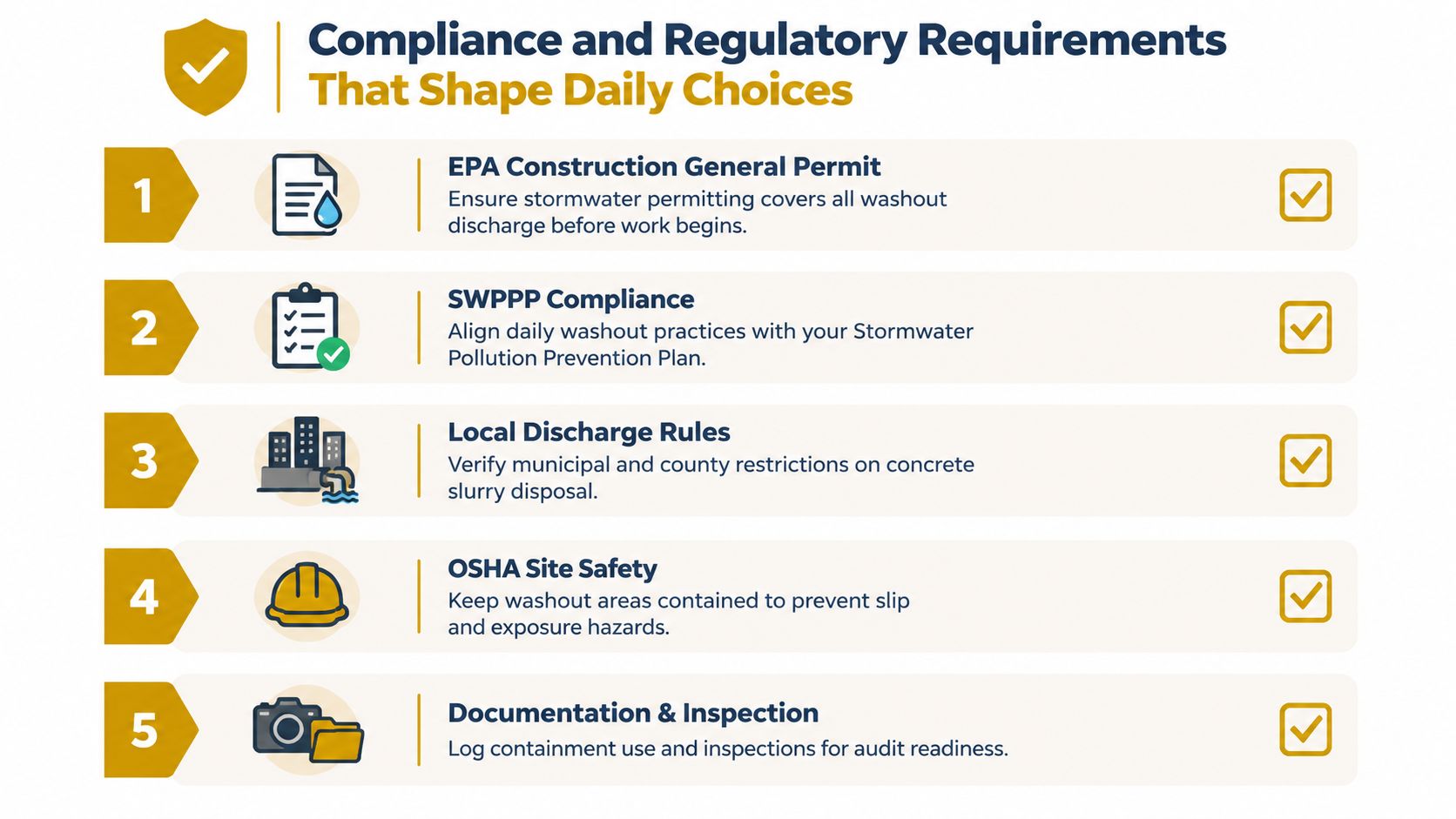
Start with stormwater. Construction activity that falls under the EPA's Construction General Permit requirements may require stormwater permit coverage and a Stormwater Pollution Prevention Plan, commonly called a SWPPP. The project team must translate that plan into physical controls. Concrete washout can't be treated as an informal cleanup area if slurry could reach soil, a storm drain, or surface water.
Five daily questions for the superintendent
- Permit coverage: Does the project's stormwater authorization address the planned work and discharge risks?
- SWPPP alignment: Does the containment location match the approved control plan and current site conditions?
- Local restrictions: Does the municipality or county impose additional requirements for slurry, wash water, or discharge?
- Worker protection: Do dust, silica, fall, slip, access, and exposure controls match the activity?
- Inspection evidence: Can the team show dated photos, inspection logs, waste records, and corrective actions?
OSHA requirements also shape daily execution. Silica exposure controls affect concrete cutting, grinding, drilling, and cleanup. Fall protection and site access requirements influence where crews can place barriers, hoses, pumps, and temporary equipment. State construction recycling rules may determine how the team separates and documents materials before removal.
Documentation is part of the control
Inspectors and owners may ask for waste manifests, discharge logs, inspection records, delivery tickets, pickup confirmations, and photographs. A compliant setup without evidence is difficult to defend after a problem.
Assign one person to maintain the record, but make every foreman responsible for reporting a changed condition. If a pan moves, a drain becomes exposed, a truck route changes, or the planned work expands, the team must update the control rather than relying on the original setup.
Compliance isn't a binder you assemble at closeout. It is a sequence of site decisions made before, during, and immediately after the work.
Procurement and Budgeting Without Surprises
A low daily rate can still produce the highest project cost. Compare the purchase method with the work duration, expected frequency, storage requirements, service obligations, and compliance exposure before approving anything.
Buy equipment when several projects will use it repeatedly, the site or yard can store it securely, and a named owner will handle inspection and maintenance. A long-term lease suits recurring portfolio work when the equipment stays deployed and the service terms are clear. Choose a short-term rental for a defined pour, demolition phase, outage, or renovation window. For a single washout need, renting often beats adding another asset to your facility management system.
Separate the money into three buckets
Build the budget line in three parts:
- Setup: Delivery, mobilization, placement, access requirements, and site preparation.
- Use: Rental period, recurring service, pump-out, vacuum service, cleaning, and disposal.
- Closeout: Pickup, demobilization, recycling, documentation, and damage or overage charges.
Include costs crews regularly miss. Account for mobilization, pickup, washout and disposal fees, lost-time cleaning, rough-terrain access, express service, and exposure created when containment fails. Reborn Rentals publishes daily pricing beginning at $25 per day and lists possible extra charges for delivery, rough terrain, and express orders in its washout rental and fee information. Confirm the actual quote before issuing the purchase order.
Compare the ownership models
| Factor | Capital Purchase | Long-Term Lease | Short-Term Rental |
|---|---|---|---|
| Best fit | Repeated use across many projects | Continuous deployment with defined service terms | One pour, phase, or renovation window |
| Main advantage | Equipment is available on demand | Predictable access without full ownership | Limited commitment and no long-term storage |
| Main burden | Storage, maintenance, depreciation, and inspection | Contract duration and return conditions | Delivery timing, availability, and rental-period control |
| Budget risk | Underused equipment becomes stranded cost | Paying while the project is inactive | Extension charges if pickup slips |
| Administrative need | Asset tracking and internal responsibility | Contract and service management | Clear dates, access notes, and pickup ownership |
Use a PO when the scope includes documented requirements, multiple services, or project accounting. A card purchase can cover a minor urgent item, but it should not bypass approval for a compliance-critical rental.
Before signing, calculate the full exposure:
Total project cost = setup + daily or recurring use + service and disposal + labor caused by the equipment + closeout and possible extension charges.
Vendor response time, chain-of-custody records, and dependable pickup matter more than a low headline rate when a full crew is waiting. Set the pickup owner and latest acceptable date in the order, then price any extension before the work begins.
Integrating Rented Washout Containment Into Your Workflow
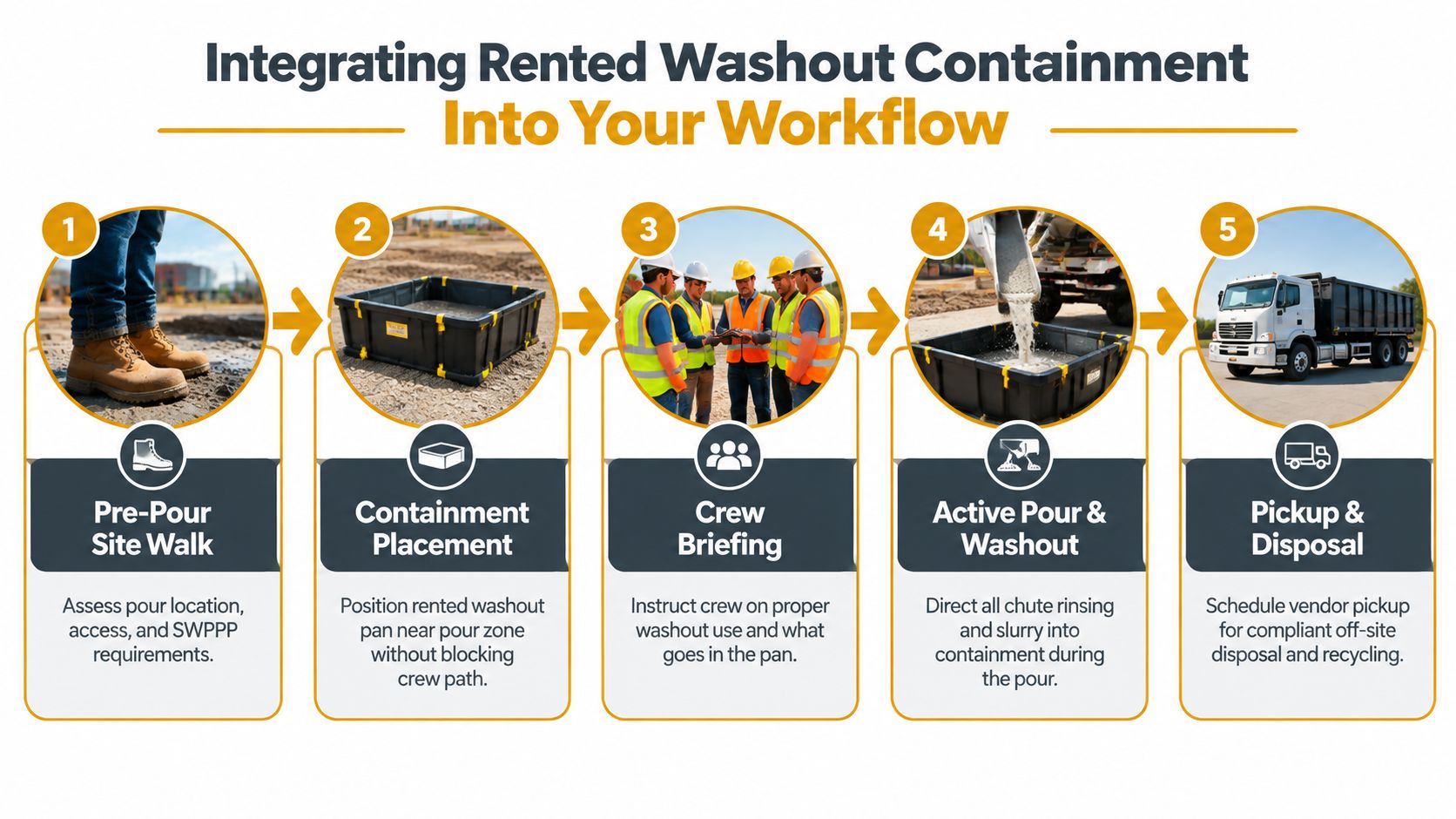
A rented washout pan should enter the pour plan as early as the concrete order. It isn't a container you find space for after the trucks are scheduled.
Walk the site before delivery
During the pre-pour walk, verify four things:
- The containment location is included in the SWPPP or site control plan.
- The ground is stable and reasonably level.
- The concrete chute can reach the pan without forcing trucks into an unsafe route.
- The delivery and pickup vehicle can access the location without blocking the next operation.
Keep storm drains, pedestrian routes, emergency access, and material staging areas visible and usable. A good location is close enough for controlled washout but far enough from traffic that a reversing truck won't strike the unit.
Brief the crew before the first washout
Tell the pump operator, truck drivers, finishers, laborers, and site supervisor exactly what belongs in the pan. Explain where the chute gets rinsed, who watches the fill level, and who contacts the vendor when the unit approaches capacity.
The human handoff matters. The dispatcher may know the delivery address but not the gate code. The superintendent may know the pour sequence but not the vendor's Saturday service window. Put those details on the pour plan and repeat them at the crew briefing.
Practical rule: Assign the full-pan call to a named person, not to “the crew.”
Manage the live pour
Position the pan before the first truck arrives. Keep the route clear for the next mixer, prevent hoses from crossing access lanes, and direct chute rinsing into the containment area. A rented unit reduces the labor and uncertainty associated with digging a temporary pit or improvising with a lined dumpster, but it still requires a person with a hose and a working eye on the operation.
Size the pan against the expected truck volume, washout activity, and service interval. If the pour expands, stop treating the original capacity estimate as fixed. Call for service, add planned capacity, or adjust the pour sequence before the unit reaches an unsafe level.
Close the task deliberately
Schedule pickup when the work window ends, not after the unit becomes an obstruction. Confirm the truck route, access conditions, site contact, and disposal documentation. The closeout record should show what was delivered, where it was used, when it was removed, and how the contained material was handled.
ROI and the Cost of Getting It Wrong
A budget meeting will not approve “better site housekeeping.” It will approve avoided labor, schedule protection, lower exposure, and clear accountability. Present facility management solutions in those terms, then tie each cost to a decision someone on site can control.
For a washout pan, compare ownership burden with the short duration of the task. Ownership includes acquisition, storage, maintenance, inspection, depreciation, internal handling, and disposal. Renting shifts much of that burden into a defined project cost. It works only when delivery, service, pickup, and extensions have named owners. For a single pour or renovation phase, a task-specific rental can produce better value than buying a broader system the site will rarely use.
That same discipline applies to maintenance technology. A useful program connects energy information with work orders, checks the result after an intervention, and reports performance across sites. The dashboard is not the return. The return comes from identifying a fault, assigning the repair, and confirming that the repair changed operating performance.
Use benchmarks carefully
Industry guidance in IFMA's research and benchmarking resources references 85% or higher preventive-maintenance compliance overall, 95% or higher for critical systems, and 5% to 15% year-over-year EUI reduction on targeted sites when analytics are used effectively. Treat these figures as maturity targets, not promises. They apply only when asset data is reliable, work ownership is assigned, and findings are closed through a defined process.
The cost of a failed control reaches beyond the material on the ground. A washout spill can create cleanup work, weaken owner trust, interrupt operations, draw regulatory attention, and complicate future bids. Add supervision, labor, equipment, reporting, schedule disruption, and the time required to explain the failure. That exposure often outweighs the rental cost of a properly planned containment unit.
| Line Item | Rented Containment Path | Failure or Non-Compliance Path |
|---|---|---|
| Equipment | Defined rental and service scope | Improvised control or emergency replacement |
| Labor | Crew uses a planned washout point | Crew digs, cleans, relocates, or responds to a spill |
| Schedule | Pour sequence includes placement and pickup | Work pauses while the team restores access or control |
| Compliance | Inspection and disposal records are assigned | Missing records create an avoidable explanation gap |
| Budget | Setup, use, service, and closeout are forecast | Cleanup, delay, penalties, and management time are uncertain |
| Reputation | Vendor and superintendent follow a documented plan | Owner and inspector see a preventable control failure |
The strongest ROI case is often the cost you keep off the incident report.
Real-World Use Cases From the Field
A facility management solution earns its place when it handles the awkward conditions that a standard plan misses. Three recurring job types show where judgment matters.
Occupied office retrofit
The problem is not just demolition. Tenants still need clean corridors, working HVAC, usable restrooms, and predictable communication while a crew opens walls or replaces equipment.
The manager's decision is to separate the work zone from the occupied area with temporary containment, schedule disruptive maintenance during an agreed window, and assign daily checks for dust migration, pressure, debris, and access. The trade-off is added setup and repeated cleaning, but that cost is easier to control than a tenant complaint that escalates into lost access or an owner-directed shutdown.
The outcome to measure is practical: did the crew maintain the planned work window, did occupants retain access, and did the team close dust and maintenance issues before the next shift?
Commercial foundation pour
The original plan calls for one washout location near the pour, but truck arrivals tighten, the chute angle changes, and the work area becomes congested. A pan placed for convenience can become a traffic conflict if the superintendent doesn't protect the route.
The decision is to verify the pan location during the pre-pour walk, brief every driver and finisher, keep the chute path clear, and monitor fill level throughout the pour. If service or pickup timing changes, the superintendent adjusts before overflow rather than asking laborers to improvise.
The trade-off is a delivery and service cost that appears on the budget. The outcome is a controlled pour sequence, cleaner closeout, and a record showing that slurry remained contained.
Municipal infrastructure work
A bridge deck or utility upgrade adds public exposure, multiple crews, changing access, and inspection timing. The washout point may serve concrete crews while excavation, traffic control, and stormwater controls change around it.
The manager assigns control ownership by shift, includes the washout condition in daily inspections, and keeps photo documentation with the project records. The decision favors a flexible, task-specific setup over equipment that must remain on site after the pour phase.
The trade-off is coordination. The benefit is that each crew understands the same control, the inspector can review evidence, and the project doesn't carry an unnecessary rental or storage burden after the task ends.
Implementation Checklist for Construction and Renovation Projects
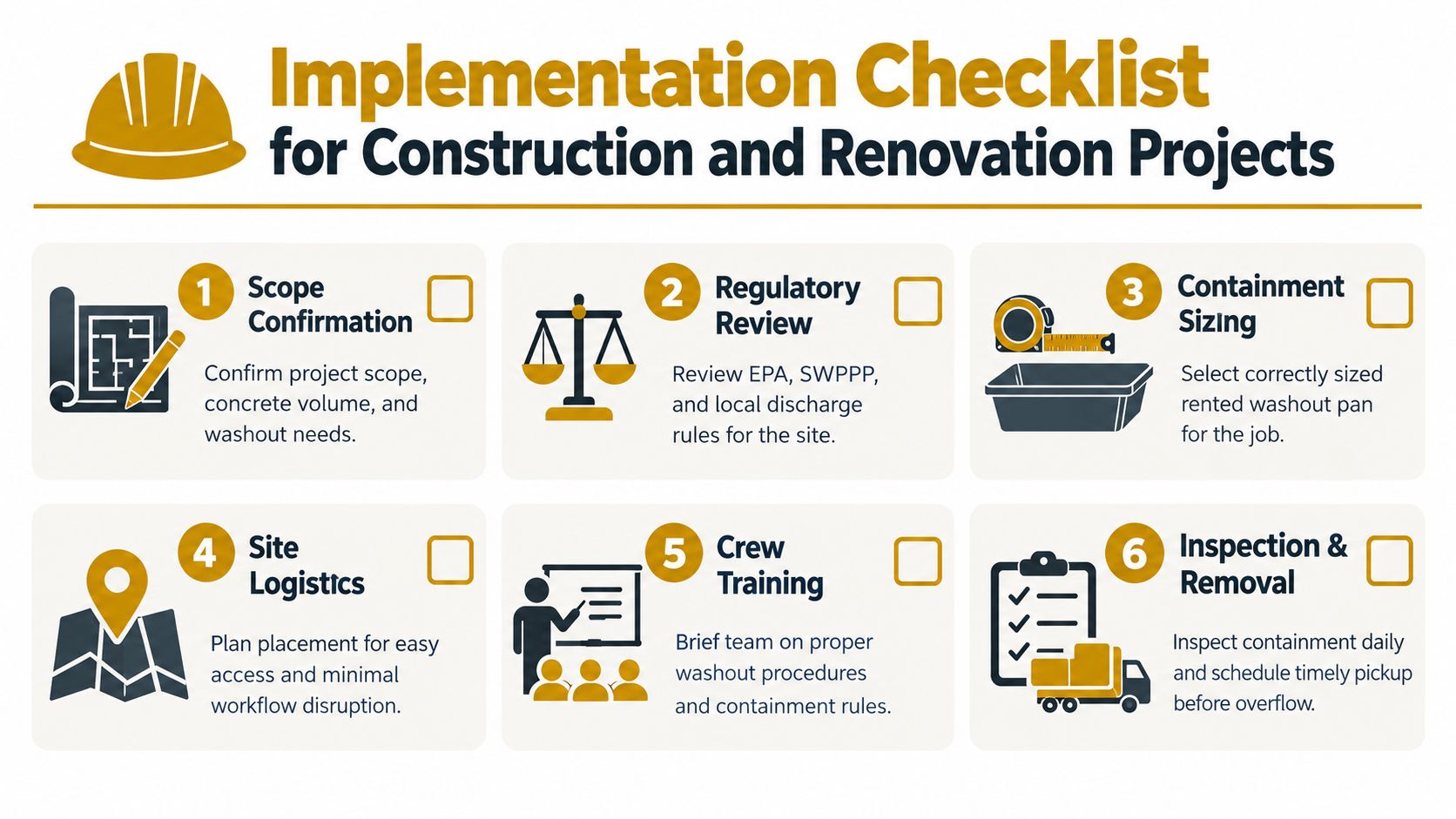
Print this list and run it before mobilization. Assign a name beside every item. If nobody owns the action, it isn't planned.
- Confirm scope: Project manager verifies the work area, concrete volume, demolition sequence, occupied zones, and expected washout needs. Ask whether the task has expanded since the original estimate.
- Review requirements: Superintendent checks permit coverage, SWPPP controls, local discharge rules, OSHA-related work controls, and recycling obligations. Confirm that the planned containment method is allowed at this site.
- Size containment: Concrete lead selects the washout pan or container against expected truck activity and washout volume. Ask whether capacity remains adequate if the pour runs longer than planned.
- Coordinate the vendor: Procurement confirms delivery date, pickup window, access notes, service intervals, disposal handling, and extension terms. Ask who receives the full-pan call and who covers weekends.
- Plan the location: Site logistics lead places the unit on stable ground near the work without blocking trucks, pedestrians, emergency access, drains, or material movement. Walk the route with the delivery driver when conditions are difficult.
- Brief the crew: Foreman explains what enters the containment, where chute rinsing occurs, who monitors the level, and how workers report a changed condition. Require every affected subcontractor to acknowledge the procedure.
- Install controls: Superintendent checks signage, hose reach, truck approach, barriers, and drain protection before the first delivery. Photograph the setup for the project record.
- Monitor active work: Assigned laborer or foreman checks fill level, leaks, access, and displacement during the task. Ask whether the unit remains stable and whether the next truck can reach the pour safely.
- Prepare inspection evidence: Project engineer keeps delivery tickets, inspection logs, photos, service records, manifests, and corrective actions together. Confirm that another supervisor can find the file without asking the installer.
- Teardown on time: Superintendent confirms the last washout, clears the route, and releases the vendor for pickup before the unit becomes a site obstacle. Ask whether the pickup vehicle still has the promised access.
- Close the budget: Project manager compares setup, rental, service, disposal, labor, and extension charges against the forecast. Record the variance while the facts are still fresh.
- Capture the lesson: Operations lead notes what worked, what overflowed, what delayed the crew, and what should change on the next project. Update the standard scope and subcontractor instructions.
Facility management solutions work when they match the decision to the actual risk and duration. Use software for repeatable records, scheduling, asset intelligence, and portfolio visibility. Use a short-term rental when a defined task needs reliable containment without creating a permanent ownership problem.
Reborn Rentals provides delivered concrete washout pans and containers, with pickup and slurry disposal coordination for designated project locations. Review the available options and arrange the dates, access details, and service needs through Reborn Rentals before your next pour or renovation phase.