
How Much Concrete Does a Truck Hold in Yards
A standard North American ready-mix truck holds about 8 to 10 cubic yards of concrete, weighing roughly 4,000 to 4,050 pounds per yard. Legal weight limits and site access often cut the ticketed load below the truck's advertised capacity.
You've got forms ready, a finishing crew lined up, and a dispatcher asking how much you need. The mistake is answering in trucks instead of yards. Before the first mixer rolls, separate the amount you're ordering from the amount each truck can deliver, then give the driver somewhere suitable to rinse.
Typical Concrete Truck Loads in Cubic Yards
A driveway pour can need several mixers, but truck count alone does not tell you how much concrete reaches the forms. Capacity varies by truck type, and the supplier's confirmed load is what matters for scheduling.
The Federal Highway Administration's concrete pavement guidance gives a baseline of 5.5 to 7.5 cubic meters, approximately 7.2 to 9.8 cubic yards, for common truck mixers.
Concrete truck capacity by type
| Truck type | Typical load | Metric equivalent | Where it fits |
|---|---|---|---|
| Standard rear-discharge ready-mix | 8 to 10 cubic yards | About 6 to 7.6 cubic meters | Most slabs, footings, and flatwork |
| Front-discharge mixer | 8 to 10 cubic yards | About 6 to 7.6 cubic meters | Pours where the driver needs to position the chute near the forms |
| FHWA common mixer range | 7.2 to 9.8 cubic yards | 5.5 to 7.5 cubic meters | Transportation baseline for ordinary truck mixers |
| Mini-mix | About 5.2 cubic yards | About 4 cubic meters | Weight-restricted roads and tight access |
| Compact urban mixer | About 1.6 cubic yards | About 1.25 cubic meters | Alleys, renovations, and restricted city sites |
For front-discharge mixers, Accio's overview of front-load concrete trucks describes common capacities of 8 to 10 cubic yards, approximately 6 to 7.6 cubic meters. Treat that as a starting point for choosing equipment. Confirm with the local plant that it operates this truck type.
What those yards mean at the forms
One cubic yard is 27 cubic feet, so a nominal 10-cubic-yard load contains about 270 cubic feet, or approximately 7.65 cubic meters. That is the concrete volume, not the space occupied by the drum.
Concrete weight limits can reduce the deliverable load. At the representative density in the FHWA guidance, 2,328 kilograms per cubic meter, a 7.5-cubic-meter load weighs roughly 17.5 metric tonnes, before counting the chassis, drum, and other equipment.
For an early estimate, use 6 to 10 cubic yards as a working range for a standard truck. Confirm the plant's equipment and permitted load with dispatch before placing the order.
Match the truck to the placement
A rear-discharge mixer needs a clear backing route and room to position its chute. A front-discharge truck can approach the forms differently, but it still needs maneuvering room and stable ground.
A smaller order does not automatically require a smaller truck. A plant may send its standard mixer with a partial load, so check both the ticketed quantity and the truck's access requirements.
Planning rule: Use the capacity chart to identify likely equipment. Use the confirmed delivery quantity to plan the pour.
Drum capacity, rated mix capacity, and the legal ticket are separate numbers. For washout, size the pan for rinse water and leftover concrete, not for a full 10-yard load.
How to Calculate Yards Gallons and Tons
Start with a tape measure, a laser level, and the actual formed dimensions. Drawing dimensions won't catch a low subgrade, a widened footing, or a thickened edge that the crew added in the field.
Use this sequence to keep dimensions, concrete volume, and delivery quantities separate.
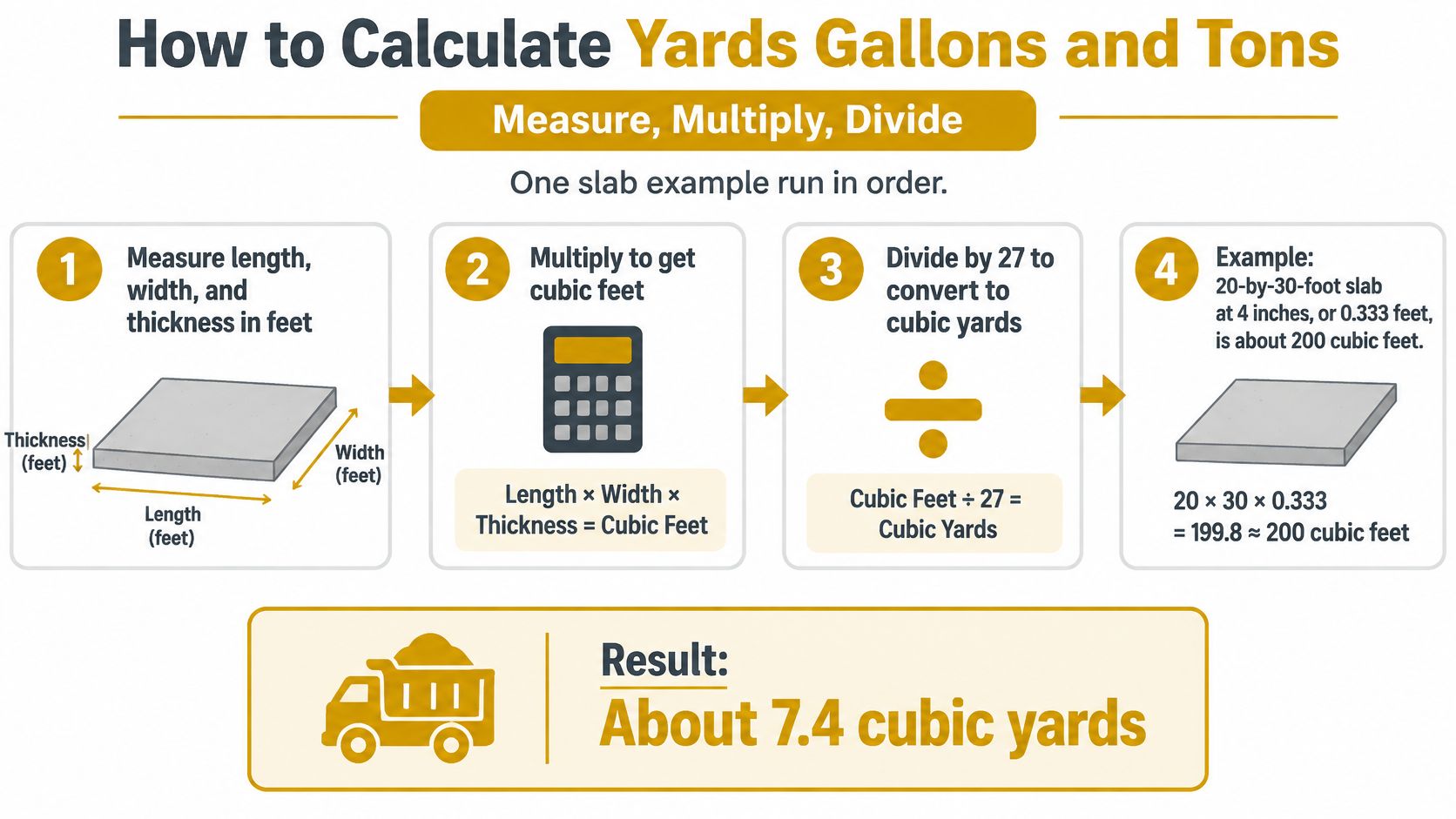
Run the slab calculation in order
Measure the placement in feet. For a hypothetical example, take a slab measuring 20 by 30 feet with a specified thickness of 4 inches. Convert the thickness to feet before multiplying, approximately 0.333 feet.
Multiply length by width by thickness. In that example, the formed volume is approximately 200 cubic feet. Calculate thickened edges, pads, and grade beams separately so they don't disappear into an average slab thickness.
Convert cubic feet to cubic yards. Divide the example's volume by 27, giving approximately 7.4 cubic yards. Keep the unrounded result in your worksheet until you've accounted for the rest of the placement.
Decide what allowance the site needs. Don't apply a universal percentage without checking the grade. Probe low spots, measure deeper forms, and discuss concrete retained in the pump system with the pumping contractor.
Check the supplier's ordering increment and actual truck payload. The example's calculated slab volume isn't automatically the final order. Add the measured extras and agreed allowance, then have dispatch confirm whether the order fits on the truck assigned to your route.
Record the final quantity, the permitted quantity per delivery, and the resulting truck count. Round the truck count upward when the division leaves a remainder, but don't mistake that last delivery for another full load.
Keep the conversion sheet beside the order
The volume entries below use the FHWA-based relationships already established. Weight entries apply the representative ready-mix range discussed under legal loading; they're planning estimates, not scale tickets.
Concrete volume and weight conversions
| Quantity | Cubic feet | Weight |
|---|---|---|
| 1 cubic yard | 27 cubic feet | 4,000 to 4,050 lb |
| 8 cubic yards | 216 cubic feet | 32,000 to 32,400 lb |
| 9 cubic yards | 243 cubic feet | 36,000 to 36,450 lb |
| 10 cubic yards | About 270 cubic feet | 40,000 to 40,500 lb |
| 7.5 cubic meters | About 265 cubic feet | About 17.5 metric tonnes |
Gallons describe volume, not washout demand. Converting the concrete order into gallons doesn't tell you how much rinse water the driver will use or how much slurry will enter a containment pan. Keep concrete-order calculations and washout estimates on separate lines.
Likewise, specify the unit when someone says tons. Pounds, US tons, and metric tonnes aren't interchangeable labels. For hauling decisions, give the supplier the mix specification and let dispatch confirm the applicable payload rather than relying on a generic density estimate.
Before you call the plant, write down calculated yards, ordered yards, yards per delivery, and truck count. That lets the dispatcher check the same arithmetic instead of interpreting a request for a truckload.
Drum Rating Versus the Legal Load
Does the truck's advertised capacity equal what it can legally deliver? Not necessarily. A large drum tells you little about the permitted payload on the route to your forms.
Engineer Fix's explanation of concrete truck capacity puts representative ready-mix weight at 4,000 to 4,050 pounds per cubic yard, meaning a nominal 10-cubic-yard load can exceed 40,000 pounds before the truck, fuel, equipment, and driver. It also notes that some fleets commonly load 8 to 9 cubic yards even when the drum is rated for more.
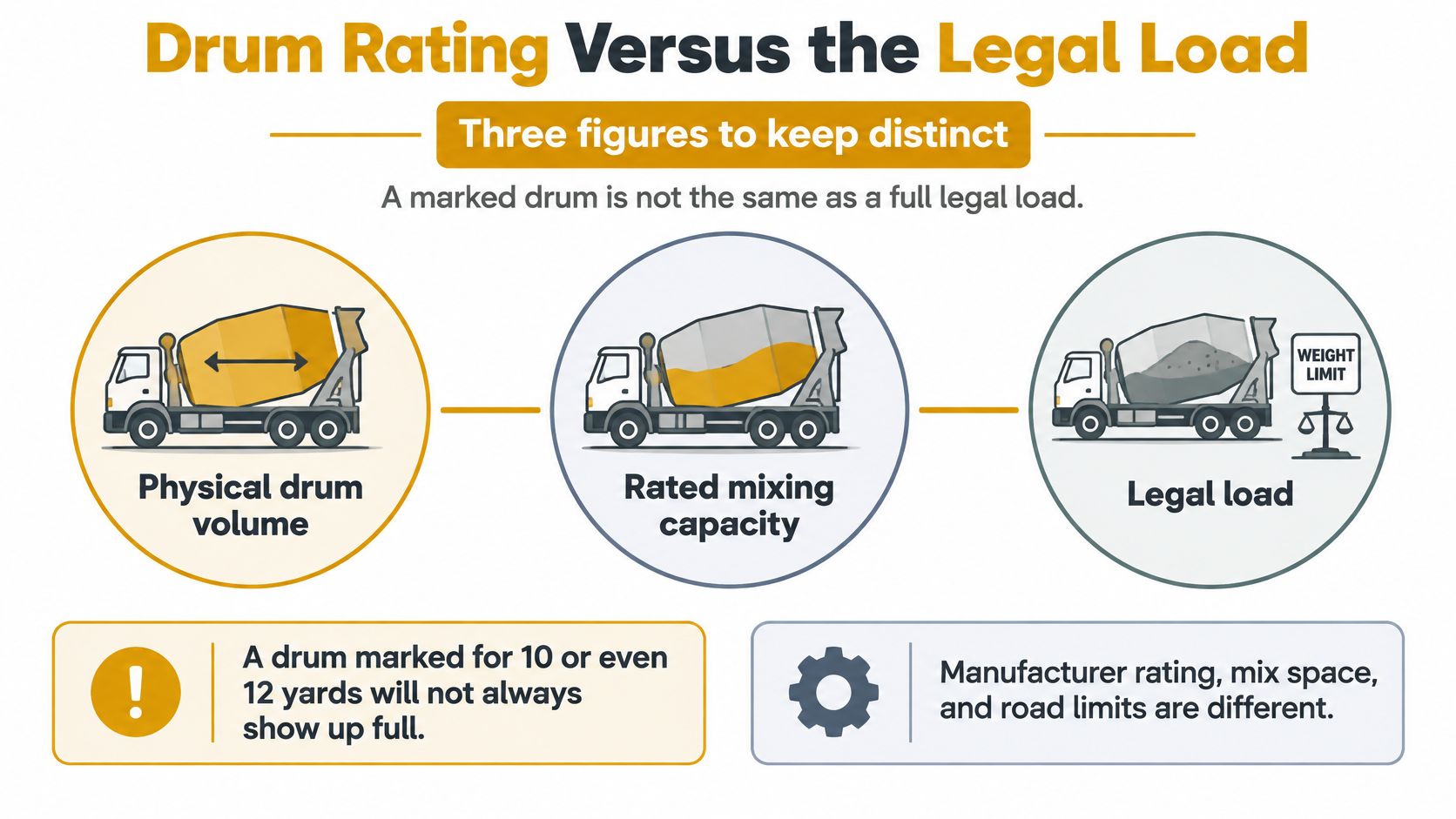
Keep the capacity figures separate
| Figure | What it means | What it doesn't establish |
|---|---|---|
| Physical drum volume | The drum's internal space | How much concrete it can properly mix |
| Rated mixing capacity | The manufacturer's rated working quantity | Permission to carry that quantity on every road |
| Legally permitted delivery volume | The concrete the configured truck may haul under applicable restrictions | The quantity actually ordered and loaded |
The actual ticket can be below the legal maximum because the customer ordered a partial load. That's another reason not to use truck size as a substitute for reading the paperwork.
Gross vehicle weight is only part of the hauling check. The supplier also has to consider axle loading, axle configuration, concrete density, and restrictions along the selected route. A bridge posting can change the delivery plan even when the roads on either side look suitable.
Catch the shortfall before placement starts
Say a footing needs 40 cubic yards in a hypothetical scheduling exercise. The foreman plans four deliveries of 10 yards, but the supplier can send only 8.5 yards per delivery on that route. Those deliveries total 34 yards, leaving 6 yards unaccounted for.
The crew hasn't made a measuring mistake. It has made a dispatching mistake. If nobody catches it until the last truck empties, the foreman has to arrange another delivery while managing the exposed end of the placement and the risk of an unintended construction joint.
Confirm these items before locking the schedule:
- Truck configuration. Ask which mixer and axle arrangement the plant will assign.
- Mix density. Make sure dispatch is checking the specified concrete, not a generic load.
- Route restrictions. Identify posted bridges and restricted approaches before trucks leave the plant.
- Supplier load policy. Confirm the actual yards planned on each ticket, including the final partial.
A drum rating is an equipment specification. A ticketed quantity is a delivery commitment.
For washout planning, count the deliveries that will discharge and rinse on site. Don't choose containment from the largest capacity advertised for the fleet.
Smaller Trucks When Access Is the Limit
A truck that can carry the order but can't reach the discharge point isn't a delivery solution. Restricted streets, renovation sites, rural approaches, and posted bridges can make access the deciding factor.
The ready-mix concrete overview identifies mini-mix vehicles around 4 cubic meters, roughly 5.2 cubic yards, for weight-restricted access, compared with conventional trucks commonly operating around 8 to 12 cubic yards. The useful comparison isn't smaller versus larger. It's access, permitted payload, discharge method, and delivery frequency.
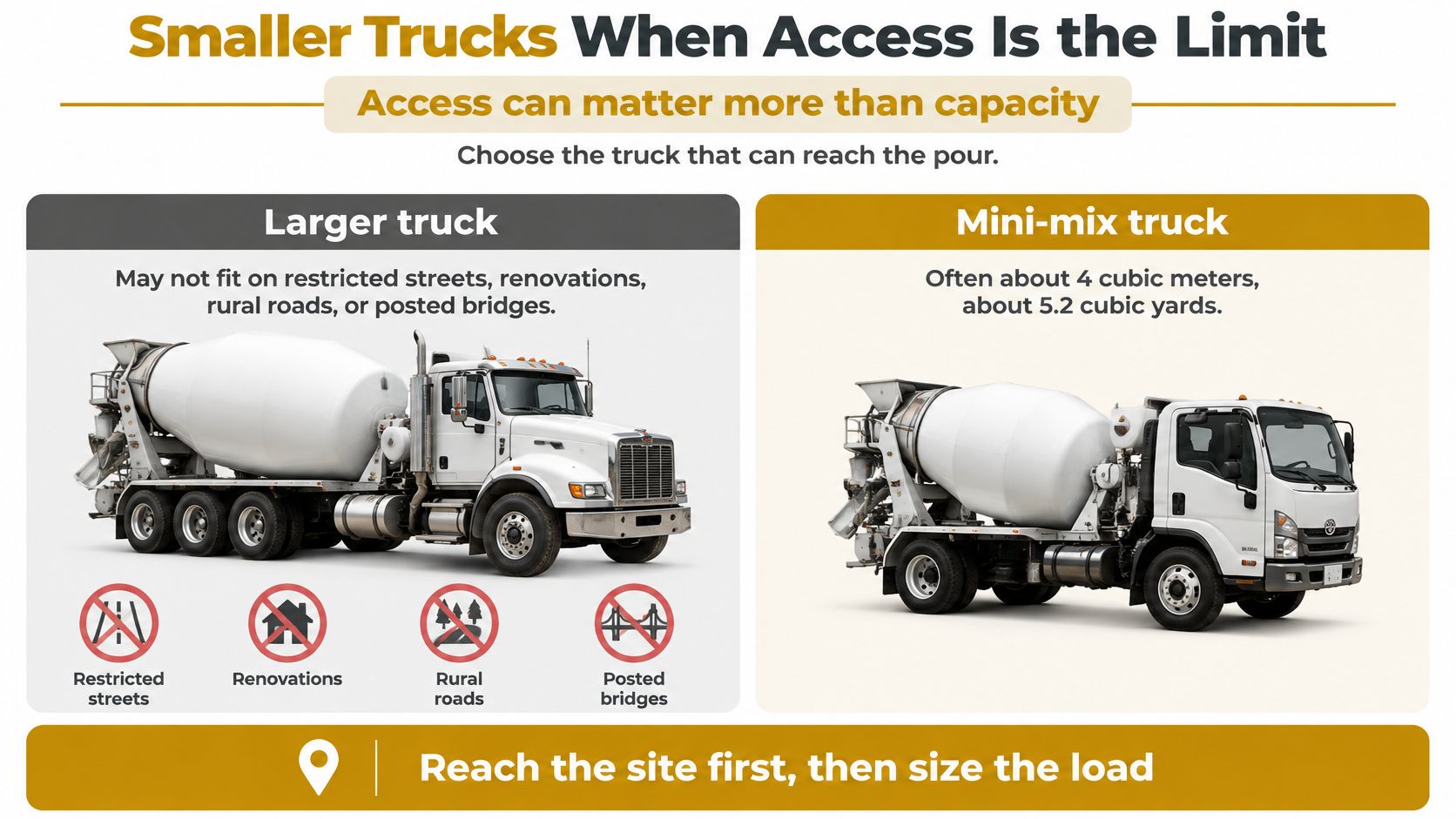
Compare the whole delivery arrangement
| Option | What works | What still needs checking |
|---|---|---|
| Full-size mixer with a full permitted load | Fewer arrivals for an accessible placement | Route, turning space, ground support, and discharge reach |
| Mini-mix | Smaller vehicle for constrained access | Fleet availability and enough deliveries to maintain placement |
| Partial load in a full-size mixer | Reduced payload without changing fleets | The truck remains full-size and may still fail the access check |
| Mixer feeding a pump from an accessible position | Keeps the mixer away from a difficult placement area | Pump setup, line route, coordination, and separate washout needs |
Suppose a full-size delivery can't use the posted bridge on the approach. Smaller deliveries may work, but only after the supplier verifies the actual vehicle and load against the restriction. A mini-mix label isn't permission to cross.
More trips create their own problems. Drivers need somewhere to wait without blocking neighbors or the next delivery, and the crew needs a sequence that doesn't interrupt placement. A smaller truck solves little if the street becomes a queue.
Walk the route beyond the gate
Use the site visit to check:
- Turning radius and road width. Check the approach, gate, discharge position, and exit, not just the entrance.
- Overhead clearance. Identify branches, temporary services, building projections, and overhead utilities.
- Ground conditions. Flag soft shoulders, recent backfill, trench edges, and unsupported pavement.
- Discharge method. Establish whether the chute reaches or whether a pump or other handling method is needed.
- Washout access. Keep the rinse location reachable without blocking the only way out.
Don't assume a partial load fixes a narrow entrance. It reduces concrete weight, not wheelbase, cab width, or overall maneuvering space.
Trip count also belongs in discussions about fuel use and fleet choice. The smallest drum isn't automatically the most efficient delivery arrangement if it requires repeated journeys. Equally, a large truck offers no efficiency advantage when the driver has to stop short of the site.
Ask dispatch which truck can legally and physically arrive, then recalculate the order around that truck's confirmed payload. That question gets you closer to a workable pour than asking for the largest mixer available.
Ordering and Washout Tips for Pour Day
The order can be mathematically correct and still fail on the morning of the pour. Trucks arrive before the pump is ready, the final delivery is released too early, or a driver discovers that the planned washout location is behind freshly placed concrete.
Put ticketed quantity, mix designation, arrival window, discharge arrangement, and site contact into the order. A truck count alone leaves too much room for different assumptions between the foreman and dispatcher.
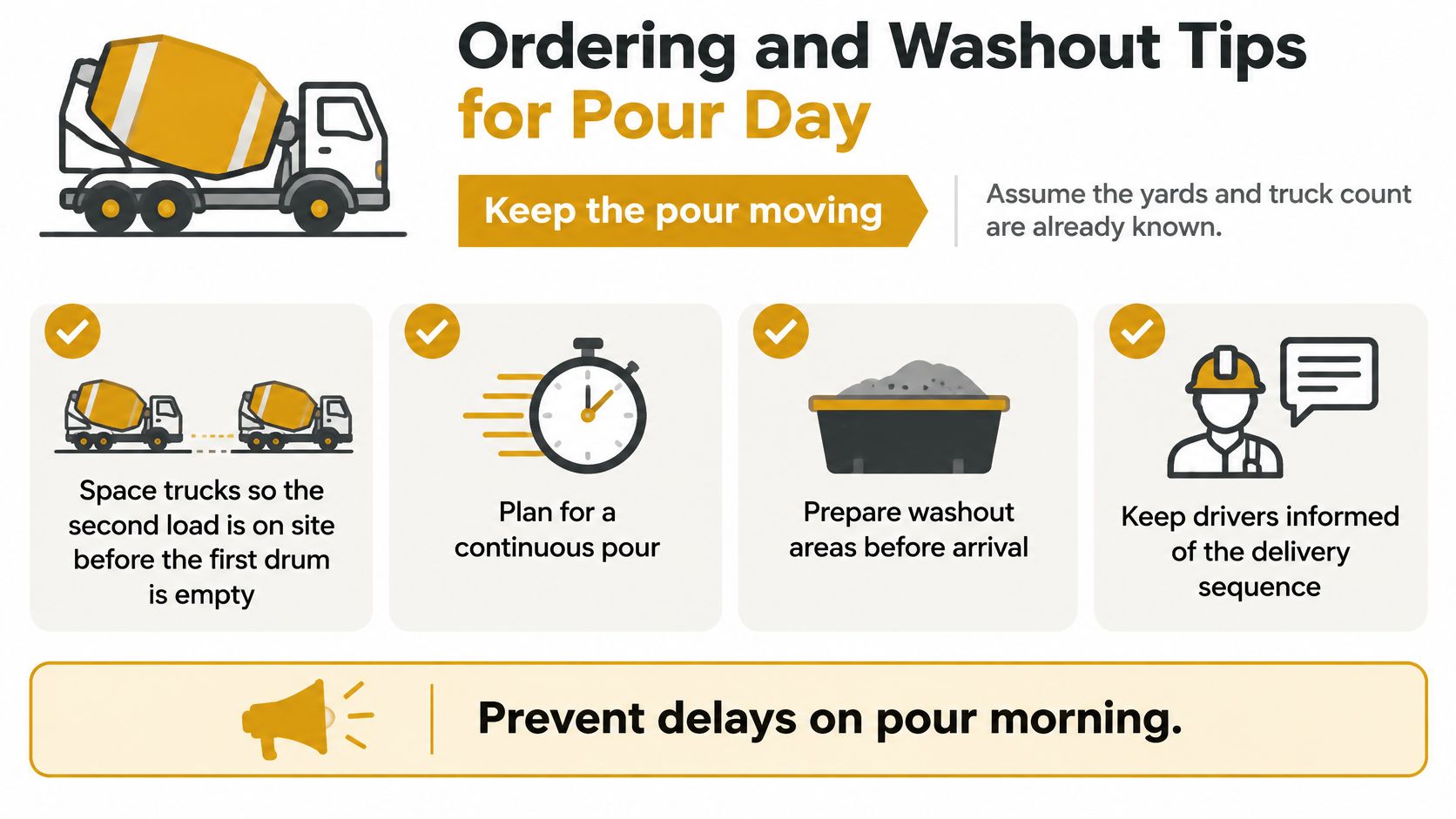
Schedule for the crew's placing rate
For a continuous placement, arrange the next delivery so it's available before the current load runs out. That doesn't mean stacking mixers nose-to-tail on a narrow street. Agree on a holding arrangement and tell dispatch promptly if the pump or finishing crew falls behind.
Handle the final delivery deliberately. Measure the remaining placement while there's still time to adjust the balance, and agree beforehand how the plant wants that update. Holding the final load without considering travel and batching time can create the very interruption you're trying to avoid.
Keep communication simple:
- Name the caller. Give one person responsibility for releasing or adjusting deliveries.
- Check each ticket. Record delivered yards and confirm the mix before discharge.
- Update the balance. Compare concrete placed with the space still unfilled.
- Tell drivers the sequence. Point out the discharge position, exit, and washout before maneuvering begins.
Size washout for what enters the pan
Washout consists of rinse water, slurry, and whatever residual concrete the agreed procedure sends into containment. It isn't the liquid-volume equivalent of the whole order.
Ask the ready-mix supplier whether drivers will rinse chutes on site and what happens to returned concrete. Separately confirm the pumping contractor's cleanout method. Pump-system residue can change the containment requirement substantially, so don't assume chute rinsing covers it.
A partial load still leaves a chute to clean. More deliveries can therefore mean more rinse events even when the total ordered concrete stays the same. Estimate those events, account for expected leftovers, and leave usable reserve capacity.
Prepare the containment before arrival
Choose a flat location the mixer can reach without crossing fresh work. Keep it clear of storm drains, drainage paths, excavations, and vehicle pinch points.
- Set up early. Don't make the first driver wait while the crew invents a washout area.
- Leave freeboard. Don't run a pan to the rim or assume settled solids leave the original liquid capacity available.
- Control rain entry. Cover unused containment when appropriate and account for water already inside.
- Protect the route. Maintain a clear approach and keep spill-response materials accessible.
- Contain the slurry. Concrete wash water is highly alkaline. Keep it out of storm drains and off unprotected ground.
Pour-day takeaway: Order concrete by the ticket, and stage washout for the expected rinses and leftovers, not the painted drum capacity.
Confirm the Ticket and the Washout
The day before placement, call dispatch with the order in front of you. Confirm the quantity on each planned ticket, whether it's a full permitted load or an intentional partial, and the delivery sequence. Make sure the plant has the correct entrance and a site contact who can answer immediately.
Have the foreman walk the mixer's entire path. Check the turn into the site, the discharge position, the route to washout, and the exit. A loaded truck shouldn't be the first test of clearance or ground support.
Finish with a field-ready handoff
Give the person meeting deliveries a short written checklist:
- Order details. Mix designation, ticketed quantities, and arrival arrangements.
- Site directions. Correct gate, holding position, discharge point, and exit.
- Placement responsibilities. Who signals the driver and who communicates with dispatch.
- Washout instructions. What may enter containment and who monitors the remaining capacity.
- Change procedure. Who can adjust the final order or request a containment swap.
For Denver-metro crews, we deliver washout containment by crane truck, with the foreman directing placement before pour day. Walk the proposed location before delivery so the pan sits where drivers can use it and the pickup truck can service it.
Match containment to the scheduled work
Our Small Concrete Washout Pan measures 72 by 72 by 14 inches and holds 310 gallons. Our Large Concrete Washout Pan holds 441 gallons; both pans are 36,500-pound load-tested. Those liquid capacities and load-test figures describe different limits, so neither should be treated as permission to receive an entire mixer load.
Plan for rinse and slurry, monitor accumulation during the pour, and arrange service before the available space runs out. Dense settled material and liquid both matter when deciding whether containment remains usable.
We schedule swap-and-haul service around the customer's pour rather than a passing route. When a pan is full, we replace it with a clean one on the customer's schedule, then haul off the concrete waste for compliant disposal. That gives the foreman an established next step instead of an improvised washout in the dirt.
The useful answer to how much concrete does a truck hold is the quantity dispatch confirms for your mix, route, and site. Finish the planning by confirming where the leftovers and rinse will go.
Reborn Rentals provides Denver-metro washout pan delivery and scheduled swap-and-haul service for concrete pours. Visit Reborn Rentals to match containment to your delivery count, rinse plan, and expected leftovers, and arrange placement before the first mixer arrives.