Predictive Maintenance Technology Explained for Sites
A concrete pour is moving on schedule when the mixer stops feeding the pump. The crew checks the service sticker. The equipment was serviced recently, yet a bearing, hydraulic component, or electrical connection has failed at the worst possible moment. Work pauses, labor remains committed, deliveries move, and a routine maintenance plan offers little help because the fault developed between scheduled inspections.
That situation is common across construction fleets and rental operations. Calendar-based service is useful, but it assumes that every machine experiences wear at roughly the same pace. A pump working through abrasive material, a generator exposed to dust, and a washout system moved across rough terrain don't follow identical maintenance calendars.
Predictive maintenance technology changes the decision from “is the service date due?” to “what does the equipment's condition suggest, and what action should we schedule?” This guide builds that idea from the ground up. You'll learn how condition data becomes a warning, how a warning becomes a work order, where the financial value comes from, and why compliance, cybersecurity, and workflow design matter as much as the analytics.

Introduction Why Equipment Failures Still Catch Teams Off Guard
A rental excavator can pass its scheduled service, work through a hotter shift, and develop a hydraulic fault before the next inspection. A contractor may then lose productive hours, while the rental provider must handle an inspection, a repair, and a replacement assignment. The service calendar recorded what was due, not what the machine experienced.
For construction teams, the cost reaches beyond the repair invoice. A failure can interrupt a pour, leave a crew waiting, trigger an urgent parts request, and disrupt the equipment's next assignment. For rental providers, the same event can reduce availability, complicate delivery commitments, affect inspection records, and weaken customer confidence.
Predictive maintenance technology connects equipment condition to a maintenance decision. Sensors collect signals such as temperature, pressure, vibration, current draw, location, or speed. Software compares those signals with the machine's usual behavior and sends an alert when the pattern changes. A technician still needs to inspect the asset, confirm the fault, and decide what work belongs on the schedule.
The operating model resembles a relay race. Sensor data starts the handoff, analysis identifies a possible problem, an inspection checks the evidence, and a work order assigns labor, parts, and timing. If any handoff fails, a technically accurate alert may still produce no business value.
Market estimates show strong commercial interest, but their totals are not directly interchangeable because researchers define the category differently. One estimate placed the global market at about $1.5 billion in 2016 and $6.9 billion in 2021, while a narrower 2022 estimate put it at $5.5 billion, with a 17% CAGR through 2028, as reported in predictive maintenance market statistics from World Metrics. Those figures should be read as directional evidence rather than a single, continuous growth line.
The practical question for a site manager is whether the company can build a dependable path from sensor, to interpretation, to inspection, to work order, and finally to a verified repair. That path also has to support compliance records and rental economics, not merely produce another dashboard.
What Predictive Maintenance Technology Really Means
Start with three maintenance decisions.
Reactive maintenance waits for failure. The machine operates until a pump loses pressure, a motor overheats, or a control circuit stops responding. This approach can make sense for low-consequence, inexpensive components, but it leaves little room to plan labor, parts, access, or customer communication.
Preventive maintenance acts according to time, hours, cycles, or a manufacturer's service guidance. It's more controlled than run-to-failure maintenance, and it remains essential for many assets. The weakness is that the schedule estimates wear instead of measuring the machine's actual condition.
Predictive maintenance uses condition information to identify an emerging problem and select a better intervention window. The system might flag an unusual vibration pattern, a rising temperature trend, or a combination of pressure and electrical signals. A technician then confirms the issue and creates planned work before the failure becomes disruptive.
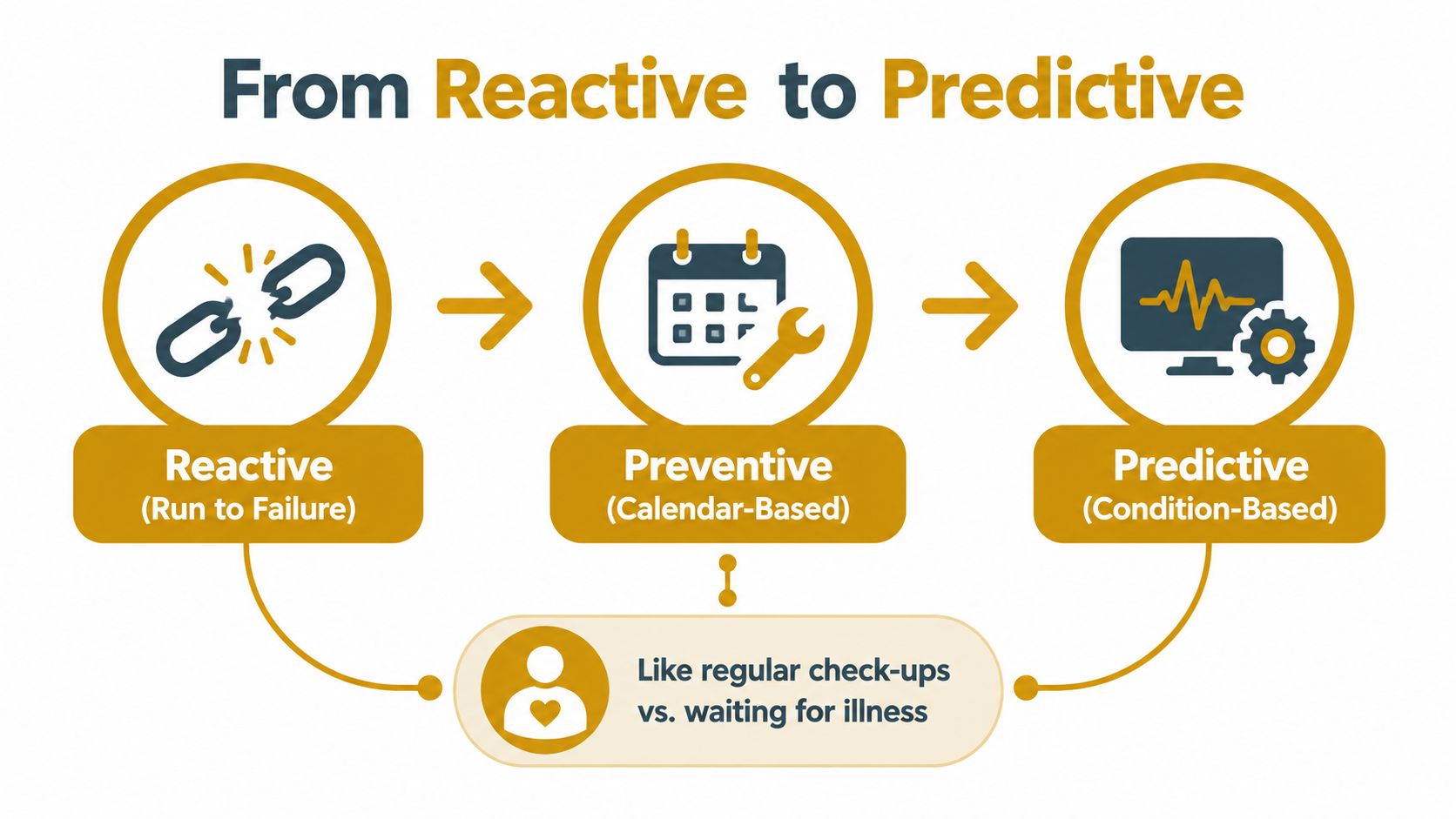
A health-monitor analogy makes the difference easier to remember. Reactive maintenance is calling a doctor after a serious symptom appears. Preventive maintenance is attending regular checkups because a calendar says it's time. Predictive maintenance is tracking relevant health signals, recognizing a change from normal, and arranging a targeted examination before the condition becomes acute.
The analogy has limits. Equipment data doesn't provide certainty by itself, and a model's alert isn't a repair instruction. It's a reason to investigate. The technician still needs context, such as recent work, operating load, environment, known failure modes, and whether the machine was connected correctly.
The decision logic matters more than the label
A calendar tells you when to inspect. A condition-monitoring system helps determine which asset needs attention and why. That distinction matters in mixed fleets, where two machines of the same model may have very different usage histories.
Predictive systems can use rules, statistical analysis, machine learning, or a combination of these methods. The technology is “predictive” when it supports an earlier, condition-based decision, not merely because a vendor uses the word AI.
Practical rule: Treat an alert as a prioritized inspection request, not as proof that a component will fail at a precise time.
This approach also explains why data quality matters. A model trained on inconsistent readings, missing maintenance history, or incorrectly identified assets may create false alarms or miss meaningful changes. The strongest programs connect the alert to a human workflow that confirms the condition and records the outcome.
Core Components That Make Predictive Systems Work
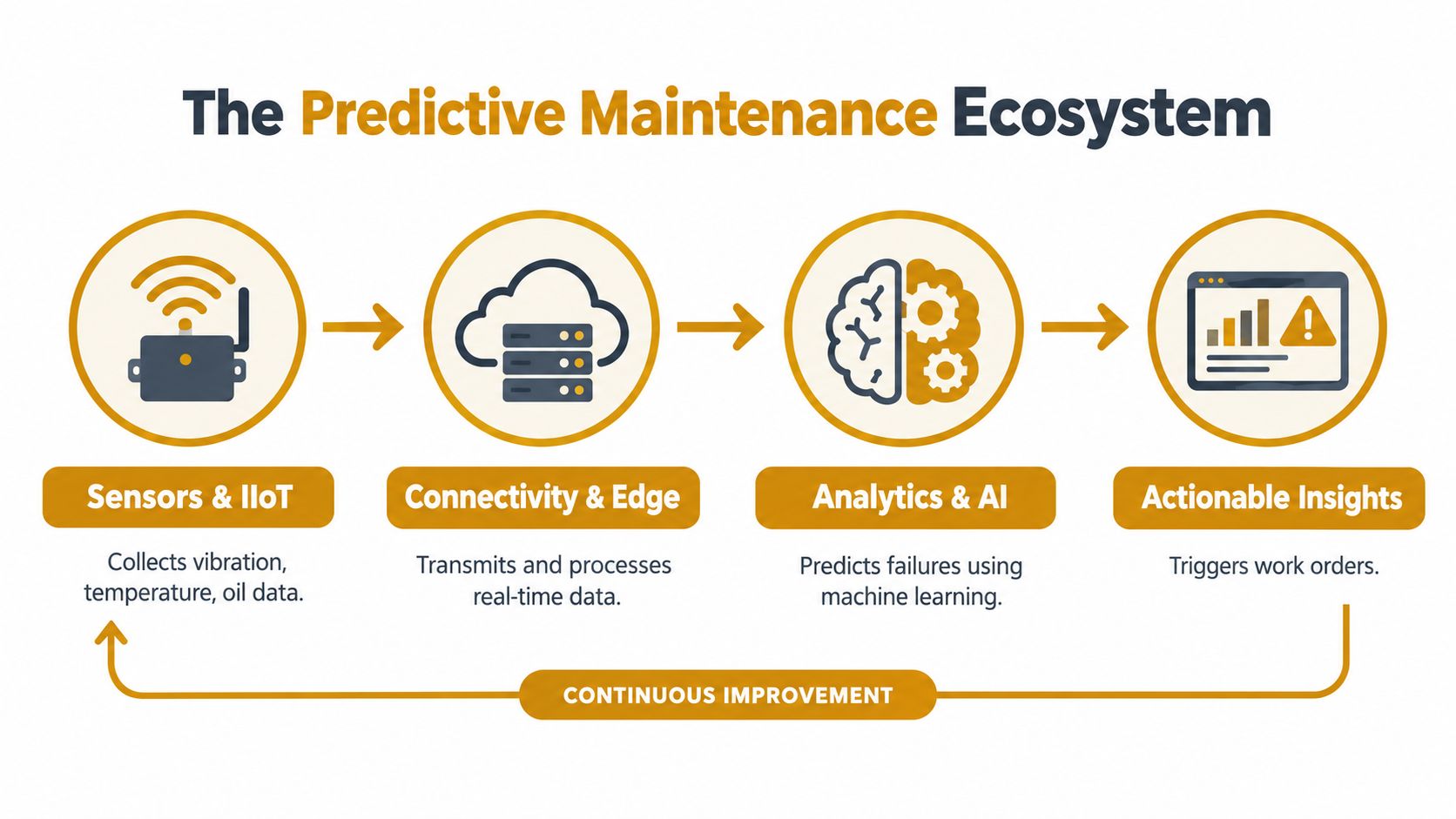
A predictive system behaves like a nervous system. Sensors act as the receptors, connectivity carries signals, analytics interprets them, and the maintenance platform turns a finding into a physical response. If one handoff fails, the system may produce a clever dashboard without changing what happens on the site.
Sensors provide the evidence
The first layer captures the equipment's condition and operating context. Depending on the asset, useful signals may include vibration, temperature, pressure, oil condition, current consumption, engine data, control states, GPS position, and speed. The right mix depends on the failure modes that matter, not on the number of sensors installed.
A benchmark called MetroPT illustrates why synchronized, multivariate data matters. It combines pressure, temperature, current consumption, digital control signals, GPS latitude and longitude, and speed for online prediction under time-dependent operating conditions, as described in the MetroPT predictive maintenance benchmark. A single vibration reading might look normal, while the combination of pressure, current, and speed reveals that the machine is working differently.
Connectivity decides where the signal is handled
Data can travel to a cloud platform, remain near the equipment through edge computing, or use a hybrid architecture. Cloud processing can simplify fleet-wide analysis and central reporting. Edge processing can reduce dependence on continuous connectivity and support fast local decisions, especially where a site has weak coverage or the equipment must keep operating during an outage.
Connectivity also creates a boundary between operational technology and information technology. Access controls, secure device configuration, software updates, network segmentation, and clear ownership need to be designed before the fleet becomes permanently connected.
Analytics turns readings into meaning
A dashboard can display values without explaining what they mean. Analytics compares current behavior with expected behavior, operating context, historical patterns, thresholds, and known failure modes. The result may be an anomaly score, a condition state, a recommended inspection, or an estimate of remaining useful life.
Machine learning is useful when failure precursors are subtle and distributed across multiple signals. It isn't a substitute for maintenance knowledge. Engineers and technicians should be able to understand the reason for an alert well enough to decide whether it deserves immediate action, a planned inspection, or no action.
CMMS integration closes the loop
The system earns its value when an alert reaches the maintenance process. That may mean creating a work request, assigning a technician, reserving a part, blocking an asset from rental, recording a compliance inspection, or scheduling a repair alongside an existing delivery route.
Without that connection, teams may see abnormal behavior and still rely on phone calls, spreadsheets, and memory. The sensor detects the issue, but the CMMS or EAM system must preserve the decision, action, and result. That record helps improve future models and gives managers evidence that condition monitoring changes operational behavior.
Benefits and ROI for Construction and Rental Fleets
A concrete pump fails during a scheduled pour. The rental customer needs a replacement, the contractor loses labor time, and the provider must coordinate recovery, inspection, and dispatch. Predictive maintenance earns attention in situations like this, where an earlier warning could change the response. A low-cost tool with an easy replacement may not justify continuous monitoring, even when sensors can observe it.
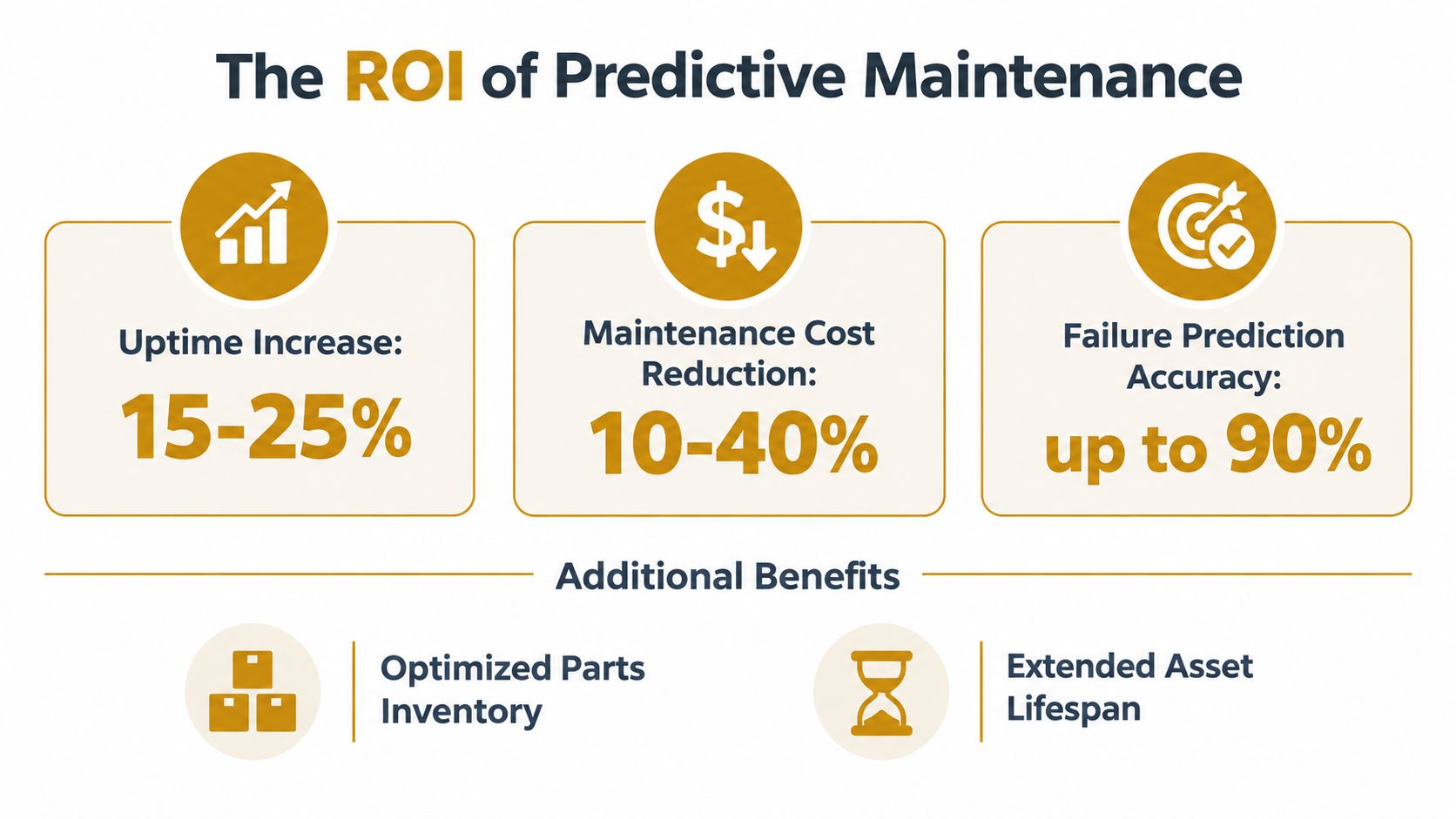
Reported ranges in the AJIS study on predictive maintenance associate AI-based maintenance models with improved failure prediction, lower maintenance costs, and higher equipment uptime. Because the source presents a secondary summary rather than a clearly established primary benchmark, treat those ranges as directional, not as a guaranteed return. The same source describes IIoT predictive maintenance examples across transportation, manufacturing, and energy. That pattern is relevant to construction and rental fleets because equipment works under changing loads, environments, operators, and schedules.
A separate experimental study examined datasets involving NASA turbofan engines, SECOM sensors, and an industrial hydraulic system. It reported higher prediction accuracy for its tested approach than for traditional maintenance methods, as described in the industrial IoT predictive maintenance study. Results from one experiment should not become a promise for every fleet. They do illustrate the operating principle: several condition signals can reveal a developing problem that a fixed service interval may miss.
Translate technical gains into fleet economics
For a rental provider, an early warning changes the availability decision. Staff can inspect an asset before dispatch, remove it from the ready-to-rent pool while its condition is uncertain, and release it only after a documented check. The sensor matters because it connects to that work-order and dispatch decision. A warning that stays in a dashboard does not protect the customer or improve rental utilization.
For a contractor, the return may appear in production planning rather than in a separate maintenance budget. A condition alert can be matched with the next access window, planned shutdown, or parts order before a crew reaches the site. Connected inspection, repair, and release records also give managers a clearer compliance trail. The operating model is the value: sensor reading, technician review, work order, scheduling decision, and asset release should remain connected.
| Asset Type | Failure Impact | Predictive Value |
|---|---|---|
| Concrete pumps and mixers | Interrupted pours, labor disruption, urgent recovery work | High when sensor data can identify hydraulic, engine, or rotating-component deterioration |
| Generators and compressors | Site shutdowns and loss of temporary power or air | High when abnormal load, temperature, or operating trends can be reviewed before dispatch |
| Fleet vehicles and mobile equipment | Missed deliveries, idle crews, and route changes | Useful when location, utilization, and condition information support scheduling |
| Washout and containment equipment | Site organization, environmental exposure, and customer service risk | Selective, with emphasis on inspection records, condition checks, and dispatch readiness |
| Low-consequence tools | Limited disruption and straightforward replacement | Often better served by simple inspection or preventive routines |
The practical choice is condition monitoring for assets where earlier knowledge changes the outcome. Managers should compare the cost of sensors, connectivity, analysis, technician time, and workflow changes with the consequence of failure. That comparison may favor predictive monitoring for a high-impact pump or generator, while a simple inspection routine remains the better fit for a low-consequence tool. The goal is a repeatable operating process, not another dashboard.
Implementation Roadmap for Site Managers and Rental Providers
A fleet can have modern sensors and still operate reactively. Implementation succeeds when managers define who responds to an alert, what evidence confirms it, and how the decision affects scheduling, dispatch, inspection, and repair.
Start with the asset and the consequence
List the equipment that can create the largest operational problem if it fails. Rank assets by failure consequence, sensor availability, maintenance history, operating variability, and the team's ability to intervene. Choose a pilot where a warning can lead to a clear action, such as inspecting a pump before a major pour or checking a generator before dispatch.
Don't begin by covering every asset class. A narrow pilot makes it easier to establish a baseline, test alert quality, and discover gaps in asset identification.
Define the work before selecting the model
Write the response path in plain language:
- Detect: A sensor or connected controller records an abnormal condition.
- Review: A responsible technician checks the reading, operating context, and recent work.
- Decide: The team creates an inspection, repair, monitoring, or no-action record.
- Schedule: The work is placed against a real access window, delivery plan, or rental return.
- Verify: The technician records the finding and confirms whether the asset is safe to release.
- Learn: Managers review false alarms, missed warnings, repair outcomes, and recurring causes.
A mobile CMMS is important because the person closest to the equipment needs to receive, update, and close the work order without returning to an office system. Standard fields should capture asset identity, fault category, condition evidence, action taken, parts used, and release status.
Standardize the operating language
Different teams may use different names for the same asset, component, or fault. Clean naming, consistent timestamps, accurate meter readings, and reliable maintenance history give analytics a usable foundation. Standardize KPIs around outcomes such as unplanned downtime, emergency work, alert-to-inspection time, planned completion, false-alert rate, and asset release readiness.
Budget gaps and skills shortages are common barriers, while data inconsistency can undermine a technically sound deployment. Maintenance trends coverage for 2026 also highlights the difficulty of converting machine data into maintenance triggers. That is why process maturity should guide the rollout.
Secure the OT and IT connection
Decide who owns device credentials, network access, alert permissions, software updates, and incident response. Edge computing can limit the amount of equipment data that must travel continuously, but it doesn't remove the need for secure configuration and governance.
Cybersecurity exposure is identified as a major blocker for connected plant deployments in research on predictive maintenance trends and edge computing. Treat security as part of the maintenance design, not as a later IT review. Before scaling, test what happens when connectivity fails, a sensor sends bad data, or an alert crosses from an OT system into a business workflow.
Real World Applications and Compliance Considerations
A transportation operator might monitor pressure, current, temperature, control signals, position, and speed on a rail system. A manufacturer may watch vibration and thermal behavior on motors, pumps, or hydraulic equipment. An energy operator can use condition information to plan access to remote or high-consequence assets. These sectors provide a useful lesson for construction: the value comes from connecting operating context to a maintenance action, not from collecting readings for their own sake.
Consider a concrete pumping operation. Before predictive monitoring, the team may rely on service intervals, operator observations, and a breakdown response. With connected condition data, an unusual combination of pressure and current behavior can trigger a review. The maintenance lead checks the machine, confirms whether the issue is real, and schedules corrective work before the pump is assigned to a critical pour. The system hasn't eliminated technician judgment. It has moved that judgment earlier.
Rental workflows add another layer. At return, the provider can associate inspection findings with the asset record, review condition changes during the rental period, and decide whether the equipment is ready for the next customer. A warning that appears during operation can influence dispatch, availability status, and customer communication. The same record can support maintenance planning and demonstrate that the provider takes equipment condition seriously.
Compliance depends on execution
Construction teams also need to manage environmental and site-control responsibilities. Concrete washout, slurry, and contaminated water should remain contained and organized rather than reaching soil, drains, or stormwater pathways. Predictive maintenance can't replace a site's environmental plan, inspection routine, or operator training, but it can help keep supporting equipment available and documented.
For example, a containment system or related handling equipment may be checked before a pour, during active use, and at return or relocation. If a condition issue affects a pump, mixer, vacuum system, or transport unit, the work order can record the inspection and the release decision. That creates a clearer chain between equipment readiness, site organization, and responsible operation.
The operational test is simple: Can a supervisor show what was detected, who reviewed it, what action followed, and whether the asset was cleared for work?
Edge deployment changes the risk conversation
Sites may have unreliable connectivity, dispersed equipment, and shared responsibility between contractors, rental companies, and technology providers. Edge processing can support local monitoring, while cloud systems can provide fleet-wide visibility. The right architecture depends on response time, connectivity, data sensitivity, integration needs, and the team's ability to maintain the devices.
Cybersecurity deserves the same attention as mechanical reliability. Connected assets create more access paths and more questions about ownership. Managers should document device inventories, permissions, update responsibilities, alert escalation, and the fallback process for disconnected equipment.
Conclusion Your Next Steps Toward Smarter Maintenance
Predictive maintenance technology works best when it becomes part of the operating model. Sensors and analytics can reveal an emerging condition, but they don't schedule a technician, reserve a part, update a rental status, or protect a construction site from disruption. People and systems must complete those handoffs.
The strongest starting point is a critical, condition-monitorable asset with a clear failure consequence. Don't begin with a fleet-wide promise. Begin with a workflow that the maintenance and operations teams can execute consistently, then use the results to improve data quality and expand the program.
A practical readiness checklist
- Choose one asset group: Select equipment where early warning can change a repair, dispatch, or site decision.
- Name the owner: Assign responsibility for reviewing alerts and approving the response.
- Define the work order: Record what counts as an inspection, repair, hold, release, and closeout.
- Set baseline KPIs: Track unplanned downtime, emergency work, response time, planned completion, and alert quality.
- Connect the mobile workflow: Give technicians a practical way to receive and close work in the field.
- Protect the connection: Establish OT and IT access rules, update ownership, and offline procedures.
- Review outcomes: Compare alerts with confirmed findings and adjust thresholds, data capture, and training.
The business case becomes clearer when managers measure avoided disruption, planned maintenance, asset readiness, and trustworthy compliance records together. A small pilot can show whether the organization is ready to scale, while standardized KPIs prevent the program from becoming an impressive but unused analytics display.
For construction and rental fleets, smarter maintenance supports more than uptime. It helps teams plan work, protect schedules, document decisions, and keep equipment dependable across changing sites and customers. Start with one asset, one workflow, and one accountable owner, then expand only when the operating process is working.
Reborn Rentals provides ready-to-deploy concrete washout containment equipment for contractors and project teams that need organized, responsible site operations. Visit Reborn Rentals to review rental options, confirm specifications and availability, and arrange delivery for your next concrete project.