
SWPPP Consultant When to Hire and What You Get
Your first slab pour is on the calendar. The pump is lined up, the finishers know what time to show, and the stormwater folder is still empty except for a site plan someone meant to mark up last week.
That's the spot where a good job gets expensive fast. The washout pan shows up late or full, nobody owns the inspection after rain, and the plan says one thing while the pad does another. A SWPPP consultant earns their keep by closing those gaps before trucks roll, not by handing you a thicker binder.
When a Job Needs an SWPPP Consultant
Start with the rule, not the schedule. If you're disturbing 1 acre or more, or disturbing less inside a larger common plan of development, you generally need construction stormwater permit coverage. The SWPPP is normally finished before the Notice of Intent, so hiring after crews mobilize is already late.
That line has a short history. The EPA construction stormwater brochure traces Phase I regulations promulgated on November 16, 1990 for construction activity disturbing at least 5 acres, the Phase II rule promulgated on December 8, 1999 expanding coverage to smaller sites disturbing 1 to 5 acres, and the July 1, 2003 Construction General Permit establishing the 1-acre threshold that still applies. It's a federal structure, not an optional green extra.
The Three Hiring Triggers
I would hire when you can't answer three questions with names. Who designs the controls? Who inspects them? Who revises the plan after grading, drainage, or subcontractor work changes? If the answer is a shrug or a job title with nobody behind it, you don't have a system yet.
Concrete work raises the stakes. Pump wash water, saw-cut slurry, and several trades sharing one disturbed pad create more chances for an unnamed task to fail. Mixed federal and state permits across jobs add another reason to bring in help.
Mark your acreage, your common plan status, and whether washout will happen on site. Then use the matching row below as your hiring brief.
| Site situation | Permit pressure | Who should lead | Must exist before work |
|---|---|---|---|
| Disturbing 1 acre or more | Construction general permit and Notice of Intent | SWPPP consultant with the operator | Finished SWPPP before the NOI |
| Under 1 acre inside a common plan | Same foundational 1-acre threshold | Consultant aligned to the larger plan | Controls consistent with that common plan |
| Concrete, pump, or saw-cut wash water | Washout wastewater is a regulated pollutant | Consultant specifies the BMP; contractor supplies it | Located, sized, reachable containment |
| Several trades on one disturbed pad | Responsibility is easy to leave unnamed | Consultant names the stormwater team | Named roles and an escalation path |
| EPA permit on one job, state permit on another | The governing permit can differ by site | Consultant tracks which version applies | Current template and NOI records |
| Stabilized or frozen site | A slower inspection schedule may be allowed | Qualified inspector | Written reason for the reduced frequency |
Don't treat the table as paperwork for its own sake. Each row tells you what has to exist in the dirt and in the file before the first load arrives. If you can't produce that artifact today, that's your scope for the consultant.
Practical rule: If the pour date is firm and the SWPPP is still a blank file, you're not shopping early. You're catching up.
The Stormwater Team Behind the Plan
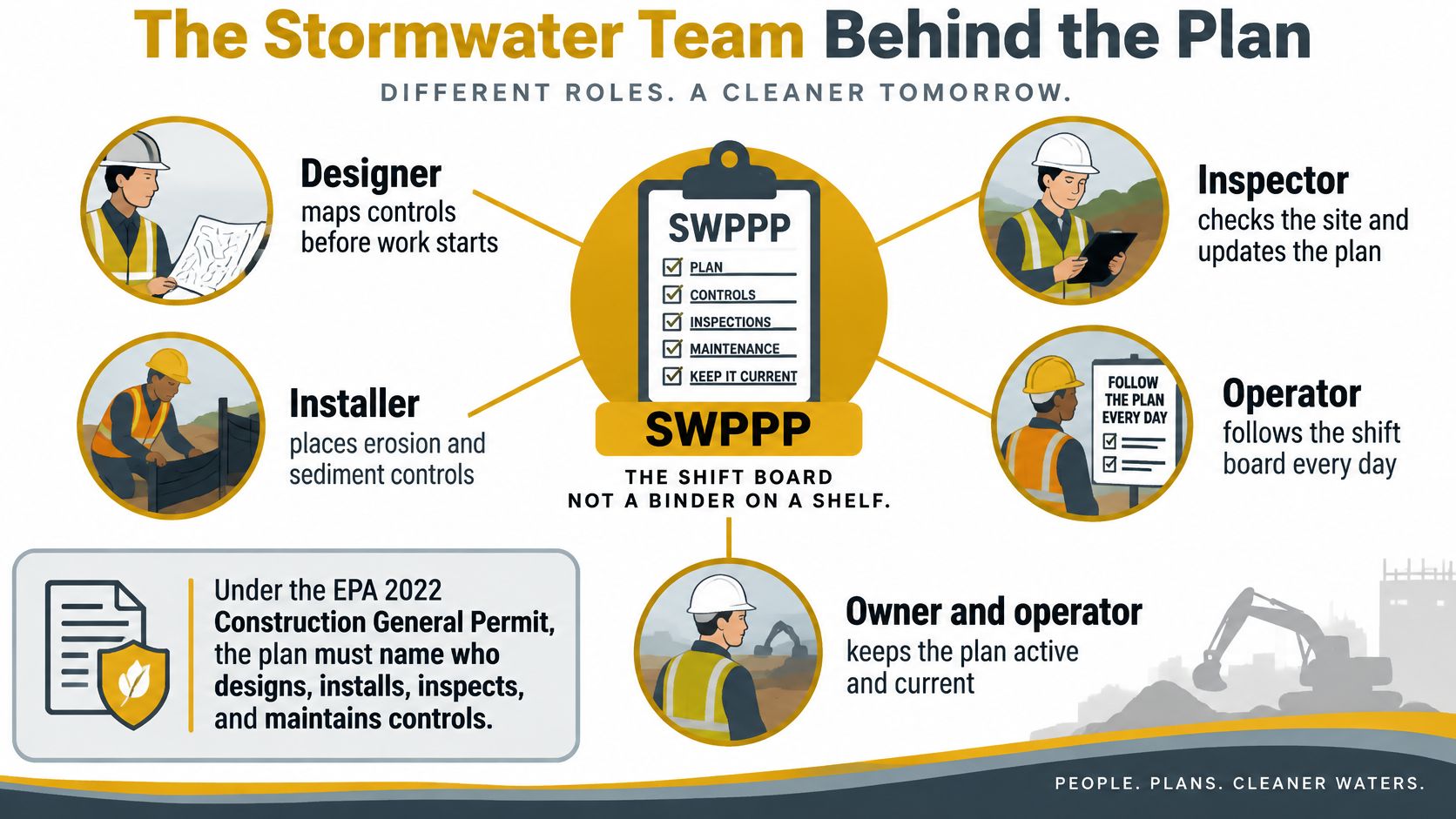
Think of the SWPPP as the shift board, not a binder on a shelf. A shift board only works if every slot has a name, a backup, and somebody with authority to change the assignment when the day goes sideways. A consultant who hands you a pretty document without that board hasn't finished the job.
Under the EPA 2022 Construction General Permit, the plan must identify personnel responsible for designing, installing, maintaining, and repairing stormwater and pollution prevention controls, plus personnel for inspections and corrective actions. That permit also requires the SWPPP to be completed before the operator submits the Notice of Intent and kept current throughout permit coverage.
Names, Not Just Titles
Superintendent isn't a name. Neither is environmental. Put a person in each slot and a named backup for days that person is off site, on another job, or stuck in an owner meeting while rain is moving in.
Then define escalation authority in plain language. Who can order a repair without waiting for approval? Who can hold a pour because containment isn't ready? Who calls for a swap, a liner repair, or extra inlet protection, and who pays for the rush?
How Revisions Actually Happen
Sites change faster than drawings. Grading shifts a swale, a utility trench opens a new flow path, a new subcontractor brings a different washout habit, or a control gets moved for access. Your consultant should set a revision workflow tied to those triggers, so the map, the narrative, and the field condition get updated together.
The failure mode is familiar. A damaged or undersized control stays in place for two weeks because everyone assumed someone else owned it. Link each control to one accountable person and that quiet failure gets much harder.
Demand these three items in the proposal before you sign:
- A named stormwater team: Every control tied to a person and a backup.
- Escalation authority by role and by name: Who can stop work, order repairs, and approve a change.
- A written revision trigger: Grading, drainage, subcontractor, or control changes force a plan update.
If a bidder can't produce that list, they're selling a document. You need a crew system.
Qualifications, Deliverables, and Costs
Don't hire on a sample SWPPP alone. A clean sample tells you they can format. It doesn't tell you they can run your pad in February mud or keep up when grading changes twice in one week.
Look for documented experience with NPDES construction permits and SWPPP preparation on jobs like yours, not just industrial or municipal work. Ask which federal and state permits they've worked under recently, who on their team handles inspections, and who turns revisions around when the site changes. Get the inspector credential in writing, whether that's the EPA inspection course route or a current certification or license covering erosion and sediment control, pollution prevention, inspections, and reporting.
Deliverables to Put in the Scope
Compare proposals line by line against the same list, or the low bid will win by leaving things out.
- Permit basis memo: Acreage, common plan status, governing permit, and NOI path in one page.
- Site specific SWPPP: Mapped controls, sequencing, stabilization, dewatering, and pollution prevention matched to your phasing.
- Stormwater team roster: Named roles, backups, contact numbers, and escalation authority.
- Inspection forms and schedule: The exact form, photo standard, rain record method, and corrective action deadlines.
- Revision log: Date, trigger, what changed in the field, and what changed on paper.
- Closeout support: Final stabilization checks and the records package you'll hand over at the end.
What Drives the Price
There's no honest flat formula. Acreage and number of disturbed areas matter, and so do the number of permits, trades, and washout points on the job. Inspection frequency drives recurring cost, while a jumpy grading plan drives revision cost.
Ask each bidder for an itemized quote that separates plan preparation, inspection visits, revisions, and equipment supplied by others. That split shows you where money goes if the schedule stretches. It also stops arguments later about whether a third revision or a Saturday inspection was included.
I would pay more for fast, documented revisions than for a thicker initial plan. The first version gets you permitted. The revisions keep you that way.
Inspection Rules a Consultant Must Run
A good narrative plan can still fail a file review. Inspectors and regulators don't grade your intentions. They check whether a qualified person looked at the site on schedule, wrote down what they found, and forced a fix by a deadline.
For projects covered under the EPA 2022 CGP from February 17, 2023 onward, EPA construction inspector training guidance states inspectors must either complete the EPA construction inspection course and pass its exam or hold a current certification or license covering erosion and sediment control principles, pollution prevention practices, control installation and maintenance, inspections, and required reporting. That same guidance describes frequency as generally once every 7 days, or once every 14 days combined with an inspection within 24 hours after a qualifying 1/2-inch rain event, with stabilized or frozen sites on a less frequent monthly schedule where applicable.
The Inspection Clock
| Condition | Frequency | Who may inspect | Records to keep |
|---|---|---|---|
| Active construction, default | Once every 7 days | EPA course and passed exam, or a current covering certification or license | Inspector, weather, findings, and actions taken |
| Active construction, rain option | Once every 14 days, plus an inspection within 24 hours after a 1/2-inch rain event | Same qualification | Rain gauge or other precipitation record plus the inspection report |
| Stabilized or frozen, where allowed | Monthly | Same qualification | Written basis for the reduced schedule |
| Concrete washout on any of those visits | Same cadence as the site schedule | Same qualification | Photos of liner, sediment level, access, and overflow risk |
Pick one schedule and run it. Drifting between options because the week got busy is how gaps appear in the record.
Making It Auditable
Your SWPPP consultant should build the paper trail as they go. Keep a rain gauge or reliable precipitation record on site, schedule inspections against actual working hours, and photograph deficiencies from the same angle after the fix. Every report needs the inspector's name, weather, findings, corrective action, and deadline.
A photo without a date, a location, and a follow up shot is just a picture of a problem you knew about.
Run the washout through that same visit every time. Check for liner damage, sediment buildup, blocked access, and overflow risk before they turn into a discharge. Confirm the inspector's credential and your chosen frequency in writing before coverage starts, not after the first storm.
Washout Containment as a Daily System
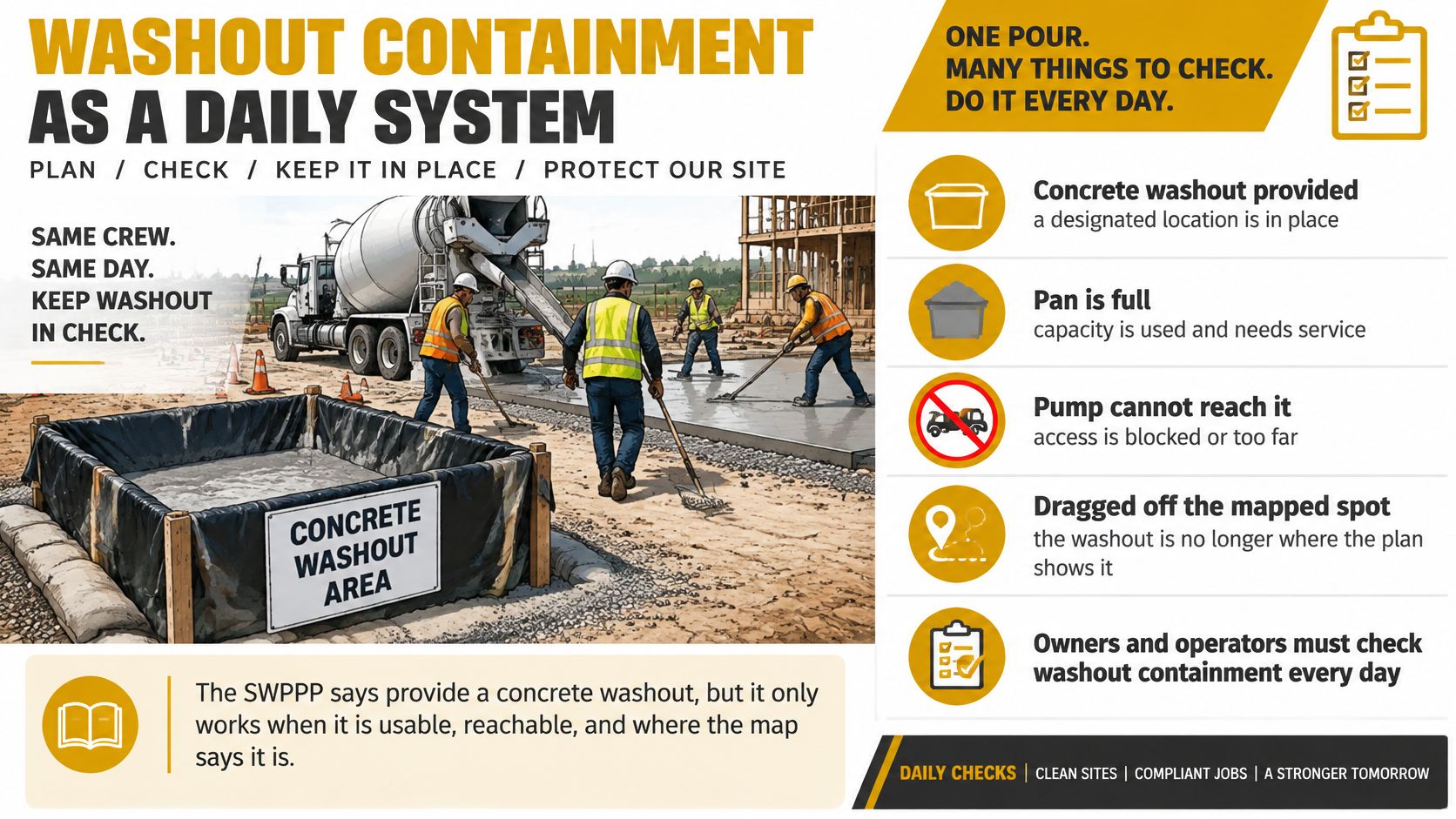
Say it's a rushed slab pour. Trucks are stacked, the pump operator is ready to clean out, and the SWPPP says to provide a concrete washout. The pan is already full, the pump can't reach it from the setup, or someone dragged it off the mapped spot to make room for rebar delivery.
Nobody planned to discharge. The system just wasn't usable at the moment it was needed.
The Rhode Island stormwater construction general permit reflects the federal expectation that owners and operators design, install, implement, and maintain effective controls, provide pollution prevention measures for concrete washout, and prohibit uncontrolled washout wastewater discharges. In the field, though, washout compliance is usually a logistics and accountability problem, not a design problem. A compliant BMP fails when it's full, moved without updating the SWPPP, placed beyond pump reach, or unavailable during a rush pour.
Who Owns Each Washout Task
| Task | Operator | SWPPP consultant | Concrete trade or hauler |
|---|---|---|---|
| Choose the location | Approves access and drainage | Maps the spot in the SWPPP | Confirms the pump or chute can reach it |
| Size the containment | Supplies the pour schedule | Checks capacity against expected slurry | Reports when the pan is nearing full |
| Install and maintain | Keeps the BMP in the approved place | Writes the maintenance standard | Washes out only in that area |
| Inspect | Receives the findings | Sets photo standards and deadlines | Repairs damage before the next pour |
| Relocate or swap | Updates site logistics | Revises the SWPPP if the spot changes | Delivers an empty container and hauls the full one |
| Overflow, damage, or no access | Stops the discharge path | Opens corrective action and escalation | Contains the spill and cleans it immediately |
Post that matrix where the concrete foreman can see it. If a task has three owners, it has none, so keep one name per cell in your site copy even though the table shows the split by company.
The Pre Pour Check
Run this before dispatch, not while the first truck is backing in:
- Flat access: Can the pump and trucks reach the pan without crossing a control or blocking the only entrance?
- Capacity remaining: Is there room for the expected slurry from today's pour, plus wash water, without riding at the rim?
- Cover plan if rain is forecast: Will rain fill the pan or push it toward overflow before service arrives?
- Photo matching the mapped spot: Does today's photo show the same location the SWPPP map shows?
Set hard relocation triggers and don't negotiate them during a pour. Swap or move the pan when it's at capacity, the liner is damaged, the pump can't reach it, or the control was moved without an SWPPP update. Each trigger gets a photo, a date, and a name.
For the container itself, request written compliance documentation and rated load capacity before you accept delivery, and confirm it's the pan named in the plan. Our washout pans are NPDES, OSHA, EPA, and BMP compliant and load tested to 36,000 lbs, which is the kind of documentation your consultant can drop straight into the file.
Escalation rule: After any overflow, damage, or blocked placement, the concrete trade stops that discharge path, the consultant opens a corrective action, and the operator confirms a new location before the next pour.
That sequence matters. Cleaning up without changing the location, capacity, or access just schedules the same failure for the next load. Fix the logistics and the compliance usually follows.
Permit Changes That Outrun a Template
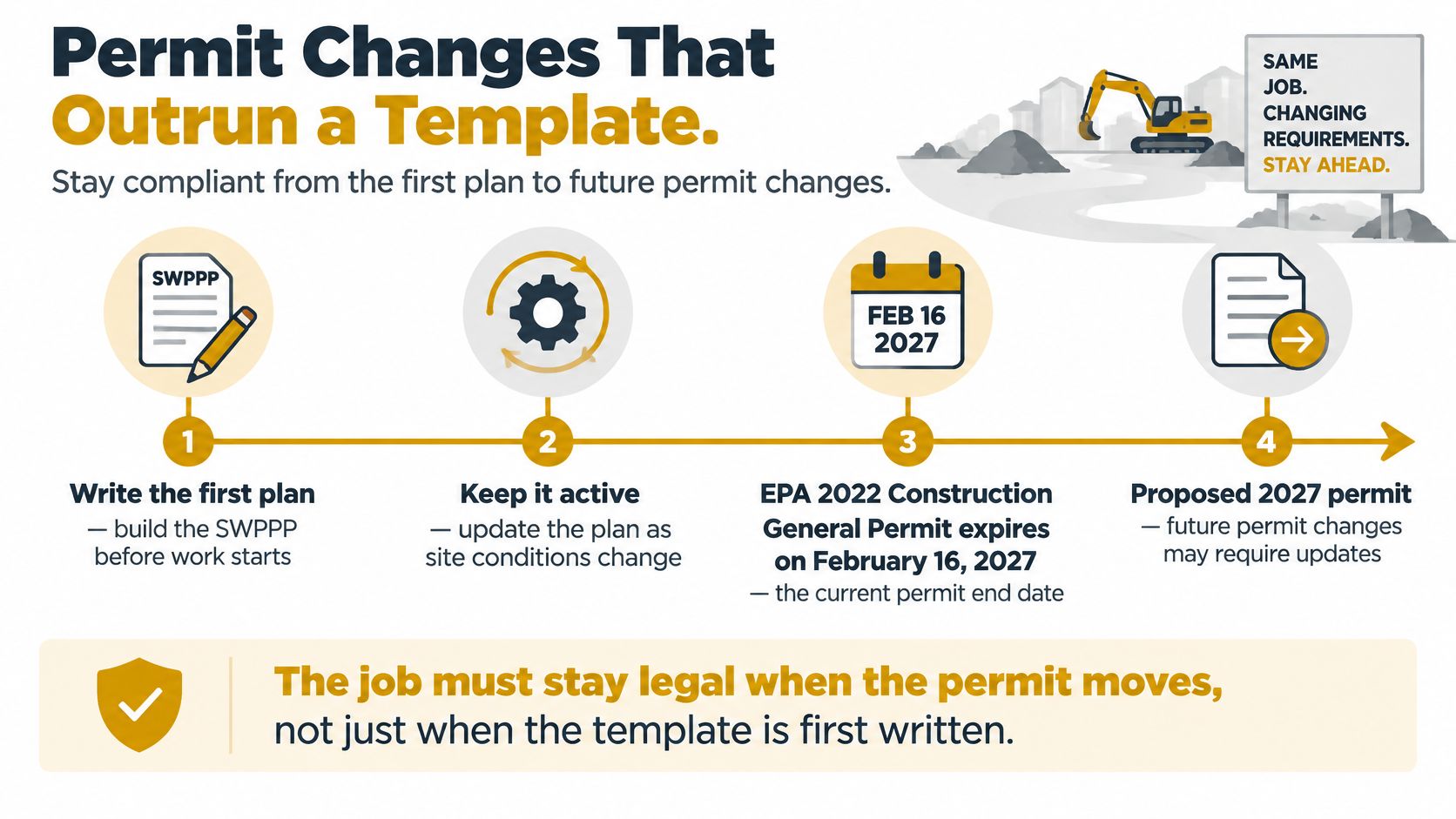
A crew arrives with the familiar SWPPP forms, but the job is covered by a different permit version. The controls may be in place, yet the paperwork no longer matches the requirements. That is a change-management failure, not a missing silt fence.
The Federal Register notice for the proposed 2027 NPDES construction general permit describes a proposal to replace the 2022 Construction General Permit, with potential changes such as requiring the full SWPPP, a viewing URL, or specified SWPPP materials with the Notice of Intent. State programs can also revise requirements, including those for a designated stormwater team.
Three Questions for an Active Job
First, which permit version governs a project already underway? Check the permitting authority's transition language. Record the applicable version and who confirmed it; don't assume the newest permit applies or that existing coverage carries over.
Second, what triggers a document update? The permit may tie changes to renewal, a coverage change, or a compliance date. Assign each template, NOI record, inspection form, and subcontractor instruction to a trigger and an owner.
Third, do field practices still match the permit? Compare the requirements with the work on site, including washout, dewatering, and stabilization. Keep dated notes and photos of the review, and update the plan if the required practices have changed.
Keep a Simple Change Log
- Permit name and expiration: Record the permit covering this site, not the company default.
- Transition status: Note whether existing coverage continues or renewal is required, and who confirmed the path.
- Update owner: Name the person responsible for templates, forms, and subcontractor notices.
- Evidence location: Identify where the current NOI, SWPPP, and revision records are kept.
For EPCM teams and multi-state contractors, the exposure is inconsistent updates across jobs. A crew may understand the controls while one site uses a revised form and another keeps an outdated version.
Set a recurring review for permit dates, NOI attachments, and site instructions. When a permit changes, update the affected job files and tell the people using them before the new requirements apply.
Lock the Washout Plan Before the Pour
Don't leave the consultant meeting with a promise to figure out containment later. Leave with four items you can hand to a superintendent, a pump operator, and an inspector without explaining yourself three different ways.
You need the permit and acreage basis, the named stormwater team, the inspection credential and frequency, and a washout note that states location, capacity, access, and who swaps a full container. If any one of those is missing, the plan isn't ready for a pour date.
Match the Note to Equipment
Then match that note to actual iron before the first truck is dispatched. Reborn Rentals is a practical way to do the containment piece your consultant specified, since customers reserve a 310 or 441 gallon washout pan and their dates online or by phone, scheduled off the customer's pour with no waiting for a truck to happen past the job.
The swap is turnkey. A new empty pan is delivered first, and then the full pan is hauled off, so the crew is never stuck choosing between delaying cleanout and using a full container. The Pan Swap and Waste Removal service is a flat $300 per pan, all included, covering replacement and disposal of concrete slurry at a recycling facility.
If you're still sizing the job, use the site's washout tools to check fit against your pour volume and pump setup before you book. That keeps the consultant's capacity note honest instead of turning it into a guess the field has to live with.
Confirm the location and capacity with your consultant, book the pan to the pour date, and update the SWPPP the same day if the spot changes.
Do those three things this week and washout stops being the loose end everyone discovers at cleanout time. It becomes just another scheduled operation, like the pump, the trucks, and the finishers. That's where you want it.
Lock in the containment your SWPPP consultant specified by reserving the right size pan for your pour date, with a clean swap ready before the full one leaves the site. Visit Reborn Rentals to book your washout pan and schedule service around your next pour.