
Concrete Pump Washout on Site: Steps and Safety
The pour's almost done, the finishers are pulling ahead, and the pump operator's asking the question nobody locked down that morning. Where do you want the washout? The hopper's caked, the line still needs flushing, and the nearest low spot on the gravel looks tempting because it's close and the trucks need to turn. That's the moment concrete pump washout stops being cleanup and becomes a compliance decision. If you don't already have a signed spot, a pan with room left in it, and a lawful route for what fills it, you're improvising with caustic water.
Why Concrete Pump Washout Cannot Hit the Ground
I've watched that last rinse start innocently. A driver cracks the hose, gray water sheets off the chute, and someone says it's mostly water anyway. Within a minute it's found the tire track, then the curb line, then it's moving toward the inlet everyone forgot to look at. Nobody planned a discharge. They just didn't plan containment, which amounts to the same thing once the water leaves the pad.
That slurry isn't dirty water in the ordinary sense. Concrete washwater is strongly alkaline, described by the U.S. Environmental Protection Agency as having a pH near 12 that makes the material caustic and corrosive, and it can contain toxic metals and other cement related contaminants. You can't judge it by how thin it looks in a puddle. The chemistry is the problem, not just the gray color.
What Happens Once It Leaves the Pad
On bare ground, washwater doesn't politely soak straight down and disappear. It can run off a site into roads, storm drains, rivers, lakes, or estuaries, especially when the ground is compacted, sloped, or already wet. Rain makes it worse. An uncovered container can overflow, and a puddle that looked contained at noon can be moving by the time a storm cell passes through.
What does infiltrate creates a slower problem. Washwater moving through soil can alter soil chemistry, inhibit plant growth, and contaminate groundwater. High pH can also increase the toxicity of other substances already present in soil and surface water. In a waterway, caustic washwater can damage fish gills and eyes and interfere with aquatic reproduction. That's why an inspector doesn't treat a gray streak toward a ditch as sloppy housekeeping.
If slurry can reach soil, a drain, or a truck route that carries it off site, you don't have a washout location. You have an uncontrolled discharge waiting for water.
Why Regulators Treat It as a Pollutant Source
The federal construction stormwater framework specifically identifies concrete truck washout as a pollutant source and prohibits wastewater from concrete washout unless it's managed with appropriate controls. This isn't a recent preference invented by a local inspector. The EPA's Phase II stormwater regulations were finalized on December 8, 1999, and became effective on March 10, 2003, expanding permitting coverage for construction activity and formalizing stronger controls for polluted runoff.
That history matters on a pour day because it explains the expectation you'll meet in the field. Pump, chute, and tool washout belongs in a dedicated, stable containment system, not on soil and not in drainage infrastructure. The container isn't a courtesy to keep the site looking tidy for photos. It's the control that keeps alkaline slurry, metals, and cement solids where you can manage them until they're removed properly.
Don't wait until the operator is holding the hose to decide whether that control exists. By then the crew's tired, the next truck's waiting, and the easiest low spot starts to look like a plan. It isn't one.
Set the Washout Spot and Size the Pan
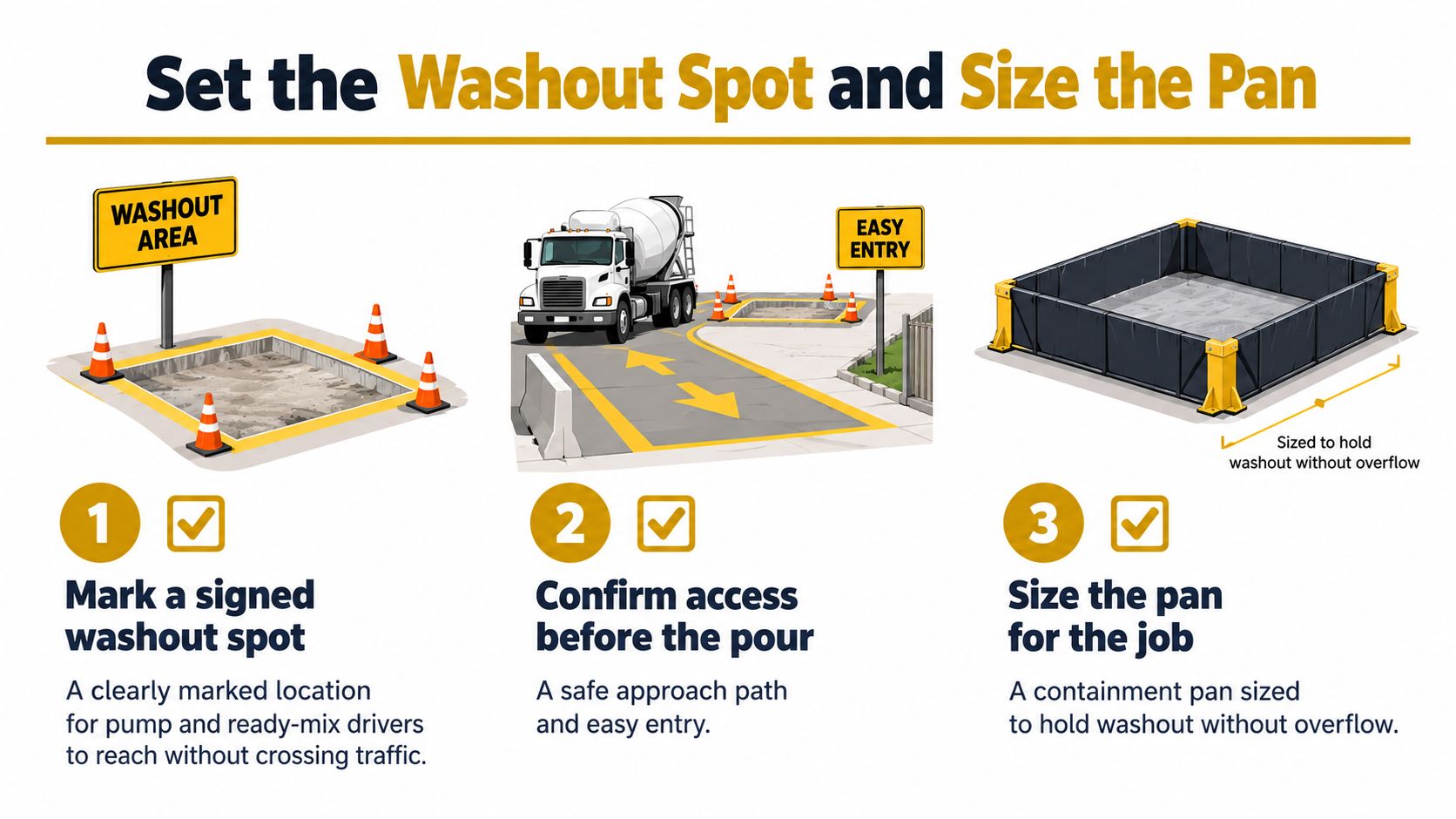
Lock the location before the first truck arrives, while you can still move the pan without arguing with a pump that's already set up. Pick a spot drivers can reach directly, mark it clearly, and reject any location that forces a truck to cross finished work, back blindly toward a drain, or wash where slurry can track into a travel lane. Convenience matters because a legal spot that's hard to reach won't get used consistently.
The separation distance isn't negotiable in practical planning. Keep the designated washout at least 50 feet from storm drain inlets, drainage ditches, and surface waters, a standard set out in EPA concrete washout guidance for siting and operation. If the only available corner sits closer than that, don't accept it and hope the sign fixes the problem. Move the operation, add controls your SWPPP allows, or get the responsible person to resolve it before concrete shows up.
Accept or Reject the Container Before Anyone Washes
Walk the pan like you'd walk any other piece of equipment. It needs to be leak proof, with no holes, tears, cracked seams, or sidewall damage that'll open up under load. Set it on stable ground where it won't rock, settle unevenly, or get clipped by a truck tire. A container that tips, leaks at a corner, or sits where splash lands outside the rim has already failed, even if it's brand new.
Size for the maximum expected volume, not the average rinse you're hoping for. Add up what the job will produce:
- Pump cleaning volume: Hopper wash, line flush, and residual material from the pump system itself.
- Chute and tool wash: Every truck that'll rinse at the same spot, not just the first one.
- Cementitious solids: Leftover concrete takes up room that liquid can't use later.
- Rain freeboard: Open space below the rim so a storm doesn't turn a compliant pan into an overflow.
That last item gets skipped constantly. A pan sized perfectly for washwater on a dry morning can overtop after one heavy rain, and rainfall doesn't care that your math worked at delivery. Leave freeboard on purpose.
Why Undersizing Shows Up Late
The chemistry inside the pan is another reason capacity discipline matters. Research summarized in federal washout material reports dissolved solids of at least 9,000 mg/L, heavy metals, and pH values up to 12.6 in concrete washout slurry characterizations. A pan that prevents today's spill can still become tomorrow's problem if multiple pours, suspended solids, and rain consume the room you thought you had.
Field check: If you can't point to the sign, the access path, and the empty space below the rim, the setup isn't ready.
Brief every driver at the gate, not after discharge. Each pump operator and ready mix driver needs to know the only authorized wash location, how to approach it, and who to call if the pan looks full or damaged. Missing signage and missing briefings are common failures because they look administrative. In practice, they're how a driver ends up rinsing at the curb while your signed pan sits empty fifty yards away.
Reject the spot if it's too close to drainage. Reject the pan if the liner's torn. Reject the plan if nobody can explain what happens when it fills. Those decisions are cheap before the pour and expensive afterward.
Contain the Pump Wash Without a Mess
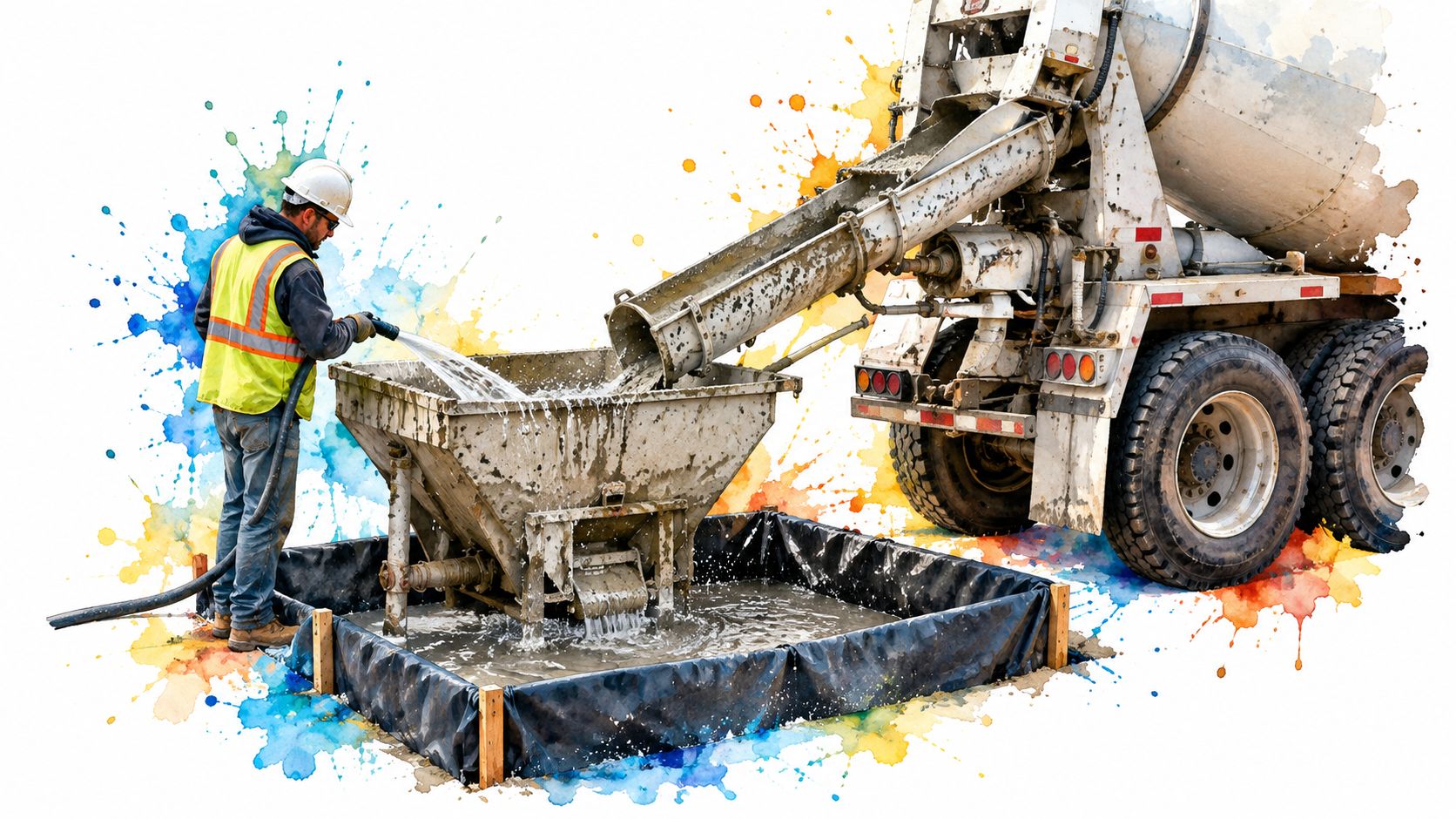
At the end of the pour, slow the crew down for two minutes before anyone opens a hose. Confirm the pan is stable, undamaged, and below capacity. Confirm the pump is positioned so discharge lands inside containment, not across the rim. If the liquid level is already high, stop and service the pan first. Washing into a nearly full container because the truck is waiting is how a controlled cleanup becomes shovel work on wet gravel.
Wash only what your site SWPPP authorizes, in the designated spot. For concrete pump washout, that typically means the pump hopper, discharge line, and external chute. Keep every stream aimed into the pan. Don't chase residue across soil with a hose, don't rinse down a curb face, and don't let slurry pool in a vehicle route where tires will carry it beyond your controls.
Work the Wash as a Controlled Sequence
Start with the material that carries the most solids, then move to rinse water, and keep someone watching the liquid level the whole time. The operator controls discharge from the hopper and line. A second person watches splash, rim height, and the ground around the pan. That second set of eyes matters because the person holding the hose is usually watching concrete, not the thin sheet of water escaping behind a tire.
PPE isn't optional because it's the last task of the day. Crew members need hard hats, nitrile gloves, and boots for this work, and anyone handling wet concrete should treat skin contact seriously because high pH material can burn skin. Keep people out of the discharge path, keep footing clear of hoses and slurry, and don't let a worker reach across moving equipment to redirect a stream by hand.
Stop conditions should be plain enough that a new laborer can call them:
- Liquid climbing toward the rim: Stop washing and arrange service or drawdown.
- Leak, tear, or sidewall damage: Stop adding water and contain what has escaped.
- Splash landing outside the pan: Reposition before continuing, don't hose it back across the ground.
- Rain starting during cleanup: Protect remaining freeboard and cover the container when the wash ends.
Inspection Is Part of the Wash
Don't treat inspection as paperwork for another day. Look at the facility daily and after heavy rain, checking liner and sidewall damage, leakage, sediment accumulation, and remaining capacity. Sediment is easy to underestimate because liquid hides it. A pan that looks half full of water may have far less usable room once solids settle in the bottom.
The operating trigger is 75% full. At or above that level, remove liquid by vacuum service or controlled evaporation, then let residual solids harden before removal and recycling. Don't wait for the rim to make the decision for you. By the time a pan is visibly close to overtopping, one more chute rinse or one downpour can push it over.
Before forecast heavy rain, lower the liquid level or cover the facility so rain can't overtop it. That single habit prevents a lot of Monday morning surprises. A covered, partly empty pan is a control. An open, nearly full pan heading into a storm is a scheduled overflow.
The performance bar isn't a pad that looks swept. It's all washwater and solids contained, with recycling of 100% where practicable. If slurry reached the soil, a drain, or the street, the wash didn't succeed just because the hopper came clean. Brief the crew on that standard before the hose comes out, and they'll make better decisions when the level starts rising.
Decide Where Washout Water Can Go
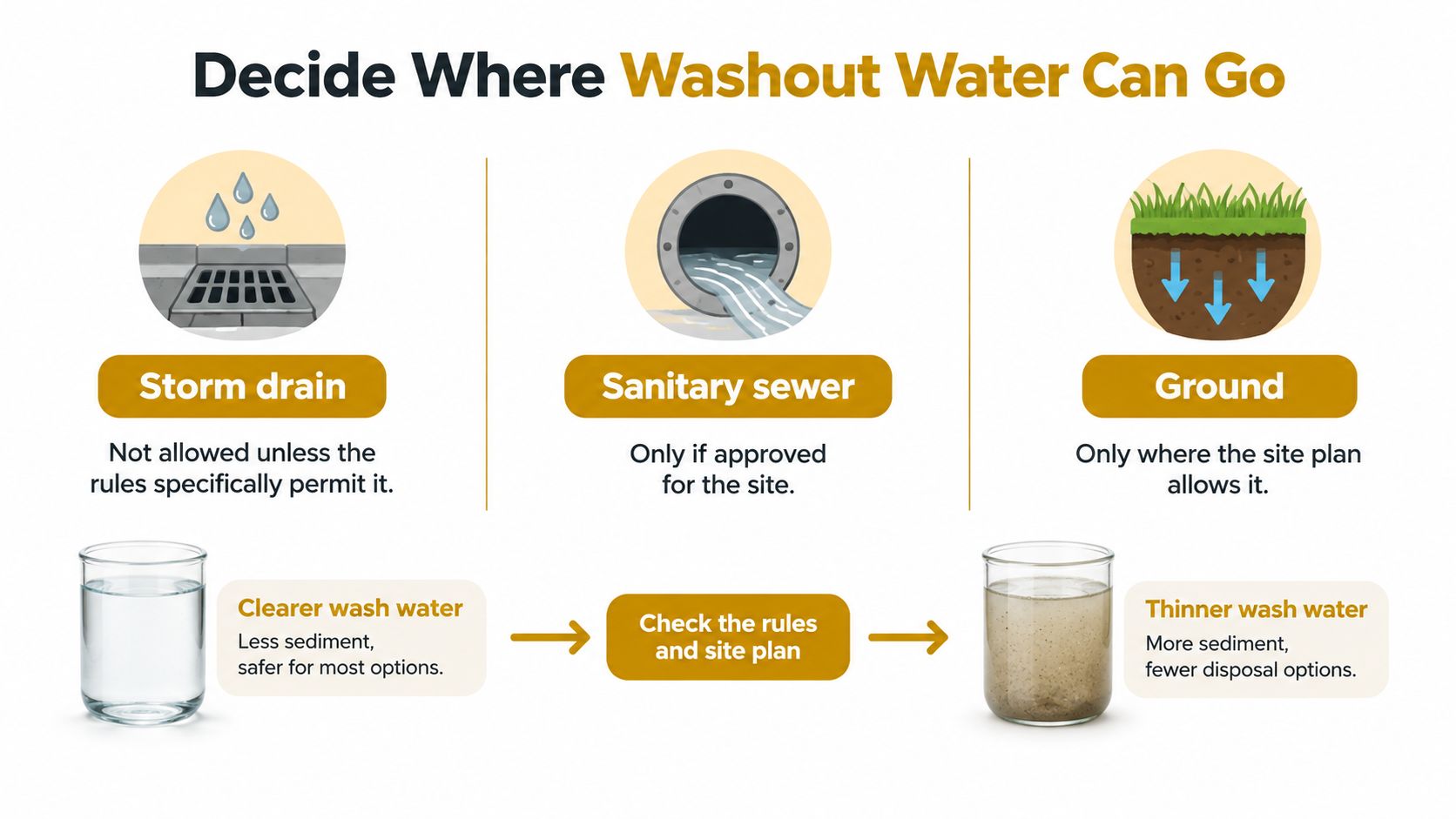
The argument usually starts with appearance. The solids have settled, the water on top looks thinner, and someone asks whether it can go to the storm drain now, or onto a back corner, or into the sanitary sewer because sewers are made for wastewater. Clearer doesn't mean acceptable. Dilution doesn't grant permission, and a pan doesn't authorize a discharge. Each route has a different owner, a different approval, and a different consequence if you guess wrong.
Construction stormwater rules prohibit concrete washout wastewater discharges unless managed by appropriate controls, a prohibition described in EPA guidance on stormwater discharges from construction activities. That means the default answer for storm drains and bare ground is no, not maybe if it looks weak enough. Storm systems lead to surface water. Soil leads to infiltration. Neither route becomes legal because the crew added more hose water.
Compare the Routes Before You Need One
| Route | Practical answer | What you need first |
|---|---|---|
| Storm drain | Don't use it as a washout outlet | A specific authorization that actually covers this wastewater, which ordinary site controls don't provide |
| Bare ground | Don't rely on infiltration or dilution | An approved control and disposal method in the project plan, not a field judgment |
| Sanitary sewer | Possible only with local approval | Permission from the receiving authority and any required pH or metals treatment and testing |
| Batching plant return or process reuse | Preferred when available and allowed | Confirmation the plant or process will accept the material |
| Licensed off site treatment or disposal | Use when reuse isn't available | An authorized hauler or facility and project disposal documentation |
The preferred path is to retain washout in leak proof containment and recycle it, including return to a batching plant or reuse in the process when that route is allowed. Recycling isn't automatically available on every job, though. A plant may refuse a load, a small renovation may have no process reuse option, or the material may not meet the receiver's requirements. Plan the fallback before the pan fills.
Sewer Permission Is Local, Not Automatic
Sanitary sewer discharge needs the receiving system's approval. Off site treatment may be required to remove metals and reduce pH before discharge to a publicly owned treatment works. Federal pretreatment rules prohibit discharges that cause corrosive structural damage, with a federal pH floor of 5.0 unless the treatment works is specifically designed for otherwise prohibited discharges. That floor doesn't mean any washwater above it is welcome. Local limits, permits, and plant capacity still control the decision.
Other jurisdictions set their own bands and restrictions. NSW guidance, for example, allows treated effluent irrigation only at pH 6.5 to 8.5 and states that recycled washdown water must not enter stormwater drainage. Don't import another project's permission, another city's verbal okay, or another country's range and treat it as your approval.
The cheapest looking option, rinsing toward a drain or letting liquid soak away, can shift the cost into a permit violation, contaminated soil, or damage at a treatment plant.
Name the responsible authority for your route before the pour. Write down who tests the liquid, who approves discharge, who hauls it if approval doesn't come, and where hardened solids go. If nobody can answer those questions, keep the material contained. Containment buys you time to get a lawful answer. Guessing spends that time creating a cleanup.
Pick a Washout Pan and Rental Window
The pump is ready to wash, the last truck is still waiting, and the pan is already holding more than expected. That is when a rental chosen by its listed capacity alone can fall short. An industry estimate puts annual pump washwater in the United States at about 68 million gallons, based on approximately 1.36 million concrete pumps operating annually and 50 gallons per pump. The estimate also puts combined truck and pump washwater at approximately 308 million gallons each year, along with 2.5 million cubic yards of washout material and 5 million tons of residual concrete. These figures appear in an industry estimate of annual pump and truck washwater volumes.
At the site, add up the planned pump wash, any line flushes, other truck cleanouts, and the time the pan will remain in place. Rain can use up freeboard before the crew has finished washing. Choose capacity for the full rental window, not just the first cleanup.
Match the Pan to the Pour
Reborn Rentals lists two rental pan options. The listed dimensions are 72 inches x 72 inches x 24 inches for the deeper unit and 72 inches x 72 inches x 14 inches for the shallower one. The listing gives the deeper pan an approximate capacity of 441 gallons, or approximately 18.25 tons, and the shallower pan a capacity of about 310 gallons. Treat the listed capacity as a planning figure, then confirm the usable volume and load limits with the rental provider. Dimensions alone do not establish how much liquid and solids the pan can safely hold.
Washout Pan Options for a Single Pour
| Pan | Listed size | Approx. capacity | Use when |
|---|---|---|---|
| Deeper rental pan | 72 inches x 72 inches x 24 inches | About 441 gallons, approximately 18.25 tons | Longer pours, multiple cleanouts, or rain in the forecast where extra freeboard matters |
| Shallower rental pan | 72 inches x 72 inches x 14 inches | About 310 gallons | A short retrofit or limited pour that still needs leak proof containment and prompt service |
Usable capacity is less than the rim-to-rim volume. Solids take up space, and the crew needs room for more washwater and rain before service or a swap. If the plan works only when the pan is nearly full, the capacity or service timing is wrong. Choose the deeper pan, arrange earlier service, or schedule a replacement.
Budget the Window, Not Just the Day Rate
Daily pricing starts at $25, with possible additional charges for delivery, rough terrain, and express orders. Confirm the truck's access and placement route before booking, and ask what happens if the pour slips a day. A rental ending before the planned cleanup can interrupt the work and leave the pan on site longer than expected.
The checkout sequence is cart, details, checkout. Enter the item, dates, site location, and delivery details, then confirm the order through a contact channel the crew will monitor, such as Messenger, WhatsApp, email, QR contact, or a scheduled callback. Get the pan dimensions, delivery window, placement location, and any added fees confirmed before dispatch.
The pan should arrive before the pump, fit the approved location, and have room for the expected liquid and solids, plus rain freeboard. Confirm the lawful handling route for liquid and hardened material as part of the job setup. A correctly sized pan starts containment; it does not, by itself, determine where its contents can go.
Close Out the Pan and Book the Next Pour
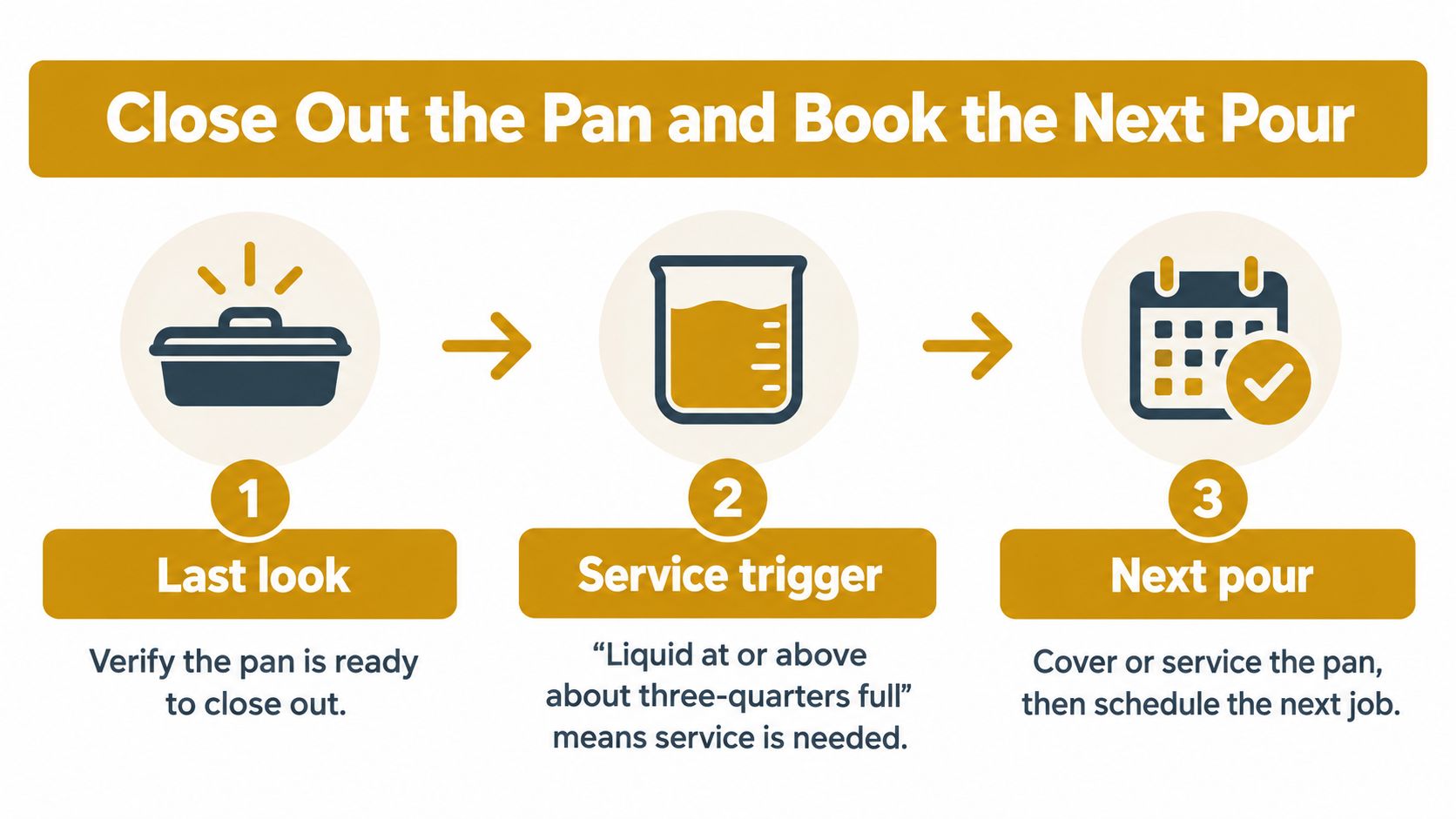
Closeout starts while the pump is still on site, not when someone notices the pan three days later. Assign one person to take the last look and make the service call. If ownership floats between the superintendent, the pump operator, and the ready mix driver, nobody owns it. The pan then sits open, collects rain, and turns from a control into stored wastewater with a hardening problem inside.
Liquid at or above about three quarters full is already a service trigger, as covered in the section above. Don't re-litigate that number at closeout. Draw down or vacuum the liquid through the approved route, cover the pan before heavy rain, and let residual material harden inside containment. Hardened residue isn't dirt just because it's dry. Remove it under the project's waste rules and send it to recycling or an authorized destination where that route is available.
Photograph a Closeout Record the Office Can Use
A superintendent doesn't need a long form to prove the pan was handled correctly. A phone photo set and a few names and dates will do more than a vague note that cleanup was completed. Capture the condition you'd want to show an inspector, a client, or the next foreman inheriting the site.
- Remaining freeboard: Photograph the liquid level against the rim before service.
- Liner and sidewall condition: Show damage, leaks, or a clean bill of health.
- Sign and access path: Confirm the washout sign is still in place and the route isn't blocked.
- Hauler or receiver: Record who took liquid or solids, whether that was a batch plant, vacuum service, or licensed hauler.
- Final ground condition: Photograph the area around the pan after removal so tracked slurry doesn't become an argument later.
Safety habits belong in that last pass too. Keep the access path clear for the pump and service truck. Keep PPE on for the final rinse and for handling residue. Stage absorbent material where the crew can reach it quickly, even though the pan is the primary control. Absorbent doesn't replace containment. It gives you a response when a hose coupling drips or a splash lands wrong during the last five minutes.
Book the Next Pan While This Job Is Fresh
Use what this pour taught you. If the pan reached its service trigger sooner than expected, your next order needs more capacity, an earlier swap, or a longer rental window. If rain consumed your freeboard, don't book the same margin and hope for better weather. Adjust the plan while the crew still remembers which truck washed where and how much material the line produced.
Before the following pour, add the pan that matches the expected gallons, set delivery dates and site location in the three step checkout, and confirm delivery, terrain, or express fees so the scheduled number matches the budget. Check current availability and listed pan specs on the company site, and use the FAQ, fees, and policy pages when the project needs a paperwork trail. That sounds administrative until an owner, inspector, or SWPPP reviewer asks who approved the rental, what it cost, and where the washout went.
A good closeout leaves no mystery for the next crew. The liquid has a lawful destination, the solids are scheduled for removal, the ground is clean, and the next pan is booked with enough room for the wash. That's the difference between renting a container and running a concrete pump washout system that holds up from first prime to final pickup.
Reborn Rentals offers washout pans and containment for scheduled pours, short retrofits, and repeat concrete work, with sizing and delivery details you can confirm before the pump is dispatched. Match the pan capacity and rental window to your expected wash volume, rain freeboard, and service plan so the last rinse stays contained. Visit Reborn Rentals to check current pan specifications and availability and book the unit for your next pour.