
Construction Equipment Rental Rates and What Drives Them
A superintendent gets a washout quote with a low daily number, writes it on the pour sheet, and moves on. The pump slips a day, the gate is tight, and the pan sits until Monday. The invoice that follows is a different document from the first line of the quote. That gap is what construction equipment rental rates are. The advertised day rate is only the start of an all-in project cost. Idle time, the trip each way, access, and small fees can outweigh a cheap headline, especially on a short concrete window. The walkthrough below reads a quote the way a project controls lead would, one lever at a time, with a washout pan as the running example.
Why a Single Daily Price Rarely Tells the Whole Story
A washout containment pan is booked for one day. The pour slips, the pan stays on site through the weekend, and the return truck needs a second trip because the access road is soft. The quoted daily rate has not changed, but the project's rental cost has.
A rental quote is like a travel fare: the base price covers only part of the trip. Equipment class, rental length, site conditions, and local availability all affect the final bill. A supplier with idle units may offer a lower rate; limited availability during a busy period can push rates higher. Those factors matter, but the quote's billing rules and logistics determine how they affect your job.
For the pan, start with the days that will be billed, not just the days crews expect to use it. Then check whether delivery and pickup are separate charges, whether the rental has a minimum term, and what happens if the return is delayed. A low daily rate can lose its advantage when the equipment sits idle or requires extra trips.
When a printed jump is not a real shortage
Rate comparisons can also mislead when equipment categories or reporting methods change. A sharp change in a published rate does not necessarily mean demand has surged. Check whether the equipment definition and the basis for comparison stayed consistent before treating a rate increase as evidence of a shortage.
Practical rule: Compare quotes only after putting rental days, delivery, pickup, access requirements, and idle time on the same basis.
For a short concrete job, the advertised rate is a starting point, not a budget. Read each quote line by line and ask what could add a billed day, another trip, or a site fee. A few clear answers can matter more than a small difference in the daily price.
How Construction Equipment Rental Rates Are Built
A defensible rate splits ownership cost from operating cost, even when the customer sees a single price.
Ownership is the cost of having the asset exist. It includes depreciation, return on invested capital, taxes, insurance, storage, and replacement escalation. Operating cost is the cost of using or turning it. That stack includes maintenance, repairs, fuel, and lubrication. A low day rate that recovers neither stack is a temporary discount, not a sustainable price.
Washington State's public rental method makes the split operational. Ownership starts from a Blue Book monthly rate, adjusted for equipment age and geographic location, then divided by 176 hours per month. When the unit is required and running, the reimbursable amount stacks that hourly ownership rate with hourly operating cost. Standby is not free just because the hour meter is quiet.
A lease that does not care if you hauled
Picture a truck on a monthly lease. The payment is due whether it hauled concrete or sat behind the trailer. Fuel and tires are a second bill. A rental rate works the same way. Part of it recovers capital that accrues while your pour slips. Part of it recovers wear that shows up only when the asset works or comes back dirty.
What the headline leaves off the pan
A cheap daily price misleads when it does not recover standby exposure, transport, cleaning, damage risk, and capital cost. On a compact asset such as washout containment, separate the ownership recovery for the rental period from variable logistics and service. Customers can challenge a delivery charge. They cannot see a capital shortfall that was buried in a teaser rate.
A useful internal check is a minimum break-even day rate. Divide monthly ownership recovery by the days you expect to bill, then add the operating and handling cost you expect on that rental. The result stops a slow month from training the fleet to work below its keep. Delivery, rough-terrain handling, and expedited service stay on their own lines so the customer can see them.
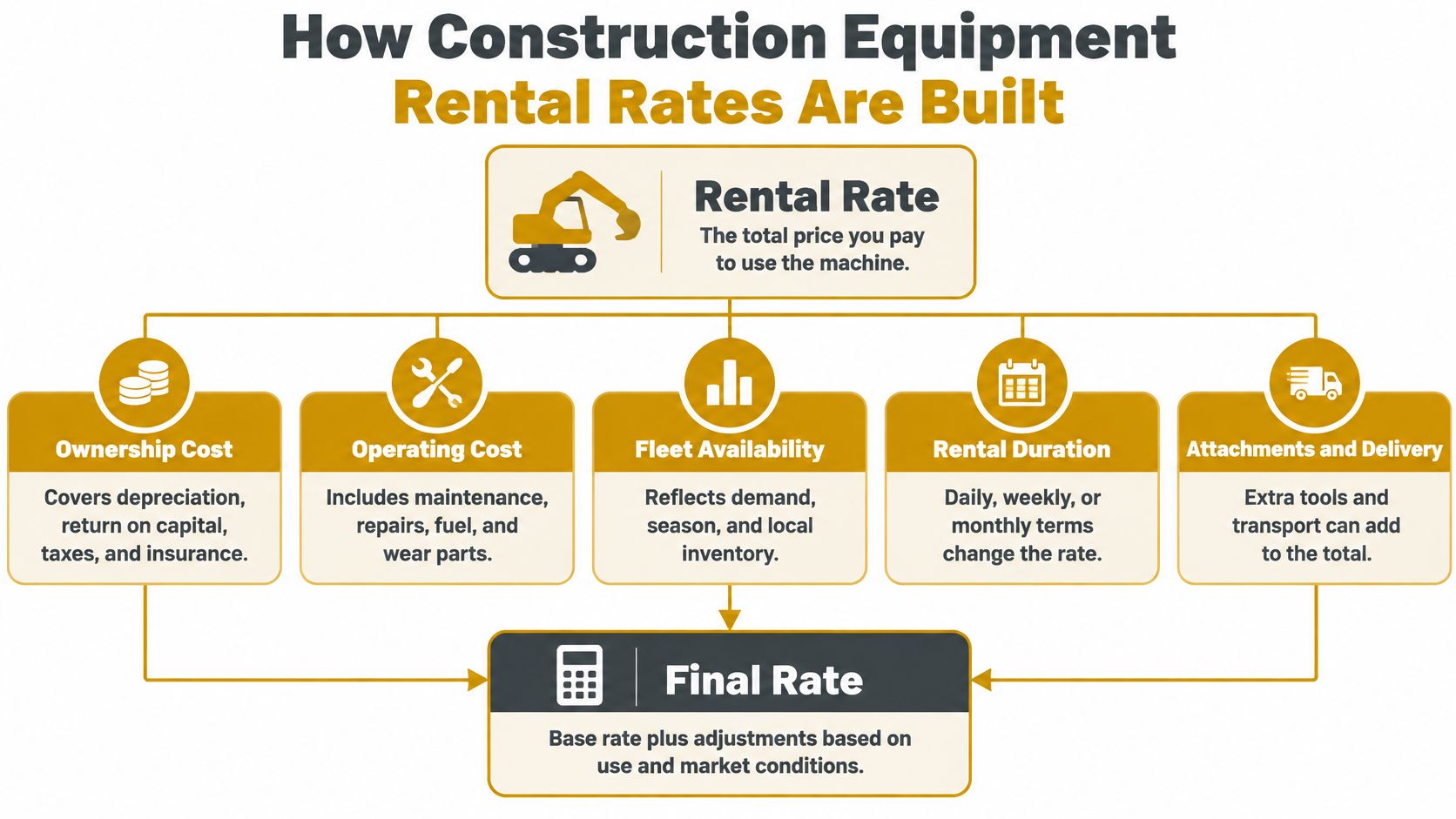
The diagram is the stack a quote is drawing from. Fleet availability and rental duration sit beside ownership and operating cost because a price that ignores the yard and the calendar will not hold. Attachments and delivery are often the largest dollars after the base, which is exactly where a washout invoice tends to grow.
How Equipment Type and Rental Length Change the Price
Ownership costs get cheaper per day only when productive days pile up. Rental charges usually do not wait for those days. They are time-based, so they accrue whether the unit runs or sits.
A published skid-steer comparison shows the spread in plain numbers. An internal recovery rate lands at $275 per day at 38% utilization. An equivalent market rental is quoted at $450 per day, $1,110 per week, or $2,860 per month, with 240 allowable meter hours per month. Against seven daily charges, the week is roughly a 21% discount. Against thirty daily charges, the month is roughly a 29% discount.
Those cuts buy the supplier something specific. A longer term keeps one unit assigned, cuts repeat pickups, and reduces the number of contracts. The customer buys a lower effective day cost and gives up flexibility. The same analysis notes that the rental clock keeps running when the machine is idle, unlike a usage-based internal rate.
Terms side by side
| Term | What the price is doing | Fit for a washout window |
|---|---|---|
| Daily | Highest cost per day, shortest commitment | One placement and a same-day or next-morning pickup you can actually hit |
| Weekly | Fewer transactions and a lower effective day cost | Several pours, or a pump date that might slip inside a known week |
| Monthly | Lowest effective day cost and the most idle risk | A repetitive calendar you will fill, not a hope that work appears |
A pan reserved from Friday through Monday is not "one pour." It is a weekend of standby plus the placement. Meter hours do not erase those days.
Match the term to dates you can defend
- Firm single placement: Keep a transparent daily base. A weekly discount is wasted money if the pan can leave the afternoon of the pour.
- Known multi-day window: Weekly or project-term pricing can beat a string of daily hits when the dates are real and the supplier is not double-charging mobilization.
- Loose schedule: Price the empty days before you take the longer discount. A cheap month with two unused weeks is an expensive month.
Test the choice against expected utilization, turnaround time, and the days that unit cannot be rented to someone else. Replacement cost alone does not pick the term. The work window does.
How Market Demand and Seasonality Move Rates
External demand moves rates even when your own utilization math is clean. In March 2003, industry reporting on the rental market said national rental companies had cut rates to some of the lowest levels in many years. Commercial construction demand had weakened and utilization had fallen. Monthly backhoe rentals dropped from about $1,800 to $2,000 to about $1,500, roughly 17% off the midpoint of the earlier range. Monthly rates on 6,000-pound forklifts fell from about $2,400 to about $1,600 to $1,800, a decline of roughly 25% to 33%.
That same report estimated U.S. rental revenue at $23.5 billion in 2002, compared with about $18 billion in equipment sales. Large national rental companies had reached about 32% of the total rental market between 1995 and 2000, nearly doubling their share from 1997 to 2000 through acquisitions. Rental was already a major procurement channel when those cuts landed. Suppliers lowered prices to keep fleets productive because contractors were postponing purchases.
Reading a move before you chase it
The reverse case is ordinary. Scarce equipment and stronger demand let rates rise. Seasonality does the same job on a shorter cycle. A spring concrete push in a tight metro is not the same market as a slow winter week with pans sitting in the yard.
A discount printed in a slack month is not a promise for the week every crew in town is pouring.
Put the movement in context before you treat it as a new normal. As the earlier market review showed, a huge printed jump can be a classification change rather than a shortage. Set daily, weekly, and monthly prices next to the utilization you expect, the season you are in, and any minimum rental period. A rate is easier to challenge when that class is soft and your dates are firm. It is harder when every similar unit nearby is already tagged. For a short washout, ask whether the minimum period turns one placement into three billed days. That floor often matters more than the posted day rate.
Working Through an All-In Rental Cost Example
Advertised day, week, and month prices rarely become a defensible all-in project cost. Public estimating practice already separates ownership costs, including depreciation, financing, insurance, taxes, and storage, from operating costs such as maintenance, repairs, fuel, and lubrication. WSDOT equipment-rental agreement guidance sits in that split. Rental charges can still apply while the unit sits, because the basis is usually time, not hours worked. The missing piece on most rate cards is the rest of the ticket.
The worksheet
Use your own quote in every cell. The labels below are the lines, not a rate card.
| Cost Line | What It Covers | How to Estimate It |
|---|---|---|
| Base rental | Time charge for the asset | Quoted period rate times the periods on the ticket |
| Standby days | On site but not working | Non-operating days inside the window, at the time rate unless the quote waives them |
| Delivery and pickup | Both trips | Price each leg, do not assume a blended "included" |
| Mobilization distance | Miles or zones past a local radius | Use the site address, not the office |
| Fuel or cleaning | Residue or fuel left behind | Ask what a pan returned with slurry costs |
| Attachments | Extra components | Only what this pour needs |
| Damage waiver or insurance | Who pays if the unit is damaged | Check whether hired-equipment coverage already exists |
| Overtime, cancel, late return | Schedule misses | Read the supplier's clock, including weekends |
The formula is short. All-in cost equals base rental for every billable day, plus logistics and handling, plus standby, cleaning, and any late or cancellation charge. Substitute the figures on the quote you hold. A number that is not on that quote does not belong in the budget.
When the higher day rate is the cheaper job
Take two washout quotes for the same placement. One day rate is lower and the yard is a long haul. The other day rate is higher and the yard is local. On a one-day window, two long trips can erase the gap in the first line before the pan is set. A higher rate with local delivery, a flexible extension, and fewer idle or return charges can be the lower completed-project cost.
The cheapest daily rate is not the lowest-cost choice when the truck, the gate, and the extra day do the real spending.
Delivery and pickup are often quoted apart from the rate. Fuel, cleaning, late returns, attachments, and damage waivers can move the final bill by more than the difference crews argue over on line one. The question to write on the quote is specific. What will this rental cost at this site, for this work window, including days it does not operate and the trips required to get it there?
Delivery, Terrain, and Surcharges to Check on Every Quote
Crews still rank suppliers by the first number on the page. That ranking fails when the first number excludes the work of getting the asset to the pour.
Distance is the plain version. A local drop and a cross-county drop are different jobs for the same pan. Rough terrain is the version people under-describe on the phone. Soft subgrade, a tight alley, a ramp the truck will not climb, or a crane pick can each add time and gear the day rate never included. Expedited service is the third. A pan needed before the next placement is not the same product as a pan booked with a week of notice. Transparent suppliers state those notes up front. If the notes are missing, the price is incomplete, not generous.
Questions to lock before anyone signs
Paste the same blanks into every bid so the totals can be compared.
- Delivery and pickup: Are both legs included, or is each leg its own line with its own mileage rule?
- Rough terrain: What does this supplier call difficult access, and does the actual gate match that definition?
- Express orders: What is the cutoff for a standard delivery, and what changes if the pour moves up?
- Late returns and extra days: Does one extra calendar day add a single daily charge, or does it reprice the whole term?
- Cleaning: What condition counts as ready to turn, especially when slurry is left in the pan?
- Minimum period: Is the floor one day, a weekend, or something longer that your schedule will trip?
How the blanks change the winner
Answer those six on both quotes and the ranking often flips. The low day rate with a separate long haul, a rough-terrain adder, and a weekend minimum can clear a higher day rate that is local, scheduled, and one day. That is the same lesson as the worksheet, applied as a filter before you negotiate.
Do not accept "delivery is extra" as a complete sentence. Ask for the dollar method, the access assumption, and the clock. Two quotes with identical blanks can be ranked. Two quotes that hide different blanks cannot, no matter how sharp the day rate looks in the email subject line.
Reducing Rental Costs and Choosing a Washout Containment Rental
The savings that hold up are scheduling habits, not a hunt for the smallest day rate.
Book dates you can keep so a weekly or project term is earned rather than hoped for. Confirm the truck path and the set spot before the order, not when the driver is already on the radio. Size the container to the slurry you expect. Paying to haul empty capacity is waste, and an undersized pan that forces a second drop is worse. Plan the return on the same day you plan the placement. Idle days between cure and pickup are a choice the ticket will price.
What to put side by side
Compare three things at once, not the day rate alone.
- Capacity: Match the pan to pour volume. A deeper, higher-volume unit and a shallower unit solve different placements, and the wrong one shows up as either wasted haul or a second delivery.
- Term: Use the daily, weekly, and longer-period logic already on the table. Predictable dates are what make the discount real.
- Fee disclosure: Delivery, rough ground, and rush orders should be readable before you commit, in the same language as the checklist above.
One specialist option for this niche is Reborn Rentals, which focuses on concrete washout containment and uses a three-step checkout, cart, then details, then checkout, so dates and location are set before the order is placed. Availability and logistics can be confirmed by Messenger, WhatsApp, email, a QR contact card, or a scheduled callback. That fits when the need is a pan rather than a mixed fleet, and when surcharge notes need to be visible while dates are still movable.

Bring three facts to any quote request: the dates you can defend, the site location, and the capacity the pour needs. Run whatever number comes back through the all-in worksheet. The day rate is only the first cell. The trips, the idle days, and the cleaning line decide whether that cell was a bargain.
Reborn Rentals rents concrete washout containment with upfront daily pricing and written notes on delivery, rough terrain, and express orders, so the all-in cost of a short pour is visible before the pan is on the truck. If you are pricing a placement now, gather your dates, site address, and capacity need and request a quote at Reborn Rentals. Compare that quote on the full worksheet, not on the day rate alone.