
How to Haul Off Concrete: A Pro Contractor’s Guide 2026
The slab is out, the crew's tired, and the client thinks the job is basically finished. Then everyone turns around and looks at the pile. Broken concrete, exposed rebar, a little mud mixed in, maybe a washout area that got treated like an afterthought. That's the point where a clean project can still turn into a costly one.
Most problems with haul off concrete don't start when the truck shows up. They start earlier, when nobody decided what counts as clean concrete, where the washout goes, who's loading, or which facility will take the material. A lot of new contractors learn this on the fly and pay for it with delays, rejected loads, extra labor, or compliance trouble.
That's also why this part of the work has become more professionalized. The global construction and demolition waste management market is valued at USD 221.38 billion in 2024 and is projected to reach USD 308.5 billion by 2030, with a 5.7% CAGR projection according to Grand View Research's construction and demolition waste management market report. Bigger market, tighter oversight, more pressure to run debris and washout correctly.
A good contractor doesn't treat concrete haul-off like cleanup. They treat it like operations. The profitable jobs usually have the same pattern. The debris stream is planned early, the site stays organized, the washout is contained, and the last truck leaves without drama.
Beyond the Breakup An Introduction
Concrete looks simple once it's broken. It isn't.
A torn-out driveway, curb section, patio, footing, or slab can leave you with material that's heavy, abrasive, awkward to load, and expensive to mishandle. Add rebar, limited access, rain in the forecast, and a disposal yard with strict acceptance rules, and suddenly haul off concrete becomes one of the most technical parts of closeout.
What separates a smooth job from a mess
The difference usually comes down to whether the contractor planned the entire chain before demolition started.
If the pile gets built without a destination in mind, crews start mixing good concrete with trash, dirt, form lumber, or slurry. Then the loader operator has to sort on the fly. Then the truck gets held up at the scale house. Then labor starts handling the same material twice.
Practical rule: Concrete haul-off works best when you decide three things up front: what the material is, where it's going, and how clean it needs to stay.
That's the field version of project controls. It isn't glamorous, but it keeps the back end of the job from eating the margin.
Why contractors need a sharper playbook
A lot of basic advice online stops at “rent a dumpster” or “call a junk hauler.” That's not enough on an active site. You need to think about traffic flow, machine access, washout compliance, stockpile separation, and whether your disposal route matches the material you have.
For example, a clean broken slab with limited contamination is one kind of job. A mixed demo pile with concrete, soil, trash, and wood is another. Reinforced concrete in a tight urban site is different again. The same hauling method won't fit all three.
The crews that stay ahead of this don't just work harder. They set the site up so the concrete leaves in the most efficient path possible. That's the habit worth building.
Planning and Permitting Your Concrete Haul
The best haul-off days are won in the office, on the phone, and in the site walk.
Before anyone swings a sledgehammer or unloads an excavator, figure out what you're moving, how much of it there is, and who's allowed to take it. Guessing at tonnage or assuming a facility will accept a load is how you end up with bad schedules and worse invoices.
Start with the load, not the truck
Most beginners choose a dumpster or truck first. That's backwards.
Start with the concrete itself. Look at slab thickness, reinforcement, access, and contamination risk. Thin residential flatwork is one thing. Reinforced grade beams or thick commercial pads are another. If you're dealing with attached rebar, note it early because it affects both breakup and disposal.
Use a simple pre-job checklist:
- Material type: Is it clean concrete only, or will it be mixed with dirt, wood, asphalt, trash, or block?
- Reinforcement: Is there rebar, wire mesh, or embedded steel that needs cutting before loading?
- Access path: Can a dump trailer, roll-off, skid-steer, or mini-ex reach the pile without tearing up the site?
- Disposal target: Recycling yard, landfill, transfer station, or a hauler with their own route?
- Local rules: Street use, truck route restrictions, permit needs, and site-specific stormwater requirements.
Call before demo day
Municipal requirements and facility rules can wreck a schedule if you leave them to the last minute.
Call the local jurisdiction if you'll be staging containers in the street, running heavy trucks through restricted areas, or working where route limits apply. Then call the disposal site and accurately describe the load. “Concrete” can mean very different things depending on whether it's clean chunks, rebar-laced rubble, or mixed demolition debris.
A five-minute call can save a full day of rehandling.
That's especially true when your site has limited staging room. If one rejected load comes back, you may not have anywhere to put it.
Urban jobs and rural jobs don't plan the same way
At this point, generic advice falls apart.
In metro areas, you may have more disposal choices, but tighter access, traffic windows, and less room for stockpiles. In rural areas, access on site may be easier, but disposal options can be thin. A 2025 survey found that 68% of rural contractors self-haul clean concrete due to lack of local dedicated services, often adding $150 to $300 in fuel and labor per load, according to this discussion citing rural haul-off constraints.
That changes the math. A self-haul plan that looks fine in town may be a bad move if the nearest acceptable drop-off is far enough away to tie up your crew and truck for most of the day.
Decide early between self-haul and hired haul
The most direct way to understand this is:
| Job condition | Usually works better |
|---|---|
| Small load, easy access, available in-house truck | Self-haul |
| Heavy reinforced concrete, tight schedule | Dedicated hauling service |
| Limited crew, active site, lots of rehandling risk | Full-service loading and haul |
| Remote site with few providers | Self-haul or hybrid plan |
A bad plan always costs more than a strong one. The trick is deciding before the pile exists.
Mastering Site Prep Containment and Safety
A concrete haul-off operation gets judged long before the first truck leaves. It gets judged by the shape of the site.
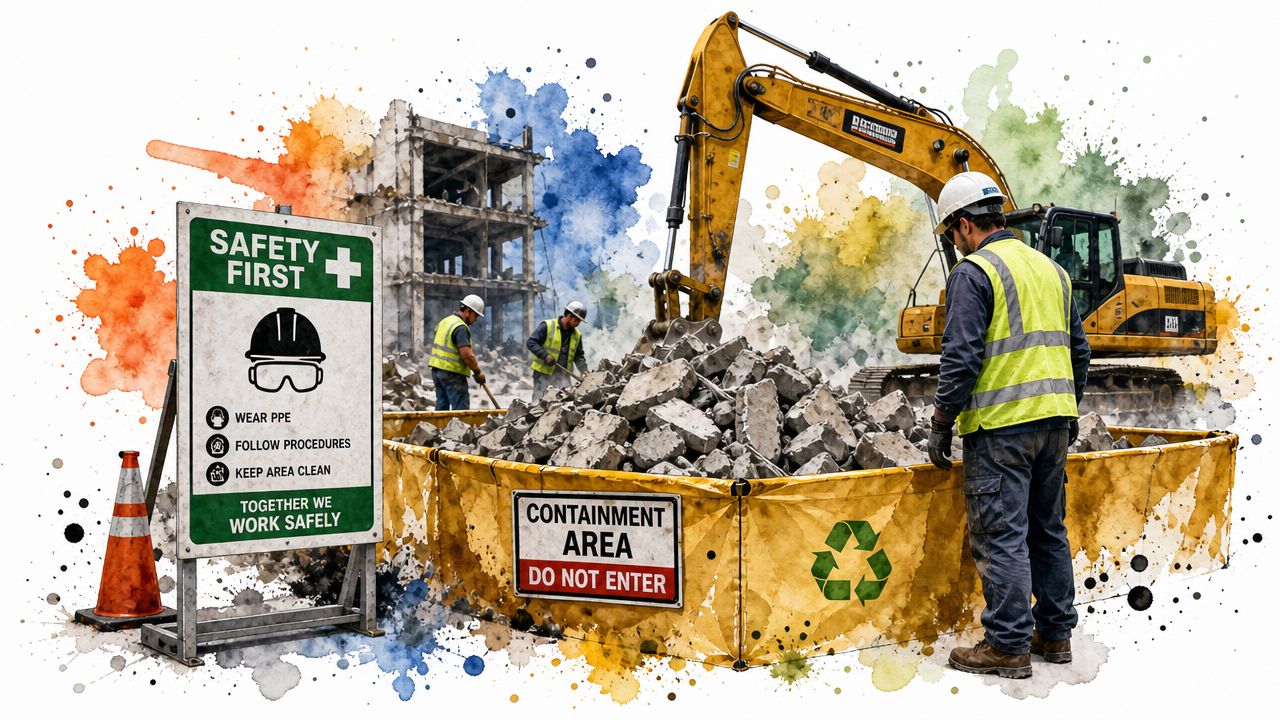
If debris is scattered, rebar is tangled, and washout is running where it wants, the haul will be slower, dirtier, and riskier. If the site is laid out right, loading goes faster and cleanup stays under control. That's why site prep isn't just housekeeping. It's production and compliance.
Break it down the right way
The breakup method should match the concrete, not the other way around.
For thinner sections, manual breakup may be workable. For heavier slabs, reinforced sections, or larger tear-outs, use the right breaker, excavator attachment, or jackhammer from the start. Oversized chunks slow every stage after demolition. They're harder to lift, awkward to stack, and rough on equipment.
A clean breakup plan usually includes:
- Controlled chunk size: Pieces need to be manageable for the loading method you chose.
- Rebar separation: Cut exposed steel before it turns the pile into a hooked mess.
- Staging area: Keep broken concrete in one dedicated zone, not spread across traffic paths.
- Clear crew roles: One team breaks, one team cleans, one operator loads. Mixed responsibility usually means mixed debris.
Washout containment is not optional
At this stage, too many jobs get sloppy.
Concrete washout water and slurry can't be treated like ordinary site runoff. If crews rinse chutes, tools, or pump gear onto bare ground or near storm drains, you're creating a compliance problem and contaminating material that might otherwise have had a cleaner disposal path.
According to Tom Kraemer Inc.’s washout guidance, washout containers must be leak-proof and placed away from drainage paths, and when a container reaches 75% capacity, the liquid needs to be removed to prevent overflow. That same guidance notes environmental fines can exceed $25,000.
Keep the washout area close enough that crews will actually use it, but far enough from drainage paths and stockpiled material that one mistake doesn't spread across the site.
That's the practical balance.
What a compliant setup looks like
A workable washout setup usually has these traits:
- Leak-proof containment: Steel pans or purpose-built containers hold slurry where it belongs.
- Smart placement: Away from inlets, runoff paths, and loader traffic.
- Visible marking: Drivers and laborers can find it without asking.
- Capacity management: Someone owns the task of checking levels before rain or heavy use.
- Closeout plan: Hardened solids get removed properly instead of being left to become tomorrow's problem.
Safety mistakes that slow the whole job
A lot of “safety issues” are really planning issues in disguise.
Leaving thick slabs unbroken creates unstable lifting situations. Letting rebar stay tangled in the pile makes loading more dangerous. Washing tools near haul paths creates slick surfaces and slurry tracking. And if you place your containment where trucks or machines have to work around it all day, someone will eventually hit it.
The safest sites usually look boring. Material is separated. The haul route is obvious. The washout location is fixed. Nobody improvises under pressure.
Choosing Your Loading and Transport Strategy
Once the concrete is broken and staged, the question changes. It's no longer “How do we demo this?” It becomes “How do we move it without burning time and labor?”
That answer depends on three things. Load size, site access, and crew capacity. Use too little equipment and the job drags. Use too much and you pay for iron that sits.
Manual loading versus machine loading
For very small jobs, manual loading still has a place. A few chunks, a short carry path, and easy truck access can justify wheelbarrows and labor. But once the pile gets serious, manpower alone starts losing money.
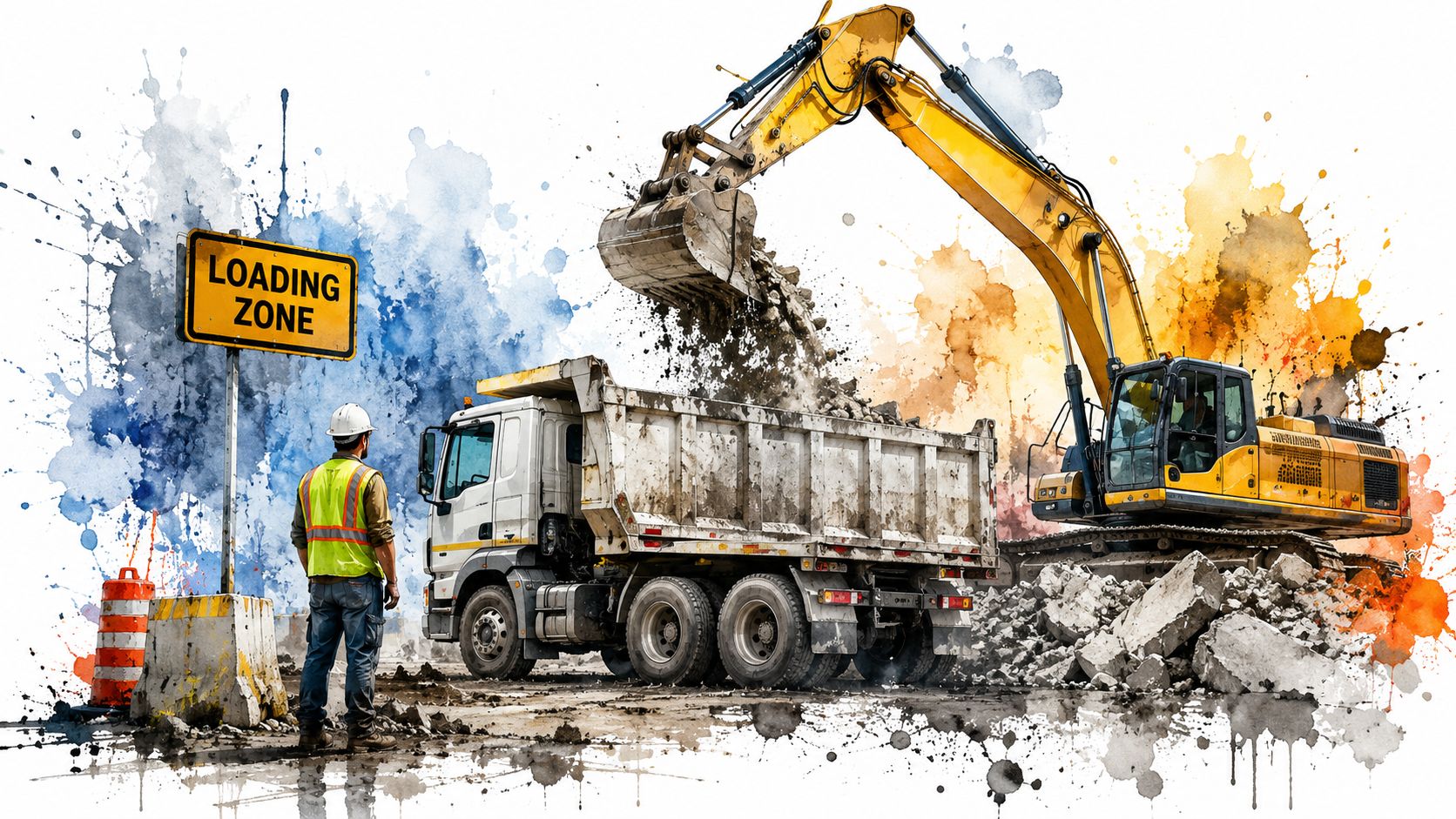
Machine loading changes the pace of the job. A skid-steer can clean up moderate piles well. A mini-excavator or larger excavator makes more sense for reinforced debris, deeper tear-outs, or when trucks need to be turned fast.
Here's a simple field comparison:
| Loading method | Best fit | Main downside |
|---|---|---|
| Wheelbarrow and hand loading | Small residential cleanup | Slow, hard on labor |
| Skid-steer | Medium piles with decent access | Needs room to work and turn |
| Mini-excavator | Tight sites with heavier pieces | May need support equipment |
| Full-size excavator | Large demolition or thick reinforced concrete | Overkill on small sites |
Match the transport method to the site
Transport is where many contractors oversimplify. The cheapest rate on paper may be the worst fit operationally.
A roll-off can work if the site has room and the crew can self-load steadily. A dedicated hauling service makes more sense if timing matters and you don't want the crew tied up loading by hand. Self-haul works when you've got the truck, the route, and a disposal target that fits the material.
If your crew spends half a day waiting on transport, you didn't save money. You moved the cost from the invoice to payroll.
A practical decision frame
Choose the hauling setup based on what the job needs most:
- Need schedule control: Use a hauling service that can turn trucks when the pile is ready.
- Need lower direct spend on a small job: Self-haul can work if your truck and labor are already available.
- Need simple staging: A roll-off keeps the material in one place, but only if the access and weight limits make sense.
- Need fewer touch points: Machine-load directly into trucks when possible. Every extra handling step costs time.
A strong loading plan keeps material moving one direction. Break, stage, load, and leave. Once concrete starts getting shuffled around the site more than once, the operation is already slipping.
Recycling vs Landfill The Disposal Decision
Where the load goes matters almost as much as how you move it.
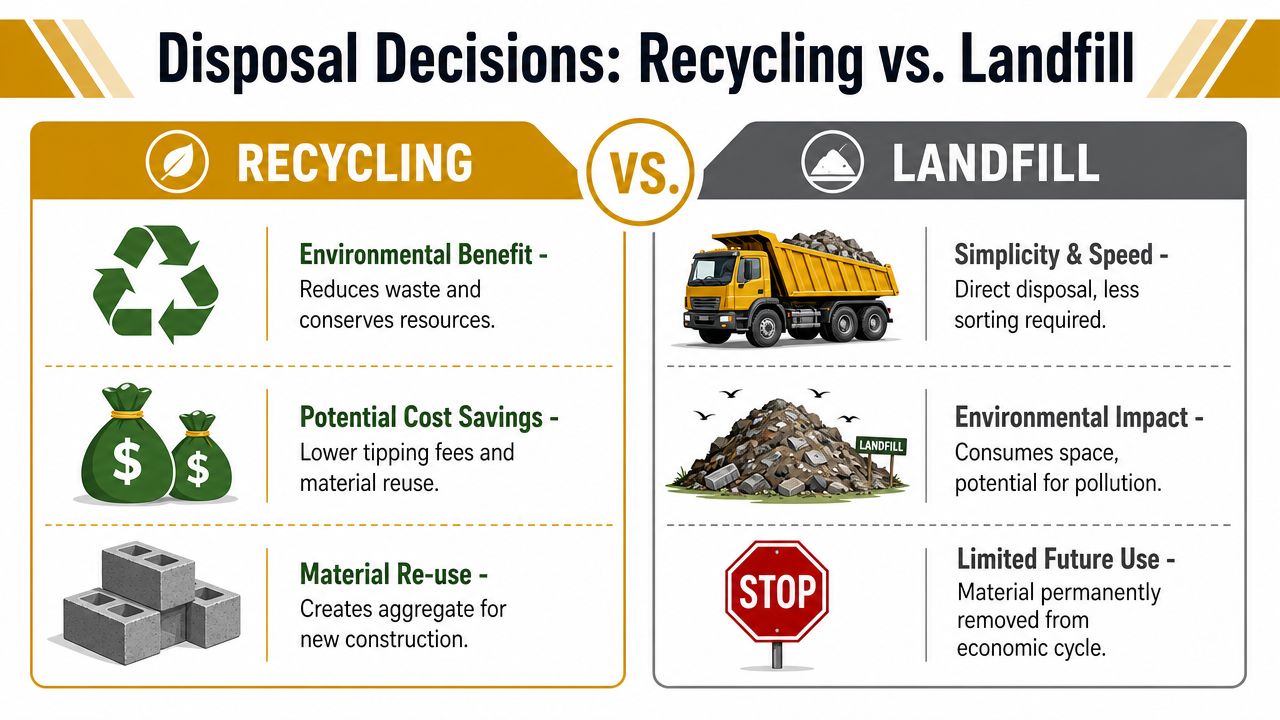
A lot of contractors still treat disposal as a last-minute call. That's a mistake. The destination affects sorting standards, hauling rhythm, site cleanliness, and total cost. If you want haul off concrete to run like a professional operation, you decide the outlet while the material is still being generated.
Why recycling keeps gaining ground
Concrete is already a major recycling stream. The global concrete recycling industry processes over 140 million tons annually, and in the U.S. construction and demolition debris makes up nearly a quarter of the national waste stream, according to Junk King's summary of construction waste and concrete debris data.
That matters on the ground because old concrete can become usable aggregate instead of dead weight in a landfill. For contractors, that can mean a more useful outlet for clean material and a cleaner story for owners who care about waste handling.
What qualifies as recyclable concrete
Recycling works best when the load is entirely clean.
That usually means broken concrete separated from obvious contaminants. Some facilities can handle attached rebar better than others, but dirt, trash, wood, plastic, and slurry-covered debris can quickly push a load out of the recycling stream and into a less favorable disposal path.
A useful field rule is this:
- Clean concrete: Broken slab, curb, wall, or footing concrete kept separate.
- Questionable concrete: Material with noticeable dirt, mixed debris, or uncontrolled washout residue.
- Bad recycling candidate: Concrete blended into general demolition waste.
The recycler can process concrete. They can't fix a load that the site contaminated all day long.
When landfill still makes sense
Landfill isn't always the wrong choice. Sometimes it's the practical one.
If the load is mixed, the site is too tight for proper separation, or the concrete is contaminated beyond what the local recycler will accept, direct disposal may be the cleaner operational move. It's often simpler. It may also require less sorting under schedule pressure.
But simple doesn't always mean cheaper in the full job-cost sense. If you skip separation too early, you may pay for easier loading with a worse disposal route later.
The best disposal decision is the one that matches the material you actually have, not the material you wish you had.
A side-by-side view
| Decision point | Recycling | Landfill |
|---|---|---|
| Clean material required | Usually yes | Less strict |
| Sorting effort on site | Higher | Lower |
| Material stays in economic use | Yes | No |
| Good fit for mixed debris | Usually no | Often yes |
| Environmental position | Stronger | Weaker |
The mistake is forcing one route onto every job. The better move is to protect your clean concrete when that path is realistic, and avoid pretending a mixed pile will somehow sort itself out at the end.
Estimating Costs and Streamlining Final Logistics
Good field habits finally become apparent in the budget.
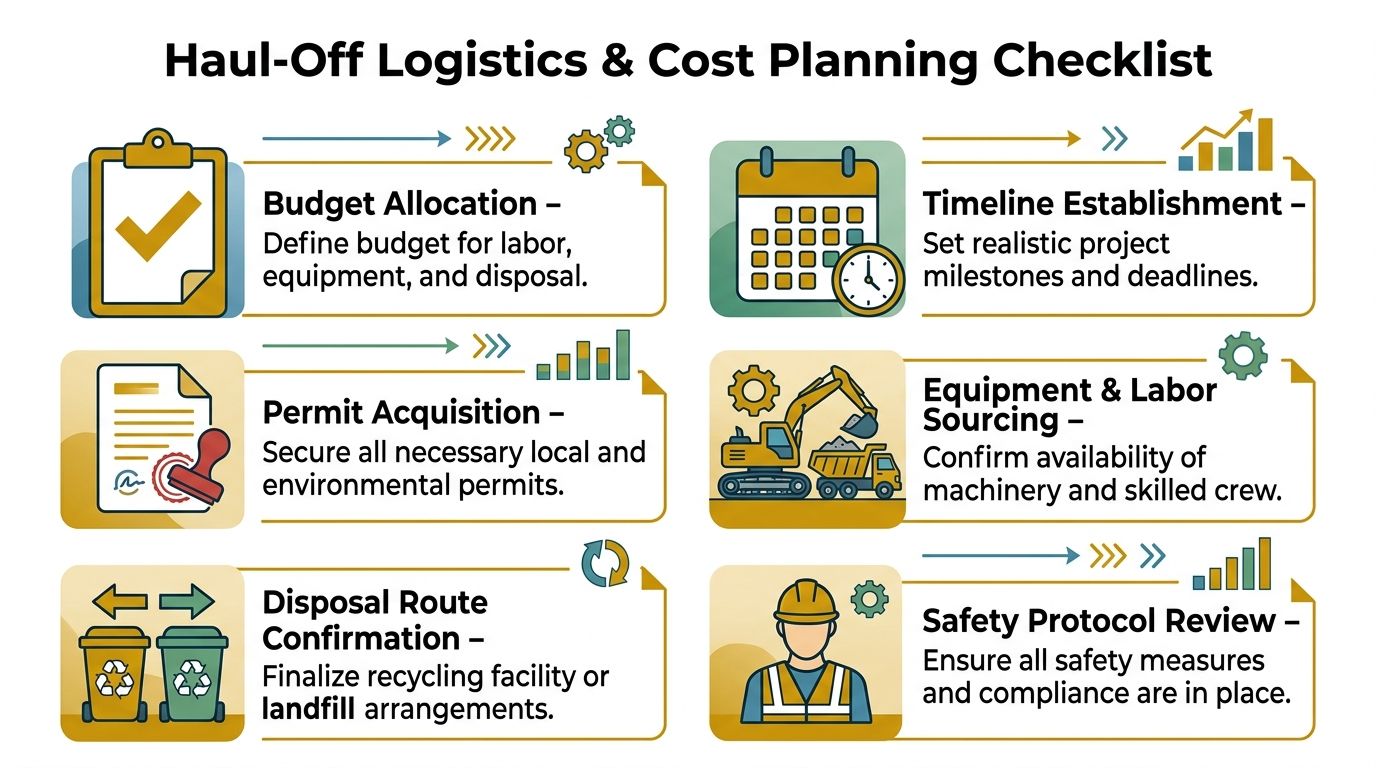
A concrete haul-off estimate should never be just “truck plus dump fee.” That's how jobs get underbid. The full cost sits across labor, breakup, loading, transport, containment, disposal, and the extra time created by bad sequencing. If you want the job to close profitably, every one of those moving parts needs a line in the plan.
Build the estimate in layers
A reliable estimate usually starts with these categories:
- Breaking and processing: Labor, breakers, saws, and time spent cutting reinforcement.
- Loading cost: Hand loading, skid-steer time, excavator time, or subcontracted loading.
- Transport: Roll-off rental, trucking, or self-haul costs including time out of production.
- Disposal: Recycling facility or landfill charges based on the load type.
- Site compliance: Washout containment, cleanup, and closeout handling.
A lot of contractors only focus on the visible invoice items. The hidden cost is delay. If the crew stands around waiting on a truck, or a truck sits while labor sorts a dirty pile, your estimate is already leaking money.
Watch the clean versus mixed concrete trap
This is one of the most missed pricing details in concrete haul-off.
In markets like Los Angeles, specialized facilities may charge 20% to 40% more per ton for clean concrete, according to Easy Waste Management's Los Angeles concrete disposal guide. That surprises people because they assume “clean” automatically means “cheaper.”
Sometimes it can work in your favor operationally. Sometimes it doesn't. The point is that you need to price the actual outlet, not a generic idea of disposal. If you promise a client one disposal number and later learn the load must go to a specialized concrete facility with different pricing, you've created your own change order problem.
Keep the schedule tied to the haul plan
A good haul-off plan doesn't emerge as a final stage activity. It's built into production.
Use a short logistics checklist before demolition starts:
- Confirm equipment dates: Make sure the breaker, skid-steer, excavator, or truck will be there when needed.
- Lock in the disposal route: Don't send the first load out while still deciding where the second load goes.
- Sequence labor correctly: Have one crew finish breakup before another crew gets trapped waiting to load.
- Protect the pile: Keep clean concrete separate from mixed debris and away from washout areas.
- Plan for weather: Rain changes access, stockpile conditions, and container capacity fast.
What streamlining really looks like
The smoothest jobs usually share a few habits:
| Habit | Why it works |
|---|---|
| Pre-call disposal sites | Fewer rejected or delayed loads |
| Separate clean concrete early | More route options later |
| Cut rebar before loading | Faster truck turns and safer handling |
| Assign one person to haul coordination | Less confusion between crew, hauler, and facility |
| Close out washout promptly | Cleaner site and fewer end-of-job surprises |
Concrete haul-off gets expensive when it becomes reactive. It gets efficient when the final truck movement is already built into the demolition plan, the compliance plan, and the budget.
If you run it that way, the pile at the end of the job stops being a problem. It becomes just another phase you already accounted for.
If your crew needs a dependable way to manage washout while keeping the site cleaner and more compliant, Reborn Rentals is worth a look. They focus on concrete washout containment rentals for active jobs, with clear pricing, delivery coordination, and equipment built for real construction use. For contractors who want fewer surprises around slurry control and closeout, that kind of straightforward rental process helps keep haul-off and site compliance from colliding.

