
Stormwater Compliance Solutions for Construction Sites
Monday starts with a pour, a pump, and a superintendent trying to keep three things true at once, the work stays on schedule, the site stays clean, and nobody has to explain a concrete slurry streak running toward the nearest inlet. That's where stormwater compliance solutions stop being a paperwork phrase and start being an operating system for the jobsite. The crews who stay out of trouble don't treat washout as an afterthought, they treat it like any other controlled work item, with a permit basis, a plan, controls, checks, and records.
The Monday Morning Compliance Picture
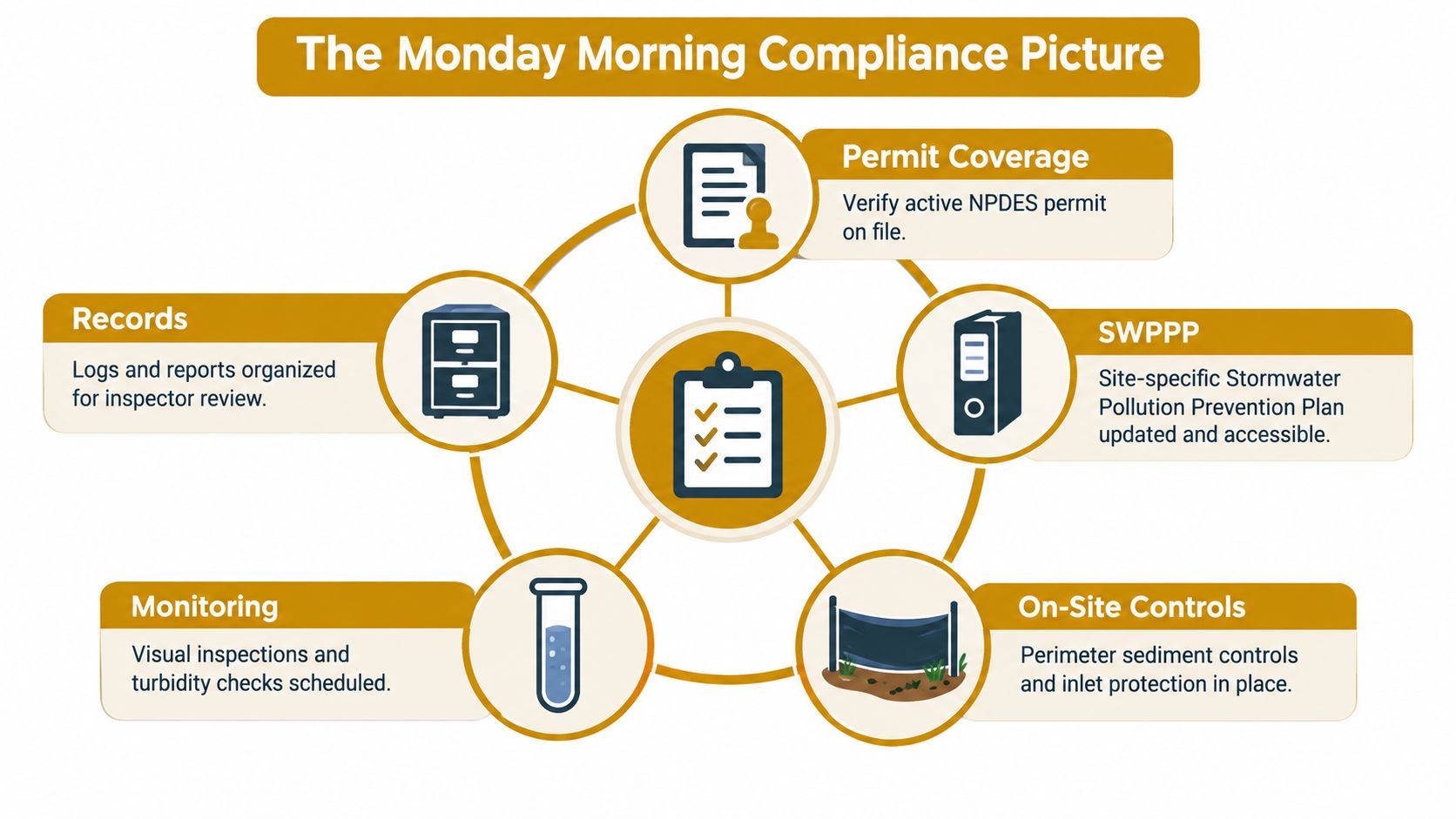
A clean Monday jobsite usually has one person looking at the pour and another person looking at the weather. Both matter, because stormwater compliance isn't one item, it's a connected set of decisions that only works when every piece is visible. The five pieces are permit coverage, a site-specific SWPPP, on-site controls, monitoring, and records.
What the superintendent should see first
Permit coverage tells you whether the project is inside the regulated stormwater framework. EPA guidance generally treats projects disturbing 1 acre or more as needing permit coverage, including smaller pieces that are part of a larger common plan that will ultimately disturb at least 1 acre (EPA construction permit guidance). The SWPPP then translates that permit basis into the actual site layout, the washout location, the drain protections, the inspection cadence, and the response steps.
On-site controls are the physical measures crews touch every day. That includes erosion control, sediment control, inlet protection, material storage, and washout containment. Monitoring is the habit of checking whether those controls still work after traffic, rain, and trade stacking. Records are the proof, the photos, logs, corrective actions, and disposal notes that show the control was present and operating, not just ordered and forgotten.
Practical rule: if a control isn't in the plan, isn't in the field, and isn't in the log, it's hard to defend during an inspection.
A one-paragraph map for a new foreman
Tell a new foreman to start every pour day by checking whether the project has active coverage, then open the SWPPP and confirm where washout belongs. After that, walk the inlet protection, the perimeter controls, and the washout container, then decide whether rain, capacity, or site movement means a correction before work continues. If the control is in place but nobody documented it, the job still has a compliance gap.
How Stormwater Rules Got Where They Are
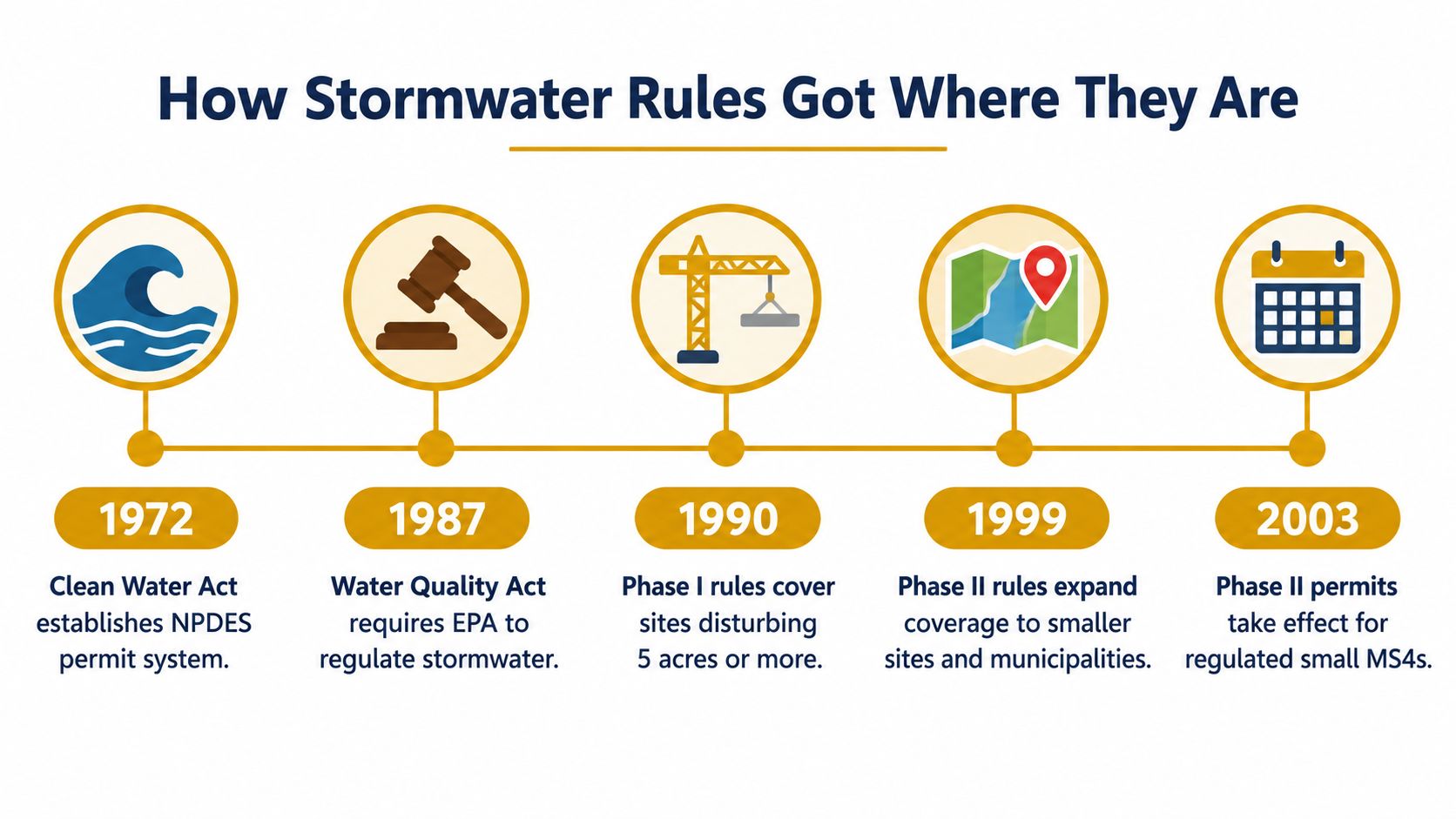
A superintendent does not inherit stormwater rules all at once. The framework grew in layers under the Clean Water Act's NPDES system, and that history is why acreage thresholds, SWPPPs, inspections, and corrective actions still shape daily work. EPA first set Phase I rules in 1990 for construction disturbing 5 acres or more, then finalized Phase II on December 8, 1999, bringing smaller sites disturbing 1 to 5 acres and small MS4s in urbanized areas into coverage. Many Phase II applications were due by March 10, 2003 (EPA permit history).
Why the 1-acre threshold keeps showing up
The timeline explains why crews still start with a land-disturbance check. Determine the threshold, confirm permit coverage, prepare the SWPPP, install erosion and sediment controls, then inspect often enough to catch problems before runoff leaves the site. EPA guidance also treats some smaller pieces of work as regulated when they are part of a larger common development plan that will ultimately disturb at least 1 acre.
A renovation can look too small to trigger concern and still sit inside a regulated plan. A phased development can appear under the line at first, then become covered once the larger common plan is clear. Acreage is the first screen, not the final answer.
The size of the current phase does not always tell you the size of the compliance obligation.
What this means on an active site
A superintendent has to read the work in permit terms, not just production terms. If the project is large enough, the permit path is straightforward. If the project is smaller but part of a bigger plan, the same logic can still apply. On an active site, that history becomes a checklist item before mobilization, confirm whether the lot stands alone or is one phase of a larger common plan, because the Phase II rule is what pulled 1-to-5-acre sites into the permit system.
Why Stormwater Pollution Is a Watershed Problem
The reason crews get asked to manage dirty water so carefully is simple, runoff leaves a site fast and it doesn't leave clean. A National Academies assessment reported that urban runoff was associated with approximately 38,114 miles of impaired rivers and streams, 948,420 acres of impaired lakes, and 2,742 square miles of impaired bays and estuaries, and that urban stormwater was the primary source of impairment for 13% of rivers, 18% of lakes, and 32% of estuaries in the cited national assessment (National Academies assessment).
What leaves a jobsite is more than mud
That scale helps explain why the obvious stuff matters. Exposed soil turns into sediment. Concrete washout can create highly alkaline wastewater. Fuel, trash, and fine debris can all move through drainage pathways if crews leave them in the open. The issue isn't only what people can see on the slab edge, it's what moves through inlets, ditches, and surface flow once rain or washwater gets involved.
For a superintendent, that means stormwater control is a source-control problem. The site has to keep pollutants from becoming mobile in the first place. If the pollutant can't leave the pad, it can't reach the inlet.
The pollutants crews should watch on pour day
- Sediment: loose soil from grading, tracking, stockpiles, and disturbed edges.
- Concrete slurry: wash water and residue from chutes, pumps, tools, and wheel cleaning.
- Fuel and oils: leaks, drips, and refueling mistakes near drainage paths.
- Trash and packaging: plastic, ties, paper, and scrap that wash easily when wind and water combine.
Concrete washout deserves special attention because it can create both visual mess and water-quality problems. When rinse water gets into soil or stormwater conveyances, the compliance issue can move from housekeeping to pollution control very quickly.
On-Site Controls That Hold Up Under Inspection
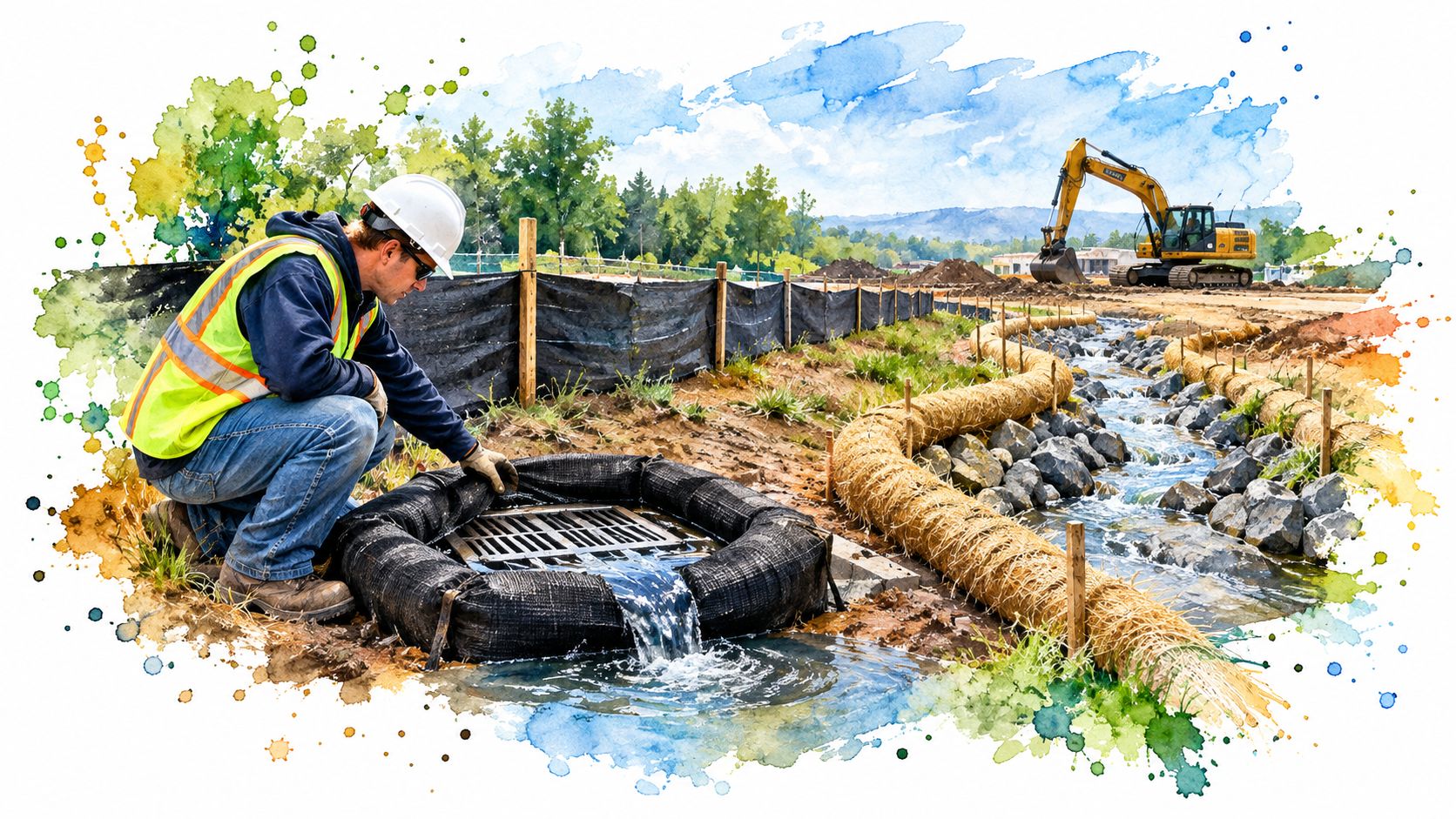
A site rarely fails because the crew lacked a plan. It fails when the controls were placed badly, left unmaintained, or never explained clearly to the people doing the work. The practical toolkit includes perimeter sediment controls, inlet protection, stabilized entrances, covered or contained material storage, and concrete washout containment.
The controls crews need to see and use
Perimeter controls slow sediment before it leaves the site. Inlet protection keeps the storm drain from becoming the first stop for mud and debris. Stabilized entrances reduce tracking, which matters because one muddy haul route can undo careful grading in a day. Material storage needs cover, containment, or both when wind and rain can move fines.
Concrete washout deserves special attention because EPA's construction stormwater requirements specifically identify concrete-truck washout as a prohibited discharge unless it is managed by an appropriate control (EPA construction stormwater requirements). That makes washout a containment task, not a convenience issue. The container belongs on stable ground, away from storm drains and surface waters, and it should be sized for the project's maximum simultaneous washout volume.
A field-ready washout workflow
A washout setup starts before the first truck arrives. Place the pan or container where drivers can reach it without cutting across an inlet area, and write the location, the responsible inspector, the maintenance trigger, and the disposal method into the SWPPP. Treat it like any other control that crews have to find, use, and verify.
Daily inspection keeps the setup from drifting out of compliance. Check it after heavy rain, lower liquid levels or cover it before storms, and act once the container reaches 75% capacity, since that is the point where the margin for safe use starts disappearing. A washout pan that looks fine on paper can still fail if the driver was never shown where it sits or if it was parked in the wrong place.
A sizing example a superintendent can use
A smaller rental pan, such as a 72' x 72' x 14' unit, fits typical chute washout and lighter small-pump use. A 72' x 72' x 24' unit suits heavier pump volumes and more frequent pours. The right choice depends on how many trucks, pumps, and cleanup cycles will hit the same container before disposal.
That is the point of rental washout solutions. They let the site match container size to the work instead of treating washout like a one-size-fits-all purchase.
Federal vs Local Rules and the Sub-Acre Decision
A superintendent on a small job can still get pulled into stormwater compliance. The common question is whether a project under an acre needs a washout setup at all. The answer depends on more than acreage. Federal construction-stormwater coverage generally applies when a project disturbs at least 1 acre and stormwater may leave the site, and EPA's BMP framework shows how MS4 programs can also handle ordinances, plan review, inspections, public complaints, and enforcement, so smaller projects can still have local obligations (EPA BMP framework).
A decision tree for the sub-acre question
| Project Profile | Federal NPDES Likely? | Local Controls Likely? | Recommended Washout Action |
|---|---|---|---|
| Disturbs 1 acre or more, stormwater leaves site | Yes | Yes | Install washout containment, document in SWPPP, inspect daily |
| Under 1 acre, but part of a larger common plan | Possibly yes | Yes | Check permit coverage and treat washout as controlled waste |
| Under 1 acre, near storm drains or drainage swales | Maybe not federally, but local rules may apply | Likely yes | Ask the authority having jurisdiction before mobilizing |
| Small renovation with no clear runoff path | Maybe not federally | Possibly yes | Confirm local rules, keep a contained washout option ready |
What to check before the first truck arrives
The acreage test is only the first gate. The next questions are who has jurisdiction, whether stormwater can leave the property, and whether the local MS4 or municipality has construction-site requirements that reach beyond the federal threshold. EPA's framework makes it clear that local programs can regulate plan review, inspections, complaints, and enforcement even when a project looks small.
If the project sits near the line, call the local reviewer before the washout pan shows up. That call is easier to handle than moving a full container after the pour has already started.
Monitoring and Documentation Workflows
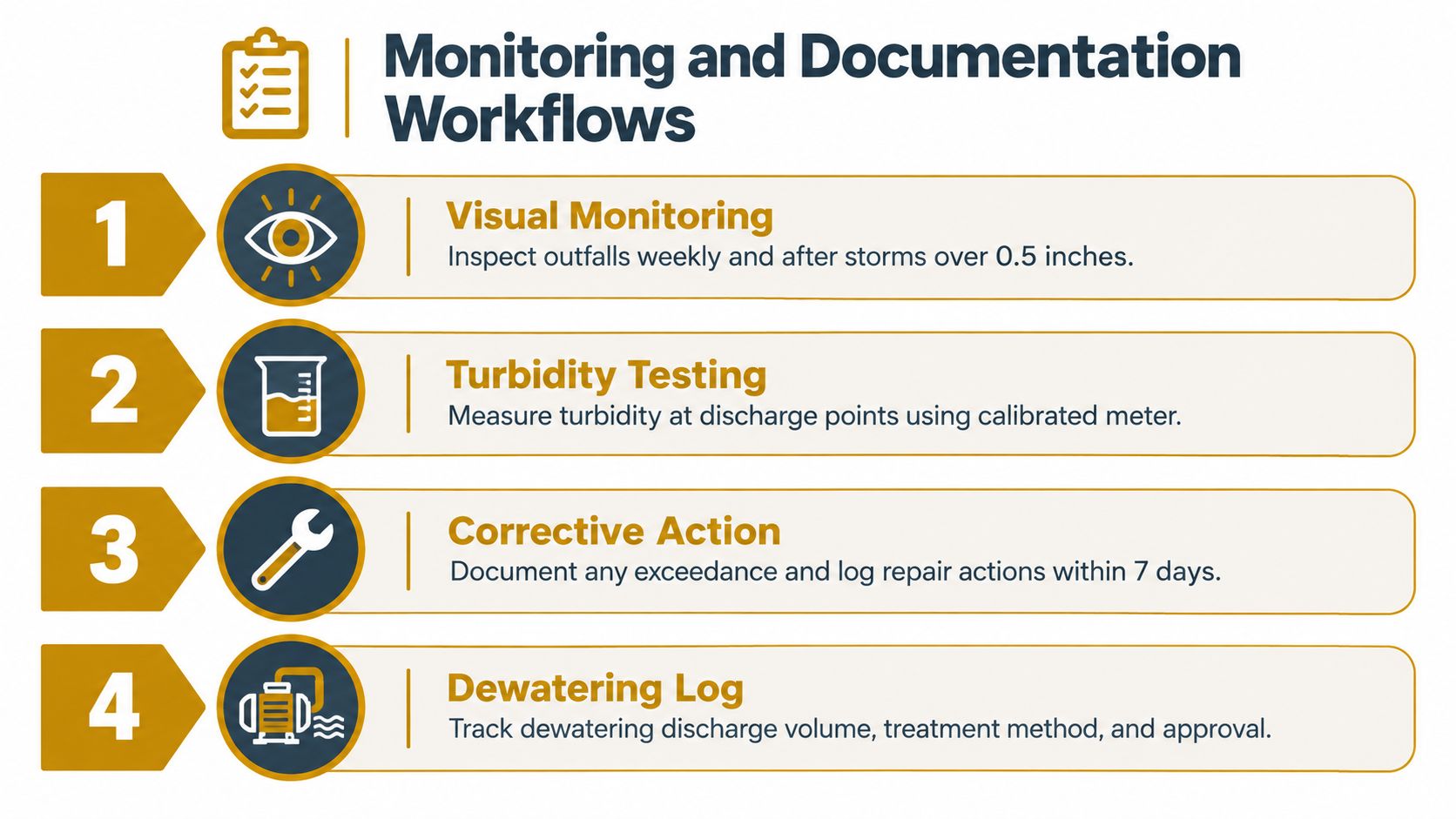
A clean-looking site can still have a weak compliance record if nobody writes down what happened. That's why the SWPPP needs to operate like a field log, not a binder that stays in the truck. EPA guidance requires turbidity benchmark monitoring for dewatering discharges to sensitive receiving waters, with sampling at each discharge point on each day a discharge occurs, and one state implementation guide illustrates an initial sample within 30 minutes of starting discharge and continued sampling at least weekly while dewatering continues, using a meter reporting nephelometric turbidity units (NTU) and an EPA-approved method such as Method 180.1 (EPA dewatering guidance).
The daily sheet that keeps the site defensible
A superintendent doesn't need a fancy system to stay organized, just a repeatable one. The daily inspection sheet should include date, weather, pan level, driver count, photo numbers, and corrective action. If rain is in the forecast, add a pre-storm check for cover status and liquid level. After the storm, note whether the control held, whether capacity changed, and whether a cleanup or disposal call is needed.
That same sheet should also capture dewatering basics when they apply, discharge point identification, test results, and the equipment or treatment method used. Photos matter because they show where the control sat, what it looked like before and after, and whether a corrective action happened.
What to log when something changes
- Before the pour: confirm the washout location, inspect the liner or container, and brief the driver.
- During the shift: check the fill level and watch for splash, overflow, or misplaced rinse water.
- After rain: document whether the facility stayed covered or needed a reset.
- After disposal: record where the waste went and whether hardened material was removed.
Keep the log simple enough that the person holding a clipboard can finish it without guessing.
The big idea is straightforward. A control that isn't documented might as well not exist when the inspector asks how you know it was operating.
Putting Rental Washout Solutions to Work
The rental decision gets easy once the compliance workflow is clear. The container is only one part of the system, but it's a useful part because it gives the crew a defined place for slurry, a defined trigger for maintenance, and a defined item to inspect against the SWPPP. Reborn Rentals offers a three-step checkout flow, Cart, Details, Checkout, with upfront daily pricing starting at $25/day and clear notes on possible delivery, rough-terrain, and express surcharges.
Matching the container to the control plan
The two common pan sizes line up with different washout loads. The 72' x 72' x 14' unit is suited to typical chute and lighter pump washout, while the 72' x 72' x 24' option is built for heavier pump work and more frequent pours, with a listed capacity of approximately 18.25 tons and ~441 gallons. The smaller unit is listed at ~310 gallons. In practice, the right choice depends on the SWPPP's washout location, the expected truck count, and how quickly the site will reach the 75% capacity inspection trigger.
The checkout and support details crews actually use
Reborn Rentals also gives crews multiple ways to confirm availability and specs fast, including Messenger, WhatsApp, email, QR contact sharing, and scheduled callbacks. That matters on a live job because the washout setup has to be ordered, placed, inspected, and documented before the concrete trucks start cycling. A rental container solves the containment piece, but the superintendent still has to keep the daily log, the rain-event checks, and the disposal record current.
A good day-one checklist is short. Verify the permit basis, open the SWPPP, place the washout where trucks can reach it, brief the drivers, inspect the fill level during the shift, and document every correction.
If you need a washout setup that fits the way your crew works, visit Reborn Rentals to review container options, delivery timing, and support contacts. Use the rental as part of the compliance workflow, not as a substitute for it, and keep your daily inspections and records ready from the first pour.

