
Impact Cases and Containers for Construction Sites
A Tuesday morning slab pour can go sideways before the first truck leaves the gate. A chute rinse hits the sidewalk grate, cloudy water runs toward the storm inlet, and an inspector arrives before the concrete has cured. The crew stops pouring, trucks idle, the superintendent starts calling for a vacuum truck, and someone nearby is already photographing the runoff.
That scene repeats itself when washout containment gets treated as an afterthought. The problem isn't only the visible spill. It's the improvised berm that leaks overnight, the tarp that tears during a storm, the container that fills before the last truck returns, and the SWPPP record that doesn't match what happened in the field. This guide is for the foreman who has to make the washout decision before the pour, not for the office team writing a generic note that says “provide washout area.”
The Washout Problem Every Contractor Knows Too Well
Concrete washwater is a process waste, not harmless rinse water. It can exceed pH 12 and may contain metals including chromium, vanadium, and barium, so uncontrolled discharge creates a high-alkalinity pollution risk for soil, waterways, and groundwater. The U.S. EPA concrete washout guidance treats containment as a formal stormwater best management practice, not a housekeeping preference.
On a busy pour, the failure usually starts with a small decision. A driver needs to rinse a chute, the designated area is too far away, and a laborer points toward a curb corner protected by a scrap of lumber and a torn tarp. The first rinse appears manageable. The next truck adds slurry, rain adds volume, and the edge of the improvised area becomes the lowest point on the site.
Field rule: If a truck can't reach the washout point without crossing active traffic or backing through finished work, the location is wrong before the pour begins.
The compliance exposure is practical. EPA guidance says washout should stay out of storm drains, streets, gutters, and uncontained areas, and it shouldn't be sent to a sanitary sewer without written permission. The EPA SWPPP guide also connects containment with inspection and recordkeeping, including inspections after qualifying rain events where the project's permit requires them.
A dedicated container gives the crew one controlled destination for chute rinses, pump cleanout, solids, and precipitation. It also gives the inspector something straightforward to evaluate: a visible, leak-tight system, placed deliberately, monitored during use, and supported by records. The container won't fix poor planning, but it removes one of the most avoidable sources of stop-work risk.
What Impact Cases and Containers Actually Are
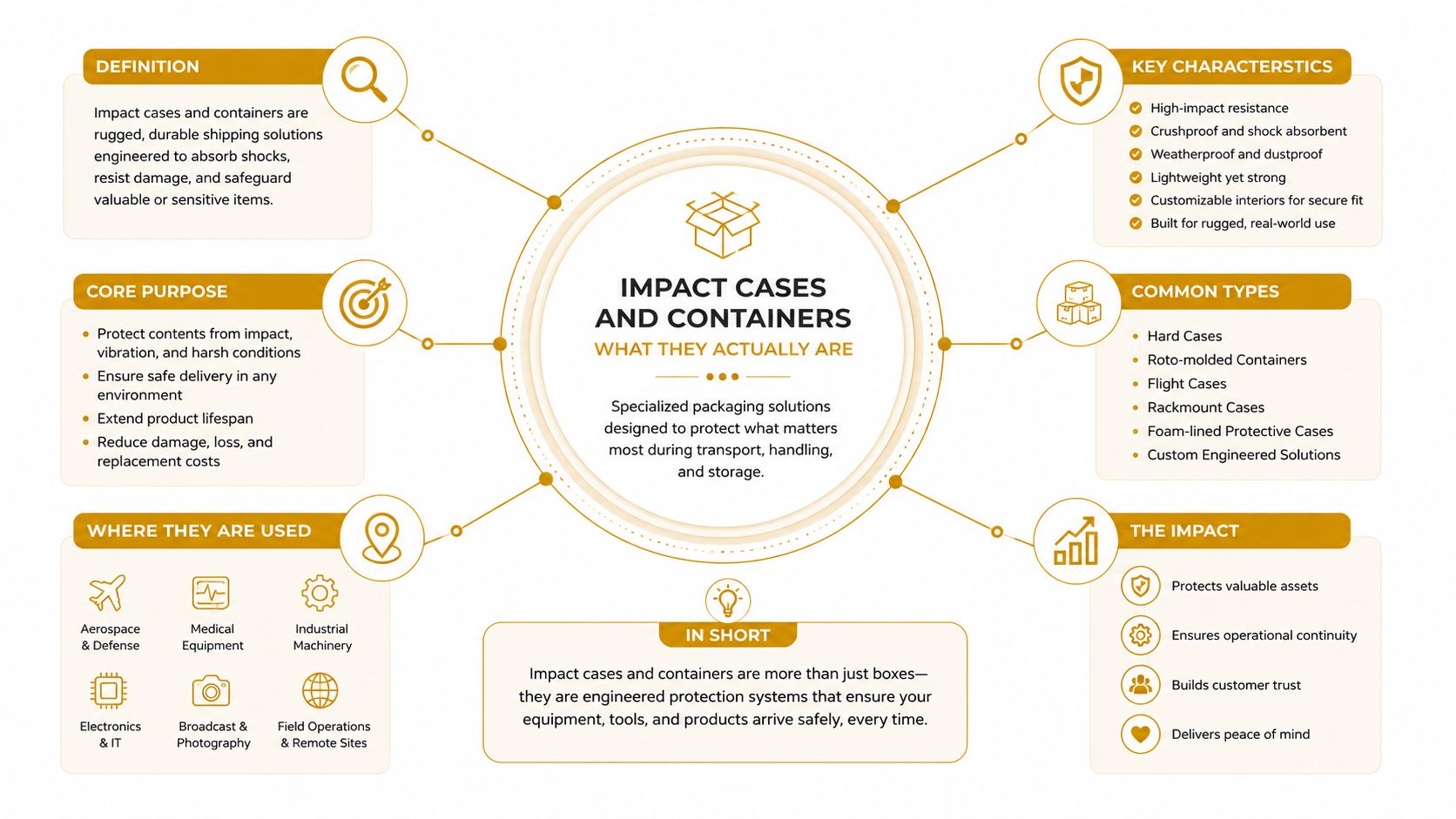
Impact cases and containers are reinforced, leak-tight receptacles used beneath concrete chutes, pump hoses, and mixer cleanout points. Their job is to retain cement slurry, aggregate fines, washwater, and hardened solids so those materials don't reach soil, surface water, groundwater, curbs, or storm infrastructure.
“Case” usually describes a compact, rigid unit that can be shipped, stacked, moved with site equipment, and positioned close to a work area. “Container” is the broader category. It can include rigid pans, lined pits, larger tubs, skips, and roll-off style receptacles. The label matters less than the control functions: impermeable containment, adequate capacity, stable placement, usable access, and a manageable removal plan.
The environmental target behind the equipment
The EPA target is direct. 100% of collected washout water and solids should be recycled, while the system must prevent caustic material from reaching soil, surface water, or groundwater. That makes the container part of the site's stormwater control system, alongside inlet protection, stabilized entrances, and other BMPs.
State and local requirements can add operational detail. Iowa DOT requires containment on projects where washwater will be generated and places washout systems at least 50 feet from storm sewer intakes, open ditches, and waterbodies, as described in the EPA concrete washout reference. Minnesota guidance calls for leak-proof containers or pits that can't contact the ground and recommends covers to prevent rainfall overflow.
The practical specification follows from those rules:
- Leak resistance: The base and sides need to hold liquid and wet solids without seepage.
- Freeboard: Leave usable space below the rim for rain and additional truck returns.
- Mobility: Fork pockets, lifting points, or suitable handling geometry matter when the container must be repositioned.
- Load control: Hardened concrete is heavy, so the container and its support surface need to suit the anticipated solids load.
- Local compatibility: The project permit, SWPPP, DOT specification, and municipal ordinance can impose requirements beyond a general EPA BMP.
A product sheet tells you what a unit can hold. The permit tells you what the project must control. You need both before ordering.
The Main Container Formats and How They Compare
Crews generally choose among four practical formats. The right one depends on the pour pattern, access, expected returns, weather exposure, and how the site will remove hardened material.
| Container Format | Best Use Case | Typical Capacity | Setup Time | Haul-Off Method |
|---|---|---|---|---|
| Rigid steel pan | Tight chute rinses and smaller slab work | Match to the pour and truck return schedule | Fast placement | Empty, clean, or remove hardened solids according to the rental plan |
| Lined pit container | High-volume pumping and repeated cleanout | Site-specific liquid, solids, and rainfall capacity | Moderate, requires stable setup and liner control | Vacuum service, liner handling, or approved solids removal |
| Single-use washout bag | Remote pads, bridge decks, and short pours | Match the manufacturer's rated volume and expected washout | Fast, with careful support and anchoring | Close, secure, and dispose of the filled bag through the approved waste route |
| Skip or roll-off tub | Multi-day foundations and larger recurring work | Larger volume for repeated truck activity | Requires delivery access and placement planning | Haul-off vehicle, cleaning, or solids management |
A rigid pan works when the washout point stays close to the chute and the crew can monitor it easily. It's simple to re-aim during a pour, but it can become the wrong choice when several trucks return repeatedly or heavy rain is likely.
A lined pit creates more working volume for pump operations, but the setup has more failure points. The liner must remain intact, edges need protection, and the pit must be positioned so stormwater can't flow into it or carry contents out of it. A liner isn't a substitute for capacity or freeboard.
Bags and biodegradable formats are useful where access is restricted or the work lasts only a short time. They reduce return logistics, but they demand disciplined support. A bag placed on sharp rock, an unprotected deck edge, or a sloped pad can fail even when the bag itself is sound. Demand for biodegradable and recyclable formats is part of the category's sustainability discussion, but disposal still depends on the material, contamination, and local requirements. A 2025 market report projects the concrete washout bag category at about $500 million in 2025 and a 6% CAGR through 2033, so treat those figures as market projections, not jobsite performance guarantees. (See the Minnesota concrete washout guidance for the broader containment and sustainability context.)
The common overspend is easy to spot. A roll-off for a small pump job adds unnecessary delivery and haul-off complexity. One small bag for a continuous footings pour creates the opposite problem, with early replacement, overflow exposure, and crew disruption.
Sizing and Siting a Container for a Real Pour
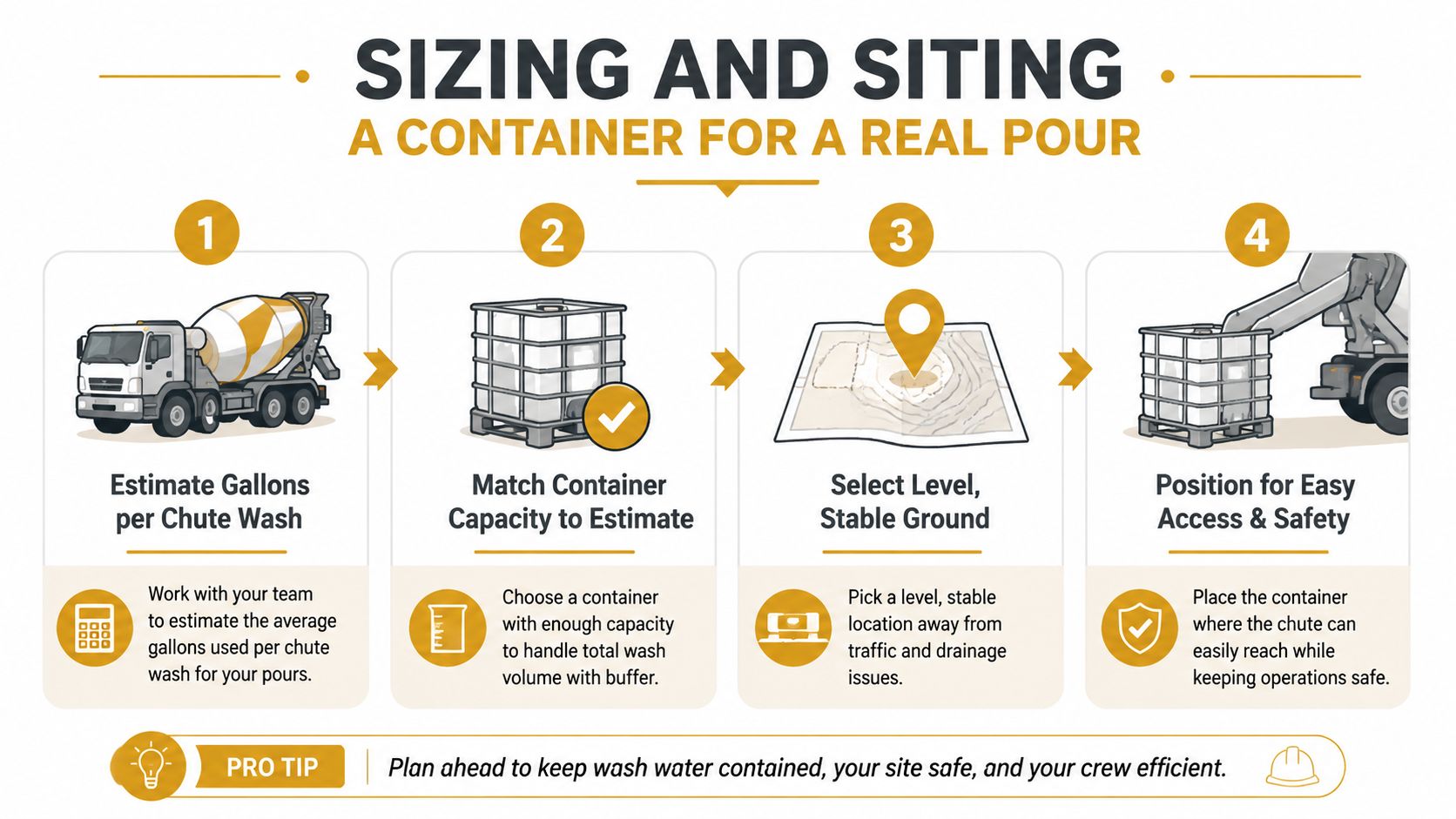
Start with the washout event, not the container footprint. Independent BMP guidance uses about 7 gallons per truck chute wash and 50 gallons per ready-mix or pump-truck hopper washout, with at least 12 inches of freeboard to handle rainfall and operational surges. Those planning values appear in the concrete washout container specification guidance.
Count the trucks, identify whether pump-hopper cleanout is expected, and then add room for solids and precipitation. A single sidewalk or small slab pour may need only a compact pan. A deck pour with frequent truck returns needs more reserve, and a multi-pour foundation may need a swap-out plan rather than one oversized unit.
A quick field sizing method
- Estimate washout volume. Use the expected number of chute and hopper washouts, not just the concrete yardage.
- Protect freeboard. Don't plan to use the container to its rim. The guidance calls for 12 inches of freeboard, and rainfall can consume that space before the next truck arrives.
- Plan for solids. Cement paste and aggregate fines reduce usable liquid volume as they settle. A container that looks adequate when empty may be marginal after repeated returns.
- Choose the handling method. Confirm whether the full unit will be swapped, vacuumed, cleaned, or hauled with hardened material inside.
The familiar 50-, 100-, and 250-gallon categories can help organize a rental conversation, but they aren't universal answers. The correct choice depends on truck count, hopper cleanout, rainfall, site sensitivity, and the project's permit conditions.
Place it for the crew and the inspector
Set the container on stable, level ground where the chute can reach without crossing a drain path. Keep it at least 50 feet from storm drains, drainage ditches, and waterbodies where the project guidance requires that setback. The container also needs enough clearance for truck swing, pump access, pedestrian separation, and pickup equipment.
England's Environment Agency uses a different capacity framework, requiring secure containment with 10% freeboard and limiting storage to a maximum of 30 m3 at a single site location. Delaware guidance specifies a built washout with dimensions of 6 feet by 6 feet by 3 feet deep, a 10-mil polyethylene liner, and 2:1 side slopes. Kentucky specifies at least 6 cubic feet of containment for every 10 cubic yards of concrete poured. These rules show why a generic “one container fits all” approach fails. (See the Environment Agency concrete water guidance.)
Economics of Renting Washout Equipment
A washout container's rate is only one line in the job cost. Price the full control: delivery, placement, rental duration, replacement, cleaning, haul-off, and the crew hours required to build or repair an improvised area. Those inputs affect both the bid and the site's stormwater compliance.
Reborn Rentals lists daily pricing starting at $25 per day on its website. The final charge can vary with equipment selection, delivery conditions, rough terrain, express service, and project timing, so use a current quote instead of an old flat allowance. Its catalog lists a 72-inch by 72-inch by 24-inch option with approximately 18.25 tons of load capacity and about 441 gallons of liquid capacity. It also lists a 72-inch by 72-inch by 14-inch option with about 310 gallons of capacity. Confirm the specifications before ordering. Freeboard and accumulated solids reduce usable working capacity.
| Container Type | Daily Rate | Weekly Rate | Common Surcharges |
|---|---|---|---|
| Rigid pan | Quoted by size and duration | Quoted by size and duration | Delivery distance, rough terrain, express requests |
| Lined pit or larger tub | Quoted by setup and capacity | Quoted by setup and capacity | Liner work, difficult placement, extended rental |
| Washout bag | Quoted by format and quantity | Quoted by project duration | Delivery, replacement, disposal, access limitations |
| Skip or roll-off tub | Quoted by container and haul-off plan | Quoted by container and haul-off plan | Haul distance, loading conditions, extra pickup, extended use |
Buying suits contractors with predictable work, storage space, maintenance capability, and a defined process for handling hardened solids. Renting fits variable project work, especially when the required capacity changes from a small renovation to a major civil pour.
The decision should include what happens after the last truck. A crew using an improvised area still has to build berms, install liners, repair tarps, check seepage, restore the ground, and document the control. Those hours carry a labor cost, and a failed containment area can create cleanup, delay, and compliance exposure.
A compliant rental converts much of that work into a scheduled equipment cost. It does not remove inspection duties or make every unit suitable for every pour, but it gives the foreman a defined control to place, inspect, and explain. That difference is often more valuable than the daily rate alone.
Why Compliant Rentals Beat Improvised Washout Areas
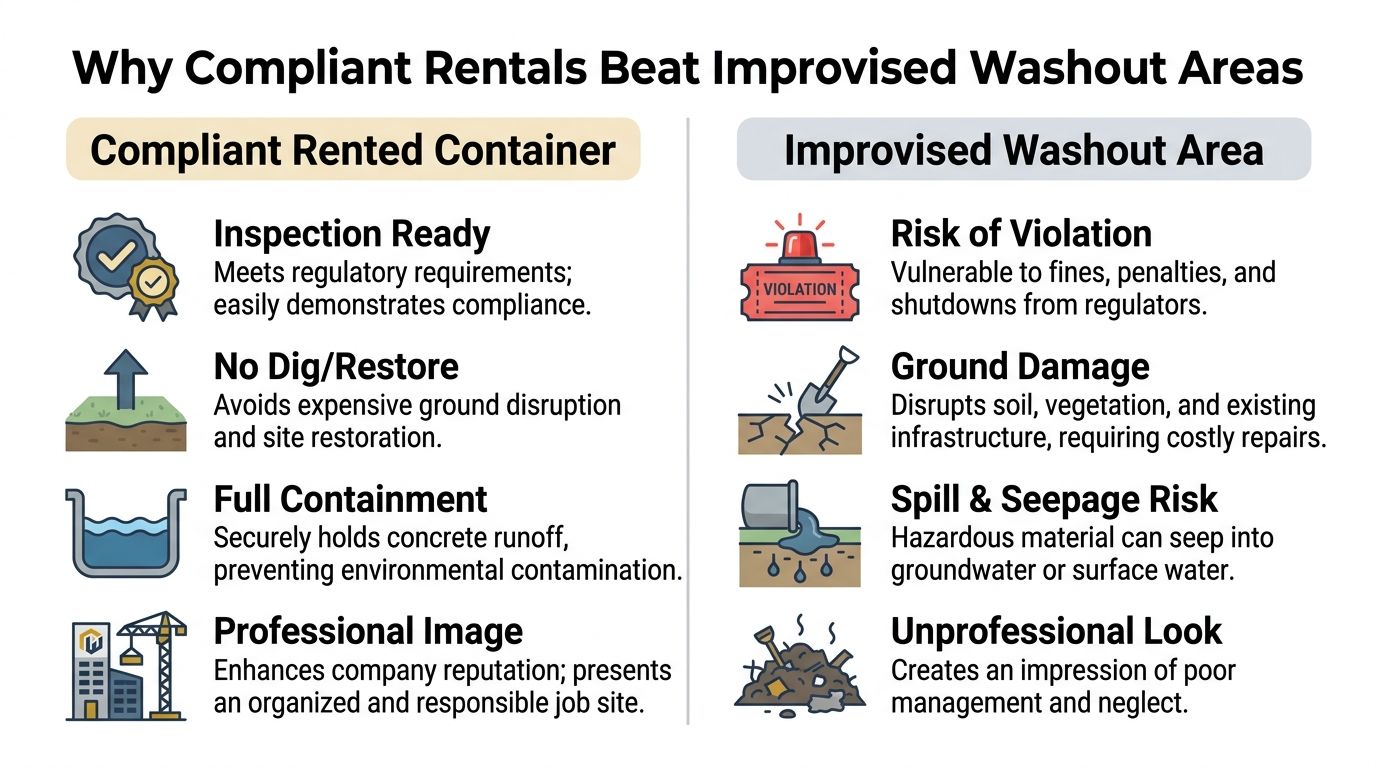
A dug pit or bermed corner can work only when it meets the project's containment requirements and the crew maintains it correctly. In practice, improvised areas often fail at the edges, where liners tear, rain enters, trucks wash outside the protected footprint, or a low point sends slurry toward an inlet.
A purpose-built rental doesn't automatically create compliance, but it gives the site a defined control with known dimensions, a documented delivery, and a clear location. That matters during an inspection because the foreman can point to the BMP, explain the capacity decision, and show inspection records instead of defending a pile of plywood, straw wattles, and wet soil.
The labor trade-off is larger than it looks
Improvised systems consume attention at the worst time. Someone has to find a location, build the berm, pin the liner, replace damaged cover material, shovel hardened concrete, and restore the area after removal. Those tasks compete with placing, finishing, traffic control, and cleanup.
A rented container reduces the setup to placement and inspection, provided the unit is suitable for the pour and the surface can support it. Full units can be exchanged on a schedule, while smaller units can be removed or cleaned according to the rental agreement. The benefit is operational consistency, not a promise that the crew can ignore the container.
A washout control should be boring on pour day. If everyone is talking about it, the setup probably wasn't ready.
The liability argument is just as important. Uncontrolled washwater can trigger cleanup, schedule disruption, owner escalation, and permit problems that dwarf the equipment charge. State and agency guidance increasingly focuses on preventing discharge before it happens, keeping containment covered when needed, and documenting inspections. A clear rental record supports that process, while an improvised area often leaves too much room for disagreement about what was installed and when.
The strongest rental case appears on changing sites. Clean equipment can arrive for the next pour, the pickup can be planned around access, and the crew doesn't have to turn a finished corner of the project into a permanent muddy washout zone.
How Reborn Rentals Supports Contractors in the Field
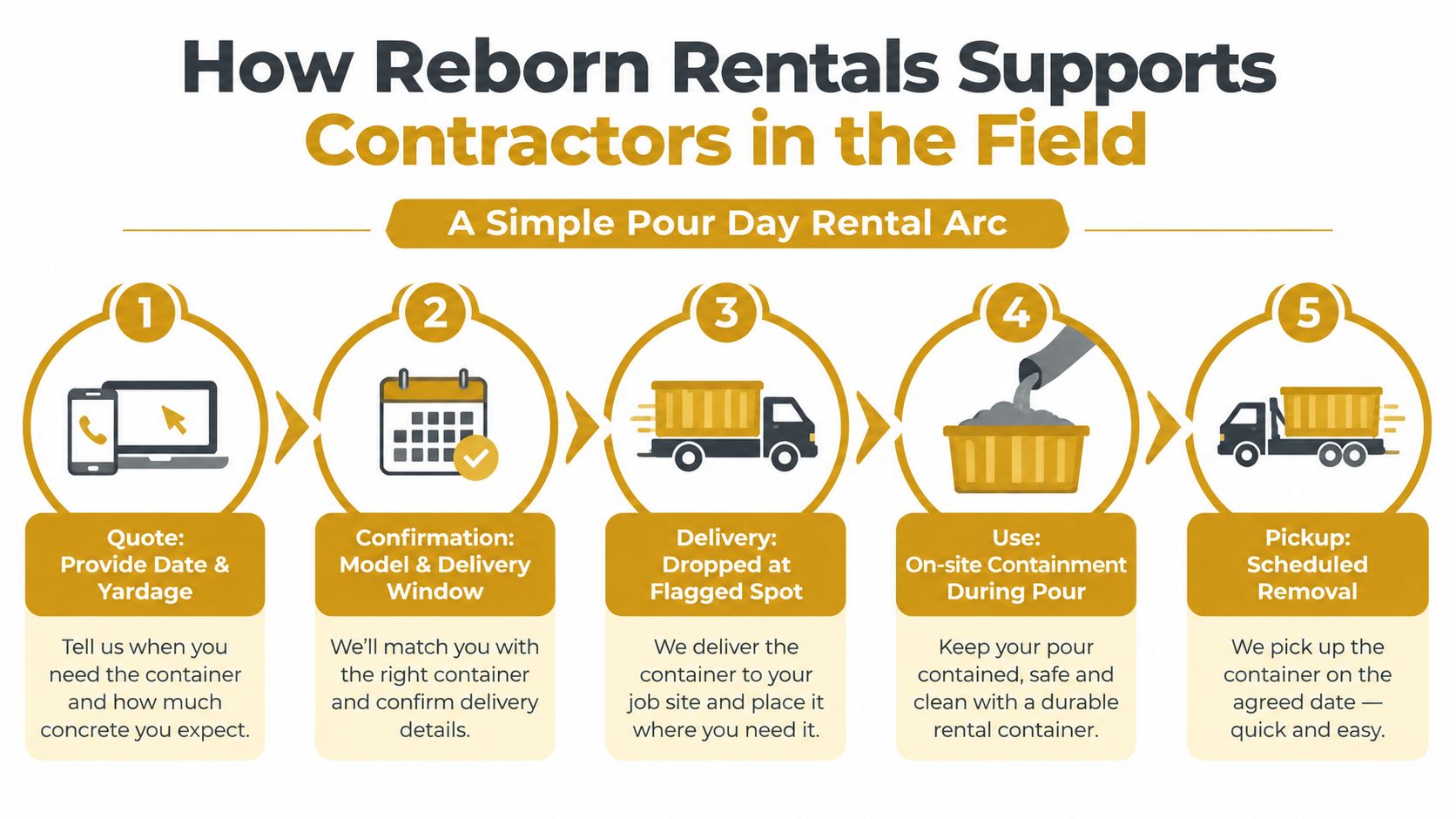
A workable rental process starts before the concrete trucks are dispatched. The contractor provides the pour date, location, expected work, and yardage or truck activity. The rental coordinator then confirms the model, delivery window, access conditions, and the spot where the driver should place the container.
Reborn Rentals lists several pan formats for different field conditions, including a compact 4-by-4 pan, a 6-by-6 mid-size, an 8-by-8 heavy-pour format, and a 10-by-10 multi-pour format. These are useful planning categories, not substitutes for checking actual capacity, freeboard, access, and the project's stormwater requirements.
What the pour-day handoff should look like
- Quote: Give the rental team the date, site address, pour pattern, and expected truck or pump activity.
- Confirmation: Verify the selected model, delivery window, placement surface, and pickup expectations.
- Delivery: Flag the access road and proposed location so the driver doesn't have to guess around active equipment.
- Use: Keep chute rinses and pump cleanout inside the container, monitor the liquid level, and record inspections.
- Pickup: Schedule removal before the unit blocks traffic, reaches its practical limit, or becomes inaccessible behind new work.
The company supports phone contact, website chat, Messenger, WhatsApp, email, QR-based contact sharing, and scheduled callbacks. After-hours dispatch is relevant for weekend and early-morning pours, but availability should be confirmed for the specific project rather than assumed.
The operational gain comes from removing avoidable decisions. The foreman doesn't need to excavate a pit at dawn, search for a last-minute liner, or explain why the only washout area sits beside a storm inlet. A marked delivery spot, a confirmed unit, and a pickup plan make inspection-day conversations shorter and give the crew a controlled place to work.
Field Checklist and Where Washout Containment Is Heading
Use this checklist before the first truck arrives:
- Confirm the permit basis: Read the SWPPP, owner specification, and local stormwater requirements for containment, setbacks, covers, and inspection timing.
- Mark the location: Choose stable, level ground away from drains, ditches, streets, gutters, and waterbodies.
- Check access: Make sure mixer chutes and pump hoses can reach the container without crossing pedestrian routes or finished work.
- Verify capacity: Account for truck chute washes, hopper cleanout, settled solids, and rainfall. Keep the required freeboard available.
- Inspect the container: Check the base, seams, liner, lifting points, and support surface before use.
- Monitor during the pour: Watch the level after each return and after rainfall. Stop and arrange a swap before the container threatens to overflow.
- Manage hardened material: Follow the approved recycling, disposal, or haul-off process for collected solids and water.
- Close the record: Log inspections, photos, weather observations, delivery details, pickup, and any corrective action in the SWPPP file.
The category is moving toward more controlled water management. Some suppliers are developing pH-neutralizing trays, decanting systems, biodegradable bags, recyclable formats, and remote sensors that alert a site manager as capacity approaches. Those features can help, but they don't replace leak-proof containment, proper siting, freeboard, or inspection discipline.
The pressure is coming from several directions. EPA and state construction stormwater requirements continue to emphasize capture and retention, while public owners increasingly ask contractors to document waste handling and sustainability choices. The practical standard is shifting from “put a tub somewhere” to select, track, inspect, and remove the containment system as part of the pour plan.
Connected equipment may eventually make capacity alerts and service records routine. For now, the contractors who perform best are still doing the fundamentals: choosing the format before the pour, placing it where trucks can use it, and keeping the paperwork aligned with the field conditions.
Reborn Rentals provides concrete washout pans and containers with scheduled delivery and pickup coordination for small renovations, pump work, and larger multi-pour projects. Review the available sizes, confirm access and surcharges, and visit Reborn Rentals to arrange a containment solution before the first truck arrives.

