
Inventory Optimization Methods for Construction Rentals
A concrete pour gets pushed because of rain. The pump crew reschedules, trucks arrive in a tighter window, and the washout equipment that was supposed to rotate back to your yard stays trapped behind a locked gate. Meanwhile, another project calls for a large containment pan tomorrow morning. A spreadsheet built on last month's rental history won't see that collision coming.
That's the operating reality behind effective inventory optimization methods for construction rentals. Demand isn't driven only by past bookings. It follows pour schedules, access conditions, project phases, weather, inspections, truck availability, and the practical limits of each site. The strongest system combines forecasting with judgment, keeps safety stock tied to risk, and treats every unit's location and condition as part of available inventory.
Why Construction Demand Breaks Classic Inventory Models
Retail inventory models usually assume that demand can be observed as a relatively consistent flow. Construction rentals behave more like a series of temporary surges. A project may need several washout pans during a major pour, then none while work pauses, then another group when a revised schedule brings crews back sooner than expected.
Economic Order Quantity, or EOQ, can still help when an operator is replenishing repeatable items with stable ordering and holding costs. It becomes less useful when the demand event is tied to a project milestone rather than a regular consumption pattern. A washout pan isn't consumed like a box of fasteners. It moves between sites, remains unavailable while awaiting pickup, and may return dirty or damaged.
Static reorder points create a similar problem. They trigger action when on-hand inventory falls below a fixed threshold, but they don't understand why units are unavailable. Ten pans sitting at a delayed project aren't equivalent to ten clean pans ready for dispatch. A reorder rule that counts both as available can leave dispatchers scrambling on the morning of a pour.
Practical rule: Count inventory by status and location, not just by total units. “On hand” should mean clean, inspected, dispatchable, and reachable within the promised service window.
From hoarding to project-aware staging
Just-in-case hoarding appears safe because it reduces the chance of an immediate stockout. It also ties up capital, consumes yard space, and can hide poor planning. Operators often end up with the wrong sizes in the wrong branch while a high-demand project waits for a unit that is technically part of the fleet.
Project-aware inventory management starts with the job, not the warehouse. For each active project, map:
- Work phase: Identify whether excavation, foundations, structural work, paving, or retrofit activity is approaching.
- Pour pattern: Separate isolated pours from concentrated schedules that could create a temporary fleet spike.
- Site constraints: Record rough terrain, limited access, staging space, and delivery restrictions.
- Recovery risk: Estimate how difficult it will be to retrieve units if the schedule changes.
- Alternative availability: Note whether a nearby branch, partner, or sub-rental source can cover an overflow request.
This approach changes the question from “How many pans should we own?” to “Which clean units must be positioned near which projects, and when?” A smaller fleet with disciplined staging can outperform a larger fleet that dispatchers can't locate or turn around quickly.
A 2026 systematic review of 31 peer-reviewed studies found that distributional safety stock methods outperformed classical normal approximations by a pooled mean of 9.3% at equivalent service levels, with the advantage strongest in high-variability SKU segments, as reported in the systematic review of inventory safety stock and optimization methods. The result supports a broader operational lesson: construction rental inventory should reflect the shape of uncertainty, not force every project into a smooth-demand assumption.
Forecasting Washout Demand Using Pour Schedules
Historical rental demand tells you what happened. A pour schedule gives you a better view of what could happen next. For washout equipment, the forecast should begin with project milestones and then adjust for the site conditions that determine how many units can remain active at once.
Build a rolling demand view
Use a rolling-wave process rather than locking the entire season into one forecast. Keep near-term dates detailed, while leaving later phases flexible until contractors confirm them.
Start with the following sequence:
- Collect the current pour schedule. Ask the general contractor, concrete subcontractor, pump company, and SWPPP consultant for the latest planned dates. Treat the schedule as a working document, not a permanent commitment.
- Map each pour to a site requirement. Record the expected crew activity, truck access, washout location, containment capacity, and whether the site needs a large pan such as a 72 x 72 x 24 model.
- Assign a confidence level. A pour with confirmed reinforcing, approved access, and booked concrete supply deserves more weight than a date shown only on an early look-ahead.
- Create a time-phased reservation. Hold the required units against the expected start and end dates, including realistic pickup and cleaning time.
- Recheck the schedule at a fixed cadence. Ask what moved, what was canceled, and what was added. A changed date should automatically trigger a review of fleet position.
- Compare planned demand with dispatchable stock. Separate clean inventory, units in transit, units at active sites, units awaiting inspection, and units in repair.
This process works because it connects the forecast to the event that creates demand. It also gives dispatch a reason for every reservation, which makes it easier to release units when a project slips.
Use site history without letting it dominate
Past site data still matters, but it needs context. Track the number and size of pans used, the actual rental duration, pickup delays, access problems, cleaning turnaround, and whether the site required extra containment. A project that historically used one pan may need more units during a compressed pour sequence or a period of repeated weather delays.
Ask SWPPP consultants for compliance-related constraints early. They can often identify where a site's approved washout area, drainage controls, or access route will limit placement. That information belongs in the demand record because a pan that cannot be positioned safely isn't a usable forecast unit.
Machine learning can support this workflow, but it shouldn't replace operational review. A 2025 systematic review of 122 inventory-control articles organized current approaches into separate estimation and optimization, static ML-integrated optimization, and dynamic ML-integrated optimization using reinforcement learning, according to the review of machine learning in inventory control. For construction rentals, dynamic methods are most relevant when schedules, locations, and availability change together. They still depend on clean status data and timely schedule updates.
Calculating Safety Stock for Volatile Job Sites
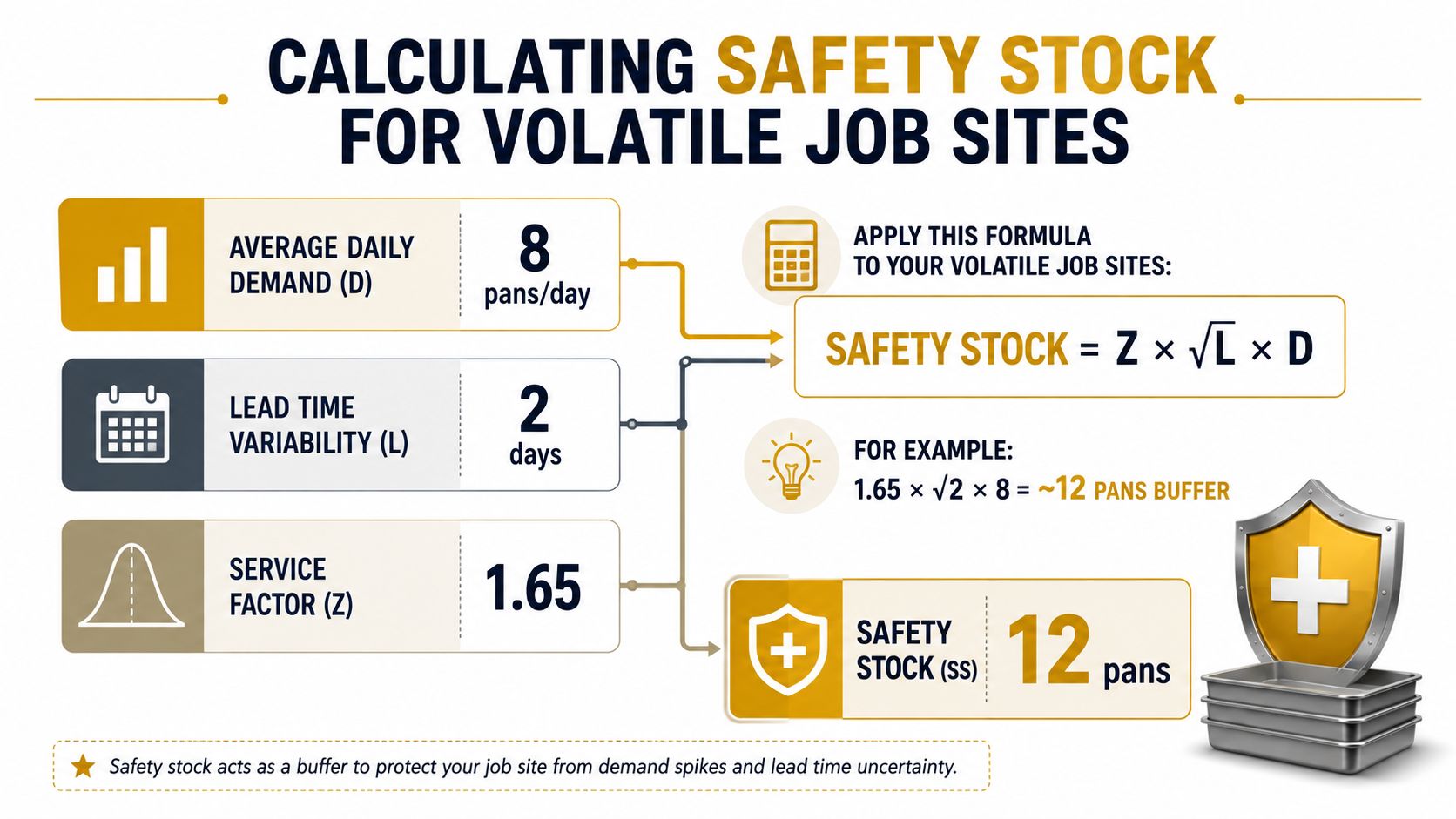
Safety stock protects service continuity when demand or supply moves outside the expected range. On a construction site, that range can change because a truck breaks down, a storm delays access, a pour gets compressed, or an inspection prevents the planned staging area from being used.
A useful calculation should therefore include more than average usage. It should reflect demand variability, lead-time variability, and the service level you're trying to protect. The infographic shows a simple operational example using the formula Safety Stock = Z x √L x D, where the example uses average daily demand of 8 pans, lead-time variability of 2 days, and a service factor of 1.65 to produce an approximately 12-pan buffer. Those figures belong to the visual's example, not a universal recommendation for every rental fleet.
Segment by operational risk
One buffer for every pan size is too blunt. Segment units according to the consequence of being unavailable and the difficulty of replacing them.
- Critical site units: Large-capacity pans required for scheduled, high-volume work deserve tighter monitoring and a stronger protection policy.
- Flexible units: Standard sizes that can serve several project types may need less location-specific stock because dispatch can reposition them.
- Constrained units: Equipment difficult to transport, clean, repair, or source through a partner should carry a separate risk flag.
- Low-priority units: Slow-moving or easily substituted equipment shouldn't absorb the same capital as a project-critical unit.
The calculation should use reliable observations from your own operation. Review actual lead times from booking to delivery, pickup to return, return to cleaning, and cleaning to inspection. If weather delays consistently extend site duration, include that behavior in the lead-time history instead of treating every late return as an exception.
A buffer is only useful when it's deployable. A pan sitting in a repair bay, behind another load, or at a site with no retrieval access doesn't protect tomorrow's booking.
Distributional methods fit irregular demand
Classical normal approximations assume a distribution shape that may not match construction rentals. Demand can be intermittent, clustered around pours, or heavily influenced by a few large projects. Distributional methods use the observed pattern of demand and lead time more directly.
The 2026 meta-analytic review cited earlier found the strongest advantage for distributional safety stock methods in high-variability SKU segments, with a pooled mean improvement of 9.3% at equivalent service levels compared with classical normal approximations (review details). Apply that insight selectively. Don't build an elaborate model for every low-risk unit. Focus analytical effort where a stockout can halt work, trigger emergency transport, or create a compliance problem.
Update the buffer after material schedule changes, repeated late returns, and meaningful shifts in project mix. A safety stock value should be a living control, not a number copied into a spreadsheet and forgotten.
Balancing Fleet Size with Dynamic Pricing
Fleet sizing is a choice between carrying capacity and buying flexibility. A larger fleet can absorb overlapping bookings, but idle steel still creates storage, maintenance, and capital pressure. A smaller fleet can work when the operator has accurate schedule visibility, fast turnaround, dependable transport, and credible overflow options.
Compare the operating choices
| Approach | What it does well | Where it breaks |
|---|---|---|
| Large fixed fleet | Covers overlapping project demand without constant external sourcing | Leaves more equipment idle when projects slip |
| Lean fleet with fixed pricing | Keeps the offer simple and can support predictable bookings | Provides little incentive for early reservations or flexible sizing |
| Dynamic pricing and staging | Uses price and delivery signals to shape demand and position units | Requires clear rules, accurate availability, and disciplined communication |
| Short-term sub-rental support | Covers unusual spikes without permanently expanding ownership | Adds coordination risk, variable condition, and possible transport complexity |
Dynamic pricing shouldn't mean surprising a contractor at checkout. It should reflect known operating differences, such as short-notice delivery, rough terrain, express handling, or a premium date with limited availability. Publish the logic clearly so customers can choose between booking earlier, accepting a different size, moving the delivery window, or paying for urgency.
Use price as a planning signal
A contractor who books early gives the rental operator more time to stage, clean, and route equipment. A modest early-booking incentive or a clearly defined premium for short-notice demand can encourage behavior that improves fleet utilization. Offer alternatives when they're operationally sound. A different pan size may work at one site but fail at another if the approved washout area or expected slurry volume doesn't support it.
Don't use pricing to hide poor inventory control. If dispatch records are inaccurate, a higher price won't prevent double-booking. If returns aren't inspected quickly, a lower price won't create capacity.
Short-term sub-rentals make sense when the spike is temporary, geographically isolated, or tied to a project whose schedule remains uncertain. Before accepting outside units, verify dimensions, capacity, structural condition, cleaning status, pickup terms, and responsibility for damage. The cheapest overflow option can become expensive if it arrives late or fails a site-readiness check.
In complex networks, coordination can create savings beyond single-location optimization. The 2026 review reported a pooled mean cost reduction of 11.4% from multi-echelon coordination, while learning-based control methods delivered up to 16% cost reductions in complex networks (systematic review findings). Rental operators can apply the underlying principle without adopting advanced software immediately: coordinate branches, routes, cleaning capacity, and partner supply as one network rather than letting each location protect itself independently.
Maintenance Rotation and Site Logistics
A pan that's physically owned but not site-ready shouldn't appear in sellable inventory. Dirt, hardened concrete, damaged corners, warped surfaces, missing labels, and unreliable lifting points all reduce the unit's practical value. Maintenance rotation protects the fleet and gives dispatch a dependable answer when a crew asks whether equipment can leave today.
Create a condition-based rotation
Use a visible status system that dispatch and yard staff understand the same way. A simple workflow can include at site, pickup scheduled, returned, cleaning, inspection, repair, and available. Don't move a unit to available until someone has verified its condition.
Inspect for:
- Structural integrity: Check walls, base, corners, seams, lifting points, and visible deformation.
- Containment condition: Look for cracks, holes, leaks, sharp edges, and residue that could affect placement or cleaning.
- Identification: Confirm the unit's size, capacity, asset identifier, and rental record.
- Site accessories: Verify required covers, signage, ramps, or handling components before loading.
- Transport readiness: Make sure the unit can be loaded, secured, and delivered along the planned route.
A use-based rotation can be more practical than a calendar alone. Units exposed to heavy slurry or rough handling may need inspection sooner than lightly used equipment. Record usage and return condition so the maintenance interval follows actual wear.
Keep cleaning connected to compliance
Cleaning isn't cosmetic. Residue can interfere with inspection, obscure damage, increase turnaround time, and create avoidable site concerns. Establish a return protocol that specifies where washout occurs, how residue is removed, and who signs off on the final condition.
Delivery planning deserves the same attention as maintenance. Confirm gate hours, ground conditions, turning space, placement instructions, and contact details before dispatch. For rough-terrain locations, send the right vehicle and account for the possibility that a planned drop point won't be accessible after rain.
The included operational checklist reinforces three habits: inspect pans after 10 uses, pressure wash after each rental return, and pre-position cleaned pans at high-demand sites. Those are the infographic's specified procedures, so operators should adapt them to their own equipment, environmental requirements, and manufacturer guidance.
Track the handoff, not just the asset
Every movement should answer four questions: where is the pan, who has responsibility, what condition is it in, and when can it move again? Digital asset tracking helps, but a disciplined scan or signed handoff can also improve visibility if the system is followed consistently.
A site photo, delivery confirmation, return note, and inspection record create a useful operational trail. They also help resolve disputes without relying on memory. The best inventory optimization methods treat maintenance and logistics data as forecast inputs, because turnaround time determines whether the next booking can be honored.
Your 90-Day Inventory Optimization Roadmap
A rental operator can make meaningful progress without replacing every system at once. The first step is to establish a trustworthy picture of fleet condition, location, demand, and timing.
Days 1 through 30 for assessment
Audit every unit and assign a clear status. Reconcile the yard, active sites, scheduled pickups, repair queue, and reservations. Then review recent bookings against pour schedules to identify where the forecast failed, where returns ran late, and which sizes repeatedly created dispatch pressure.
Set baseline operational measures, including utilization rate, on-time delivery percentage, return-to-available turnaround, reservation accuracy, and stockout incidents. Keep the definitions consistent. Utilization should distinguish rented units from units merely reserved, and on-time delivery should use an agreed delivery window.
Days 31 through 60 for planning
Create a rolling schedule with project milestones, site constraints, confidence levels, and expected recovery dates. Segment the fleet by criticality and establish separate replenishment or staging rules. Start with a spreadsheet or existing rental platform if necessary, but make status changes mandatory at each handoff.
Train dispatchers to challenge impossible reservations. If a unit is still at a delayed site, the system should not promise it elsewhere without a confirmed recovery plan.
Days 61 through 90 for controlled improvement
Run the method against live projects. Review exceptions weekly, adjust safety stock for the highest-risk segments, and compare planned versus actual delivery, pickup, cleaning, and inspection times. Test whether early booking incentives, alternative sizes, or carefully screened sub-rentals reduce peak pressure without damaging service.
The roadmap should end with a repeatable review, not a one-time project. A 2025 review of machine learning in inventory control shows the field's movement toward dynamic, data-driven policies, including reinforcement learning for changing conditions (machine learning inventory-control review). Most rental operators should first fix status accuracy and schedule discipline before adopting advanced models. Clean operational data is the foundation that makes any method useful.
Reborn Rentals provides ready-to-deploy concrete washout pans and containers for construction and renovation projects, with clear daily pricing, delivery coordination, and options suited to different capacity needs. Visit Reborn Rentals to check availability, confirm site logistics, and reserve washout containment before your next pour schedule shifts.

