
Roswell City Dump: A Contractor’s Guide to Disposal
You've got a load in the truck, a crew waiting on the next task, and somebody on-site says, “Just take it to the Roswell city dump.” That sounds simple until you start searching and realize there's more than one Roswell, and the rules aren't interchangeable.
That mix-up burns time fast. A residential drop-off point in one Roswell isn't the same thing as a municipal landfill program in the other. If you're hauling from a jobsite, especially if the load includes construction debris, mixed waste, or anything questionable, you need to know which system you're dealing with before the tires leave the pavement.
First Off Which Roswell City Dump
The phrase Roswell city dump causes confusion because people usually mean one of two places. One is in Roswell, Georgia. The other is in Roswell, New Mexico. They operate very differently, and if you treat them like the same facility, you're setting yourself up for a wasted trip.

Roswell Georgia is mostly a resident service point
In Georgia, the City of Roswell operates a city dumpster off Hembree Road that serves over 25,000 residential customers for weekly garbage, recycling, and yard waste collection, according to the referenced local discussion about the facility's role in city service at Roswell's Hembree Road dumpster discussion.
That matters because the Georgia location is tied to a city residential waste system. If you're a contractor looking for a landfill-style disposal routine, permit handling, or guidance around regulated waste, that's usually not the answer you need.
Roswell New Mexico is the one contractors need to sort out
For jobsite hauling, Roswell, New Mexico is where the details matter more. That's the location with the municipal landfill process, permit-related questions, hazardous material restrictions, and the kind of gate-check routine that can either go smoothly or wreck half your day.
Practical rule: Before you load the first bucket, confirm the state, confirm the facility, and confirm whether your load is residential cleanup, contractor debris, or material that needs separate approval.
If your crew is working in New Mexico, the right mindset is simple. Treat the dump run like any other scheduled operation. Verify the destination, sort the load before the truck leaves, and make sure the driver knows what the landfill will and won't accept.
Why the New Mexico side deserves the closer look
A lot of dump runs fail before arrival. Not because the driver can't find the place, but because nobody handled the paperwork, the load got mixed, or prohibited material got tossed in with everything else. Roswell, NM has a structure for disposal that rewards preparation and punishes assumptions.
That's why the rest of this guide focuses on Roswell, New Mexico. If you're managing labor, equipment, concrete work, demolition debris, or a cleanup with uncertain materials, that's where the practical decisions start.
Navigating the Roswell NM Landfill
A crew loses time here in a predictable way. The truck gets loaded, somebody points the driver toward “the Roswell dump,” and only after arrival does the job stall over the wrong state, the wrong program, or a load that should have been sorted before it left the site.
For Roswell, New Mexico, the landfill run starts in the office or at the tailgate meeting. Confirm the facility, confirm how the load is classified, and confirm whether the disposal falls under a city program or a standard paid drop. Roswell, GA and Roswell, NM are not interchangeable, and treating them like they are is how you burn half a day.
Handle the permit question before the truck rolls
The City of Roswell in New Mexico runs a Clean and Safe program tied to local property cleanup, with a $5 permit fee, as described by Roswell NM landfill services.
That matters because the permit side affects who should be making the run. If the load is tied to a qualifying local property, settle that before loading equipment or dispatching a driver. Do not assume gate staff will sort out ownership, eligibility, or missing permit details while your truck is sitting in line.
Use this handoff standard:
- Identify the source of the material. Know which property the debris came from.
- Confirm who is responsible for the permit. Owner, contractor, or office staff needs to be clear before departure.
- Keep the right contact information with the driver. If a question comes up, a fast phone call beats a rejected load.
Plan around site hours, not your jobsite schedule
Landfill hours control the day. Your pour, demo window, or cleanup deadline does not change what happens at the gate.
Roswell's municipal landfill can have holiday closures, operating changes, and special schedule adjustments. One known example is an early closure at noon on June 30. The practical takeaway is simple. Check hours before you send a truck, especially near holidays, month-end, or before you stack multiple loads into one afternoon.
A late arrival creates expensive problems fast. You still pay the driver. The material stays on the truck. The next morning starts behind schedule.
Show up early, with a sorted load and the permit question already settled.
A pre-trip checklist that saves time
Run through these items in this order:
Confirm the destination
Verify the driver is heading to Roswell, New Mexico, not Roswell, Georgia.Classify the load
Separate routine debris from anything that may need special handling or approval.Verify permit status
If the Clean and Safe program applies, get that squared away before the truck leaves.Save the landfill contact details
Drivers should be able to call immediately if site staff questions part of the load.Prep the truck
Secure the load, clear loose papers from the cab, and make sure the driver can describe exactly what is being hauled.
What a smooth run looks like
The easy runs are plain. The material is sorted. The driver knows the job address. The permit question is already handled. The truck gets there with enough time left in the day to deal with a delay if one comes up.
The bad runs usually share the same pattern. Mixed debris, vague answers about where it came from, and a driver who was told to “see what they take.” That approach works on almost no municipal landfill job, and it is a poor bet in Roswell, NM when contractors are dealing with regulated materials, permit questions, or cleanup loads tied to a specific property.
What You Can and Cannot Haul
The worst load at the landfill isn't the heavy one. It's the mixed one. Weight is manageable. A truck full of unsorted debris, unknown containers, and last-minute toss-ins is what gets people delayed or turned around.
For Roswell, NM, the smart move is to sort by material before loading. If the item is obviously inert, obviously clean, and obviously part of ordinary debris, your day usually goes better. If the item leaks, sprays, smokes, powers up, contains chemicals, or has a battery, stop and verify before hauling.
Quick sort table for crews
| Material Type | Status | Key Instructions & Notes |
|---|---|---|
| General household trash | Usually accepted | Keep it bagged or contained where possible. Don't mix in hazardous items. |
| Construction debris | Usually accepted if properly sorted | Keep the load free of liquids, chemicals, and clearly prohibited materials. |
| Scrap wood | Commonly manageable in general debris loads | Separate out treated, painted, or questionable material if site staff may need clarification. |
| Drywall | Commonly manageable | Keep it dry if possible and don't bury prohibited items inside broken sheets. |
| Metal | Often better sorted separately | Clean scrap is easier to handle than mixed debris with metal tangled through it. |
| Yard debris | May be acceptable depending on site rules | Keep it free from trash contamination. Don't mix brush with demolition waste if you can avoid it. |
| Concrete and masonry rubble | Often accepted as inert material | Keep it free of washout slurry, liquid residue, trash, and rebar bundles that complicate unloading. |
| Roofing tear-off | Verify before hauling | Dense loads create handling and fee issues at many landfills. Ask before assuming. |
| Tires | Restricted | Don't bury them in a mixed load. Ask for the correct disposal route first. |
| Paint, solvents, fuels, oils | Prohibited or restricted | These fall into hazardous categories. Don't send them in general debris. |
| Batteries | Prohibited or restricted | Pull them out before loading. Don't leave them in toolboxes or equipment compartments. |
| Propane cylinders or pressurized containers | Prohibited or restricted | Remove them from the load entirely and route them properly. |
| Electronics | Restricted | Don't assume they can go with demolition debris. Verify first. |
| Household hazardous waste | Pre-approval required | Call ahead before hauling any HHW-related material. |
| Liquid waste | Not suitable for general dumping | Never rely on the landfill to figure out a liquid or slurry problem after you arrive. |
The field rule that keeps you out of trouble
If a crew member says, “It's probably fine,” that item needs a second look.
Most landfill problems come from materials that were tossed in during cleanup. Half-used cans, old chemicals from a shed, batteries from equipment, or random containers from the back of a service truck. Those aren't small mistakes. They contaminate an otherwise straightforward load.
A good dump run starts on the jobsite, not at the scale house. The sorting decision happens at the pile.
Best practice for mixed construction cleanup
When I'm training crews on debris handling, I want three separate thought processes before anything gets loaded:
- Inert debris like concrete, block, or clean fill-type rubble
- General demolition like wood, drywall, trim, insulation, and mixed teardown material
- Question-mark items like containers, chemicals, batteries, electronics, and anything with fluid
That third category is where jobs go sideways. Keep a designated spot on-site for hold-and-verify items. Don't let them ride with the general load just because the truck has room.
Your On-Site Unloading Playbook
A landfill run goes smoother when the driver treats it like equipment yard traffic. Stay alert, follow directions, don't freelance, and keep the truck moving.
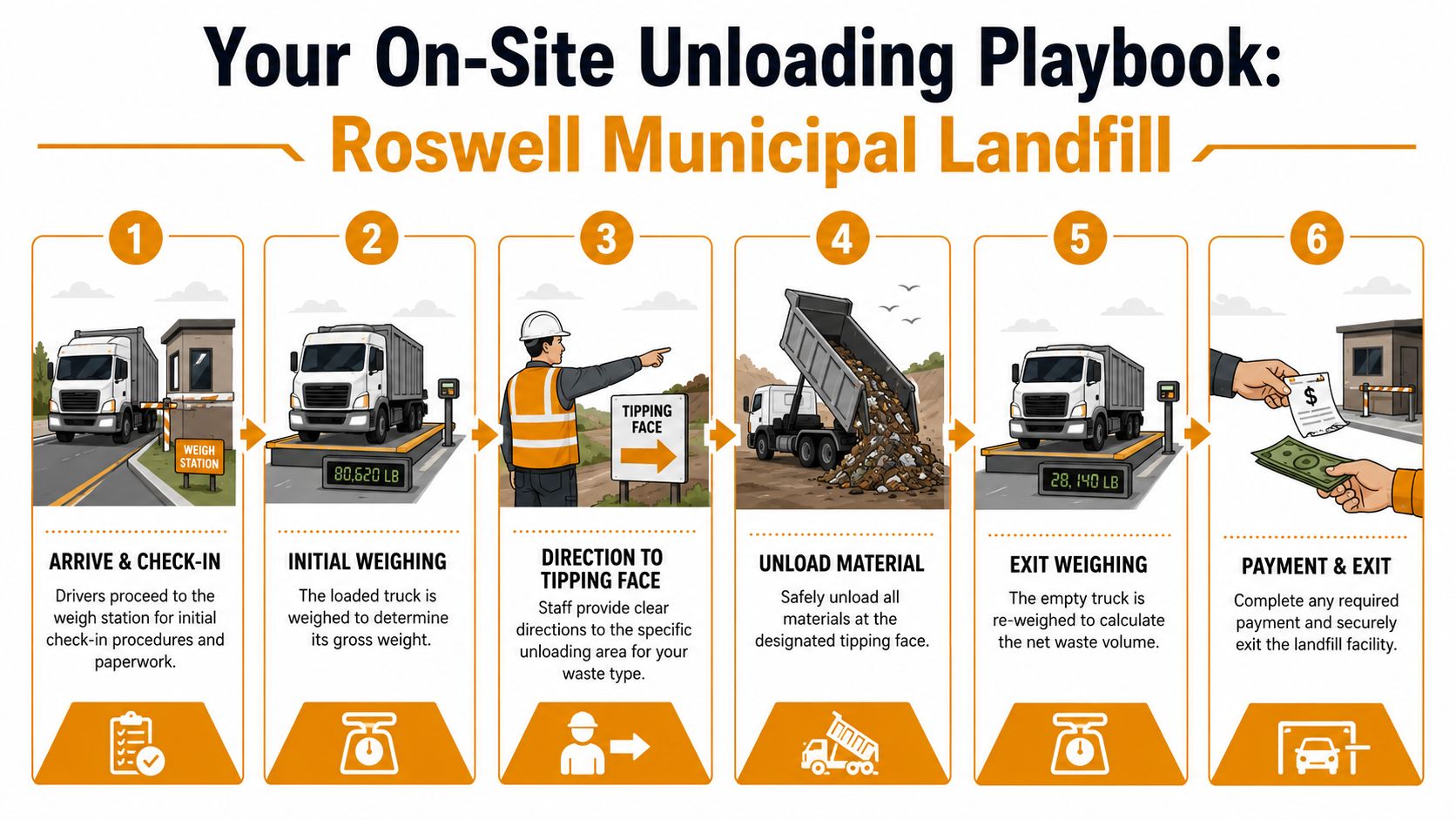
Step one starts at the gate, not the dump face
When you arrive, expect to check in first. The driver should have permit-related information ready if it applies, know what's on the truck, and be prepared to answer basic questions without guessing.
If you send a laborer who didn't load the truck and doesn't know what's in it, you're inviting confusion. The best driver for a landfill run is the person who can say exactly what the load contains and what it does not.
Follow the sequence and don't skip ahead
The normal flow is straightforward:
- Check in at the entrance
- Get weighed if directed
- Take instructions from site staff
- Drive to the assigned unloading area
- Unload carefully and completely
- Return through exit procedures and settle out
That sequence sounds obvious, but people still mess it up by pulling ahead, backing where they shouldn't, or unloading in the wrong area because they think all trash goes to the same spot. It doesn't.
At the tipping area, keep your head on a swivel
Landfill traffic isn't like a retail dump trailer line. You may be operating near heavy equipment, uneven ground, active push operations, or other haulers trying to turn loads quickly.
Use basic site discipline:
- Wear the right PPE: Boots, gloves, high-visibility gear, and eye protection make sense here.
- Watch backing angles: Don't raise a bed on unstable ground.
- Check overhead clearance: Any raised body or trailer needs room.
- Keep helpers visible: No one should stand in blind spots while unloading.
- Clean out the bed fully: Loose debris left hanging can create a problem on the drive out.
If the ground looks soft, sloped, or cut up by equipment, stop and reassess before lifting the bed. A rushed unload can become a rollover.
Concrete washout is not a casual add-on
One mistake I've seen on many jobs is crews treating leftover concrete residue or wash water like ordinary debris. It isn't. Slurry, rinse-out, and washout material need controlled handling. You can't improvise with a random hole in the dirt and call it good practice.
At the landfill, don't assume there's a place for you to deal with concrete washout on the fly. If your truck or tools need washout management, that should be planned before the run, not solved after arrival.
Before you leave the site
The run isn't done when the truck is empty. Finish the process cleanly.
Check these before rolling out:
- Tailgate secured
- No debris hanging from the chassis
- Tarp, straps, and tools accounted for
- Paperwork or receipt collected
- Driver clear on the next stop
That last check matters. A clean landfill exit keeps dirt, loose debris, and compliance problems from following you back onto public roads or the next site.
Avoid These Common and Costly Dump Run Mistakes
You load out a cleanup job, send the truck across town, and then lose half the day because one small item in the bed should never have been there. That is how dump runs get expensive in Roswell, NM. It is usually not the big debris pile that causes trouble. It is the paint can under scrap wood, the battery in a bucket, the jug with no label, or the bag a laborer tossed in at the last minute.
That confusion gets worse because some crews search for "Roswell city dump" and pull up information for Roswell, Georgia. If your job is in New Mexico, work from Roswell, NM rules and call the local facility when a load has anything questionable in it. Guessing from the wrong Roswell is an easy way to get turned around on accepted materials and procedures.
The mistake that burns the most time
Mixed loads are the problem I see over and over. A standard construction cleanup load can become a problem load fast if anyone treats hazardous or questionable material like ordinary trash.
As noted earlier, the Roswell, NM landfill has specific acceptance rules for special waste and household hazardous material. If there is any doubt, get approval before the truck leaves the site. Waiting until you reach the gate puts the driver in a bad position and usually means a reload, a second trip, or both.
The bad habits that keep costing crews money
These are the ones that eat a schedule:
- Sorting at the landfill instead of on-site. Staff expects a load that is ready for disposal, not a truck bed full of surprises.
- Letting "small amounts" slide. A little paint, one battery, or one unknown container can hold up the whole load.
- Sending a driver who does not know what is in the truck. If the top layer looks clean but the bottom does not, the driver still has to answer for it.
- Combining cleanup debris with garage or shed leftovers. That is where old chemicals, oils, pesticides, and other problem items tend to get mixed in.
- Cutting the timing too close. If there is an issue late in the day, you have less room to sort it out without losing tomorrow morning too.
How experienced crews prevent those problems
Set the rules at the jobsite before loading starts. That is the only point where you still control the load.
Use a simple system:
- Make a hold area for anything unmarked, leaking, or questionable.
- Put one person in charge of final load approval.
- Keep special items separate until the facility confirms they can be accepted.
- Send the driver with enough job information to answer basic questions at the scale or gate.
- Build extra time into the run if the load came from a garage cleanout, estate cleanout, remodel, or mixed-use property.
I would rather leave five questionable items behind for a second decision than send one bad load to the landfill and tie up a truck for hours.
One-trip efficiency can backfire
Crews often try to save money by packing everything into one run. Sometimes that works. On mixed jobs, it often creates a load that is slower to inspect, harder to explain, and more likely to be rejected.
The better move is to combine materials that clearly belong together and keep questionable items out until you know where they go. In Roswell, NM, that approach saves more money than forcing a "full truck no matter what" rule. One clean trip beats one messy trip and one return trip every time.
When the Dump Isnt the Right Answer
Not every waste problem should be solved with a landfill trip. A dump run works when the material is dry, solid, accepted, and ready to haul. It's the wrong tool when the waste stream needs containment, staging, or cleaner separation on-site.
Use the dump for disposal, not for managing active site mess
If your crew is framing, demolishing, or doing general cleanup, hauling to the Roswell city dump may be the right move. If your crew is pouring concrete, washing tools, rinsing chutes, or generating slurry, you need a different plan before the first pour starts.
That's where crews get themselves in trouble. They treat washout like trash. It isn't. It needs containment.

Smarter options for specific waste streams
Some materials are easier to manage before they ever become a landfill issue:
- Concrete washout: Use a dedicated containment solution on-site instead of improvised pits or edge-of-lot dumping.
- Clean metal: Keep it separated from mixed debris so it doesn't complicate the load.
- Reusable materials: Doors, fixtures, and some framing members may be better pulled aside than buried in teardown debris.
- Yard clearing material: Keep it free from demolition trash so you're not turning one simple stream into a contaminated one.
Experienced site managers know how to save time. They don't ask one destination to solve five different waste problems.
What works better on active concrete jobs
On concrete work, a contained washout setup usually beats trying to deal with slurry after the fact. It keeps the site tighter, gives the crew a designated spot for cleanup, and reduces the chances of somebody making a bad decision behind the building or at the edge of the lot.
That's not about being fancy. It's about controlling mess, protecting the site, and avoiding a preventable compliance problem.
Make the disposal plan fit the material
Good site management is matching the method to the waste stream. Solid debris goes one route. Recyclables may go another. Hazardous items need verification. Concrete washout needs containment.
Once you start thinking that way, fewer runs get rejected, fewer loads get contaminated, and fewer crew hours disappear into avoidable cleanup.
If your project needs a cleaner way to manage concrete slurry and tool washout before anything ever heads to the landfill, Reborn Rentals offers specialized washout containment rentals built for construction crews that need a practical, compliant setup on-site.

