
What Is a Shipping Surcharge and Why Does It Matter
A shipping surcharge is an extra fee added on top of a carrier's base shipping rate, usually for special handling, accessorial services, or variable costs. Accessorials can add about 8–15% to a freight invoice, while fuel surcharges in some carrier programs reach roughly 15–25% of base line-haul. Octolize's surcharge overview explains why that distinction matters when you're pricing a real equipment delivery rather than reading a headline rate.
You may be looking at a rental quote right now, trying to decide whether the daily equipment price fits the project budget. The advertised rate looks reasonable until delivery, site access, fuel, and rush-service lines appear underneath it. A shipping surcharge isn't automatically an error or a hidden trick, but it can change the final delivered cost enough to affect scheduling, vendor selection, and job profitability.
The Moment the Quote Stops Making Sense
A project manager opens a rental quote for a 60-foot articulating boom. The daily rental rate looks fine, and the equipment seems available for the required dates. Then the delivery section lists a $285 delivery fee, a $120 rough-terrain access fee, and a fuel surcharge that appears to change with carrier conditions.
That's the point where the quote stops looking like a simple equipment rental and starts looking like a transport invoice. The machine still has to reach the jobsite, but the cost of getting it there depends on more than the distance between the yard and the project.
A shipping surcharge is an extra fee layered on top of a carrier's base rate to cover special handling, accessorial services, or variable costs that the base rate alone doesn't capture. Major carriers use surcharges for services and conditions such as residential delivery, remote areas, fuel, special handling, and oversized shipments. They may charge a fixed amount per shipment or package, or calculate the fee as a percentage of the base rate, as described in ShipHerHQ's shipping surcharge strategy guide.
Read the quote as a cost map
Start by separating the quote into three parts:
- Equipment cost: The amount charged to rent the boom, lift, telehandler, excavator, or other machine.
- Base transportation cost: The carrier's standard charge for moving the equipment.
- Surcharges and accessorials: Extra amounts tied to fuel, access, handling, urgency, size, or site conditions.
That separation shows you what you can control. You may not be able to change the equipment's daily rate, but you might be able to improve the drop zone, schedule a standard delivery window, or bundle multiple machines into one haul.
Practical rule: Don't approve a rental from the daily rate alone. Approve the all-in delivered cost.
A surcharge line becomes useful once you know what triggered it. Ask whether the fee applies to delivery, pickup, or both. Confirm whether fuel is recalculated before dispatch. Check whether “rough terrain” means the truck must travel off pavement, or whether it covers a narrow entrance, unstable ground, a locked gate, or a long carry from the unloading area.
The objective isn't to remove every extra fee. It's to identify each one early enough to decide whether the charge is necessary, avoidable, or negotiable.
Why Surcharges Exist in the First Place
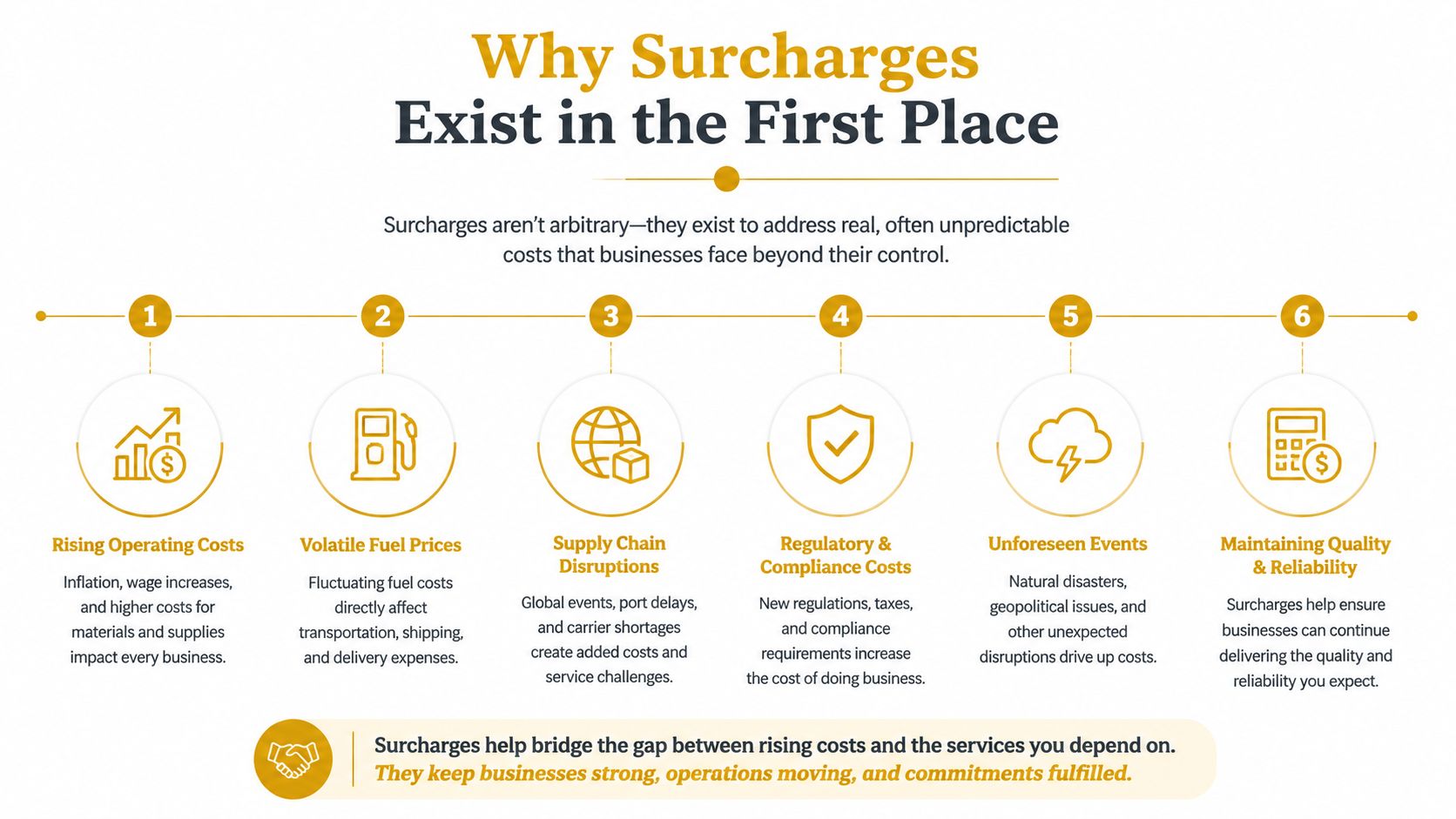
Carriers didn't create surcharges because a base rate was useless. They created them because a single headline price can't respond efficiently to every cost that affects a modern logistics network.
A simple point-to-point move may involve fuel consumption, tolls, labor, insurance, equipment availability, loading requirements, traffic, delivery restrictions, and final-site conditions. Those variables change at different speeds. A carrier that rebuilt its entire rate sheet every time diesel prices or access requirements shifted would make pricing harder for both sides.
Surcharges provide a separate adjustment layer. The base rate can describe the normal movement, while additional lines recover costs that are volatile, exceptional, or specific to the shipment. Reveel's explanation of shipping surcharges describes how these charges became routine as logistics networks grew more complex and variable costs increased. By 2026, industry guides describe surcharges as standard across major carriers including FedEx, UPS, USPS, and DHL, with some schedules updated weekly or monthly.
A base rate covers normal movement
For a standard parcel, the base rate may assume ordinary dimensions, a conventional delivery address, and routine handling. A construction-equipment shipment often breaks several of those assumptions at once.
A carrier may need to coordinate a lowboy trailer, verify route clearance, use specialized loading equipment, wait for a jobsite contact, or unload on a surface that won't support an ordinary trailer. The base linehaul covers the primary movement, but it may not cover the additional work.
That's why delivery to a construction site isn't always priced like delivery to a commercial dock. A locked gate, unpaved approach, tight turn, soft ground, or restricted delivery window can create labor and equipment requirements that the standard rate doesn't include.
Variable costs need a flexible mechanism
Fuel is the clearest example. Fuel surcharges are commonly connected to benchmark diesel indices rather than static tariffs, according to Reveel's carrier surcharge guide. When the carrier updates the fuel component, the final transport cost can change even if the quoted base rate remains unchanged.
The same principle applies to demand and capacity. Recent carrier updates include higher demand, oversize, and additional-handling surcharges. USPS also updated its dimensional-weight divisor from 166 to 139 in July 2026, which makes package size more likely to influence charges, as reported in ShipHerHQ's 2026 carrier rate update.
A surcharge is therefore best understood as a cost-allocation tool. It separates predictable transportation from conditions that require extra resources or change faster than the main rate card.
How Carriers Actually Calculate the Extra Fee
Most surcharge math follows one of two models. The carrier either adds a fixed fee to the shipment or applies a percentage to the base rate.
The fixed-fee model is straightforward. If a quote includes a set charge for a liftgate, limited access, or residential delivery, that amount remains the same regardless of the base freight cost. A $175 site-access fee stays $175 whether the base delivery is relatively low or relatively high.
The percentage model moves with the base transportation charge. A fuel surcharge, for example, may be calculated as a percentage of the linehaul and adjusted as fuel conditions change. The governing principle is documented in Octolize's breakdown of surcharge calculations, which identifies fixed-per-shipment and percentage-based charges as the two typical approaches.
A worked equipment-delivery example
Suppose a skid steer has a $900 base delivery rate. The carrier adds a 24% fuel surcharge, which equals $216, plus a $175 rough-terrain access fee. The landed delivery cost is:
- Base delivery: $900
- Fuel surcharge: $216
- Rough-terrain fee: $175
- Total delivered transport: $1,291
The calculation is:
$900 + ($900 × 24%) + $175 = $1,291
The fuel line changes with the base rate and the applicable surcharge percentage. The rough-terrain charge doesn't. That difference matters when you're budgeting equipment across a long project, comparing multiple delivery dates, or deciding whether to combine machines on one trip.
| Model | How It Works | Example on $900 Base Rate | Best Used For |
|---|---|---|---|
| Fixed fee | Adds a predetermined amount per shipment or service | $900 + $175 access fee = $1,075 before other charges | Site access, liftgate service, special handling |
| Percentage surcharge | Multiplies the base rate by a stated percentage | $900 + 24% fuel surcharge of $216 = $1,116 before other charges | Fuel and other variable cost programs |
Ask what the percentage applies to
A common billing mistake happens when a team assumes the percentage applies to the entire invoice. It may apply only to the base linehaul, or it may apply to a defined transportation component. Ask the carrier or rental provider to identify the calculation base, the effective date, and whether pickup receives the same treatment as delivery.
That question turns a confusing line into a checkable formula. You can then compare quotes on the same basis rather than comparing one vendor's base rate with another vendor's partially loaded total.
Surcharge Types That Show Up on Rental Orders
A telehandler may be headed to a gravel lot with a locked gate, while a scissor lift must arrive before a retrofit crew begins work. Those details change the transport job even when the rental order looks straightforward. Rather than treating surcharge names as fixed categories, use each invoice line as a clue about what happened at the site.
Start with the physical trigger
For every surcharge, ask: What physical condition or service caused this charge? Then check three details:
- Was the condition reported before dispatch? Compare the invoice with the site information sent to the rental provider.
- Is the fee fixed or variable? A fixed amount may relate to a service or handling requirement. A variable amount may depend on distance, fuel rules, equipment, or urgency.
- Can the carrier show the calculation? Request the rate basis, applicable dates, and the movement covered by the charge.
This turns a vague accessorial line into an item you can verify.
Check delivery and pickup separately
A delivery line covers the move from the rental yard to the project. Pickup may be billed separately because the return trip is treated as another transport leg. For a scissor lift, confirm whether the quote includes the initial drop, collection after the final inspection, or both.
Ask the provider to identify the origin, destination, and movement covered by each line. A quote that says “delivery” may not include removal when the machine is ready to return.
Match access fees to site instructions
Rough-terrain and limited-access charges should connect to a specific condition. The truck may need to leave pavement, cross mud or unfinished grade, wait at a locked gate, or unload where normal positioning is not possible. A telehandler delivered to an open equipment yard is a different job from one taken behind a locked construction gate.
Review the dispatch notes for these details:
- Surface: Paved, gravel, mud, compacted soil, or unfinished grade.
- Entry: Gate width, turning space, overhead clearance, and weight restrictions.
- Unloading: Truck position, safe unloading area, and whether a spotter is required.
- Contact: Site contact, gate instructions, and access times provided before dispatch.
If the invoice includes an access charge but the provider received accurate site information and faced no added work, ask which condition triggered it.
Test whether urgency changed the plan
Express or same-day fees relate to a delivery outside the normal booking window. The carrier may have rearranged a route, assigned equipment quickly, or used a different dispatch plan. A missing pump accessory discovered on the morning of a concrete pour is a practical example of the situation.
Compare the requested time with the confirmed delivery window. Then ask whether the rush charge was approved before dispatch and whether it covers delivery only or another service as well. Early confirmation of the equipment, window, and site can prevent an avoidable urgent move.
Separate variable fuel lines from equipment handling
A fuel surcharge may change according to the carrier's schedule or diesel benchmark, so verify the calculation base rather than assuming it applies to the whole invoice. Ask whether it covers delivery, pickup, or both, and whether the same rule applies to the equipment move being billed.
Oversized or overweight handling requires a different check. Boom lifts, telehandlers, excavators, and large scissor lifts may need special routing, permits, an escort, a different trailer, or a route review. Match the line to the machine's dimensions and weight, then request the supporting service or permit detail.
The useful review is simple: connect every fee to a site condition, a dispatch decision, or a documented calculation. If the line cannot be connected to one of those items, pause payment and request clarification.
How Stacked Fees Reshape the Final Invoice
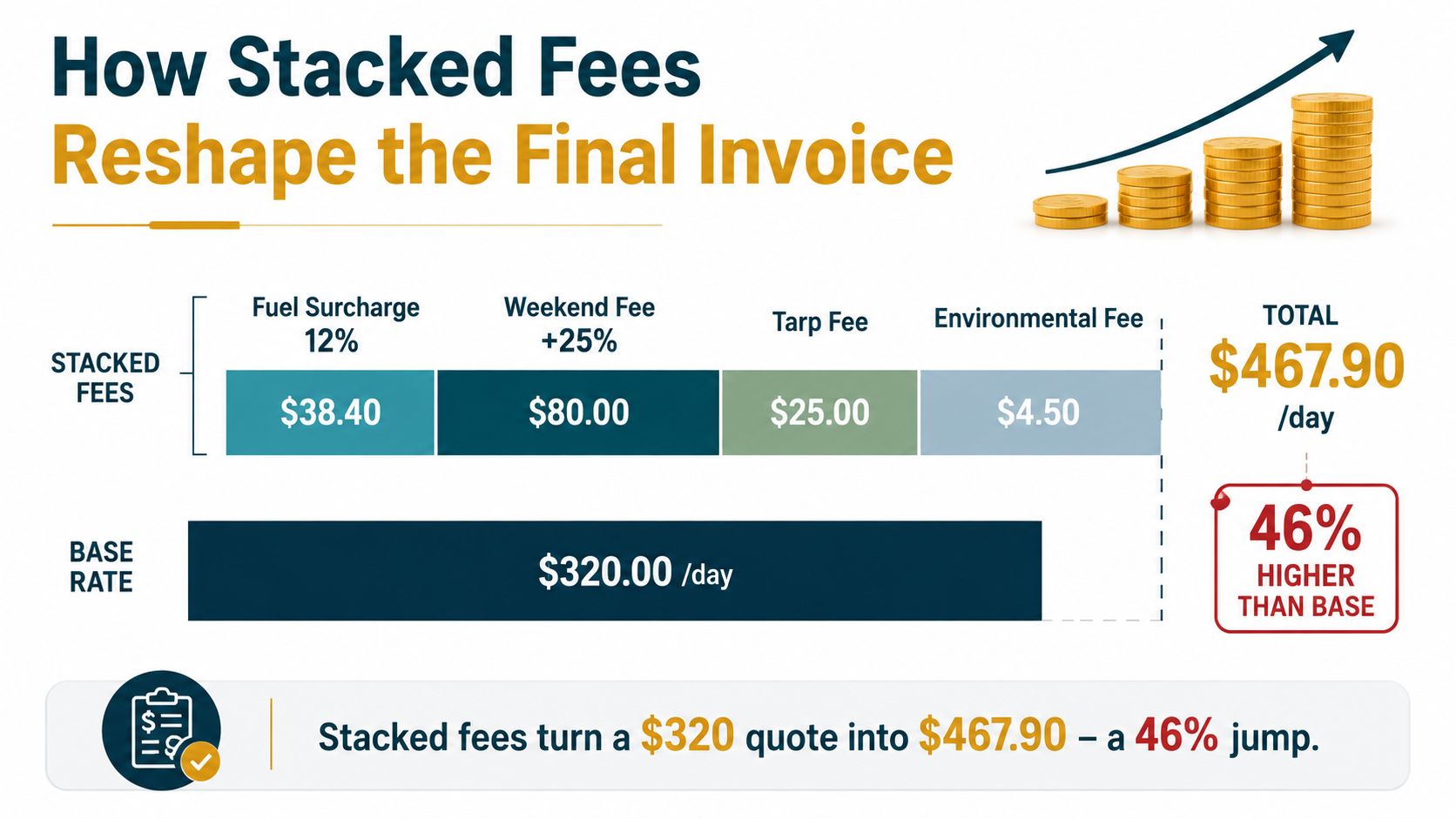
A project manager approves a $2,000 equipment delivery, then sees several smaller lines added before payment. Each charge may be reasonable on its own, yet together they can change the rental decision.
Industry sources report that accessorials can add about 8–15% to a freight invoice. On a $2,000 delivery, that range equals roughly $160 to $300 before other adjustments. Fuel surcharge programs may also represent roughly 15–25% of base line-haul, as detailed by Octolize's shipping surcharge analysis. The practical lesson is to test the fee rules against the actual delivery, not judge them by a percentage alone.
A construction-rental quote might begin with a base rate for delivering a rough-terrain forklift. The final invoice can then include a fixed equipment-movement charge, a fuel percentage, and a site-access fee. If express service is added because the machine must reach the jobsite before a scheduled lift, the original vendor comparison no longer shows the true cost.
Compare totals, not isolated lines
Two vendors can quote the same boom lift at the same rental rate and still produce different delivered totals. One may include standard delivery, while another advertises a lower base rate and bills fuel, access, and pickup separately.
Use a worksheet like this:
| Cost component | Vendor A | Vendor B |
|---|---|---|
| Equipment rental | Enter quote | Enter quote |
| Base delivery | Enter quote | Enter quote |
| Pickup | Enter quote | Enter quote |
| Fuel surcharge | Enter quote | Enter quote |
| Site-access fee | Enter quote | Enter quote |
| Express or special handling | Enter quote | Enter quote |
| All-in total | Calculate | Calculate |
The lowest individual line does not determine the better offer. A vendor with a higher fuel surcharge may still have the lower all-in price if its base delivery rate is more competitive or its access fee is already included.
Recent 2026 coverage describes fuel surcharges near record levels, with ground surcharges above 26% and express fuel surcharges above 27%. It also describes ocean carriers adding peak-season and overweight fees of hundreds to thousands of dollars per container on major trade lanes. FreightWise's parcel and rate-update coverage shows why surcharge changes belong in budget reviews, not only invoice disputes.
The number that protects the budget is the delivered total, not the attractive number at the top of the quote.
Smart Moves to Anticipate and Reduce Surcharges
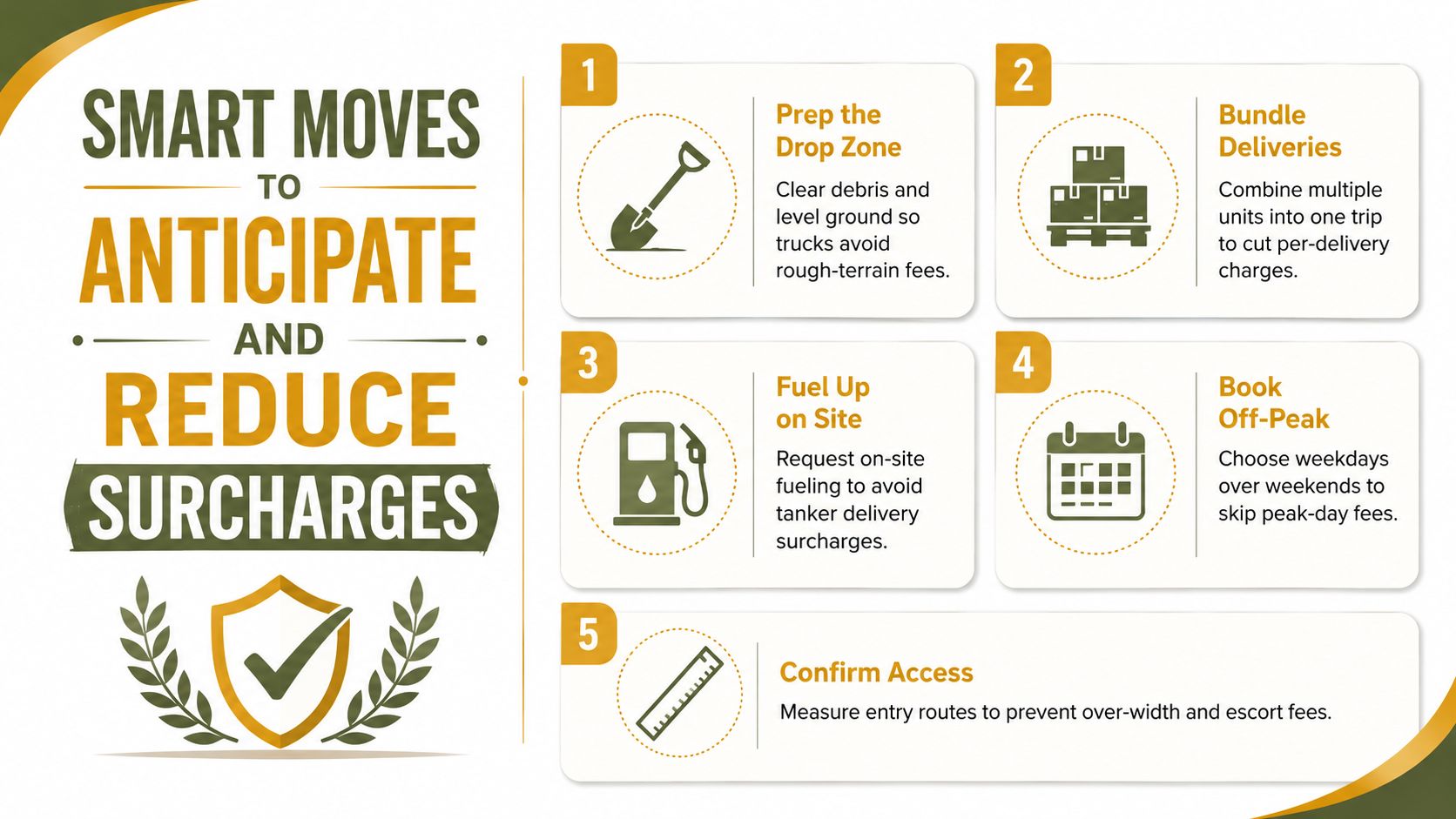
You can't eliminate every surcharge, but crews can remove avoidable triggers before the booking reaches dispatch. Treat the site plan as part of the transportation plan.
Prepare the drop zone
Clear debris, level the unloading area, and confirm that the truck can reach a stable position. This directly addresses rough-terrain and limited-access charges. If the ground is soft, tell the provider before booking rather than letting the driver discover the problem at the gate.
Bundle equipment
If several machines are needed from the same yard, ask whether the provider can combine them into one planned haul. A boom lift, skid steer, and attachments may require different transport arrangements, but early coordination can reduce repeated delivery movements.
Book standard windows
Avoid rush scheduling when the project calendar allows it. Booking a normal delivery window gives the dispatcher more flexibility than requesting same-day service after the crew has already arrived.
Confirm access details
Send gate codes, site contacts, delivery instructions, and route restrictions in writing. Measure the entrance and check overhead clearance for tall equipment. This helps prevent failed delivery attempts, waiting charges, and last-minute route changes.
Request an all-in price
Ask the vendor to provide the complete delivered and picked-up cost, including known fuel, access, handling, and express charges. If the fuel component can change, ask how and when the provider recalculates it.
Before you approve: Ask, “What could make this quote higher before delivery occurs?”
A five-minute phone call can reveal a surcharge that an hour of rate shopping would miss. The conversation should cover the equipment dimensions, destination type, access surface, delivery window, pickup plan, and every fee that may be added later.
Key Takeaways and the Road Ahead
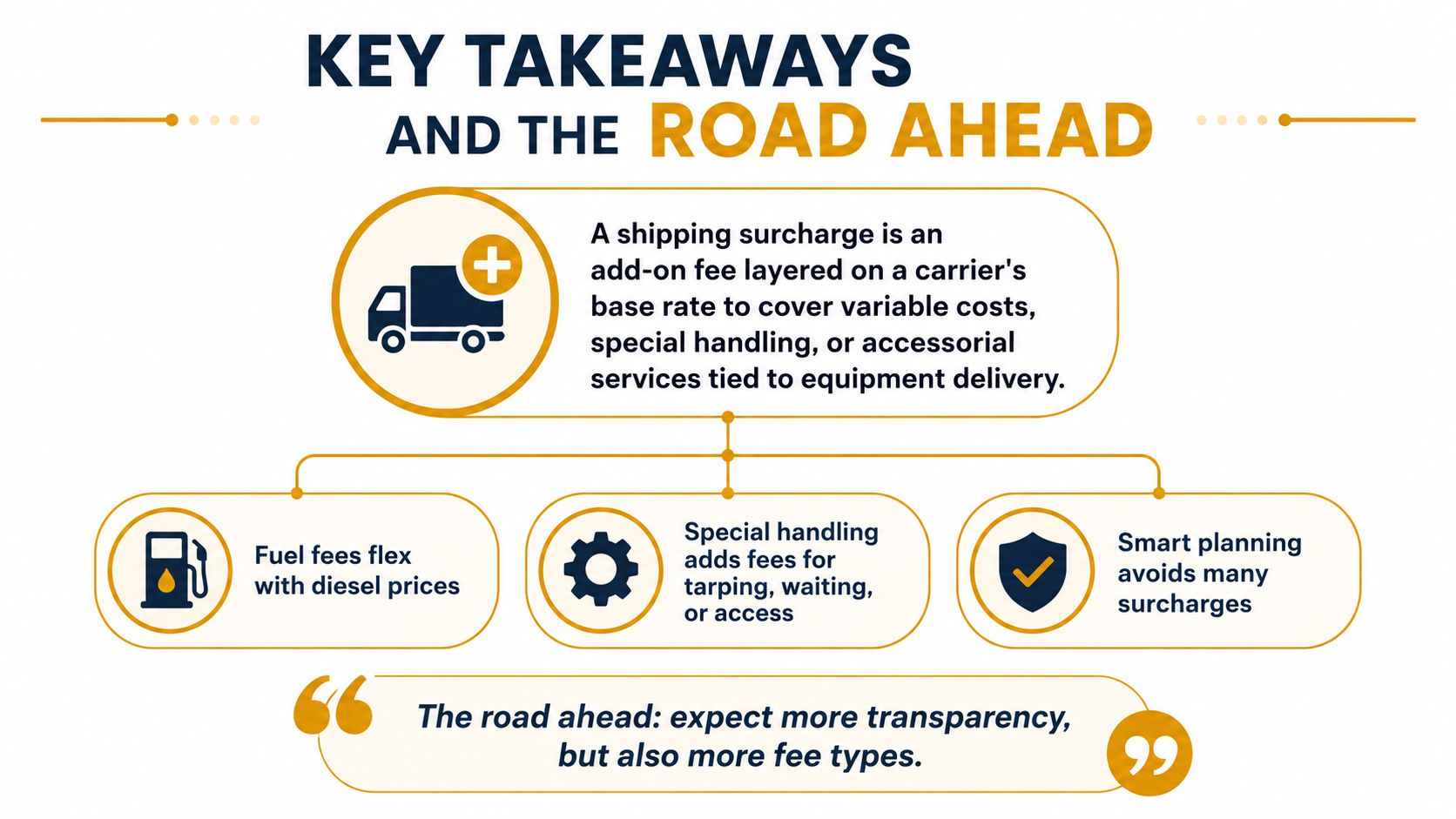
Before approving an equipment-rental quote, check three things. Request the all-in delivered price, not only the daily equipment rate. Map each surcharge to a real site condition, such as rough access, oversized handling, fuel, pickup, or express delivery. Confirm whether each fee is fixed or calculated from a percentage of the applicable base rate.
That review works like checking a rental machine before it leaves the yard. The quote should show what service is being purchased, which condition triggers the fee, and whether the amount can change. A fixed delivery charge is easier to budget than a fuel or percentage-based fee that moves with the underlying rate.
Use the site details to test the quote. Provide dimensions, entrance measurements, surface conditions, gate information, route restrictions, delivery windows, and the pickup plan. These details help the carrier price the move before dispatch instead of adding charges after a failed attempt or difficult access.
Keep the invoice review practical. Ask, “What could make this quote higher before delivery occurs?” Then compare the delivered and picked-up total, not competing headline rates. For construction teams, clear access information and early scheduling can prevent a small rental price from becoming an unexpectedly large transport bill.

