
Civil Infrastructure Projects: A Practical 2026 Guide
You're standing at the edge of a pour, trucks are staged, the pump line is primed, and somebody is asking where the washout is going to go before the first chute swings. That's the actual life of civil infrastructure projects, not the glossy ribbon-cutting version. The work is a chain of decisions, and if one link is weak, the site feels it fast in rework, delays, permit trouble, or a mess the crew has to clean up at the end of the shift.
What Counts as a Civil Infrastructure Project
The cleanest way to define civil infrastructure projects is by what they build and who depends on them. Roads, rail, bridges, tunnels, water systems, utility corridors, flood control, and sitework all sit in the same family because they shape how people move, how water is managed, and how communities function. Heavy civil work also tends to be horizontal rather than vertical, which means the job is often spread out, exposed to weather, and tied to public right of way, easements, or regulated land.
A morning on a bridge pour makes the definition feel obvious. The superintendent is watching delivery timing, the foreman is checking forms and rebar, the environmental lead is looking at the washout area, and someone is waiting on a submittal before the next placement can start. That mix of earthwork, structural work, concrete, utilities, and compliance is what separates civil jobs from a typical building project.
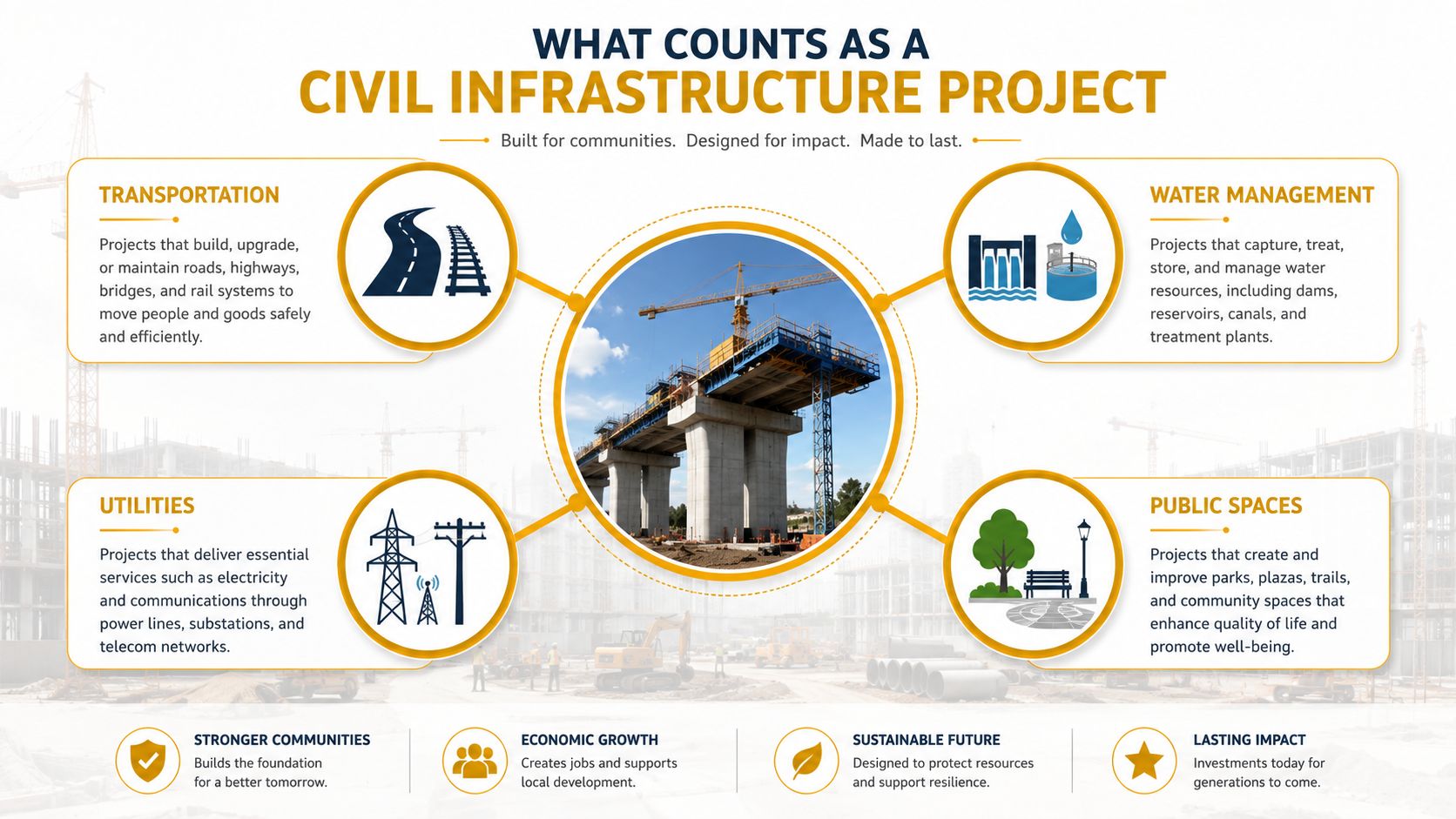
The working typology crews actually use
A practical project team usually sorts the work into four buckets. Transportation covers roads, bridges, rail, tunnels, and transit corridors. Water management includes dams, stormwater systems, drainage, treatment, and flood control. Utilities covers power, telecom, and buried service corridors. Public spaces show up as plazas, parks, and site improvements where grading, access, and drainage still matter.
That categorization matters because it changes the rules, the stakeholders, and the long tail of ownership. A private developer may own the asset from day one, but many civil assets shift to public agencies or utility operators after handover. That handoff affects submittals, warranty documentation, maintenance planning, and who answers when something settles, leaks, or clogs.
Practical rule: if the asset will still be serving people twenty years from now, treat it as more than a construction job. The build is only one part of the job.
The category also helps new hires and clients understand why civil work feels different. It's not just excavation and concrete. It's the controlled assembly of public systems that have to survive traffic, water, weather, regulation, and maintenance.
The Lifecycle from Planning to Maintenance
A short bridge replacement is the easiest way to see the full lifecycle. The path is simple on paper, planning, design, procurement, construction, commissioning, operations and maintenance. In the field, each step hands off something specific, and the handoff is where jobs either stay clean or start bleeding time.
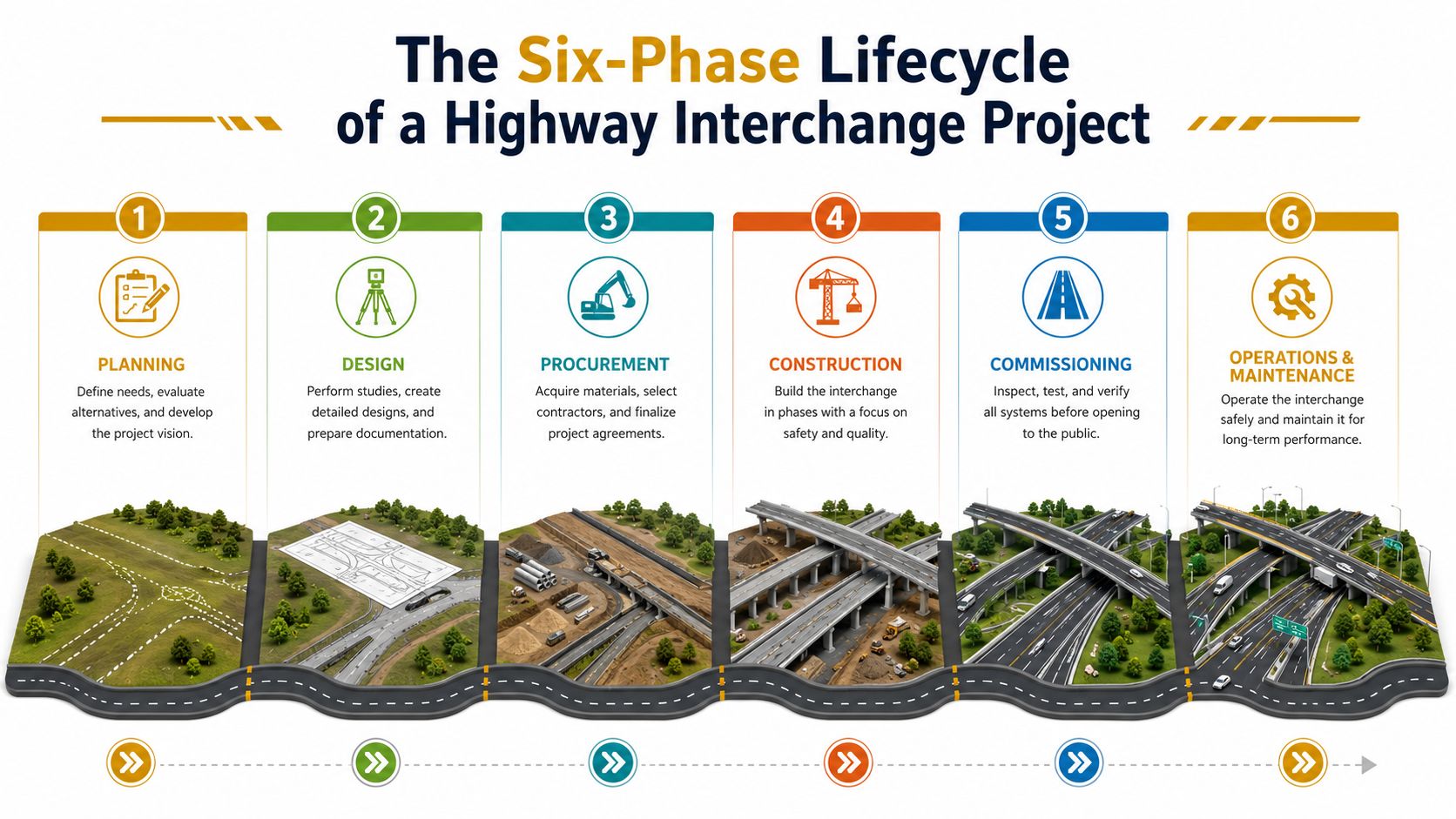
Planning and design need real field data
Planning starts with the questions that decide whether the job is buildable. The IRC bridge preparation manual calls for an index map, route and topographical context, and geological and other site data because those inputs affect design and construction operations, and incomplete subsurface or alignment information can force redesign later IRC bridge project-preparation manual. That's not theory. A survey gap at the beginning can become a changed footing, a different temporary works plan, or a revised sequence after excavation starts.
Civil plans then turn that field knowledge into an executable package. Site, grading, utility, and structural information have to line up, because mismatches create rework and change orders. The best teams treat early survey and subsurface investigation as production inputs, not paperwork. They capture site data where the work happens and connect it to schedule and cost systems so the drawing set reflects current conditions, not old assumptions.
Procurement, construction, and handover are one chain
Procurement is where the sequence can get bent. If a long-lead item lands late, the field doesn't care that the procurement log was green last month. Crews care that the next activity is waiting on steel, pipe, formwork, or a specialty piece of equipment. That's why the procurement package has to match the construction sequence, not just the estimate.
Construction is where the job becomes physical, and commissioning is where the project proves it can operate. A good handover package includes as-builts, O&M manuals, inspection records, and the maintenance assumptions the owner needs to keep the asset alive. If those documents are thin, the owner inherits a functioning asset with a weak memory.
The last step is the one many teams underfund. Operations and maintenance should be planned from the start, because the asset doesn't stop costing money when the ribbon is cut. It moves into a different cost bucket.
Schedule, Cost, and Safety Risks That Actually Hit Crews
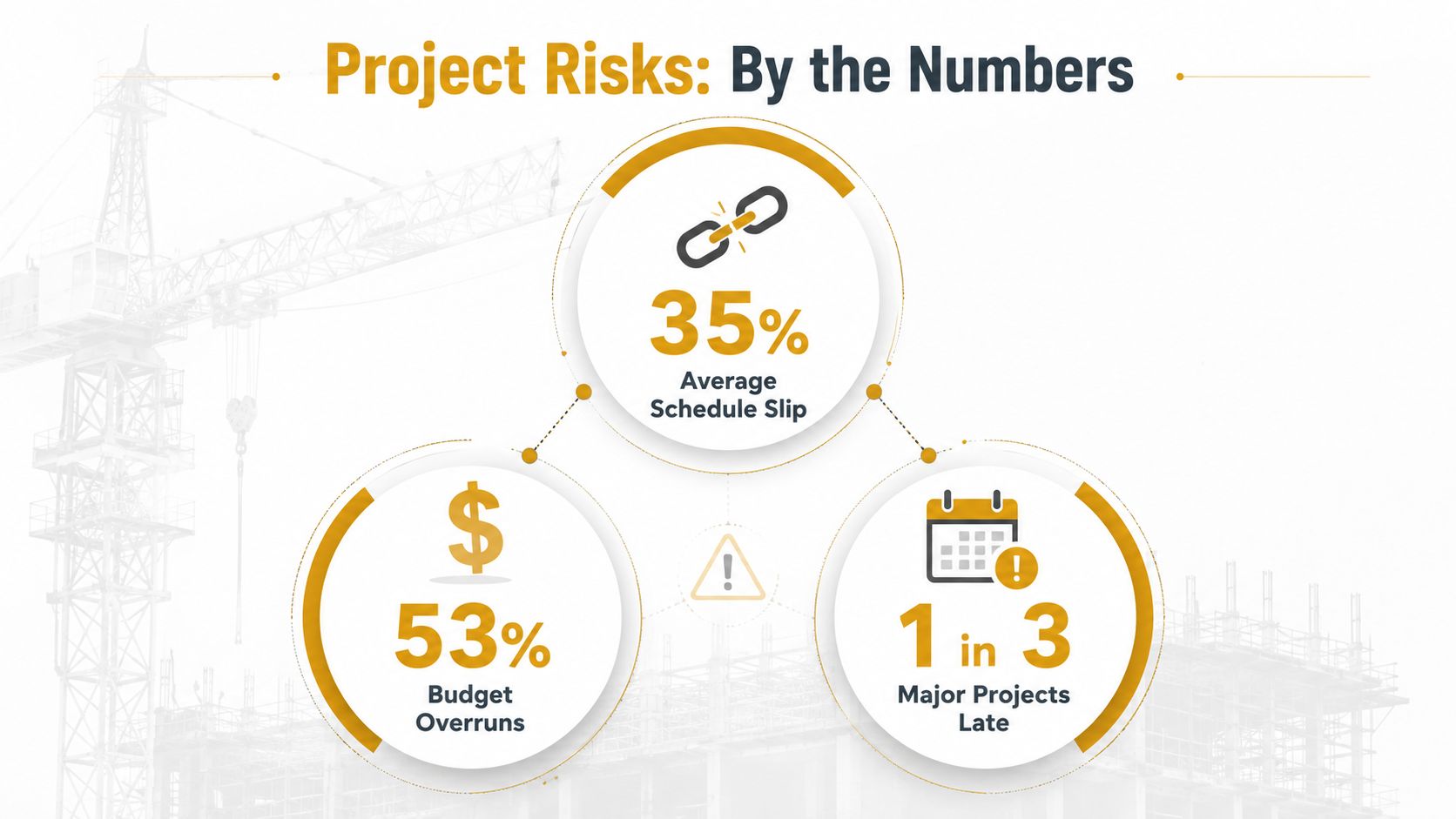
The benchmark numbers are blunt. About one-third of major transport infrastructure projects exceed their estimated schedule, the delayed projects average 35% schedule overrun, the average overrun across all transport projects is 12%, and 53% exceed their estimated cost International Major Infrastructure Projects Benchmarking Review. That isn't a story about bad luck. It's the shape of the work.
The five risks a superintendent feels first
Long-lead schedule risk shows up when the critical path depends on one item that hasn't arrived yet. The fix is boring and effective, track submittals, approve early, and tie the lookahead plan to real delivery dates.
Commodity and quantity cost risk hits when a job burns through concrete, aggregate, fuel, or haul costs faster than expected. Crews can't control the market, but they can control waste, breakage, and bad sequencing that causes extra mobilizations.
Multi-trade safety risk grows when crews, subs, pump trucks, inspectors, and utility crews all work in the same footprint. The more interfaces on site, the more important traffic control, lift planning, and clear access become.
Environmental risk often starts as a simple housekeeping problem. Poor washout control, sloppy stockpiles, and weak drainage management turn into inspection headaches fast.
Stakeholder and permit risk shows up when a condition in the permit, traffic plan, or access agreement wasn't read closely enough. A field team can do good work and still lose time if the public-facing obligations weren't mapped into the schedule.
Field habit: keep a short risk register that lives with the lookahead plan, not in a binder nobody opens. If the risk doesn't affect a crew tomorrow, it doesn't need a novel. If it does, it needs an owner.
A superintendent doesn't need abstract risk language. The job needs a daily list of what might stop trucks, stop pours, or stop approvals. That list is where schedule control begins.
Permitting, SWPPP, and Erosion Control on Site
Permitting isn't an upstream formality. It shapes where the trailer goes, where material gets staged, where discharge can happen, and what the inspector expects to see before the first wet activity starts. A site that looks efficient on paper can be a problem in the field if the controls weren't laid out with the permit conditions in mind.
Start with the site layout, not the paperwork stack
A good SWPPP turns water management into field actions. Crews need stabilized entrances, inlet protection, sediment control, and a designated washout area that is visible, accessible, and kept out of traffic paths. The logic is straightforward. If stormwater can carry sediment or slurry offsite, the control needs to be in place before the discharge path exists.
A missing curb cut protection or a weak entrance treatment can become the first thing an inspector notices. That's why the best crews don't wait for the next inspection to fix obvious problems. They walk the site after rain, after deliveries, and after concrete work, because those are the moments when erosion controls get stressed.
A practical SWPPP review should answer three questions. Where can water leave the site, what controls stop that water from carrying pollution, and who is responsible for checking those controls? If the answer to any of those is unclear, the field will feel it.
Read the narrative like a foreman
The narrative matters because it tells the crew how the site is supposed to behave. It should identify the discharge points, the inspection rhythm, and the corrective action process. If the document names a control, it needs to exist on the ground. If the site changes, the control plan has to change too.
That's why washout containment belongs in the permit conversation early. Concrete work creates its own compliance pressure, and the washout area is part of the site's water protection system. It's not a separate convenience item.
Concrete Work and Washout Containment That Actually Works
Concrete is where a lot of good plans get messy. The pump is moving, the chute is swinging, vibrators are running, and the crew is focused on placement, finishing, and timing. When the pour is done, the washout doesn't go away, it becomes the environmental condition the site has to manage before the next truck shows up.
Concrete washwater and slurry are highly alkaline, and uncontained washout is one of the quickest ways to create a SWPPP problem. The fix is simple in concept, but it works only when the containment is part of the pour plan, not an afterthought.
Put the washout where the work actually happens
The washout area should sit close enough to the chute or pump that crews will use it, but not so close that it blocks traffic or gets buried in the delivery path. If the pan is off to the side in a spot nobody wants to walk to, somebody will improvise somewhere else. That's how violations start.
Capacity matters too. The pan has to fit the volume and residual from the trucks and pump cleanup, with enough room that a rushed crew isn't trying to top it off or spread it thin. Pickup timing matters just as much. If the next pour is scheduled before the container is emptied, the site is already behind.
For teams evaluating a rental, one option is a concrete washout pan from Reborn Rentals, which is positioned as a site-compliance tool for washout containment on construction and civil jobs. That kind of equipment is most useful when the pour location, access path, and pickup timing are all planned together.
Compare the pan to the failure cost
| Spec | Heavy-Duty Pan | Standard Pan |
|---|---|---|
| Best use | Repeated pours, tighter site controls, higher residue volume | Smaller pours, lighter-duty placement, simpler access |
| Field advantage | Better tolerance for rough handling and more demanding schedules | Easier to deploy when the washout need is limited |
| Planning focus | Match it to pump cleanup, truck count, and site access | Match it to a shorter duration and lower residue load |
A rent line is easier to defend than a failed inspection or a cleanup that pulls labor off the pour. The right comparison isn't rental versus nothing. It's planned containment versus avoidable cleanup, rework, and delay.
Practical rule: if the crew will spend more time arguing about where to dump slurry than placing concrete, the washout plan is already too weak.
The best washout setup is the one the field can use without thinking. Place it well, size it properly, and get it picked up before it becomes one more thing the superintendent has to chase.
Community Engagement and Lifecycle Cost Beyond the Ribbon-Cutting
The least appreciated delivery risk on civil work is often the one outside the fence. Independent and policy sources say success depends on early, continuous engagement, co-design, transparent stakeholder mapping, and publishing project pipelines so communities and suppliers can anticipate what's coming ASCE civil engineering source. That matters because opposition, confusion, and mistrust show up later as delay, redesign pressure, or slower buy-in.
Engagement is a field risk, not a public relations task
If a project affects access, noise, drainage, traffic, or local livelihoods, the community will notice it long before the final inspection. The weak move is to treat engagement like a checkbox after design is basically done. The stronger move is to identify who needs to know what, when they need to know it, and what kind of response the project can realistically absorb.
The practical pattern is simple. Ask who is affected, what concerns they'll raise, and which decisions are still flexible enough to respond. That's where early workshops and clear mapping help. They don't eliminate conflict, but they reduce the surprise factor that turns manageable issues into schedule problems.
Lifecycle cost belongs in the budget from day one
The World Bank notes that disadvantaged-region infrastructure planning should explicitly anticipate maintenance costs, not just initial build costs, because long-term service can fail when upkeep is underfunded World Bank transport blog. The National League of Cities also pushes lifecycle thinking and matching funding to project milestones, which is the right instinct for any owner who has to keep the asset working after turnover National League of Cities infrastructure finance guidance.
That changes the budget conversation. A project that looks cheaper at award can become expensive if it ignores maintenance access, compliance obligations, or operating revenue needs. The owner inherits not only the asset, but the responsibility to inspect it, repair it, and keep it functioning.
A useful budgeting habit is to reserve a visible line for post-completion upkeep, testing, and compliance follow-up. If the team can't explain how the asset will be maintained, the project isn't finished. It's just handed off.
A Field-Ready Checklist for Project Teams
Use the checklist below in the same order the job moves.
- Planning deliverables: confirm survey control, topographic context, and subsurface investigation are complete before design locks in.
- Design handoffs: verify site, grading, utility, and structural packages agree on elevations, corridors, and access.
- Community input: schedule a co-design or stakeholder meeting early enough that the team can still adjust access, staging, or phasing.
- Procurement gate: tie long-lead items to the construction sequence, not just to the estimate.
- Pre-pour readiness: confirm the washout area is included in SWPPP coverage, easy for the crew to use, and out of the traffic line.
- Containment check: verify pan capacity against the expected pump cleanup and truck residual.
- Inspection rhythm: keep the erosion control log current and assign one person to correct issues fast.
- Pre-handover package: collect as-builts, O&M material, and maintenance assumptions before the last crew demobilizes.
The best civil jobs don't win because everything goes perfectly. They win because the team keeps the field, the paperwork, and the maintenance plan pointed in the same direction. If you're putting together a pour plan, a SWPPP correction, or a bridge replacement package, use this list before the next truck rolls. A cleaner site, a better handoff, and a more realistic maintenance plan start with the same habit, checking the details while there's still time to fix them.
If you're lining up washout containment for an upcoming pour or trying to keep a civil site cleaner through the concrete phase, review the rental options at Reborn Rentals and match the container to your pour schedule, access route, and pickup timing before the next truck arrives.