
Compactor Receiver Box: A Site Manager’s Guide
By mid-morning, most active jobs already have the same problem. Cutoffs are piling up near the saw station, broken pallets are leaning against a fence, cardboard is blowing across the laydown yard, and somebody is asking where to dump washout after the next concrete load. If that waste stream isn't controlled early, the site gets harder to run by the hour.
A clean site isn't about appearances. It affects labor efficiency, truck access, fire exposure, housekeeping, and whether your stormwater controls work. The container you choose often plays a bigger role than typically recognized. A Compactor receiver box can solve two very different site problems when it's selected correctly. It can handle routine compacted debris from a stationary compactor, and in the right configuration it can also serve as a contained solution for concrete washout and slurry management.
The Unsung Hero of Job Site Waste Management
On a busy commercial site, waste doesn't arrive in one neat pile. It shows up in waves. Framing scrap in the morning, packaging by lunch, drywall offcuts in the afternoon, and wet concrete residue whenever pours or pumping wrap up. If crews don't have the right destination for each stream, they improvise. That's when you get scattered debris, overloaded dumpsters, and washout ending up where it shouldn't.
Most project managers focus first on production equipment. That's normal. Cranes, pumps, lifts, and delivery sequencing are obvious schedule drivers. Waste handling gets treated like a support task until it starts slowing work down or creating a compliance issue.
Practical rule: If laborers are walking waste across the site because container placement or container type is wrong, you're paying for the wrong system every hour.
A compactor receiver box earns its keep because it supports both workflow and control. For dry debris, it pairs with a stationary compactor so crews can keep feeding material without relying on open-top dumping alone. For concrete operations, a sealed and properly specified box can act as a contained collection point for washout material that would otherwise threaten soil and stormwater protections.
Why ordinary disposal setups fall short
A standard roll-off works fine for many jobs, but it has limits. Light debris can blow out. Bulky material stacks inefficiently. Wet concrete residue can harden where you don't want it. If the waste stream changes during the project, the original dumpster plan often stops matching field conditions.
Two site issues usually show up first:
- Lost time: Crews spend extra minutes breaking down material, relocating piles, or waiting for a swap.
- Exposure: Open or poorly contained waste creates tripping hazards, runoff concerns, and unnecessary cleanup.
What experienced teams look for
Good supers don't just ask, "Where do we throw this?" They ask a better set of questions.
- How is the waste generated: Continuous small loads, forklift dumps, chute-fed debris, or end-of-day cleanup all need different access.
- What happens when it's full: Can the container be hauled without shutting down the whole operation?
- Can it contain wet material safely: That's critical anywhere concrete trucks, pumps, saw cutting, or finishing work are involved.
A compactor receiver box isn't glamorous equipment. It is, however, one of those pieces that keeps a site from drifting into disorder.
What Is a Compactor Receiver Box
A compactor receiver box is the detachable container that accepts waste from a stationary compactor and carries that material off site for disposal. On a construction project, it is the part of the system that takes the abuse of repeated loading, compaction pressure, hauling, and swap-outs.
That matters because crews often call any large waste container a dumpster, then assume the equipment is interchangeable. It is not. A receiver box is built to connect to a stationary compactor and hold material after the ram packs it tight.
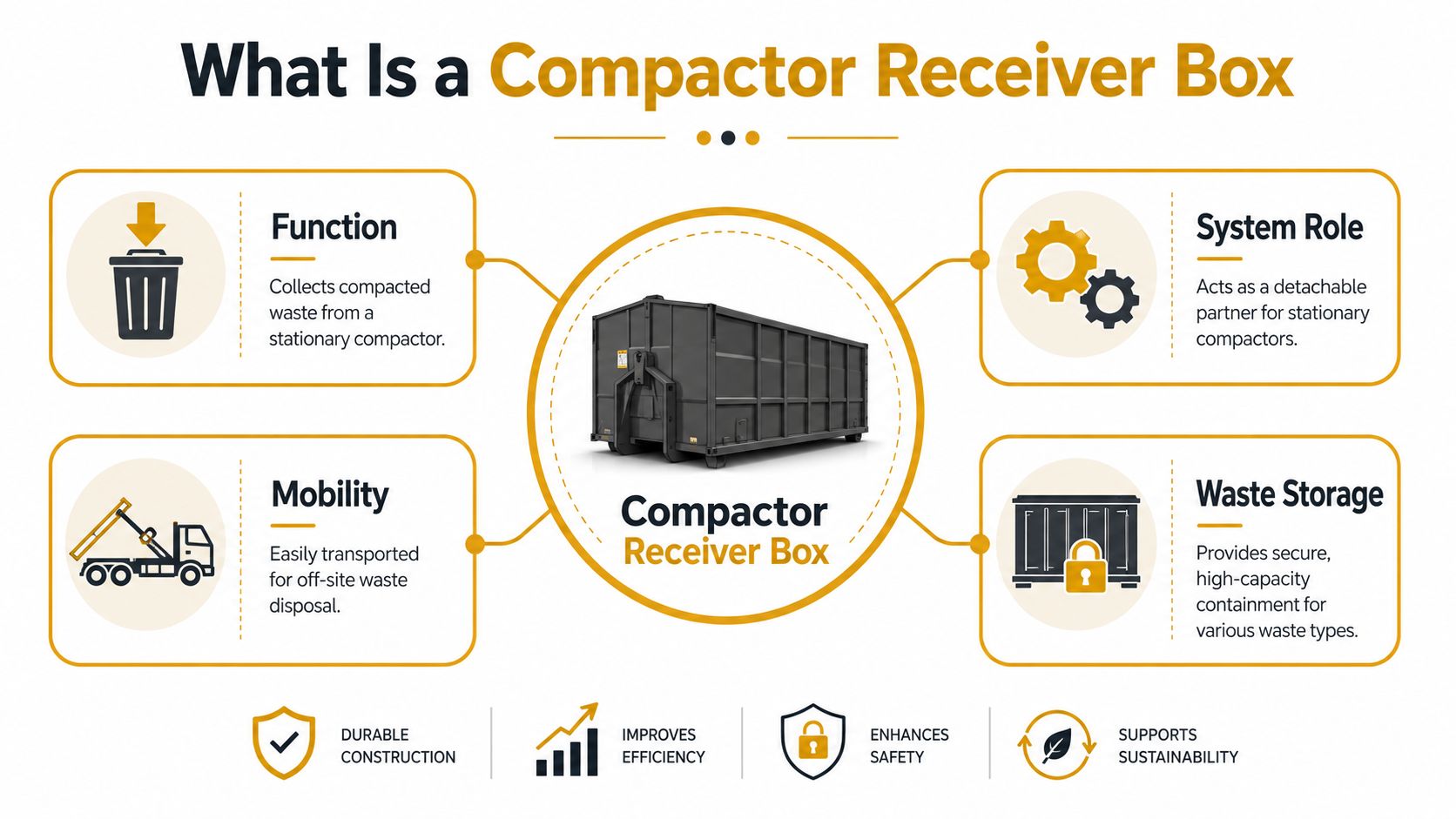
The detachable container in a fixed compactor system
In a stationary setup, the compactor head stays installed in one location. Crews load debris into the charge chamber, and the ram pushes it into the attached receiver box. Once the box is full, the hauler disconnects that container, removes it, and leaves the compactor in place for the next box.
That arrangement is one reason these units work well on active jobs with steady waste generation. The loading point stays put. Site logistics stay more predictable. You are not repositioning the whole compactor every time the container needs service.
From a rental and operations standpoint, that detachable box is what gives the system flexibility. Reborn Rentals sees that on sites handling mixed packaging, wood, and plastic one week, then needing controlled containment for concrete washout on another phase. The box is still the haul-away piece, but the material and compliance standard can change fast.
How it differs from a standard roll-off
A standard roll-off is built mainly to hold loose material loaded from the top or through a rear door. A receiver box has a different job. It has to mate correctly with the stationary compactor and stand up to repeated force at the connection point, floor, and sidewalls.
Here are the field differences that affect planning:
| Equipment | Main role | Typical loading method | What gets hauled |
|---|---|---|---|
| Standard roll-off dumpster | Holds loose waste | Top-load, walk-in door, machine dump | Entire container |
| Stationary compactor | Compresses waste | Hopper, chute, dock, or hand feed | Stays on site |
| Compactor receiver box | Holds compacted waste | Receives waste from ram | Container only |
That last point drives labor and housekeeping. Compacting waste into a receiver box reduces the volume of loose debris around the loading area and can cut the number of hauls compared with open-top disposal. On the right project, that means less congestion, fewer windblown materials, and a cleaner pad around the waste station.
What breakaway means in plain language
Haulers and equipment reps often call this a breakaway box. The term means the receiver box disconnects from the stationary compactor for transport. The compactor stays anchored and ready for the replacement container.
That setup is useful for ordinary construction debris, but it also matters for specialized containment. If a project needs a properly specified box for concrete washout or slurry-related material, detachability makes pickup and replacement more controlled. The system can support production while helping the site contain wet waste, protect soil, and stay aligned with stormwater requirements.
That is the practical definition. A compactor receiver box is not just a metal container. It is the haul-away half of a fixed waste system, and on some jobs it pulls double duty for both general debris and managed concrete-related waste streams.
Understanding Key Specifications and Sizes
A receiver box earns its keep or creates headaches based on details that are easy to miss during ordering. On a construction site, the wrong box shows up later as extra hauls, poor housekeeping, leak risk, or a driver who cannot swap it safely without shutting down part of the job.
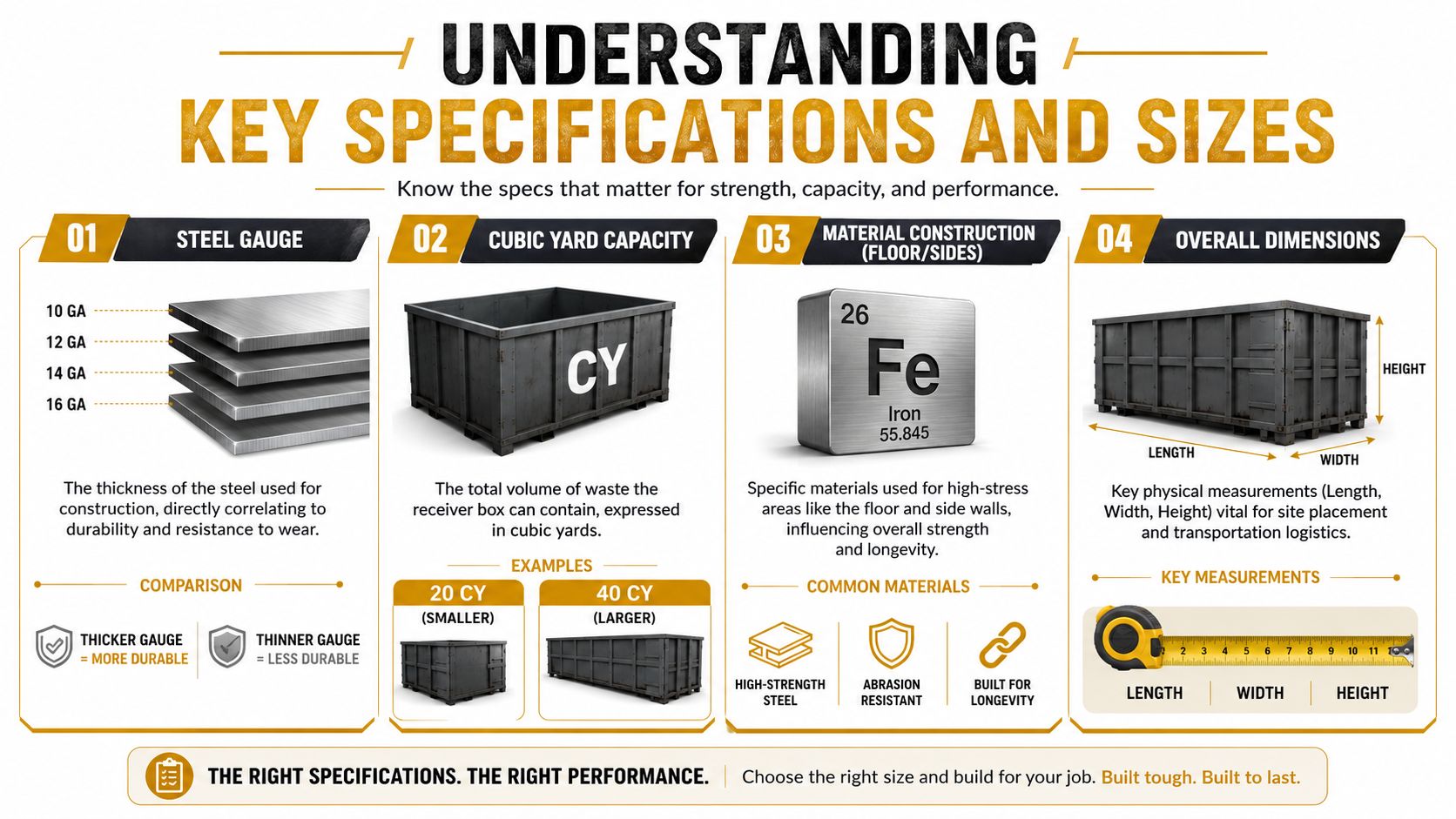
Steel thickness and wear areas
Start with the floor, lower sidewalls, and the nose where the box connects to the compactor. Those are the areas that take repeated stress during loading, compaction, disconnect, and haul-off. If the waste stream is light packaging, standard construction usually holds up fine. If the box may also handle concrete residue, slurry solids, or mixed abrasive fines, wear shows up faster and repairs get expensive.
I look for steel where the punishment happens, not just a heavy overall build. Floors take drag and impact. Lower walls take abrasion from dense material shifting inside the box. The connection point takes abuse every time the hauler pulls and resets the container.
Check these areas before renting:
- Floor construction: Handles impact, standing moisture, and dense loads sliding forward during transport.
- Lower wall reinforcement: Helps prevent bowing, denting, and premature wear.
- Nose and connection area: Needs to stay square and sound through repeated hookups.
- Weld quality: Clean, continuous welds matter more than fresh paint.
Capacity is tied to service rhythm and site access
Receiver boxes are usually discussed by cubic-yard class, but size selection is an operations decision, not a catalog decision. A larger box can cut swap frequency. It also takes more room to stage, more turning clearance for the truck, and more discipline around fill levels.
As noted earlier, larger stationary compactor setups are often paired with larger receiver boxes. That does not mean bigger is better on every project. On tight urban jobs, a mid-size box with reliable pickup service often works better than a large box that crowds fire lanes, backs up deliveries, or sits too long before haul-off.
A quick field-level comparison:
| Capacity class | Best fit | Watch for |
|---|---|---|
| Smaller receiver box | Tight sites, lighter debris stream, frequent service | More haul coordination and less buffer for peak cleanup days |
| Mid-size receiver box | Steady waste generation with manageable site traffic | Requires a clear service lane and disciplined loading |
| Larger receiver box | High-volume jobs with space for staging and truck access | Wasted footprint on cramped sites and overloaded boxes if crews treat size as a free pass |
Features that matter for concrete washout
A box that performs well for dry compacted debris may still be a poor choice for concrete-related waste. That is the trade-off many project teams miss. Reborn Rentals works in both waste handling and concrete washout containment, and the box spec has to reflect that dual role if the site expects one container strategy to support both needs.
For concrete washout or slurry-heavy material, treat the receiver box like a containment unit first. Capacity still matters, but containment controls the risk. Wet concrete waste can leak, track across the pad, stain pavement, and create stormwater problems fast if the tailgate, welds, or floor are not up to the job.
For that use, check for:
- Sealed tailgate
- Tight contact points and good closure condition
- Sound welds with no visible cracks or patch failures
- Floor and lower wall construction suited to wet, heavy contents
- No obvious leak path during staging, loading, or transport
Wet concrete waste changes the standard. Once slurry and wash water are involved, the box has to contain material reliably, not just hold volume.
That is the practical difference between ordering a generic receiver box and ordering one that fits the work. If the job includes both everyday construction debris and managed concrete washout, the right specification protects production, keeps the waste station cleaner, and helps the site stay aligned with environmental requirements.
Primary Use Cases on Construction Sites
A compactor receiver box pulls double duty when it's chosen for the right application. Most crews know the first use. Fewer take full advantage of the second.
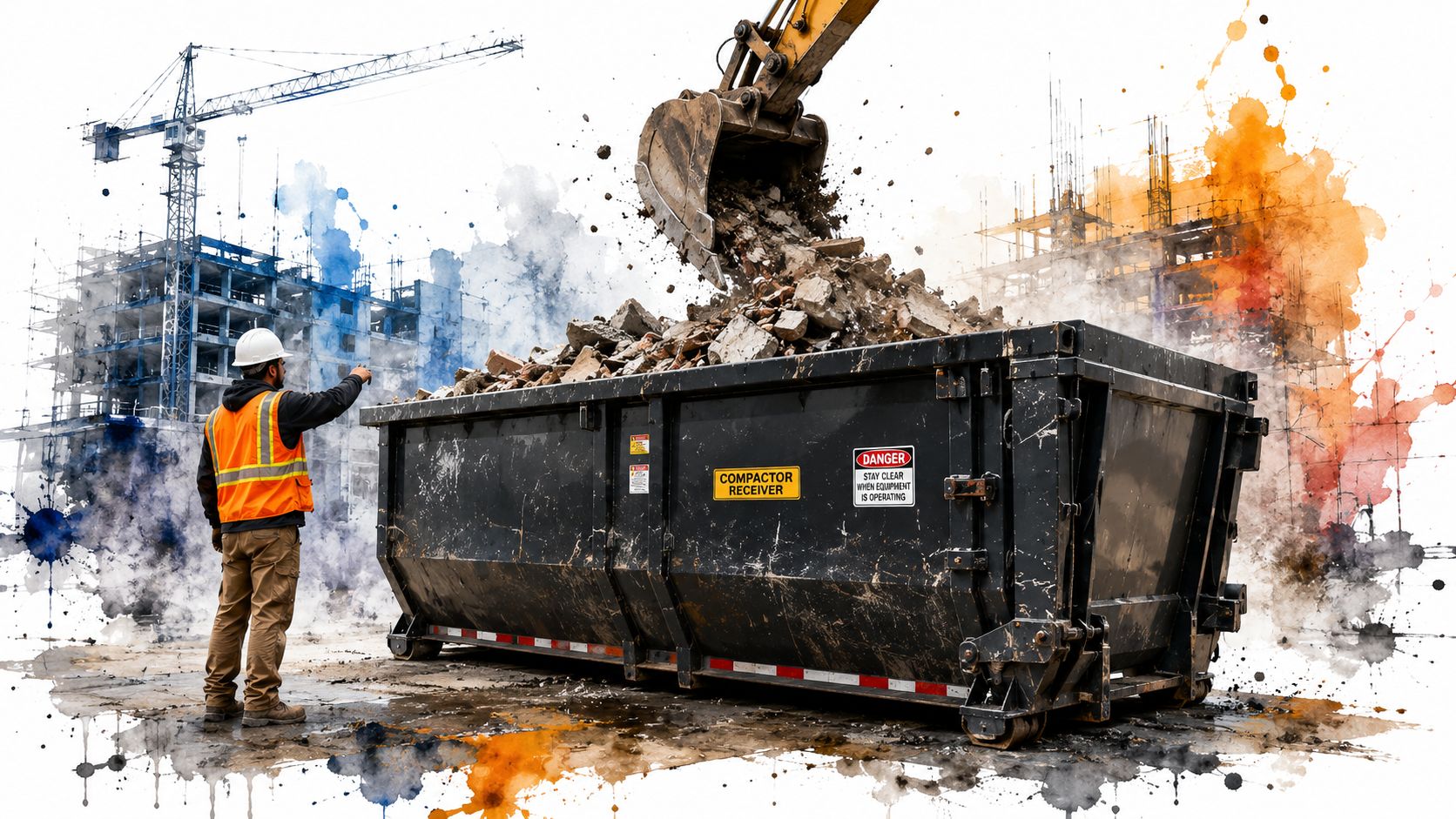
Dry debris from everyday construction activity
The standard use case is straightforward. A stationary compactor feeds a receiver box with dry, compactable waste generated by normal construction operations. Think wood offcuts, cardboard, plastic wrap, drywall packaging, and similar debris that eats space fast when left loose.
This setup works best when the project generates a steady stream of material instead of occasional cleanup piles. Distribution-style jobs, large tenant improvements, manufacturing buildouts, and commercial ground-up work all fit that pattern.
It tends to outperform open-top disposal when the site is dealing with:
- Bulky packaging waste: Pallets, wrap, and boxes create a lot of air space if they aren't compacted.
- Controlled loading areas: Dock-fed, chute-fed, or designated laborer-fed stations keep debris where it belongs.
- Housekeeping-sensitive jobs: Sites with public exposure, limited laydown room, or strict housekeeping standards benefit from closed, directed disposal.
What doesn't work is using a compactor system as a catch-all for random mixed material. Rebar, long timbers, large metal pieces, and heavily contaminated debris can create jams, damage, or inefficient loading patterns.
Concrete washout and slurry containment
This is the use case that deserves more attention. On projects with active concrete work, crews need a reliable place for truck chute rinseout, pump washout, tool cleaning residue, and slurry from related tasks. If there isn't a proper containment method, somebody ends up washing into bare soil, gravel, or a low corner of the site. That's how cleanup becomes a compliance problem.
A properly specified receiver box can serve as a heavy-duty containment option for this waste stream, especially when the box has sealed features and the job requires a larger centralized collection point. In that role, it stops being just a waste container. It becomes part of the site's environmental controls.
Concrete washout demands a different standard than dry debris because the material is wet, alkaline, and capable of migrating. The concerns are simple:
| Use case | Main concern | Container requirement |
|---|---|---|
| General dry debris | Capacity and haul efficiency | Compactor-compatible durability |
| Concrete washout | Leak prevention and runoff control | Sealed containment and stable placement |
Side-by-side with other options
Teams usually compare a receiver box against open washout pits, lined berms, portable washout pans, and standard dumpsters. Each has a place. The right choice depends on the scale of the pour, available access, and whether the waste stream is centralized or spread across the job.
A receiver box is usually the stronger option when:
- The site needs an effective central containment point
- Equipment or trucks can access one controlled washout area
- The project wants cleaner haul-off than improvised field-made solutions
- The team needs a container that can support both waste management planning and stormwater compliance
Portable pans still make sense for small pours, interior work, or locations where trucks can't reach the primary washout zone. Open-top dumpsters are often a poor substitute unless they're specifically set up for containment and approved for the material being placed in them.
Crews don't need the biggest container. They need the one that matches how washout is actually happening on that site.
Selection Placement and Safety Checklist
Ordering the right box is only half the job. A good container placed in the wrong spot will create traffic conflicts, loading problems, and safety exposure within a day. Before you schedule delivery, run a field checklist the same way you'd review crane access or pump setup.
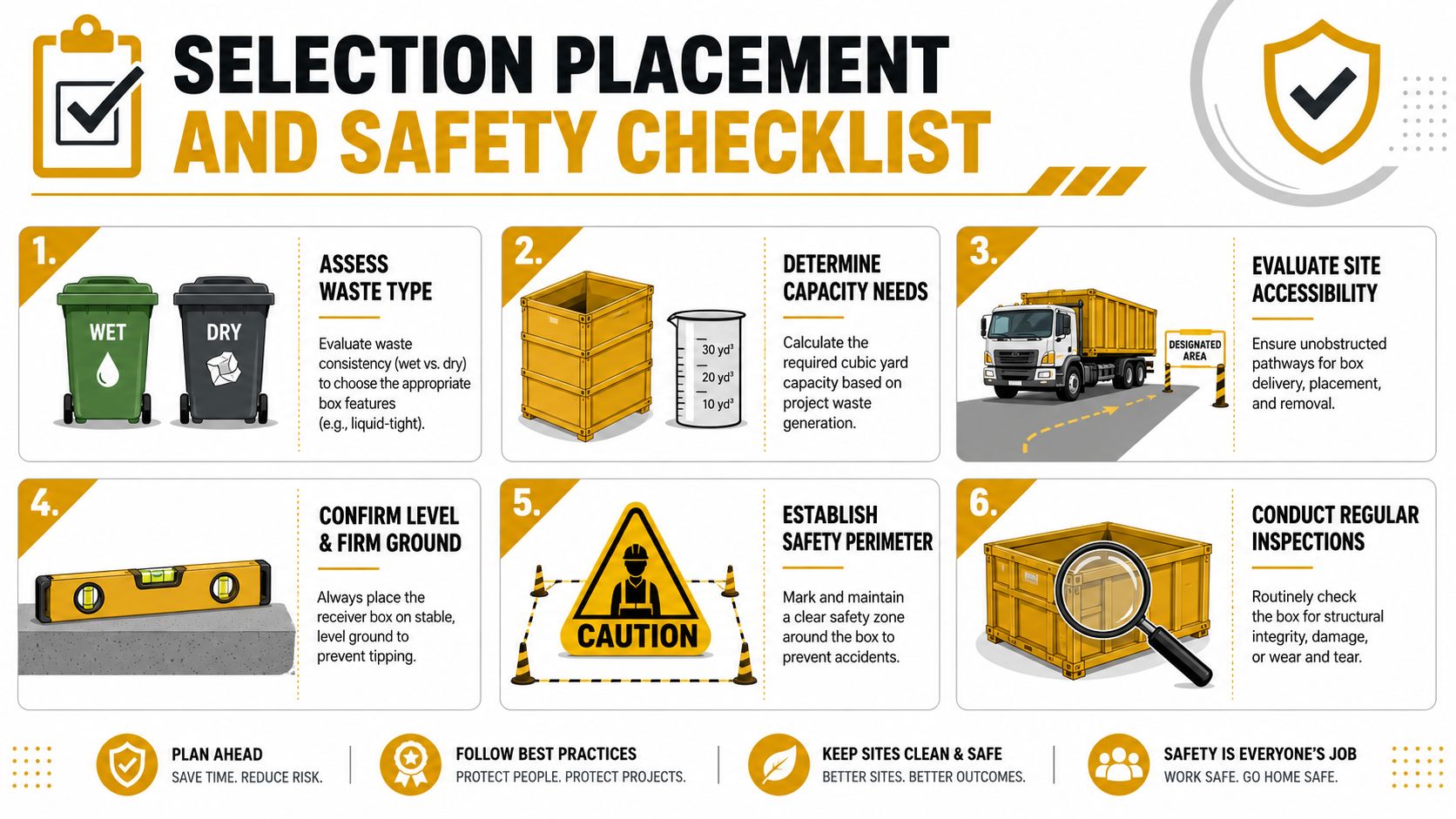
Selection starts with the waste stream
Don't start with box size. Start with material.
If the receiver box will collect dry compacted debris only, your focus is equipment compatibility, haul timing, and durability. If it may hold slurry, rinseout, or wet concrete residue, containment features move to the top of the list. The wrong assumption here causes most of the downstream headaches.
Use this pre-order screen:
- Dry waste only: Confirm compatibility with the stationary compactor and expected debris type.
- Wet or washout material: Verify the container is suitable for liquid-bearing material and won't leak during service.
- Mixed use: Separate streams when possible. Mixing dry compactable debris with washout usually creates disposal and housekeeping issues.
Placement has to support both work and haul-off
The best location is close enough for crews to use consistently and far enough from active traffic, drains, and sensitive areas to avoid creating a new problem. That's a field judgment call, but some rules rarely change.
Check these before placement:
Ground condition
Set the box on firm, level ground. Soft fill, muddy edges, or sloped temporary pads invite shifting, poor drainage, and trouble during pickup.Truck path
Make sure the delivery and haul truck can enter, align, and exit without backing through a maze of materials or crossing active pedestrian routes.Overhead and side clearance
Watch power lines, temporary lighting, scaffold projections, stored pipe, and fence pinch points.Drainage exposure
Keep washout-related containers away from storm drains, curb inlets, drainage swales, and any route where overflow would travel.User behavior
If workers have to take the long route to reach it, they won't. Illegal mini-piles start forming closer to the workface.
Safety comes from discipline, not just hardware
A receiver box doesn't stay safe by itself. It stays safe because the crew uses it correctly and someone owns inspection.
Daily field habits matter more than signs posted on a fence:
| Check item | What to look for | Why it matters |
|---|---|---|
| Fill level | Material below safe haul height | Prevents spillage and unsafe transport |
| Load balance | No heavy concentration to one side | Reduces shifting and pickup issues |
| Tailgate area | No seepage, damage, or poor closure | Critical for wet material containment |
| Ground around box | No debris pileup or slurry escape | Keeps access safe and compliant |
Don't wait for pickup day to inspect the box. That's when it's hardest to correct overfilling, bad loading, or leakage.
One more point that gets missed. If the box is being used for concrete washout, designate who is allowed to use it and how. Pump crews, finishers, laborers, and truck drivers shouldn't all be guessing. A short field briefing does more for compliance than a stack of paperwork nobody reads.
Renting a Compactor Receiver Box Logistics and Compliance
The rental side is where planning either pays off or unravels. A compactor receiver box isn't hard to source, but getting the right service cycle takes more than calling for "a container sometime this week."
What to line up before delivery
Have your basic site information ready before you place the order. The rental provider will need to know what the box is being used for, where it will sit, how trucks access it, and whether haul swaps need to happen on a fixed schedule or on-call basis.
The most useful information to confirm up front is:
- Material type: Dry compacted debris, washout, or another special stream.
- Service plan: One-time use, recurring haul, or standby swap.
- Access limits: Gate hours, site contact, escort rules, and staging constraints.
- Pickup condition: Whether material needs curing time, segregation, or special handling before removal.
That last point matters on concrete jobs. Wet material can change weight, handling, and cleanup expectations. If the provider doesn't understand that, the project ends up sorting it out the hard way at the gate or during pickup.
Budgeting without surprises
Rental cost is rarely a single line item. It often includes the container rental itself, transport, haul charges, disposal-related charges, and potential surcharges tied to access or turnaround demands. Good vendors explain those conditions before the truck rolls.
What I've seen work best is simple. Ask for the service assumptions in writing. If the site has rough terrain, tight access, time-sensitive delivery windows, or nonstandard material, address it before delivery day.
Why the provider matters as much as the box
This equipment touches site operations and environmental responsibility at the same time. For general debris, that mainly affects efficiency and housekeeping. For concrete washout, it directly affects containment and compliance.
A knowledgeable rental partner won't just ask what size container you want. They should ask what you're putting in it, whether it needs to be sealed, where it will be staged, and how your site handles washout control. If they don't ask those questions, you're probably ordering equipment from someone who treats all waste streams the same. They aren't the same.
The right provider helps you avoid the common mistakes. Wrong box. Wrong placement. Wrong service plan. Wrong assumptions about wet material. Those mistakes cost far more than taking a few extra minutes to coordinate the rental properly.
If your project needs a dependable concrete washout or containment rental, Reborn Rentals makes the process simple. You can review equipment, set dates and location details, and arrange delivery through a straightforward checkout flow. For teams that need practical washout solutions, clear pricing, and responsive coordination, they're worth contacting early in the planning cycle.

