
Concrete Contractor Supplies: Essential Washout Guide
The last truck is backing out, finishers are already on the slab, and the pump operator is looking at you with a hose in his hand. He needs to clean out. The driver needs to rinse his chute. If you didn't plan where that slurry goes before the pour started, you're about to make a mess you're still cleaning up tomorrow. That's the moment concrete contractor supplies stop being a shopping list and become a system.
The Jobsite Reality of Concrete Work
A pour looks controlled from the street. On site, it's a timed sequence that doesn't wait for anyone. Trucks arrive in rotation, the pump primes, screeds and floats come out, and every tool that touches wet concrete needs rinsing before it sets up on the steel.
That rinsing is where jobs get sloppy. A driver washes a chute onto bare ground because no one showed him the washout area. A laborer rinses a wheelbarrow near a curb inlet because the pan is on the far side of the site. Nobody intended a violation. They just used the closest flat spot.
Supplies Are a Workflow, Not a Pile
Think of your supplies in the order the work happens. Placement tools put concrete where it belongs. Finishing tools get the surface right while the clock runs. Safety gear keeps alkaline slurry off skin and silica dust out of lungs. Containment catches everything the first three categories leave behind.
Miss one link and the others suffer. Good finishers standing around waiting for a clean trowel lose the window for a flat floor. A full washout pan with no service scheduled forces a crew to choose between stopping work and rinsing somewhere they shouldn't. Neither choice is acceptable, and both were preventable at the planning stage.
The cheapest time to solve washout is before the first truck is dispatched. After that, every solution costs more and works worse.
Access matters as much as the container itself. Drivers and pump operators won't walk slurry across a finished surface or drag a hose through mud to reach a pan tucked behind material staging. Put containment where trucks naturally stage, on ground that stays stable when wet, with a clear route in and out for the truck that will eventually service it.
Weather changes the picture too. Rain adds water to an open container, wind moves splash beyond a pan's edges, and a hot afternoon speeds evaporation but also speeds setting on tools. Crews that treat washout as a fixed object instead of a managed process get surprised by all three. The sites that run clean assign one person to own that process for the day, and everyone on the pour knows who it is.
Understanding the Concrete Supply Chain
Concrete feels local because you order it by phone and it shows up in a truck. Behind that phone call sits one of the largest industrial supply chains on earth, and its scale explains a lot of the friction contractors deal with daily.
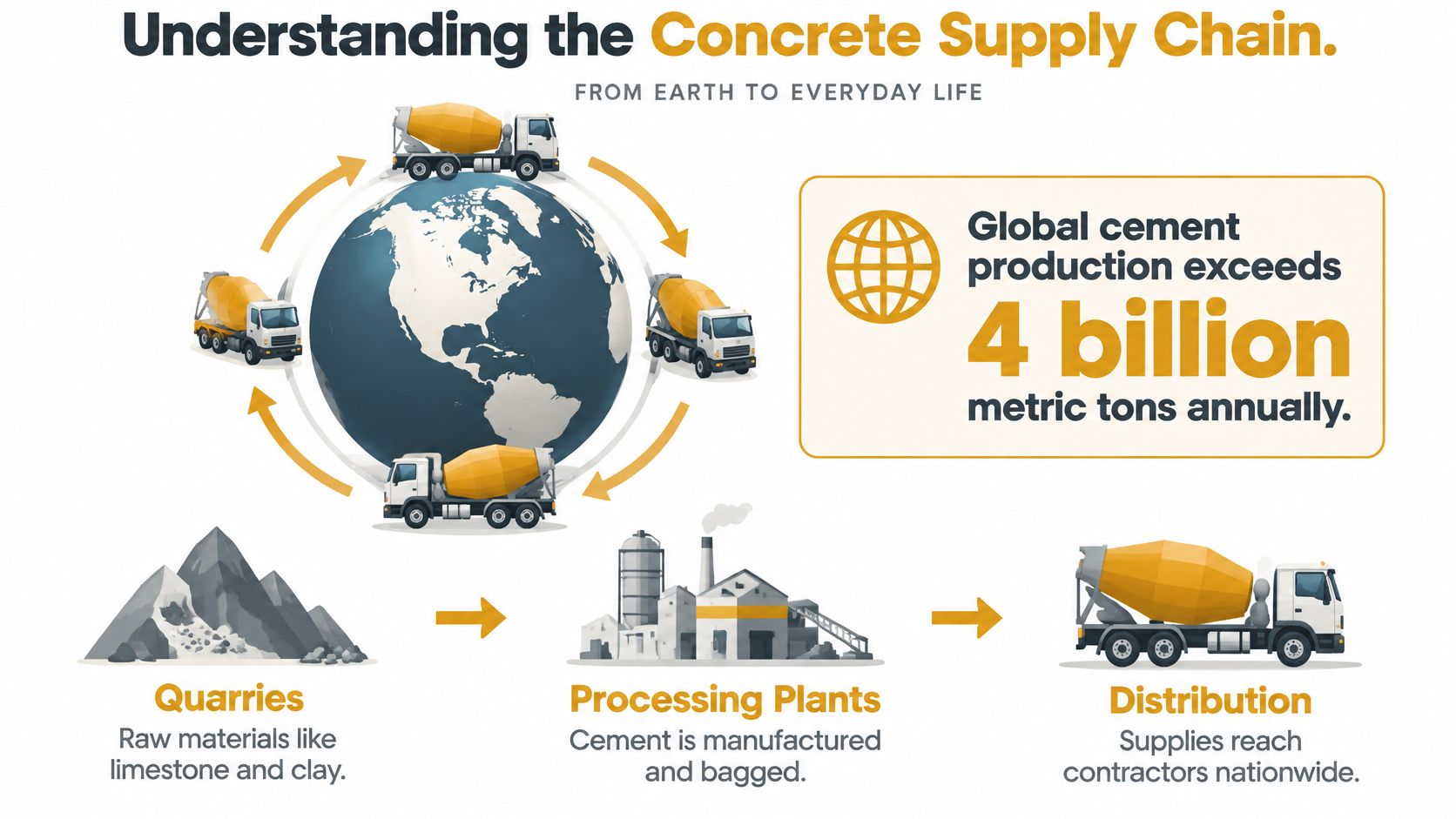
Cement is the binding material behind ready-mix, precast products, mortar, grout, and repair materials. The U.S. Geological Survey cement summary estimated approximately 4.0 billion metric tons of cement production worldwide in 2023, with about 2.0 billion metric tons in China, 450 million metric tons in India, and 90 million metric tons in the United States. That means China and India together accounted for roughly 61% of reported output while the U.S. represented about 2.2%, according to the same summary.
Why Global Numbers Hit a Local Jobsite
High-volume material is expensive to move and useless once it sets. That's why your plant's capacity on a busy Friday, your aggregate source's trucking, and your admixture supplier's lead time all shape your schedule more than any single tool purchase. Regional markets feel pricing and availability differently even when global supply is plentiful, because concrete is made near where it's placed.
Contractors who understand this order earlier, confirm backup plants, and don't assume a pan, a pump, or a load will be available on two hours' notice during peak season.
Standards Turn Materials Into Specifications
This industry runs on tested performance, not appearance. Portland cement was patented in 1824 by English inventor Joseph Aspdin, systematic strength testing followed from 1835 to 1850, and cements of roughly modern composition appeared around 1860, as traced in this history of concrete and cement standardization. The same history notes that ASTM Committee C01 formed in 1902 and issued its first cement standard in 1904, while ASTM Committee C09 was established in 1914 for concrete standards.
That lineage is why product specs, load ratings, delivery tickets, and compliance records aren't paperwork for its own sake. They're how an engineer, an inspector, and a finisher who never meet agree on what was placed. When you buy concrete contractor supplies, you're buying into that documented system, from mix design to the container that catches the residue.
Core Supplies Every Crew Needs
Walk a site before a pour and you can inventory the essentials in minutes. The crews that struggle usually aren't missing exotic equipment. They're missing basics, or they brought basics that don't match the work.

Tools That Match the Placement Method
Screeds, bull floats, edgers, groovers, trowels, and curing supplies follow directly from how concrete arrives and what finish is specified. A pump job needs hoses, reducers, and cleanup balls ready. A chute job needs wheelbarrows or buggies staged where they won't block truck movement. Cutting and drilling work needs a reliable water source for the blade, plus somewhere controlled for that water to go afterward.
That last point gets overlooked. OSHA's construction silica framework sets an 8-hour permissible exposure limit of 50 micrograms per cubic meter and identifies continuous water delivery to a saw blade as an engineering control, per OSHA guidance on respirable crystalline silica controls. Wet methods cut airborne dust, but they create slurry. Pair every wet tool with collection from the start.
PPE That Reflects Real Hazards
- Nitrile gloves and skin coverage: Fresh concrete is caustic. Prolonged contact burns skin, and kneeling in wet concrete through soaked fabric is a common, preventable injury.
- Hard hats and high-visibility gear: Pump booms swing, trucks reverse, and crews work with their heads down. Visibility and head protection aren't optional around moving equipment.
- Waterproof safety boots: Finishers stand in wet material for hours. Boots need toe protection, grip, and enough height to keep slurry off skin.
- Eye protection: Splash during chute rinsing and pump cleanout is routine. Caustic slurry in an eye ends a worker's day, and possibly worse.
Containment as Core Equipment
A washout pan or container belongs on the same list as the screed, not on an afterthought list. It needs capacity for chute rinsing, pump line cleaning, and tool washing across the whole pour, plus a service plan for when it fills. Stage it before trucks arrive, mark it clearly, and brief every driver at the gate. A container nobody knows about contains nothing.
Renting vs Buying Washout Containers
Ownership feels cheaper because the invoice stops. Rental feels expensive because it doesn't. The honest comparison includes everything that happens between pours.
Where Renting Fits
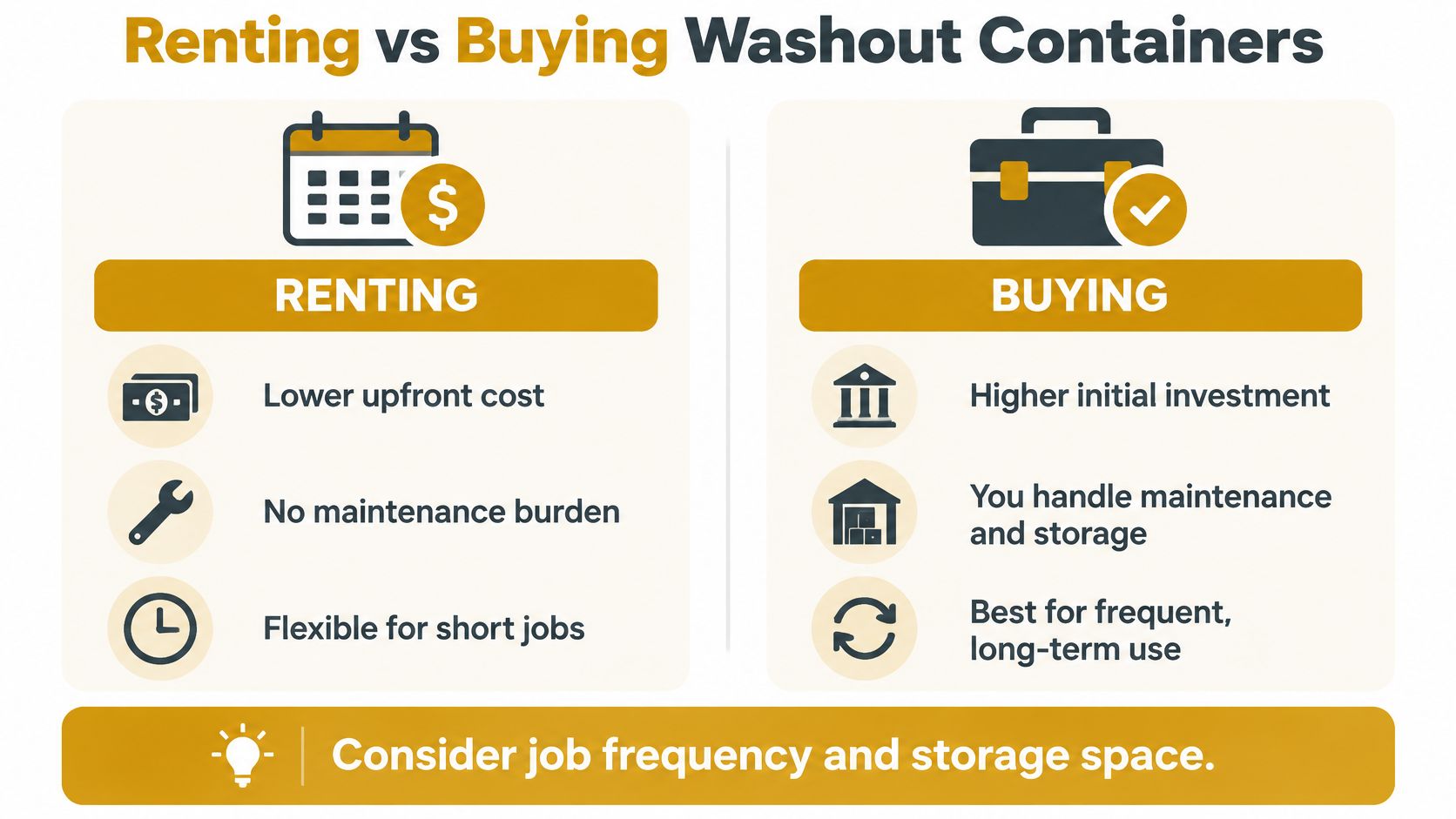
Rental suits crews whose work varies. A small renovation pour and a multi-truck slab don't need the same capacity, and renting lets you match container to job instead of forcing one owned pan onto every site. The rental provider handles delivery, pickup, and typically the servicing logistics that keep a full container from sitting in your way. You also skip storage. An owned pan occupies yard space and a trailer slot whether it works that week or not.
For example, Reborn Rentals lists washout pans in two capacity classes sized for mixer and pump truck washout, with delivery and scheduled swap and haul service. Presented as a rental option, that model shifts transport and removal off your crew's plate.
Rental's real cost driver isn't the daily rate. It's time on rent. A pan ordered early for a pour that slips a week, or left sitting full because nobody called for pickup, eats the margin the rate seemed to offer.
Where Buying Fits
Buying can work for high-volume operators with steady pours, yard space, a truck and trailer to move pans, and a reliable route for disposing of hardened solids and captured water. Without that disposal route, ownership just means you now own the problem at the end of every job.
Ownership also means maintenance. Dents, failed seams, damaged lifting points, and built-up residue are your responsibility, and a damaged container isn't leak-proof anymore. Inspect owned pans with the same rigor you'd apply to a rental delivery, because the compliance standard doesn't care whose name is painted on the side.
Decision rule: If you can't name who maintains it, where it sleeps between jobs, and where its contents go when it's full, you aren't ready to own it.
The Trade-Off That Actually Decides It
Run the comparison on cost per compliant pour, not cost per day or cost per purchase. Include delivery or your own hauling time, servicing, disposal, storage, repairs, and the downtime cost when capacity or transport isn't available. Crews with predictable volume often find ownership wins on that math. Crews with spiky schedules usually find rental wins, because flexibility prevents both idle assets and undersized containment.
Washout Compliance and Inspection Best Practices
Compliance isn't a pile of paperwork that follows the work. It's a small set of physical conditions, checked often enough that they never have a chance to fail.
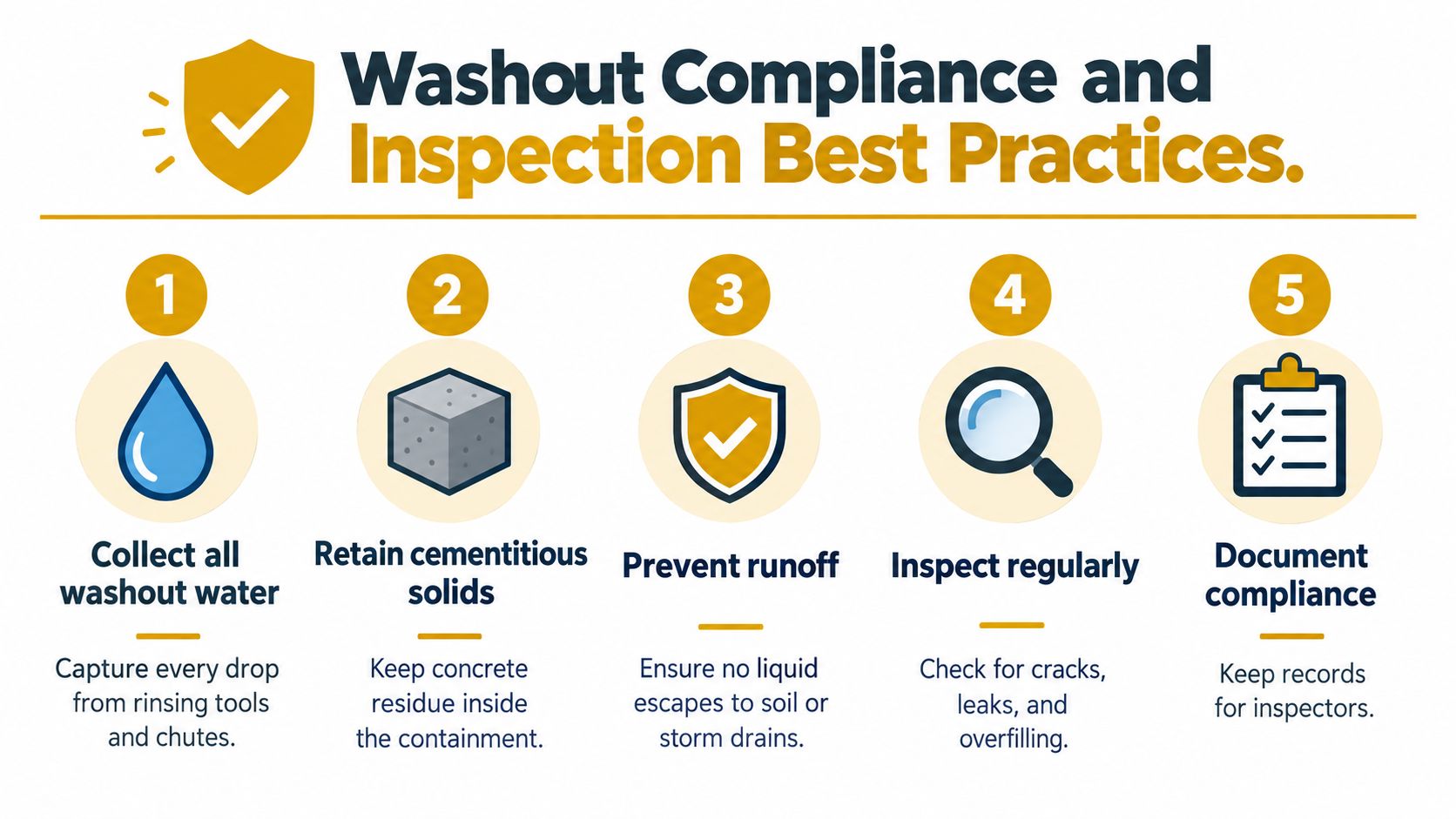
The EPA sets two core objectives in its concrete washout guidance for construction sites: collect and retain all washout water and cementitious solids in leak-proof containers, and recycle 100% of the collected water and solids. The same guidance states that once a container exceeds 75% capacity, washwater should be vacuumed or allowed to evaporate, and hardened solids should be removed and recycled.
That capacity threshold is your operational trigger. It isn't a suggestion to think about servicing. It's the line where the next chute rinse becomes an overflow risk.
A Daily Inspection That Takes Minutes
- Check the container body: Look for tears, punctures, cracked welds, and failed seams before the first washout of the day, not after slurry finds the hole.
- Check placement: Confirm the container sits on stable ground, away from drainage paths, inlets, and slopes that carry water off site.
- Read the fill level: Mark the service threshold on the container so any crew member can judge it at a glance.
- Record what you saw: Date, fill level, condition, and initials. A short log entry beats a good memory during an inspection.
- Call service early: Schedule vacuuming, swap, or removal with lead time for the truck to reach you.
Connecticut's stormwater guidance makes the same point operationally. As summarized in the DPR market conditions discussion of washout practice, containers should be leakproof, inspected daily and after heavy rain, and washout requirements should be written into concrete delivery contracts.
Why the Log Matters
Your SWPPP describes controls on paper. Inspectors verify controls in the field. A dated inspection log with fill levels and service records is the bridge between the two, and it's also your evidence that a discharge, if one is alleged, wasn't business as usual. Assign the log to a named person per pour. Shared responsibility with no owner means nobody checks until the pan is already full.
Brief drivers separately. Your crew may know the system, but a ready-mix driver visiting for twenty minutes doesn't. A sign at the entrance and one sentence at the gate, wash out only in the marked container, prevents most violations before they happen.
Sizing Your Washout System and Budget
Undersizing is the most expensive way to buy washout capacity. The small pan saves money at checkout and spends it later on emergency pumping, a second delivery, cleanup labor, or a pour delayed while someone finds a legal place to rinse a pump.
Work the Sizing Inputs in Order
- Pour volume and truck count: More trucks mean more chute rinses. Count expected washouts, not just cubic yards placed.
- Pump involvement: Pump priming and line cleanout generate slurry all at once, at the end, when the container is already partly full.
- Tool and equipment washing: Finishers rinse repeatedly. Small volumes per rinse add up across a full crew and a long pour.
- Rainfall exposure: An open container under a forecast storm loses usable capacity to rainwater. Covered or lidded options protect that capacity.
- Footprint and access: The right capacity in the wrong location fails. Confirm delivery, vacuum, and removal trucks can reach the spot when the site is busy, not just when it's empty.
- Service timing: Plan removal around the capacity trigger discussed earlier, with enough lead time that a delayed service truck doesn't shut you down.
Washout Pan Capacity Comparison
| Pan Dimensions | Approx Capacity | Approx Load |
|---|---|---|
| 72' x 72' x 24' | ~441 gallons | Approximately 18.25 tons |
| 72' x 72' x 14' | ~310 gallons | Not listed |
Use listed capacities as planning ceilings, then discount them. Your usable capacity is the volume you can hold while still leaving room for the final pump cleanout and a margin below the service threshold. A container that's exactly big enough on paper is too small in the field.
Size for the last hour of the pour, not the average hour. That's when volume spikes and options disappear.
Budget the Whole Service, Not the Rate Card
Build your number from every line that can appear. Delivery and pickup depend on distance and site access. Rough terrain can add charges when placement requires extra equipment or effort. Express orders cost more than scheduled ones, which is another way of saying late planning has a price. Add service calls for mid-job vacuuming or swaps on multi-day pours.
Then compare that honest total against the cost of getting it wrong. One emergency service call, one afternoon of cleanup, or one documented discharge typically outweighs the difference between the smaller and larger container. That's not an argument for always renting the biggest pan. It's an argument for sizing from your actual inputs instead of from the lowest sticker.
Washout as Part of Material Circularity
Contractors increasingly place concrete specified for recycled content or lower carbon, then rinse the residue onto the ground behind the pour. The specification did its job. The jobsite undid it.
The scale behind that contradiction is documented in a UN-linked training estimate summarized in this construction waste management market overview, which puts global construction and demolition waste at about 2.2 billion tonnes in 2025, roughly 70% above 2012 levels, and at around 30% or more of global solid waste. The same source notes that mixes using up to 50% clinker replacement plus 30% recycled aggregate can reduce upfront carbon by 40% to 50%.
Those gains are real, and they're fragile. Caustic washwater reaching soil or a waterway is a pollution event regardless of how sustainable the mix design was. Owners asking for environmental reporting don't just want recycled content percentages. They want a defensible record of how material was handled from delivery to disposition.
One Documentation Chain
Treat these records as a single workflow rather than separate files owned by separate people:
- Procurement records: What was ordered, including any recycled aggregate or supplementary cementitious materials specified.
- Mix design documentation: What was supplied and placed, tied to delivery tickets.
- Washout inspection logs: Condition, fill levels, and service dates for containment on site.
- Recovered material disposition: Where hardened solids and captured water went, and whether they reentered use.
- Owner sustainability reporting: The summary that turns the above into a credible project record.
Recovered washout solids aren't automatically waste, and they aren't automatically clean fill either. Handling and recycling requirements vary by jurisdiction and by what went into the mix. Separate universal good practice, contain everything and document it, from local rules that govern what happens next. Suppliers of concrete contractor supplies who can document their side of that chain make your reporting easier. Ask about disposition before you rent, not after the pan leaves.
Building Your Pre-Pour Action Plan
Everything above collapses into a short routine you can run the day before concrete arrives. Crews don't need a binder. They need five confirmed answers and one accountable name.
The Day-Before Check
- Washout location confirmed: Container placed on stable ground away from drainage, marked, and reachable by trucksAY trucks and service vehicles at peak activity.
- Container verified: Inspected for damage, empty or with known remaining capacity, and the service threshold marked where the crew can see it.
- Service scheduled: Vacuum, swap, or removal booked against expected fill timing, with a phone number posted for the crew lead.
- PPE and tools staged: Gloves, boots, eye protection, wet-cutting water supply, and slurry collection ready before they're needed mid-pour.
- Roles assigned: One person owns washout inspection and the log. Drivers and the pump operator get briefed at arrival, not at cleanout.
Coordinate the Handoffs
Most washout failures happen between companies, not within one. The general contractor assumes the finisher arranged containment. The finisher assumes the ready-mix supplier handles its own drivers. The pump operator arrives expecting a container nobody ordered. Close those gaps in the pre-pour call. State who provides the container, who inspects it, who calls for service, and where drivers wash out. Put it in the delivery paperwork so it survives a personnel change.
Add a rain contingency while you're at it. If weather moves in, who checks the container, and does the service call move earlier? Decide in the office, in daylight, rather than during the storm.
Close the Loop After the Pour
Walk the washout area before demobilizing. Photograph the container condition, note the final fill level, confirm the service or removal is booked, and file the log with the delivery tickets. That five-minute habit supports your compliance record, your sustainability reporting, and your position in any later dispute about site condition. It's also how the next pour starts smarter, because you'll know exactly how much capacity this one used.
If your next pour needs containment sized and serviced before the trucks roll, Reborn Rentals rents concrete washout pans and containers with jobsite delivery and scheduled swap and haul service. Check available capacities against your truck count and pour plan, set your dates and site location, and book early enough that washout is staged and marked before the first chute swings.