
Concrete Disposal Denver CO: Concrete Disposal Denver CO:
You’ve got broken slab stacked by the saw-cut, a truck waiting on direction, and someone on the crew asking whether the washout can just go in the dirt by the fence. That’s usually when concrete disposal becomes a problem instead of a line item.
On Denver jobs, concrete disposal isn’t one task. It’s two. You have solid debris that can often be recycled if you keep it clean, and you have liquid washout slurry that can create a compliance mess fast if you treat it like ordinary site runoff. If you only plan for one, you’re leaving risk, cost, and schedule headaches sitting on the project.
Understanding Denver's Concrete Disposal Regulations
Denver doesn’t treat concrete disposal as an afterthought, and neither should you. If your project crosses the permit threshold, the city expects a disposal plan before the work gets moving. That matters because concrete is one of the easiest materials to recycle on paper and one of the easiest materials to mishandle in the field.
Under Denver’s ordinance, construction and demolition projects larger than 500 sq. ft. must achieve at least 50% waste diversion through reuse or recycling of debris, including concrete, and a waste diversion plan must be submitted with the permit application identifying recycling partners and methods. Denver spells that out in its Universal Recycling and Composting Ordinance requirements.
What the city is really asking from you
The rule isn’t just paperwork. The city wants to know, before demolition starts, where your material is going and how you’ll keep recyclable loads from getting contaminated. If you wait until demo day to figure that out, you’ll usually end up paying more and diverting less.
A workable plan usually includes:
- Material separation so concrete stays separate from wood, trash, drywall, and mixed demo.
- Named recycling outlets for clean rubble rather than a vague note that the debris will be “handled off-site.”
- A site process for loading, staging, and documenting hauled material.
- A washout strategy so concrete wastewater doesn’t undermine the rest of your compliance effort.
Practical rule: If you can’t explain your concrete path from demo area to final drop-off before the first hammer hits, the plan isn’t ready.
Why Denver tightened its approach
The reason is simple. The region handles a huge volume of construction-related waste. In 2021, Denver’s four major landfills managed over 2.5 million cubic yards of waste, and municipal solid waste was only 6% of that total, which shows how heavily the disposal system is driven by construction and demolition material, according to waste site mapping for the Denver metro area.
That changes how inspectors and owners look at concrete. They don’t see it as inert junk you can pile wherever there’s room. They see a high-volume material that needs to be sorted, documented, and routed correctly.
What compliance looks like on a real job
The crews that stay out of trouble usually do a few plain things well:
| Jobsite task | What works | What causes problems |
|---|---|---|
| Permit prep | Submit the diversion plan early | Treat diversion as a closeout issue |
| Demo staging | Use a dedicated concrete pile | Mix rubble with general debris |
| Hauling | Send clean loads to recycling | Load mixed material and hope the yard takes it |
| Washout | Designate containment before the pour | Decide on washout after the truck arrives |
If you’re searching for concrete disposal denver co, this is the part that gets missed most often. People look for a dump site. Denver wants a system.
Your First Decision Solid Rubble vs Liquid Slurry
Before you line up trucks or dumpsters, separate the waste streams in your head. Concrete disposal on a Denver job splits into solid rubble and liquid slurry. They don’t move through the same channels, they don’t get accepted by the same facilities, and they don’t create the same type of risk.
That first decision affects everything after it. It affects labor, staging, haul timing, cleanup, and whether your “disposal plan” works outside the trailer.
Solid concrete follows a recycling or landfill path
Solid rubble is often the primary type that comes to mind. Broken slab, curb, footings, rejected precast, saw-cut sections, and demo chunks usually fall into this bucket. If the load is clean enough, you can often send it to a recycler. If it’s mixed with other material, it usually turns into a landfill or mixed-load problem.
That matters in Denver because construction material dominates the disposal sector. As noted earlier in the regulatory context, the landfill system is carrying a heavy construction burden, which is why concrete recycling gets so much attention on permitted jobs.
Clean concrete is the key phrase. If the rubble is loaded with trash, soil, asphalt, or loose mixed debris, you lose flexibility fast.
Liquid slurry is a different problem entirely
Washout water, chute rinse, pump cleanup, and slurry from cutting or finishing work aren’t just a wet version of solid debris. They’re managed differently because they can migrate across the site, hit stormwater paths, and contaminate otherwise recyclable material.
Crews get into trouble when they blur these categories. Common bad calls include:
- Using a rubble pile as a washout area and turning recyclable concrete into contaminated waste
- Letting drivers rinse onto bare ground because “it’ll dry out”
- Sending wet slurry with a solid load and assuming the yard will sort it out
- Leaving washout location decisions to the last minute
A clean concrete pile and a compliant washout area need to be two separate places on the site. Once you mix them, you usually create two problems instead of one.
Use this decision test before work starts
If you’re running the site, ask these questions before the first pour or first demo shift:
- Will this material hold shape in a bucket or truck as solid debris? If yes, route it through your rubble plan.
- Does it contain free liquid or washout residue? If yes, it needs containment, not a rubble haul.
- Can the receiving yard take it as delivered? If the answer is uncertain, assume you need cleaner separation on-site.
- Will your crew know the difference without supervision? If not, mark the areas and brief them before production starts.
A lot of concrete disposal mistakes in Denver don’t come from bad intent. They come from treating all concrete waste as one category. It isn’t.
A Practical Guide to Recycling Solid Concrete in Denver
If the material is solid and clean, recycling is usually the smartest path. It supports your diversion requirements, cuts down on landfill dependence, and gives the crew a clear disposal routine. The trick is keeping the load clean enough from the moment demolition starts.
The field process is straightforward, but only if you stay disciplined.
Start with the pile, not the truck
The best recycling loads are built on the ground before they’re ever loaded. Don’t make the loader operator sort your mistakes with a bucket. Set a dedicated staging area for concrete only, and keep it out of the traffic path for framers, roofers, and laborers who are looking for a convenient place to dump mixed debris.
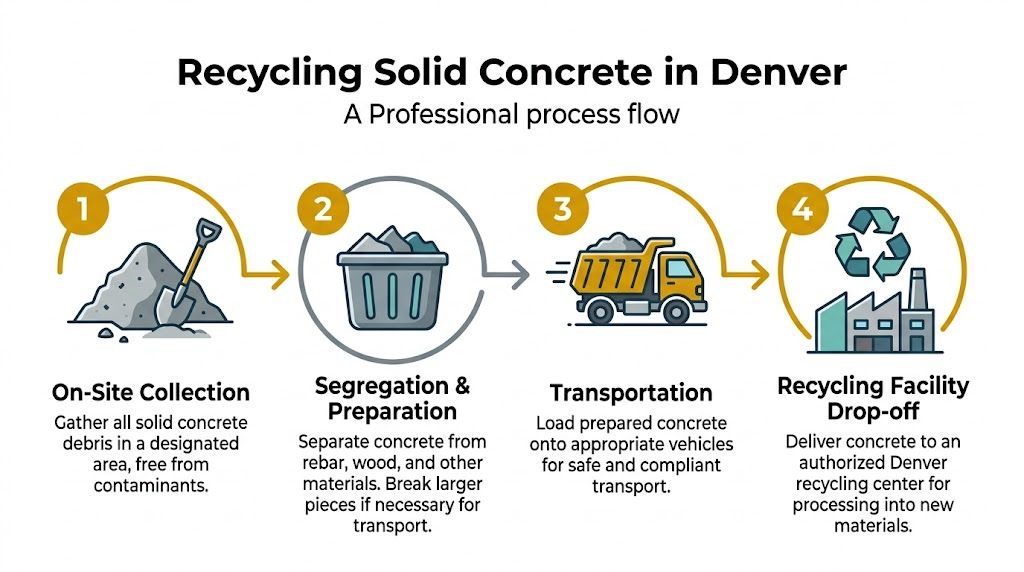
The basic flow is consistent. The Denver-area recycling process overview describes it this way: demolition breaks concrete into manageable chunks, loading into trucks is the most labor-intensive phase, and the material is then transported to a facility where it is crushed and screened to 1-1/2 inch max for reuse as subbase. That same source notes that clean loads are often free, while contaminated loads can cost $50-100/ton.
What clean concrete actually means on a jobsite
“Clean” sounds obvious until the truck gets rejected. In practice, clean means the load is concrete, not concrete plus everything else that happened to be nearby.
Use this standard with your crew:
- Acceptable material includes plain concrete and properly separated concrete pieces prepared for transport.
- Remove metal and trash early so rebar, tie wire, wood, plastic, and packaging don’t ride out with the load.
- Keep asphalt separate because mixed paving material changes where the load can go.
- Watch the chunk size so loading stays efficient and transport doesn’t turn into a double-handling exercise.
If your laborer needs to explain the load at the scale house, the load probably wasn’t sorted well enough.
A practical hauling sequence
This is the sequence that works on active sites:
Break it down on purpose
Demo into manageable pieces rather than oversized chunks that waste truck space and slow loading.Stage by material type
Keep concrete in its own pile. Don’t rely on later sorting if multiple trades are working nearby.Clean the pile before loading
Pull out loose contamination while it’s easy to reach.Load for transport, not just for volume
A neat, predictable load is easier to tarp, haul, and unload.Send clean loads to a recycler
In the Denver market, contractors often use facilities such as Colorado Aggregate Recycling in Golden for clean concrete.
Where crews lose money
The expensive mistakes usually aren’t dramatic. They’re ordinary jobsite shortcuts.
| Mistake | Result |
|---|---|
| Mixing concrete with general demo | Load may be charged as contaminated material |
| Waiting to remove rebar and loose debris | Cleanup takes longer and slows haul-out |
| Leaving oversized pieces in the pile | Loading and trucking become less efficient |
| Using one dumpster for everything | Diversion drops and disposal cost usually goes up |
If your goal is efficient concrete disposal denver co, think like a recycler before you think like a hauler. The truck should be the last step, not the sorting plan.
Best Practices for On-Site Concrete Washout Management
Most writeups about concrete disposal stop at rubble. That’s only half the job. On active sites, the washout side is where crews create the ugliest compliance problems because wet concrete waste doesn’t sit politely in one place once it hits bare ground.
Colorado contractors keep running into this issue. Existing Denver-area disposal content has a clear gap around liquid slurry, and that gap matters because Colorado construction wastewater violations rose 18% year-over-year, while recycling yards prohibit liquids, according to this discussion of the slurry disposal gap in the Denver market. That’s why washout management needs to be planned as its own operation.

What doesn’t work anymore
A lot of old habits are still floating around jobsites. They were sloppy years ago, and they’re riskier now.
Bad washout practices include:
- Rinsing chutes onto open soil
- Letting pump cleanup run to the edge of the lot
- Using a random excavation as a washout pit
- Assuming the slurry can dry in place without any containment
- Pointing drivers to the rubble pile
Every one of those choices creates a site control problem. You lose containment, lose predictability, and make cleanup harder for the next trade.
What a professional washout setup looks like
Good washout control is boring by design. It should be obvious, easy to access, and hard for the crew to misuse. The best setups are established before the first truck arrives.
A solid washout plan usually includes:
- A designated location close enough for concrete crews to use without excuses
- Physical containment that holds liquid and solids in one place
- Clear crew direction so every driver and finisher knows where to go
- Separation from recyclable rubble so clean concrete stays clean
- Regular checks during active pour days, especially on tight urban sites
Wet concrete waste needs a home before the pour starts. If you’re assigning the washout location after the truck is on-site, you’re already behind.
Why containment beats improvised solutions
Improvised washout areas fail because they depend on perfect behavior from busy crews. That’s not a plan. That’s wishful thinking. A contained washout system gives the site one approved place for rinse water, slurry, and residual material, and it cuts off the usual excuses.
For site managers, the practical benefits are simple:
| Washout method | Field reality |
|---|---|
| Open-ground washout | Fast in the moment, messy after, hard to defend |
| Shared debris area | Contaminates recyclable material |
| Improvised pit | Unpredictable, often poorly located, hard to maintain |
| Contained washout basin or pan | Clear, repeatable, easier to supervise |
This is the part of concrete disposal denver co that separates organized jobs from cleanup jobs. Solid concrete can often be fixed with better sorting. Slurry mistakes spread.
How to run washout without constant policing
You don’t need a speech every morning. You need a setup that crews can follow under production pressure.
Use these field habits:
- Mark the washout area clearly with visible direction for drivers and pump operators.
- Keep access simple so no one has to maneuver through stacked material or blocked lanes.
- Inspect after each pour and don’t wait for the end of the week to see whether the containment is overwhelmed.
- Train subs once, then verify because even experienced crews default to convenience if the site doesn’t control the process.
The biggest mistake is treating washout as someone else’s problem. It’s a site logistics issue, and if you own the site, you own the result.
Planning Your Project's Logistics and Disposal Costs
“Free concrete disposal” sounds good until you put a foreman, laborer, truck, and half a day behind it. Then it stops being free. On Denver jobs, disposal cost is rarely about the posted gate rate alone. It’s about how many times you touch the material, how far you move it, and whether your crew creates a compliance issue while trying to save money.
That’s where a lot of disposal plans break down. They optimize for one visible cost and ignore the rest.

Build the plan around movement
For solid concrete, the cheapest option on paper can become the expensive option in the field if the crew double-handles material. For slurry, the cheapest-looking option is often the one that creates exposure.
The hidden cost issue is well summarized in this Denver concrete disposal cost discussion, which notes that the actual cost of “free” disposal includes fuel, labor, and hauling-related impacts. That same source says a 2026 SWPPP update in Denver imposes fines over $5,000 for improper washout, and that a $25/day washout pan rental is often cheaper than the total cost and risk tied to hauling waste from a 10-cubic-yard project.
A simple framework for estimating the real cost
Use this lens before you approve the plan:
Labor time
Who breaks, sorts, loads, escorts, and waits at the yard?Truck time
How long is the truck out of production while making the disposal run?Material risk
Could contamination turn a recyclable load into a charged load?Washout exposure
Are you trusting field improvisation instead of designated containment?Permit and documentation impact
Will the plan support your diversion reporting cleanly at closeout?
The lowest posted disposal price rarely wins if the crew burns hours chasing it.
What works best on active Denver projects
The most reliable jobs treat concrete disposal as part of logistics planning, not cleanup. That means scheduling rubble haul-out and washout containment at the same time you schedule pours, demo, and access control.
A balanced plan usually looks like this:
| Project need | Strong choice |
|---|---|
| Clean demo concrete | Separate pile and direct recycling haul |
| Tight urban site | Minimize unnecessary truck movements |
| Repeated pours | Dedicated washout containment on-site |
| Permit-driven diversion tracking | Keep solid and liquid streams documented separately |
If you want the shortest version of my advice, it’s this: recycle the solid concrete, contain the slurry, and decide both before work starts. That’s the combination that protects your budget and your permit file.
If you need a straightforward washout setup for an upcoming Denver-area project, Reborn Rentals offers concrete washout containment rentals with clear daily pricing, delivery coordination, and equipment built for real site conditions. For crews trying to keep slurry contained, protect recyclable concrete loads, and avoid preventable compliance problems, it’s a practical way to lock in the washout piece before the first truck shows up.