
Concrete Floor Pan Guide for Clean Compliant Sites
The pour is moving, the pump crew is ready, and the last truck driver asks where to rinse the chute. Someone points toward an open patch of soil beside the access road. By the time the crew notices the gray water spreading toward a drain, the cleanup has become a compliance problem, not just a housekeeping task.
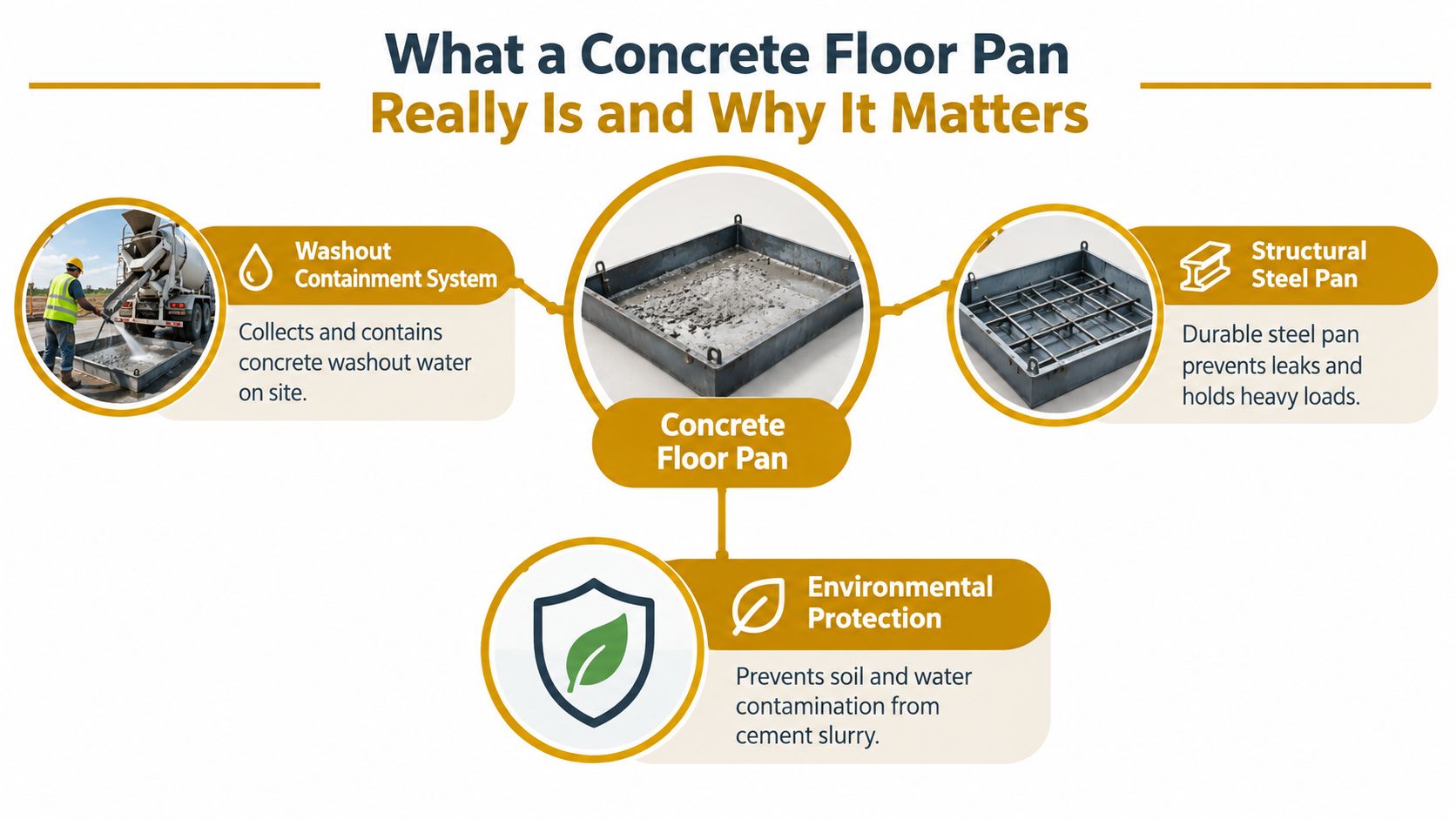
The phrase concrete floor pan creates confusion because it can describe two different jobsite products. In structural work, a steel pan forms concrete voids in a floor system. In modern site operations, a washout pan collects concrete residue, water, and solids so they don't reach soil or drainage systems. Both products depend on durable containment, but they serve different purposes.
This guide separates those meanings, then concentrates on the field decision that many guides skip: choosing and managing washout capacity for actual truck activity, rain, and pickup delays. The right pan is more than a container. It acts like a drip tray for the entire pour, giving the crew a controlled place to wash equipment and a clear process for handling what remains.
What a Concrete Floor Pan Really Is and Why It Matters
A modern washout pan is a leak-proof containment system for concrete wash water and solids. It gives pump operators, truck drivers, and finishers a designated location for rinsing chutes, tools, and equipment. Instead of allowing slurry to soak into the ground, the pan holds the material until the crew can manage it properly.
The structural meaning came first. Steel pans used to create voids in concrete floor construction date back to 1912, when C. Louie Meyer is credited with inventing the removable steel-pan concept, as documented in Ceco's history of concrete floor pan construction. Those pans sit inside a floor assembly and shape the concrete around the void. A washout pan sits on the jobsite surface and performs an environmental control function.
The simple mental model
Think of the washout version as a drip tray for a concrete operation. A drip tray catches oil beneath a machine. A washout pan catches the alkaline water and cement solids produced when concrete equipment is cleaned.
That distinction matters because a bare patch of ground isn't containment. A shallow depression may slow the spread, but it doesn't necessarily stop leakage, overflow, or movement through soil. EPA guidance calls for systems that collect and retain wash water and solids, while state guidance directs crews to use a pit or leak-proof container rather than discharge onto the ground, streets, storm drains, or streams. The EPA concrete washout guidance explains the containment and closeout expectations.
A correctly managed pan helps the foreman answer practical questions during an inspection:
- Where does equipment wash out? The location is obvious and controlled.
- Can slurry reach a drain? The pan is designed to retain it.
- What happens when the pan fills? The crew has a monitoring and removal plan.
- Is the work area organized? Drivers and operators aren't improvising near traffic routes.
Field rule: If the crew can't point to the washout location before the first truck arrives, the site isn't ready for the pour.
The pan also protects the crew's workflow. It keeps washout activity away from foundations, pedestrian paths, and material storage, provided the foreman selects a stable location and maintains access. The product may be called a concrete floor pan, washout pan, or washout container, but the operating purpose is the same: contain first, then recover or dispose of the material responsibly.
Choosing the Right Size and Material Without Guessing
Capacity should follow the job's real conditions, not just the size of the next delivery. A pan that handles a quiet repair may be unsuitable for a large placement, a wet forecast, or a project where pickup can't happen immediately.
Available catalog examples include a 72' x 72' x 24' pan with approximately 18.25 tons of load capacity and about 441 gallons of liquid capacity, plus a 72' x 72' x 14' option with about 310 gallons of liquid capacity, as listed in the supplied Reborn Rentals catalog information. Those figures describe available product configurations, not a universal sizing formula.
Start with the operating scenario
Ask four questions before ordering:
- How many trucks or equipment units may wash out? Count the expected activity across the period before emptying, not only the first placement.
- Can rain enter the pan? An uncovered pan can collect stormwater, reducing usable capacity.
- Could pickup be delayed? Treat schedule uncertainty as a capacity requirement.
- Will the pump, chutes, and crew reach it safely? A large pan is useless if operators avoid it because access is poor.
Public guidance doesn't provide a widely adopted method that converts truck counts, weather, and pickup timing into one required pan size. That leaves the foreman to plan conservatively from the schedule, expected washout activity, and forecasted precipitation. The University of Michigan washout guidance emphasizes monitoring capacity and planning around rain, while Minnesota guidance emphasizes preventing overflow caused by inadequate sizing or precipitation.
Compare the choices
| Pan Dimensions | Liquid Capacity | Best For |
|---|---|---|
| 72' x 72' x 24' | Approximately 441 gallons | Heavy washout activity, extended use, or conditions requiring substantial reserve capacity |
| 72' x 72' x 14' | Approximately 310 gallons | Smaller placements, shorter service periods, or locations with faster planned removal |
Steel and poly each have a place. A steel pan suits demanding loading conditions and repeated handling, while a suitable poly or lined system can offer easier movement and corrosion resistance. The deciding question isn't which material sounds tougher. Check the manufacturer's load rating, liner design, compatibility with caustic slurry, and handling requirements.
Practical sizing decision: Upsize when rain, truck volume, or pickup uncertainty can consume your reserve. Add a second containment point only when the site plan can keep each unit controlled, accessible, and inspected.
Don't fill the pan to its advertised maximum during normal operations. Usable capacity must include room for rain, solids, and a delayed service visit. If the project has changing pour phases, reassess the plan before the next placement rather than assuming the original selection still fits.
Environmental Rules and SWPPP Guidance You Cannot Ignore
A truck finishes discharging, and the crew rinses the chute into the nearest pan. Rain starts before anyone checks the fill level. Without controlled containment, alkaline wash water can migrate into soil, drains, or nearby waterways. Fresh concrete wash water carries cement particles and is strongly alkaline. Guidance on concrete slurry risks and disposal describes slurry as typically measuring around pH 12.5 to 13, with readings that can reach 13.8. That chemistry can harm aquatic life and change soil conditions.
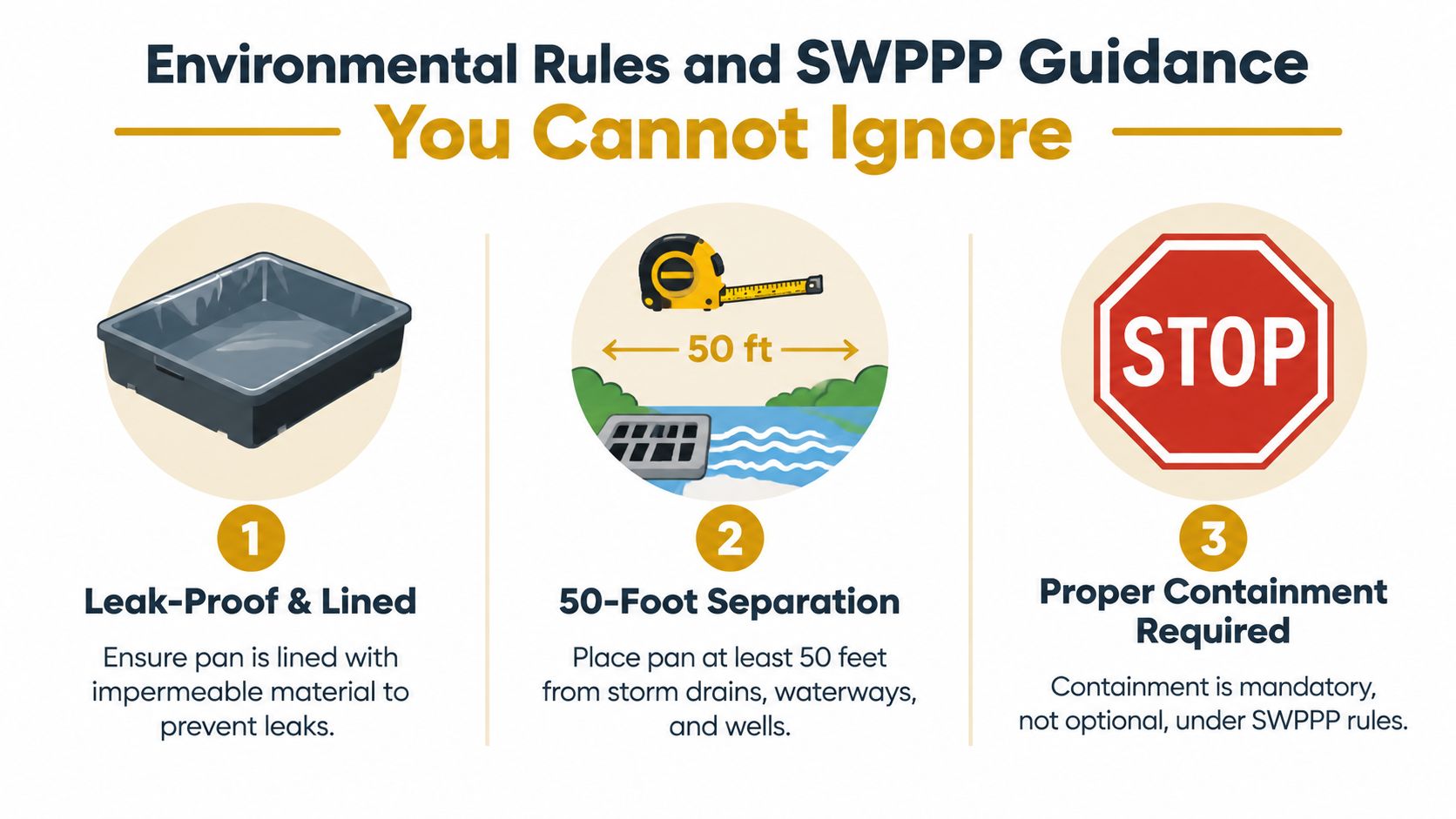
The practical rule is simple. Washout needs an impermeable barrier that stays intact during washing, rainfall, and ordinary jobsite movement. A concrete floor pan is therefore part of the project's environmental control system, not merely a convenience for the next crew.
What the site should show
State guidance commonly directs wash water into a pit or leak-proof container. It also prohibits discharge onto the ground, storm drains, streets, or streams. Tennessee's concrete washout handbook describes a 50-foot minimum separation from storm drain inlets, drainage facilities, and watercourses.
Before the first washout, the foreman should confirm:
- Leak-proof construction: The pan, seams, and liner stop liquid from escaping.
- Correct placement: The unit meets the required separation from drains, drainage features, and watercourses.
- Documented control: If the project falls under NPDES or SDS permitting, the SWPPP includes the washout control when applicable.
Distance and containment solve different problems. A pan far from a drain still fails if it leaks or overflows. A sound liner cannot make an unsuitable location acceptable if trucks must cross an active drainage path to reach it.
Compare improvised and engineered controls
An open soil washout is quick to build, but it does not reliably retain caustic water. A lined pit can perform well when crews install and inspect it correctly, including its liner, sidewalls, and access. A purpose-built pan gives the crew visible boundaries and a movable control point. It still requires proper sizing, fill-level checks, and timely service.
Inspectors look for results: contained wash water, a stable control, a sensible location, and enough remaining capacity to prevent overflow. Keep the site plan, SWPPP notes, inspection records, and service arrangement consistent with actual crew practices. That alignment turns the pan from a container into documented protection for the jobsite and surrounding environment.
Site Placement Setup and Safe Use on Active Jobsites
A pan can be correctly sized and still fail if it sits on a slope beside a travel lane. Start with the ground, then plan equipment access, worker movement, and inspection.
Choose a flat, stable area that will not rut under truck traffic or shift as the pan fills with liquid and solids. Keep it away from steep grades and active drainage paths. Chutes and pumps should reach it without awkward positioning, while reversing trucks must have enough clearance to avoid striking the unit.
Run the setup like a pre-pour inspection
Before the first truck arrives, walk the route with the pump operator and truck drivers. Confirm each stopping point, the chute swing, and the path workers will use to approach the pan without entering a vehicle lane.
Use this field sequence:
- Inspect the base: Remove sharp debris and verify that the support surface is level enough to keep the pan stable.
- Test access: Position a chute or check pump reach so operators do not wash out at the edge of the containment area.
- Secure the unit: Stop tipping, sliding, or distortion with the manufacturer-approved stabilizing method.
- Check the liner: Look for tears, punctures, displaced edges, and gaps before use.
- Brief every operator: Include the washout location in each truck's arrival instructions, rather than relying on a last-minute hand signal.
Concrete slurry is highly alkaline, so worker protection belongs in the same control plan as containment. Follow the project safety plan and the manufacturer's instructions for protective equipment, handling, and cleanup. The foreman should also explain where contact can occur and how the crew will respond if slurry escapes.
Keep the work area predictable
Cover the pan while it is idle if the cover is designed for that use. A suitable cover can reduce rain entry and keep debris out, but it must not block active washing or create a trip hazard.
Inspect the pan during the workday, especially after equipment moves, heavy rain, or a changed pour sequence. A small shift can open a liner gap, reduce usable capacity, or place the unit in the path of a truck.
Use clear radio language. “Wash out at the pan” gives operators a location, while “clean up over there” does not. Assign one person to watch the fill level, another to call for service when required, and a responsible person to record problems. Clear ownership prevents the common failure where everyone assumes someone else is monitoring the unit.
Maintenance Emptying and Responsible Disposal That Closes the Loop
A pan that looks manageable at the start of a pour can become an overflow risk by the end of the shift. Capacity must be managed as deliberately as placement and cleanup.
EPA guidance recommends monitoring washout containers and emptying them before they exceed 75% capacity, reducing the chance that rain or another truck will push slurry over the edge. It also calls for removing hardened solids and recycling them, while the collection method retains both water and solids. Review the EPA concrete washout requirements with the person responsible for environmental closeout.
Turn monitoring into a scheduled task
Check the pan at shift start, after heavy washout activity, and before forecasted rain. Record the approximate fill level, liner condition, and any action taken. That brief record gives the superintendent a clear handoff and tells the service provider how quickly the unit needs attention.
Capacity checkpoint: Schedule emptying before the container passes 75% capacity, not after the next storm begins.
Plan pickup around the work calendar. A large placement before a weekend, holiday, or uncertain hauling window calls for earlier service. Waiting until the pan is nearly full leaves no practical buffer if the truck is delayed.
Separate water, solids, and decisions
After the material hardens, remove the solids without cutting or deforming the pan or liner. Keep recovered concrete separate from general trash when recycling is planned. Before transport, confirm the receiving facility's rules for classification, dewatering, hauling, and beneficial reuse, since those requirements can differ by jurisdiction.
“Collect and recycle” is only the starting instruction. The foreman still needs answers about whether the solids qualify for a receiving facility, how wet material will be handled, and whether a local processor can use it as aggregate or another input.
A useful recovery plan treats the pan like a settling tank. Water and solids need different handling paths, and each path needs an identified owner. Treated wash water may also have a reuse pathway. A 2026 study in PMC reported that treated wash water could replace up to 50% of potable mixing water in ready-mix plants without significant loss of mechanical performance.
That finding does not approve untreated slurry reuse on a jobsite. It does show why closeout planning should examine recovery options before labeling every captured material as waste. The loop closes when the crew controls capacity, separates materials, and sends each stream to an approved destination.
Rental Logistics Pricing and Smart Planning for Contractors
A delivery that arrives late, cannot reach the placement area, or leaves no time for cleanup can disrupt the pour. Rental planning should therefore start with the schedule, not just the pan dimension. Confirm delivery and return dates, location, ground conditions, access, expected washout volume, and the time needed to remove recovered material.
Reborn Rentals lists pricing starting at $25 per day, with possible charges for delivery, rough terrain, and express orders. Treat that figure as an entry point rather than the project budget. Request the delivered cost, then confirm that the unit can handle the site's expected load and retain liquid without overflow.
Use a simple order conversation
Give the rental provider enough field information to prevent a poor fit:
- Project timing: Provide the delivery date, expected return date, and any weather-related uncertainty that could delay pickup.
- Site access: Describe slopes, unfinished surfaces, narrow approaches, gates, and rough-terrain conditions.
- Containment demand: Explain the pour sequence, equipment types, and whether multiple operations could wash out at once.
- Service plan: Confirm who removes hardened solids or liquid, when removal occurs, and what project records are required.
- Product details: Verify dimensions, capacity, load rating, liner requirements, covers, and handling instructions.
A short checkout routine keeps the administrative work clear. Select the item, enter the dates and location, then review delivery arrangements before finalizing the order. The provider lists Messenger, WhatsApp, email, QR-based contact sharing, and scheduled callbacks as support channels. A site manager can use one of these to confirm availability, specifications, access limits, and the pickup plan.
Rental planning also depends on which meaning of “concrete floor pan” applies. Structural steel pans belong to a long-standing void-forming system. Historical development included standardized arrangements based around 30-inch voids with 6-inch-wide joists at 3 feet on center, as documented in Ceco's historical overview. A washout pan serves a different purpose, yet the selection rule is similar: match the product to its actual load, material, access conditions, and planned reuse or disposal route.
Putting It All Together for Cleaner Safer Pours
A clean pour begins with a decision made before the trucks arrive. First, define which concrete floor pan you mean. If you're forming voids in a structural slab, you're dealing with a steel floor-pan system. If you're managing chute and pump washout, you're selecting an environmental containment pan.
For washout operations, make the decision in this order:
- Plan for real conditions: Include equipment activity, rain entering the container, and the possibility that pickup will be delayed.
- Select suitable construction: Confirm leak-proof performance, liner integrity, load capacity, and compatibility with caustic slurry.
- Place it intelligently: Use stable ground, maintain required separation from drainage features, and preserve safe chute and pump access.
- Assign ownership: Name the person who checks fill level, communicates with drivers, requests service, and records inspections.
- Close the loop: Empty before the pan exceeds the 75% capacity threshold identified in EPA guidance, then handle water and hardened solids through approved recovery or disposal channels.
A disciplined crew makes the process look uneventful. The pan sits where everyone can reach it, drivers know the instruction, the foreman checks it during the shift, and the service call happens before weather turns a manageable task into an overflow. That calm result isn't accidental. It comes from treating containment as part of production planning.
The strongest jobsite standard is simple: no washout leaves the controlled system. When contractors size for uncertainty, protect access, document inspections, and recover material responsibly, environmental compliance supports safer operations and a more orderly site. It also gives the owner, inspector, and next trade confidence that the crew is managing the work rather than reacting to spills.
Reborn Rentals provides concrete washout pans and containers for rent, with delivery options and product information for construction and renovation sites. Visit Reborn Rentals to review available containment equipment, enter your project dates and location, and confirm the right setup before the pour.