
Concrete Pit Lids: Load Ratings, Sizes and Selection
You're standing over a washout pit after the last truck pulls off, and someone wants the cover on before the evening rain. The slab looks thick. The frame looks square. Nobody has asked what will roll across it at 7 a.m., or how much empty space is left under it once the slurry settles.
That is where most crews misread concrete pit lids. Thickness is easy to see. Overflow is not. A closed lid can still let a pit spill if rain, leftover liquid, and hardened solids use up the volume. A heavy-looking lid can still crack if one wheel bears near the edge.
Think of the pit as a deep storage tub. The cover keeps rain, debris, and people out, and it also has to carry whatever walks or rolls over it. The empty depth, the distance to the nearest drain, and the routine before a storm decide whether that tub stays put.
What a Concrete Pit Lid Is and How It Works
A concrete pit lid is a concrete cover that closes an opening in the ground. It usually bears on a frame or collar set into the pit wall. You will meet one over a utility manhole, a stormwater pit, a sump, or a washout pit.
The tub analogy only goes so far. A storage-tub lid mostly keeps dust out. A pit lid is judged as an assembly of lid, frame, and pit, not as a loose slab. A thick-looking cover can still crack or punch through under a small wheel if the seat under it is narrow, uneven, or soft.
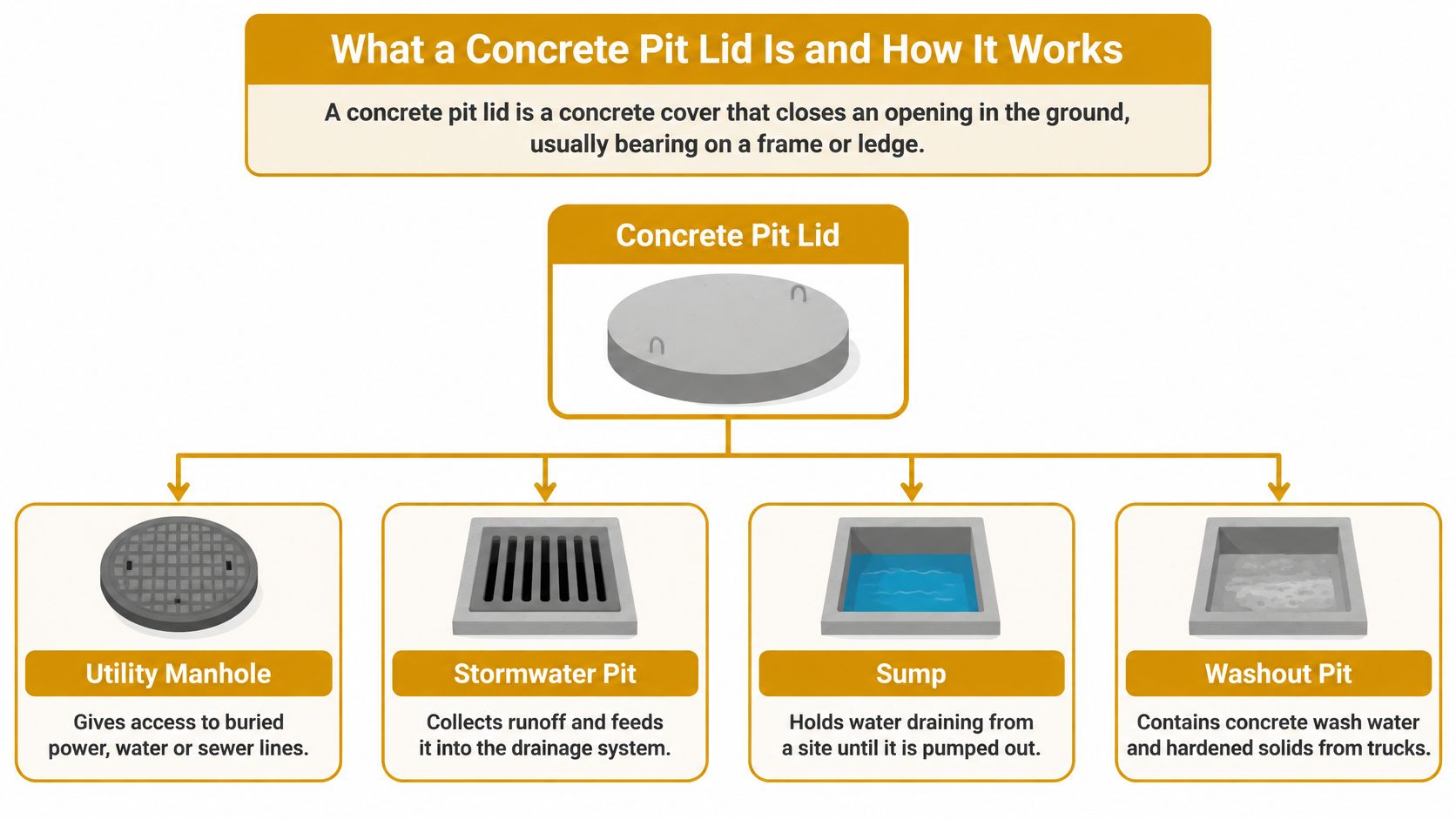
Common forms and what they are made of
Most specified units are precast concrete manhole covers or cover slabs. On site you will also see flat slabs with lifting recesses, lids with a central access opening, hinged or removable panels, and lids cast with handles.
The lid itself is reinforced concrete, meaning steel bars or mesh sit inside the concrete so it can carry bending as well as weight. It usually sits in a steel or cast-iron frame. That frame is the seat. If the seat rocks, chips, or sits proud of the surrounding slab, the lid never gets to use the strength the factory built into it.
You meet these covers in four everyday places:
- Utility access: crews lift the lid to reach buried power, water, or sewer lines.
- Stormwater inlets: the pit collects runoff and feeds a drain line.
- Floor openings: a cover closes a hole workers or carts could fall through.
- Washout pits: the container holds concrete wash water and the solids that settle out of it.
Practical rule: Before you accept a lid, name the heaviest thing that will cross it and the surface it sits on. Those two answers beat any guess based on how thick the concrete looks.
Load Classes and Sizes You Can Specify
There is no single universal capacity for concrete pit lids. In India's IS 12592:2002 product manual, covers are sorted into four grades. The number in the grade is the minimum test load in tonnes-force, applied through a 300 mm diameter loading block. That block is about the size of a large dinner plate, so the class describes a concentrated push, not weight spread evenly over the whole lid.
| Class | Minimum test load | Approx. lbf | Intended use |
|---|---|---|---|
| LD-2.5 Light Duty | 25 kN | 5,620 | Pedestrian and landscaped areas, not vehicles |
| MD-10 Medium Duty | 100 kN | 22,480 | Moderate duty, between landscaped areas and city-road traffic |
| HD-20 Heavy Duty | 200 kN | 44,960 | City roads, bus terminals, and substantial vehicle traffic |
| EHD-35 Extra Heavy Duty | 350 kN | 78,700 | Especially heavy-duty applications |
Read the code from the letters, then the number. LD-2.5 is light duty. MD-10 steps up. HD-20 is the grade tied to city roads, bus terminals, and substantial vehicle traffic. EHD-35 is for especially heavy-duty work. A landscaping cover can be the wrong product under trucks, pumps, forklifts, or a concentrated construction load, even when it looks similar.
How the test is run
The check is simple enough to explain to a new hire.
- The lid holds the specified load for 30 seconds.
- Inspectors look for failure and for permanent deformation, meaning the lid stays bent after the load comes off.
- The load is then raised until the lid breaks, and that breaking load is recorded.
Select by documented class and by location. Don't select by thickness or by how sturdy the lid looks in the yard.
Weight sets the handling plan
Size and mass change the lift, not the class. In 2025, Sanmar's concrete manhole covers ranged from 15 kg for a 30 × 30 cm lid to 845 kg for a 100 × 100 cm lid at 20 cm thick. Global Precast listed an 80 kg unit mass for a medium-duty round lid with a 640 mm outside diameter, a 545 mm inside diameter, and 125 mm thickness.
An 80 kg lid is a planned two-person lift, with a clear place to set it down. A lid near 845 kg is not a manual lift. It needs a machine, a sling plan, and a path that won't drop it on the frame edge.
Ask the supplier for five things in writing: the class, the test load, the clear opening, the weight, and a frame drawing. Section notes on wheel and pallet loads come next. The class only tells you what the 300 mm block did in the test.
Selection Criteria for Load, Fit and Seal
Lids fail in a repeatable order. Walk the checks in that order, and you catch the problem before the concrete truck does.
Name the governing load first. Foot traffic, a pallet, a cart wheel, a forklift outrigger, and a truck tire are different worst cases. The governing load is the one case that stresses the lid hardest, not the average day.
Separate a concentrated load from a spread-out load. A benchmark in ASTM C1227 shows why. Where only residential lawn loading applies, design uses a minimum live load of 100 lbf/ft² (5 kPa) or a 2,250 lb (10 kN) load on a 10-by-10-inch (250-by-250-mm) patch, whichever produces more stress. The same standard also calls for dead load, live load, and earth and hydrostatic pressure with the structure full or empty. A small wheel or outrigger can control the design even when the lid looks heavy. That edge load can cause punching shear (a plug of concrete pushed through), cracking, or bearing failure where the lid meets the frame.
Then check the opening and the seat. Measure the clear opening, the width of the bearing seat, and whether the lid can be lifted without chipping its edge. A lid that only touches the frame at two high spots is already rocking.
Check how the force leaves the lid. Bearing width, span, and eccentricity (the load sitting off center) decide whether the frame or concrete collar can pass reactions into the pit wall. A lid rated for feet is not automatically fit for a driveway. Traffic needs a higher certified class and a frame that can carry the reaction.
Treat concrete strength, reinforcement, and thickness as supporting data. They explain how the lid was built. They are not a substitute for a documented class.
Match the use before you buy
| Use case | Governing load | Frame or collar need | Extra check |
|---|---|---|---|
| Pedestrian walkway or landscaped pit | Foot traffic and dropped tools | Seated bearing on the pit wall | Confirm no carts or vehicles cross it |
| Palletized materials or carts over an opening | Concentrated pallet and cart wheel loads | Restraint against shifting | Mark the lid as a cover and confirm the load basis |
| Forklift route | Concentrated wheel and outrigger loads | Full frame or concrete collar | Load test or calculation for the actual support |
| Construction truck or pump route | Heavy wheel loads with impact | Certified frame that transfers loads to the structure | Certification of the installed assembly |
| Washout pit under truck traffic | Truck wheel loads near the edge | Frame plus anchoring | Watertight seal and restraint against traffic and wind |
Restraint comes next: sliding, rocking, and uplift from wind or a passing tire. Where runoff or washout liquid is involved, check the seal or gasket for gaps.
A cheaper foot-traffic cover on a driveway is a common saving that doesn't survive the first loaded wheel. If any vehicle can cross the opening, specify a recognized access-cover class and ask for certification of the installed assembly.
How Lids Fit Pit-Style Washouts and Storm Capacity
A covered washout pit can look finished and still overflow. Rain lands on the lid and runs to the rim. Slurry and hardened solids have already stolen the volume that should have been emergency space. The lid didn't fail as a slab. The operating plan failed.
On a pit-style washout, the lid has four jobs. It keeps rain out, which cuts the volume someone must pump. It keeps debris and animals out. It limits access to people who are supposed to be there. It does not create capacity that slurry has already filled.
EPA concrete washout guidance says washout systems must hold all liquid and solids in leak-proof containers, and it recommends lowering the liquid level or covering the container before heavy rain. Related state guidance, including Minnesota's, says covers should prevent rainfall exposure and that the facility must be sized so precipitation can't cause overflow.
The capacity you actually control
Work the rain as a volume over the pit footprint, not as a vibe about the weather. Measure the plan area of the opening, apply the rainfall depth in the forecast, and compare that volume with the empty depth under the lid. That empty depth is freeboard, the spare capacity you refuse to fill with slurry.
A fully sealed lid keeps rain out best. A lid that takes two people and a bar to open gets skipped when the storm is two hours out. If crews can't check it quickly, they won't. A removable or partly vented cover trades a little rain control for inspections people will reliably do. Prefer the cover your crew can open on a wet Tuesday.
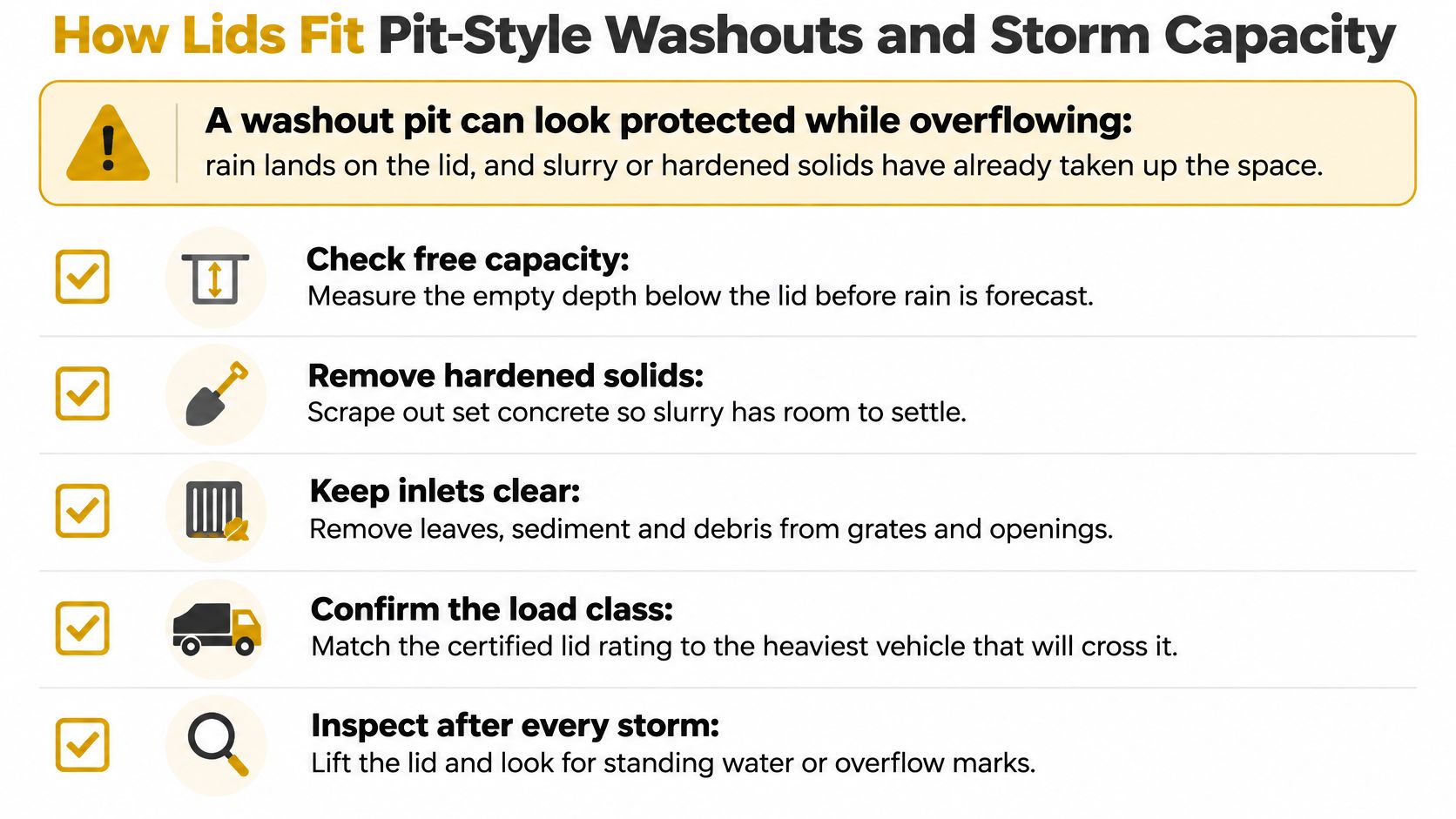
Before a forecast storm, run this check and name an owner for each line:
- Measure depth. The pump operator reads liquid level against the freeboard line.
- Pump down. The same person removes liquid if the forecast eats the margin.
- Clear solids. The washout crew scrapes set concrete off the floor and clears vents.
- Inspect the seal. The site lead checks the gasket and anchors.
- Log it. The superintendent writes who did the check and what was removed.
The legal setbacks and leak-proof rules sit in the next section. The field question is simpler. How much empty space is left, and who is assigned to protect it?
Compliance Rules That Apply to Pit Lids
No single national rule covers every pit lid. Obligations stack. Local permits and state standards often set distance and inspection duty. Federal washout guidance sets the leak-proof baseline. Worker-safety rules cover floor openings. Traffic specs cover wheels. Flood exposure can force a watertight frame.
| Rule or source | Applies to | What it requires | Check before installing |
|---|---|---|---|
| EPA concrete washout guidance | Washout containers | Retain all liquid and solids in leak-proof containers | Leak-proof seal and capacity |
| Illinois 2025 temporary concrete-washout standard | Washout facilities | 50 ft (15 m) setback; smaller sites place the facility as far away as practicable, with added inspections | Distance and inspection log |
| Salt Lake County requirements | Washout facilities | Adequately sized, leak-proof; concrete wastewater entering a storm drain or waterway is a prohibited discharge | Sizing and drain proximity |
| OSHA cover rule | Worker-accessible floor openings | Cover supports at least twice the maximum intended load, is secured against displacement, and is marked as a cover | Load basis and marking |
| AASHTO M306 benchmark (via NPCA) | Traffic-rated castings | Minimum 40,000 lb proof load over a 9 × 9 in test area | Traffic class certification |
| Municipal and utility specifications | Frames and covers in flood or ponding zones | Watertight frames and covers below the 100-year flood elevation or where ponding occurs | Flood exposure and frame type |
How the stack actually lands on site
Neutral public guidance commonly puts washout facilities at least 50 feet from storm drains, open drainage, and watercourses. Illinois' 2025 temporary concrete-washout standard uses that same 15-meter / 50-foot figure, allows a smaller site to place the facility as far away as practicable, and requires extra inspections when the distance can't be met. Salt Lake County requires adequately sized, leak-proof facilities and treats concrete wastewater in a storm drain or waterway as a prohibited discharge. The 50-foot figure is a default control, not a permit by itself.
For a hole workers can fall through, OSHA-aligned cover practice expects the cover to support at least twice the maximum intended load, stay secured against displacement, and be marked as a cover. Equipment, materials, and carts count, not just a person standing on it.
Traffic-rated castings are a different test again. The National Precast Concrete Association identifies AASHTO M306 highway-rated castings as needing a minimum 40,000-pound proof load on a 9-by-9-inch area. That is wheel contact, not a uniform blanket of weight. Related municipal specs describe H-20 or H-20-S16 live loading and an 18-kip equivalent single-axle wheel load. A public-utility spec may also require AASHTO HS-20 vehicle loading, 120 pounds per cubic foot of soil above the structure, 100 pounds per cubic foot of equivalent lateral soil pressure, and 63 pounds per cubic foot of internal liquid pressure. Watertight frames and covers may be required below the 100-year flood elevation or where water ponds.
Ask the local authority which of these apply, and bring the SWPPP or EPCM consultant in before the pit is dug. Keep four papers on site: the load certificate, the lid and frame drawing, the setback record, and the inspection log.
Installing and Maintaining a Pit Lid
A strong lid doesn't make a bad spot acceptable. Install in this order, and keep the reason with the step.
- Confirm the location. Check it against the default setback from drains and watercourses in the compliance notes. If a tight site can't meet it, write down why and plan secondary controls. Distance is a control, not a suggestion.
- Map the nearest inlet and the slope. Pick the flattest spot where a spill can't run downhill into that inlet. Slope beats a tidy-looking corner.
- Seat the frame or collar. Bed it level and confirm the opening matches the lid. An out-of-square frame makes a lid bind or rock.
- Set the lid. It should sit flush, with no rocking when you step on each corner. Rocking means the load is on two points.
- Restrain it. Use the anchors the supplier specifies so traffic, wind, or a pry bar can't slide or lift it.
- Check the seal and the mark. Close gaps in the gasket, and mark the unit as a cover so nobody treats it as loose plywood.
- Protect the downhill inlet and log the work. Inlet protection is the backup when the setback is short.
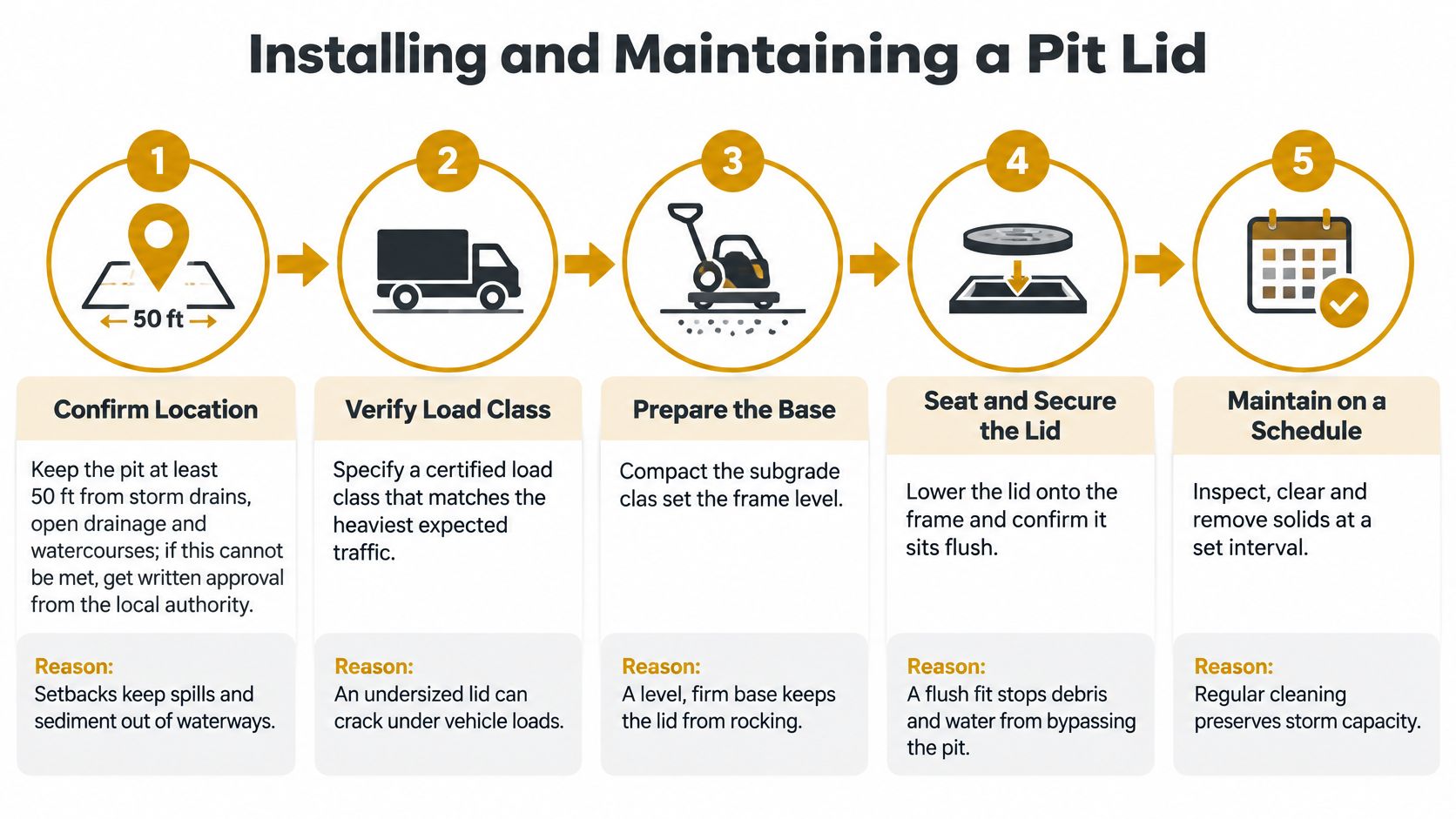
What to look at after washout and rain
After each washout cycle and each rain, look for edge cracks, a lifted seal, a corroded frame, loose anchors, and clogged vents. Clean solids out before they steal freeboard. Fill hairline cracks early, while they are still a maintenance item.
Replace the lid if a crack runs through the thickness or if the bearing edge is gone. A patch on a lid that no longer sits on its frame is a delay, not a repair.
On a crowded site that couldn't meet the usual setback, inspect more often and write the reason in the log. The record is what shows a short distance was managed, not ignored.
Can a covered pit sit closer than the usual drain setback on a tight urban site? Only when the permit allows it, and only with stronger secondary controls plus documented inspections. A certified lid doesn't relocate the inlet.
Choose Between Renting and Buying Your Pit Lid
Decide by the job, not by habit. Rent for a single pour or a short retrofit. Buy when the same site will pour again and again. Either way, specify a certified load class for the heaviest thing that will cross the cover.
Buying looks cheaper on day one and then adds storage, upkeep, and disposal. Renting charges for the days you use the container, and the honest quote includes delivery, rough-terrain access, and any rush fee. Idle owned pans don't earn their yard space between jobs.
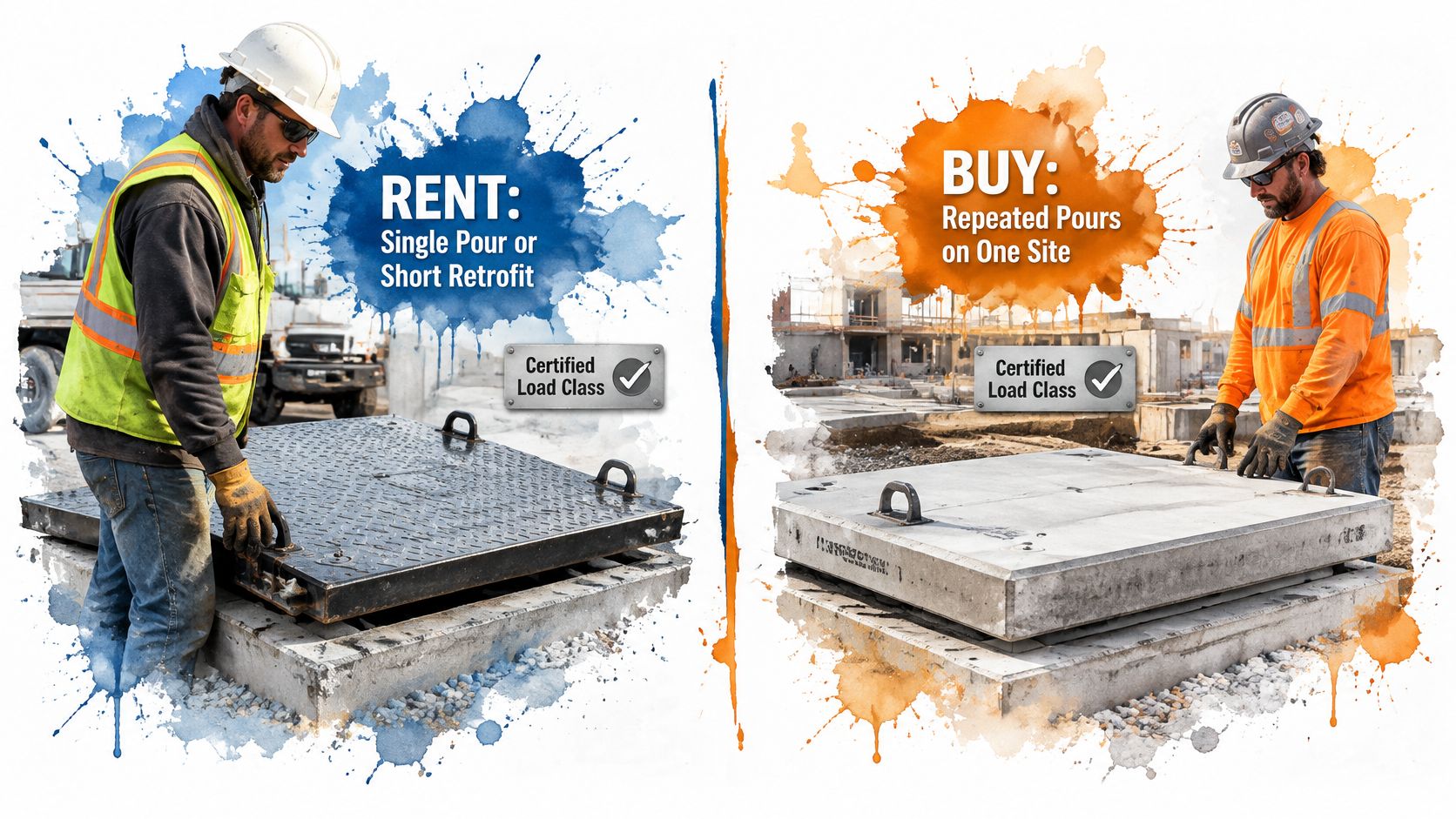
Compare any rental pan with a purchased setup on the points that actually decide a spill:
- Cover: Is a lid included, and can your crew open it before a storm?
- Rating: Does the documented class match the heaviest wheel on this site?
- Volume: Does empty capacity cover slurry plus the rain volume you calculated earlier?
| Situation | Better choice | Why | What to confirm |
|---|---|---|---|
| Single pour or short retrofit | Rent | You pay for the period of use, with no storage or disposal | Daily rate, delivery, and rough-terrain fees |
| Repeated pours on one site across a year | Buy | Repeat use spreads the cost | Lid rating matches the heaviest load |
| Heavy truck or pump route with a set load class | Either, with a certified rating | The rating has to match this site, not a catalog photo | Certification or load documentation |
| Tight urban site with a short setback | Either, with an inspection plan | Setback and inspection matter more than who owns the pan | Permit conditions and inspection schedule |
| Contractor with several sites and varied pours | Rent for peak demand; buy core units | The mix covers peaks without a yard full of idle stock | Availability and delivery window |
Send the provider a short brief before you book: footprint, peak slurry volume, heaviest load, the forecast rain window, and the delivery location. That is enough to confirm the pan fits the site instead of merely fitting the truck.
If the next pour needs a contained washout without a lid left in the yard afterward, Reborn Rentals rents concrete washout pans and containers sized for jobsite slurry. Match the pan to your load class, your drain setback, and the empty depth you plan to protect before rain. Check availability and delivery with Reborn Rentals before the trucks are on site.