
Construction Cost Estimation: A Practical Guide for 2026
The bid is due this afternoon. Your quantities look clean, your crew rates make sense, and your material pricing is close enough to current market reality that you can defend it. But there's still that nagging feeling every experienced estimator knows. Not that you missed the concrete or the steel. It's the smaller jobsite costs that don't look small once the project starts. Temporary controls. Cleanup. Containment. Delivery conditions. Extra rental days because the pour slid by a shift. The things that rarely lose a bid on paper, but often take profit out of the field.
That's where construction cost estimation stops being a spreadsheet exercise and becomes a management discipline. A good estimate isn't just a price. It's the first version of project control. It tells the project manager what the job can carry, tells operations what assumptions were baked in, and tells ownership whether the work is worth chasing in the first place.
Construction teams generally know how to count visible scope. They can measure slab area, calculate concrete volume, and build labor around crew output. Where estimates break down is in the support costs around that work. A line item like temporary washout containment often gets treated as a late add, a field purchase, or “something we'll sort out once we mobilize.” That approach works right up until the site inspector asks where the containment plan is, the rental period extends, and a small omission turns into a real budget leak.
Strong estimating practice fixes that on day one. It treats compliance and temporary rentals the same way it treats formwork, pumping, or haul-off. Defined scope. Assigned duration. Clear assumptions. Cost loaded into the estimate early, not after the award.
Introduction Beyond the Bottom Line
Construction cost estimation decides two things before the first truck shows up. Can you win the work, and can you make money doing it? If either answer is shaky, the estimate isn't finished.
A lot of overruns don't start with dramatic mistakes. They start with ordinary omissions. Somebody carried the concrete but not the full cleanup cycle. Somebody included equipment pickup but not an extra day on site. Somebody assumed environmental compliance would sit inside a generic allowance, then found out the site needed a specific containment setup.
That's why the estimate has to work like a field plan, not just a bid summary.
What the estimate really has to do
A reliable estimate should answer practical questions a project manager will ask later:
- What are we buying? Materials, labor, rentals, permits, and temporary controls need to be visible.
- What assumptions are driving the price? Crew output, duration, site access, delivery timing, and cleanup responsibilities should be stated.
- Where can this job drift? Any item tied to schedule movement, inspection requirements, or weather exposure needs attention early.
- What costs are easy to forget? These are the line items that usually come back as change orders, field buys, or margin erosion.
Practical rule: If the field will need it to stay productive, safe, or compliant, the estimate should carry it.
The most useful estimates I've seen are not always the prettiest. They're the ones that survive contact with the jobsite. The estimator thought about access, sequence, rentals, and inspection risk before the PM had to call asking why a necessary item wasn't included.
Where hidden losses usually start
The danger isn't always in the major trades. It's in the support scope that falls between disciplines. Concrete work is a common example. Teams usually estimate the pour itself with reasonable discipline, but they may leave environmental handling outside the main cost model. That creates a blind spot.
Treating washout pans, liners, delivery conditions, and related containment logistics as “miscellaneous” is a budgeting mistake. Those items belong inside the estimate structure from the start, assigned to the activity that creates the need. That's how you protect both compliance and margin.
What Exactly Is Construction Cost Estimation
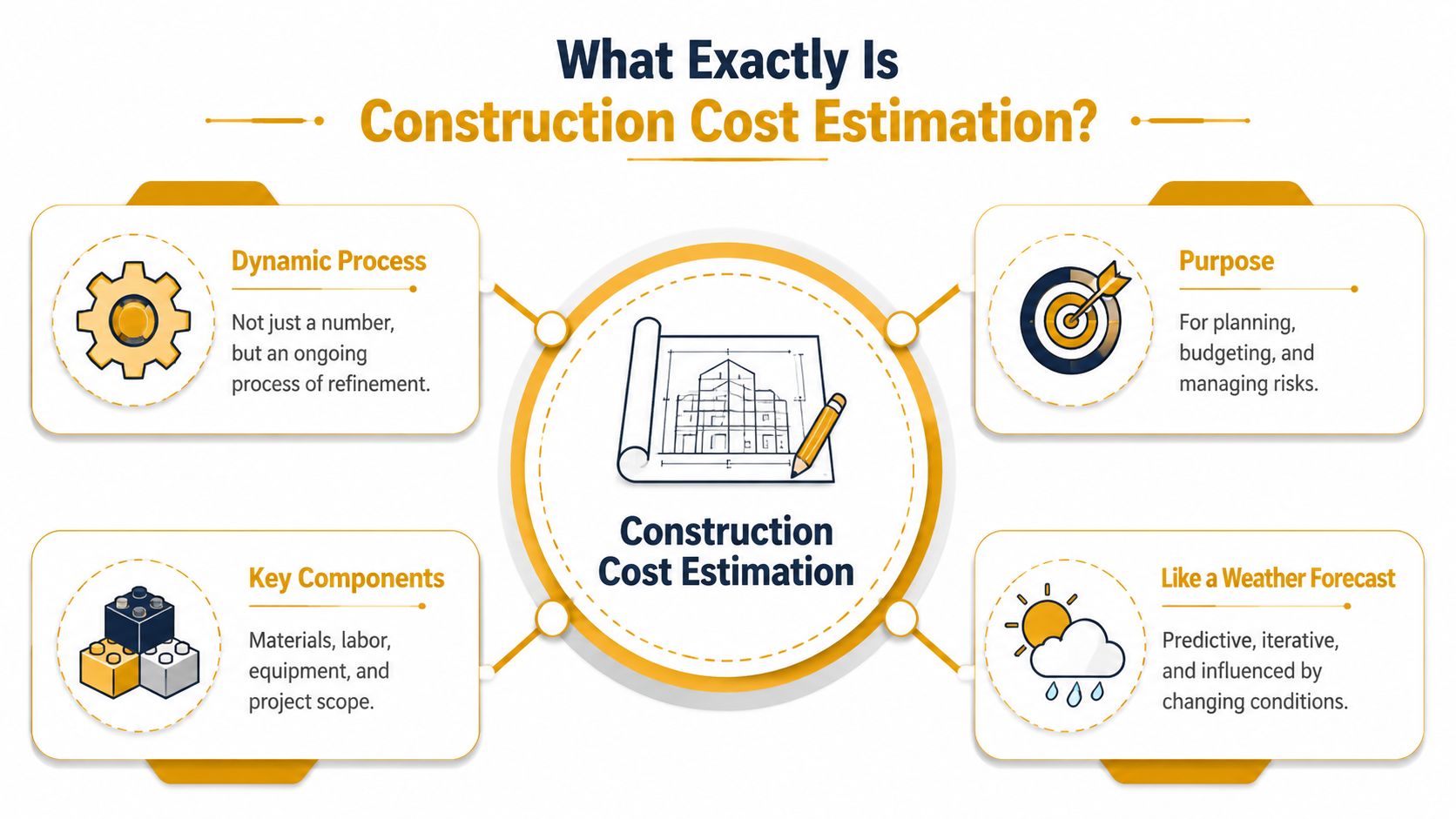
Construction cost estimation is the process of predicting what a project will cost based on the information available at a given time. That last part matters. At a given time is what separates a rough early estimate from a final bid.
Consider a weather forecast. A forecast several days out can tell you the general direction. A forecast close to the event is usually more precise because more conditions are known. Estimating works the same way. Early in a project, you're pricing uncertainty along with scope. As drawings, specifications, logistics, and sequencing become clearer, the estimate should tighten.
It's not the same as a quote or a bid
People use these terms loosely, but they aren't interchangeable.
A construction estimate is the cost model. It's your internal calculation of what the work should cost based on scope, production, risk, and assumptions.
A quote is usually narrower. It often refers to supplier or subcontractor pricing for a specific piece of work or material package.
A bid is what you submit to win the job. It may be based on your estimate, but it also reflects strategy. You might carry risk differently, sharpen markup, or qualify scope depending on competition and confidence.
Why project teams need more than one estimate
Different stages require different levels of confidence. Early on, an owner might only need enough information to decide whether a project is worth developing. Later, the contractor needs enough detail to commit to a number and then manage against it.
That's why estimating is iterative. It evolves with design maturity, trade input, site knowledge, and procurement clarity. A one-time estimate that never gets refined usually stops being useful the moment the project changes.
The estimate should get more specific as the unknowns get smaller. If it doesn't, the team is carrying false confidence.
What a good estimate captures
At minimum, a workable estimate should tie together these moving parts:
| Part of the estimate | Why it matters |
|---|---|
| Scope definition | Prevents pricing something vague and then discovering it means more in the field |
| Quantities | Gives labor, material, and equipment something measurable to attach to |
| Production assumptions | Converts quantities into labor hours and duration |
| Temporary requirements | Captures short-term needs like containment, cleanup, and access support |
| Exclusions and assumptions | Shows what the number depends on and where risk still sits |
When estimators miss one of those categories, the problem usually shows up later as confusion between estimating, operations, and the field. The PM thinks it's covered. The superintendent assumes someone will order it. Accounting sees an unplanned cost. Margin disappears one small purchase at a time.
Key Estimating Methods and When to Use Them
Not every project needs the same estimating approach. The mistake is using a rough method too late, or using a detailed method before the design is developed enough to support it. Good construction cost estimation matches the method to the maturity of the job.
The AACE estimate class framework summarized by Vista Projects gives a useful reality check. Class 5 estimates sit at roughly 0–2% project definition and carry an accuracy range of -50% to +100%. Class 3 estimates are commonly in the -10% to +30% range. Class 1 estimates, built from complete construction documents, tighten to -3% to +15%.
Order of magnitude estimate
This is the fast first pass. You use it when the project is still conceptual and the goal is a go or no-go decision, not a commitment to field execution.
It's useful when an owner asks, “Are we in the right ballpark?” It's dangerous when a contractor treats it like a bid number.
Best use cases:
- Early feasibility
- Budget screening
- Rough capital planning
What it needs:
- Basic scope narrative
- Similar past projects
- Broad market awareness
What it doesn't do well:
- Capture unique site conditions
- Support precise procurement planning
- Carry temporary compliance items with confidence unless you deliberately add them
Unit cost estimate
This method applies a cost to a unit of work, such as cubic yards of concrete, square feet of slab, or linear feet of curb. It works well for repetitive scope.
Unit pricing is practical, but only if the unit reflects how the work will happen. A square-foot number can hide real complexity if access is tight, sequencing is broken up, or cleanup demands are unusual.
Parametric estimate
A parametric estimate uses historical relationships and adjustment factors. It's stronger than a guess and faster than a full takeoff. Seasoned estimators rely on known drivers like height, complexity, congestion, and location to scale prior work into a current model.
For temporary rentals and compliance items, parametric thinking helps. If a project has repeated pours, restricted staging, or a phased sequence, the estimate should reflect those conditions instead of assuming one flat miscellaneous allowance.
Detailed bottom-up estimate
This is the bid builder. You break the project into work packages, perform takeoffs, assign labor and equipment, and cost each line item at activity level. It takes longer, but it gives the PM and superintendent something usable after award.
It's the right method when:
- The documents are mature
- The contract risk is real
- You need cost control after mobilization
A bottom-up estimate is where forgotten rentals stop being forgotten. If the work package needs it, the estimate should show it.
Comparison of construction cost estimation methods
| Method | When to Use | Required Inputs | Typical Accuracy |
|---|---|---|---|
| Order of magnitude | Early feasibility, pre-design budgeting | Limited scope information, historical comparisons | Class 5 can range from -50% to +100% in early definition stages |
| Unit cost | Repetitive work with measurable production units | Unit prices, quantities, basic job conditions | Varies with the quality of unit data and job comparability |
| Parametric | Early to mid-stage planning when similar project history exists | Historical cost data, project drivers, adjustment factors | Stronger than rough budgeting, weaker than full takeoff |
| Detailed bottom-up | Final bidding, buyout planning, cost control | Complete drawings, specs, takeoff, labor assumptions, vendor input | Class 1 estimates can tighten to -3% to +15% when documents are complete |
No single method wins every time. The best estimators shift methods as the project develops, and they don't pretend a conceptual number has bid-level precision.
The Anatomy of a Construction Estimate
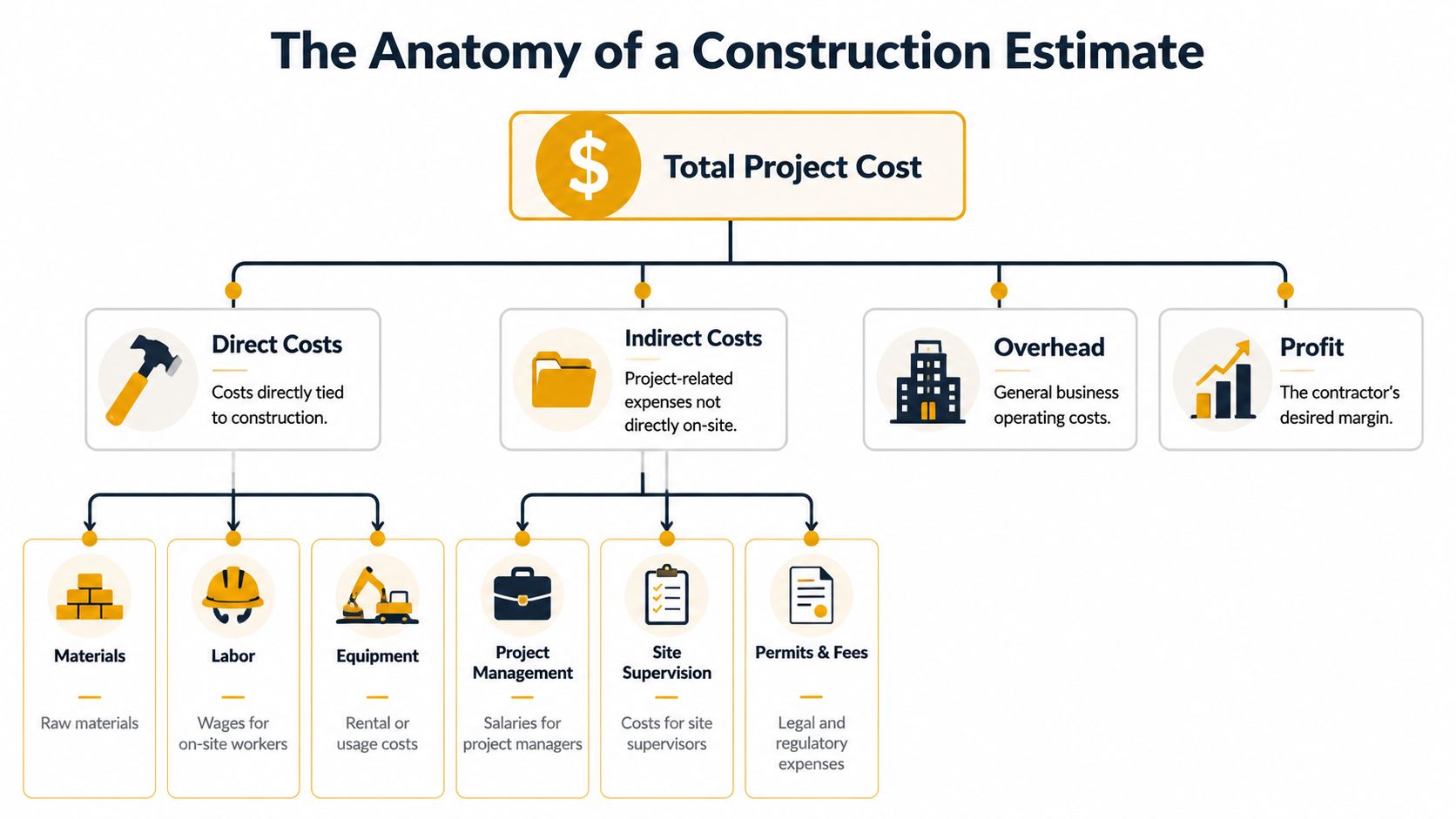
Every estimate has a simple job. It needs to account for the full cost of doing the work. The problem is that many estimates are only complete in the obvious categories. They capture visible production costs and leave support costs floating in allowances or field discretion.
That's where jobs get hurt.
Direct costs
Direct costs are tied straight to the work in place. Materials, labor, and equipment sit here.
According to Autodesk's discussion of cost estimating methods, labor typically accounts for 25–40% of total project costs, while materials often range from 30–50%. For concrete work, labor productivity is often benchmarked at 0.5–1.5 man-hours per cubic yard, and Autodesk also notes that integrating unit-day rental rates for equipment like washout pans into the cost model allows for more granular, risk-adjusted estimates.
That last point matters more than many estimates reflect.
Labor
Labor isn't just wage rate. It's productivity. A crew can be expensive and still profitable if production holds. A cheaper crew can lose money if access, sequencing, or rework drags output down.
For concrete scope, labor assumptions should match the actual site setup. Form complexity, placement conditions, and finishing access all affect production. If the site needs more containment handling, more movement around the pour area, or stricter cleanup controls, labor can drift even when concrete quantities don't.
Materials
Material takeoff errors are obvious. Less obvious is failing to account for material-related support handling. Concrete volume may be correct, but the estimate can still miss disposal support, liner replacement, or site protection tied to that material operation.
Equipment and rentals
This category often gets underbuilt. Teams remember the pump or skid steer because they're visible and expensive. They forget short-duration rentals that are operationally necessary.
A washout pan is a good example. It should be treated as equipment support tied to the concrete activity, not as a vague site miscellaneous line. If the rental is driven by pour count, duration, or location constraints, build it that way.
Indirect costs
Indirect costs support the job without becoming part of the finished work. Site supervision, temporary facilities, permits, traffic control, cleanup coordination, and compliance administration usually sit here.
These are the costs that tend to look optional from a distance and mandatory on site.
Field reality: If an inspector can stop the operation over it, it isn't optional. Price it before the bid goes out.
Overhead and profit
Overhead keeps the company running. Profit keeps the company healthy. Neither one should be used to absorb scope that should have been estimated directly.
That's a common failure point. An omitted compliance rental doesn't stay small just because it lands in overhead later. It becomes unplanned cost eating planned margin.
The overlooked category that causes trouble
A lot of estimates need one more lens: temporary compliance scope.
This includes:
- Containment equipment tied to concrete operations
- Delivery and pickup conditions that affect actual rental cost
- Daily duration assumptions when schedule movement can extend use
- Cleanup cycles that may require more than one event over the course of the work
- Responsibility gaps between GC, subcontractor, pumper, and supplier
If nobody owns those assumptions in the estimate, the field will own the cost.
Putting It All Together A Sample Estimate
The simplest way to see whether an estimate works is to build one from the ground up. Take a small concrete slab job, something like a residential-style patio or equipment pad. The exact price isn't the lesson here. The lesson is how the line items are structured so nothing important falls through.

Start with the work breakdown
A practical bottom-up estimate for a small slab might include:
Layout and prep
Site check, layout, minor grading, and subgrade prep.Forms and reinforcement
Form boards, stakes, fasteners, reinforcement, chairs, and installation labor.Concrete placement and finishing
Concrete quantity, placement crew, finishing crew, curing approach, and cleanup.Equipment and temporary support
Small tools, compaction support if needed, and washout containment for the pour operation.Project support costs
Delivery coordination, supervision time, and any permit or site rule items tied to the work.
That breakdown matters because it forces support items into the same logic as production items. If concrete placement is in the estimate, the containment tied to concrete placement should be in the estimate too.
Build labor around production, not hope
Once quantities are known, assign labor by task. Don't just spread hours evenly across the job. Forming, placing, and finishing each have different production profiles.
For concrete work, labor assumptions should reflect actual field conditions. If access is limited, if the pour is broken into phases, or if cleanup must happen under tighter site rules, that affects crew time. A clean spreadsheet with unrealistic labor assumptions is still a bad estimate.
Add temporary rentals as activity costs
Many estimates immediately improve through the following method. Instead of placing washout containment in a catch-all allowance, attach it directly to the concrete activity.
A better approach is to ask:
- Is the pan needed for one pour event or several?
- Is the site duration likely to extend if weather or sequencing shifts?
- Does delivery access add complexity?
- Who is responsible for coordinating pickup and swap-out if conditions change?
When you price the pan as an activity-level cost, the PM can see it, the superintendent can plan around it, and accounting won't be surprised later.
If a rental depends on days on site, estimate the days honestly. “One day should do it” is not a strategy.
Document assumptions before the bid leaves
For a small slab estimate, assumptions may be as important as the line items themselves. State the basis clearly.
A simple assumption log might include:
- Site access is clear for delivery and pickup
- Concrete work is completed within the planned sequence
- Containment equipment is available for the required pour window
- No additional compliance measures beyond the stated scope are required
- Weather delays beyond the planned duration may affect rental time
This isn't paperwork for its own sake. It gives the project manager a map of what the estimate expected. If reality changes, the team can identify the reason quickly instead of arguing about whether the cost was ever included.
Roll it into a usable bid
After direct and indirect costs are assembled, the company adds its overhead and profit according to internal policy and job strategy. The exact markup isn't the universal lesson. The lesson is that markup should sit on top of a complete cost model, not compensate for an incomplete one.
That's the difference between a number that wins work and a number that survives the job.
Pro Tips for Accurate and Compliant Bids
Most estimating errors aren't math problems. They're scope definition problems. The spreadsheet did exactly what the estimator told it to do. The trouble is that the estimator didn't tell it enough.
The fix is usually procedural, not heroic.
Use a repeatable estimate template
Build a standard estimate structure for recurring work types. Concrete scope should always trigger the same review of support items, including containment, cleanup, and temporary compliance needs.
Templates help because they reduce memory-based estimating. Nobody's judgment is perfect at the end of a long bid day. A checklist-backed template catches what experience alone can still miss.
Keep your historical data honest
Historical data only helps if it's normalized and reviewed. If the team undercoded rental extensions, buried field buys in miscellaneous cost codes, or failed to separate compliance spend from general cleanup, the database will teach the wrong lesson.
Good historical cost records should show where the estimate was right, where the field had to supplement it, and which “small” items kept appearing after award.
Peer review the estimate before submission
A second set of eyes won't just catch bad formulas. It will catch missing scope logic. Ask the reviewer to look specifically for temporary requirements, handoff risks, and compliance obligations.
That review should include one blunt question: what will the superintendent need on day one that this estimate doesn't clearly carry?
Don't isolate compliance costs from the main estimate
This is the big one. Compliance-related scope should live inside the estimate logic, not in a side note or a vague contingency bucket.
A 2025 GAO finding discussed in Kahua's article on accurate construction estimating noted that failing to account for full environmental compliance costs during conceptual estimating contributed to 12–24% of observed cost overruns in public works contracts. That's the warning estimators need to take seriously.
If a job involves concrete operations, temporary containment isn't an afterthought. It's part of the means and methods of doing the work responsibly and without interruption.
Bids get tighter when the estimate includes reality early. They get riskier when the team postpones reality until the field.
Price duration risk where it actually lives
Rental-dependent items should be tied to duration assumptions, not hidden in lump sums. If schedule movement affects the cost, say so in the estimate. If site access can affect delivery conditions, say that too.
That gives the PM something usable. It also creates a cleaner path for change management if job conditions shift outside the original basis.
Write assumptions like operations will read them
Because they will. Keep them short, direct, and specific. The best assumption logs don't sound legal. They sound practical.
A strong estimate protects margin before the project starts. An even better one protects compliance, field execution, and margin at the same time.
If your team wants a cleaner way to budget concrete washout containment from the start, Reborn Rentals makes that easier. Their rental catalog is built around specialized washout pans with clear daily pricing, straightforward delivery setup, and product details that help estimators and project managers plan accurately before the pour is scheduled. That's useful when you're trying to keep compliance scope visible in the estimate instead of chasing it after mobilization.