
Construction Stormwater Compliance: A Practical Guide
Construction sites disturbing 1 acre or more need an NPDES permit and a SWPPP, and EPA guidance treats concrete washout as a high-priority pollution source because alkaline slurry can enter storm drains if it isn't contained. That requirement becomes practical on pour day, when washwater, cement fines, changing site access, and sudden rain can turn a small housekeeping gap into a documented compliance problem.
A crew may have the erosion controls installed, the inspection folder in the truck, and the concrete scheduled before lunch. Then the pump truck needs to wash out, the planned containment area is blocked by equipment, and a storm drain sits downhill from the work. The question isn't whether the crew understands the rule in theory. It's whether someone has already chosen a workable washout location, checked its capacity, assigned responsibility, and recorded the control in the site's operating routine.
Construction stormwater compliance works best when contractors treat it as a field system rather than a permit form. The permit establishes coverage, the SWPPP defines the controls, inspections verify that those controls still work, and disciplined washout management prevents one of the most obvious pollutant pathways.
What Permit Coverage Requires Before Ground Disturbance
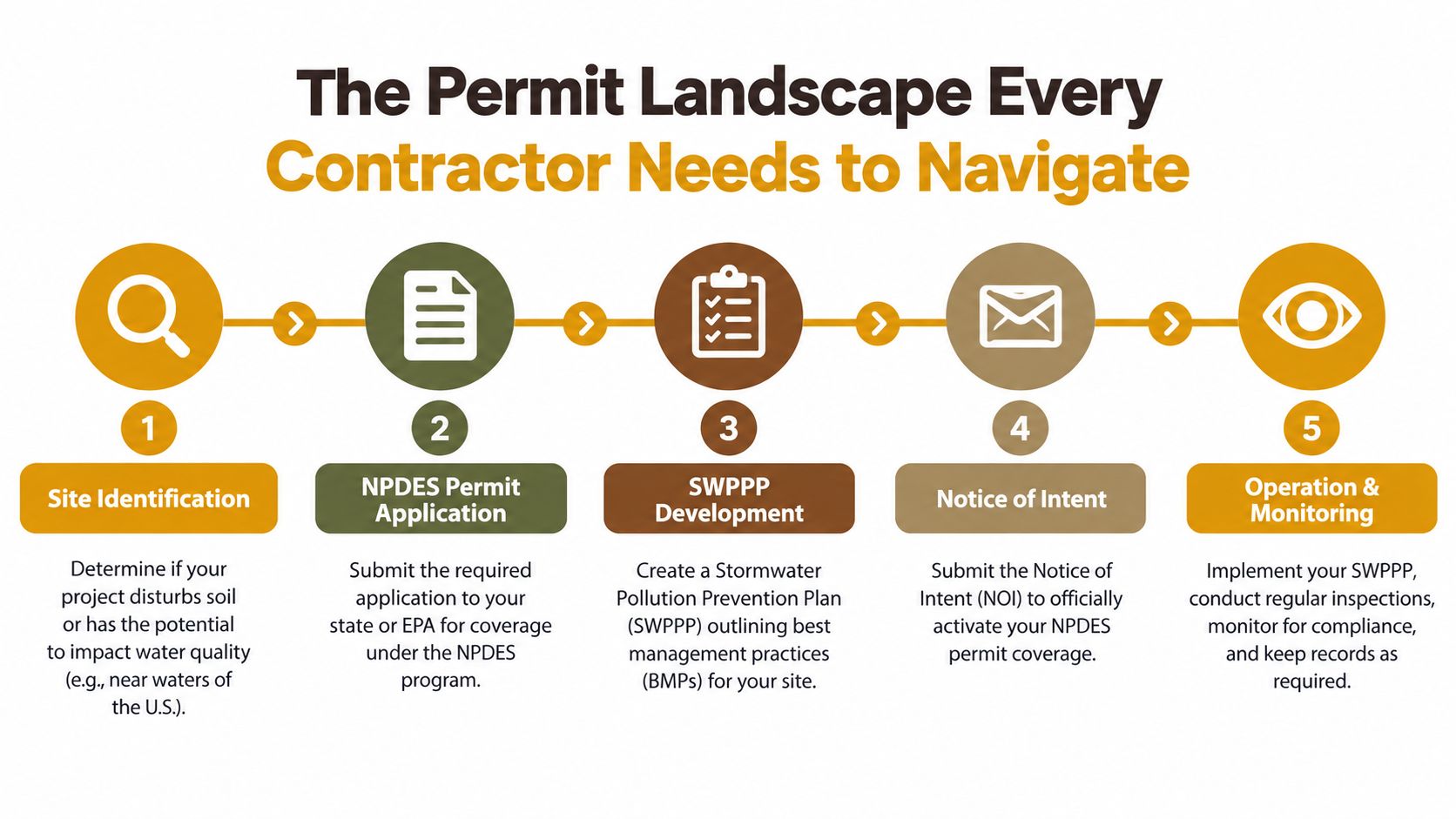
An inspector arriving at an active site may first ask questions that have nothing to do with the concrete pan: Is this project covered? Was permit coverage obtained before earth disturbance? Is the SWPPP available and accurate? If any answer is unclear, well-installed BMPs cannot fix the underlying authorization gap.
The main federal trigger is disturbance of 1 acre or more, or a smaller area that belongs to a larger common plan of development. Covered projects generally require NPDES stormwater authorization, a Stormwater Pollution Prevention Plan, and controls for erosion, sediment, and other pollutants. The agency handling coverage and the filing process can vary by jurisdiction, so the project team must confirm applicable state, local, or federal requirements before mobilization.
Why the threshold matters
A smaller job still deserves a permit check. A building addition, utility connection, or phased subdivision may be one piece of a wider development plan. That relationship can place the work within the permit system even when the immediate disturbance looks limited.
The regulatory timeline shows how these requirements developed. EPA promulgated Phase I stormwater regulations in 1990, and large construction-site permits followed in 1992, as described in EPA's construction stormwater program history. Phase II expanded coverage to construction sites disturbing 1 acre or more in 1999, with smaller-site permits required starting in 2003.
Before mobilization, walk through five questions:
- What land will the project disturb? Count grading, access, staging, utility work, and later phases.
- Does the work belong to a larger common plan? Review the development as a connected project, not as one isolated parcel.
- Which authority issues coverage? Filing requirements and electronic processes can differ by jurisdiction.
- Who owns the SWPPP? Identify the qualified person or responsible team, rather than naming only the company.
- What must happen before disturbance? Confirm approvals, postings, controls, and inspection arrangements before equipment starts.
Practical rule: If the team cannot explain the permit trigger and identify the person responsible for the SWPPP, the project is not ready for ground disturbance.
Permit coverage starts the compliance process. The field team must then operate the controls in the SWPPP, inspect them, correct failures, and contain pollutant sources such as concrete washout before slurry reaches a drainage system. A planned washout area, with enough capacity and a backup location when access changes, turns that requirement into a workable production routine.
Understanding the SWPPP as Your Living Compliance Document
A SWPPP should tell a crew what to do when site conditions change. It normally identifies the project, maps disturbed areas and drainage routes, describes erosion and sediment controls, addresses material and waste handling, establishes inspections, and explains how the team will correct deficiencies. EPA describes the covered-site obligation in its construction stormwater requirements, including SWPPP implementation, stabilization, inspections, and effective pollution-prevention controls.
Treating the plan as a one-time submittal creates a predictable problem. A plan may show a washout area beside an access route, but the access route may later become the only path for deliveries. A sediment barrier may be appropriate during mass grading, then need adjustment when utilities are installed. A concrete subcontractor may arrive with a different pump layout from the one anticipated during planning.
What the document needs to answer
A field-ready SWPPP connects each risk to a person, control, inspection point, and response. It should make the following decisions visible:
- Site conditions: Where does runoff leave the work area, and which inlets, ditches, or water bodies could receive it?
- Erosion and sediment controls: Which measures protect exposed soil, slopes, entrances, stockpiles, and drainage paths?
- Pollution sources: Where will concrete washout, fuel, trash, paints, curing compounds, and other materials be handled?
- Inspection duties: Who checks the controls, what do they look for, and where are findings recorded?
- Corrective actions: What happens when a control is damaged, full, displaced, overtopped, or no longer suitable for the phase of work?
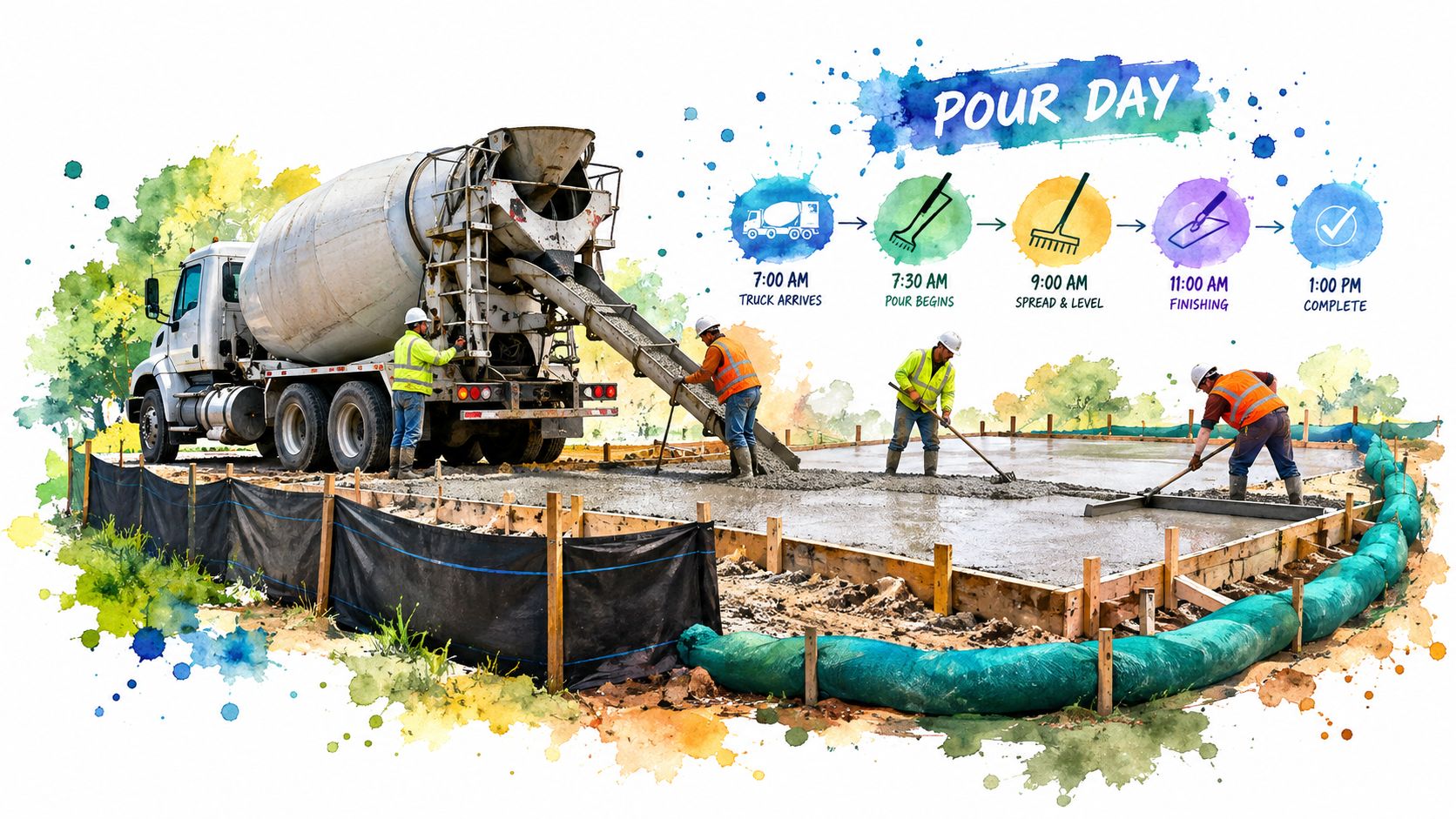
Concrete washout deserves a clearly marked location in this system. Unmanaged washwater is not just a messy byproduct of finishing. Cement fines and alkaline water can travel from a work area to an inlet and then to surface water, which is why EPA rules prohibit unmanaged concrete washout wastewater discharges.
Updating the plan when the site changes
The superintendent should compare actual conditions with the SWPPP during mobilization, before major phase changes, and whenever a control no longer matches the work. That review might lead to a revised washout location, an added inlet protection measure, a different access route, or a new responsible person for a subcontractor activity.
A strong plan also makes field instructions simple. The concrete foreman shouldn't have to interpret a long narrative during a busy pour. The plan or site map should make the approved washout location, access route, containment method, inspection responsibility, and escalation process easy to find.
The document protects the contractor only when it reflects reality. If the plan says one thing and the site shows another, an inspector has a reason to question both the controls and the team's management of them.
BMPs in Action on a Typical Pour Day
A compliant pour starts before the first truck arrives. The site supervisor reviews the day's layout, confirms where trucks will enter and leave, checks that the washout container is empty enough to receive waste, and walks the drainage path toward nearby inlets. The crew doesn't wait until the pump operator asks where to clean out.
EPA identifies concrete washout as a high-priority pollution source because alkaline washwater and cement fines can leave the site, enter storm drains, and reach surface waters. Its concrete washout BMP guidance recommends cleaning the container at 75% capacity, then vacuuming excess liquid or allowing it to evaporate so the remaining solids can harden and be recycled. EPA's example SWPPP also places washout areas at least 50 feet from storm drain inlets.
Before the pour
The crew chooses a stable location away from the direct drainage path and checks that trucks can reach it without crossing exposed soil unnecessarily. A rented pan, framed lined area, or other approved containment setup must be large enough for the expected operation and protected from damage by traffic.
The supervisor then checks nearby controls. Inlet protection should be secure, silt fencing should be intact where it is part of the drainage strategy, and the access route should limit sediment tracking. These measures have different jobs. Inlet protection intercepts material at the drainage point, while washout containment prevents cementitious waste from becoming mobile in the first place.
Field habit: Assign one person to own washout readiness before the pour begins. Shared responsibility often becomes no responsibility when trucks arrive together.
During placement and cleanup
The concrete crew directs chute residue, pump priming material, and truck washout into the designated container. Workers shouldn't rinse tools or equipment onto soil, pavement, or a sloped surface that leads to an inlet. If the pan fills faster than expected, the foreman pauses the washout activity and calls for servicing or an approved alternate control. Improvising a shallow pile beside the work is exactly how a contained task becomes a discharge pathway.
The supervisor should watch for splash, liner damage, overtopping, and stormwater entering an uncovered container. A lid or cover can help keep rain from adding volume and contacting cementitious waste, but it doesn't replace capacity checks or proper cleanup.
At the capacity checkpoint
The 75% mark is an action trigger, not a target to exceed. Before the container reaches that level, the responsible person arranges removal of excess liquid by vacuuming or allows evaporation as appropriate, then manages the hardened solids according to the project's waste procedures. The crew records the condition and any service performed.
If a storm arrives while the container is nearly full, the remaining capacity may disappear quickly. A location that looked adequate during a dry morning can become vulnerable once rain adds volume and runoff approaches from the surrounding surface. That is why capacity, cover, drainage, and inspection must be considered together.
After the final truck leaves, the team checks the route, removes tracked material, verifies that no washwater escaped, and updates the inspection record. The pour is complete only when the waste stream is controlled and the evidence matches what happened on the ground.

Inspection Rhythms and Recordkeeping That Satisfy Regulators
A control that exists but isn't inspected can fail unnoticed. A control that was repaired but not documented can leave the project unable to demonstrate what happened, when it happened, or who responded.
EPA's construction SWPPP guidance identifies daily inspection of washout areas and cleanup when holding capacity reaches 75%, as noted in its construction activity requirements. The permit and local authority may impose additional inspection requirements, so the project team should use the applicable permit as the controlling schedule.
Build the routine around decisions
An inspection should produce a useful answer, not just a signature. The person checking the site should record whether the washout is correctly located, stable, intact, covered when needed, and below the capacity trigger. For erosion and sediment controls, the record should identify damage, sediment accumulation, bypasses, tracking, or conditions that require maintenance.
| Inspection Type | Frequency | Key Items to Document |
|---|---|---|
| Washout area check | Daily and during active concrete work | Container condition, approximate capacity, location, cover, leakage, access, and cleanup action |
| Site control inspection | According to the applicable permit and SWPPP | Inlet protection, silt barriers, stabilized entrances, exposed soil, drainage paths, and deficiencies |
| Event-driven review | After rain or a significant site change, where required | Runoff pathways, overtopping, displaced controls, sediment movement, and corrective actions |
| Corrective action follow-up | Until the issue is resolved | Problem description, responsible person, repair date, replacement materials, and verification |
Keep records with the SWPPP or in a controlled digital system. Photos can help show the condition of a washout area or damaged control, but they should support written observations rather than replace them. A useful entry says what the inspector saw, what risk it created, what the crew did, and whether the response was complete.
Recordkeeping principle: Write the inspection record for a person who wasn't on site. They should be able to understand the condition, the decision, and the follow-up without guessing.
Train foremen and subcontractors on the reporting path before work starts. If a pump operator sees a full pan, that person should know whom to contact and what activity must stop until the issue is addressed. The strongest records come from a routine that crews can follow during production, not from paperwork reconstructed at the end of the week.
Enforcement Reality and the Cost of Noncompliance
Construction stormwater enforcement has a measurable history. EPA's evaluation of the Phase I Construction Storm Water Program estimated 186,000 regulated entities nationwide, and reported that 42% of on-site compliance inspections resulted in enforcement actions in 2003, according to the EPA program evaluation.
Those figures are historical program data, not a prediction of what will happen on every current project. They do show why contractors should treat inspections, permit coverage, and pollution controls as operating requirements rather than optional administrative work.
What enforcement is trying to correct
Regulators are concerned with preventable pollutant movement. A missing permit, an inaccurate SWPPP, an unmaintained inlet control, or an overflowing washout can each point to a failure in the site's management system. Corrective action may require the contractor to repair controls, stabilize disturbed areas, improve inspection practices, document changes, or address an unauthorized discharge.
The same EPA evaluation associated enforcement actions with reductions of 19,394,000 pounds of sediment, 28,656,034 pounds of total suspended solids, 15,188 pounds of fuel oil and diesel fuels, and 64,479 pounds of total dissolved solids. Those figures demonstrate why enforcement focuses on field conditions. The program addresses material that can otherwise move from construction sites into receiving waters.
The business impact of a preventable gap
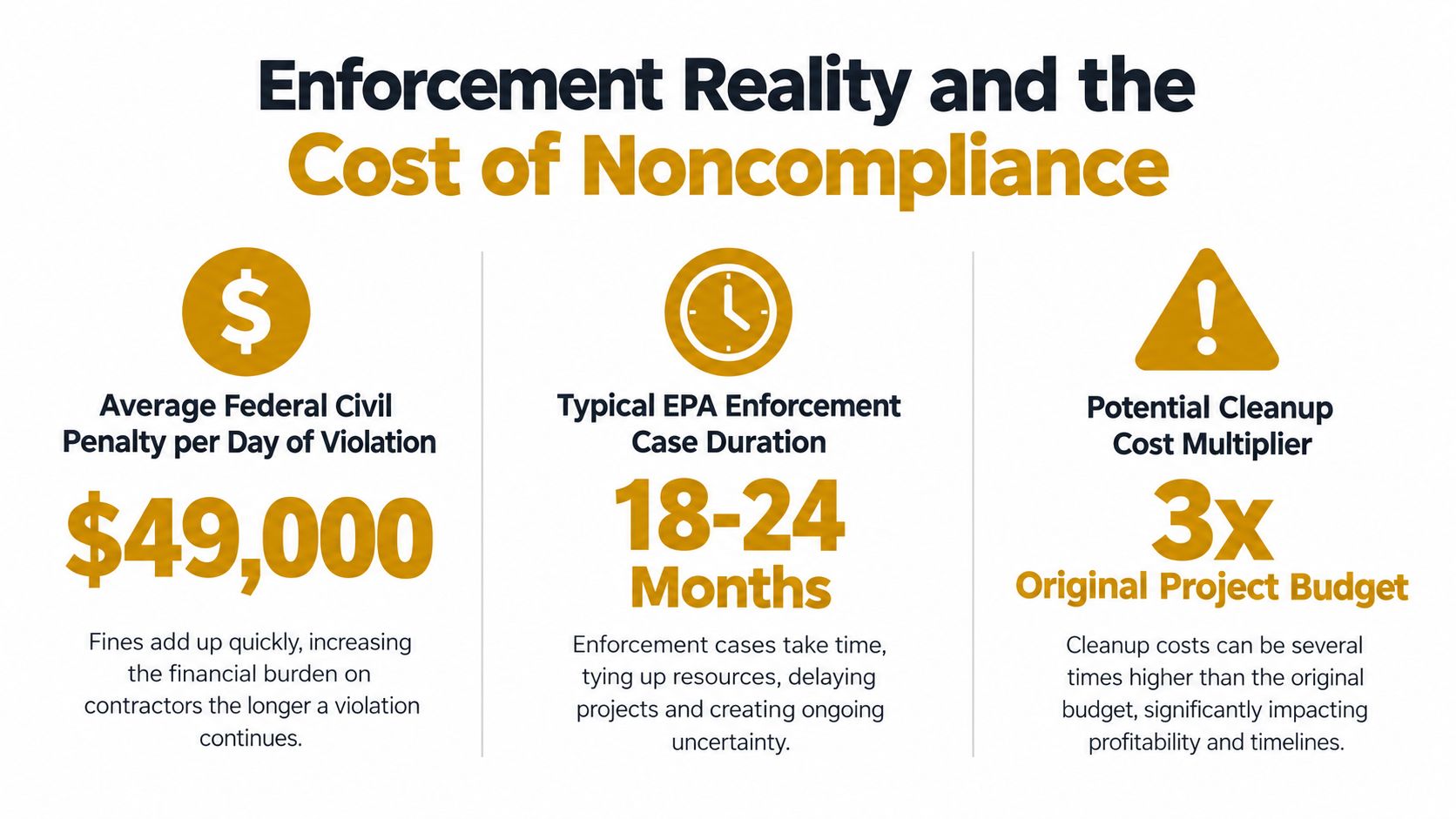
A contractor may face more than a single repair. Corrective work can pull supervisors away from production, force subcontractor coordination, create schedule friction, and require additional inspections or reporting. The impact depends on the jurisdiction, permit, facts, duration, and seriousness of the violation, so teams shouldn't rely on generic penalty figures to assess their exposure.
The practical response is to fix high-risk gaps before an inspector finds them:
- Confirm coverage: Keep permit authorization and required filings accessible to the project team.
- Walk the drainage path: Look from the work area to the nearest inlet or water body, not just at the active pour.
- Check capacity: Treat the 75% washout threshold as a service trigger.
- Close the record: Document deficiencies and verify that repairs are complete.
A contractor who invests in a workable washout setup is addressing both environmental risk and inspection risk. The goal isn't to make the site look compliant for a visit. It is to make the compliant action the easiest action during ordinary production.
Building a Practical Compliance Strategy for Your Projects
Start with the essentials. Confirm whether the project needs coverage, identify the responsible SWPPP lead, make the plan match actual site logistics, and establish an inspection rhythm that crews can follow. Then focus on the pollutant sources most likely to create a direct pathway, especially concrete washout during short pours, repair work, and changing site phases.
The operational gap is often simple to describe. A project needs containment, but a permanent installation may not suit a small work area. The planned location may become inaccessible, or a contractor may need a solution for a brief retrofit rather than the full life of a large project. Municipal guidance highlights the need to prevent concrete washout from entering inlets, while EPA materials emphasize permit coverage, SWPPP controls, inspections, and corrective action. Contractors still have to connect those requirements to a physical setup on the ground, as the New York City construction stormwater guidance illustrates.
Match containment to the work
A rental can be a practical option when the project needs deployable containment without committing to permanent infrastructure. Reborn Rentals offers concrete washout pans for construction and renovation work, including a 72 by 72 by 24 inch option listed at approximately 441 gallons and a 72 by 72 by 14 inch option listed at about 310 gallons, with project teams responsible for confirming fit, access, capacity, and site requirements before ordering.
Use the equipment decision as part of the SWPPP conversation. Confirm the location, setback, traffic path, cover, inspection owner, servicing plan, and waste-removal method before the pour. The container is one BMP within a system, not a substitute for permit coverage or documented inspections.
A practical strategy has three layers:
- Foundation: Determine coverage and maintain an accurate SWPPP.
- Field control: Position and maintain washout containment, inlet protection, erosion controls, and stabilized access.
- Verification: Inspect, record, correct, and update the plan when conditions change.
Construction stormwater compliance becomes manageable when the crew knows exactly what to do before, during, and after the work. For upcoming pours or small retrofit projects, review your site map, choose the washout location, confirm capacity and servicing, and arrange the equipment before trucks are scheduled. To discuss a concrete washout containment rental for your project, visit Reborn Rentals and confirm availability, dimensions, delivery conditions, and dates with the team.