
Construction Stormwater Management Guide
A storm doesn't wait for the SWPPP binder to come out of the trailer. One hard rain can move loose soil toward an inlet, carry tracked mud onto a public road, and fill an improvised washout pit before the crew has time to react. By the time an inspector arrives, the problem is no longer theoretical. It's visible in the water, on the pavement, and around the concrete trucks.
Construction stormwater management works when the site team treats runoff as a daily logistics problem, not a document kept on a shelf. The practical priorities are straightforward: keep clean water away from disturbed ground, keep soil from leaving the site, and isolate concrete wash water, slurry, fuel, waste, and other pollutants before rain can contact them.
Runoff on Active Job Sites: What Actually Happens
A grading crew can begin on firm ground and end the shift with exposed soil, tire ruts, stockpiles, and open drainage paths. Concrete trucks, pumps, fuel cans, and temporary access roads add pollutant sources before the first rain arrives. The site plan may be complete, but runoff control still depends on where crews place materials and how they work each day.

The superintendent's first task is separating clean water from dirty water. Divert clean runoff from undisturbed slopes around the work area where practical. Any flow that contacts exposed soil, aggregate, waste, equipment, or concrete needs to be slowed, contained, treated, or kept on the property.
Erosion control starts with the dirt
Erosion control keeps soil in place. Phased grading, temporary stabilization, mulch, vegetation, slope protection, and directed drainage limit the material rain can mobilize. Stabilize finished portions of the site promptly, because every protected area reduces the load placed on downstream controls.
Sediment control captures material that has already left the ground. Silt fences, inlet protection, sediment basins, check dams, and dewatering treatment can remove suspended solids, but they cannot correct poor source placement. A silt fence at the property line will not solve a stockpile beside an inlet or a washout pan leaking across compacted soil.
Concrete washout deserves the same field attention as erosion controls. Place the containment area where trucks can reach it without crossing the drainage path, inspect it before pours, and keep spare containment materials nearby. A signed SWPPP does not contain slurry. The crew, location, and inspection routine do.
Practical rule: Put the control closest to the pollutant source first. Perimeter controls should be the second line of defense, not the only line.
The regulatory history reflects the scale of the problem. The Interstate Technology and Regulatory Council overview of construction stormwater explains that EPA first regulated stormwater in 1973, Congress added Clean Water Act Section 402(p) in 1987, and the first construction rules extended NPDES permitting to land disturbance greater than 5 acres in 1990. Phase II later lowered the construction threshold to 1 acre in 1999.
That framework matters because an unmanaged discharge can reach receiving waters quickly. EPA identifies uncontrolled construction runoff as a significant risk to rivers, lakes, and estuaries, which keeps erosion and sediment controls central to active jobsite practice. Source control also limits cleanup, enforcement exposure, and the chance of fines or a stop-work order. Plan the drainage, locate pollutant sources, and give the crew a clear response before weather changes.
Navigating NPDES Permits and SWPPP Requirements
The first question isn't “Which BMP should we buy?” It's whether the project needs permit coverage and what the applicable state and local programs add to the federal baseline.
Under the federal framework, construction activities disturbing 1 acre or more generally require coverage under an NPDES permit. A project below that area can still fall under the requirement when it forms part of a larger common plan of development or sale that will ultimately disturb 1 acre or more, as described in EPA's small construction stormwater overview.
Start with the disturbance footprint
Measure more than the building pad. Include grading, utility corridors, access roads, staging areas, borrow or spoil areas, drainage work, and other portions of the common plan that will be disturbed. A phased residential project can create a compliance problem when each individual phase is viewed in isolation even though the approved development plan covers a larger disturbance.
The permit decision should happen before mobilization. State agencies and local MS4 programs may impose forms, plan reviews, inspection procedures, stabilization expectations, or discharge limits that go beyond the federal starting point. The owner, contractor, civil engineer, and stormwater professional need one agreed project boundary and one current construction sequence.
Treat the SWPPP as a field operating plan
A SWPPP should identify where water enters and exits the property, which areas will be disturbed, where materials will be stored, and how each pollutant source will be controlled. The maps need to match the current phase. If the access road moved, the inlet was relocated, or the concrete staging area changed, the plan and the site should no longer contradict each other.
Federal construction requirements also establish several mandatory controls. EPA's construction stormwater discharge requirements require effective erosion and sediment controls, stabilization of disturbed areas when work stops for more than 14 days, and a prohibition on untreated concrete washout wastewater discharges.
That last point deserves attention. Wash water, slurry, and fines are pollutants at the source. Diluting them with clean water or allowing them to seep through an unlined pit doesn't convert an illegal discharge into a compliant one.
A working permit system should answer these questions before the first earthwork shift:
- What is disturbed: Has the team mapped the full common plan, not just the current work zone?
- Who is responsible: Can the crew name the person responsible for inspections, repairs, records, and weather response?
- What changes the plan: Are there triggers for revising BMPs after a new phase, altered drainage path, or failed control?
- Where is the evidence: Can the site produce the current SWPPP, inspection records, repair notes, and discharge observations when requested?
A permit is permission to discharge under specified conditions, not permission to let the site discharge uncontrolled sediment or concrete waste.
Designing Site Logistics for Source Control
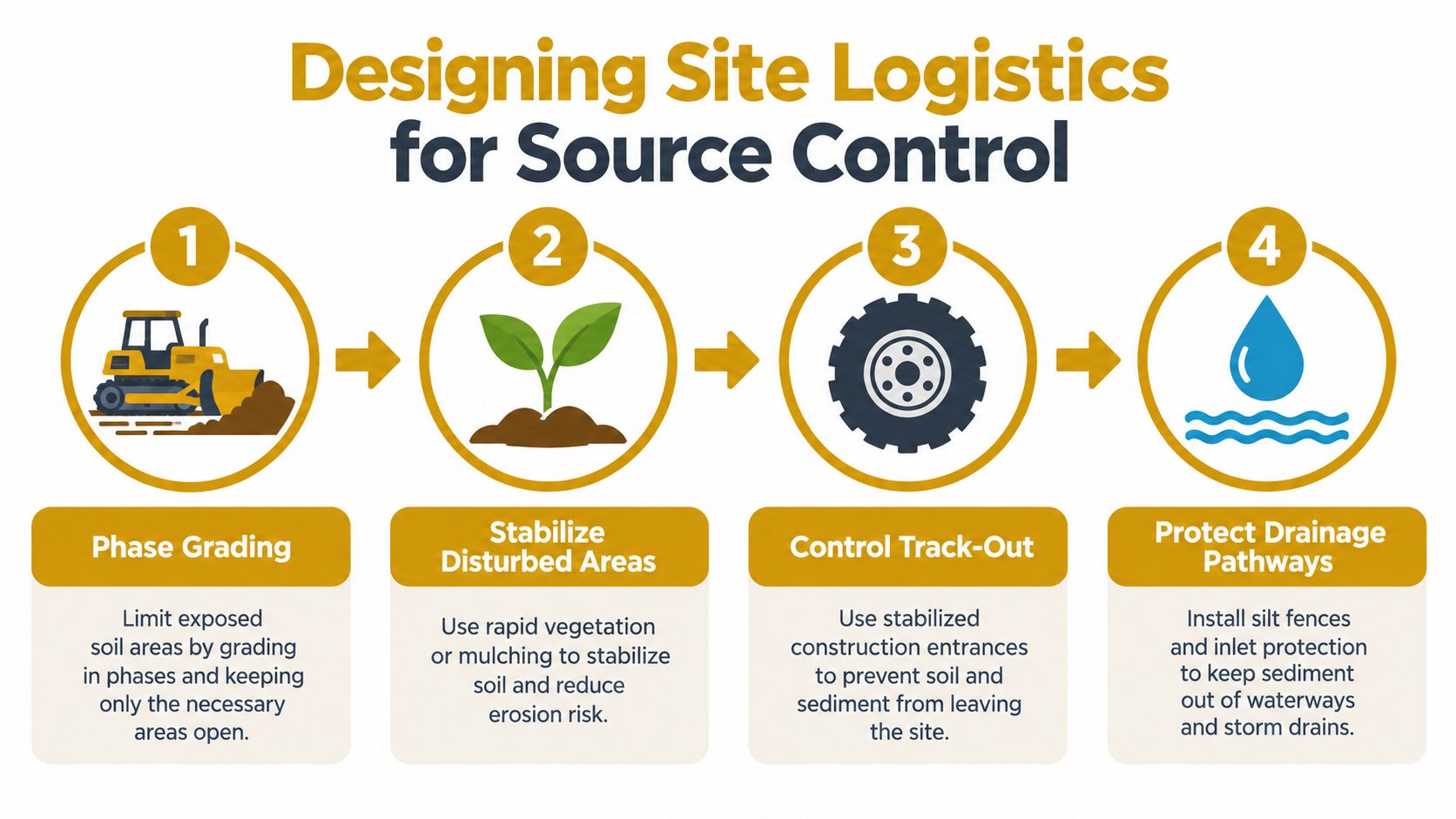
A SWPPP becomes credible when the physical layout makes compliance easier than noncompliance. If workers must carry washout waste across the site, drive through a drainage swale to reach a storage area, or cross an unprotected inlet to access a pour, the plan is fighting the operation.
Build the layout around the water
Begin with the existing drainage pattern and the planned final drainage pattern. Mark low points, discharge locations, inlets, slopes, crossings, stockpiles, and likely ponding areas. Then place controls where they can be inspected and maintained without forcing the crew to dismantle them every time equipment moves.
Phase grading so the site doesn't carry more exposed soil than the work requires. Finish and stabilize sections as soon as the schedule allows. A broad, uncovered grading area creates a larger source for sediment and increases the amount of water that must be managed after every storm.
Put pollutant sources under a roof or inside containment
Material storage, fueling, equipment maintenance, waste collection, and concrete operations need designated locations. Keep cement, admixtures, absorbents, trash, and spare parts away from flow paths. Use secondary containment where a leak could reach a drain or watercourse, and make spill kits visible rather than locked in an office.
The access route deserves the same attention as the work area. A stabilized construction entrance can reduce track-out, but it must connect to a route that crews use. If the entrance is too short, buried under mud, or placed beside a different preferred gate, drivers will bypass it.
Make inspection routes part of the schedule
A competent inspection isn't a quick walk past the perimeter fence. The inspector or designated site lead should trace water from the upper boundary through the active work zones to each outlet. That route reveals bypasses, undercut fencing, blocked inlets, sediment accumulation, and controls that looked adequate on the plan but failed under traffic.
| Site feature | Operational question |
|---|---|
| Perimeter control | Can runoff pass around, under, or through the barrier? |
| Inlet protection | Is the inlet still accessible, functional, and free of excessive sediment? |
| Stockpile | Is the pile covered, stabilized, or positioned away from drainage? |
| Entrance | Are vehicles carrying mud onto the road despite the installed tracking control? |
| Washout area | Can every concrete crew reach containment without crossing a drainage path? |
Source control costs less in disruption than repairing a downstream discharge after a storm.
Good logistics also assigns ownership. The grading foreman maintains soil controls, the concrete superintendent manages washout, the equipment lead handles fueling and maintenance areas, and the site superintendent verifies that the pieces work together. A SWPPP becomes operational when each control has a person, a location, an inspection frequency, and a repair response.
Containing Concrete Washout and Slurry
Concrete washout is a concentrated pollutant source, not ordinary dirty water. Truck chutes, pump lines, tools, rejected loads, and finishing work can generate alkaline water containing cement fines. If it reaches a storm drain, ditch, exposed soil, or receiving water, the project has created a discharge that downstream treatment may not correct.
Federal requirements prohibit untreated concrete washout wastewater discharges. The field response is straightforward: contain washout at the point of generation. Dilution, a shallow excavation, or a low area away from the nearest inlet does not provide reliable containment.
Place containment where trucks can use it
Set the washout pan on stable ground, outside active drainage, and close enough to the pour that drivers will use it without improvising. Provide room for truck alignment, pump access, worker movement, and removal or servicing. A pan hidden behind material stacks may appear correctly located on a drawing, but it will fail operationally if crews cannot reach it during a busy pour.
Size capacity for the actual operation rather than an average day. A major pour, several trucks, pump priming, rejected concrete, and tool cleaning can fill a small container quickly. Confirm that the container is liquid-tight, inspect its sides and base before use, and define a response for overflow or an unexpectedly large washout volume.
Rain can consume available capacity, so a covered or lidded setup may help. The cover still needs to allow truck access and safe handling. If workers must struggle with it at every washout, they will eventually leave it open or move it aside.
Control the residue after the pour
Hardened concrete residue adds weight, reduces working capacity, and can damage the container during removal. Assign responsibility for checking fill level, arranging service, and determining where the hardened material will go. A full pan discovered when the next truck is backing in creates an avoidable delay and a compliance risk.
Use a defined work sequence:
- Direct every washout: Identify the approved location to drivers and pump crews during the pre-pour briefing.
- Inspect before use: Check for tears, cracks, unstable placement, accumulated residue, and leakage.
- Monitor during the pour: Assign someone to watch capacity when production is continuous or several crews share the area.
- Secure the area: Prevent traffic, tools, and equipment from striking the container.
- Remove residue responsibly: Service the setup before the next operation requires its full capacity.
Reborn Rentals offers rental washout pans and containers for construction and renovation projects, including liquid-containment options and accessories such as watertight lids. Confirm availability, dimensions, delivery conditions, and site access before the scheduled pour.
Inspectors look beyond the pan itself. They check whether the location makes sense, whether concrete splatter surrounds the setup, whether the container leaks, and whether the crew knows the procedure. A clean, accessible washout area shows that the project controls slurry at its source instead of documenting the problem after a discharge.
Monitoring Turbidity and Field Benchmarks
Clear-looking water can still carry fine sediment. Turbidity gives the field team a practical way to detect suspended particles and evaluate whether dewatering, inlet protection, settling, or treatment is working.
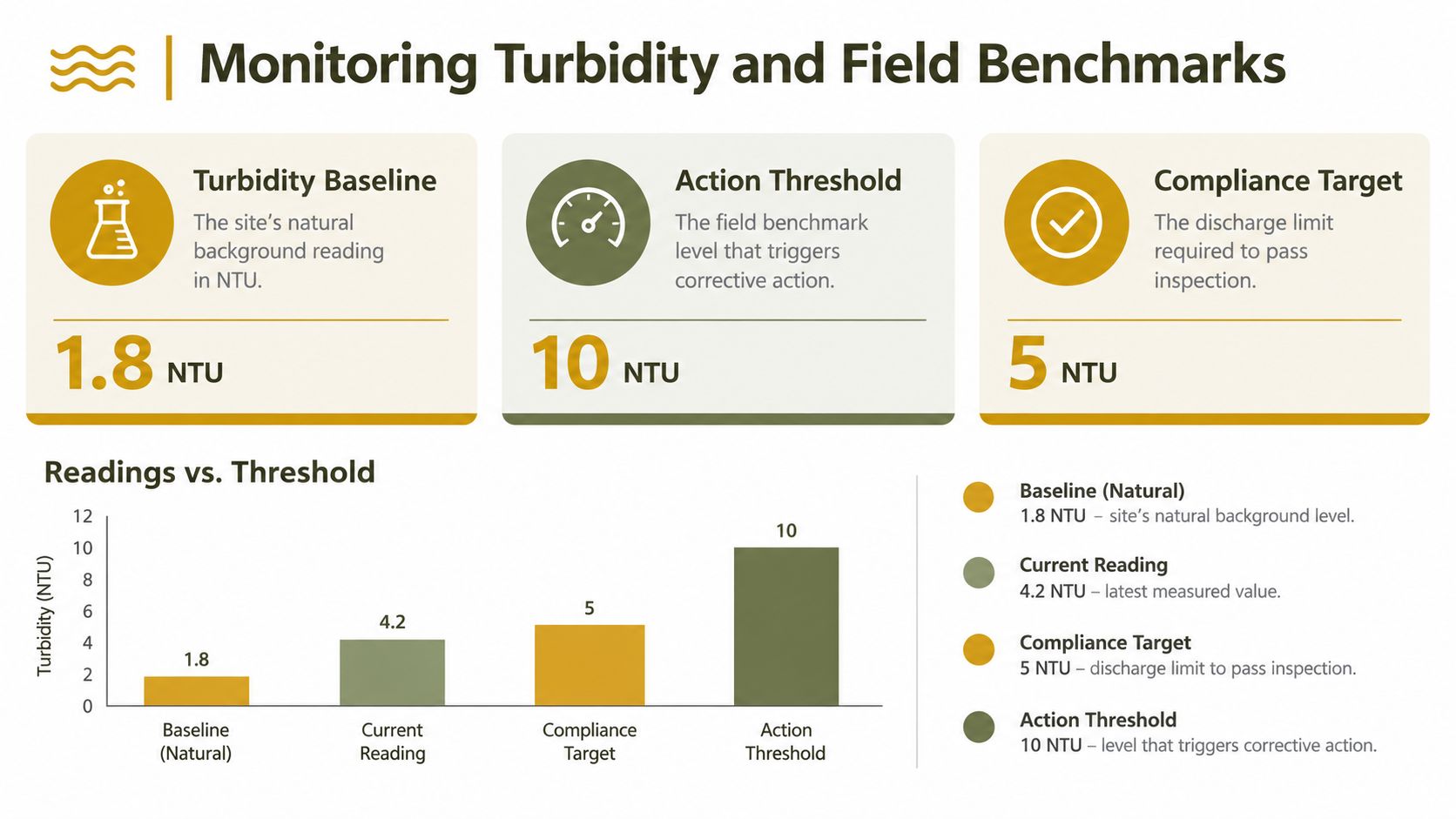
EPA describes a commonly implemented receiving-water criterion of no more than 5 NTU above background, while many construction permits use a 25 NTU discharge benchmark that triggers corrective action and additional BMPs. Some programs escalate at 250 NTU with immediate notification requirements, as detailed in EPA's treatment chemicals and particulate removal guidance. The applicable permit controls, so the project team must verify which benchmark applies at its discharge point.
Measure against a known baseline
NTU means Nephelometric Turbidity Units. In plain terms, the reading reflects how strongly suspended material scatters light in water. The number matters, but the trend matters too. A rising reading after a grading change, pump increase, or failed sediment control tells the superintendent that the process is losing control.
Take readings at consistent locations and record the conditions. A defensible log identifies the sampling point, time, weather, activity underway, instrument condition, result, and response. Pair the number with a visual check of upstream and downstream controls. A reading without a site observation can miss the source.
Respond before the result becomes a discharge event
When turbidity trends upward, don't just increase the pump or add chemicals. First reduce the source, slow the flow, and inspect the treatment train. Staged treatment may include settling, filtration, and approved chemical treatment where the permit and project procedure allow it. Each stage needs room to function and a maintenance plan for accumulated solids.
| Observation | Likely field response |
|---|---|
| Water is visibly cloudy at the outlet | Stop or reduce the discharge if safe, inspect upstream controls, and prevent additional sediment from entering the flow. |
| Reading approaches the action benchmark | Increase monitoring, repair or upgrade BMPs, and document the corrective action. |
| Reading exceeds the applicable escalation level | Follow the permit's notification and response procedure immediately. |
| Treatment performance declines | Check clogged media, overloaded settling space, chemical dosing, and bypass routes. |
The cause and effect is direct. Fine suspended solids raise turbidity, and high turbidity signals ineffective capture with greater risk to aquatic systems. Field monitoring is useful only when the crew is able to change the operation quickly.
The Shifting Rules for Smaller Projects
The one-acre threshold is a federal starting point, not a universal exemption. A small site can still sit inside a larger common plan, discharge through a sensitive local drainage system, or face municipal requirements that apply to the disturbance type rather than the total acreage.
Philadelphia proposed exempting small residential developments under 1 acre from post-construction stormwater management while still requiring erosion and sediment control plan approval for disturbances of 5,000 square feet or greater, according to the Philadelphia Water Department's spring 2026 development newsletter. Seattle's 2026 code requires a custom construction stormwater control and soil management plan for projects with 5,000 square feet or more of new or replaced hard surface or demolition disturbance, as described in the same reference.
Those examples point to a practical shift. Local reviewers are looking at hard surface, demolition, soil disturbance, drainage connection, and construction phase, not only the headline acreage.
Ask the local questions early
A project manager should confirm:
- Which authority reviews the work: Federal, state, county, city, or an MS4 operator may each have a role.
- What area is measured: Total disturbance, new hard surface, demolition, or the larger development plan may control.
- Which plans are separate: Erosion control, soil management, post-construction, and discharge documents may have different triggers.
- What must be approved before mobilization: Don't assume permit coverage answers every local plan-review requirement.
Small residential work, utility repairs, tenant improvements, and phased redevelopment often have tight staging areas. That makes source control more important, not less. A compact site has fewer places to move stockpiles, stage a washout pan, or route clean water around the work.
A smaller footprint reduces the quantity of work, but it doesn't remove the need to control the path a pollutant takes.
The safe habit is to ask for a site-specific determination before equipment arrives. Keep the written response with the project records, then build the field controls to satisfy the strictest applicable requirement.
The Pre-Pour Site Readiness Checklist
Before the first concrete truck arrives, walk the site as if rain is already moving through it. The purpose isn't to admire installed BMPs. It's to verify that water, traffic, workers, and waste will follow the intended paths during the busiest part of the operation.
Confirm the site boundary and drainage
- Review the current plan: Make sure the SWPPP and site map reflect the present grading phase, access points, stockpiles, inlets, discharge locations, and concrete work area.
- Trace clean water: Identify where runoff enters the property and confirm it has a route around disturbed soil where feasible.
- Check perimeter controls: Look for undercut sections, gaps, bypasses, damaged stakes, and sediment accumulation that could block flow or cause overtopping.
- Inspect inlets and outlets: Verify protection is secure, functional, and accessible for cleaning.
Prepare the concrete operation
- Place containment first: Set the washout pan on stable ground outside drainage paths, with enough room for truck and pump access.
- Check liquid tightness: Inspect the base, sides, seams, and lid or cover before the pour begins.
- Confirm capacity management: Identify who will watch the fill level and what happens if the expected volume increases.
- Brief every crew: Truck drivers, pump operators, finishers, and laborers should know the approved washout location and the prohibited discharge paths.
- Plan residue removal: Arrange servicing before hardened concrete reduces usable capacity.
Check the rest of the pollutant controls
- Secure materials: Move cement products, chemicals, fuel, waste, and loose fines away from drainage and protect them from rain.
- Control track-out: Confirm the stabilized entrance is usable and that someone will respond if mud reaches the public road.
- Prepare for spills: Put absorbents and response equipment where the crew can reach them immediately.
- Review weather response: Assign who checks forecasts, who makes the call to cover or stabilize exposed areas, and who documents changes.
The final check belongs to the superintendent, but the responsibility is shared. A foreman who sees a blocked inlet or a nearly full washout pan should be able to stop the activity and correct it without waiting for an inspector.
Use the checklist before major pours, after significant site changes, and whenever forecasted rain could alter the risk. The binder proves what the project intended to do. The condition of the site proves what the team did.
Reborn Rentals provides ready-to-deploy concrete washout pans and containers for projects that need practical slurry containment during pours, renovations, and civil work. Visit Reborn Rentals to review rental options, confirm site logistics, and arrange delivery before your next concrete operation.