
Environmental Compliance Services for Construction Sites
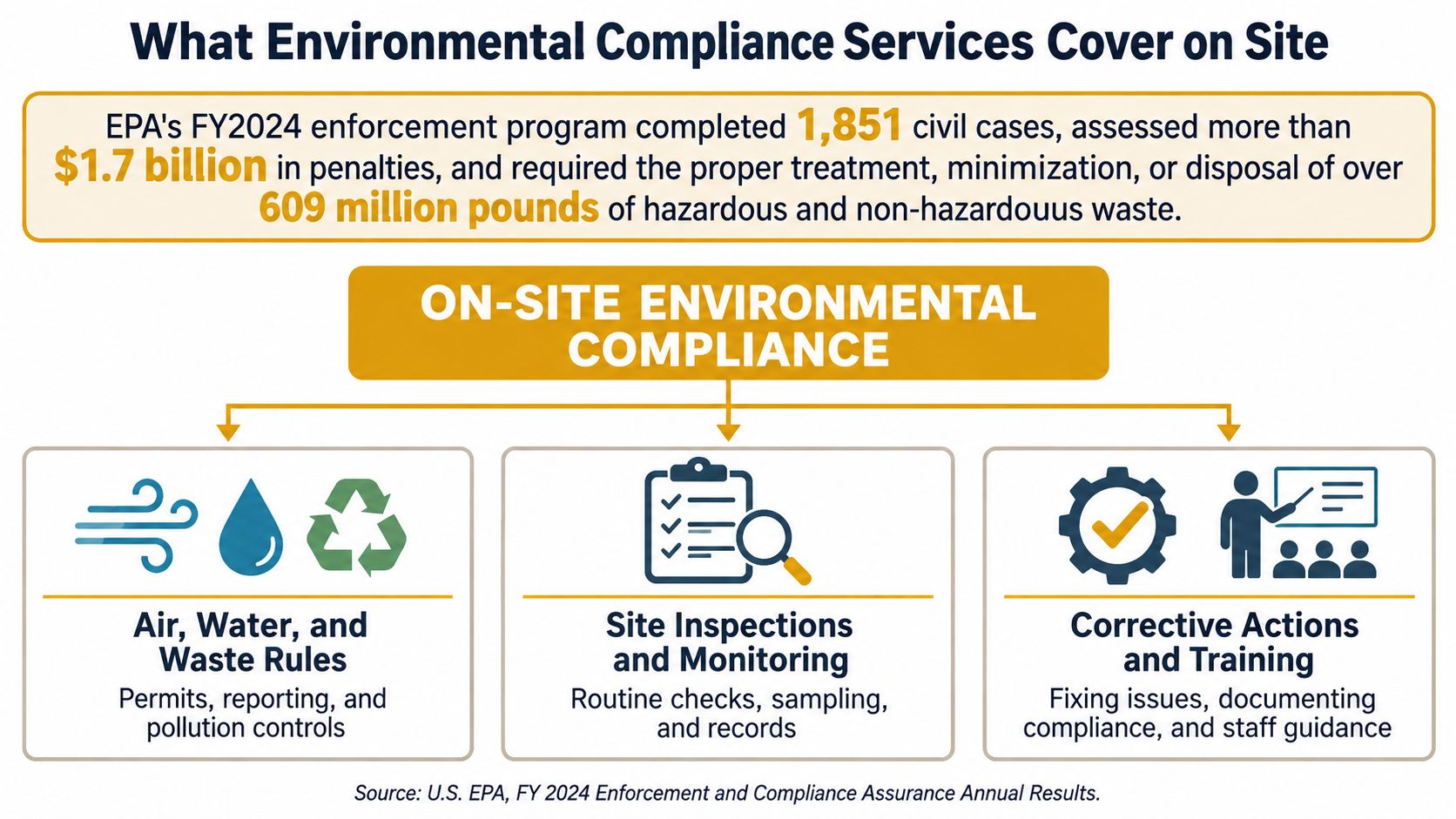
The EPA enforcement and compliance assurance annual results for fiscal year 2024 reported 1,851 completed civil enforcement cases, more than $1.7 billion in penalties, and proper treatment, minimization, or disposal of more than 609 million pounds of hazardous and non-hazardous waste. That scale reframes compliance on a construction site. A washout container sitting in the corner isn't proof of anything unless it's sized right, reachable by trucks, checked before rain, and backed by records an inspector can readily read.
What Environmental Compliance Services Cover on Site
Say a general contractor is pouring podium decks while another crew cuts trench lines and a third stages fuel and form oil near a storm inlet. Each activity touches a different rule, but an inspector won't grade them as separate efforts. He'll ask one question across the whole site. Can you show that your controls work and that someone checked them?
That's what environmental compliance services are in plain terms. They're the ongoing work that keeps a project inside its air, water, waste, chemical, and stormwater rules, not just the permit filed before mobilization. Think of a pilot's pre-flight checklist. The value isn't the paper itself. It's catching a faulty gauge, a low fluid level, or a missed switch before the plane leaves the ground.
The Four Layers of the Work
- Planning: Someone reviews the permits, coordinates the stormwater pollution prevention plan, or SWPPP, and confirms which controls belong where before work starts.
- Field controls: Crews install the physical barriers that stop a release, including washout containment, sediment barriers, inlet protection, and spill kits staged where fueling happens.
- Monitoring: A named person walks those controls on a schedule, checks fill levels and liner condition, and looks at the drainage path, not just the container.
- Records and corrective action: Every check produces proof, and every failure produces a dated fix. A torn liner without a repair entry reads to an inspector like a control nobody owned.
Concrete washout is only one control inside that system. A single site can need stormwater, wastewater, solid waste, and chemical controls running at the same time, and a failure in one area often exposes weak habits in the others. If washout logs are missing, an inspector will reasonably wonder about your fuel storage and sediment checks too.
A container alone doesn't make a site compliant. The sizing math, the access route, the inspection habit, and the paper trail do.
By the time you've worked through your own job, you should be able to answer three questions without hunting through a trailer. Which rules apply to this site? Who checks each control and how often? What proof exists that those checks happened? If any answer depends on one person's memory, your compliance program has a gap, no matter how good the equipment looks.
Which Rules Apply to Your Project
Concrete washout is regulated in layers, and the strictest layer that applies to your site sets your standard. Crews get in trouble when they follow the federal baseline and stop there, because the document that governs their washout area is usually more specific than the baseline.
The EPA page on stormwater discharges from construction activities explains that construction stormwater rules generally cover projects disturbing at least one acre, and that concrete washout wastewater is prohibited unless managed with an appropriate control. That same guidance puts the washout area outside buffers and at least 50 feet from streams, wetlands, storm-drain inlets, or other sensitive resources, and calls for capacity that holds washout volume plus rainfall without overflow. State permits and MS4 programs stack on local ordinances, plan review, inspections, and public reporting, and they set the inspection schedule in writing rather than leaving it to crew habit.
Rule Layers That Shape a Washout Plan
| Layer | Applies When | What It Adds |
|---|---|---|
| Federal construction stormwater | Projects disturbing one acre or more | Prohibits washout discharge unless controlled |
| SWPPP | Projects covered by a stormwater plan | Names the washout area, controls and inspection schedule |
| State permit | Set by each state | Can add sizing, inspection or reporting terms |
| Local MS4 program | Sites in municipalities under an MS4 permit | Adds ordinances, plan review, inspections and public reporting |
| Site conditions | Every project | Rain, snowmelt, truck access and pour volume set whether the design works |
Read the table from top to bottom and you'll see why generic advice fails. The federal layer tells you washout must be controlled. Your SWPPP tells you where and how on this specific site. The state permit and the local MS4 program can tighten sizing, inspection, or reporting terms beyond both. Then weather and truck traffic decide whether that compliant design survives contact with a Tuesday pour.
A container can satisfy the paper requirement and still fail in the field. It is undersized for the pour schedule, so it fills by Thursday. It sits where mixer trucks can't safely reach it, so drivers rinse chutes wherever they parked. It stays uncovered ahead of a storm, so rainwater eats the freeboard and slurry overtops the rim. None of those failures appear in a purchasing decision. They appear in operations, and then in the inspection log.
Three Questions for Your SWPPP Preparer
Put these to your SWPPP preparer or regulator before you order equipment, and get the answers in writing.
- Local terms: Which local ordinance or MS4 requirements apply to this site beyond the state permit?
- Sizing basis: What sizing basis does the plan use for the washout container, and does it account for rainfall?
- Inspection frequency: How often must the washout be inspected in writing, and who signs the log?
I'd also keep two lists in your project file. One lists the federal baseline requirements. The other lists every stricter state and local addition. When an inspector asks why a control exists, your documentation should point to the exact rule it answers, not to a general claim that you're being careful.
Pre-Pour Compliance Checklist for Washout Containment
No truck should arrive until the washout setup passes six checks. Run them in order, initial each one, and file the sheet with the stormwater plan. If a row can't be initialled, the pour doesn't start. That rule sounds strict until you've watched a driver with a spinning drum look for somewhere, anywhere, to rinse a chute.
The reason for the discipline is how regulators classify this waste. The EPA page on stormwater discharges from construction activities explains that for sites under NPDES stormwater permitting, generally projects disturbing at least 1 acre, EPA prohibits concrete washout wastewater unless it's managed with an appropriate control, using a designated area that directs slurry into a leak-proof container or lined pit. That same guidance puts the area outside buffers and at least 50 feet from streams, wetlands, storm-drain inlets, or other sensitive resources. Washout is a controlled non-stormwater discharge, not ordinary site wastewater, and the checklist is what proves the control exists.
Pre-Pour Washout Compliance Checklist
| Checkpoint | Requirement | Evidence to Keep |
|---|---|---|
| Washout location | Outside buffers and at least 50 feet from streams, wetlands and storm-drain inlets | Marked site plan |
| Container capacity | Expected washout volume plus rainfall inflow and usable freeboard | Written sizing calculation |
| Container integrity | Leak-proof container or lined pit with no visible damage | Dated photo at delivery |
| Truck access | Safe route for mixer trucks and pump operators, clear of drainage | Access route on site plan |
| Signage | Clear marker showing where drivers wash out | Photo of installed sign |
| Crew training | Drivers, pump crews and finishers know the location and the no-wash-elsewhere rule | Signed training sheet |
Location and access deserve more attention than crews usually give them. A container placed the required distance from an inlet still fails if the truck route crosses the drainage path to that inlet, because drips and splashes travel with the truck. Walk the route yourself. Look for low spots, unprotected inlets, and any turn tight enough that a driver will shortcut it.
How to Size the Container
Capacity is where most setups go wrong, because crews order by the nominal volume printed on the container. Run this procedure instead and keep the written calculation in the record.
- Estimate washout volume per pour. Count the slurry left in the mixer drum and chute after rinsing, for every truck and pump expected that day.
- Add rainfall inflow. Multiply your design storm depth by the area that drains into the container.
- Add usable freeboard. Leave space above the expected liquid level so splashing and minor surge don't overtop the rim.
- Compare against the working limit. A container is treated as full at 75 percent, so a 310-gallon pan gives about 232 gallons of usable space.
If your total exceeds that working figure, don't hope for dry weather. Use a larger container, add a second container, or build a lined pit. Then finish the remaining rows. Photograph the container at delivery so preexisting damage isn't attributed to your crew. Install the sign where a driver sees it before he reaches the pour, not after. Brief drivers, pump crews, and finishers together, because the person who violates the rule is usually the one who was never told it.
How to Run Washout Inspections and Keep Records
Start with the triggers, because triggers are what turn a good intention into a schedule your crew can run without interpretation.
Washout Inspection Triggers and Actions
| Trigger | Required Action | Record Kept |
|---|---|---|
| Start of each working day | Check for leaks, torn liner or cracked sidewalls | Date, weather, photo |
| After heavy rain | Check container and drainage path toward inlets | Repairs logged, photo of drainage path |
| Fill reaches 75 percent | Vacuum liquid or let it evaporate; remove hardened solids | Estimated fill percentage |
| Forecast major rain | Lower liquid level or cover the container | Forecast checked and action taken |
| Weekly minimum where a permit requires it | Check structural integrity, capacity and overflow | Written inspection log |
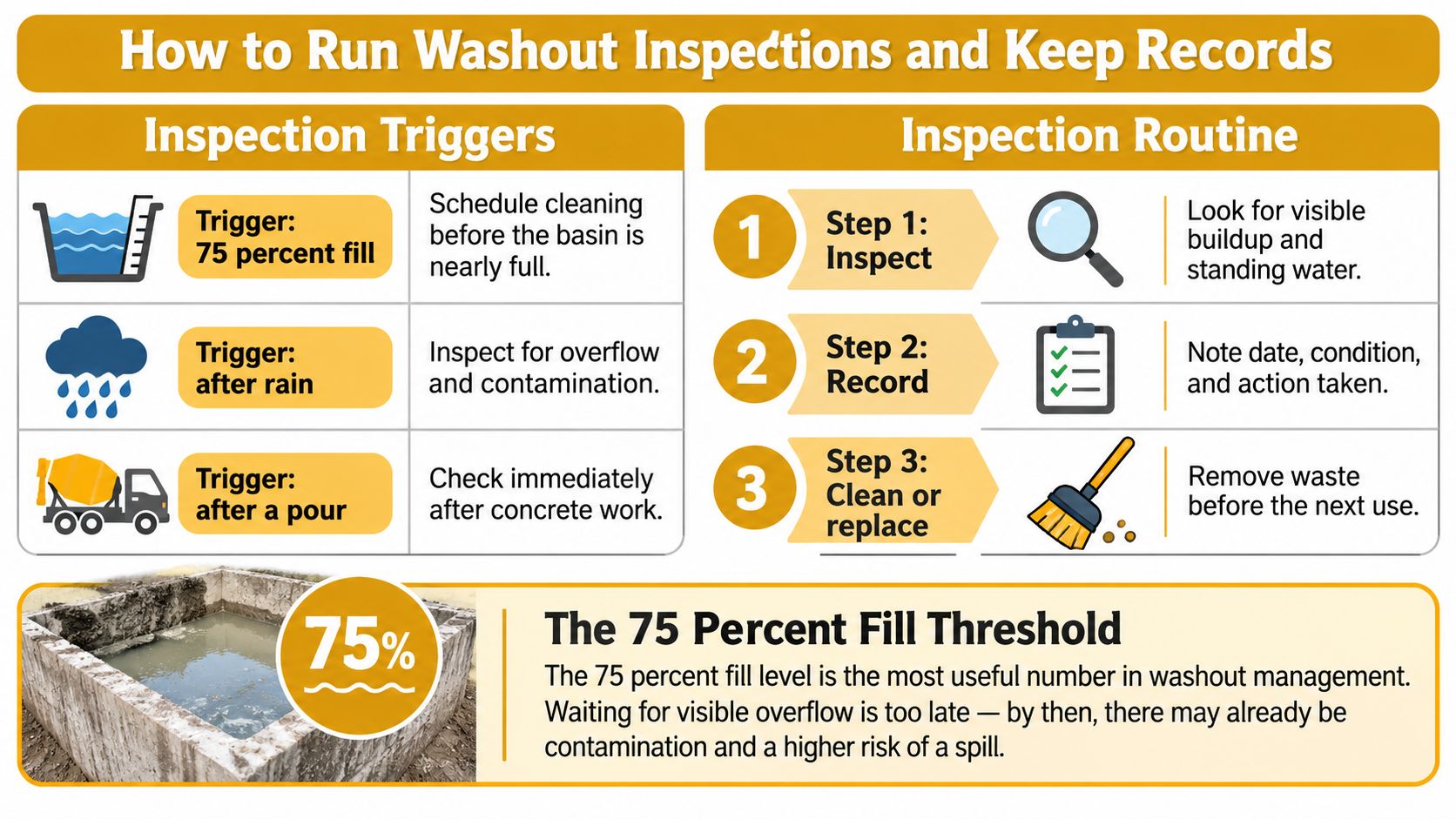
The 75 percent fill threshold is the most useful number in washout management. Waiting for visible overflow is too late, because one storm can consume whatever freeboard remains while nobody's watching. The EPA concrete washout BMP guidance recommends inspections daily and after heavy rain to identify leaks, damaged liners or sidewalls, and containers filled beyond 75 percent capacity, and it states that once that threshold is reached, washwater should be vacuumed or allowed to evaporate, with hardened solids removed and recycled.
The Daily Routine
- Walk the container first. At the start of each working day, check the liner and sidewalls for leaks, tears, and cracks.
- Check after heavy rain. Inspect the container and walk the drainage path toward the nearest storm inlets.
- Read the fill level. Estimate the percentage from marks on the inside wall. Paint the marks on if the container doesn't have them.
- Act at 75 percent. Vacuum the liquid or let it evaporate before any more slurry goes in.
- Remove hardened solids. Once material cures, take it out for recycling so it doesn't eat your freeboard.
- Prepare for forecast rain. Lower the liquid level or cover the container before a major storm arrives.
- Log everything. Record the date, weather, fill estimate, photos, and any repair, every time.
The habit that matters most: Log the uneventful days too. A blank stretch in the log tells an inspector the routine stopped, even if the container looks fine.
The common slip is logging only after a problem. A crew finds an overflow, writes a thorough report, and believes the paperwork is handled. It isn't. The log is the first thing an inspector reads, and it needs to show a routine that ran on ordinary days, not a response that started after a discharge. A complete short entry beats a detailed one-time report every time.
An in-spec week is easy to recognize. There's an entry for every working day, every fill reading sits below the threshold or shows the pumping it triggered, and the drainage photos show clean ground between the container and the nearest inlet. If your week doesn't look like that on paper, it doesn't matter how it looked in person.
When Rental Pans and Containers Solve the Problem
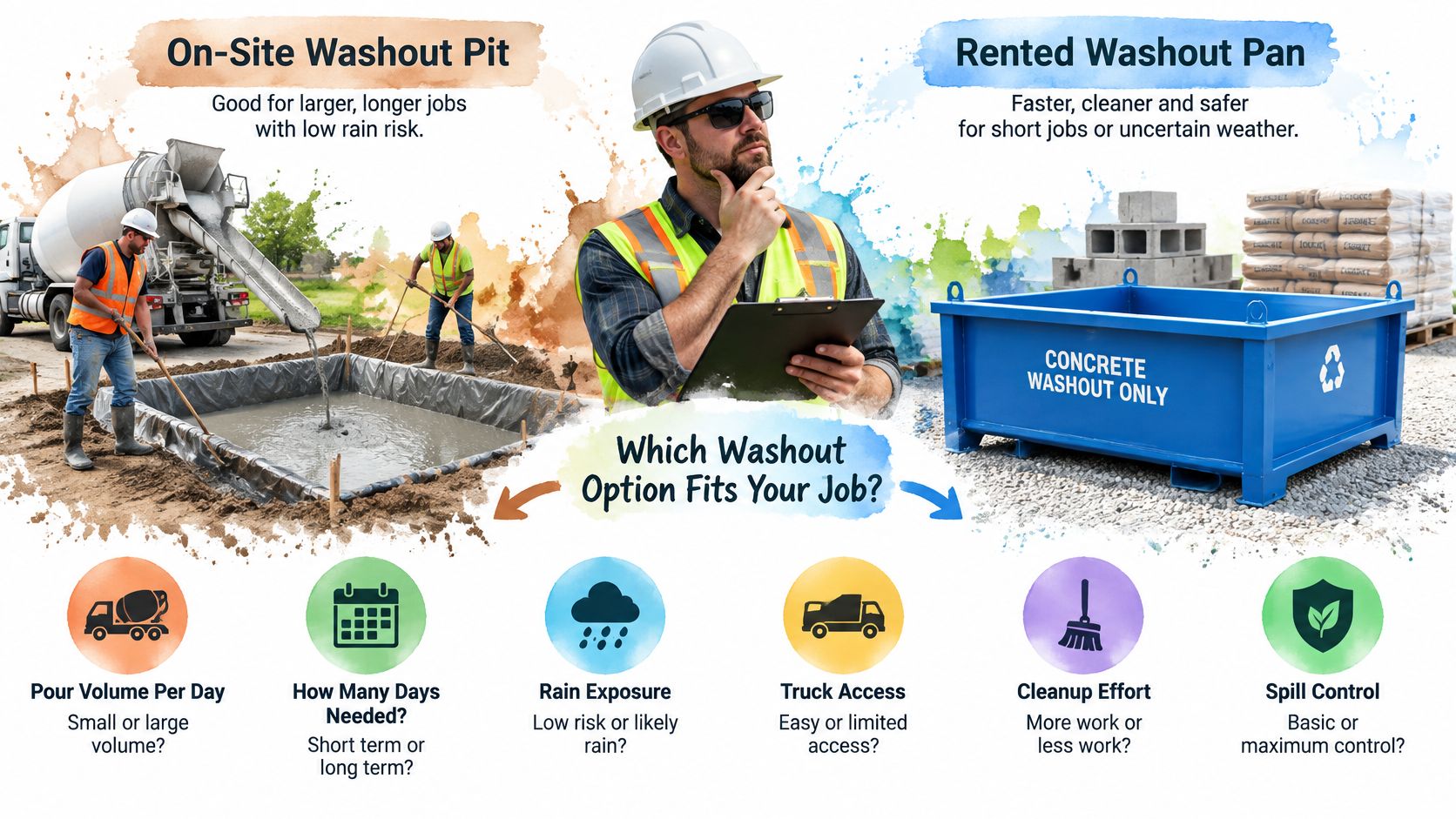
Building a washout pit and renting a pan solve the same problem at different costs in labor, time, and attention. The right choice depends on five criteria. How much volume will you pour each day? How many days will you need washout? How exposed is the spot to rain? Can trucks reach it easily? And does your crew have the skill and hours to maintain a pit properly?
It's like renting a dumpster rather than building a landfill. For a defined amount of waste over a defined period, you bring in a tested container, swap it when it's full, and let someone else handle disposal. You only build your own facility when volume and duration justify the construction and upkeep.
Build or Rent Criteria for a Washout Setup
| Criterion | Rent a pan or container | Build a washout pit |
|---|---|---|
| Pour volume per day | Predictable, modest volumes | High, sustained volumes |
| Duration | Temporary work with a clear end date | Long-running work |
| Rain exposure | Container covered or lowered before each storm | Liner, berms and cover built and maintained on site |
| Truck access | Placed on a marked route with a turnaround | Pit located and graded for trucks with a stable approach and turnaround |
| Maintenance | Manufacturer manual and provider swap service | Qualified crew maintains the pit |
| Disposal | Swap-and-haul at $300 per pan, slurry taken to a recycling facility | Hauling arranged by the site through its own waste contractor |
| Start-up speed | Tested pan on site quickly | Excavation, liner and sizing first |
Our pans at Reborn Rentals are NPDES, OSHA, EPA, and BMP compliant and load-tested to 36,000 lbs, so you can check a tested specification against your plan instead of trusting a sales description. The small pan measures 72 by 72 by 14 inches with a 310 gallon capacity, which lets your crew run its sizing calculation against a real number before ordering. For swap-and-haul work, our pan swap service is a flat $300 per pan, all included, with immediate replacement and disposal of concrete slurry at a recycling facility.
Understand what rental doesn't do. It moves the equipment problem, not the responsibility. Your site still runs the inspections, keeps the logs, watches the fill level, and maintains the container according to the manufacturer's manual. An inspector who finds an overflowing rented pan will cite the operator of the site, not the rental company.
My decision rule is simple. Rent when the washout need is temporary, the volume is predictable, and you need a tested container on site quickly. Build a pit when volume and duration are both high and a qualified crew can construct and maintain it for the life of the pour schedule. The wrong answer is the cheap middle ground, a hastily dug pit that nobody maintains because it was only supposed to last a few weeks.
Fixing Common Washout Gaps Before Mobilizing
The gap that causes the most overflow is sizing to nominal volume only. A container chosen by its printed capacity has no allowance for rain, so the first wet week pushes it past its working limit and slurry goes over the rim. Fix that one first. Run the sizing procedure before you order anything, file the calculation, and size up when the math is close.
Closing the Remaining Gaps
- Unreachable container: If trucks can't reach the washout safely, drivers will rinse where they stand. Move the container onto a marked access route with a turnaround and confirm a mixer can use it without crossing drainage.
- No rain plan: Assign someone to check the forecast daily. Before each storm, lower the liquid level or cover the container. Don't leave this to whoever happens to notice clouds.
- Washout missing from the SWPPP: Add the location, control type, and inspection frequency to the plan, and update it with the agency where that's required. A control that isn't in the plan barely exists during an inspection.
- Retroactive logs: If entries get written after an inspector visit, switch to a daily entry with photos starting now. Backfilled logs are easy to spot and they damage your credibility on everything else.
- Hardened solids filling freeboard: Schedule solids removal as part of each pour instead of a separate cleanup task that keeps getting postponed.
Sequence these fixes by lead time. Signage and a crew briefing take a day. A revised stormwater plan with agency sign-off can take weeks, so that one starts first even though it feels less urgent than the physical setup. Crews often do this backwards, perfecting the container placement while the plan amendment sits in someone's inbox.
Our services include concrete washout disposal and setting up an MSA, and our scheduled swap-and-haul service replaces full pans on a set schedule with no waiting on disposal. That scheduling matters here, because a swap that arrives on a fixed day is a backstop for your fill checks. If a pour runs heavy, you're not choosing between an overflow and an emergency call.
Confirm Before You Mobilize
- Name one owner. One person owns the washout plan and every inspection. Shared ownership means no ownership when that person is off site.
- Confirm the equipment details. Verify pan specifications, availability, and delivery terms by phone or message before the pour date, and ask which licence, permit, or certificate costs fall to you as the customer.
- Set the first inspection date. Put it on the schedule now, before the first truck is booked.
Do one thing this week. Send your site plan and pour schedule to both your equipment provider and your SWPPP preparer, and ask each of them the same question. Does this washout setup work for this site, in this weather, at this volume? If either answer hesitates, you've found your gap while it's still cheap to fix.
If your sizing math says a rented pan fits the pour, we can put a tested, compliant washout pan on your site and swap it on schedule so full pans never sit waiting on disposal. Send us your site plan and pour dates, confirm the pan specifications and delivery terms with our team, and line up your first inspection before the first truck rolls in. Start at Reborn Rentals and get your washout plan sorted before mobilization, not after an inspector finds the gap.