
Construction Stormwater Permit: A 2026 Compliance Guide
A construction stormwater permit is generally required when clearing, grading, or excavation disturbs 1 acre or more, including smaller parcels within a common development plan. The same threshold can apply when several work areas, storage zones, or project phases collectively disturb the regulated acreage.
The concrete truck arrives before the morning weather changes. The crew pours, washes chutes, and leaves a slurry-filled pan near the access road. Nobody records the washout location, the container is nearly full, and the site inspector later finds a pale trail leading toward an inlet. The crew intended to control the discharge, but intent isn't what an inspector can verify.
That gap explains why a construction stormwater permit is more than an application filed before earthwork. It is a working system that connects site planning, physical controls, inspections, corrective actions, subcontractor coordination, and records. A site can have functioning silt fence and still face exposure if the inspection log is incomplete or the SWPPP no longer reflects actual conditions.
Understanding Construction Stormwater Permit Requirements
A construction stormwater permit authorizes covered stormwater discharges associated with land-disturbing activity, subject to conditions designed to prevent sediment and other pollutants from reaching receiving waters. The federal framework comes from the Clean Water Act and the EPA's National Pollutant Discharge Elimination System, or NPDES. States may administer that program themselves through state-issued general permits, but the operator still has to follow the applicable permit and state requirements.
The framework developed in stages. EPA's Phase I regulations, promulgated in 1990, initially covered large construction activity disturbing 5 acres or more, including smaller sites within a common plan that would disturb at least 5 acres. EPA and states began issuing permits for those large sites in 1992. The Phase II rule, finalized in December 1999, expanded coverage to construction disturbing 1 acre or more, with permits for those smaller activities beginning in 2003, as described in EPA's construction general permit guidance.
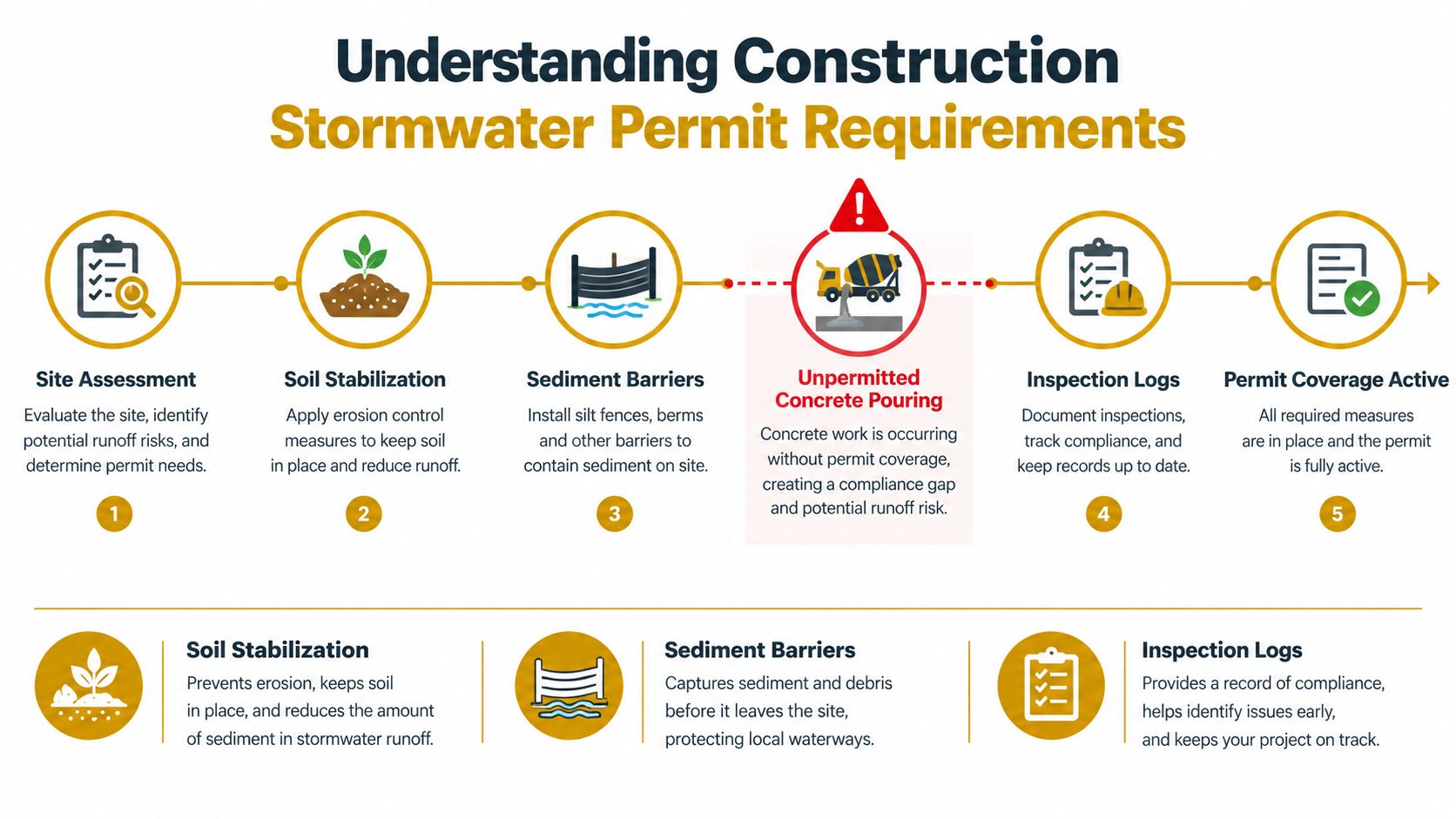
The permit follows the work
Coverage normally applies when clearing, grading, excavating, or related activity exposes soil and stormwater may discharge to waters of the United States or a regulated municipal separate storm sewer system. The obligation doesn't end when the first erosion-control measure is installed. It continues through active earthwork, concrete operations, material handling, stabilization, inspections, and closeout.
A useful superintendent's test is simple:
- Before disturbance: Confirm the permit pathway, identify the operator, complete the SWPPP, and install initial controls.
- During construction: Keep controls functional, inspect them, record findings, and respond to changed conditions.
- During concrete work: Contain washout, keep slurry away from drains and discharge systems, and document what happened.
- At stabilization: Verify that disturbed areas meet the applicable stabilization and termination requirements before treating the job as complete.
Field rule: A permit isn't a folder that sits in the trailer. It is a set of duties that must match what crews are doing on the ground today.
The federal permit framework establishes the baseline, but the issuing authority determines how operators submit notices, pay applicable fees, conduct inspections, retain records, and report results. A contractor working across states can't assume that one state's general permit, forms, deadlines, or site procedures will transfer unchanged to another jurisdiction.
Who Needs a Construction Stormwater Permit
The acreage trigger is straightforward, but the project boundary is where many coverage decisions go wrong. The relevant question isn't always how much soil a subcontractor disturbs during its current phase. The operator must assess the full common plan of development or sale, including work that may occur later or on a separate parcel.
A residential development illustrates the problem. One contractor may grade a small section, another may install utilities, and a third may prepare a later building pad. Each individual assignment can look limited when viewed in isolation. If those activities belong to a larger common plan that ultimately disturbs at least 1 acre, the smaller parcels and phases can fall within the permit universe.
Count the disturbance that supports the project
The assessment should account for more than the obvious building footprint. Associated borrow areas and material-storage areas may be part of the disturbance calculation. Staggered earthwork can also create a misleading picture when the active phase is reviewed without the approved development plan.
Before mobilization, the project team should ask:
- What land will be cleared, graded, excavated, or otherwise disturbed across the full plan?
- Are borrow areas, staging areas, access routes, or storage areas connected to that plan?
- Will stormwater leave the site through a receiving water or regulated MS4?
- Does the state or local authority use a stricter standard or require additional approvals?
- Could the permitting authority designate the project for coverage even if it falls below the normal acreage threshold?
EPA's construction permit materials explain that coverage can apply to a common plan ultimately disturbing at least 1 acre, and that authorities may require coverage below the usual threshold when a project could contribute to a water-quality violation or significant pollutant discharge. The same guidance also identifies associated borrow and storage areas as factors operators should evaluate in their small construction activity overview.
Make the decision before breaking ground
The responsible operator should document the acreage assessment, not just discuss it in a preconstruction meeting. Keep the site plan used for the calculation, identify assumptions, and record the authority or qualified professional consulted when the boundary is complicated.
A parcel that appears below the threshold isn't automatically outside the program. Nor does permit coverage automatically mean every subcontractor becomes the permit operator. The operator-specific duties, delegated responsibilities, and site contacts should be clear before the first excavator starts work.
How to Apply for Construction Stormwater Coverage
Application work should begin with the operator, not with a generic form. The operator is the party responsible for the covered activity and must understand the discharge points, project boundaries, expected pollutants, controls, and people who will carry out inspections and corrective actions.
Build the file in the right order
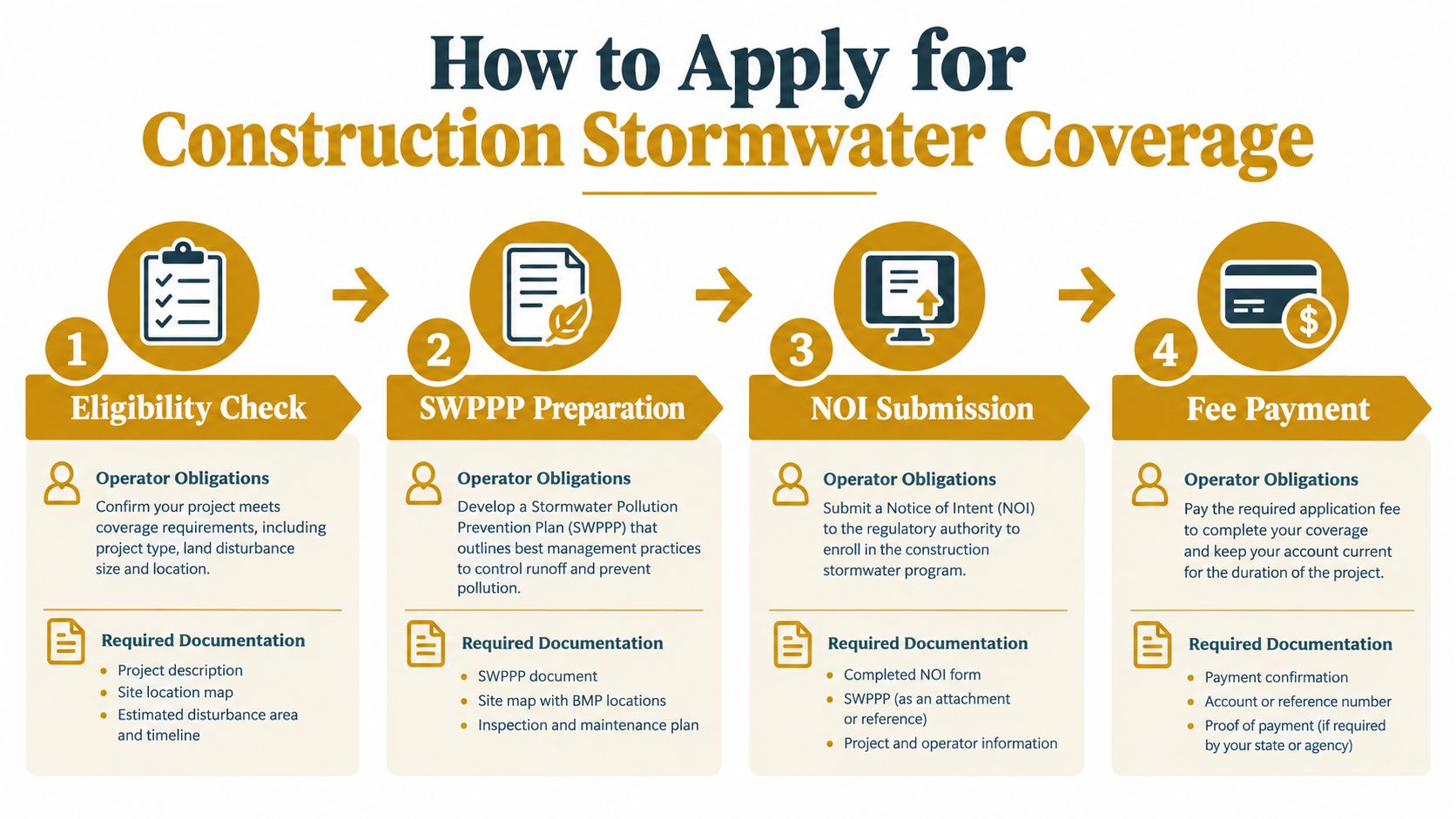
Start with a site assessment. Map disturbed areas, slopes, drainage routes, nearby waters, inlets, discharge points, soil exposure, material storage, concrete work, and likely dewatering locations. Then establish the project's permit eligibility and identify the state or local program that receives the submission.
Prepare the Stormwater Pollution Prevention Plan, or SWPPP, before filing the Notice of Intent. The SWPPP should identify reasonably expected pollutant sources and specify controls, inspection procedures, responsible personnel, and the response process when controls fail or site conditions change.
A practical preparation sequence looks like this:
- Define the operator: Record the entity responsible for permit obligations and identify the parties with delegated field duties.
- Map the work: Include planned phases, access, storage, borrow areas, discharge points, and concrete operations.
- Identify pollutants: Consider exposed soil, sediment, cement slurry, wash water, fuels, waste, and other materials that could contact runoff.
- Select controls: Match perimeter protection, stabilization, inlet protection, sediment treatment, dewatering measures, and washout containment to actual site risks.
- Assign inspection duties: Name the inspector, define the inspection record, and establish who receives and closes corrective actions.
- File the NOI: Submit the operator-specific Notice of Intent through the applicable authority and retain confirmation with the project records.
Make the SWPPP usable in the field
A plan that describes controls nobody can install or inspect isn't a strong compliance tool. Put the washout location, access route, inspection points, sampling access, and emergency contacts where the superintendent and concrete foreman can find them. If the planned control depends on a specific location, make that location visible on the plan and at the site.
The general contractor, SWPPP professional, and subcontractors should agree on handoffs. The concrete subcontractor needs to know where washout is allowed, what to do when the designated area is full, and who must be notified if the pour location changes. The SWPPP professional needs timely information about those changes, not a surprise discovered during a later inspection.
Electronic reporting is also pushing teams toward more structured information. EPA materials identify data fields involving construction activity, best management practices, soil and fill, impervious area, and runoff coefficients in the direction of more auditable submissions. Treat those fields as operational data, not administrative trivia. If the information is wrong at filing, later updates and field records become harder to reconcile.
Required Controls and Inspection Protocols
No single best management practice fits every site. A silt fence can intercept sheet flow but won't solve concentrated runoff. A sediment basin can provide treatment for a large drainage area but needs capacity, access, and maintenance. A stabilized entrance reduces tracking onto public roads, but it doesn't control slurry from a concrete truck.
Choose controls by asking where water starts, how it moves, what it can carry, and where it leaves the property.
| Site condition | Useful control focus | What the crew must verify |
|---|---|---|
| Broad exposed slopes | Soil stabilization and perimeter sediment controls | Controls remain anchored and are not bypassed by concentrated flow |
| Drainage toward an inlet | Inlet protection and upstream sediment reduction | The inlet remains protected without creating unsafe ponding |
| Large contributing area | Basin or other treatment system | Capacity, access, sediment accumulation, and discharge condition |
| Active concrete work | Designated contained washout | Capacity, location, access, overflow protection, and removal records |
| Pumped groundwater or stormwater | Discharge-point treatment and monitoring | Sampling access, discharge dates, turbidity results, and corrective action |
Treat washout as a discharge-control decision
Concrete washout belongs in the SWPPP because cement slurry can be highly alkaline and can carry suspended solids to inlets or receiving waters. The control should be visibly marked, protected from stormwater, located away from drains and surface waters, and sized for the planned pour and truck-cleaning activity.
A pan that works for a small placement may fail during a larger pour or a busy delivery window. A container can also become unusable because it is full, the access route is blocked, the ground is saturated, or the pour moves to another part of the site. The correct response isn't to improvise a discharge point. Stop the washout activity, provide a functional contained location, and notify the person responsible for the SWPPP if the arrangement changes.
Keep dewatering streams separate
For dewatering discharges to environmentally sensitive receiving waters under EPA's Construction General Permit, the turbidity benchmark is 50 Nephelometric Turbidity Units, or 50 NTU, unless EPA approves an alternative benchmark. Operators must collect at least one sample from every dewatering discharge point on each day discharge occurs, compare weekly averages with the benchmark, take corrective action when the weekly average exceeds it, and submit quarterly monitoring results within 30 days after the monitoring quarter, as set out in EPA's dewatering inspection and monitoring guide.
That requirement changes where the superintendent should look. A control installed upstream may appear intact while the actual discharge point carries sediment or concrete fines. Keep groundwater, sediment-laden water, and concrete washout liquids segregated. Maintain safe sampling access, record each discharge date and location, and make the corrective-action trigger clear to the pump operator and inspector.
Common Compliance Pitfalls and Violation Risks
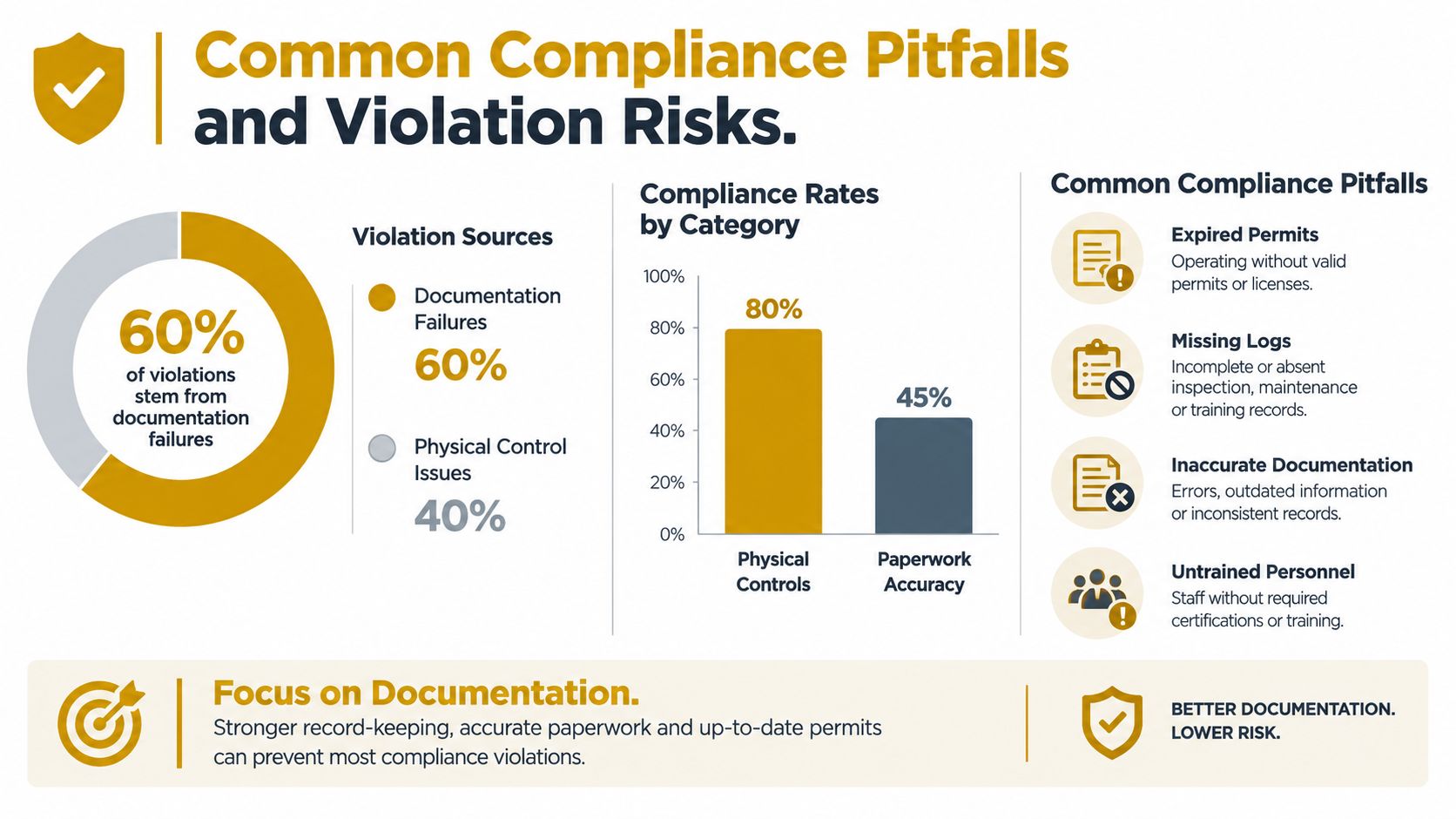
The most dangerous assumption on a construction site is that good-looking controls prove compliance. They don't. An inspector evaluates what was installed, whether it worked, whether someone inspected it, what changed, and whether the records prove the operator responded.
An EPA-referenced national inspection study found paper deficiencies at 40% of construction sites, while 30% lacked adequate erosion or sediment controls, according to the EPA-referenced stormwater inspection report. Those figures point to two different failure modes. Physical controls can be inadequate, but a site can also remain exposed because the paper trail doesn't demonstrate proper management.
Know the violation categories
EPA's violation taxonomy treats several failures as distinct issues. That matters because a contractor can't repair one problem and assume every other obligation is satisfied.
- SWPPP development or maintenance: The plan is missing required content, isn't updated, or no longer reflects field conditions.
- Inspections: Required inspections weren't performed, were late, or lack enough detail to show what the inspector observed.
- Records: Photographs, sampling data, corrective-action closeout, waste-transfer documents, or communications are missing.
- Control implementation: The planned BMP wasn't installed, operated, maintained, or repaired.
- NOI information: Required operator or submission information wasn't provided accurately or kept current.
The EPA violation reference table separates these categories rather than treating them as one general paperwork problem. That distinction helps during internal audits. Ask whether the failure was a planning defect, a field-control defect, an inspection defect, a record-retention defect, or a submission defect.
Build evidence as the work happens
A defensible file should connect the event to the response. After a pour, record the washout location, condition, capacity, and any removal or transfer activity. After rain, document control performance and repairs. After a corrective action, show the problem, the fix, the responsible person, and the closeout date.
A photograph of a clean site proves what the site looked like when the photograph was taken. It doesn't prove what happened before or after it.
Use dated photographs with identifiable site context, not a collection of close-up images that could come from anywhere. Keep inspection entries, corrective-action records, washout-location changes, waste-transfer records, and communications between the general contractor, concrete subcontractors, and SWPPP professional together. The evidence chain should allow another person to reconstruct the decision without relying on memory.
Practical Examples and Best Practices
A concrete pour can expose a weak stormwater process within minutes. The designated washout area may be blocked by equipment, fill before the pour ends, sit on saturated ground, or be too far from an unexpected placement point. The crew needs a written response path before access or capacity becomes a field problem.
If the planned station is unavailable, the foreman should stop discharge, secure the truck and chute, contact the responsible site manager, and move to an approved contained location. The team should inspect the replacement area, verify protection from stormwater and nearby drains, record the change, and notify the person maintaining the SWPPP. If that location becomes the new working setup, update the plan and map. Leaving the old station on the drawing creates a record that conflicts with field conditions.

Make responsibility visible
The general contractor should set approved washout locations and site rules. The concrete subcontractor should follow those rules, inspect the station before use, report access or capacity problems, and document its activity. The SWPPP professional should review changes affecting pollutant sources, controls, discharge paths, or inspection procedures.
A short daily check keeps physical controls and records aligned:
- Before the pour: Confirm location, capacity, access, weather exposure, and the responsible contact.
- During the pour: Keep wash water contained and stop work if overflow or bypass could occur.
- After the pour: Photograph the condition, record cleanup or transfer, and report changes.
- After a site change: Revise the SWPPP or supporting map when the control arrangement no longer matches the site.
Reborn Rentals provides concrete washout containment rentals for construction and renovation work, including jobsite delivery, scheduled swaps, and concrete-waste haul-off or disposal arrangements. Contractors can review options and coordinate site logistics through Reborn Rentals.
Before the next pour, review the current development plan, confirm operator and SWPPP responsibilities, and walk every discharge path. Arrange containment that matches the site's access, capacity, and weather conditions through Reborn Rentals.