
8 Stormwater Inspection Checklist Resources
Rain is moving in, concrete work is active, and the crew needs a clear answer before the first drops hit. Are the washout pans positioned away from drainage paths? Is each pan intact, stable, and ready for the next load? Can the supervisor prove what the site looked like before the storm, and can someone show which deficiencies were fixed afterward?
A strong stormwater inspection checklist is more than a form pulled from a filing cabinet. It connects pre-storm preparation, routine inspections, post-storm checks, photo evidence, recordkeeping, and corrective action. It also separates formal permit documentation from the daily notes crews need to keep concrete work moving safely.
The eight resources below serve different roles. Some support regulatory compliance, some help crews monitor washout containment each day, and others improve training, audits, or digital reporting. Confirm the requirements for your permit, state, municipality, and project before adopting any checklist as the controlling form.
1. EPA Construction General Permit Stormwater Inspection Checklist
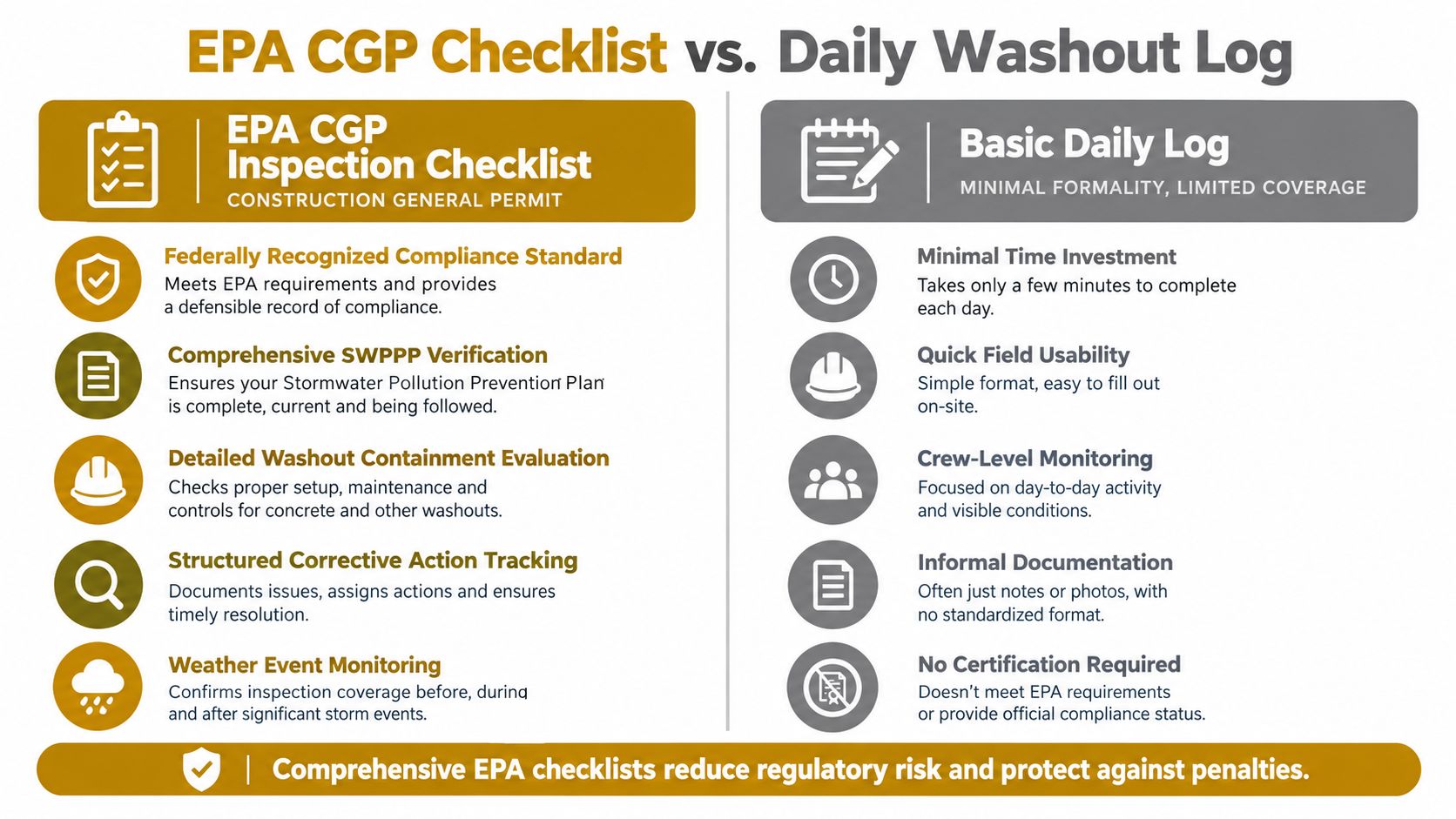
The EPA construction inspection framework gives supervisors a dependable starting point for checking erosion controls, sediment controls, pollution prevention measures, and general site conditions. It works best as the formal compliance record, not as a substitute for the site-specific Stormwater Pollution Prevention Plan, or SWPPP.
For construction stormwater programs, a widely used standard calls for inspections once every seven days during active construction and an additional inspection within 24 hours after rainfall exceeding 0.5 inches in 24 hours. EPA's stormwater inspection guidance reflects this recurring framework and explains why a checklist must be ready before weather changes site conditions.
Concrete washout deserves a specific line item rather than a vague “pollution prevention” check. Verify that the containment system is in the approved location, has no visible damage, shows no overflow evidence, and remains accessible for inspection and maintenance. Look around the pan as well as inside it. Slurry outside the containment area can migrate toward inlets even when the pan itself appears serviceable.
What to record on the formal inspection
The record should identify the inspected area, observed condition, deficiency, responsible person, and required completion action. Add photographs that show the entire containment setup and close-ups of any crack, displacement, sediment buildup, or escaped residue.
Practical rule: A signed inspection report should show who inspected the site, who was authorized to certify the report, and how the team addressed each deficiency. EPA guidance connects inspection work with a qualified inspector and formal certification, so an unsigned field note may not provide the same accountability.
Use this resource for weekly and rainfall-triggered compliance inspections, then pair it with a shorter daily washout log. That combination prevents the formal form from becoming too cumbersome for a crew that needs to verify containment before every pour.
2. SWPPP Site Inspection Form State Specific Variations
A state-specific SWPPP inspection form usually reflects local terminology, submission procedures, designated inspection responsibilities, and permit conditions. That makes it more useful than a generic internet checklist when a project operates under a state construction stormwater program.
Start by obtaining the form from the applicable environmental agency or from the project's SWPPP preparer. Minnesota's construction guidance, for example, states that inspections occur during active construction and after qualifying rainfall, while its municipal stormwater manual requires inspections to be documented and retained under the applicable MS4 permit provisions. Minnesota's municipal inspection guidance shows how inspection records become part of broader permit administration rather than informal site notes.
The form should match the actual site. A project with several discharge points, concrete staging areas, stockpiles, and temporary drainage controls needs more location detail than a small repair job. Mark each washout area on the site map, identify nearby inlets, and make sure the inspector can distinguish a temporary control from a permanent stormwater asset.
Make the form usable for subcontractors
State forms often fail in the field when crews receive them without context. Before work begins, review the form with the concrete pumping and finishing subcontractors. Explain which sections the formal inspector completes and which conditions the crew must report immediately.
A shared inspection calendar helps avoid missed visits and conflicting responsibilities. Digital forms can also auto-populate project information and attach location data to photographs, but only if the team configures the template correctly before deployment.
Use this resource when the jurisdiction's form carries legal or permit significance. Keep a project-specific working copy for field coordination, but don't alter required fields in a way that removes information the agency expects to see. The strongest approach is to preserve the official form and add controlled project fields for washout capacity, pan condition, maintenance, and corrective-action status.
3. Construction Site SWPPP Inspection Checklist
The project SWPPP is the operating document that turns broad permit requirements into site-specific controls. Its inspection checklist should follow the locations, practices, and corrective measures already described in that plan.
Read the SWPPP before confirming equipment placement. Identify the approved washout location, drainage direction, access route, inspection frequency, responsible inspector, and response procedure for a failed control. If the plan says the washout area must be relocated as the site grades change, the checklist should make that condition visible to the person walking the site.
A consultant-developed checklist can be especially useful on large developments and infrastructure work, where several subcontractors affect the same controls. The inspector can check perimeter controls, disturbed soil, stockpiles, inlet protection, concrete operations, and discharge points without losing sight of the project's specific risk areas.
Inspect the washout area as a complete system
Don't inspect only the pan. Check the surrounding ground, access path, berms, liners, signs, and nearby drainage routes. A sound container in a poor location can still create a problem if truck traffic pushes slurry toward a storm drain or if runoff enters the containment area and reduces usable capacity.
The inspection record should also show maintenance activity. Note whether sediment or hardened concrete was removed, whether a damaged component was repaired, and whether the crew changed the location or added supplemental protection. Washington Stormwater Center's electronic checklist package demonstrates how the same workflow can be offered in Word, fillable PDF, and Survey123 formats, giving teams a practical way to preserve a consistent inspection process across project phases.
“A checklist is only as useful as the decision it supports.”
Use the SWPPP checklist for scheduled inspections and consultant reviews. Give crews a simpler daily form for immediate operational checks, then connect both records through the same location name, equipment identifier, and corrective-action reference.
4. Daily Concrete Washout Containment Inspection Log
A daily washout log answers a narrower question than a formal stormwater inspection. Before concrete work starts, is the containment system ready for the day's activity?
That focus makes the log easier for concrete crews, forepersons, and site supervisors to use. Record the date, project area, person completing the check, equipment identifier, visible condition, available capacity, and any action taken before the pour. The log should prompt the user to inspect the base, sides, liner, access, and surrounding ground.
A laminated paper form can work on a small site if someone is responsible for completing it and transferring important findings into the project record. A mobile form may be better where supervisors manage several pours or need immediate visibility from the office. Neither format fixes an unclear process. The crew still needs to know what counts as an unacceptable condition and who can stop the work.
Keep the daily check practical
Use short prompts that lead to action:
- Placement: Confirm that the pan remains in the approved area and away from active drainage paths.
- Integrity: Look for tears, cracks, deformation, leakage, or unstable support.
- Capacity: Check whether accumulated concrete residue or liquid leaves enough usable containment for the planned work.
- Housekeeping: Remove loose residue around the pan and keep truck access controlled.
- Escalation: Notify the supervisor before work if the system needs cleaning, repair, relocation, or replacement.
The daily log shouldn't pretend to be the full permit inspection. It should feed that inspection with better site history. Practical guidance on stormwater inspections emphasizes preparation, visual review, BMP checks, and documentation through logs, photos, and digital records. That evidence chain matters when a supervisor needs to explain not only what was observed, but what happened between inspections.
5. Environmental Compliance Audit Checklist for Construction Washout Areas
An audit checklist is designed to test whether the site's system works over time, not merely whether a crew completed yesterday's check. It brings together permits, the SWPPP, inspection reports, photographs, maintenance records, training evidence, and open corrective actions.
Auditors should trace a deficiency from discovery to closure. If an inspection found a damaged washout liner, the audit should show who received the assignment, what repair or replacement occurred, when the work was completed, and how someone verified the result. A checkbox marked “fixed” without supporting evidence leaves an avoidable gap.
Audit the process around the pan
The washout area is only one part of the review. Check whether the site keeps clean runoff separate from contaminated areas, protects nearby inlets, controls access, and maintains a reliable way to remove hardened material. Review whether subcontractors understand the approved location and whether changes in grading or traffic have made that location unsuitable.
Schedule an audit while the project still has time to correct weaknesses. A late review may identify the same problem, but the team has fewer opportunities to improve the process before completion. The audit should also test version control. Make sure field teams aren't using an obsolete form after the project's SWPPP, permit references, or submission instructions change.
Audit question: Can a person who wasn't present on the inspection date reconstruct what happened from the record?
A strong audit checklist doesn't reward the longest form. It rewards clear evidence, consistent ownership, and closed actions. Use findings to revise internal procedures for future projects, especially where crews repeatedly miss the same inspection prompt or where equipment placement creates recurring maintenance problems.
6. SWPPP Inspector Certification Training Checklist
The quality of a stormwater inspection depends on the person conducting it. Training checklists help supervisors confirm that an inspector understands the project SWPPP, recognizes failed controls, documents conditions accurately, and knows when an observation requires immediate escalation.
Training should combine classroom knowledge with a walk through the actual site. An inspector might understand sediment controls in theory but still overlook a washout pan that sits directly in a runoff path. Field practice should include identifying drainage routes, locating discharge points, checking inlet protection, recognizing escaped concrete residue, and taking photographs that show useful context.
Train for decisions, not form completion
A competent inspector should be able to answer practical questions:
- What changed: Did grading, traffic, weather, or concrete operations alter the approved control layout?
- What failed: Is the issue damage, inadequate capacity, poor placement, missing maintenance, or incorrect use?
- What happens next: Does the crew need to clean the area, relocate the pan, protect a drain, notify a supervisor, or document a permit-related correction?
- What proves completion: Will a dated photograph, repair note, or follow-up inspection demonstrate that the deficiency is closed?
Keep training records with inspection records where the project requires proof of inspector qualifications. Refresh site orientation when responsibilities change or when the SWPPP is revised. Certification alone doesn't guarantee a good inspection, and a familiar crew member may still need formal instruction on documentation and escalation.
The useful training checklist ends with a field demonstration. Have the inspector complete a sample inspection, photograph a washout area, write a deficiency clearly, assign an owner, and verify the correction. That exercise exposes gaps that a knowledge quiz may miss.
7. Mobile Stormwater Inspection App and Digital Checklist Platform
Digital platforms can improve stormwater inspections when they reduce friction without hiding important judgment. Tools such as iAuditor, Touchplan, and FieldConnect can support mobile forms, photographs, task assignments, and reporting workflows, depending on the configuration and subscription used by the project team.
Start with one project rather than moving every site at once. Test whether inspectors can open the correct form, work safely with limited connectivity, attach photographs to the right inspection item, and submit a report without duplicating information. A platform that works in an office but fails beside a muddy access road won't improve field performance.
Pre-load the details that inspectors repeatedly type. Include the project name, site areas, washout locations, equipment identifiers, responsible supervisors, and links to the current SWPPP. Build prompts for the conditions that matter most, such as containment integrity, available capacity, leakage, overflow evidence, and surrounding sediment.
Configure the workflow before the first storm
Automatic reminders can help teams maintain the required inspection rhythm, but reminders aren't enough. Assign each deficiency to a named person, set a due date appropriate to the risk, and require a completion photograph or verification note before closure.
Use permissions carefully. The person recording a field condition shouldn't be able to erase the original observation after a supervisor reviews it. Preserve submission times, revisions, and attachments so the record shows how the issue developed and how the team responded.
A digital checklist also needs a paper fallback for dead batteries, damaged devices, or poor connectivity. Transfer the paper record into the controlled system promptly, and label it as a transcribed entry rather than allowing parallel records to drift apart. The goal is a reliable evidence trail, not technology for its own sake.
8. Post Storm Stormwater Inspection and Assessment Checklist
A post-storm inspection asks whether rainfall exposed weaknesses that a dry-weather walk-through couldn't reveal. Water can move sediment, displace inlet protection, fill a washout area, damage temporary controls, and create new drainage paths around active work.
Prepare before the weather arrives. Check that the washout area has usable capacity, the container is stable, nearby drains are protected, and equipment isn't positioned where runoff will carry residue toward a receiving system. Record pre-storm conditions with photographs so the team can distinguish existing damage from storm-related movement.
After the event, inspect the entire flow path rather than walking directly to the washout pan and leaving. Look for ponding, rills, sediment deposits, exposed soil, displaced controls, overflow marks, and signs that clean water entered a contaminated area. Check catch basins, outlets, and other permanent or temporary assets according to the project's inspection program.
Turn storm evidence into a correction
Photographs should show the location and the defect. A close-up of muddy water may prove little without a wider image that identifies the pan, drain, slope, or control involved. Record whether the washout system held material, whether the surrounding ground remained stable, and whether any residue escaped the designated area.
Some facilities use different schedules for different assets. A checklist for an aging underground system may require attention that a temporary construction control doesn't, while a detention basin needs a different inspection perspective from an inlet. A municipal stormwater inspection checklist illustrates why asset type, infrastructure condition, and local program requirements should shape the inspection workflow.
After a storm, don't ask only whether the control survived. Ask what the water revealed about the site.
Assign each finding before the inspection closes. The responsible person may need to clean the pan, repair a liner, move the containment area, stabilize a slope, restore inlet protection, or update the SWPPP site map. A follow-up check confirms that the correction worked under the conditions that caused the problem.
Stormwater Inspection Checklists, 8-Resource Comparison
| Item | Core features | UX (ease & time) | Value proposition | Target audience | Key trade-offs / Cost |
|---|---|---|---|---|---|
| EPA Construction General Permit (CGP) Stormwater Inspection Checklist | Federal template; erosion/sediment controls; washout evaluation; corrective-action tracking; weather monitoring | Detailed and thorough; time-consuming; needs trained inspectors | Ensures EPA compliance; standardized documentation; liability protection | Contractors on CGP projects; SWPPP consultants; regulators | High admin burden; training required; may need state-specific adjustments |
| SWPPP Site Inspection Form (State-Specific Variations) | State-tailored fields; BMP assessment; inspector certification/signatures; frequency rules | Moderate effort; aligned to local regs; periodic (weekly/bi-weekly) | Meets state requirements; defensible records; reduces local non-compliance risk | Multi-state contractors; permit holders; local inspectors | Forms vary by jurisdiction; learning curve for multi-state work; inspection costs |
| Construction Site SWPPP Inspection Checklist | Project-specific SWPPP cross-reference; pre/post-storm protocols; maintenance schedules; training docs | Comprehensive; often consultant-led; resource-intensive | Ensures SWPPP implementation; audit-ready; consistent BMP accountability | General contractors; SWPPP consultants; large projects | Consultant fees; frequent updates; may require equipment upgrades |
| Daily Concrete Washout Containment Inspection Log | Simple checkbox daily log; capacity/drain/sediment checks; photo attachment capability | Quick (5–10 min); crew-level use; low admin overhead | Early issue detection; continuous documentation; empowers crews | Concrete crews; site supervisors; small/fast-track projects | May not satisfy certified-inspector rules; requires daily discipline |
| Environmental Compliance Audit Checklist for Washout Areas | Third-party audit tool; scoring/compliance rating; training and corrective-action review | Thorough and formal; disruptive; external auditor needed | Objective assessment; reduces corporate liability; improves qualifications | Developers; corporate EHS; insurers; contractors seeking bonding/LEED | Costly; can reveal urgent costly fixes; potential legal discovery risk |
| SWPPP Inspector Certification Training Checklist | Structured curriculum; hands-on BMP field training; competency assessment; CE requirements | Time-intensive; formal training and renewal cycle | Produces qualified inspectors; consistent standards; reduces inspection variability | Site supervisors; environmental coordinators; consultants | Training/time cost; renewal obligations; state-specific variations |
| Mobile Stormwater Inspection App & Digital Checklist Platform | Mobile/cloud templates; photo with GPS/timestamp; real-time sync; offline mode; auto reports | Fast after setup; user-friendly; requires initial training | Streamlines inspections; instant access; automates reporting and audits | Large contractors; SWPPP consultants; tech-enabled crews | Subscription/device costs; connectivity and battery dependency; data security concerns |
| Post-Storm Stormwater Inspection & Assessment Checklist | Post-event rainfall data; structural integrity checks; sediment/pollutant assessment; photo evidence | Urgent response needed; can be difficult in adverse conditions | Verifies real-world performance; prevents subsequent issues; documents storm response | Projects in high-rainfall or storm-prone areas; SWPPP managers | Requires quick mobilization; may reveal expensive repairs; possible work stoppages |
Turn Inspection Findings Into Site Action
A stormwater inspection checklist becomes valuable when it changes what happens on the ground. Start with the form that governs the project, whether that's an applicable construction permit form, a state-specific SWPPP inspection document, or a municipal procedure. Confirm the required inspection timing, signatory responsibilities, retention rules, and submission process before treating the form as final.
Add a daily washout log for the people who handle concrete. The formal inspector may visit on a scheduled route, but the concrete crew sees the pan before every pour and notices changes in access, residue, capacity, and condition first. Keep the daily log focused enough that it gets completed, then connect it to the formal inspection record through the same site area, equipment identifier, and date.
Set two types of triggers. The first is routine, based on the governing permit and project schedule. The second is event-based, tied to qualifying rainfall or any storm that could move sediment, damage controls, or change drainage conditions. EPA guidance describes a widely used construction framework of weekly active-construction inspections plus an inspection after rainfall greater than 0.5 inches in 24 hours, with the additional inspection conducted within 24 hours. The EPA inspection standard should be checked against the requirements that apply to your site.
Photograph the conditions that matter. Take a wider image to establish location, then a closer image for damage, residue, sediment, leakage, or overflow evidence. Store the images with the inspection record, preserve timestamps where possible, and use consistent file names or digital tags. A photograph shouldn't replace a written observation, but it can make the observation easier to verify.
Every deficiency needs an owner and a completion record. “Needs attention” isn't an action. Write who will clean, repair, relocate, protect, notify, or recheck the control. Record the completion date, attach evidence, and have a qualified person verify closure when the project procedure requires it.
For concrete work, verify four things every time: placement, condition, capacity, and maintenance. The pan must be positioned where it can contain slurry without directing runoff toward a drain. It must remain structurally sound, have sufficient available capacity for the planned operation, and receive maintenance before residue or damage turns into an uncontrolled discharge.
The checklist doesn't replace the SWPPP, permit, or local requirements. It translates those requirements into repeatable field actions, but the project team remains responsible for using the correct governing documents and updating the workflow when site conditions change.
When rental containment equipment is needed, review the available specifications and delivery details before the pour. Reborn Rentals lists washout pans and containers for construction and renovation work, with product information covering dimensions, liquid capacity, load capacity, delivery, and potential surcharges. Confirm that the selected equipment fits the project's approved washout arrangement and that the delivery timing works with site access and concrete scheduling.
Reborn Rentals provides concrete washout containment equipment for construction, renovation, pumping, and finishing work, with online ordering, date and location selection, and delivery coordination. Visit Reborn Rentals to review available washout pans, confirm specifications, and arrange equipment before your next stormwater inspection or concrete pour.