
Dewatering Equipment Rental: A Contractor’s Complete Guide
You arrive before the excavation crew and find water rising through the bottom of the cut. The discharge route isn't approved, the rental yard needs more notice for a standby pump, and the pump you ordered is rated for the flow but not the actual pipe run. By the time someone resolves those issues, the excavation has softened, access has deteriorated, and the schedule is already moving.
Dewatering equipment rental can solve the immediate problem, but only when the rental is treated as a complete temporary water-control system. Pump capacity, system head, standby equipment, permits, treatment, fuel, hoses, access, monitoring, and removal all belong in the plan. The cheapest pump on the quote may be the most expensive choice if it can't keep the work area stable or discharge legally.
Why Dewatering Equipment Rental Matters
A foundation excavation can change from manageable seepage to a working pond after rain, groundwater movement, or a cut below the water table. A superintendent who rents a pump at that point may get water moving, but moving water isn't the same as controlling it. The system still needs a suitable intake, reliable power, discharge routing, sediment control, and enough capacity to keep working when the first pump needs service.
Buying equipment rarely fits that uncertainty. A contractor may need a trash pump for one excavation, a vacuum-assisted system for another, or a high-head arrangement where the available discharge point sits far from the pit. Rental gives the project team access to different equipment without leaving a specialized pump idle between jobs.
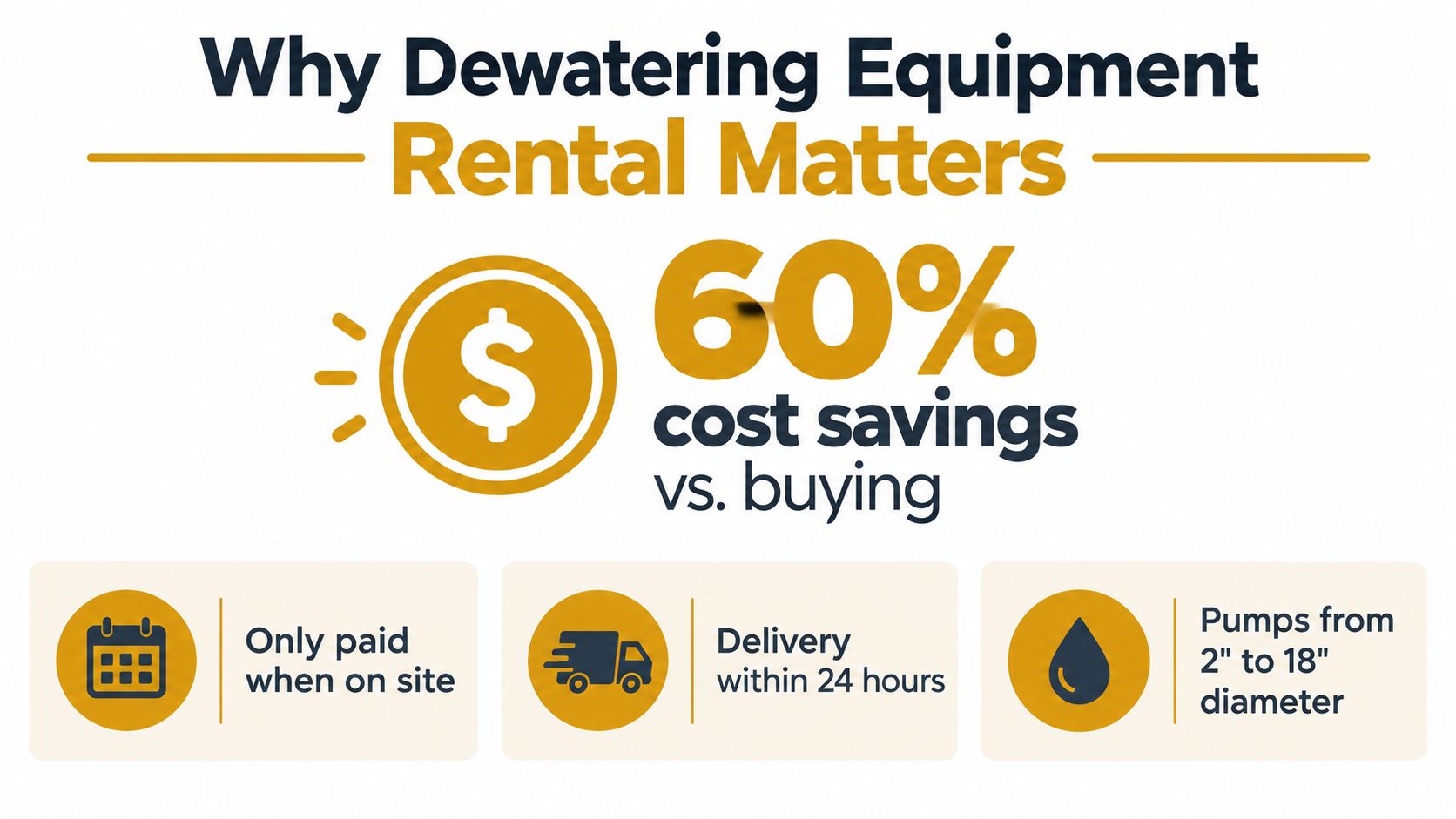
The market reflects that operational preference. The global industrial pump rental market was estimated at USD 3.59 billion in 2025 and is projected to reach USD 7.77 billion by 2035, representing an 8.02% CAGR, according to Global Growth Insights' industrial pump rental market data. Dewatering represented about 34% of that market in 2025, or roughly USD 1.22 billion, and more than 45% of construction-related rental pump demand was linked to dewatering applications, according to the same source.
Rental works when the project needs flexibility
A short excavation, emergency bypass, or changing groundwater condition doesn't justify owning every pump configuration. A rental provider can often supply the pump, hose, fittings, controls, and service support as the field conditions become clearer.
The commercial case also extends beyond the pump itself. A separate dewatering pumps market analysis estimates that rental fleets will account for 41.0% of market share in 2026, because short project cycles favor hired equipment over ownership. That source also reports that fluid solutions equipment represented 7% of United Rentals' equipment rental revenue in 2025, while specialty rentals grew 13.6% year over year.
Practical rule: Rent for the conditions you have to manage, not for the pump you already know how to operate.
Rental doesn't remove responsibility from the project team. It makes planning more important, because the equipment is temporary and the return date can arrive before the groundwater problem is finished. A good rental order starts with a site assessment and ends with a documented removal plan.
Sizing Your Dewatering System Correctly
A pump can meet its nameplate flow and still fail on site. The unit must deliver that flow at the total dynamic head created by excavation depth, discharge elevation, pipe length, fittings, friction, and receiving-point pressure. A long, narrow hose with multiple bends can consume much of the available output before water reaches the discharge point.
Start with the ground conditions and the full discharge route, not the catalog.
Establish the expected inflow
Build a working ground model from geotechnical information, observed seepage, nearby water bodies, soil layers, and the planned excavation depth. Where the project scale or failure risk justifies it, run a field pumping test before finalizing the rental. Measured results provide a better basis for estimating the abstraction rate than an assumed groundwater volume.
Record how quickly the water level drops, how fast it rebounds, and whether pumping at one location affects adjacent areas. Those observations help separate a small perched-water issue from a connected aquifer that can keep feeding the excavation. They also show whether the planned pump can maintain control through changing excavation stages.
Size the duty system above the expected inflow. Average seepage is not enough if a storm, trench connection, rising water table, or lower excavation level can increase the load. Ask the rental provider what capacity remains at the actual operating head, not only the advertised maximum flow.
Calculate the whole hydraulic path
Give the rental provider a site sketch that includes:
- Static lift: Measure from the water surface or intake elevation to the discharge elevation.
- Pipe friction: Include hose diameter, total length, bends, valves, reducers, and temporary crossings.
- Discharge pressure: Confirm whether the outlet enters a tank, treatment unit, storm system, or other pressurized point.
- Solids and debris: Match the pump to the expected sediment and debris load. A clean-water pump can clog or wear quickly in excavation water.
- Power and fuel: Confirm the available electrical supply, or plan for diesel operation, refuelling access, ventilation, spill controls, and noise restrictions.
The quote should state the expected duty point and the supplied hose and fittings. Request a pump curve or equivalent performance information showing expected output at the calculated head. A cheaper pump can become the more expensive choice if it needs extra hose, treatment capacity, fuel deliveries, or repeated callouts.
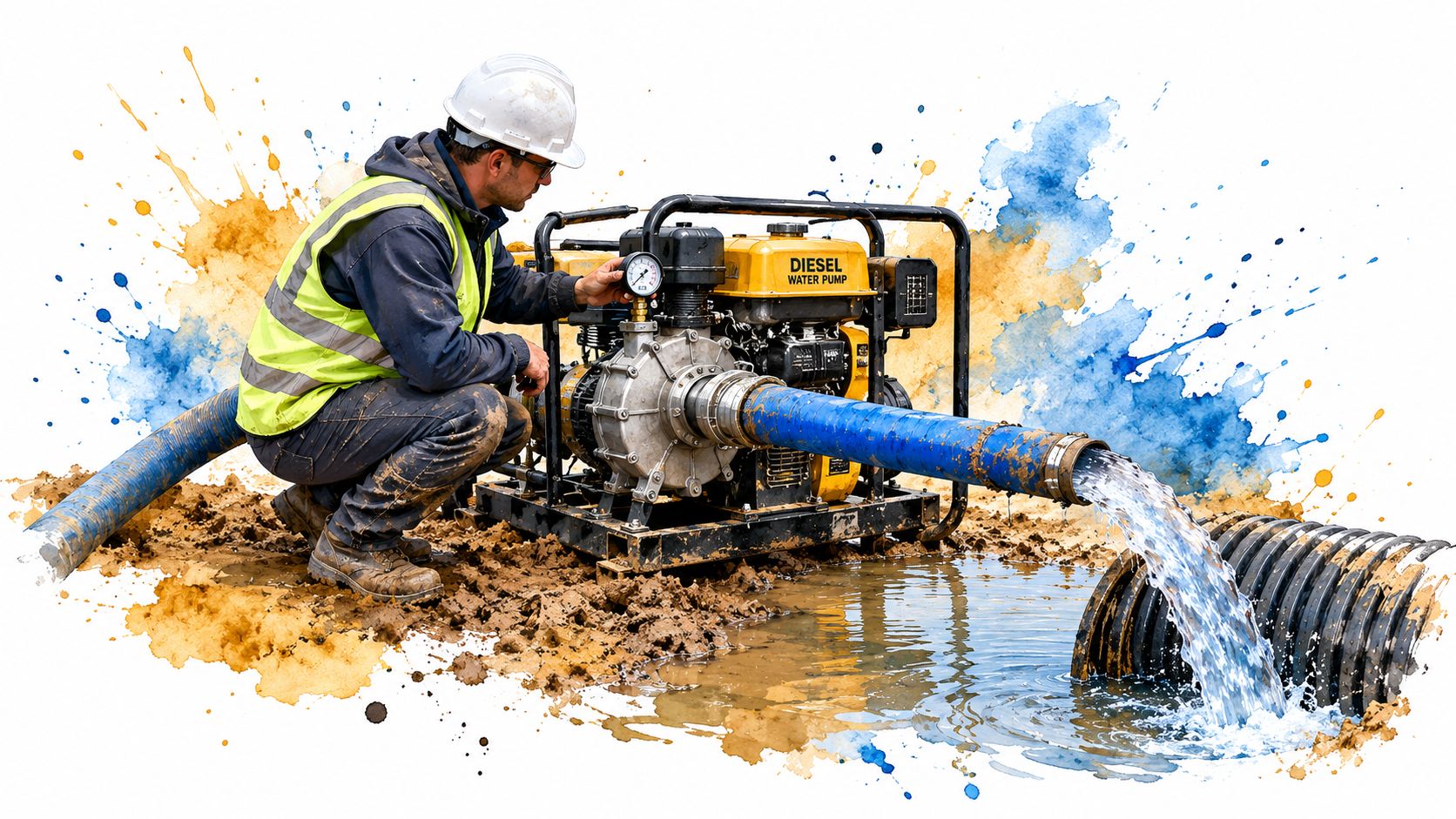
Build failure into the plan
Standby capacity protects the programme when flooding can stop concrete work, cut off access, undermine excavation support, or damage installed work. Guidance commonly specifies standby capacity equal to 50% to 100% of duty capacity, depending on the consequence of failure and site risk, as described in construction dewatering monitoring guidance.
That reserve can be a connected spare, a second pump stored on site, or a documented rapid-replacement commitment from the rental yard. Choose the arrangement by the time available before the excavation becomes unsafe, rather than by daily rental rate alone. Test float controls, backup power, alarms, fuel arrangements, and the changeover procedure before the primary unit fails. Availability also needs to cover weekends, storms, and delivery delays.
Navigating Permits and Discharge Requirements
A rented pump can be ready for delivery and still leave the project unable to discharge water. Excavation water may contain sediment, concrete residue, hydrocarbons, metals, or other contaminants. Sending it to a storm drain, surface water, sanitary system, or neighboring property without confirming the rules can trigger a stop-work order, enforcement action, or an expensive last-minute change to the discharge plan.
Start this review before placing the rental order. Approval requirements depend on the jurisdiction, receiving water, water source, flow, quality, and pumping duration. Groundwater dewatering may require an NPDES permit or state-equivalent discharge authorization. Some sites also require water-rights or water-taking approval.
Use a pre-delivery compliance workflow
- Identify the receiver. Confirm the precise discharge location. A permitted connection, sediment basin, infiltration area, storm system, and natural waterway can each impose different conditions.
- Characterize the water. Review previous site use, soil records, and nearby contamination risks. Arrange field or laboratory testing when poor clarity or contamination is possible.
- Confirm acceptance criteria. Do not treat informal field benchmarks as approval. Ask the regulator or receiving authority what testing, flow limits, monitoring, and notifications apply.
- Select treatment. Include filtration, settling tanks, flocculation, oil control, or other treatment when the water fails the receiver's quality conditions.
- Document the decision. Keep permits, sampling records, inspection logs, discharge volumes, treatment checks, and corrective actions together on site.
The dewatering monitoring and inspection guidance calls for attention to water levels, flow rates, and discharge quality during the rental period. Assign someone to record those checks and define who can reduce the flow, add treatment, or stop pumping when conditions change.
Clear water can still cause trouble
Water that looks clean may fail a permit condition. A high-volume discharge can also erode a ditch or overload a drain even when sediment is limited. Use stable outlets, energy dissipation, and source control to prevent scour and off-site sediment movement.
Confirm whether the rental quote includes treatment tanks, filters, hoses, sampling points, flow meters, discharge monitoring, and waste handling. Also ask who supplies replacement media and responds to a failed treatment unit. If those responsibilities are unclear, the rental is not fully priced or ready for site use.
Choosing Between Sump Pumping and Wellpoints
Sump pumping and wellpoints solve different groundwater problems. Sump pumping collects water after it enters the excavation. A wellpoint system lowers groundwater around the work area before it reaches the cut. Selecting between them depends on soil behavior, drawdown depth, inflow, excavation geometry, and how sensitive the surrounding ground is to movement.
| System Type | Best For | Drawdown Capacity |
|---|---|---|
| Sump pumping | Perched water, shallow drawdown, and relatively limited seepage where some water can safely enter the excavation | Shallow drawdown |
| Wellpoint system | Permeable soils, trenches, tanks, and excavations requiring more uniform groundwater control | About 15 to 18 feet per stage, with deeper wells needed beyond that range, according to IStructE construction dewatering guidance |
When a sump is the right tool
A sump is simple and fast when water is perched above a less permeable layer or seepage is localized. It can work well for a shallow cut where the excavation remains stable and the water can be collected without washing fines out of the soil.
The weakness is that the sump accepts water inside the work area. That can soften subgrade, move sediment, erode the excavation face, and interfere with a footing or slab. Place the intake in a protected sump, use a strainer suited to the debris, and route the discharge so it doesn't cut a new channel across the site.
When wellpoints earn their complexity
Wellpoints are more appropriate when the project needs controlled drawdown around a trench or excavation. They can reduce the amount of water entering the work zone and provide more even groundwater control in suitable permeable soils.
They also require more planning. Installation access, header layout, vacuum equipment, staged drawdown, and discharge treatment all affect performance. Some guidance notes that a dewatering system may need one to three weeks before substantial drawdown is achieved, so a wellpoint rental scheduled only for the excavation date may arrive too late.
Use a deep-well approach when the required drawdown exceeds what a wellpoint stage can provide or when the aquifer and excavation scale demand a different arrangement. The decision belongs with the geotechnical and dewatering teams, especially where drawdown could affect neighboring structures.
Understanding the True Cost of Rental
The daily pump rate is rarely the project cost. A workable budget includes mobilization, hoses, fittings, installation, fuel or power, permits, treatment, sampling, operator time, maintenance, standby equipment, teardown, and return transport. Leave any of those out and the quote can look attractive while the actual water-control cost keeps climbing.
A practical estimate should separate fixed setup costs from operating costs. Mobilization and installation may happen once, while fuel, treatment media, inspections, and pump hours continue for the full rental period. Add a contingency for weather and groundwater changes, then define who pays if the equipment stays on site beyond the original return date.
Build the quote around the discharge plan
A larger pump can increase more than flow. It may require larger hoses, stronger outlets, additional treatment capacity, more fuel, and a different permit condition. A smaller pump can be cheaper to operate but may run continuously, provide no recovery margin, and fail to keep pace with inflow.
For a mid-size commercial project, independent construction guidance places the total rental cost of a typical wellpoint system at about USD 1,500 to USD 3,000 per day, as described in Projul's construction dewatering cost guidance. That total-cost framing matters because it includes more than the pump's advertised rate.
Request an itemized quote with these questions answered:
- What arrives: Pump, standby unit, hose, header, wellpoints, tanks, filters, controls, fuel system, and monitoring equipment.
- Who installs it: Rental-yard crew, site crew, or a specialist subcontractor.
- What treatment costs: Tanks, filters, media, chemicals, disposal, sampling, and replacement parts.
- What happens after failure: Response time, replacement stock, after-hours support, and responsibility for lost production.
- How extensions work: Daily, weekly, or monthly rates, minimum periods, and off-hire requirements.
Know when rental should become a service package
Short-notice rentals make sense when the method is straightforward and the duration is uncertain but limited. Extended infrastructure work can be different. If the system needs continuous adjustment, treatment, reporting, refuelling, and maintenance, a turnkey dewatering service may provide better cost control than managing separate rental components.
The right comparison isn't pump rental versus ownership. Compare a complete rental system against the cost of downtime, environmental delays, emergency mobilization, and internal labor. Then compare both with a managed service that carries more of the operational burden.
Logistics, Delivery, and Site Preparation
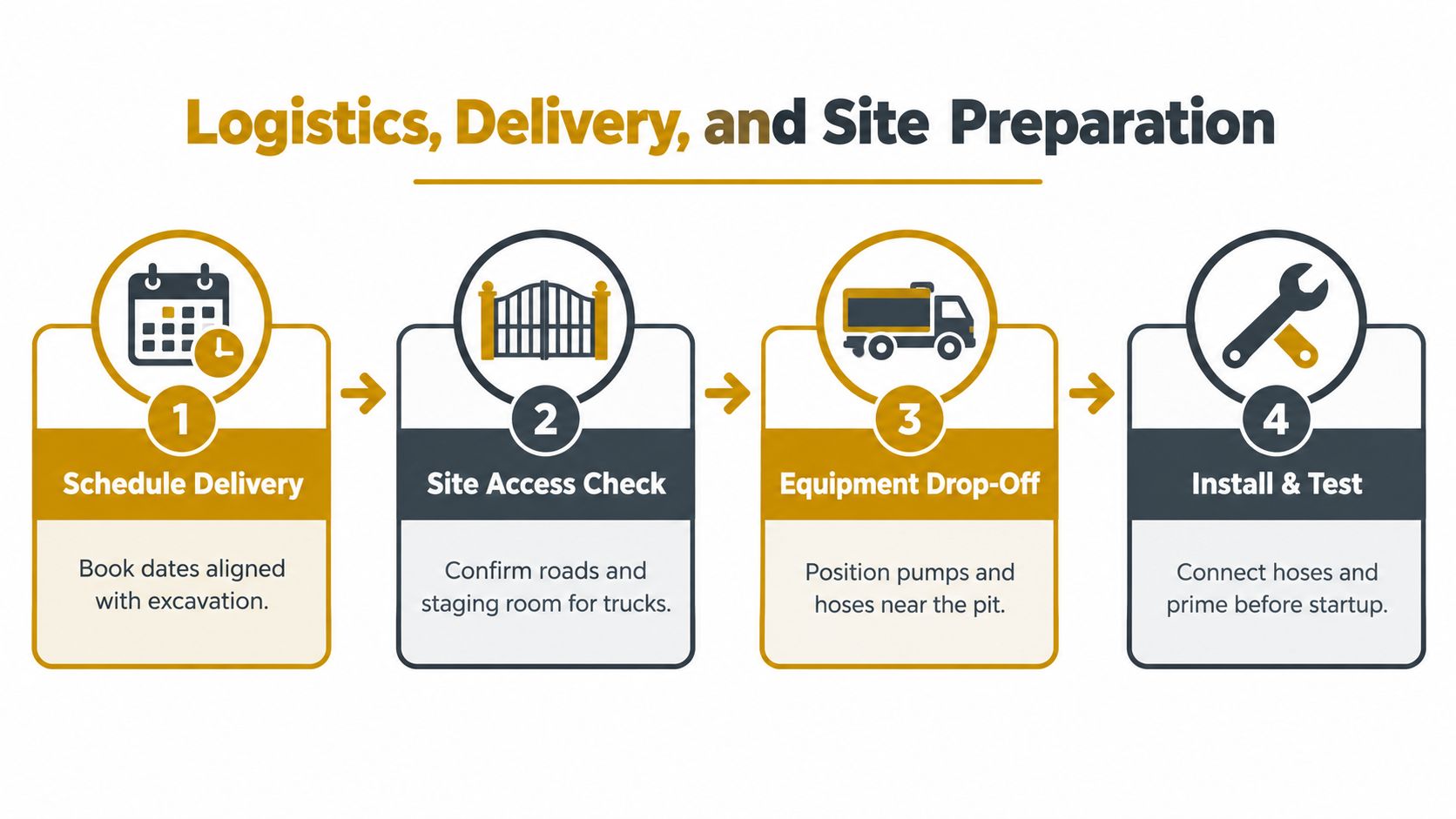
A pump can't protect an excavation from the back of a truck. Delivery planning should begin with the route from the public road to the staging area, then continue to the intake, discharge point, power source, and fuel access. Rough ground, tight gates, overhead services, soft shoulders, and active haul routes can make installation slower than the pumping itself.
Prepare the site before the truck arrives
Walk the route with the delivery driver or rental coordinator when the equipment is large, tracked, trailer-mounted, or diesel powered. Confirm turning space, ground bearing, clearance, and a stable placement area that won't flood or undermine the pump.
The staging area should be level enough to prevent tipping and positioned so operators can inspect the unit without entering an unsafe zone. Keep fuel, electrical connections, exhaust, hoses, and pedestrian routes separated. Protect hoses at crossings and don't leave discharge lines where moving plant can crush or disconnect them.
Coordinate access with the wider project
Schedule delivery around excavation, concrete, haulage, and crane operations. If a truck needs a road closure, traffic control, escort, or temporary access permit, resolve that before the equipment date. A missed delivery window can leave the site exposed to the next rainfall or groundwater rise.
Use a simple readiness check:
- Access is open: Gates, roads, ramps, and turning areas are available.
- Ground is stable: The pump and treatment units have a firm, level base.
- Discharge is ready: The approved route, tanks, filters, and outlet protection are installed.
- Power is confirmed: Connections, generator placement, fuel, and weather protection are arranged.
- Crew is briefed: Operators know priming, startup, shutdown, alarms, and emergency isolation.
Prime the pump and test the full hose route before production work depends on it. Check every coupling, valve, float, and discharge outlet under operating conditions. A system that runs successfully during a short demonstration can still fail when the excavation reaches its full inflow.
Best Practices for a Successful Rental
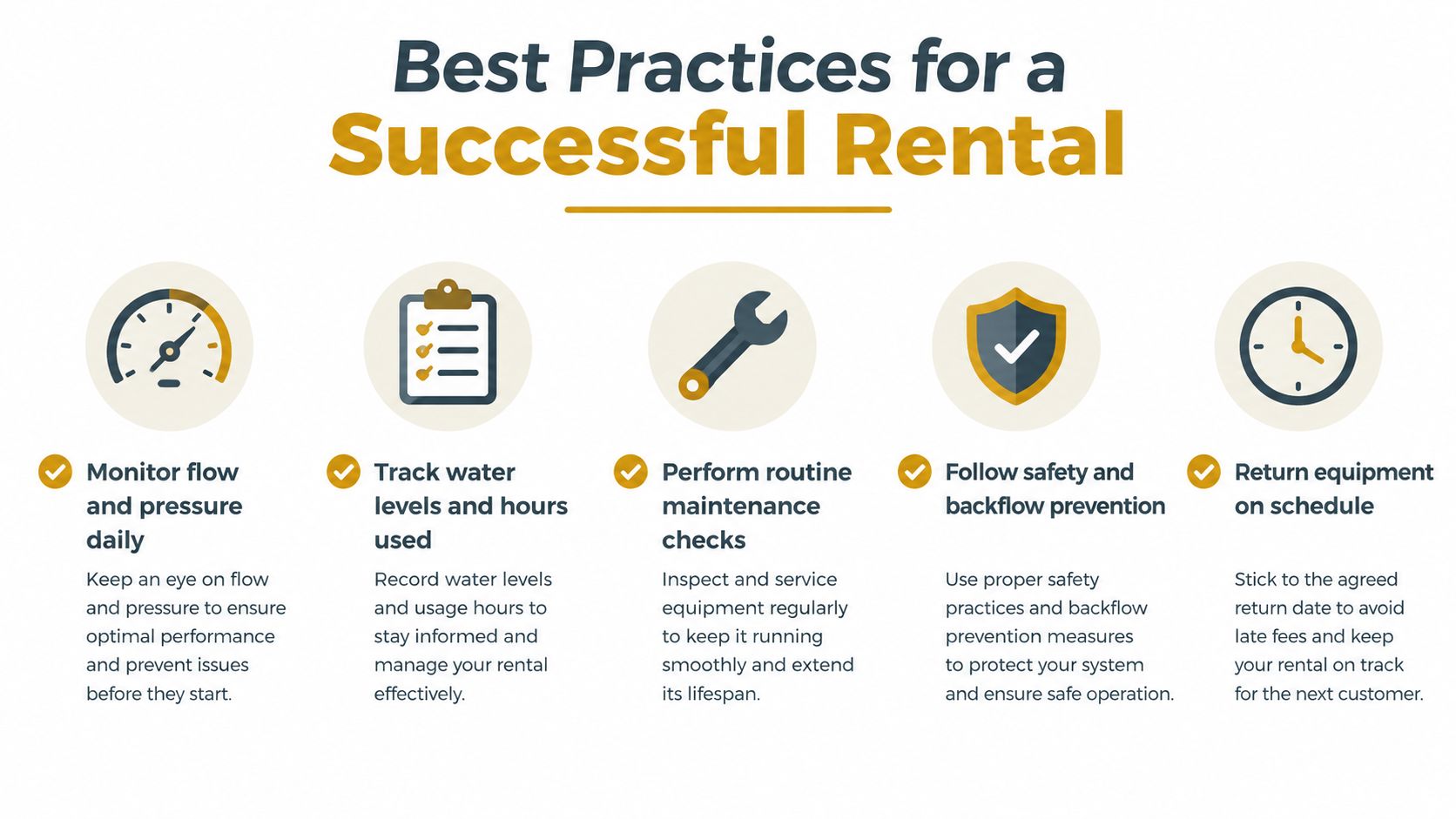
A successful rental is managed as a live site operation, not left unattended after startup. Assign one person to check the system, record readings, communicate changes, and escalate alarms. The log should show water levels, flow rates, pressure, runtime, fuel, maintenance, discharge quality, weather, and any changes to the setup.
Keep the system visible and recoverable
Walk the intake and discharge route at the start of each shift. Look for blocked strainers, damaged hoses, loose couplings, changing water levels, erosion, unusual vibration, fuel leaks, and sediment buildup. Don't wait for the pump to stop before calling the rental provider.
Maintain a written contingency plan with the standby pump, replacement hoses, backup power, contact numbers, and a safe shutdown procedure. If the primary unit fails, the crew should know who starts the backup and who protects the excavation while the changeover happens.
Water management gets safer when the site team can see a trend before it becomes an emergency.
Keep compliance records with the project documentation. Include permits, inspection sheets, sampling results, treatment records, discharge checks, maintenance notes, and off-hire confirmation. These records help resolve disputes over performance and demonstrate that the team controlled the discharge rather than only moving water elsewhere.
Use the rental calendar as an operational tool. Review the expected excavation sequence, forecasted weather, drawdown progress, concrete dates, and return conditions before requesting an extension or arranging removal. Returning equipment early can create a gap in control, while returning it late without notice can create avoidable charges.
Final check: The pump is only one component. The rental works when capacity, standby, discharge quality, access, monitoring, and documentation all function together.
Reborn Rentals provides concrete washout pan and container rentals for containing construction slurry, with delivery coordination and options that support organized, compliant concrete work around active sites. If your project needs dependable washout containment alongside its water-control planning, visit Reborn Rentals to review the available rental options and arrange delivery.