
EPCM Project Management Explained from Design to Delivery
You're standing at the edge of a major capital project. The design team is still refining equipment specifications, procurement is chasing a long-lead item, several trade contractors are preparing bids, and the site team is asking where concrete washout will happen. None of these tasks exists in isolation. A late design decision can change a purchase package, a delayed delivery can disrupt a contractor's sequence, and a poorly located washout area can create environmental and access problems just as field activity accelerates.
That's the environment where EPCM project management earns its place. Instead of asking one contractor to absorb every delivery responsibility, the owner appoints a specialist to coordinate engineering, procurement, construction interfaces, controls, safety, and commissioning while the owner retains direct control of the underlying contracts. The arrangement offers visibility and flexibility, but it also requires the owner to understand where risk remains.
Introduction to EPCM Project Management in Modern Capital Projects
A manufacturing expansion can lose time at the interfaces long before construction appears behind schedule. A design requirement may differ from the basis used for procurement pricing. Supplier documents may arrive after an installer needs them. A foundation may be poured before the equipment vendor confirms its final dimensions. Each mismatch creates rework, claims, or pressure on the programme.
Turnkey EPC delivery places engineering, procurement, and construction under one contractor, which can make accountability straightforward when scope and performance requirements are stable. An owner may prefer a different arrangement when technology remains subject to change, direct supplier comparison matters, several packages must be sequenced, or new work must connect to an operating facility.
EPCM separates management responsibility from direct construction execution. The owner holds the contracts with designers, suppliers, and trade contractors. The EPCM provider coordinates the system around those agreements, maintains the interfaces, and supplies the information required for timely owner decisions. The model suits projects where owners want direct visibility into scope, commercial terms, and delivery choices. Construction Law Made Easy explains the distinction between EPC and EPCM.
Field perspective: EPCM does not remove complexity. It provides a way to identify, assign, and control it before an unresolved office decision becomes a site problem.
The approach matters at both governance and field level. A procurement strategy affects delivery dates and storage areas. A contract boundary affects who protects an opening or verifies an equipment interface. An environmental requirement must become a practical control, such as a designated concrete washout area with suitable containment, access, inspection, and disposal arrangements.
This guide supports owners structuring a project, contractors working across package boundaries, and consultants coordinating design, procurement, construction, and commissioning. It examines the delivery model, project stages, risk allocation, controls, procurement, and site measures.
The governing test is simple. Office governance becomes valuable only when it improves field execution. A baseline should guide purchasing, a schedule should reflect access and work sequences, and an environmental plan should identify how requirements will operate on the actual site.
What EPCM Project Management Means and How It Works
EPCM stands for Engineering, Procurement and Construction Management. The EPCM provider coordinates engineering, procurement, construction management, project controls, safety oversight, and commissioning support. The client retains the supply and construction contracts, while the EPCM provider manages the delivery system around them, as explained in This model definition is set out in the construction-law overview of EPC and EPCM. This arrangement gives the owner direct control of commercial relationships, but it also requires clear decisions, disciplined interfaces, and active contract administration.
A useful analogy is an orchestra. An EPC turnkey contractor performs the complete piece under one principal arrangement. In EPCM, the owner hires a conductor to coordinate specialist sections. The conductor does not play every instrument, just as the EPCM provider generally does not perform construction directly. The owner engages the contractors and remains responsible for the commercial relationships between them.
The management role
An EPCM provider's responsibilities connect office decisions with field execution:
- Engineering coordination: Develop design packages, manage reviews, control revisions, and verify that the design can be procured and built.
- Procurement planning: Divide the scope into packages, set sourcing strategies, coordinate technical evaluations, and track supplier documents.
- Construction management: Coordinate trade contractors, work fronts, access, interfaces, quality activities, safety oversight, and field reporting.
- Project controls: Maintain the cost baseline, schedule, forecasts, change register, risk register, and reporting cadence.
- Commissioning support: Plan system turnover, manage completion records, coordinate testing, and support the transition to operations.
The provider manages the process, while the owner usually signs the construction and supply contracts. That boundary determines who may instruct a contractor, who receives a claim, and who carries the financial effect of delay or defective work. It also affects practical controls. For example, a requirement for concrete washout containment must be assigned to a responsible party, shown in site planning, inspected, and connected to disposal arrangements.
EPCM compared with EPC
An EPC contract is generally a single-contractor turnkey model. The EPC contractor designs, procures, and constructs the facility under one principal agreement, then manages its subcontractors. The owner has fewer direct contract interfaces, although changes can become commercially difficult after the fixed scope and price are established.
EPCM is an owner-managed, multi-contract approach. It gives the owner more direct control over suppliers and package decisions, which can suit evolving scope or projects requiring several specialist contractors. The trade-off is greater owner involvement in governance, approvals, change control, and dispute management.
The model works only when “construction management” has a defined meaning. The contract should state whether the EPCM provider supervises, coordinates, controls interfaces, advises on means and methods, or performs work. Without that boundary, the parties can begin with different assumptions about authority and responsibility.
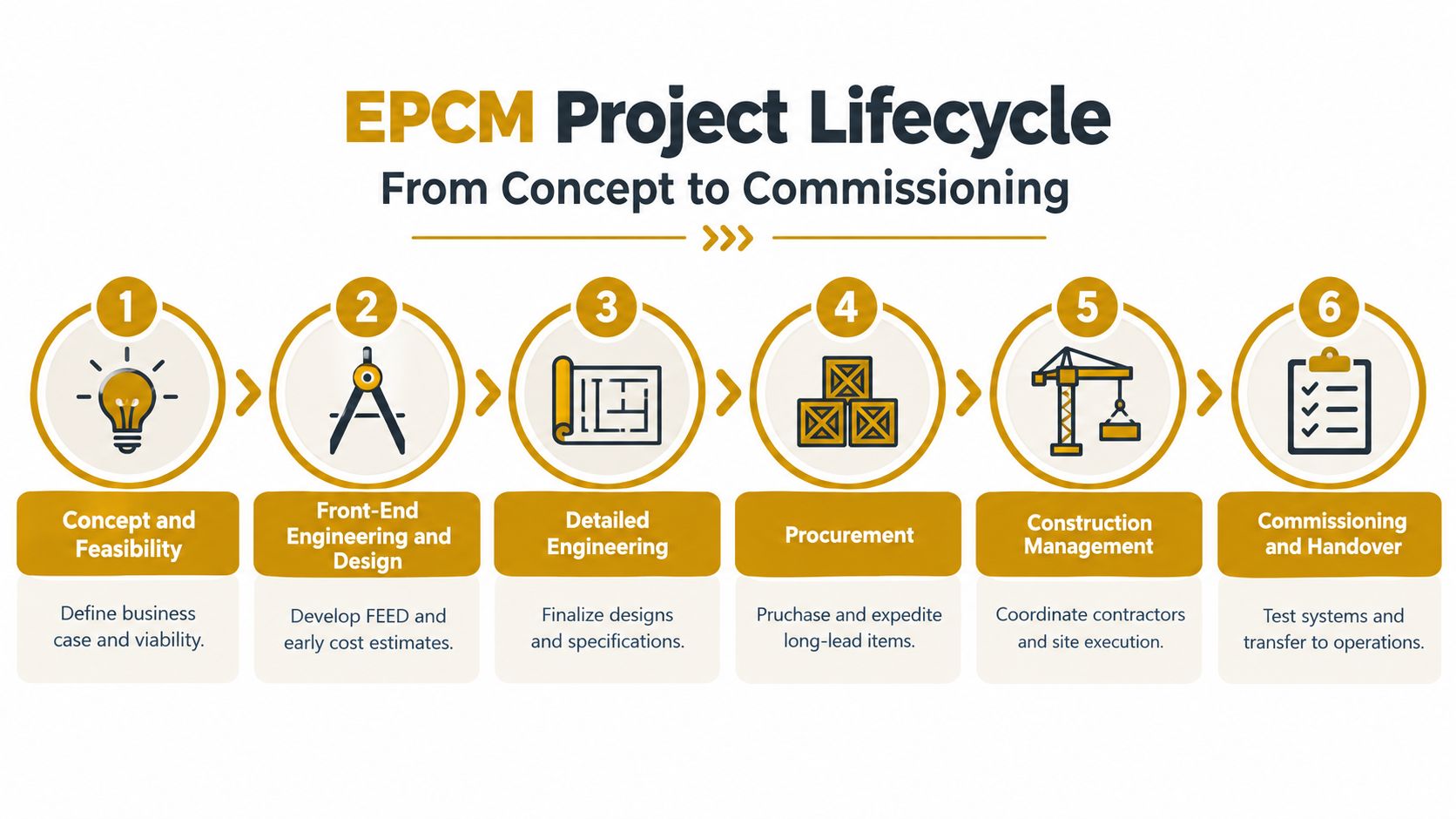
EPCM Project Lifecycle From Concept to Commissioning
EPCM project management begins before construction mobilization. Early decisions determine how the work will be packaged, what information suppliers need, and whether the site can support the planned sequence.
Concept and feasibility
At concept stage, the owner defines the business need, production objectives, site constraints, permitting path, and initial delivery assumptions. The EPCM team helps test whether the proposed facility can be engineered and delivered within the owner's commercial and operational requirements.
The output isn't a finished design. It's a decision-quality basis for moving forward, including major scope boundaries, preliminary risks, likely package interfaces, and information that must be resolved during front-end engineering and design.
Front-end engineering and design
FEED converts the concept into a more reliable technical foundation. The team develops the process arrangement, major equipment requirements, plot plan, utility assumptions, and early cost and schedule information. Owners should use this phase to identify long-lead equipment and define which decisions cannot safely remain open during construction.
A weak FEED package creates downstream uncertainty. Contractors may price different interpretations, suppliers may receive incomplete requirements, and the schedule may hide dependencies that only appear after award.
Detailed engineering
Detailed engineering turns the approved basis into drawings, specifications, calculations, material requisitions, installation requirements, inspection plans, and commissioning information. The EPCM provider coordinates discipline interfaces so that structural, mechanical, electrical, instrumentation, civil, and process packages fit together.
Design reviews should focus on constructability, procurement timing, maintainability, safety, and environmental controls, not just drawing completeness. A pipe route that works in a model may still obstruct crane access or leave no practical location for concrete washout.
Procurement and package breakdown
The team divides the work into packages that can be bid, awarded, supplied, and installed with clear boundaries. Procurement sequencing matters because a late equipment decision can affect foundations, embedded items, cable routes, lifting plans, and commissioning logic.
The execution framework referenced in the engineering, procurement, construction, and commissioning overview indicates that construction may account for roughly 80% of skilled engineering, procurement, and construction management and supervision man-hours, and about 95% of manual construction man-hours. That concentration explains why owners invest effort in package definition, procurement timing, and interface planning before field labor reaches its highest intensity.
Construction management
During construction, the EPCM provider coordinates contractors rather than replacing them. The field team aligns work permits, access, laydown, temporary facilities, inspections, quality records, safety observations, environmental measures, and turnover boundaries.
The schedule must reflect actual work fronts. If a supplier's equipment is incomplete, the contractor may need to resequence foundations, cable installation, or testing. The controls team should record the effect, assign the decision, and update the forecast rather than allowing a verbal workaround to become an undocumented change.
Commissioning and handover
Commissioning starts during design, not after construction ends. Systems need defined boundaries, inspection records, test packs, punch lists, operating procedures, training requirements, and spare-parts information.
The EPCM team coordinates turnover from separate contractors into an operating facility. That makes interface discipline especially important. Mechanical completion by one contractor doesn't automatically mean the integrated system is ready for energization or performance testing.
Roles Contracts and Risk Allocation in EPCM Delivery
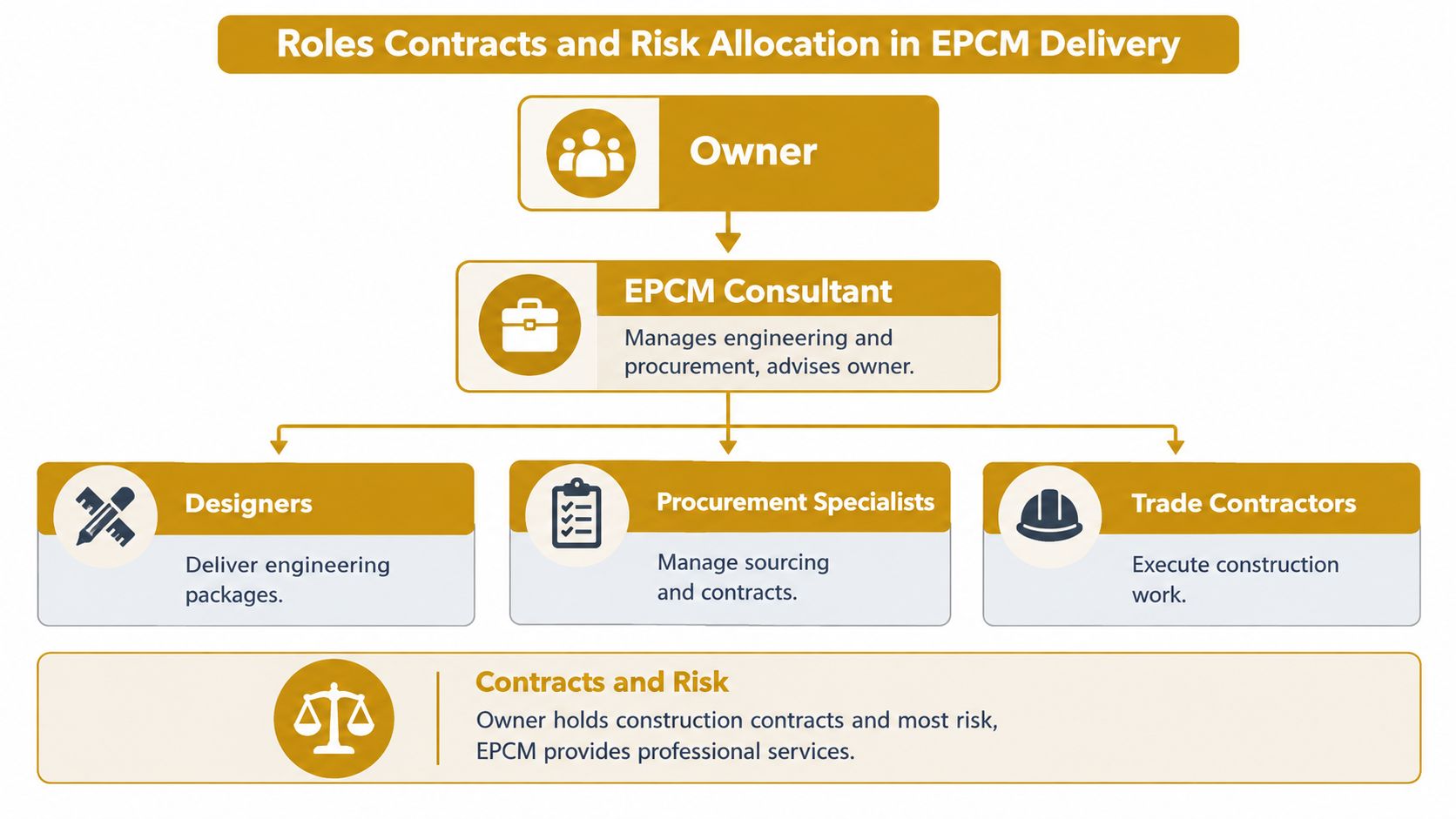
EPCM delivery is easiest to understand when responsibilities are mapped to contracts. The owner appoints the EPCM consultant for professional services, then holds direct agreements with construction contractors, equipment suppliers, and other vendors. Designers and procurement specialists may work within the EPCM organization or under separate appointments, depending on the project structure.
The owner sets objectives, approves budgets and major changes, provides funding, accepts risk, and signs the underlying contracts. The EPCM consultant coordinates the technical and delivery system. Trade contractors perform site work under their own agreements and remain responsible for their means, methods, workmanship, and defined scope.
The commercial difference
EPCM is a service agreement. The EPCM contractor manages design, procurement, and coordination but doesn't take full construction responsibility. As Freshfields notes in its discussion of the shift from EPC to EPCM, this structure can shift cost and schedule risk to the owner and make disputes more complex. The first IChemE standard-form EPCM contract, the Blue Book, was published in 2024, which also indicates that formal market conventions are still developing.
EPC places more execution responsibility with one contractor. That can simplify the owner's contract map, but it doesn't make every risk disappear. The owner still controls requirements, approvals, access, and changes, and unclear employer requirements can create disputes under either model.
| Criteria | EPCM Model | EPC Turnkey Model |
|---|---|---|
| Contract structure | Owner holds construction and supply contracts, EPCM provides professional services | One main contractor holds the turnkey delivery contract |
| Construction execution | Trade contractors perform the work directly for the owner | EPC contractor manages its subcontractors |
| Owner control | High, with direct visibility into packages and commercial decisions | Lower during execution, with a single delivery interface |
| Cost position | Actual package costs remain visible, with owner exposure to overruns | Lump-sum price offers greater predictability if scope is defined |
| Change flexibility | Generally more adaptable across separate packages | Changes may require formal variations and price adjustment |
| Risk allocation | Owner retains substantial cost, schedule, and interface risk | Contractor accepts more defined execution risk |
| Best fit | Complex, evolving, multi-package, or brownfield work | Stable, well-defined scope where turnkey accountability matters |
Contract rule: If the owner signs the trade contract, the owner must understand the risk in that contract. An EPCM provider can administer a claim without becoming the party that owes the money.
Choose EPCM when direct control, package flexibility, and technical coordination outweigh the owner's desire for a single point of execution responsibility. Choose EPC when scope certainty, financing requirements, or limited owner capability make risk transfer more valuable than open-book visibility.
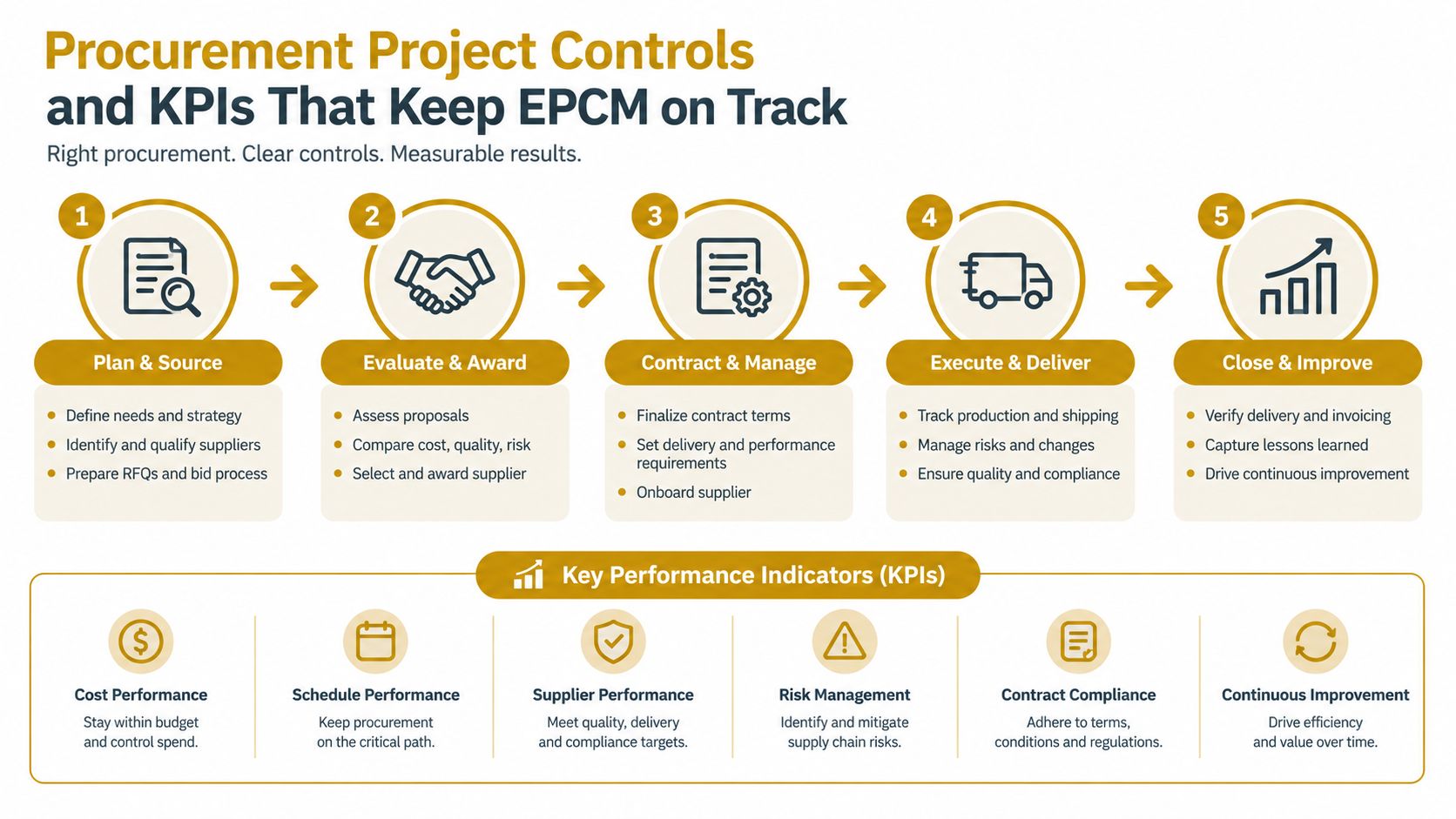
Procurement Project Controls and KPIs That Keep EPCM on Track
Project controls connect the estimate to the field. The process begins with a defensible basis of estimate and baseline information, then converts those assumptions into an integrated controls plan. PMI describes this approach to EPC project controls, including the trending of material quantities and construction cost through design and the use of proactive value engineering to keep total project cost visible.
Start with a credible baseline
The basis of estimate should state what the project includes, what it excludes, and which assumptions support the pricing. The schedule baseline should identify engineering releases, procurement milestones, fabrication, delivery, installation, testing, and turnover.
Controls become unreliable when the baseline is vague. A package may appear within budget only because quantities were never reconciled with the latest design. Likewise, a delivery date may look achievable until the team adds vendor document review, customs, inspection, transport, and site readiness.
Link procurement to construction
A procurement register should do more than show purchase-order status. It should connect each package to:
- Design maturity: Are specifications and requisitions approved for bidding?
- Commercial status: Has the contract been awarded, and are exclusions understood?
- Supplier progress: Are drawings, manufacturing, inspection, and release dates moving as planned?
- Site dependency: What foundation, access, lifting, storage, utilities, or labor must be ready?
- Commissioning need: Which documents, spares, certificates, and test records are required for turnover?
This structure exposes bottlenecks early. If a supplier is late with a drawing, the team can assess whether the issue affects fabrication, installation, or testing rather than treating every document delay as equally urgent.
Measure decisions, not just activity
Useful KPIs should show whether controls reduce coordination failures. Track design release against package need dates, procurement progress against the integrated schedule, approved and pending changes, forecast cost against the baseline, unresolved interfaces, safety actions, environmental observations, and turnover readiness.
Digital tools can help when they support decisions. Industry coverage identifies BIM, cloud project platforms, AI forecasting, drones, digital twins, and integrated project delivery among technologies changing EPCM delivery. The same coverage also points to governance and risk management for AI, persistent product teams, and value realization as important project-management concerns. Review the industry commentary on digitalization in EPCM.
A dashboard isn't proof of control. Ask whether the information causes someone to release a purchase order, resolve an interface, revise a work plan, protect a drainage inlet, or escalate a forecast. If it doesn't change a decision, it may be reporting activity rather than managing delivery.
Practical Implementation Tips and Site Level Environmental Controls
A concrete pour starts before the first truck arrives. The EPCM team must already have a released work package, an approved washout location, clear inspection responsibilities, and a disposal route. That same readiness standard applies to design changes, contractor interfaces, safety observations, and other environmental controls.
Build a package routine
For each construction package, keep a concise execution record covering scope, current drawings, prerequisites, interfaces, risks, inspections, and turnover requirements. Before work begins, confirm that the area is accessible, materials are released, permits are available, temporary works are approved, and adjacent contractors understand the sequence. The record gives the superintendent and EPCM team one shared reference at the work front.
Change control should follow a traceable path:
- Record the proposed change and its reason.
- Identify effects on design, procurement, cost, schedule, safety, quality, and the environment.
- Obtain the required technical and commercial approvals.
- Update drawings, schedules, registers, and field instructions.
- Verify closeout and retain the final record for turnover.
Treat washout as a planned work package
Concrete washout shows how high-level governance becomes a site control. Crews need a designated containment area before placement begins. Once slurry reaches a drain or spreads beside a haul road, the project is managing an incident rather than executing the planned method.
Coordinate the location with the civil contractor, environmental lead, concrete supplier, pump operator, and site logistics team. The area must be accessible to trucks and pumps, separated from drainage paths, stable under expected traffic, and positioned so inspection and compliant disposal remain practical. Put the control on the site logistics plan and include it in the concrete-pour briefing.
Use a field checklist:
- Select the location: Keep the containment area away from stormwater inlets, open drainage, traffic conflicts, and sensitive ground.
- Confirm capacity: Match the pan or container to the expected pour and servicing plan. Recheck the arrangement when pour volumes or sequencing change.
- Inspect before use: Check the liner or container for damage, confirm it sits level, and ensure access does not send trucks across unstable ground.
- Control the fill level: Assign monitoring responsibility and arrange removal or servicing before the unit is overloaded. Active pours require particular attention to overflow.
- Protect during downtime: Cover or secure the area where appropriate, especially when rain could dilute and spread contained material.
- Document disposal: Record who removes hardened material or liquid, where it goes, and which site environmental requirements apply.
Site control: A washout unit is part of the construction method, not an afterthought. Put it on the site logistics plan, the environmental inspection route, and the concrete-pour briefing.
Rental planning belongs in the same procurement register as other work-package requirements. Confirm delivery dates, access conditions, terrain, pickup requirements, and additional logistics charges before the pour. When the washout package is rented rather than built, confirm those details against the work sequence. Reborn Rentals publishes daily pricing and delivery terms that can be recorded alongside the package's procurement and servicing checks.
Choosing and Running EPCM for Successful Project Outcomes
EPCM project management is a strong fit when the project has several interdependent packages, evolving technical requirements, complex procurement, brownfield interfaces, or an owner that wants direct commercial visibility. It isn't a shortcut around responsibility. The owner must be ready to make decisions, manage contracts, fund exposure, and maintain competent technical, commercial, safety, quality, environmental, and commissioning functions.
Before appointment, test the provider against the work that will be delivered:
- Can the proposed team coordinate the relevant disciplines and trade interfaces?
- Does the contract define professional services, authority limits, deliverables, and exclusions?
- Is the package strategy aligned with long-lead equipment and construction access?
- Does the baseline show realistic scope, quantities, assumptions, and schedule logic?
- Who owns each change, claim, safety action, environmental control, and turnover item?
- Will the KPI system identify emerging failures early enough to act?
The most persistent failures begin with late scope changes and unclear interface ownership. Owners can reduce that exposure by defining decision rights early, keeping the estimate and schedule integrated, and requiring every package to connect design, procurement, construction, commissioning, and environmental obligations.
The best EPCM system is therefore not the one with the most reports. It's the one that turns a design decision into a controlled purchase, a purchase into a buildable work front, and a work front into a safe, compliant, testable system ready for operations.
For concrete work within an EPCM site plan, Reborn Rentals provides specialized washout pans and containers, delivery coordination, and clear daily rental pricing to support slurry containment and environmental control. Review the available options before your next pour, confirm site access and servicing requirements, and schedule the equipment alongside the construction package.