
Inventory Management Construction: A Practical Guide
Materials account for 60% to 65% of a construction project's total estimated cost, while inventory in the construction-related Energy, Resources & Industrials segment often remains tied up for about 50 to 60 days. That makes inventory management construction a working-capital discipline, not merely a stores or warehouse task.
On a busy jobsite, the financial consequences appear before a material is installed. A duplicate order, an unrecorded transfer, or a delayed delivery confirmation can trap cash in stock, force an emergency purchase, or leave a crew waiting on a critical item. The practical answer is a control system that connects purchasing, receiving, storage, consumption, rentals, compliance, and project scheduling.
Why Inventory Management Drives Project Profitability
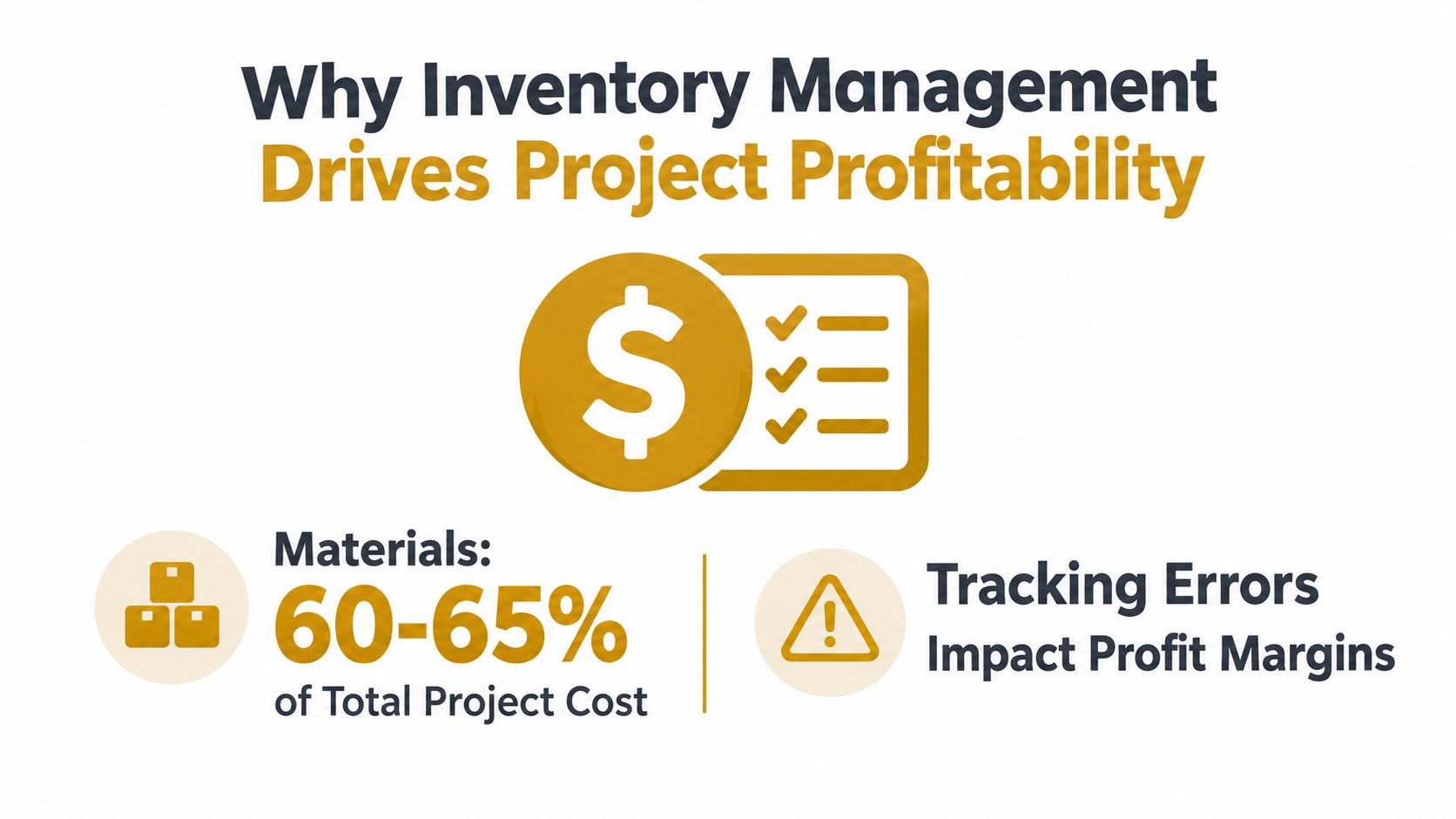
Materials represent 60% to 65% of estimated project cost, making construction inventory management a working-capital discipline, not merely a stores or warehouse task. A 2025 paper on inventory management systems in the construction trade describes construction-material inventories as the industry's largest consumer of working capital. A small control failure can therefore affect liquidity, financing decisions, and the funds available for later work.
The issue becomes clearer through Days Inventory Outstanding, or DIO. In the construction-related Energy, Resources & Industrials segment, DIO often sits at about 50 to 60 days, according to the same research. In practical terms, a contractor may fund materials well before installation creates progress value. Until stock is installed, returned, or reassigned, that cash cannot support payroll, supplier payments, equipment, or the next phase of work.
Where cash gets trapped
Over-ordering is only one source of tied-up cash. Poor location records can make usable materials appear unavailable, prompting another purchase. Delayed data entry can make a delivery look incomplete even after the supplier has dropped it at the site. A change order can also leave project-specific materials idle because nobody reassigned, returned, or redeployed them.
The financial chain is direct:
- Over-ordering: Cash leaves before the project needs the material.
- Idle stock: Materials occupy storage and remain exposed to damage, theft, or deterioration.
- Poor tracking: Teams lose confidence in records and buy defensively.
- Late reconciliation: Project managers see cost problems after the decision that created them.
- Stockouts: Crews wait, schedules move, and procurement teams resort to rushed buying.
Practical rule: Treat every material movement as a financial transaction, even when no new purchase occurs.
Why materials come first in project controls
Labor and equipment matter, but material availability often determines whether those resources can work productively. A crew can be fully staffed and an excavator ready, yet the operation still stops when the required pipe, fittings, reinforcement, or containment equipment is missing.
Accurate inventory records connect purchasing decisions, cash forecasting, cost-code allocation, and schedule coordination. They also give finance and operations a shared operating view. Operations can confirm what is physically available, while finance can see what cash is tied up and whether the project is consuming stock as planned. That visibility also supports rental coordination, including timely returns and documentation when equipment must meet project or compliance requirements.
The strongest system is not the one with the most features. It is the one that gives the superintendent, project manager, buyer, and controller the same answer about what arrived, where it is, who owns it, and when the project will consume it. That shared record protects cash flow while keeping financing decisions tied to actual site conditions.
Core Processes for Receiving and Tracking Materials
Inventory accuracy starts at the gate. If the receiving process is vague, every later report inherits the error. Assign ownership before materials arrive, with responsibility divided by site, material category, project phase, or storage zone. One person may receive deliveries, another may approve quantity, and a project manager may reconcile the purchase order, but the handoff must be explicit.
A dependable receiving routine follows a simple sequence:
- Prepare against the purchase order. The receiver checks the expected item, description, quantity, delivery date, and project allocation before unloading.
- Inspect before acceptance. Damaged packaging, incorrect specifications, shortages, or visible defects get recorded immediately.
- Identify the destination. Mark whether the material belongs to general stock, a specific project, a subcontractor, or a defined phase of work.
- Update the record at receipt. The system should show the accepted quantity, location, condition, and responsible project while the delivery is still fresh.
- Escalate exceptions. The buyer and superintendent need prompt notice when a delivery doesn't match the order.
Preventing stock commingling
Keep general stock separate from project stock. A shared yard may be convenient, but unmarked materials become vulnerable to duplicate purchasing and unauthorized consumption. Use visible zone labels, project identifiers, and consistent item descriptions. If a transfer occurs, record both the origin and destination rather than changing the quantity.
QR or barcode scans help because they replace memory with a recorded transaction. The scan should capture the item, movement, location, and project assignment. It doesn't eliminate judgment, but it creates a reliable starting point for resolving disputes with suppliers or subcontractors.
Count small and often
Infrequent full audits create a bad choice between disrupting work and accepting stale records. Small-cycle counts are more practical for active sites. Count high-value, fast-moving, or schedule-critical materials more frequently, then investigate variances while the cause is still identifiable.
A superintendent who updates a delivery from a tablet as it arrives has a different operating picture from one who keeps notes until the end of the week. In the first case, the foreman can see the available stock, the buyer can confirm the receipt, and the project manager can compare consumption with the schedule. In the second, several deliveries, transfers, and partial uses may have blended together.
The construction inventory management guide from BoxHero recommends clear ownership, immediate record updates, separated stock zones, scanning, and frequent small-cycle counts. Those practices work because they place control at the moment an error is created, not after the project team has to reconstruct events.
Choosing Between Spreadsheets, QR Tagging, and Software
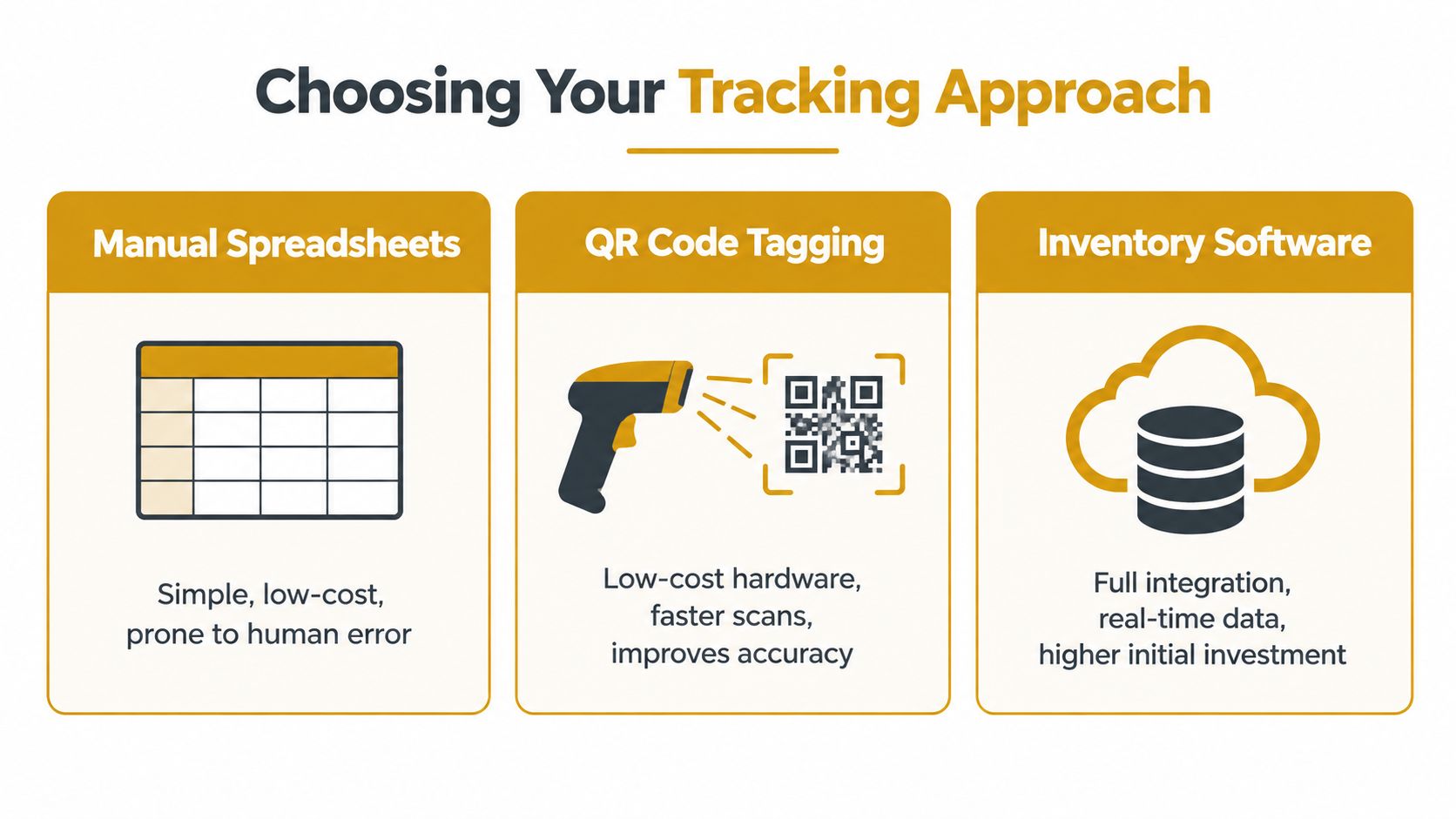
The right tracking method depends on material movement, financial risk, and coordination demands. A spreadsheet can serve a small, stable operation with one storage location and limited material variety. It becomes fragile when several jobs draw from shared stock, subcontractors handle transfers, or change orders alter the demand plan. The choice affects more than recordkeeping. It determines how quickly the team can protect cash tied up in materials, support project financing decisions, and explain cost variance.
A 2026 survey of 108 construction and trade operators found that 86% still tracked inventory in spreadsheets, 35% used pen and paper, and only about one in five used dedicated inventory software. The same source reports that 81% managed inventory without dedicated software, while 52% identified inventory accuracy as their biggest improvement area and 61% ranked improving it as their top priority. The figures describe a sector still shifting from manual control toward connected tracking.
Manual spreadsheets
Spreadsheets are easy to start and inexpensive to maintain. They can work when one person owns the file, updates happen consistently, and the inventory boundary stays clear.
Their weakness is coordination. Multiple versions can circulate, mobile updates may be delayed, and a formula cannot show whether material was damaged, moved to another site, or consumed without a record. Spreadsheets also make accountability difficult when several people edit or verbally override the same entry.
Use a spreadsheet as a controlled register, not as proof that physical stock remains unchanged. Set an owner, lock formulas, define required fields, and reconcile the file against planned purchasing and project cost records. That discipline matters when excess material ties up cash or an unexplained shortage threatens a funded work package.
QR and barcode tagging
QR or barcode tagging gives each material or storage location a physical identity. A field worker can scan an item during receipt, transfer, issue, return, or count, reducing rekeying and improving update timing.
This approach suits contractors who need better visibility without adopting a full enterprise platform. It still requires disciplined naming, reliable connectivity or an offline process, and clear rules for damaged, split, or partially consumed materials. A scan cannot correct an ambiguous description or an unassigned project.
Dedicated inventory software
Dedicated software makes more sense when the business needs centralized dashboards, automatic low-stock alerts, multi-location tracking, and links to procurement or project schedules. Buyers gain a shared view across jobs instead of forcing each site to operate as an island. That visibility can support purchasing decisions, reduce unnecessary stock commitments, and give finance a clearer basis for forecasting cash needs.
The trade-off is implementation effort. Teams need clean item records, user permissions, training, and a process for exceptions. Buying software before defining ownership usually digitizes confusion rather than solving it.
| Approach | Best fit | Main strength | Main risk |
|---|---|---|---|
| Spreadsheet | Stable, low-complexity stock | Fast to deploy | Delayed or inconsistent updates |
| QR or barcode tagging | Mobile sites needing faster transactions | Physical scans improve traceability | Requires disciplined item setup |
| Inventory software | Multi-site operations with active procurement | Centralized visibility and alerts | Higher implementation demand |
The construction materials inventory guidance from CCLS identifies delayed data entry, manual logs, and missing reorder thresholds as common failure modes. Its recommended controls, centralized dashboards, low-stock alerts, and schedule-linked procurement, should guide the choice of tool. Do not buy a platform to look modern. Buy or build the control that the current process cannot reliably perform. A simple register with clear ownership may protect cash better than an expensive system no one updates.
Coordinating Rentals and Delivery Scheduling
Purchased materials aren't the only inventory that can disrupt a job. Rented equipment and temporary containment supplies also have a cost, location, delivery window, condition, and return requirement. If a rental arrives too early, it consumes scarce site space. If it arrives too late, the crew may be unable to begin work or may create a compliance exposure.
Concrete washout containers are a useful example. The project team needs to coordinate the pour schedule, available access, container capacity, placement, pickup timing, and any site restrictions. The rental should appear in the same operational plan as formwork, concrete deliveries, pumps, and cleanup responsibilities, even though it isn't a permanent asset.

Build the rental record before the pour
A useful rental record answers five questions:
- What is required? Specify the container or equipment type, dimensions, capacity, and intended use.
- When is it needed? Tie delivery to the confirmed pour window rather than a vague project date.
- Where will it go? Identify a stable, accessible location that doesn't interfere with trucks, workers, or emergency routes.
- Who owns the handoff? Name the person responsible for receiving, inspecting, and confirming placement.
- How will pickup work? Record the expected removal trigger, contact method, and site access requirements.
The Reborn Rentals catalog demonstrates the kind of detail a contractor should confirm with any rental partner, including item specifications, dates, locations, delivery arrangements, and pricing notes. A team can use the provider's checkout process to organize the request, then verify rough-terrain, express-order, or delivery conditions before approval.
Coordinate through one accountable channel
The failure I see most often isn't a lack of effort. It's fragmented communication. The superintendent tells the pump operator, the office emails the rental company, and a foreman assumes someone else confirmed pickup. Use one order record and identify the person who will close each step.
For urgent work, confirm availability and delivery timing directly through the provider's available channels. Record the confirmation in the project log, including any surcharge or access note. That record protects the budget and prevents the crew from treating an informal promise as a scheduled delivery.
A rental also supports compliance when the site team places, monitors, and removes it correctly. The container should be included in the daily site check, not treated as a separate vendor matter. Good inventory coordination keeps the item available, the work zone orderly, and the cleanup responsibility visible.
KPIs, Compliance, and Jobsite Checklists
A tracking system earns its place when it changes a purchasing, scheduling, or financing decision. The strongest construction inventory KPIs connect physical control with cash flow, project progress, and site performance. Track inventory accuracy, stockout frequency, emergency purchase rate, equipment utilization, and maintenance cost per operating hour, as outlined in construction materials inventory control guidance.
A variance does not automatically mean the warehouse team failed. It may result from an incorrect unit of measure, a subcontractor issue, damage, an unposted transfer, or a project change that bypassed procurement. The KPI shows the symptom. The investigation identifies the control that needs repair and the cost exposure that follows.
Use KPIs to trigger action
A useful dashboard answers operational questions instead of displaying numbers without a response plan.
- Inventory accuracy: Which categories or storage locations repeatedly disagree with physical counts?
- Stockout frequency: Which materials stop work or create avoidable purchasing pressure?
- Emergency purchase rate: Which buying decisions bypass normal planning, and what caused them?
- Equipment utilization: Which rented or owned assets remain idle while rental, ownership, or financing costs continue?
- Maintenance cost per operating hour: Which equipment requires maintenance, replacement, or a change in utilization?
Set reorder thresholds around actual project requirements, supplier lead times, storage limits, and schedule risk. A generic minimum quantity can leave one project carrying excess stock while another still runs short. Connect alerts to the project schedule where possible, then require a person to review the need before an automatic order creates a financial commitment.
Add compliance to the same routine
Sustainability and regulatory requirements make inventory control broader than cost reduction. Recent literature identifies supply shocks, price volatility, waste, and regulatory obligations as continuing construction challenges, while research on digital tracking and construction inventory reports that 17.36% of construction projects are delayed by more than three months because of material shortages and 35% of construction-material inventory is miscounted because of human error.
Those findings support records that serve production, payment review, and accountability. Keep delivery confirmations, damage reports, transfer records, waste documentation, rental details, and cleanup checks in a retrievable project file. For concrete work, inspect and manage containment supplies as part of the environmental control process, not as a separate vendor task.
Run this jobsite checklist
At receiving
- Confirm the purchase order, item description, quantity, and project assignment.
- Inspect for damage and record exceptions before acceptance.
- Mark the storage zone and update the inventory record immediately.
During movement and use
- Scan or record every transfer, issue, return, and partial consumption.
- Separate general stock from project-specific materials.
- Perform targeted cycle counts on critical or fast-moving items.
- Review low-stock alerts against the current schedule before ordering.
For rentals and compliance
- Confirm specifications, capacity, access, delivery timing, and pickup responsibility.
- Include rented equipment and containment supplies in daily site inspections.
- Record damage, cleaning, waste handling, and disposal evidence.
- Close the rental record only after pickup or return is confirmed.
At project closeout
- Reconcile remaining stock against the project record.
- Decide what to return, transfer, reuse, or dispose of.
- Capture lessons from shortages, emergency purchases, and recurring variances.
The 2024 review of construction inventory challenges connects poor inventory practice with delays, scrap waste, and missed compliance obligations. A combined KPI and checklist routine addresses these risks together. It gives project leaders a financial view of stock, field teams a clear view of availability, and the business an evidence trail for responsible site management. That visibility also supports financing decisions by showing whether cash is tied up in usable materials, idle equipment, or unresolved losses.