
Equipment Rental for Construction: Washout Guide
A concrete crew is halfway through a pour when someone notices the washout setup has become a liability. The only available option is a shallow trench with a torn tarp, positioned too close to a storm drain and already collecting slurry. Trucks are waiting, the ground is muddy, and an inspection is scheduled for the next morning. In that moment, equipment rental for construction isn't about finding another excavator or lift. It's about getting specialized containment on site before a preventable cleanup problem becomes a compliance event.
Concrete washout is easy to overlook because it sits at the edge of the operation. Yet the wash water and solids can contain caustic slurry that migrates into soil, groundwater, or stormwater systems when containment fails. The EPA concrete washout guidance says the objective is to retain 100% of concrete washout water and solids, with containers placed near the pour area for convenient truck access.
A properly selected rental pan or containment bin gives the superintendent a controlled place for truck chutes, pumps, tools, and residual concrete. It also creates a clearer inspection story: the unit is sealed, accessible, sized for the work, and included in the site's stormwater controls. The sections below focus on the details that determine whether that rental works in the field.
Concrete Washout Failures on the Job Site
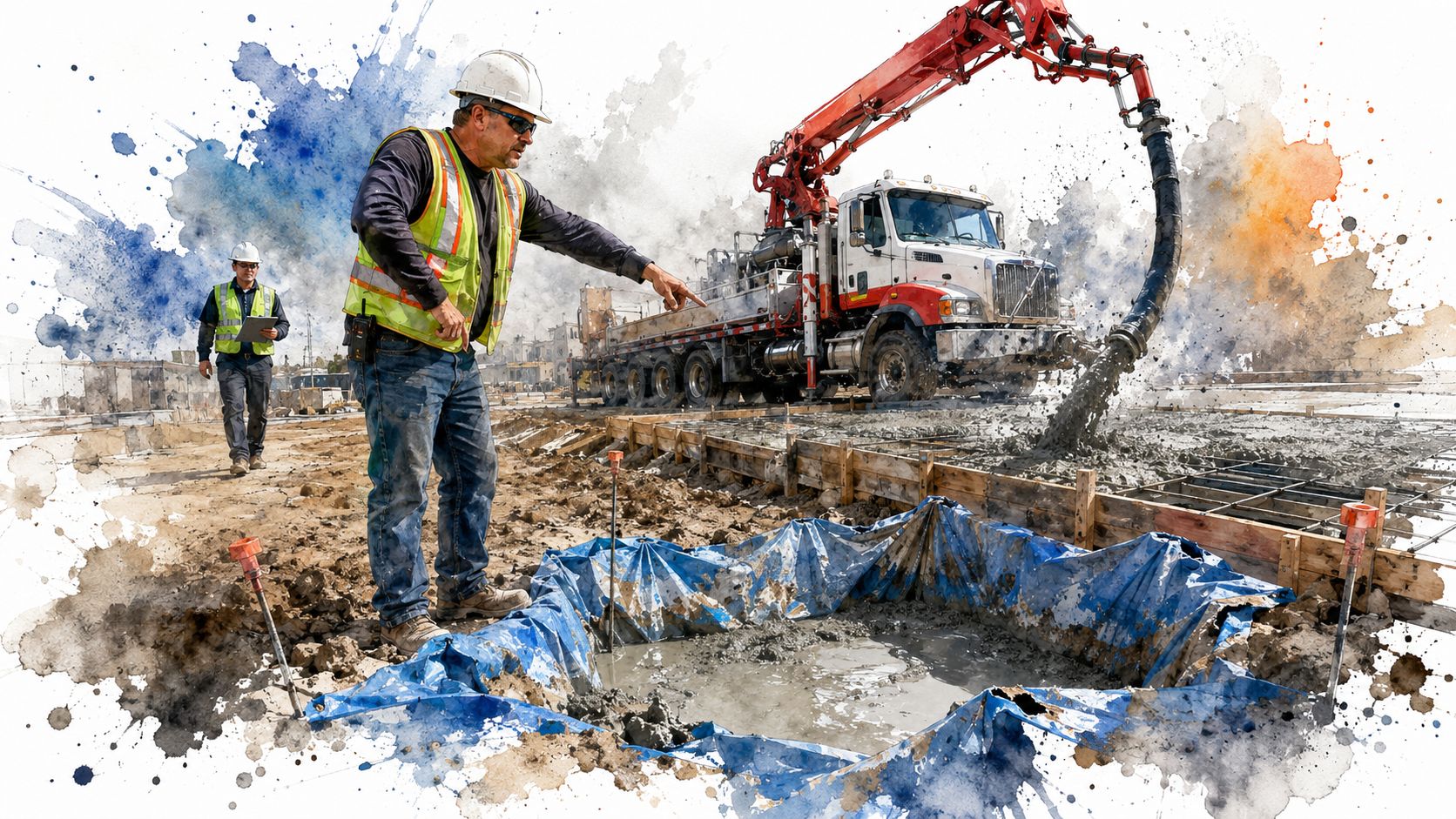
The first ready-mix truck is discharging at a mixed-use development in a tight urban corridor. The pump is cycling smoothly, the finishing crew is moving fast, and the superintendent finds a shallow trench lined with a torn tarp. Wet concrete has folded the tarp inward, the edges are unsecured, and a nearby inlet gives slurry a direct route off the site.
The SWPPP inspector arrives the next morning. With the local stormwater authority already watching concrete discharges closely, the superintendent has little time to correct the setup without interrupting the pour. Finding a rental pan, arranging delivery through muddy access, and placing it where trucks can reach it becomes part of concrete production, not an afterthought.
Why makeshift containment fails
A tarp spread over soil has predictable failure points. Forklifts, boots, truck tires, rebar, and aggregate can puncture it. Folds let slurry escape, while a shallow excavation provides little capacity when rain adds water or several trucks wash out in the same location.
Placement can defeat good equipment. Put a washout unit behind the building or beyond the truck chutes, and drivers may rinse wherever access is easier. A sound pan in an unsafe or inconvenient location still becomes a compliance problem because crews will avoid equipment that takes too long to reach.
Field rule: Place washout where drivers can reach it without crossing active traffic paths, stormwater flow routes, or unstable ground.
Rental as a control measure
Washout pans, bins, liners, lids, and portable containment systems are specialized construction rentals. General contractors often do not keep them in their yards because these bulky, single-purpose items require cleaning, inspection, transport, and disposal planning after the pour.
The rental decision also carries logistics that a daily rate may hide. Confirm the unit's capacity, delivery access, ground conditions, placement method, service needs, and pickup terms before the truck arrives. A unit that cannot be unloaded safely or serviced without moving traffic is not a practical control.
A rental provider can replace an improvised hole with a purpose-built containment point on a planned schedule. The superintendent still owns the field decisions, including placement and crew access, but the site gains equipment that can be documented for the SWPPP file and used consistently during the pour. That reduces the chance of an avoidable discharge, emergency cleanup, or inspection finding becoming part of the project record.
Why Equipment Rental for Construction Is the New Standard
Construction rental has moved from occasional backup support to a mainstream procurement model. Market forecasts place the global construction equipment rental market in the low-to-mid hundreds of billions of U.S. dollars. One Fact.MR market forecast estimates US$131.2 billion in 2024 and projects US$201.81 billion by 2034, a 4.4% compound annual growth rate over that period. A separate outlook estimates USD 132.77 billion in 2024 and USD 175.40 billion by 2030, at a 4.75% CAGR, reflecting different market definitions and boundaries.
Contractors rent because ownership ties up capital in equipment that may sit idle between phases. They also avoid storing every machine, carrying the full maintenance burden, and guessing which technology or attachment will remain useful as project requirements change. Rental gives a project manager access to the right tool for the current scope without making the balance sheet carry every future possibility.
The North American market shows how established that model has become. Reporting on the U.S. construction equipment rental market places the 100 largest North American rental firms at US$43.6 billion in revenue in 2024. The same source describes a broader market projected to grow 5.7% in 2025 to nearly US$82.6 billion, following US$78.2 billion in the prior year.
Specialized gear has a different ownership equation
Concrete washout containment is an especially strong rental candidate. A contractor may need it for a concentrated pour, a short renovation, or a project phase that won't repeat for months. After use, the unit still needs to be emptied, cleaned, inspected for cracks, stored, and moved to the next site.
Ownership also leaves the contractor responsible for keeping the unit suitable for local requirements. A cracked liner, damaged corner, missing lid, or poorly documented cleaning history can undermine the setup when an inspector asks how the containment was maintained. Rental doesn't remove the contractor's duty to use the equipment correctly, but it can shift much of the asset management burden to a supplier.
| Factor | Ownership | Rental |
|---|---|---|
| Capital | Funds remain tied up in a single-purpose asset | Cost follows the project need |
| Storage | Requires secure yard or warehouse space | Supplier stores the unit between jobs |
| Maintenance | Contractor handles cleaning, repairs, and liner replacement | Supplier manages readiness and condition |
| Compliance risk | Contractor must track suitability and documentation | Contractor receives a specified unit and rental records |
| Logistics | Contractor arranges internal transport and placement | Delivery and pickup can be coordinated with the rental order |
| Flexibility | Size is limited to what the contractor owns | Unit size can change with the pour |
The broader shift is documented in construction equipment rental market analysis, which describes demand moving toward flexible and specialized access rather than ownership replacement alone. For washout containment, rental functions as a risk-transfer mechanism. The superintendent can focus on truck sequencing, access, and placement instead of warehousing a rarely used bin.
Sizing and Selecting the Right Washout Containment
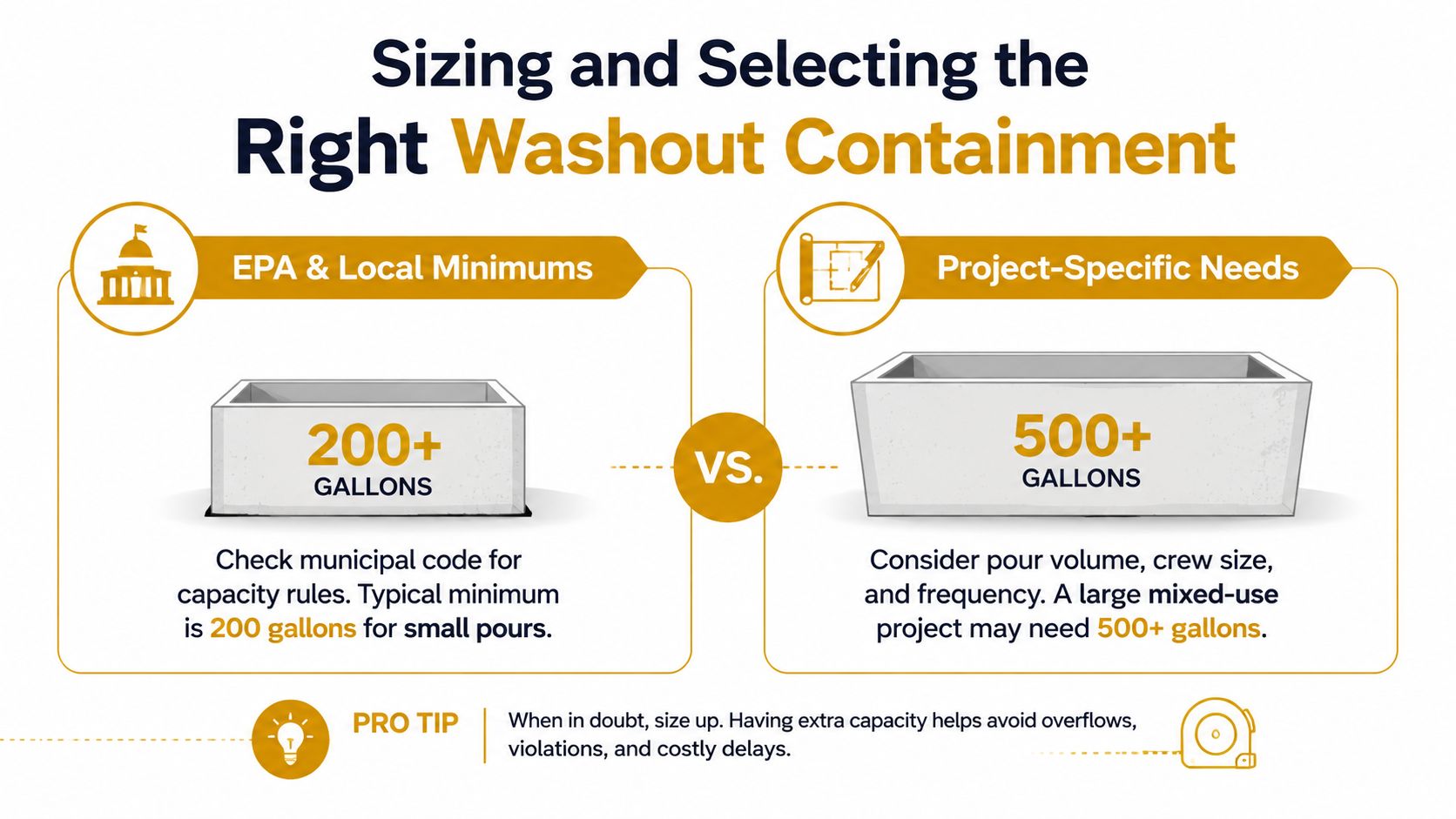
Start with the rules that apply to the site, then size for the work that will happen. A municipal standard from Denton requires at least 6 cubic feet of containment for every 10 cubic yards poured, while EPA guidance says the container should be checked when it exceeds 75% capacity and emptied before overflow, especially when rain is expected. Review the Denton concrete waste management standard alongside the project's permit and local stormwater requirements.
The most reliable sizing process is operational:
- List the scheduled trucks and pour sequence. Include pump washout, returned loads, chute rinsing, and any delay that could cause several trucks to use the unit before service.
- Estimate the slurry and solids volume. Don't size only for the concrete left in a chute. Water used for rinsing and rain entering an uncovered unit can materially change the containment load.
- Add working room. A container that reaches its limit before the final truck arrives creates an immediate field problem. The EPA's 75% inspection threshold is a useful operating trigger, not permission to keep filling the unit.
- Check the placement footprint. A large bin that blocks truck access or sits in a drainage path isn't a solution. Confirm level ground, stable bearing, hose reach, and a route for pickup.
Match the unit to the pour
A small polyethylene pan can work for light residential placement when the crew can monitor it and the site has straightforward access. Commercial pours need more structural margin, especially where pump lines, repeated truck returns, heavy washout, or rough travel routes are involved. Steel-reinforced bins are generally better suited to demanding conditions because they tolerate handling and loading forces that can damage a light pan.
Don't choose by footprint alone. Ask the supplier for liquid capacity, solids capacity, liner details, load limits, and placement requirements. A unit that's wide but shallow may have less useful working capacity than a deeper container with a smaller footprint.
Positioning matters as much as volume
The container should be close enough that drivers can use it without improvising, but it must stay clear of storm drains, ditches, waterways, and active runoff channels. Where a project has several separated pour zones, use the site plan and truck routes to determine whether one central unit is practical or whether multiple units reduce misuse.
Sizing decision: The correct unit is the smallest one that safely handles the planned washout with operating margin, not the cheapest pan listed on a rental page.
Undersizing leads to overflow, emergency pumping, contaminated soil, and a preventable SWPPP violation. Oversizing can create delivery and placement problems, so confirm the actual truck access route before committing to a roll-off-style unit.
The True Cost of Renting Versus Ad Hoc Cleanup
The daily rental price is only one line in the decision. A proper comparison includes delivery, pickup, cleaning terms, terrain, labor, disposal, water use, and the consequences of a failed containment setup. A tarp may appear cheaper until a laborer has to build a box, secure it, dismantle it, shovel hardened concrete, and clean the surrounding ground.
Ad hoc methods also produce inconsistent results. Plywood can bow or leak at joints, plastic sheeting can tear, and hose-down cleanup can move slurry farther across the site instead of containing it. The EPA washout guidance specifically frames containment around retaining all wash water and solids, so a method that depends on the crew catching leaks after they occur is already the wrong control.
A practical cost model
For a mid-size commercial pour, the rental side typically includes the quoted unit charge, delivery, pickup, and any agreed cleaning or disposal service. The improvised side may include materials, setup labor, dismantling labor, water, sludge handling, replacement tarps, and cleanup around the failed area.
| Cost Factor | Rented Washout Pan | Ad Hoc / Tarp Method |
|---|---|---|
| Initial setup | Quoted unit and delivery | Materials, labor, and improvised construction |
| Placement | Supplier can plan access and handling | Crew creates a location with available site materials |
| Leak control | Sealed, impervious design when properly selected | Depends on tarp condition, seams, and ground preparation |
| Cleanup | Terms are defined before pickup | Crew handles hardened residue and surrounding soil |
| Disposal | May be included or separately quoted | Contractor coordinates solids and contaminated material |
| Schedule exposure | Lower when delivered before the pour | Higher if the setup fails or needs rebuilding |
| Compliance record | Rental agreement and delivery record support documentation | Evidence depends on photos, field notes, and material condition |
A single enforcement event can erase any apparent saving. The supplied data doesn't establish a universal fine amount, so don't budget around a made-up penalty figure. Instead, price the exposure: a halted pour, corrective excavation, consultant time, disposal, owner notification, and possible enforcement under the applicable permit and local rules.
The overlooked cost is interruption
Concrete work runs on coordination. If an inspector or superintendent stops the operation because washout is overflowing or discharging toward a drain, trucks may wait, finishers lose their sequence, and the crew may need to remobilize. Those costs are project-specific, but they can exceed the rental invoice quickly.
The 2026 State of Rental Report describes a more price-sensitive rental environment, with U.S. equipment rental growth projected at 3.3% in 2025 and 2.3% in 2026, while Canada's growth is projected at 0.6% in 2026. That makes quote discipline important, but low headline pricing shouldn't push the site toward a weak containment method. The right question is whether the rental removes labor, delay, and compliance uncertainty from the pour.
Navigating Delivery Logistics and Hidden Fees
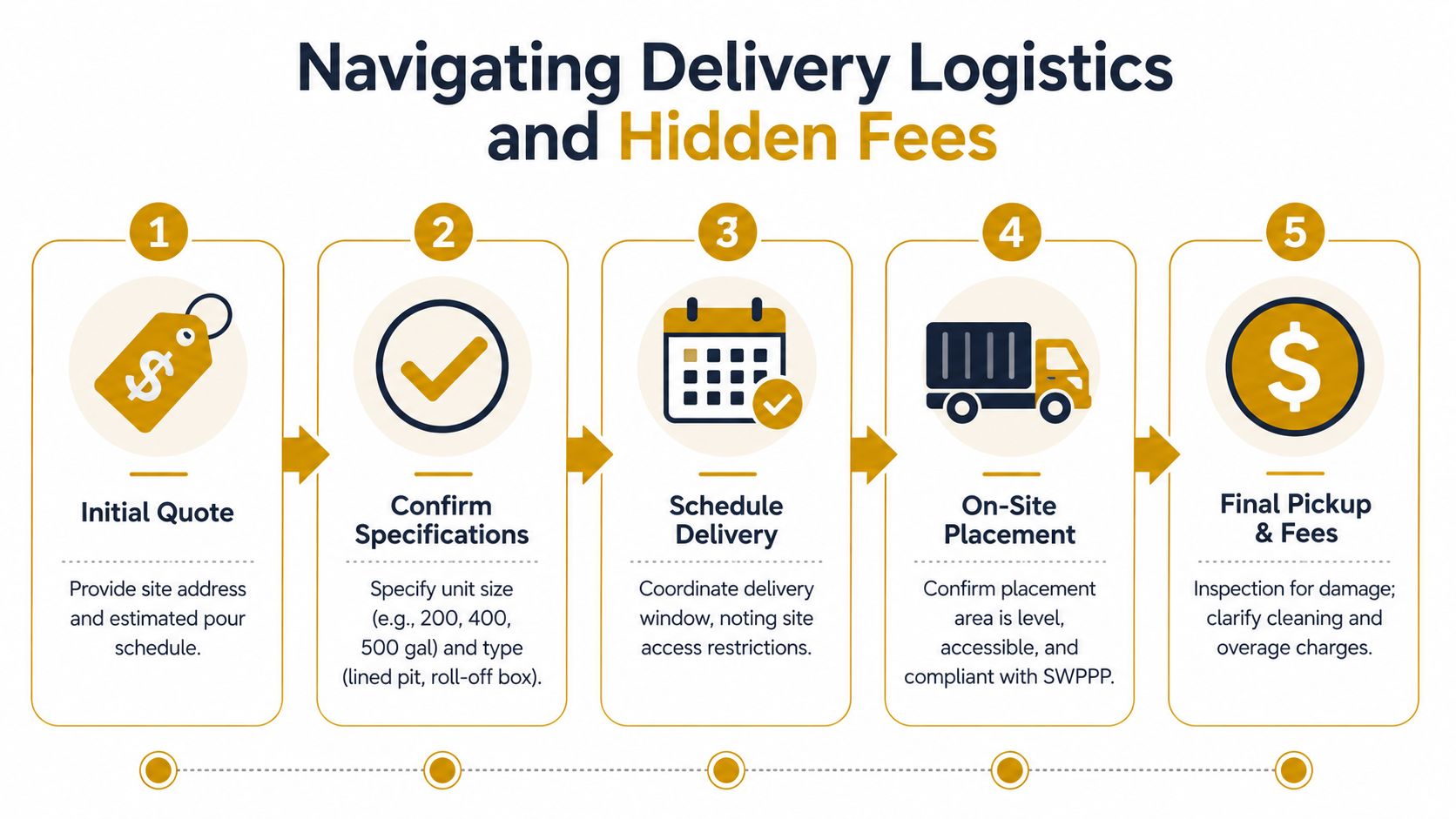
A washout rental can fail before it reaches the job if the supplier doesn't know what the site is like. Give the rental desk the address, delivery window, pour area, surface condition, access restrictions, required unit size, and the equipment available for placement. A pan that can be unloaded from a truck is a different logistics problem from a heavy bin that needs a forklift, telehandler, or crane.
Start the quote with the complete movement plan. Ask where the delivery vehicle will stop, whether it can turn around, how far the unit must travel to the pour, and whether muddy or unpaved ground changes the rate. On a constrained urban project, the placement path may matter more than the rental rate.
Ask for the invoice before the truck arrives
The common extras are predictable, but they still catch crews off guard:
- Terrain charges: Mud, loose fill, steep grades, or unpaved access may require different delivery equipment or extra handling.
- Express service: Same-day, weekend, or after-hours delivery can carry a premium, particularly during an active pour schedule.
- Mileage and fuel: Remote sites may incur travel-related charges that aren't obvious in the base unit price.
- Weight or overage: A unit returned with excessive solids or beyond its handling limit may require special loading or disposal.
- Cleaning and disposal: Clarify whether the rental includes cleaning, whether hardened concrete is treated separately, and who owns the waste after pickup.
Put each item in writing. For a project with repeated pours, ask for bundled delivery and pickup pricing rather than negotiating every dispatch separately. Suppliers may also be able to coordinate a longer rental window, which reduces the risk of paying for emergency swaps when the schedule moves.
Inspect the delivery
Before signing the receipt, check the pan or bin for cracks, punctures, warped edges, damaged fittings, and missing liners or lids. Photograph the unit from several angles, record the condition on the delivery ticket, and confirm the capacity matches the order.
If the unit arrives damaged or undersized, don't fill it while waiting for a decision. Call the supplier immediately, send the photos, and request a documented swap. Also tell the supplier exactly where the replacement must go. A replacement that arrives at the gate but can't reach the washout location still leaves the superintendent exposed.
Meeting EPA Standards and SWPPP Compliance
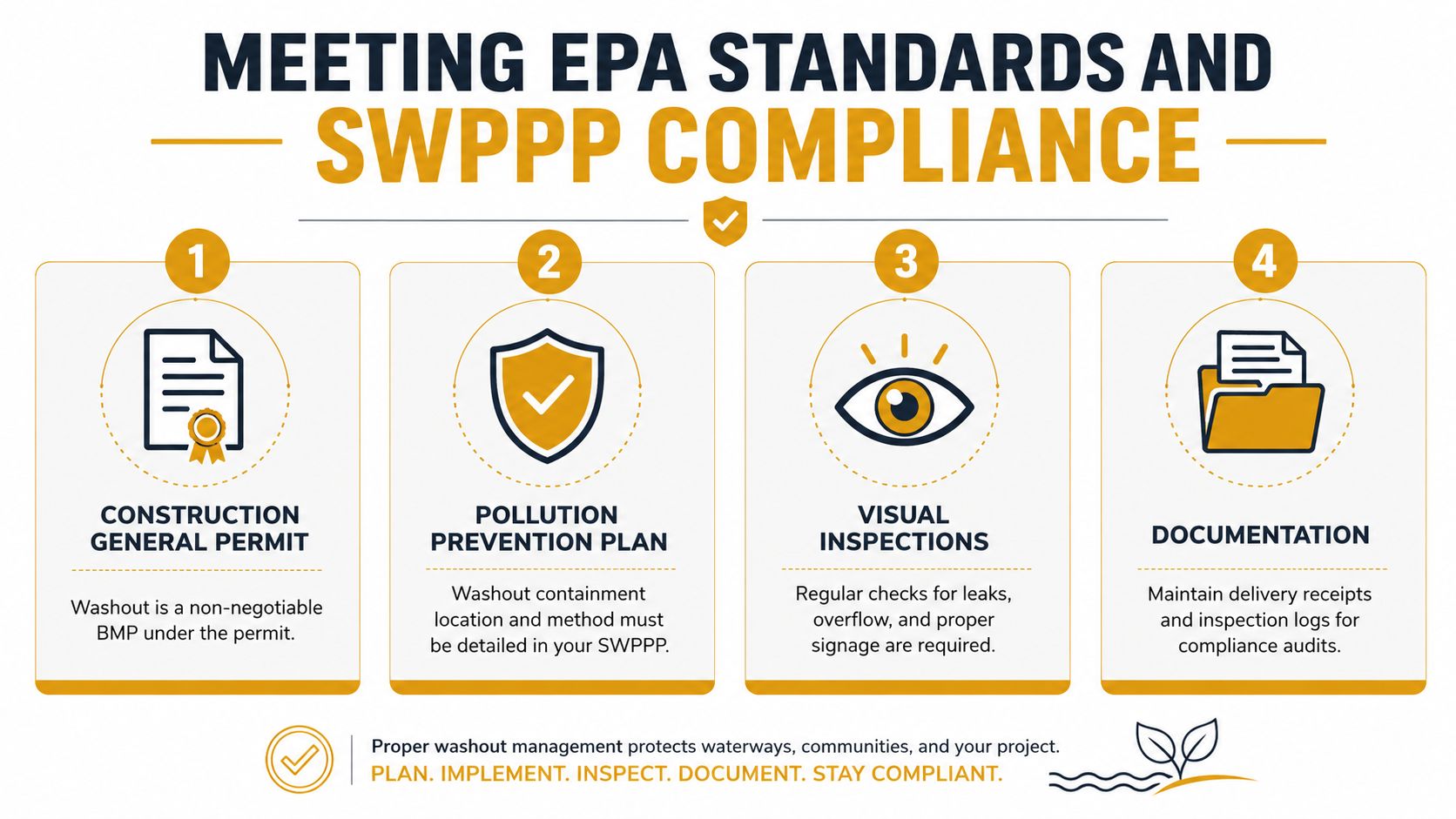
Treat washout containment as a required best management practice from the start of the pour plan. The EPA standard, cited earlier, applies only when the contractor places, monitors, and services the rental unit correctly. A container sitting beside the work area does not protect the project if trucks cannot reach it or runoff can bypass it.
The SWPPP should identify the washout location and method before concrete arrives. Inspectors typically check the containment setup, placement, access, drainage controls, and inspection records. Local requirements may also specify signage, secondary containment, inspection frequency, liners, or disposal procedures. Use the approved plan and instructions from the local authority as the controlling documents.
Build the setup around inspection questions
A practical inspection file should answer these questions without relying on text messages or someone's memory:
- What equipment was delivered? Retain the rental agreement and delivery ticket.
- Where was it placed? Save a site photo showing the unit, access route, and nearby drainage controls.
- Was it sound? Record condition checks, damage reports, and any repair or swap request.
- Was it monitored? Log routine checks, service calls, and emptying before the unit overflowed.
- Where did the waste go? Keep the disposal or pickup records required by the project and jurisdiction.
Documentation protects the project
Photos do not replace a compliant setup. They show that the field team addressed the control deliberately and provide a record if conditions change after delivery. Photograph the containment area during setup, after major weather, and whenever the unit is moved or serviced.
Assign responsibility before the pour. The superintendent, SWPPP consultant, and environmental manager should agree on who inspects the unit, who requests service, and who archives the records. That handoff matters on busy sites, where a full unit can remain unnoticed after the crew changes.
Organized records also support owner questions and permit reviews. They show that the contractor used a planned control rather than relying on a tarp and verbal instructions. Keep the rental ticket, inspection notes, photographs, service records, and disposal documentation together.
Inspection standard: If a new foreman cannot locate the washout, understand its operating limits, and find its service record, the control is not ready for a busy site.
Your Pre-Pour Washout Readiness Checklist
Run this checklist before the first truck arrives. Save it with the daily pour records or on the tablet used for SWPPP inspections.
- Confirm the rental order: Verify the unit type, capacity, delivery date, pickup terms, cleaning rules, and any terrain or express charges.
- Inspect the delivered equipment: Photograph the pan or bin and record cracks, punctures, missing liners, or damaged edges before use.
- Verify placement: Set the unit on stable, reasonably level ground, away from storm drains, ditches, waterways, and active runoff paths.
- Check truck access: Have a driver or pump operator confirm that chutes and hoses can reach the unit without unsafe maneuvering.
- Validate capacity: Compare the unit's working capacity with the day's trucks, pump washout, expected solids, and weather conditions.
- Set the monitoring trigger: Use the EPA's 75% capacity check point and arrange emptying before overflow, particularly when rain is forecast, as described in the EPA washout document.
- Secure the containment system: Confirm liners, lids, berms, and edges are intact and won't fold or shift under use.
- Post clear instructions: Tell every concrete driver and pump operator where to wash out and prohibit discharge elsewhere.
- Stage response supplies: Keep spill response materials and the contact information for the rental provider and waste hauler where the crew can reach them.
- Complete the records: File the rental agreement, delivery ticket, placement photos, inspection notes, service calls, and pickup documentation.
Recheck the setup when the pour sequence changes. A unit that was adequate for the morning plan may not remain adequate after added trucks, pump work, rain, or a delayed pickup.
Reborn Rentals provides concrete washout pans and containers for construction and renovation projects, with delivery coordination and upfront daily pricing starting at $25 per day described on its site. Review the available options and logistics through Reborn Rentals, then confirm capacity, access conditions, delivery charges, and pickup requirements before your next pour.

