
Flat Rate Dumpster Rental: What It Really Costs in 2026
The foreman radios the office: “What's the dumpster going to cost for next week's slab pour?” The dispatcher gives one clean number, and the job gets booked. Then the concrete arrives, the washout gets heavy, the truck can't reach the planned pad, and the final invoice includes overage, terrain, fuel, or extra-day charges nobody discussed.
That's the problem with treating a flat rate dumpster rental as a guaranteed final price. The quoted amount is useful, but it's only reliable when the debris type, weight, rental period, delivery conditions, and pickup terms match the order. A contractor who checks those line items before signing can budget confidently. One who doesn't may discover that a “flat” quote was a bundle of assumptions.
What Flat Rate Dumpster Rental Actually Means
A flat-rate dumpster quote is a single bundled price for a defined service. It commonly includes the container, delivery, pickup, disposal or landfill fees, taxes, a rental period, and an agreed weight allowance. Current U.S. pricing benchmarks describe the national average for a standard residential dumpster rental at about $385 in 2026, with many homeowners paying roughly $294 to $480. Another benchmark places a typical 10- to 20-yard rental at $225 to $700 for a 7- to 10-day period, averaging about $386.
That bundled structure removes the uncertainty of watching a daily rental meter. You know the base charge before the container arrives, and the hauler can quote transportation and disposal as one package instead of making you calculate every service component separately.
The word flat has limits, though. It doesn't mean unlimited weight, unlimited time, unlimited access, or unlimited material types. The quote usually applies only if the load stays within the included tonnage, the dumpster remains on site for the agreed period, and the debris complies with the provider's accepted-material rules.
What the quoted amount normally covers
A dispatcher should be able to identify each included item without relying on vague language such as “all-inclusive.” Ask for these details:
- Container service: The size of the roll-off, delivery, and scheduled pickup.
- Disposal handling: The landfill, transfer-station, or disposal charge included in the quote.
- Rental window: The start date, end date, and process for requesting additional time.
- Weight allowance: The number of tons included before an overage charge applies.
- Accepted debris: The waste category that matches the quoted disposal rate.
The headline amount becomes the starting point for the invoice when the crew exceeds any of those boundaries. Heavy materials can reach the weight cap while the container still has plenty of physical space, and a difficult drop zone can create a delivery charge even when the rental period and tonnage are correct.
The sentence to repeat to the dispatcher: “Please confirm the container size, included weight, rental dates, accepted materials, pickup terms, and every charge that applies if we exceed them.”
That sentence forces the provider to define the quote in operational terms. If the answer isn't written on the order, treat the issue as unresolved.
Flat Rate vs Per-Day vs Per-Ton Pricing Models
Concrete and mixed-debris jobs expose the weakness of a flat-rate headline. A single quoted amount looks simple, yet the final bill can rise when the site runs long, the truck faces difficult access, or the load triggers an express or disposal surcharge. Choose the billing model by identifying which part of the job is most likely to change.
A flat rate combines the main service charges into one amount for a specified container, rental period, and service scope. It gives the crew a clear starting figure and works well when the demolition sequence and pickup date are predictable. Read the exclusions carefully. Overage handling, difficult placement, extra rental time, express service, and restricted materials can sit outside the advertised rate. Market pricing guidance describes flat-rate rentals as commonly lasting 7 to 14 days. Treat that window as a contract term, not as unlimited time.
Per-day billing separates the container charge from the number of days it remains on site. This model can suit an open-ended remodel with uneven debris flow or pauses between demolition phases. The calendar becomes the cost risk. A delayed inspection, weather interruption, missed pickup, or access problem can add rental days even when the container is not full.
Per-ton pricing bases disposal on the measured weight of the material, while transportation, container use, and other services may remain separate. It can fit a concrete, dirt, asphalt, or brick load when disposal weight is the main uncertainty. Ask the provider to list every non-disposal charge. A low per-ton figure does not describe the complete service unless hauling, container placement, pickup, and site conditions are included in writing.
| Pricing Model | How the Bill Is Calculated | Best Fit Job Type | Primary Risk |
|---|---|---|---|
| Flat rate | Bundled container, hauling, disposal, rental period, and stated service terms | Fixed-scope cleanup or planned demolition | Overage, access, time, material, or express surcharges |
| Per-day | Container and service charges accumulate for each rental day | Open-ended remodels and irregular debris flow | Delays extend the bill |
| Per-ton | Disposal follows measured material weight, with other charges listed separately | Concrete, soil, asphalt, brick, and other dense loads | The service total exceeds the quoted disposal figure |
Match the model to the job
For a single concrete phase with a firm pickup plan, request a flat quote and require every surcharge to appear on the order. For a renovation with an uncertain finish date, negotiate the daily rate, extension terms, and pickup response before delivery. For mixed debris, ask the provider to define the material category and explain how contamination changes the charge.
On a difficult site, ask whether placement requires special equipment or an express delivery arrangement. Those conditions can matter more than the opening price. The right model assigns the largest uncertainty to a line item your crew can monitor and control.
What Drives the Cost Inside a Flat Rate Quote
A concrete crew can fill a container by weight long before it looks full. Container size sets the physical limit, while material density, included tonnage, site access, and service timing set the cost. Common roll-off sizes include 10-, 20-, 30-, and 40-yard units, but a larger box is not automatically safer for concrete, brick, tile, or asphalt.
Start with the included weight allowance. Weight-limit guidance identifies common ranges of about 1 to 2 tons for 10-yard units, 2 to 4 tons for 20-yard units, and 4 to 10 tons for 30- to 40-yard units. Dense debris can consume that allowance before the container reaches its rim, so estimate the material by type and weight rather than visual fullness.
Read the quote as an operating agreement
A usable quote must answer five questions:
- What size is being delivered? Confirm the actual yardage and dimensions, not only a generic “standard roll-off.”
- What weight is included? Get the allowance in tons and the overage rate in writing.
- How long can it stay? Published rental guidance commonly places weekly pricing within a broad range, with flat-rate packages varying by container size. Use those figures as a comparison point, then rely on the local written quote.
- What debris class applies? Mixed construction waste, clean concrete, dirt, and masonry may receive different disposal treatment.
- How does pickup work? Confirm whether pickup is automatic, scheduled ahead, or triggered by a site call.
Regional tipping costs, mileage, and fuel policies can change the base quote. Ask how far the delivery price extends and whether the service area includes your site. If the project needs multiple containers, request the swap-out fee and turnaround time before delivery.
The clauses that change the invoice
Prohibited materials can create separate disposal charges. Difficult placement can produce a dry-run or repositioning fee if the truck cannot safely place or retrieve the container. Extra days may add a daily charge, while a delayed swap can leave the crew paying for idle time as demolition continues.
National rental pricing guidance places many U.S. dumpster rentals roughly between $275 and $750, with 10-yard units commonly around $275 to $450 and 20-yard units around $375 to $575. Use those figures to test whether the starting quote is plausible, not to approve it. Before signing, have the dispatcher identify the weight allowance, accepted material category, access conditions, express-service charge, and every surcharge schedule. The headline price is only the starting point. Those clauses determine whether the bill stays predictable after the container reaches a demanding job site.
Budgeting for Concrete Washout Container Rentals
Concrete washout requires a different calculation from ordinary demolition debris. The container may look underfilled while the load is already expensive, and washout water adds weight that crews often overlook. Start with the material estimate, then add the operational residue from chutes, pumps, slurry pits, and cleanup.
For a worked example, assume a 20-yard container and the planning rule that each cubic yard of cured concrete weighs roughly 2 tons. A load filled to a 10-ton debris line would represent about $2,400 at a quoted $120 per-ton rate. Those figures are an example of the tonnage exposure described in the job plan, not a universal market price. Your dispatcher must confirm the actual rate, included allowance, and accepted washout material before booking.
A flat-rate alternative might quote the same container at $1,650, including 8 tons. That sounds easier to budget, but the crew has only a 2-ton buffer before the overage provision applies. Pump residue, slurry water, rebar, and wet material can use that buffer faster than the physical fill level suggests.
Compare the pour conditions before choosing the allowance
| Line Item | Clean Pour (Single Chute) | Messy Pour (Pump + Slurry) |
|---|---|---|
| Main discharge | Controlled chute placement | Pump truck residue plus chute handling |
| Washout pattern | Centralized and easier to monitor | Multiple cleanup points and slurry accumulation |
| Weight exposure | Lower operational uncertainty | Higher because water, residue, and reinforcement may remain |
| Flat-rate concern | Included allowance may be sufficient if measured carefully | The allowance needs a deliberate buffer or a different pricing structure |
| Dispatcher instruction | Confirm container capacity and pickup timing | Report pump use, slurry handling, and expected residue before delivery |
For the clean scenario, assign one person to monitor chute washout and keep unauthorized material out of the container. Don't let the crew judge capacity by the visible top layer. Record what enters the washout, especially wet slurry, because water weight affects the disposal load even when the container still has open space.
Treat a pump pour as a separate risk profile
A pump truck introduces more cleanup points and more opportunities for residue to enter the container. Slurry pits can also add water that wasn't part of the original concrete-volume estimate. If the job includes rebar, broken forms, or masonry, separate those materials where possible instead of combining them with washout.
Field rule: Before requesting a swap, tell the dispatcher how much chute residue, pump cleanup, slurry water, and reinforcement entered the container. “It isn't full” is not a weight report.
Use a scale ticket, disposal receipt, or provider weight record to reconcile the final charge. If the provider can't explain how it measures overage, get that process in writing before the pour starts.
Common Surcharges That Change the Final Bill
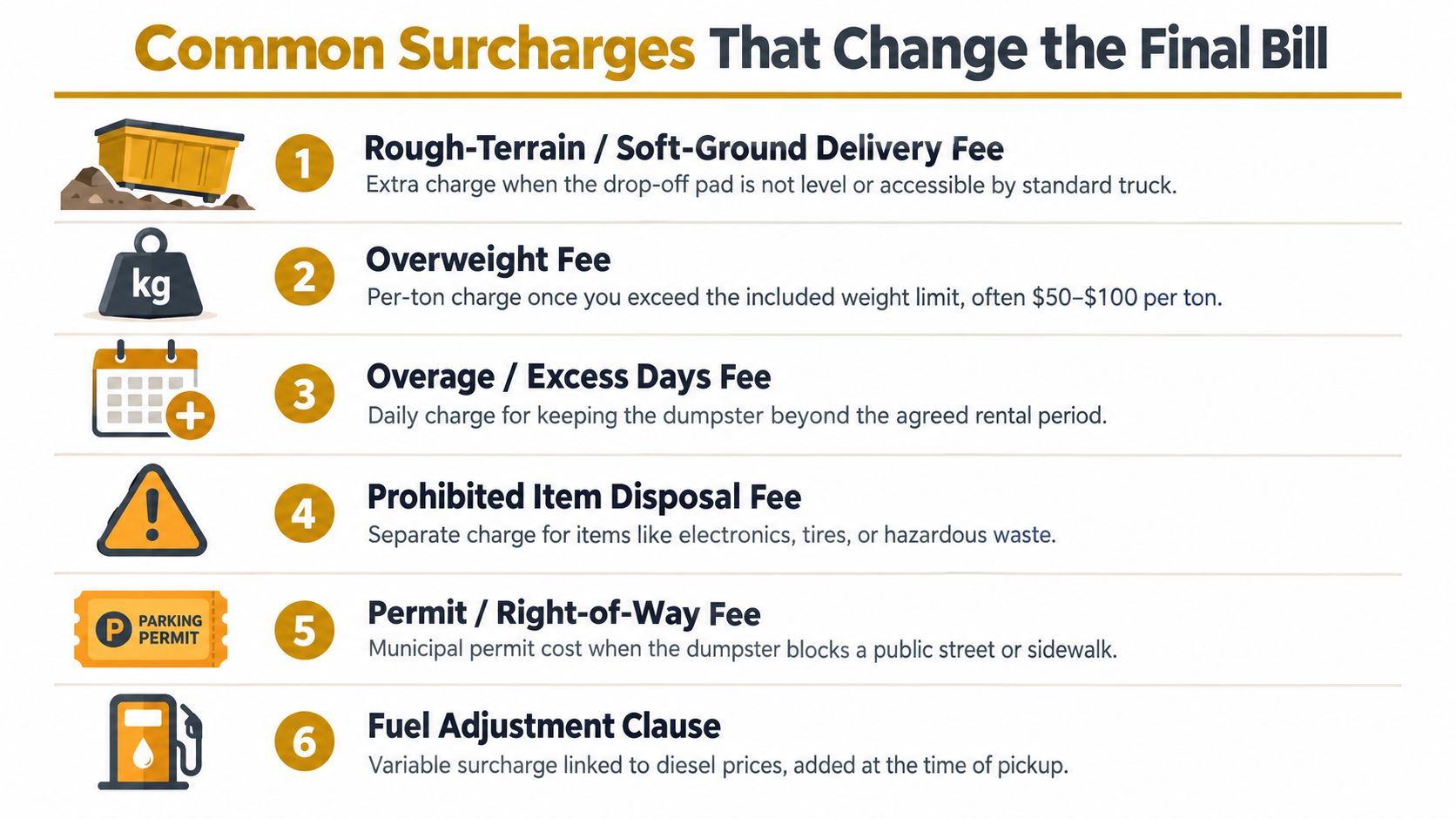
A flat-rate quote can change when the delivery conditions differ from the assumptions made over the phone. The most common surprises come from rough terrain, soft ground, distance, urgent scheduling, excess weight, prohibited materials, missed swaps, and variable fuel policies. Recent 2026 rental guidance also highlights extended time, prohibited items, weekend or holiday delivery, difficult positioning, and fuel-related surcharges as potential additions.
Charges tied to the physical site
A container behind a fence line, across soft soil, or on an uneven access route may require special positioning. The delivery truck needs a stable route and a level placement area, not merely an open patch of ground. Send photos before booking and ask whether the driver can reach the proposed pad without repositioning, blocking traffic, or crossing unsupported ground.
Mileage and zone charges appear when the project sits outside the provider's normal dispatch area. Confirm the service address, not just the city name. A site near a boundary can receive a different quote from a site in the provider's standard zone.
Permit and right-of-way costs can apply when the dumpster occupies a public street or sidewalk. Ask who obtains the permit and whether that cost is included. Never assume the hauler handles municipal requirements unless the order says so.
Charges caused by scheduling and load control
Express delivery can carry a premium when a same-day or next-morning container is needed. Pay it when a missed pour, shutdown, or blocked production line costs more than the delivery upgrade. Avoid it by booking before the demolition or pour calendar becomes fixed.
Overweight charges apply once the included allowance is exceeded. A 2026 industry guide cites overage charges of roughly $95 per ton and reports a median 20-yard rental of $675, with delivery, pickup, and a standard allowance included. Treat that as a benchmark for evaluating the structure of a quote, not as a guaranteed local rate.
Contamination fees can follow liquid paint, tires, appliances, electronics, hazardous waste, or other prohibited materials. Separate those items at the source. Idle-day, dry-run, and extra-day charges are also avoidable when the crew confirms the pickup date, clears the access route, and requests swaps through a live contact.
Vetting Quotes and Booking Your Rental With Confidence
Don't approve a flat-rate dumpster rental from a verbal total alone. Run the order like a subcontractor purchase: define the scope, document assumptions, and create a record of what happens when the job changes.
Start with a written quote
Request the quote by email, text, or a dispatch portal. It should identify the address, container size, delivery date, pickup date, included weight, accepted debris, base price, and every surcharge category. Marketing language such as “all-inclusive” isn't enough unless the provider defines what it includes.
Ask for the overage rate in the same document. A quote that names the allowance but omits the charge above it leaves the largest cost risk unresolved.
Ask the dispatcher four direct questions
Use these questions exactly:
- What counts as an overage? Ask whether the provider measures by scale ticket, estimated volume, container level, or another method.
- Which materials are excluded? Confirm the rules for liquids, concrete, dirt, rebar, tires, appliances, electronics, and hazardous waste.
- Where will the truck stage the container? Confirm the surface, approach, clearance, and whether the driver can place the unit without crossing soft ground.
- Does the rate change if the swap falls on a Saturday? Include weekend, holiday, express, and after-hours terms in the answer.
The dispatcher should also explain whether pickup happens automatically or only after the site calls. That distinction controls how long the container remains on site and whether a full box can interrupt production.
Document the drop zone and the communication path
Take photos from the street, the approach route, and the intended pad. Mark the location on the site plan and note gates, overhead obstructions, pavement limits, and areas that can't support truck weight. If the provider recommends a different placement, record the change before delivery.
Choose one communication channel and name the person responsible for it. Text may be fastest for a swap request, while email creates a stronger written record. A dispatch portal may work well for larger projects, but only if the crew knows who monitors it during the workday.
Booking standard: No truck should roll until the confirmation identifies the date, address, size, allowance, pickup terms, surcharge schedule, prohibited-item list, and contact for changes.
Save the confirmation with the purchase order. When the truck arrives, compare the container and placement with the written order before loading begins.
Final Checklist Before You Sign the Rental Order
A flat-rate dumpster rental is ready to sign only when the crew knows both the included service and the conditions that can expand it. Review the order against the actual site, not the assumptions from the initial phone call.
- Rental period: Confirm the start and end dates, pickup timing, and charge for extra days.
- Included tonnage: Verify the weight allowance and per-ton overage rate.
- Prohibited items: Review the accepted-material list with the foreman and disposal crew.
- Drop-off surface: Confirm that the pad and access route can support the truck and loaded container.
- Permit status: Establish whether a street or sidewalk permit is needed and identify who pays.
- Fuel adjustment clause: Ask whether the provider can add a fuel-related charge at pickup.
- Swap procedure: Document how far in advance the crew must request a replacement container.
- Dispute path: Name the contact who reviews weight tickets, delivery problems, and invoice differences.
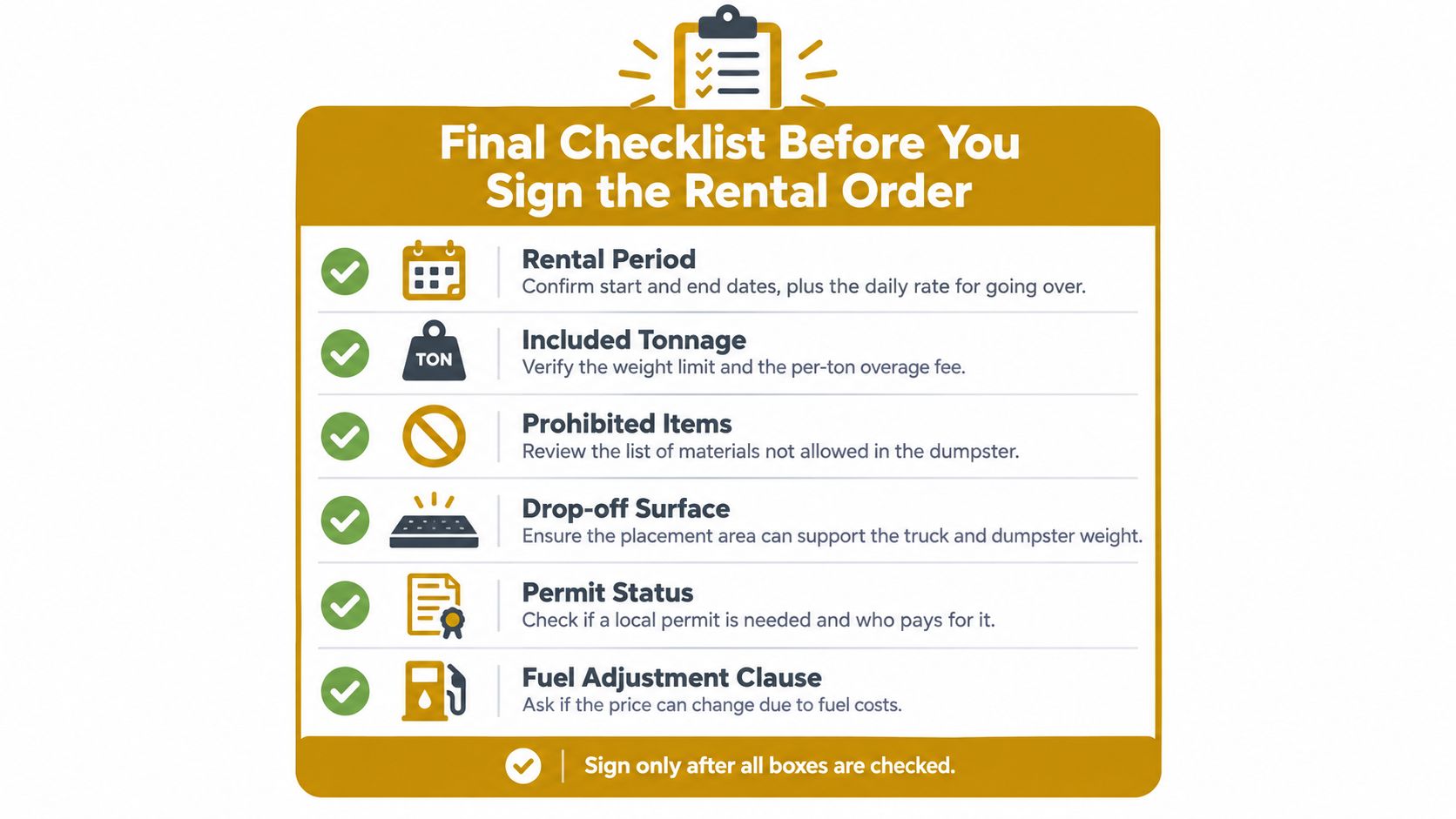
The final safeguard is simple: put the overage rate, pickup schedule, swap-out procedure, and change process on the quote or written change order before delivery. If a surcharge isn't documented, ask for clarification before the truck rolls.
For concrete pours and renovation work, Reborn Rentals provides specialized washout containment rentals with clear booking, delivery, and surcharge details to help crews control slurry and site logistics. Visit Reborn Rentals to review available containers, confirm your dates and location, and arrange the right washout setup before the pour begins.